

ERA 1980-1990
SUBMITTED TO – Ar. FARAH NAZ
CONTEMPORARY ARCHIRTECTURE
PRESENTATION ON
PRESENTED BY –
SHRUTI JAIN , ZAHRA JABEEN
SOCIO-ECONOMIC CHANGES IN 1980s
• Building Inactivity: For much of the 1980s, the US economy was not at
its best. In 1970, unemployment was 4.9%; in 1980 it reached 7.1%.
By 1983, national unemployment hit a high of 9.6%.
• The economy of UK and other European countries remained stable
because of which most of the architectural innovation was in these
countries.
• Middle East was mainly affected by wars. In 1979, the Soviet Union
invaded Afghanistan, which led to an ongoing war for ten years.
ARCHITECTURE IN 1980s
• Architecture consisted of new
decorative and functional designs
• IN 1980s the goal was
neighbourhood development.
• A new urban landscape called
“edge cities” was rapidly developed
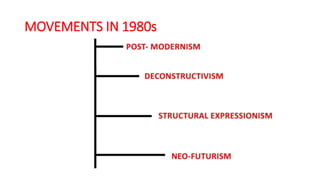
MOVEMENTS IN 1980s
STRUCTURAL EXPRESSIONISM
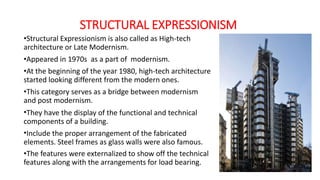
•Structural Expressionism is also called as High-tech
architecture or Late Modernism.
•Appeared in 1970s as a part of modernism.
•At the beginning of the year 1980, high-tech architecture
started looking different from the modern ones.
•This category serves as a bridge between modernism
and post modernism.
•They have the display of the functional and technical
components of a building.
•Include the proper arrangement of the fabricated
elements. Steel frames as glass walls were also famous.
•The features were externalized to show off the technical
features along with the arrangements for load bearing.
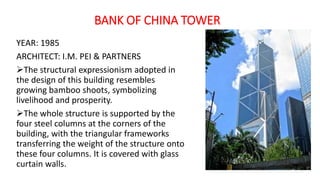
BANK OF CHINA TOWER
YEAR: 1985
ARCHITECT: I.M. PEI & PARTNERS
The structural expressionism adopted in
the design of this building resembles
growing bamboo shoots, symbolizing
livelihood and prosperity.
The whole structure is supported by the
four steel columns at the corners of the
building, with the triangular frameworks
transferring the weight of the structure onto
these four columns. It is covered with glass
curtain walls.
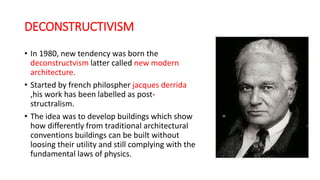
DECONSTRUCTIVISM
• In 1980, new tendency was born the
deconstructvism latter called new modern
architecture.
• Started by french philospher jacques derrida
,his work has been labelled as post-
structralism.
• The idea was to develop buildings which show
how differently from traditional architectural
conventions buildings can be built without
loosing their utility and still complying with the
fundamental laws of physics.
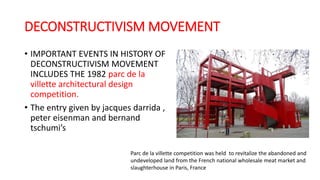
DECONSTRUCTIVISM MOVEMENT
• IMPORTANT EVENTS IN HISTORY OF
DECONSTRUCTIVISM MOVEMENT
INCLUDES THE 1982 parc de la
villette architectural design
competition.
• The entry given by jacques darrida ,
peter eisenman and bernand
tschumi’s
Parc de la villette competition was held to revitalize the abandoned and
undeveloped land from the French national wholesale meat market and
slaughterhouse in Paris, France
• It is characterized by ideas of fragmentation
• An interest in manipulating ideas of a
structure’s surface or skin
• Non – rectilinear shape which serve to distort
and dislocate some of the elements of
architecture such as structure and envelope
• The structure of the building has a feeling of
controlled chaos and stimulating
unpredictability.
• Stands in opposition to the limiting rules of
modernism, including materials fidelity, purity
of form or forms functioning.
• Rejects the rule of ornament as a side effect or
an item of decoration.
CHARACTERISTICS
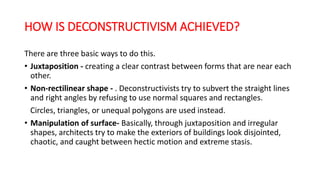
HOW IS DECONSTRUCTIVISM ACHIEVED?
There are three basic ways to do this.
• Juxtaposition - creating a clear contrast between forms that are near each
other.
• Non-rectilinear shape - . Deconstructivists try to subvert the straight lines
and right angles by refusing to use normal squares and rectangles.
Circles, triangles, or unequal polygons are used instead.
• Manipulation of surface- Basically, through juxtaposition and irregular
shapes, architects try to make the exteriors of buildings look disjointed,
chaotic, and caught between hectic motion and extreme stasis.
ARCHITECTS
• FRANK O GEHRY
• PETER EISENMAN
• BERLAND TSCHUMI
• REM KOOLHAS
• ZAHA HADID
• DANIER LIBERKIND
• COOP HIMMELB
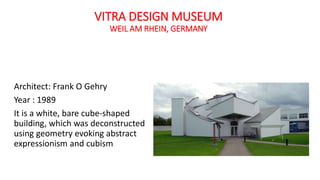
VITRA DESIGN MUSEUM
WEIL AM RHEIN, GERMANY
Architect: Frank O Gehry
Year : 1989
It is a white, bare cube-shaped
building, which was deconstructed
using geometry evoking abstract
expressionism and cubism
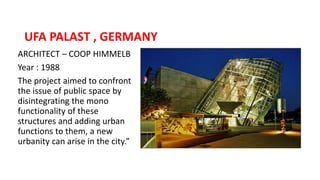
ARCHITECT – COOP HIMMELB
Year : 1988
The project aimed to confront
the issue of public space by
disintegrating the mono
functionality of these
structures and adding urban
functions to them, a new
urbanity can arise in the city.”
UFA PALAST , GERMANY
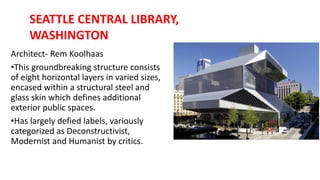
Architect- Rem Koolhaas
•This groundbreaking structure consists
of eight horizontal layers in varied sizes,
encased within a structural steel and
glass skin which defines additional
exterior public spaces.
•Has largely defied labels, variously
categorized as Deconstructivist,
Modernist and Humanist by critics.
SEATTLE CENTRAL LIBRARY,
WASHINGTON
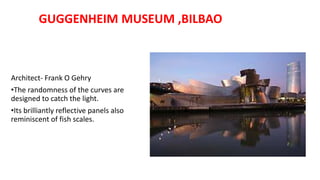
Architect- Frank O Gehry
•The randomness of the curves are
designed to catch the light.
•Its brilliantly reflective panels also
reminiscent of fish scales.
GUGGENHEIM MUSEUM ,BILBAO
NEO-FUTURISM
• The Neo-Futurists are an experimental theatre troupe founded by Greg Allen in 1988.
• The Neo-Futurist architects, designers and artists believe in eco-sustainable cities cross-
pollinated by arts and technology to provide a better quality of life.
• It could be seen as a departure from the attitude of post-modernism and represents
an idealistic belief in a better future and "a need to periodize the modern support with
the technological".
• Neo-futuristic urbanists, architects, designers and artists believe in cities releasing
emotions, driven by eco-sustainability, ethical values and implementing new materials
and new technologies to provide a better quality of life for city-dwellers.
ARCHTECTS
William Pereira, America
Charles Luckman, America
Henning Larsen, Denmark
Jørn Utzon, Denmark
CONTEMPORARY ARCHITECTURE (1980 90) globally

CONTEMPORARY ARCHITECTURE (1980 90) globally

  • 1.
    ERA 1980-1990 SUBMITTED TO– Ar. FARAH NAZ CONTEMPORARY ARCHIRTECTURE PRESENTATION ON PRESENTED BY – SHRUTI JAIN , ZAHRA JABEEN
  • 2.
    SOCIO-ECONOMIC CHANGES IN1980s • Building Inactivity: For much of the 1980s, the US economy was not at its best. In 1970, unemployment was 4.9%; in 1980 it reached 7.1%. By 1983, national unemployment hit a high of 9.6%. • The economy of UK and other European countries remained stable because of which most of the architectural innovation was in these countries. • Middle East was mainly affected by wars. In 1979, the Soviet Union invaded Afghanistan, which led to an ongoing war for ten years.
  • 3.
    ARCHITECTURE IN 1980s •Architecture consisted of new decorative and functional designs • IN 1980s the goal was neighbourhood development. • A new urban landscape called “edge cities” was rapidly developed
  • 4.
  • 5.
    STRUCTURAL EXPRESSIONISM •Structural Expressionismis also called as High-tech architecture or Late Modernism. •Appeared in 1970s as a part of modernism. •At the beginning of the year 1980, high-tech architecture started looking different from the modern ones. •This category serves as a bridge between modernism and post modernism. •They have the display of the functional and technical components of a building. •Include the proper arrangement of the fabricated elements. Steel frames as glass walls were also famous. •The features were externalized to show off the technical features along with the arrangements for load bearing.
  • 6.
    BANK OF CHINATOWER YEAR: 1985 ARCHITECT: I.M. PEI & PARTNERS The structural expressionism adopted in the design of this building resembles growing bamboo shoots, symbolizing livelihood and prosperity. The whole structure is supported by the four steel columns at the corners of the building, with the triangular frameworks transferring the weight of the structure onto these four columns. It is covered with glass curtain walls.
  • 7.
    DECONSTRUCTIVISM • In 1980,new tendency was born the deconstructvism latter called new modern architecture. • Started by french philospher jacques derrida ,his work has been labelled as post- structralism. • The idea was to develop buildings which show how differently from traditional architectural conventions buildings can be built without loosing their utility and still complying with the fundamental laws of physics.
  • 8.
    DECONSTRUCTIVISM MOVEMENT • IMPORTANTEVENTS IN HISTORY OF DECONSTRUCTIVISM MOVEMENT INCLUDES THE 1982 parc de la villette architectural design competition. • The entry given by jacques darrida , peter eisenman and bernand tschumi’s Parc de la villette competition was held to revitalize the abandoned and undeveloped land from the French national wholesale meat market and slaughterhouse in Paris, France
  • 9.
    • It ischaracterized by ideas of fragmentation • An interest in manipulating ideas of a structure’s surface or skin • Non – rectilinear shape which serve to distort and dislocate some of the elements of architecture such as structure and envelope • The structure of the building has a feeling of controlled chaos and stimulating unpredictability. • Stands in opposition to the limiting rules of modernism, including materials fidelity, purity of form or forms functioning. • Rejects the rule of ornament as a side effect or an item of decoration. CHARACTERISTICS
  • 10.
    HOW IS DECONSTRUCTIVISMACHIEVED? There are three basic ways to do this. • Juxtaposition - creating a clear contrast between forms that are near each other. • Non-rectilinear shape - . Deconstructivists try to subvert the straight lines and right angles by refusing to use normal squares and rectangles. Circles, triangles, or unequal polygons are used instead. • Manipulation of surface- Basically, through juxtaposition and irregular shapes, architects try to make the exteriors of buildings look disjointed, chaotic, and caught between hectic motion and extreme stasis.
  • 11.
    ARCHITECTS • FRANK OGEHRY • PETER EISENMAN • BERLAND TSCHUMI • REM KOOLHAS • ZAHA HADID • DANIER LIBERKIND • COOP HIMMELB
  • 12.
    VITRA DESIGN MUSEUM WEILAM RHEIN, GERMANY Architect: Frank O Gehry Year : 1989 It is a white, bare cube-shaped building, which was deconstructed using geometry evoking abstract expressionism and cubism
  • 13.
    ARCHITECT – COOPHIMMELB Year : 1988 The project aimed to confront the issue of public space by disintegrating the mono functionality of these structures and adding urban functions to them, a new urbanity can arise in the city.” UFA PALAST , GERMANY
  • 14.
    Architect- Rem Koolhaas •Thisgroundbreaking structure consists of eight horizontal layers in varied sizes, encased within a structural steel and glass skin which defines additional exterior public spaces. •Has largely defied labels, variously categorized as Deconstructivist, Modernist and Humanist by critics. SEATTLE CENTRAL LIBRARY, WASHINGTON
  • 15.
    Architect- Frank OGehry •The randomness of the curves are designed to catch the light. •Its brilliantly reflective panels also reminiscent of fish scales. GUGGENHEIM MUSEUM ,BILBAO
  • 16.
    NEO-FUTURISM • The Neo-Futuristsare an experimental theatre troupe founded by Greg Allen in 1988. • The Neo-Futurist architects, designers and artists believe in eco-sustainable cities cross- pollinated by arts and technology to provide a better quality of life. • It could be seen as a departure from the attitude of post-modernism and represents an idealistic belief in a better future and "a need to periodize the modern support with the technological". • Neo-futuristic urbanists, architects, designers and artists believe in cities releasing emotions, driven by eco-sustainability, ethical values and implementing new materials and new technologies to provide a better quality of life for city-dwellers. ARCHTECTS William Pereira, America Charles Luckman, America Henning Larsen, Denmark Jørn Utzon, Denmark