Alternative building materials
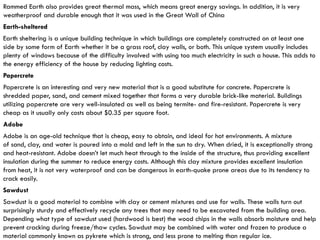
Rammed Earth also provides great thermal mass, which means great energy savings. In addition, it is very
weatherproof and durable enough that it was used in the Great Wall of China
Earth-sheltered
Earth sheltering is a unique building technique in which buildings are completely constructed on at least one
side by some form of Earth whether it be a grass roof, clay walls, or both. This unique system usually includes
plenty of windows because of the difficulty involved with using too much electricity in such a house. This adds to
the energy efficiency of the house by reducing lighting costs.
Papercrete
Papercrete is an interesting and very new material that is a good substitute for concrete. Papercrete is
shredded paper, sand, and cement mixed together that forms a very durable brick-like material. Buildings
utilizing papercrete are very well-insulated as well as being termite- and fire-resistant. Papercrete is very
cheap as it usually only costs about $0.35 per square foot.
Adobe
Adobe is an age-old technique that is cheap, easy to obtain, and ideal for hot environments. A mixture
of sand, clay, and water is poured into a mold and left in the sun to dry. When dried, it is exceptionally strong
and heat-resistant. Adobe doesn’t let much heat through to the inside of the structure, thus providing excellent
insulation during the summer to reduce energy costs. Although this clay mixture provides excellent insulation
from heat, it is not very waterproof and can be dangerous in earth-quake prone areas due to its tendency to
crack easily.
Sawdust
Sawdust is a good material to combine with clay or cement mixtures and use for walls. These walls turn out
surprisingly sturdy and effectively recycle any trees that may need to be excavated from the building area.
Depending what type of sawdust used (hardwood is best) the wood chips in the walls absorb moisture and help
prevent cracking during freeze/thaw cycles. Sawdust may be combined with water and frozen to produce a
material commonly known as pykrete which is strong, and less prone to melting than regular ice.
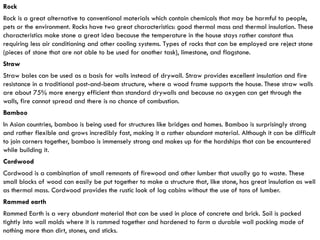
Rock
Rock is a great alternative to conventional materials which contain chemicals that may be harmful to people,
pets or the environment. Rocks have two great characteristics: good thermal mass and thermal insulation. These
characteristics make stone a great idea because the temperature in the house stays rather constant thus
requiring less air conditioning and other cooling systems. Types of rocks that can be employed are reject stone
(pieces of stone that are not able to be used for another task), limestone, and flagstone.
Straw
Straw bales can be used as a basis for walls instead of drywall. Straw provides excellent insulation and fire
resistance in a traditional post-and-beam structure, where a wood frame supports the house. These straw walls
are about 75% more energy efficient than standard drywalls and because no oxygen can get through the
walls, fire cannot spread and there is no chance of combustion.
Bamboo
In Asian countries, bamboo is being used for structures like bridges and homes. Bamboo is surprisingly strong
and rather flexible and grows incredibly fast, making it a rather abundant material. Although it can be difficult
to join corners together, bamboo is immensely strong and makes up for the hardships that can be encountered
while building it.
Cordwood
Cordwood is a combination of small remnants of firewood and other lumber that usually go to waste. These
small blocks of wood can easily be put together to make a structure that, like stone, has great insulation as well
as thermal mass. Cordwood provides the rustic look of log cabins without the use of tons of lumber.
Rammed earth
Rammed Earth is a very abundant material that can be used in place of concrete and brick. Soil is packed
tightly into wall molds where it is rammed together and hardened to form a durable wall packing made of
nothing more than dirt, stones, and sticks.
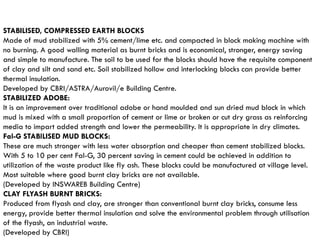
STABILISED, COMPRESSED EARTH BLOCKS
Made of mud stabilized with 5% cement/lime etc. and compacted in block making machine with
no burning. A good walling material as burnt bricks and is economical, stronger, energy saving
and simple to manufacture. The soil to be used for the blocks should have the requisite component
of clay and silt and sand etc. Soil stabilized hollow and interlocking blocks can provide better
thermal insulation.
Developed by CBRI/ASTRA/Aurovil/e Building Centre.
STABILIZED ADOBE:
It is an improvement over traditional adobe or hand moulded and sun dried mud block in which
mud is mixed with a small proportion of cement or lime or broken or cut dry grass as reinforcing
media to impart added strength and lower the permeability. It is appropriate in dry climates.
Fal-G STABlLISED MUD BLOCKS:
These are much stronger with less water absorption and cheaper than cement stabilized blocks.
With 5 to 10 per cent Fal-G, 30 percent saving in cement could be achieved in addition to
utilization of the waste product like fly ash. These blocks could be manufactured at village level.
Most suitable where good burnt clay bricks are not available.
(Developed by INSWAREB Building Centre)
CLAY FLYASH BURNT BRICKS:
Produced from flyash and clay, are stronger than conventional burnt clay bricks, consume less
energy, provide better thermal insulation and solve the environmental problem through utilisation
of the flyash, an industrial waste.
(Developed by CBRI)
FLYASH/SAND-LIME BRICKS:
Produced from fly ash or sand with lime as binder, are strong, superior in water absorption and
crushing strength. However this needs autoclaving.
(Developed by CBRI/CFRI)
FLYASH-LIME-GYPSUM (Fal-G) PRODUCTS:
Manufactured by blending flyash, lime and calcined gypsum (from by product of phosphogypsum
or natural gypsum) for making a useful product, named Fal-G, and can be used as a cementeous
material for mortar/plasters and for masonry blocks of any desired strength. It can also be used
for road pavements and plain concrete in the form of Fal-G concrete.
(Developed by INSWAREB Building Centre)
CLAY RED MUD BURNT BRICKS:
Produced from alumina red mud or bauxite an industrial waste of aluminium producing plants in
combination with clay. Possess all the physical properties of normal clay bricks and solves the
problem of disposal of the waste product and environmental pollution. In addition, they have good
architectural value as facing bricks due to their pleasing hues of colour. Red mud in addition
improves the quality of bricks made from inferior soil deficient in clay content.
(Developed by CBRI)
LATO BLOCKS:
These are improved bricks made from lateritic soil and cement or lime. Available in South-West
India as large soft rock masses. The blocks are moulded under pressure to produce strong and
good quality blocks which consume lesser energy than conventional bricks and hence cheaper.
They are available in pleasing hues of colours ranging from cream to light crimson.
(Developed by CBRI)
PRECAST STONE BLOCKS:
These are of larger size than normal bricks are manufactured by using waste stone pieces of
various sizes with lean cement concrete and enable a rationalised use of natural locally available
materials. Shaping stones in this manner, enables speedy construction saves on cement, reduces
thickness of stone walls and effects overall saving by eliminating plasters on internal/external wall
surface. Appropriate architectural rendering on exterior surfaces can also be given.
(Developed by CBRI)
PRECAST CONCRETE BLOCKS:
Made to similar dimension of stone blocks without large size stone pieces, but using coarse and
fine graded aggregate with cement. They have excellent properties comparable to other masonry
block, are cheaper and facilitate speedy construction and especially suitable where good quality
clay for brick making is not available.
(Developed by CBRI)
PRECAST HOLLOW CONCRETE BLOCKS:
These are manufactured using lean cement concrete mixes and extruded through block making
machines of egg laying or static type need lesser cement mortar and enable speedy construction
as compared to brick masonry. The cavity in the blocks provide better thermal protection and also
do not need external or internal plastering. These can be used for walling block or as roofing
blocks along with inverted precast tee beams.
(Developed by CBRI)
FLYASH BASED LIGHT WEIGHT AERATED CONCRETE WALLING AND ROOFING BLOCKS:
These are manufactured by a process involving mixing of flyash, quick lime or cement and gypsum,
foaming agents such as aluminium powder. These are considered excellent products for walling
blocks and prefab floor slabs.
(Developed by CBRI/CFRI)
PRECAST AERATED/CELLULAR CONCRETE WALLING BLOCKS AND ROOFING SLABS:
These are manufactured through aerated cellular concrete manufacturing process. When used in
multistoried structures reduce weight, resulting more in economic design of structure. These
components can also be worked and handled easily, have high fire resistance rating and provide
better insulation.
(Developed by CBRI)
RAT -TRAP BOND:
This is an alternate brick bonding system for English and Flemish bond. This is economical, strong
and aesthetic. 25% of the total number of bricks and 40% of motor the cost of the wall can be
saved by using RAT -TRAP BOND. It is simple to build and has better insulation properties.
(Developed by Laurie Baker)
BAMBOO/TIMBER MAT BASED WALLS (EKRA WALLING):
Plastered on either side by mud or cement mortar over bamboo mat placed between horizontal
and vertical timber/bamboos as a frame. Are easy to construct, cost less and are popular in hilly
areas due to self help. However, these are non-load bearing and need supporting structure. This
upgraded traditional tecgnology is a relevant for earthquake view point walling option.
(Conventional)
COMPOSITE FERROCEMENT SYSTEM:
It is simple to construct and made of ferrocement i.e. rich mortar reinforced with chicken and
welded wire mesh. These reduce the wall thickness and allow larger carpet area. Precast
ferrocement units in trough shape are integrated with R.C.C. columns. Ferrocement units serve as a
permanent skin unit and as a diagonal strut between columns. Inside cladding can be done with
mud blocks or any locally available material. Ideally suitable for seismic areas.
(Developed by HUDCO)
Container housing - Earthauz
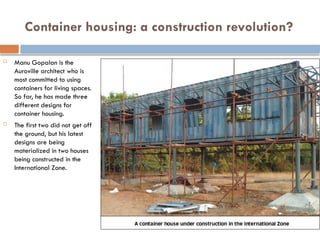
Container housing: a construction revolution?
 Manu Gopalan is the
Auroville architect who is
most committed to using
containers for living spaces.
So far, he has made three
different designs for
container housing.
 The first two did not get off
the ground, but his latest
designs are being
materialized in two houses
being constructed in the
International Zone.
What are the advantages of using containers for housing?
 In typical construction projects you have two big tasks. The first is to create a structure that withstands the
elements, the second to finish it to the user’s aesthetic satisfaction. The former typically takes about 75% of
the project’s time. The advantage of containers is that on day one, you have the first task nearly finished,
especially if you are building a ground floor house. So all you need to do is to customize the structure.
One big advantage of using a container is the time saved, which translates into money saved.
 We estimate the new models which we are trying out in the International Zone will cost about Rs 9,500 a
square metre, which is less than half the cost of conventional construction in Auroville. Overall,
each of these container houses, which are about 90 square metres, will cost between 8 – 8.5 lakh rupees.
Then there is the aspect of mobility. In Auroville we often find people want to move from community to
community. Housing becomes a major bottleneck because every time you move you have to convert it to a
money value and find a ‘buyer’, which is also against the spirit of Auroville. This problem can be solved if
the house itself is mobile. With containers, all you have to do is fold up the windows, put all your things
inside and then put it on a truck. It is also a very secure structure if you are going
away for some time.
 Then again, there is the longevity factor. Because the steel is of such high quality, container homes will last
up to 80 years if they are looked after properly, which compares very well with the 60 years’ lifetime of
conventional buildings. Of course, any additional steel used on the structure, for example, for making
window overhangs, would not be of the original Corten Steel and would be prone to corrosion and require
to be painted every 4 years.
What do you have to do extra that you don’t have to do with conventional
buildings?
 In conventional houses, the walls take care of insulation against the sun. Containers are very bad at doing
that as the walls are metal and transmit the heat inside. So we need to take care of this by preferably
insulating both the inside and the outside of the walls. In these houses we use recycled wood to clad the
walls inside and outside and in between we use Thermocrete cement mix, which is a lightweight insulation.
Containers can be stacked vertically up to seven floors high to create a big boxlike structure.
But if you want to create other forms we have found that containers are not so adaptable. So this
is a drawback.
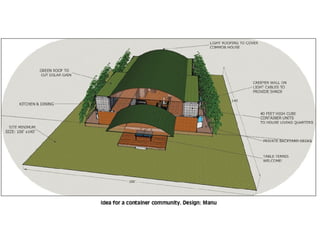
 How different is your latest design from your earlier one for the Transit Lounge?
The Transit Lounge container house was 20 x 8 feet, and it sat on the ground with a similar-sized
platform abutting it. For that size the cost was a bit too much: it worked out at about Rs.15,000 per square
meter. Now we have lifted the container off the ground one storey by putting it on stilts,
at the ground level you get a stilted space. On top of the container we also put stilts and made a roof of
Onduline sheets (recycled paper & cloth set in bitumen), so you also have a room above container that
works like a double roof to insulate against the sun. Also, the walls of the container are shaded by
overhangs which go out 1.2 metres. In this way we have tripled the floor area of the house with the same
size container, thereby bringing the cost down to about Rs. 9500 a square meter.
In India containers are being used for offices, but not for housing; these in Auroville
are the first examples. Why?
 In India the consciousness regarding insulated walls in housing is not developed enough to
include them as a major factor in keeping your house cool in the summer. In the West, people
believe that insulation can work!
 If these two trial houses take off, do you see the possibility of doing many more in
Auroville?
Yes. I am very happy that Krupa and Sumeet have taken this leap of faith when the Auroville
system did not understand it. They deserve credit for this. They have already taken a lot of
initiative to personalize their designs. Once people see this and realize that this is not just a
metal box but it can be made into something like any other house, I think there will be a lot of
people interested in following their example.

Alternative traditional building materials.pptx

  • 1.
  • 2.
    Rammed Earth alsoprovides great thermal mass, which means great energy savings. In addition, it is very weatherproof and durable enough that it was used in the Great Wall of China Earth-sheltered Earth sheltering is a unique building technique in which buildings are completely constructed on at least one side by some form of Earth whether it be a grass roof, clay walls, or both. This unique system usually includes plenty of windows because of the difficulty involved with using too much electricity in such a house. This adds to the energy efficiency of the house by reducing lighting costs. Papercrete Papercrete is an interesting and very new material that is a good substitute for concrete. Papercrete is shredded paper, sand, and cement mixed together that forms a very durable brick-like material. Buildings utilizing papercrete are very well-insulated as well as being termite- and fire-resistant. Papercrete is very cheap as it usually only costs about $0.35 per square foot. Adobe Adobe is an age-old technique that is cheap, easy to obtain, and ideal for hot environments. A mixture of sand, clay, and water is poured into a mold and left in the sun to dry. When dried, it is exceptionally strong and heat-resistant. Adobe doesn’t let much heat through to the inside of the structure, thus providing excellent insulation during the summer to reduce energy costs. Although this clay mixture provides excellent insulation from heat, it is not very waterproof and can be dangerous in earth-quake prone areas due to its tendency to crack easily. Sawdust Sawdust is a good material to combine with clay or cement mixtures and use for walls. These walls turn out surprisingly sturdy and effectively recycle any trees that may need to be excavated from the building area. Depending what type of sawdust used (hardwood is best) the wood chips in the walls absorb moisture and help prevent cracking during freeze/thaw cycles. Sawdust may be combined with water and frozen to produce a material commonly known as pykrete which is strong, and less prone to melting than regular ice.
  • 3.
    Rock Rock is agreat alternative to conventional materials which contain chemicals that may be harmful to people, pets or the environment. Rocks have two great characteristics: good thermal mass and thermal insulation. These characteristics make stone a great idea because the temperature in the house stays rather constant thus requiring less air conditioning and other cooling systems. Types of rocks that can be employed are reject stone (pieces of stone that are not able to be used for another task), limestone, and flagstone. Straw Straw bales can be used as a basis for walls instead of drywall. Straw provides excellent insulation and fire resistance in a traditional post-and-beam structure, where a wood frame supports the house. These straw walls are about 75% more energy efficient than standard drywalls and because no oxygen can get through the walls, fire cannot spread and there is no chance of combustion. Bamboo In Asian countries, bamboo is being used for structures like bridges and homes. Bamboo is surprisingly strong and rather flexible and grows incredibly fast, making it a rather abundant material. Although it can be difficult to join corners together, bamboo is immensely strong and makes up for the hardships that can be encountered while building it. Cordwood Cordwood is a combination of small remnants of firewood and other lumber that usually go to waste. These small blocks of wood can easily be put together to make a structure that, like stone, has great insulation as well as thermal mass. Cordwood provides the rustic look of log cabins without the use of tons of lumber. Rammed earth Rammed Earth is a very abundant material that can be used in place of concrete and brick. Soil is packed tightly into wall molds where it is rammed together and hardened to form a durable wall packing made of nothing more than dirt, stones, and sticks.
  • 4.
    STABILISED, COMPRESSED EARTHBLOCKS Made of mud stabilized with 5% cement/lime etc. and compacted in block making machine with no burning. A good walling material as burnt bricks and is economical, stronger, energy saving and simple to manufacture. The soil to be used for the blocks should have the requisite component of clay and silt and sand etc. Soil stabilized hollow and interlocking blocks can provide better thermal insulation. Developed by CBRI/ASTRA/Aurovil/e Building Centre. STABILIZED ADOBE: It is an improvement over traditional adobe or hand moulded and sun dried mud block in which mud is mixed with a small proportion of cement or lime or broken or cut dry grass as reinforcing media to impart added strength and lower the permeability. It is appropriate in dry climates. Fal-G STABlLISED MUD BLOCKS: These are much stronger with less water absorption and cheaper than cement stabilized blocks. With 5 to 10 per cent Fal-G, 30 percent saving in cement could be achieved in addition to utilization of the waste product like fly ash. These blocks could be manufactured at village level. Most suitable where good burnt clay bricks are not available. (Developed by INSWAREB Building Centre) CLAY FLYASH BURNT BRICKS: Produced from flyash and clay, are stronger than conventional burnt clay bricks, consume less energy, provide better thermal insulation and solve the environmental problem through utilisation of the flyash, an industrial waste. (Developed by CBRI)
  • 5.
    FLYASH/SAND-LIME BRICKS: Produced fromfly ash or sand with lime as binder, are strong, superior in water absorption and crushing strength. However this needs autoclaving. (Developed by CBRI/CFRI) FLYASH-LIME-GYPSUM (Fal-G) PRODUCTS: Manufactured by blending flyash, lime and calcined gypsum (from by product of phosphogypsum or natural gypsum) for making a useful product, named Fal-G, and can be used as a cementeous material for mortar/plasters and for masonry blocks of any desired strength. It can also be used for road pavements and plain concrete in the form of Fal-G concrete. (Developed by INSWAREB Building Centre) CLAY RED MUD BURNT BRICKS: Produced from alumina red mud or bauxite an industrial waste of aluminium producing plants in combination with clay. Possess all the physical properties of normal clay bricks and solves the problem of disposal of the waste product and environmental pollution. In addition, they have good architectural value as facing bricks due to their pleasing hues of colour. Red mud in addition improves the quality of bricks made from inferior soil deficient in clay content. (Developed by CBRI) LATO BLOCKS: These are improved bricks made from lateritic soil and cement or lime. Available in South-West India as large soft rock masses. The blocks are moulded under pressure to produce strong and good quality blocks which consume lesser energy than conventional bricks and hence cheaper. They are available in pleasing hues of colours ranging from cream to light crimson. (Developed by CBRI)
  • 6.
    PRECAST STONE BLOCKS: Theseare of larger size than normal bricks are manufactured by using waste stone pieces of various sizes with lean cement concrete and enable a rationalised use of natural locally available materials. Shaping stones in this manner, enables speedy construction saves on cement, reduces thickness of stone walls and effects overall saving by eliminating plasters on internal/external wall surface. Appropriate architectural rendering on exterior surfaces can also be given. (Developed by CBRI) PRECAST CONCRETE BLOCKS: Made to similar dimension of stone blocks without large size stone pieces, but using coarse and fine graded aggregate with cement. They have excellent properties comparable to other masonry block, are cheaper and facilitate speedy construction and especially suitable where good quality clay for brick making is not available. (Developed by CBRI) PRECAST HOLLOW CONCRETE BLOCKS: These are manufactured using lean cement concrete mixes and extruded through block making machines of egg laying or static type need lesser cement mortar and enable speedy construction as compared to brick masonry. The cavity in the blocks provide better thermal protection and also do not need external or internal plastering. These can be used for walling block or as roofing blocks along with inverted precast tee beams. (Developed by CBRI) FLYASH BASED LIGHT WEIGHT AERATED CONCRETE WALLING AND ROOFING BLOCKS: These are manufactured by a process involving mixing of flyash, quick lime or cement and gypsum, foaming agents such as aluminium powder. These are considered excellent products for walling blocks and prefab floor slabs. (Developed by CBRI/CFRI)
  • 7.
    PRECAST AERATED/CELLULAR CONCRETEWALLING BLOCKS AND ROOFING SLABS: These are manufactured through aerated cellular concrete manufacturing process. When used in multistoried structures reduce weight, resulting more in economic design of structure. These components can also be worked and handled easily, have high fire resistance rating and provide better insulation. (Developed by CBRI) RAT -TRAP BOND: This is an alternate brick bonding system for English and Flemish bond. This is economical, strong and aesthetic. 25% of the total number of bricks and 40% of motor the cost of the wall can be saved by using RAT -TRAP BOND. It is simple to build and has better insulation properties. (Developed by Laurie Baker) BAMBOO/TIMBER MAT BASED WALLS (EKRA WALLING): Plastered on either side by mud or cement mortar over bamboo mat placed between horizontal and vertical timber/bamboos as a frame. Are easy to construct, cost less and are popular in hilly areas due to self help. However, these are non-load bearing and need supporting structure. This upgraded traditional tecgnology is a relevant for earthquake view point walling option. (Conventional) COMPOSITE FERROCEMENT SYSTEM: It is simple to construct and made of ferrocement i.e. rich mortar reinforced with chicken and welded wire mesh. These reduce the wall thickness and allow larger carpet area. Precast ferrocement units in trough shape are integrated with R.C.C. columns. Ferrocement units serve as a permanent skin unit and as a diagonal strut between columns. Inside cladding can be done with mud blocks or any locally available material. Ideally suitable for seismic areas. (Developed by HUDCO)
  • 8.
  • 9.
    Container housing: aconstruction revolution?  Manu Gopalan is the Auroville architect who is most committed to using containers for living spaces. So far, he has made three different designs for container housing.  The first two did not get off the ground, but his latest designs are being materialized in two houses being constructed in the International Zone.
  • 10.
    What are theadvantages of using containers for housing?  In typical construction projects you have two big tasks. The first is to create a structure that withstands the elements, the second to finish it to the user’s aesthetic satisfaction. The former typically takes about 75% of the project’s time. The advantage of containers is that on day one, you have the first task nearly finished, especially if you are building a ground floor house. So all you need to do is to customize the structure. One big advantage of using a container is the time saved, which translates into money saved.  We estimate the new models which we are trying out in the International Zone will cost about Rs 9,500 a square metre, which is less than half the cost of conventional construction in Auroville. Overall, each of these container houses, which are about 90 square metres, will cost between 8 – 8.5 lakh rupees. Then there is the aspect of mobility. In Auroville we often find people want to move from community to community. Housing becomes a major bottleneck because every time you move you have to convert it to a money value and find a ‘buyer’, which is also against the spirit of Auroville. This problem can be solved if the house itself is mobile. With containers, all you have to do is fold up the windows, put all your things inside and then put it on a truck. It is also a very secure structure if you are going away for some time.  Then again, there is the longevity factor. Because the steel is of such high quality, container homes will last up to 80 years if they are looked after properly, which compares very well with the 60 years’ lifetime of conventional buildings. Of course, any additional steel used on the structure, for example, for making window overhangs, would not be of the original Corten Steel and would be prone to corrosion and require to be painted every 4 years.
  • 11.
    What do youhave to do extra that you don’t have to do with conventional buildings?  In conventional houses, the walls take care of insulation against the sun. Containers are very bad at doing that as the walls are metal and transmit the heat inside. So we need to take care of this by preferably insulating both the inside and the outside of the walls. In these houses we use recycled wood to clad the walls inside and outside and in between we use Thermocrete cement mix, which is a lightweight insulation. Containers can be stacked vertically up to seven floors high to create a big boxlike structure. But if you want to create other forms we have found that containers are not so adaptable. So this is a drawback.  How different is your latest design from your earlier one for the Transit Lounge? The Transit Lounge container house was 20 x 8 feet, and it sat on the ground with a similar-sized platform abutting it. For that size the cost was a bit too much: it worked out at about Rs.15,000 per square meter. Now we have lifted the container off the ground one storey by putting it on stilts, at the ground level you get a stilted space. On top of the container we also put stilts and made a roof of Onduline sheets (recycled paper & cloth set in bitumen), so you also have a room above container that works like a double roof to insulate against the sun. Also, the walls of the container are shaded by overhangs which go out 1.2 metres. In this way we have tripled the floor area of the house with the same size container, thereby bringing the cost down to about Rs. 9500 a square meter.
  • 13.
    In India containersare being used for offices, but not for housing; these in Auroville are the first examples. Why?  In India the consciousness regarding insulated walls in housing is not developed enough to include them as a major factor in keeping your house cool in the summer. In the West, people believe that insulation can work!  If these two trial houses take off, do you see the possibility of doing many more in Auroville? Yes. I am very happy that Krupa and Sumeet have taken this leap of faith when the Auroville system did not understand it. They deserve credit for this. They have already taken a lot of initiative to personalize their designs. Once people see this and realize that this is not just a metal box but it can be made into something like any other house, I think there will be a lot of people interested in following their example.