BONDING

REVIEW
Directions: Each slide provides information in a question answer format.
Click once to see the question and then again for the answer.
Bonds Between Atoms

Polyatomic Ions
Ionic
Covalent

Molecular
Substance

Metallic

Network
Solids
Polar
Nonpolar

What are we going to learn about???

Coordinate
Covalent
See if you can define the following words before starting the lesson…

• Anion- negative ion
• Cation-positive ion
• Octet Rule- rule that states that atoms tend to gain, lose,
or share electrons so that each atom has full outermost
energy level which is typically 8 electrons.
• Polyatomic Ion- charged group of covalently bound
atoms
• Monatomic Ion- ion formed from a single atom
• Molecule-neutral group of atoms united by covalent
bonds
• Alloy- homogeneous mixture of metals

• Unshared Pair- pair of electrons that is not involved in
bonding but instead is held exclusively by one atom.
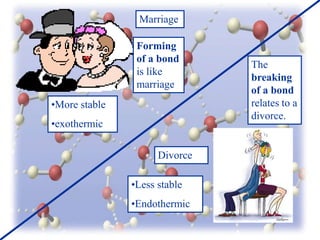
Marriage
Forming
of a bond
is like
marriage
•More stable
•exothermic
Divorce
•Less stable
•Endothermic

The
breaking
of a bond
relates to a
divorce.
Ionic Bonds
•What is an Ionic Bond?
- An Ionic Bond is a chemical bond
resulting from the TRANSFER of electrons
from one bonding atom to another
• When is an ionic bond formed?
- An ionic bond is formed when a cation
(positive ion) transfers electrons to an
anion (negative ion).
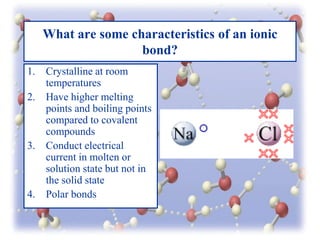
What are some characteristics of an ionic
bond?
1.
2.

3.

4.

Crystalline at room
temperatures
Have higher melting
points and boiling points
compared to covalent
compounds
Conduct electrical
current in molten or
solution state but not in
the solid state
Polar bonds
Covalent Bonds
•What is an Covalent Bond?
- A covalent bond is a chemical bond
resulting from SHARING of electrons
between 2 bonding atoms.
• What forms a covalent bond?
- A covalent bond is formed between two
nonmetals.
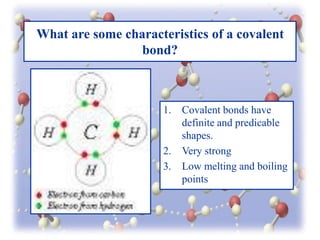
What are some characteristics of a covalent
bond?

1.

2.
3.

Covalent bonds have
definite and predicable
shapes.
Very strong
Low melting and boiling
points
Covalent Bonds can have multiple bonds, so you should be
familiar with the following…
Single Covalent Bondchemical bond resulting
from sharing of an electron
pair between two atoms.
Double Covalent Bondchemical bond resulting
from sharing of two electron
pairs between two atoms.
Triple Covalent Bondchemical bond resulting
from sharing of three
electron pairs between two
atoms.
There are five different categories associated with covalent
bonds. What are the 5 different categories?

Covalent

Molecular
Substance

Network
Solids
Polar

Nonpolar

Coordinate
Covalent
First, we are going to look at Polar Covalent…
What is polar covalent?
-Polar covalent is a description of a
c
bond that has an uneven distribution
of charge due to an unequal sharing of
bonding electrons.

The boy is not equally
sharing with anyone
else but rather taking
all the food for himself.
Next, we are going to look at Non-Polar Covalent…
What is non-polar covalent?
-Non polar covalent is a covalent
bond that has an even distribution of
charge due to an equal sharing of
bonding electrons.

This couple is
non- polar
because they are
sharing the drink
equally between
them.
Next, we are going to look at Molecular Substances…
What is a molecular substance?
-A molecular substance is a substance
that has atoms held together by
covalent bonds.
Name 2 Characteristics of a
Molecular Substance.
1. Weak
2. Low melting and boiling
points
Next, we are going to look at Coordinate Covalent…
What is a Coordinate Covalent Bond?
-A coordinate covalent bond is a
bond formed when one atom donates
both electrons that are shared.

People donate their
blood to help others
just like atoms
“donate” electrons to
form stable octets.

*Think about the party analogy!
Now, we are going to look at Network Solids…
What is a Network Solid?
-A network solid is a solid that has
covalently bonded atoms linked in
one big network or one big
macromolecule.
Name 3 Characteristics of a
Network Solid.
1. Poor conductors of heat
and electricity
2. Hard / Strong

3. High melting and boiling
points

Diphenylglycoluril
assembles into a unique, twodimensional hydrogen
bonding network in the solid
state, while exhibiting a
twisted molecular structure.
Metallic Bonding
What is a Metallic Bond?

- A metallic bond occurs in
metals. A metal consists of
positive ions surrounded by a
“sea” of mobile electrons.
This
shows
what a
metallic
bond
might
look
like.

Name 4 Characteristics of a
Metallic Bond.
1. Good conductors of heat
and electricity
2. Great strength
3. Malleable and Ductile
4. Luster
Polyatomic Bonds
Polyatomic ions usually have a
charge because the collection of
atoms has either gained an extra
electron or else it has lost an
electron.

What is a Polyatomic Bond?
- A polyatomic bond is
charged group of covalently
bonded atoms. It is made up
of more than one atom.
Linear
Trigonal Planer

Trigonal Bipyramidal
Tetrahedral

Octahedral
Just as a summary to what each
bond looks like…
REVIEW
Now that you have completed the review provided you may wish to
practice for your test by answering the following regents questions.
The question is presented in the same way that
http://regentsprep.org/ does them. If you would like to get reasons to
why your answers were incorrect you can find the explanations
there. After you have gotten your answer, click the mouse and the
right answer will show up.
If you chose…
If you chose…
If you chose…
If you chose…
If you chose…
If you chose…
Bonding 2005

Bonding 2005

  • 1.
    BONDING REVIEW Directions: Each slideprovides information in a question answer format. Click once to see the question and then again for the answer.
  • 2.
    Bonds Between Atoms PolyatomicIons Ionic Covalent Molecular Substance Metallic Network Solids Polar Nonpolar What are we going to learn about??? Coordinate Covalent
  • 3.
    See if youcan define the following words before starting the lesson… • Anion- negative ion • Cation-positive ion • Octet Rule- rule that states that atoms tend to gain, lose, or share electrons so that each atom has full outermost energy level which is typically 8 electrons. • Polyatomic Ion- charged group of covalently bound atoms • Monatomic Ion- ion formed from a single atom • Molecule-neutral group of atoms united by covalent bonds • Alloy- homogeneous mixture of metals • Unshared Pair- pair of electrons that is not involved in bonding but instead is held exclusively by one atom.
  • 4.
    Marriage Forming of a bond islike marriage •More stable •exothermic Divorce •Less stable •Endothermic The breaking of a bond relates to a divorce.
  • 5.
    Ionic Bonds •What isan Ionic Bond? - An Ionic Bond is a chemical bond resulting from the TRANSFER of electrons from one bonding atom to another • When is an ionic bond formed? - An ionic bond is formed when a cation (positive ion) transfers electrons to an anion (negative ion).
  • 6.
    What are somecharacteristics of an ionic bond? 1. 2. 3. 4. Crystalline at room temperatures Have higher melting points and boiling points compared to covalent compounds Conduct electrical current in molten or solution state but not in the solid state Polar bonds
  • 7.
    Covalent Bonds •What isan Covalent Bond? - A covalent bond is a chemical bond resulting from SHARING of electrons between 2 bonding atoms. • What forms a covalent bond? - A covalent bond is formed between two nonmetals.
  • 8.
    What are somecharacteristics of a covalent bond? 1. 2. 3. Covalent bonds have definite and predicable shapes. Very strong Low melting and boiling points
  • 9.
    Covalent Bonds canhave multiple bonds, so you should be familiar with the following… Single Covalent Bondchemical bond resulting from sharing of an electron pair between two atoms. Double Covalent Bondchemical bond resulting from sharing of two electron pairs between two atoms. Triple Covalent Bondchemical bond resulting from sharing of three electron pairs between two atoms.
  • 10.
    There are fivedifferent categories associated with covalent bonds. What are the 5 different categories? Covalent Molecular Substance Network Solids Polar Nonpolar Coordinate Covalent
  • 11.
    First, we aregoing to look at Polar Covalent… What is polar covalent? -Polar covalent is a description of a c bond that has an uneven distribution of charge due to an unequal sharing of bonding electrons. The boy is not equally sharing with anyone else but rather taking all the food for himself.
  • 12.
    Next, we aregoing to look at Non-Polar Covalent… What is non-polar covalent? -Non polar covalent is a covalent bond that has an even distribution of charge due to an equal sharing of bonding electrons. This couple is non- polar because they are sharing the drink equally between them.
  • 13.
    Next, we aregoing to look at Molecular Substances… What is a molecular substance? -A molecular substance is a substance that has atoms held together by covalent bonds. Name 2 Characteristics of a Molecular Substance. 1. Weak 2. Low melting and boiling points
  • 14.
    Next, we aregoing to look at Coordinate Covalent… What is a Coordinate Covalent Bond? -A coordinate covalent bond is a bond formed when one atom donates both electrons that are shared. People donate their blood to help others just like atoms “donate” electrons to form stable octets. *Think about the party analogy!
  • 15.
    Now, we aregoing to look at Network Solids… What is a Network Solid? -A network solid is a solid that has covalently bonded atoms linked in one big network or one big macromolecule. Name 3 Characteristics of a Network Solid. 1. Poor conductors of heat and electricity 2. Hard / Strong 3. High melting and boiling points Diphenylglycoluril assembles into a unique, twodimensional hydrogen bonding network in the solid state, while exhibiting a twisted molecular structure.
  • 16.
    Metallic Bonding What isa Metallic Bond? - A metallic bond occurs in metals. A metal consists of positive ions surrounded by a “sea” of mobile electrons. This shows what a metallic bond might look like. Name 4 Characteristics of a Metallic Bond. 1. Good conductors of heat and electricity 2. Great strength 3. Malleable and Ductile 4. Luster
  • 17.
    Polyatomic Bonds Polyatomic ionsusually have a charge because the collection of atoms has either gained an extra electron or else it has lost an electron. What is a Polyatomic Bond? - A polyatomic bond is charged group of covalently bonded atoms. It is made up of more than one atom.
  • 18.
  • 19.
    Just as asummary to what each bond looks like…
  • 20.
    REVIEW Now that youhave completed the review provided you may wish to practice for your test by answering the following regents questions. The question is presented in the same way that http://regentsprep.org/ does them. If you would like to get reasons to why your answers were incorrect you can find the explanations there. After you have gotten your answer, click the mouse and the right answer will show up.
  • 21.
  • 22.
  • 23.
  • 24.
  • 25.
  • 26.