Ebba Ossiannilsson
Professor Dr.
Sweden
I4Quality.se;
ICDE OER Advocacy
Committee, Ambassador
and Chair
Breakout Session 3 :
StrengtheningGlobal
Digital Cooperationfor
a ResilientDigital
Environment
AI and OER Initiatives
Ossiannilsson UNESCO 3rd World Congress November 19-
20, 2024. Dubai
Ossiannilsson UNESCO 3rd World Congress November 19-
20, 2024. Dubai
The research presented the
features, benefits, key
challenges, and practical
issues related to using AI
technologies from
professional, ethical,
sustainable, and equitable
perspectives, while also
focusing on the five areas of
the UNESCO OER
Recommendation
Professional. Providing writing supportfor creating and drafting texts,
checkingspelling and grammar, and ensuring the use of plain language.
Personalise learning for different contexts; Encourage public annotation
of different texts/resources; Foster collaboration between learners and
teachers, regardless of location.
Ethical. Verify AI-generated content for accuracy, credibility and
relevance. Promote transparency and critical thinking. Avoid replicating
biases when usingAI as a creative tool.
Sustainable. AI promotesefficiency by helping brainstorming,
summarising information, promoting discussions, providing real-time
feedback, and suggesting learning pathways. It can also empower
learners to be OER creators and improve digital literacy.
Equitable. AI has the ability to provide supplementary reading/writing
support and guarantee language accessibility by captioning and
transcribing resources.
Ossiannilsson UNESCO 3rd World Congress November 19-
20, 2024. Dubai
Ossiannilsson UNESCO 3rd World Congress November 19-
20, 2024. Dubai
We concluded that, while there is:
• great potential for the use of AI
in the context of the
Open Movement
• there is also a need for
professional ethics, equity, and
sustainable capacity building,
access, inclusion, policy,
models, and international
collaboration at all levels and
all stakeholders, not at least
leadership.
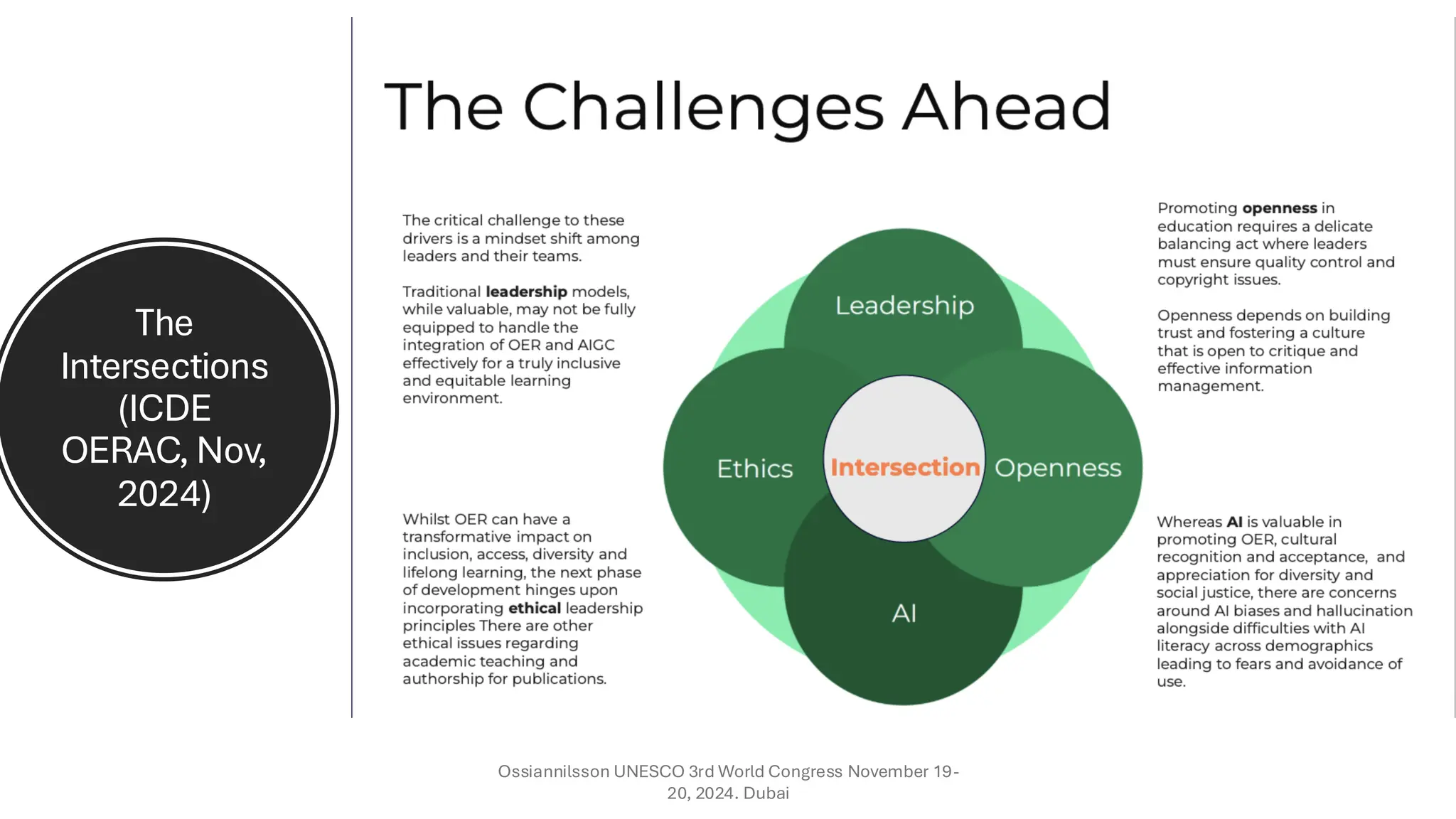
The
Intersections
(ICDE
OERAC, Nov,
2024)
Ossiannilsson UNESCO 3rd World Congress November 19-
20, 2024. Dubai
Generative AI Facilitates Greater Access than Traditional OER (Wiley, 10
September 2024 https://opencontent.org/blog/archives/7589
Because it can create new resources on
demand, generative AI can provide access to
dramatically more resources, on more topics,in
more languages, with more examples, using
more pedagogies, in more formats,etc., than
the current“create traditional OER by hand
through a bespoke process”approach can.
When we connect this fact back to the primary
goal of the open education movement, the
implication becomes clear. If:
the primary goal of the open education
movement is to increase access to educational
opportunities, and
the primary strategy for accomplishing this goal
is to increase access to educational resources,
and
generative AI can provide access to
dramatically more resources than the current
bespoke OER authoring process can, then
the optimal tactic for accomplishing the open
education movement’s primary goal is no
longer creating and sharing traditional OER –
the optimal tactic for accomplishing the open
education movement’s primary goal is to use
generative AI.
Ossiannilsson UNESCO 3rd World Congress November 19-
20, 2024. Dubai
Ossiannilsson UNESCO 3rd World Congress November 19-
20, 2024. Dubai
1. WHAT IS PAID BY
TAXMONEY
SHOULD GO BACK
TO THE TAXPAYERS
2. THE LARGEST CHALLENGE
WITH OER IS TO GO BEYOND THE
EDUCATIONAL INSTITUTIONS
3. WE HAVE TO ASK WHAT DO WE WANT AI TO DO FOR US?
Some clains
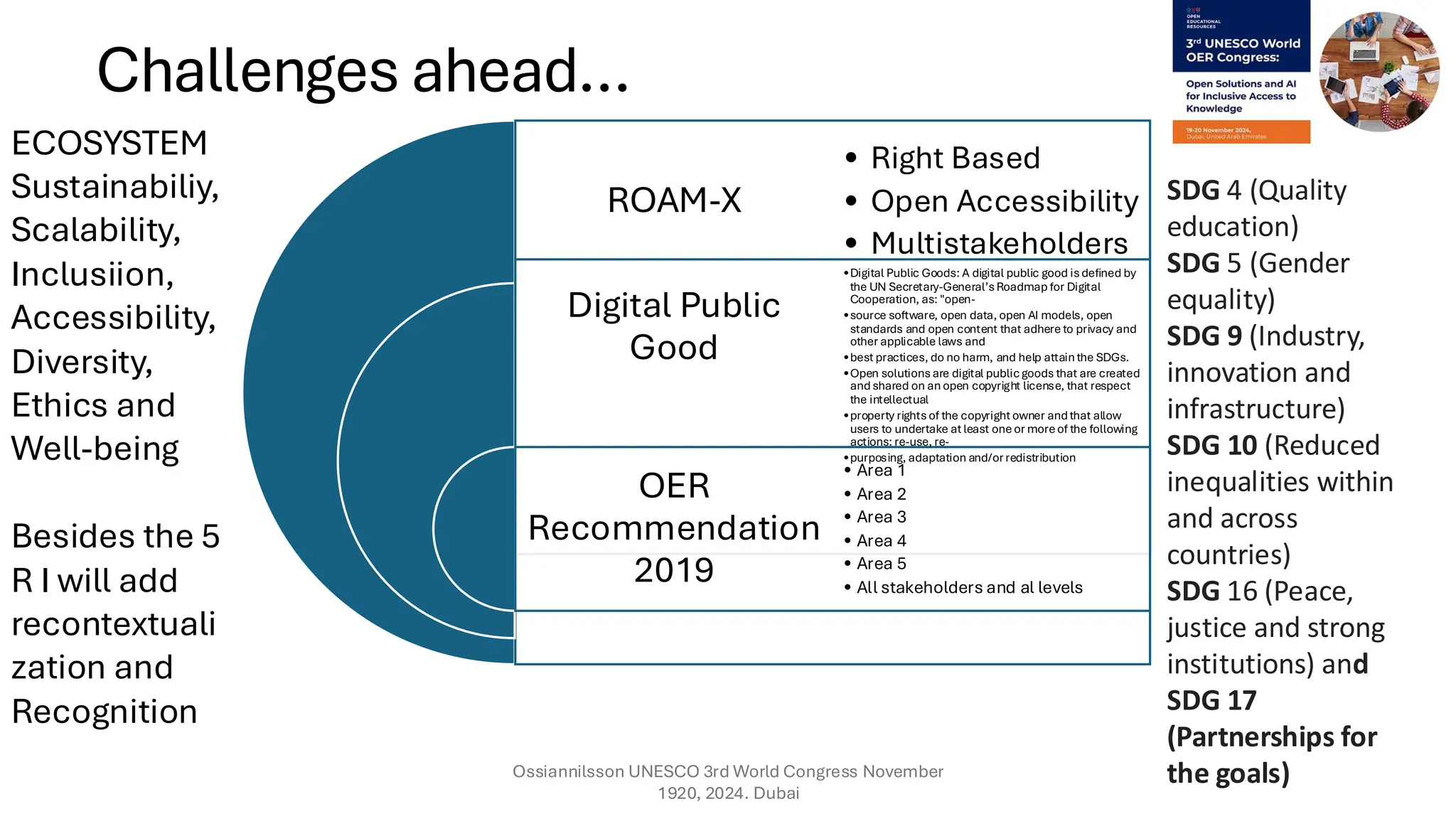
ROAM-X
Digital Public
Good
OER
Recommendation
2019
• Right Based
• Open Accessibility
• Multistakeholders
•Digital Public Goods: A digital public good isdefined by
the UN Secretary-General’s Roadmap for Digital
Cooperation, as: "open-
•source software, open data, open AI models, open
standards and open content that adhere to privacy and
other applicable laws and
•best practices, do no harm, and help attain the SDGs.
•Open solutionsare digital publicgoods that are created
andshared on anopen copyright license, that respect
the intellectual
•property rightsof the copyright owner andthat allow
users to undertake at least one or moreof the following
actions: re-use, re-
•purposing, adaptation and/or redistribution
• Area 1
• Area 2
• Area 3
• Area 4
• Area 5
• All stakeholders and al levels
Challenges ahead…
ECOSYSTEM
Sustainabiliy,
Scalability,
Inclusiion,
Accessibility,
Diversity,
Ethics and
Well-being
Besides the 5
R I will add
recontextuali
zation and
Recognition
Ossiannilsson UNESCO 3rd World Congress November
1920, 2024. Dubai
SDG 4 (Quality
education)
SDG 5 (Gender
equality)
SDG 9 (Industry,
innovation and
infrastructure)
SDG 10 (Reduced
inequalities within
and across
countries)
SDG 16 (Peace,
justice and strong
institutions) and
SDG 17
(Partnerships for
the goals)
Ossiannilsson UNESCO 3rd World Congress November 19-
20, 2024. Dubai
My Footprints
www.i4quality.se
Ebba.Ossiannilsson@gmail.com
info@i4quality.se
CARING is SHARING, SHARING is CARING
THANK YOU

The UNESCO OER 3rd World Congress 2024_20 Nov2024

  • 1.
    Ebba Ossiannilsson Professor Dr. Sweden I4Quality.se; ICDEOER Advocacy Committee, Ambassador and Chair Breakout Session 3 : StrengtheningGlobal Digital Cooperationfor a ResilientDigital Environment AI and OER Initiatives
  • 2.
    Ossiannilsson UNESCO 3rdWorld Congress November 19- 20, 2024. Dubai
  • 3.
    Ossiannilsson UNESCO 3rdWorld Congress November 19- 20, 2024. Dubai The research presented the features, benefits, key challenges, and practical issues related to using AI technologies from professional, ethical, sustainable, and equitable perspectives, while also focusing on the five areas of the UNESCO OER Recommendation
  • 4.
    Professional. Providing writingsupportfor creating and drafting texts, checkingspelling and grammar, and ensuring the use of plain language. Personalise learning for different contexts; Encourage public annotation of different texts/resources; Foster collaboration between learners and teachers, regardless of location. Ethical. Verify AI-generated content for accuracy, credibility and relevance. Promote transparency and critical thinking. Avoid replicating biases when usingAI as a creative tool. Sustainable. AI promotesefficiency by helping brainstorming, summarising information, promoting discussions, providing real-time feedback, and suggesting learning pathways. It can also empower learners to be OER creators and improve digital literacy. Equitable. AI has the ability to provide supplementary reading/writing support and guarantee language accessibility by captioning and transcribing resources. Ossiannilsson UNESCO 3rd World Congress November 19- 20, 2024. Dubai
  • 5.
    Ossiannilsson UNESCO 3rdWorld Congress November 19- 20, 2024. Dubai We concluded that, while there is: • great potential for the use of AI in the context of the Open Movement • there is also a need for professional ethics, equity, and sustainable capacity building, access, inclusion, policy, models, and international collaboration at all levels and all stakeholders, not at least leadership.
  • 6.
    The Intersections (ICDE OERAC, Nov, 2024) Ossiannilsson UNESCO3rd World Congress November 19- 20, 2024. Dubai
  • 7.
    Generative AI FacilitatesGreater Access than Traditional OER (Wiley, 10 September 2024 https://opencontent.org/blog/archives/7589 Because it can create new resources on demand, generative AI can provide access to dramatically more resources, on more topics,in more languages, with more examples, using more pedagogies, in more formats,etc., than the current“create traditional OER by hand through a bespoke process”approach can. When we connect this fact back to the primary goal of the open education movement, the implication becomes clear. If: the primary goal of the open education movement is to increase access to educational opportunities, and the primary strategy for accomplishing this goal is to increase access to educational resources, and generative AI can provide access to dramatically more resources than the current bespoke OER authoring process can, then the optimal tactic for accomplishing the open education movement’s primary goal is no longer creating and sharing traditional OER – the optimal tactic for accomplishing the open education movement’s primary goal is to use generative AI. Ossiannilsson UNESCO 3rd World Congress November 19- 20, 2024. Dubai
  • 8.
    Ossiannilsson UNESCO 3rdWorld Congress November 19- 20, 2024. Dubai 1. WHAT IS PAID BY TAXMONEY SHOULD GO BACK TO THE TAXPAYERS 2. THE LARGEST CHALLENGE WITH OER IS TO GO BEYOND THE EDUCATIONAL INSTITUTIONS 3. WE HAVE TO ASK WHAT DO WE WANT AI TO DO FOR US? Some clains
  • 9.
    ROAM-X Digital Public Good OER Recommendation 2019 • RightBased • Open Accessibility • Multistakeholders •Digital Public Goods: A digital public good isdefined by the UN Secretary-General’s Roadmap for Digital Cooperation, as: "open- •source software, open data, open AI models, open standards and open content that adhere to privacy and other applicable laws and •best practices, do no harm, and help attain the SDGs. •Open solutionsare digital publicgoods that are created andshared on anopen copyright license, that respect the intellectual •property rightsof the copyright owner andthat allow users to undertake at least one or moreof the following actions: re-use, re- •purposing, adaptation and/or redistribution • Area 1 • Area 2 • Area 3 • Area 4 • Area 5 • All stakeholders and al levels Challenges ahead… ECOSYSTEM Sustainabiliy, Scalability, Inclusiion, Accessibility, Diversity, Ethics and Well-being Besides the 5 R I will add recontextuali zation and Recognition Ossiannilsson UNESCO 3rd World Congress November 1920, 2024. Dubai SDG 4 (Quality education) SDG 5 (Gender equality) SDG 9 (Industry, innovation and infrastructure) SDG 10 (Reduced inequalities within and across countries) SDG 16 (Peace, justice and strong institutions) and SDG 17 (Partnerships for the goals)
  • 10.
    Ossiannilsson UNESCO 3rdWorld Congress November 19- 20, 2024. Dubai
  • 11.