Quality improvement of the use of OER
 in higher education - challenges and
            consequences


 Lund University/Ossiannilsson /LU_EADTU_ESKISEHIR;TURKEY2011/ CC BY-NC-ND
We are …
       Ebba Ossiannilsson
         Lund University
       ebba.ossiannilsson@ced.lu.
                   se


             Alastair Creelman
            Linnaeus University
              alastair.creelman@lnu.se
                      Lokal_Profil CC-BY-SA-2.5 www.creativecommons.org/licenses/by-sa/2.5 via Wikimedia Commons

Lund University/Ossiannilsson /LU_EADTU_ESKISEHIR;TURKEY2011/ CC BY-NC-ND
Kanwar, Balasubramanian and Umar (2010)
defines OER as:

”The   phenomenon of OER is an empowerment
   process, facilitated by technology in which
   various types of stakeholders are able to
   interact, collaborate, create and use materials
   and pedagogic practices, that are freely
   available, for enhancing access, reducing
   costs and improving the quality of education
   and learning at all levels”.


Lund University/Ossiannilsson /LU_EADTU_ESKISEHIR;TURKEY2011/ CC BY-NC-ND
Wikimedia
                         Commons

               iTunes U


Lund University/Ossiannilsson /LU_EADTU_ESKISEHIR;TURKEY2011/ CC BY-NC-ND
Extended learning environments
Stretched learning (Kroksmark, 2011)
    Lund University/Ossiannilsson /LU_EADTU_ESKISEHIR;TURKEY2011/ CC BY-NC-ND
Open educational practices
and cultures

• Sharing as default

• National policies
  meet grassroots
  enthusiasm


CC Some rights reserved by Shahram Sharif
 Lund University/Ossiannilsson /LU_EADTU_ESKISEHIR;TURKEY2011/ CC BY-NC-ND
Culture of sharing

We don’t compete
with content

Context is king

Sharing facilitates
new teacher role


                                      cc. sonyaf.blogg.se


                                                                     Some rights reserved by HikingArtist.com

Lund University/Ossiannilsson /LU_EADTU_ESKISEHIR;TURKEY2011/ CC BY-NC-ND
CC by krissen. 5213463465_ebb19ed107.jpg


Lund University/Ossiannilsson /LU_EADTU_ESKISEHIR;TURKEY2011/ CC BY-NC-ND
Changing roles


                                                       The role of the student

                                                       The role of the teacher

                                                       The role of the university

                                                       The role of the course

                                                       The role of
                                                       degree/cerification
                                             Some rights reserved by enda_001

Lund University/Ossiannilsson /LU_EADTU_ESKISEHIR;TURKEY2011/ CC BY-NC-ND
"The greatest danger in times of
turbulence is not the turbulence. It is to act
with yesterday's logic." - Peter Drucker


                                                                             Steve Wheeler, University of Plymouth, 2011
Rethinking international university
education and beyond


 Lund University/Ossiannilsson /LU_EADTU_ESKISEHIR;TURKEY2011/ CC BY-NC-ND
          http://pixdaus.com
Quality
   Networking, collaboration, connectivism,
               building bridges


Lund University/Ossiannilsson /LU_EADTU_ESKISEHIR;TURKEY2011/ CC BY-NC-ND
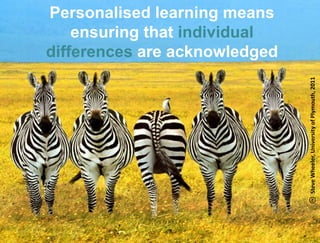
Personalised learning means
             ensuring that individual
         differences are acknowledged


                                                                            Steve Wheeler, University of Plymouth, 2011
Lund University/Ossiannilsson /LU_EADTU_ESKISEHIR;TURKEY2011/ CC BY-NC-ND
Rethinking international university education and beyond


         Learn anything, anywhere…if you know how
                                                                          Some rights reserved by Spree2010

   Lund University/Ossiannilsson /LU_EADTU_ESKISEHIR;TURKEY2011/ CC BY-NC-ND
Steve Wheeler, University of Plymouth, 2011
  The future of
  learning is Open


                                                        http://www.flickr.com/photos/42232541@N04/4267059
Lund University/Ossiannilsson /LU_EADTU_ESKISEHIR;TURKEY2011/ CC BY-NC-ND
                                                        618/
STAKEHOLDERS
Governments,
Higher educational providers
Teaching staff
Student bodies
Quality assurance/accreditation bodies
and academic recognition bodies
(UNESCO-COL 2011a p.13).


  Lund University/Ossiannilsson /LU_EADTU_ESKISEHIR;TURKEY2011/ CC BY-NC-ND
Benchmarking
Self evaluation for quality enhancement


                                                                     benchmark-careers.com
 Lund University/Ossiannilsson /LU_EADTU_ESKISEHIR;TURKEY2011/ CC BY-NC-ND
Benchmarking is an exemplar-driven teleological process
                                  operating within an organization [sic] with the objective of
                                  intentionally changing an existing state of affairs into
                                  a superior state of affairs. (Moriarty, 2008, p. 30).


 ifi.se                                                 …the ´locus´ of benchmarking lies
                                                        between the current and desirable
                                                        states of affairs and contributes to the
                                                        transformation processes that realise
                                                        these improvements. (Moriarty and
                                                        Smallman, 2009, p. 484)


                              ...is a technique, method, process, activity,
                              incentive, or reward which conventional wisdom
citybenchmarkingdata.com
                              regards as more effective at delivering a particular
                              outcome than any other technique, method,
                              process, etc. when applied to a particular condition
                              or circumstance


      Lund University/Ossiannilsson /LU_EADTU_ESKISEHIR;TURKEY2011/ CC BY-NC-ND
Benchmarking


                                                           E.P.M. Smoyer, L.A. Taplin, and R.S. Berns, ...
                                                           art-si.org

         Lund University/Ossiannilsson /LU_EADTU_ESKISEHIR;TURKEY2011/ CC BY-NC-ND
Benchmarking of OER

                                                 to identify success factors for the
                                                 use and reuse of OER
                                                 how social aspects really work
                                                 and how they contribute to the
                                                 success of OER activity generally.
                                                 identify communities of practice
                                                 identify stakeholders
                                                 identify approaches in the use of
                                                 OER
                                                 develop       best    practice and
                                                 cultivate cultures in the use of OER
                                                 identify the process towards OEP
                                                 and OEC


Lund University/Ossiannilsson /LU_EADTU_ESKISEHIR;TURKEY2011/ CC BY-NC-ND
Future of learning in 2020-2030
 Learning objectives will focus on
 competences rather than knowledge
                                                  Learning will be more tailored to the
                                                  needs of individuals
Learning will be more active and
                                                 Technologies will be an integral part of
connected to real life.
                                                 learning and life
Teachers will become lifelong learners
themselves                            Education needs to change to respond
                                      to the needs of the economy and
                                      society
ICT are creating and impacting change
in learning, but more knowledge is
needed.
                                   Teachers need to be encouraged to be
                                   part of implementing the change

Organizational change is required to
                                                     Ala-Mutka, Redecker, Punie, Ferrari, Cachia and Centeno
allow and encourage innovation in                    (2011). IPTS.
education.                                           http://ipts.jrc.ec.europa.eu/publications/pub.cfm?id=3679

    Lund University/Ossiannilsson /LU_EADTU_ESKISEHIR;TURKEY2011/ CC BY-NC-ND
Key competences 2025/2030

• The present eight Key competences 2006 to be reached 2010.
…and the future


• Environment; nature, sustainability
• Problem-solving; analysing,
   critizing, KISS
• Identity; self confindence,
   self-esteem, keep independece
• Flexibility to change,
   openess to change, adapting to change,
   stress management (IPTS, 2010)
Lund University/Ossiannilsson /LU_EADTU_ESKISEHIR;TURKEY2011/ CC BY-NC-ND
The door is
                                                                open …


                                                     Practice
                                                     Culture
                                                     Business models
                                                     Etc.

Bild: Wikimedia Commons, Push the button, CC BY SA


       Lund University/Ossiannilsson /LU_EADTU_ESKISEHIR;TURKEY2011/ CC BY-NC-ND
LUND UNIVERSITY

               LINNEAUS UNIVERSITY

               DO IT YOURSELF UNIVIERSITY

               OER UNIVERSITY etc….
                                                                            …and/or


                                                   THE BADGE MOVEMENT

Lund University/Ossiannilsson /LU_EADTU_ESKISEHIR;TURKEY2011/ CC BY-NC-ND
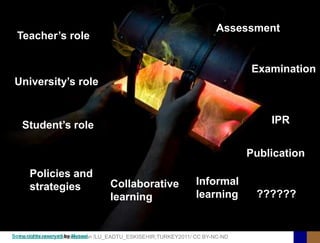
Assessment
 Teacher’s role


                                                                             Examination
University’s role


   Student’s role                                                                IPR


                                                                             Publication
      Policies and
      strategies                 Collaborative                 Informal
                                 learning                      learning       ??????


Some rights reserved by Mycael /LU_EADTU_ESKISEHIR;TURKEY2011/ CC BY-NC-ND
  Lund University/Ossiannilsson
Ebba Ossiannilsson, Lund University, SE


                                                           Footprints
                                                           W:www.lu.se,
                                                           www.oulu.fi
                                                           E:Ebba.Ossiannilsson@ced.lu.se
                                                           E:Ebba.Ossiannilsson@oulu.fi
                                                           FB:Ebba Ossiannilsson
                                                           T:@EbbaOssian
                                                           Phone: +4670995448
                                                           S:http://www.slideshare.net/Ebba
                                                           Ossiann


Lund University/Ossiannilsson /LU_EADTU_ESKISEHIR;TURKEY2011/ CC BY-NC-ND

EADTU2011 Turkey

  • 1.
    Quality improvement ofthe use of OER in higher education - challenges and consequences Lund University/Ossiannilsson /LU_EADTU_ESKISEHIR;TURKEY2011/ CC BY-NC-ND
  • 2.
    We are … Ebba Ossiannilsson Lund University ebba.ossiannilsson@ced.lu. se Alastair Creelman Linnaeus University alastair.creelman@lnu.se Lokal_Profil CC-BY-SA-2.5 www.creativecommons.org/licenses/by-sa/2.5 via Wikimedia Commons Lund University/Ossiannilsson /LU_EADTU_ESKISEHIR;TURKEY2011/ CC BY-NC-ND
  • 3.
    Kanwar, Balasubramanian andUmar (2010) defines OER as: ”The phenomenon of OER is an empowerment process, facilitated by technology in which various types of stakeholders are able to interact, collaborate, create and use materials and pedagogic practices, that are freely available, for enhancing access, reducing costs and improving the quality of education and learning at all levels”. Lund University/Ossiannilsson /LU_EADTU_ESKISEHIR;TURKEY2011/ CC BY-NC-ND
  • 4.
    Wikimedia Commons iTunes U Lund University/Ossiannilsson /LU_EADTU_ESKISEHIR;TURKEY2011/ CC BY-NC-ND
  • 5.
  • 6.
    Extended learning environments Stretchedlearning (Kroksmark, 2011) Lund University/Ossiannilsson /LU_EADTU_ESKISEHIR;TURKEY2011/ CC BY-NC-ND
  • 7.
    Open educational practices andcultures • Sharing as default • National policies meet grassroots enthusiasm CC Some rights reserved by Shahram Sharif Lund University/Ossiannilsson /LU_EADTU_ESKISEHIR;TURKEY2011/ CC BY-NC-ND
  • 8.
    Culture of sharing Wedon’t compete with content Context is king Sharing facilitates new teacher role cc. sonyaf.blogg.se Some rights reserved by HikingArtist.com Lund University/Ossiannilsson /LU_EADTU_ESKISEHIR;TURKEY2011/ CC BY-NC-ND
  • 9.
    CC by krissen.5213463465_ebb19ed107.jpg Lund University/Ossiannilsson /LU_EADTU_ESKISEHIR;TURKEY2011/ CC BY-NC-ND
  • 10.
    Changing roles The role of the student The role of the teacher The role of the university The role of the course The role of degree/cerification Some rights reserved by enda_001 Lund University/Ossiannilsson /LU_EADTU_ESKISEHIR;TURKEY2011/ CC BY-NC-ND
  • 11.
    "The greatest dangerin times of turbulence is not the turbulence. It is to act with yesterday's logic." - Peter Drucker Steve Wheeler, University of Plymouth, 2011 Rethinking international university education and beyond Lund University/Ossiannilsson /LU_EADTU_ESKISEHIR;TURKEY2011/ CC BY-NC-ND http://pixdaus.com
  • 12.
    Quality Networking, collaboration, connectivism, building bridges Lund University/Ossiannilsson /LU_EADTU_ESKISEHIR;TURKEY2011/ CC BY-NC-ND
  • 13.
    Personalised learning means ensuring that individual differences are acknowledged Steve Wheeler, University of Plymouth, 2011 Lund University/Ossiannilsson /LU_EADTU_ESKISEHIR;TURKEY2011/ CC BY-NC-ND
  • 14.
    Rethinking international universityeducation and beyond Learn anything, anywhere…if you know how Some rights reserved by Spree2010 Lund University/Ossiannilsson /LU_EADTU_ESKISEHIR;TURKEY2011/ CC BY-NC-ND
  • 15.
    Steve Wheeler, Universityof Plymouth, 2011 The future of learning is Open http://www.flickr.com/photos/42232541@N04/4267059 Lund University/Ossiannilsson /LU_EADTU_ESKISEHIR;TURKEY2011/ CC BY-NC-ND 618/
  • 16.
    STAKEHOLDERS Governments, Higher educational providers Teachingstaff Student bodies Quality assurance/accreditation bodies and academic recognition bodies (UNESCO-COL 2011a p.13). Lund University/Ossiannilsson /LU_EADTU_ESKISEHIR;TURKEY2011/ CC BY-NC-ND
  • 17.
    Benchmarking Self evaluation forquality enhancement benchmark-careers.com Lund University/Ossiannilsson /LU_EADTU_ESKISEHIR;TURKEY2011/ CC BY-NC-ND
  • 18.
    Benchmarking is anexemplar-driven teleological process operating within an organization [sic] with the objective of intentionally changing an existing state of affairs into a superior state of affairs. (Moriarty, 2008, p. 30). ifi.se …the ´locus´ of benchmarking lies between the current and desirable states of affairs and contributes to the transformation processes that realise these improvements. (Moriarty and Smallman, 2009, p. 484) ...is a technique, method, process, activity, incentive, or reward which conventional wisdom citybenchmarkingdata.com regards as more effective at delivering a particular outcome than any other technique, method, process, etc. when applied to a particular condition or circumstance Lund University/Ossiannilsson /LU_EADTU_ESKISEHIR;TURKEY2011/ CC BY-NC-ND
  • 19.
    Benchmarking E.P.M. Smoyer, L.A. Taplin, and R.S. Berns, ... art-si.org Lund University/Ossiannilsson /LU_EADTU_ESKISEHIR;TURKEY2011/ CC BY-NC-ND
  • 20.
    Benchmarking of OER to identify success factors for the use and reuse of OER how social aspects really work and how they contribute to the success of OER activity generally. identify communities of practice identify stakeholders identify approaches in the use of OER develop best practice and cultivate cultures in the use of OER identify the process towards OEP and OEC Lund University/Ossiannilsson /LU_EADTU_ESKISEHIR;TURKEY2011/ CC BY-NC-ND
  • 21.
    Future of learningin 2020-2030 Learning objectives will focus on competences rather than knowledge Learning will be more tailored to the needs of individuals Learning will be more active and Technologies will be an integral part of connected to real life. learning and life Teachers will become lifelong learners themselves Education needs to change to respond to the needs of the economy and society ICT are creating and impacting change in learning, but more knowledge is needed. Teachers need to be encouraged to be part of implementing the change Organizational change is required to Ala-Mutka, Redecker, Punie, Ferrari, Cachia and Centeno allow and encourage innovation in (2011). IPTS. education. http://ipts.jrc.ec.europa.eu/publications/pub.cfm?id=3679 Lund University/Ossiannilsson /LU_EADTU_ESKISEHIR;TURKEY2011/ CC BY-NC-ND
  • 22.
    Key competences 2025/2030 •The present eight Key competences 2006 to be reached 2010. …and the future • Environment; nature, sustainability • Problem-solving; analysing, critizing, KISS • Identity; self confindence, self-esteem, keep independece • Flexibility to change, openess to change, adapting to change, stress management (IPTS, 2010) Lund University/Ossiannilsson /LU_EADTU_ESKISEHIR;TURKEY2011/ CC BY-NC-ND
  • 23.
    The door is open … Practice Culture Business models Etc. Bild: Wikimedia Commons, Push the button, CC BY SA Lund University/Ossiannilsson /LU_EADTU_ESKISEHIR;TURKEY2011/ CC BY-NC-ND
  • 24.
    LUND UNIVERSITY LINNEAUS UNIVERSITY DO IT YOURSELF UNIVIERSITY OER UNIVERSITY etc…. …and/or THE BADGE MOVEMENT Lund University/Ossiannilsson /LU_EADTU_ESKISEHIR;TURKEY2011/ CC BY-NC-ND
  • 25.
    Assessment Teacher’s role Examination University’s role Student’s role IPR Publication Policies and strategies Collaborative Informal learning learning ?????? Some rights reserved by Mycael /LU_EADTU_ESKISEHIR;TURKEY2011/ CC BY-NC-ND Lund University/Ossiannilsson
  • 26.
    Ebba Ossiannilsson, LundUniversity, SE Footprints W:www.lu.se, www.oulu.fi E:Ebba.Ossiannilsson@ced.lu.se E:Ebba.Ossiannilsson@oulu.fi FB:Ebba Ossiannilsson T:@EbbaOssian Phone: +4670995448 S:http://www.slideshare.net/Ebba Ossiann Lund University/Ossiannilsson /LU_EADTU_ESKISEHIR;TURKEY2011/ CC BY-NC-ND