Prepared by:
Alaa Ibrahim Mohammed
U of K
FMLS
Department of Haematology & Immunohaematology
Haemoglobin Estimation
Introduction:
 Haemoglobin is the red pigment contained in
erythrocytes, responsible for transporting
oxygen & carbondioxide.
 It consists of 4 Heme molecule + 4 globin
chains.
(iron-containing molecules & protein chains)
 Its synthesis starts during red blood cells
maturation particularly at polychromatic
erythroblast and continue untill reticulocyte
stages.
 The main Hb type of normal adults is HbA,
and little percentage of HbA2.
Aim of Hb. Estimation:
 To evaluate an individual condition, is it
normal, anaemic or polycythaemic.
Methods:
 Haemoglobin concentration (Hb) of a solution
can be estimated by three methods:
1. Iron content method.
2. Oxygen content method.
3. Colorimetric methods.
1. Iron content method:
- By measuring the iron content of Hb.
- Every 100 g of Hb 0.347 g of
iron.
 Disadvantages:
Not suitable for routine work.
2. Oxygen content method:
- By measuring the oxygen content of Hb (Hb
binding capacity)
- Every 1 g of Hb 1.34 ml of
oxygen.
 Disadvantages:
Not suitable for routine work (it is hardly
practical).
3. Colorimetric methods:
- By measuring its color.
- There are many colorimetric methods:
i. Acid haematin method.
ii. Alkaline haematin method.
iii. Oxyhaemoglobin method.
iv. Cyanomethaemoglobin method. (The
standardized method)
i. Acid haematin method:
 Apparatus: by using Sahli apparatus.
 Reagent: by using 0.1 M HCL.
 It depends on comparison of Hb with HCL by
necked eye, so it is not recommended.
(Blood is added to 0.1 N HCL, leading to RBCs lysis and
the color which is developed is compared with solid
glass standard by necked eye).
 It is not accurate because the color develops
slowly, un stable and begins to fade immediately
after it reaches its peak.
 Procedure:
1. Fill the graduated Sahli tube to 20 mark with 0.1
N HCL.
2. Add 0.02 ml of blood by immersing the nozzle of
the pipette in the bottom of the graduated tube,
and gently blow the blood.
3. Using the provided glass rod (mixer), mix the
blood.
4. Incubate for 5 – 10 min.
5. Add D.W with pasteur pipette gradually untill the
color of the diluted blood in the test tube exactly
matches the solid glass standard.
6. Result is then read on Sahli scale. (100% = 14
g).
ii. Alkaline haematin method:
 Apparatus: by using colorimeter.
 Reagent: by using 0.1 N NaoH.
 It gives a true estimate of total Hb even if
Hbco, Hi, or SHb is present.
 Also it is not recommended because some Hb
resist denaturation with NaoH & participate in
crystals.
iii. Oxyhaemoglobin method:
 Apparatus: by using Colorimeter.
 Reagent: 0.4% Ammonia in H2O.
 Our tested blood is added with the ammonia
solution and the resulting oxyhaemoglobin
Hbo2 solution produced is then measured
photometrically at 540 nm against blank
solution.
iv. Cyanomethaemoglobin method:
 It is the highly recommended method for
determining or estimating the Hb concentration.
 It is considered as the reference method for
hemoglobin estimation.
 Apparatus: by using colorimeter.
 Reagent: by using Modified Drabkin’s reagent.
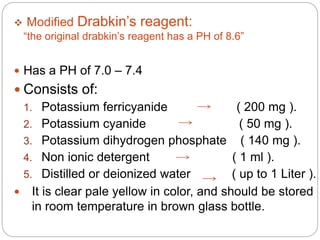
 Modified Drabkin’s reagent:
“the original drabkin’s reagent has a PH of 8.6”
 Has a PH of 7.0 – 7.4
 Consists of:
1. Potassium ferricyanide ( 200 mg ).
2. Potassium cyanide ( 50 mg ).
3. Potassium dihydrogen phosphate ( 140 mg ).
4. Non ionic detergent ( 1 ml ).
5. Distilled or deionized water ( up to 1 Liter ).
 It is clear pale yellow in color, and should be stored
in room temperature in brown glass bottle.
** The basis or principle of the method is that:
 Well mixed EDTA anticoagulated blood is
diluted in Drabkin’s solution; non-ionic detergent
will lyses the red cells to:
(1) liberate haemoglobin, and to (2) decrease the
turbidity caused by red cell membrane fragments
by dissolving them.
 Then, haemoglobin is oxidized and converted to
methemoglobin (Hi) by potassium ferricyanide
producing un stable brown color.
This step is accelerated by the dihydrogen
potassium phosphate, and requires approximately
3 to 5 minutes for total conversion.
 After that, potassium cyanide will provide cyanide
ions to form cyanomethemoglobin (HiCN), which is
stable reddish in color and have a broad spectrum
of absorption at 540 nm.
 The absorption can then be compared with a
haemoglobin standard with a known haemoglobin
concentration, and by applying Beer’s law extract
the haemoglobin concentration of the unknown
(i.e. the patient).
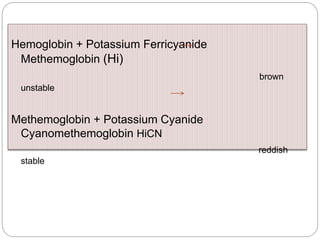
Hemoglobin + Potassium Ferricyanide
Methemoglobin (Hi)
brown
unstable
Methemoglobin + Potassium Cyanide
Cyanomethemoglobin HiCN
reddish
stable
** Advantages of cyanomethaemoglobin
(HiCN) method:
1. The availability of a stable & reliable
reference preparation.
2. Allow the measurements of all types of Hb
except sulphaemoglobin (SHb).
3. The amount of cyanide in the reagent is
low (50 mg/l) which is less hazard.
Hb estimation Lab
using Haemiglobincyanide (HiCN;
Cyanomethaemoglobin) method
 Aim.
 Principle.
 Materials & reagents.
 Method.
 Calculation.
 Result expression.
 Normal values.
 Interpretatin of the result.
Aim:
 To evaluate an individual condition, is it normal,
anaemic or polythcyaemic.
Principle:
 Blood is diluted in a solution containing Potassium
ferricyanide and Potassium cyanide resulting in
lysis of RBCs where then Hb, methaemoglobin Hi,
and carboxyhaemoglobin Hbco but not
sulphaemoglobin SHb are converted to
cyanomethaemoglobin HiCN, which can be
measured photometrically at 540 nm against
drabkin’s blank.
 Its absorbance is proportionate to the amount of
haemoglobin in the blood.
Materials & reagents:
1. Colorimeter.
2. Drabkin’s reagent.
3. Blood sample: either
- EDTA anticoagulated venous blood sample, or
- free flowing capillary blood, without squeezing.
4. Standard Cyanomethemoglobin solution (STD).
5. Test tubes.
6. Micropipette (0.02 ml) and 5 ml glass pipette.
7. Rack.
8. gauze or cotton.
Method:
1. In clean test tube using 5 ml glass pipette, put 4
ml or 5 ml of drabkin’s solution according to the
dilution factor.
2. Add 20 µl of well mixed test blood ( 0.02 ml) to
the drabkin’s solution.
3. Mix them well.
4. Let the mixer to stand at a room temperature for
5 min.
5. Adjust the zero point by blank (darbkin’s) at 540
nm.
6. Read the absorbance of the STD and then
absorbance of the test sample.
7. Calculate the conc. Of the test using beer’s law.
Calculation:
Conc. Of the Test = O.D of the test × Conc. of
the STD
g/dl O.D of the STD
Result:
 Expressed as:
 g/dl
Percentage %
14.6 g/dl 100 %
conc. of test in g/dl ( x %)
Conc. of test in % = conc. of the test in g/dl ×
100
14.6 g/dl
Reference Values:
• Men: 15 + 2 g/dl
• Women: 12 to 15 g/dl
• Children: 11 to 16 g/dl
• Neonates: 16 to 19 g/dl
Interpretation of the result:
 Normal:
if the Hb concentration is within the normal
values.
 Low Hb concentration (Anaemic):
if the Hb concentration is less than the normal
values beyond the age & sex.
 High Hb concentration (Polycythaemic):
if the Hb concentration is above the normal
values beyond the age & sex.
Errors in haemoglobin estimation:
Errors in sampling:
 — inadequate flow of blood from the finger prick;
 — excessive squeezing of the finger after pricking;
 — prolonged use of a tourniquet when collecting
venous blood, which leads to
 concentration of blood cells;
 — insufficient mixing of venous blood, which has
sedimented after collection;
 — small clots in venous blood due to inadequate
mixing with EDTA after collection;
 — adding too little or excess blood to Drabkin diluting
fluid;
 — air bubbles trapped in pipettes.
Faulty or dirty equipment, such as:
 — broken or chipped pipettes;
 — dirty pipettes;
 — dirty cuvettes;
 — dirty filters;
 — a defective spectrophotometer, haemoglobinometer
or colorimeter.
Faulty technique:
 — using a dilution factor different from the one for which
the spectrophotometer, haemoglobinometer or
colorimeter was calibrated;
 — inadequate mixing of reagent;
 — placing the cuvette in the chamber with the frosted
sides facing the light path;
 — air bubbles in the cuvette;
 — using a standard filter from another
spectrophotometer or haemoglobinometer for
adjustment;
 — using the wrong filter for the colorimeter.
Any questions…?
Hb estimation
Hb estimation
Hb estimation
Hb estimation
Hb estimation
Hb estimation
Hb estimation

Hb estimation

  • 1.
    Prepared by: Alaa IbrahimMohammed U of K FMLS Department of Haematology & Immunohaematology Haemoglobin Estimation
  • 2.
    Introduction:  Haemoglobin isthe red pigment contained in erythrocytes, responsible for transporting oxygen & carbondioxide.  It consists of 4 Heme molecule + 4 globin chains. (iron-containing molecules & protein chains)  Its synthesis starts during red blood cells maturation particularly at polychromatic erythroblast and continue untill reticulocyte stages.  The main Hb type of normal adults is HbA, and little percentage of HbA2.
  • 3.
    Aim of Hb.Estimation:  To evaluate an individual condition, is it normal, anaemic or polycythaemic.
  • 4.
    Methods:  Haemoglobin concentration(Hb) of a solution can be estimated by three methods: 1. Iron content method. 2. Oxygen content method. 3. Colorimetric methods.
  • 5.
    1. Iron contentmethod: - By measuring the iron content of Hb. - Every 100 g of Hb 0.347 g of iron.  Disadvantages: Not suitable for routine work.
  • 6.
    2. Oxygen contentmethod: - By measuring the oxygen content of Hb (Hb binding capacity) - Every 1 g of Hb 1.34 ml of oxygen.  Disadvantages: Not suitable for routine work (it is hardly practical).
  • 7.
    3. Colorimetric methods: -By measuring its color. - There are many colorimetric methods: i. Acid haematin method. ii. Alkaline haematin method. iii. Oxyhaemoglobin method. iv. Cyanomethaemoglobin method. (The standardized method)
  • 8.
    i. Acid haematinmethod:  Apparatus: by using Sahli apparatus.  Reagent: by using 0.1 M HCL.  It depends on comparison of Hb with HCL by necked eye, so it is not recommended. (Blood is added to 0.1 N HCL, leading to RBCs lysis and the color which is developed is compared with solid glass standard by necked eye).  It is not accurate because the color develops slowly, un stable and begins to fade immediately after it reaches its peak.
  • 9.
     Procedure: 1. Fillthe graduated Sahli tube to 20 mark with 0.1 N HCL. 2. Add 0.02 ml of blood by immersing the nozzle of the pipette in the bottom of the graduated tube, and gently blow the blood. 3. Using the provided glass rod (mixer), mix the blood. 4. Incubate for 5 – 10 min. 5. Add D.W with pasteur pipette gradually untill the color of the diluted blood in the test tube exactly matches the solid glass standard. 6. Result is then read on Sahli scale. (100% = 14 g).
  • 10.
    ii. Alkaline haematinmethod:  Apparatus: by using colorimeter.  Reagent: by using 0.1 N NaoH.  It gives a true estimate of total Hb even if Hbco, Hi, or SHb is present.  Also it is not recommended because some Hb resist denaturation with NaoH & participate in crystals.
  • 11.
    iii. Oxyhaemoglobin method: Apparatus: by using Colorimeter.  Reagent: 0.4% Ammonia in H2O.  Our tested blood is added with the ammonia solution and the resulting oxyhaemoglobin Hbo2 solution produced is then measured photometrically at 540 nm against blank solution.
  • 12.
    iv. Cyanomethaemoglobin method: It is the highly recommended method for determining or estimating the Hb concentration.  It is considered as the reference method for hemoglobin estimation.  Apparatus: by using colorimeter.  Reagent: by using Modified Drabkin’s reagent.
  • 13.
     Modified Drabkin’sreagent: “the original drabkin’s reagent has a PH of 8.6”  Has a PH of 7.0 – 7.4  Consists of: 1. Potassium ferricyanide ( 200 mg ). 2. Potassium cyanide ( 50 mg ). 3. Potassium dihydrogen phosphate ( 140 mg ). 4. Non ionic detergent ( 1 ml ). 5. Distilled or deionized water ( up to 1 Liter ).  It is clear pale yellow in color, and should be stored in room temperature in brown glass bottle.
  • 14.
    ** The basisor principle of the method is that:  Well mixed EDTA anticoagulated blood is diluted in Drabkin’s solution; non-ionic detergent will lyses the red cells to: (1) liberate haemoglobin, and to (2) decrease the turbidity caused by red cell membrane fragments by dissolving them.  Then, haemoglobin is oxidized and converted to methemoglobin (Hi) by potassium ferricyanide producing un stable brown color. This step is accelerated by the dihydrogen potassium phosphate, and requires approximately 3 to 5 minutes for total conversion.
  • 15.
     After that,potassium cyanide will provide cyanide ions to form cyanomethemoglobin (HiCN), which is stable reddish in color and have a broad spectrum of absorption at 540 nm.  The absorption can then be compared with a haemoglobin standard with a known haemoglobin concentration, and by applying Beer’s law extract the haemoglobin concentration of the unknown (i.e. the patient).
  • 16.
    Hemoglobin + PotassiumFerricyanide Methemoglobin (Hi) brown unstable Methemoglobin + Potassium Cyanide Cyanomethemoglobin HiCN reddish stable
  • 17.
    ** Advantages ofcyanomethaemoglobin (HiCN) method: 1. The availability of a stable & reliable reference preparation. 2. Allow the measurements of all types of Hb except sulphaemoglobin (SHb). 3. The amount of cyanide in the reagent is low (50 mg/l) which is less hazard.
  • 18.
    Hb estimation Lab usingHaemiglobincyanide (HiCN; Cyanomethaemoglobin) method  Aim.  Principle.  Materials & reagents.  Method.  Calculation.  Result expression.  Normal values.  Interpretatin of the result.
  • 19.
    Aim:  To evaluatean individual condition, is it normal, anaemic or polythcyaemic.
  • 20.
    Principle:  Blood isdiluted in a solution containing Potassium ferricyanide and Potassium cyanide resulting in lysis of RBCs where then Hb, methaemoglobin Hi, and carboxyhaemoglobin Hbco but not sulphaemoglobin SHb are converted to cyanomethaemoglobin HiCN, which can be measured photometrically at 540 nm against drabkin’s blank.  Its absorbance is proportionate to the amount of haemoglobin in the blood.
  • 21.
    Materials & reagents: 1.Colorimeter. 2. Drabkin’s reagent. 3. Blood sample: either - EDTA anticoagulated venous blood sample, or - free flowing capillary blood, without squeezing. 4. Standard Cyanomethemoglobin solution (STD). 5. Test tubes. 6. Micropipette (0.02 ml) and 5 ml glass pipette. 7. Rack. 8. gauze or cotton.
  • 22.
    Method: 1. In cleantest tube using 5 ml glass pipette, put 4 ml or 5 ml of drabkin’s solution according to the dilution factor. 2. Add 20 µl of well mixed test blood ( 0.02 ml) to the drabkin’s solution. 3. Mix them well. 4. Let the mixer to stand at a room temperature for 5 min. 5. Adjust the zero point by blank (darbkin’s) at 540 nm. 6. Read the absorbance of the STD and then absorbance of the test sample. 7. Calculate the conc. Of the test using beer’s law.
  • 23.
    Calculation: Conc. Of theTest = O.D of the test × Conc. of the STD g/dl O.D of the STD
  • 24.
    Result:  Expressed as: g/dl Percentage % 14.6 g/dl 100 % conc. of test in g/dl ( x %) Conc. of test in % = conc. of the test in g/dl × 100 14.6 g/dl
  • 25.
    Reference Values: • Men:15 + 2 g/dl • Women: 12 to 15 g/dl • Children: 11 to 16 g/dl • Neonates: 16 to 19 g/dl
  • 26.
    Interpretation of theresult:  Normal: if the Hb concentration is within the normal values.  Low Hb concentration (Anaemic): if the Hb concentration is less than the normal values beyond the age & sex.  High Hb concentration (Polycythaemic): if the Hb concentration is above the normal values beyond the age & sex.
  • 27.
    Errors in haemoglobinestimation: Errors in sampling:  — inadequate flow of blood from the finger prick;  — excessive squeezing of the finger after pricking;  — prolonged use of a tourniquet when collecting venous blood, which leads to  concentration of blood cells;  — insufficient mixing of venous blood, which has sedimented after collection;  — small clots in venous blood due to inadequate mixing with EDTA after collection;  — adding too little or excess blood to Drabkin diluting fluid;  — air bubbles trapped in pipettes.
  • 28.
    Faulty or dirtyequipment, such as:  — broken or chipped pipettes;  — dirty pipettes;  — dirty cuvettes;  — dirty filters;  — a defective spectrophotometer, haemoglobinometer or colorimeter.
  • 29.
    Faulty technique:  —using a dilution factor different from the one for which the spectrophotometer, haemoglobinometer or colorimeter was calibrated;  — inadequate mixing of reagent;  — placing the cuvette in the chamber with the frosted sides facing the light path;  — air bubbles in the cuvette;  — using a standard filter from another spectrophotometer or haemoglobinometer for adjustment;  — using the wrong filter for the colorimeter.
  • 30.