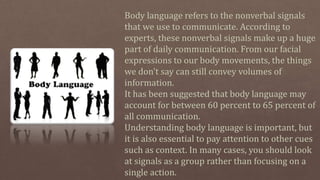
Body language refers to the nonverbal signals
that we use to communicate. According to
experts, these nonverbal signals make up a huge
part of daily communication. From our facial
expressions to our body movements, the things
we don't say can still convey volumes of
information.
It has been suggested that body language may
account for between 60 percent to 65 percent of
all communication.
Understanding body language is important, but
it is also essential to pay attention to other cues
such as context. In many cases, you should look
at signals as a group rather than focusing on a
single action.
Nonverbal communication plays four roles:
• Repetiton: it repeats and often strengthens the message you’re
making verbally.
• Contradiction: it can contradict the message you’re trying to convey,
thus indicating to your listener that you may not be telling the truth.
• Substitution: it can substitute for a verbal message. For example, our
facial expression often conveys a far more vivid message than words
ever can.
• Accenting: it may accent or underline a verbal message. Pounding the
table, for example, can underline the importance of our message.
The many different types of nonverbal
communication or body language include:
Facial expressions: The human face is extremely
expressive, able to convey countless emotions
without saying a word. And unlike some forms of
nonverbal communication, facial expressions are
universal. The facial expressions for happiness,
sadness, anger, surprise, fear, and disgust are the
same across cultures.
The expression on a person's face can even help
determine if we trust or believe what the
individual is saying. One study found that the most
trustworthy facial expression involved a slight
raise of the eyebrows and a slight smile. This
expression, the researchers suggested, conveys
both friendliness and confidence.
The Eyes
The eyes are frequently referred to as the
"windows to the soul" since they are
capable of revealing a great deal about
what a person is feeling or thinking. As
you engage in conversation with another
person, taking note of eye movements is a
natural and important part of the
communication process. Some common
things you may notice include whether
people are making direct eye contact or
averting their gaze, how much they are
blinking and etc.
Eye Signals
• Eye gaze: When a person looks directly into your eyes while having a conversation, it
indicates that they are interested and paying attention. However, prolonged eye contact
can feel threatening. On the other hand, breaking eye contact and frequently looking away
might indicate that the person is distracted, uncomfortable, or trying to conceal his or her
real feelings.
• Blinking: Blinking is natural, but you should also pay attention to whether a person is
blinking too much or too little. People often blink more rapidly when they are feeling
distressed or uncomfortable. Infrequent blinking may indicate that a person is
intentionally trying to control his or her eye movements.
• Pupil size: Pupil size can be a very subtle nonverbal communication signal. While light
levels in the environment control pupil dilation, sometimes emotions can also cause small
changes in pupil size.
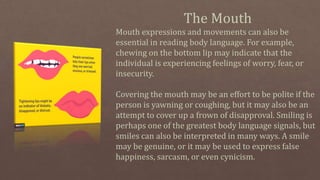
The Mouth
Mouth expressions and movements can also be
essential in reading body language. For example,
chewing on the bottom lip may indicate that the
individual is experiencing feelings of worry, fear, or
insecurity.
Covering the mouth may be an effort to be polite if the
person is yawning or coughing, but it may also be an
attempt to cover up a frown of disapproval. Smiling is
perhaps one of the greatest body language signals, but
smiles can also be interpreted in many ways. A smile
may be genuine, or it may be used to express false
happiness, sarcasm, or even cynicism.
Mouth and lip Signals
• Pursed lips: Tightening the lips might be an indicator of distaste,
disapproval, or distrust.
• Lip biting: People sometimes bite their lips when they are worried, anxious, or
stressed.
• Covering the mouth: When people want to hide an emotional reaction,
they might cover their mouths in order to avoid displaying smiles or
smirks.
• Turned up or down: Slight changes in the mouth can also be subtle
indicators of what a person is feeling. When the mouth is slightly turned
up, it might mean that the person is feeling happy or optimistic. On the
other hand, a slightly down-turned mouth can be an indicator of sadness,
disapproval, or even an outright grimace.
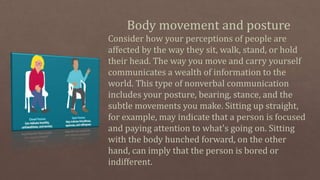
Body movement and posture
Consider how your perceptions of people are
affected by the way they sit, walk, stand, or hold
their head. The way you move and carry yourself
communicates a wealth of information to the
world. This type of nonverbal communication
includes your posture, bearing, stance, and the
subtle movements you make. Sitting up straight,
for example, may indicate that a person is focused
and paying attention to what's going on. Sitting
with the body hunched forward, on the other
hand, can imply that the person is bored or
indifferent.
Posture Signals
• Open posture involves keeping the trunk of the body open and
exposed. This type of posture indicates friendliness, openness, and
willingness.
• Closed posture involves hiding the trunk of the body often by keeping
the arms and legs crossed. This type of posture can be an indicator of
hostility, unfriendliness, and anxiety.
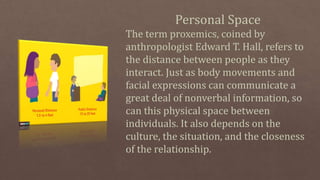
Personal Space
The term proxemics, coined by
anthropologist Edward T. Hall, refers to
the distance between people as they
interact. Just as body movements and
facial expressions can communicate a
great deal of nonverbal information, so
can this physical space between
individuals. It also depends on the
culture, the situation, and the closeness
of the relationship.
Personal Space Signals
Intimate distance -6 to 18 inches: This level of physical distance often indicates a closer relationship or
greater comfort between individuals. It usually occurs during intimate contact such as hugging, whispering,
or touching.
Personal distance -1.5 to 4 feet: Physical distance at this level usually occurs between people who are family
members or close friends. The closer the people can comfortably stand while interacting can be an indicator
of the level of intimacy in their relationship.
Social distance -4 to 12 feet: This level of physical distance is often used with individuals who are
acquaintances. With someone you know fairly well, such as a co-worker you see several times a week, you
might feel more comfortable interacting at a closer distance. In cases where you do not know the other
person well, such as a postal delivery driver you only see once a month, a distance of 10 to 12 feet may feel
more comfortable.
Public distance- 12 to 25 feet: Physical distance at this level is often used in public speaking situations.
Talking in front of a class full of students or giving a presentation at work are good examples of such
situations.
Touch
We communicate a great deal through touch. Think about the very
different messages given by a weak handshake, a warm bear hug, a
patronizing pat on the head, or a controlling grip on the arm, for
example.
Voice
Things they pay attention to include your timing and pace, how
loud you speak, your tone and inflection, and sounds that convey
understanding, also tone of voice can indicate sarcasm, anger,
affection, or confidence.
THANKS FOR ATTENTION

Body language

  • 2.
    Body language refersto the nonverbal signals that we use to communicate. According to experts, these nonverbal signals make up a huge part of daily communication. From our facial expressions to our body movements, the things we don't say can still convey volumes of information. It has been suggested that body language may account for between 60 percent to 65 percent of all communication. Understanding body language is important, but it is also essential to pay attention to other cues such as context. In many cases, you should look at signals as a group rather than focusing on a single action.
  • 3.
    Nonverbal communication playsfour roles: • Repetiton: it repeats and often strengthens the message you’re making verbally. • Contradiction: it can contradict the message you’re trying to convey, thus indicating to your listener that you may not be telling the truth. • Substitution: it can substitute for a verbal message. For example, our facial expression often conveys a far more vivid message than words ever can. • Accenting: it may accent or underline a verbal message. Pounding the table, for example, can underline the importance of our message.
  • 4.
    The many differenttypes of nonverbal communication or body language include: Facial expressions: The human face is extremely expressive, able to convey countless emotions without saying a word. And unlike some forms of nonverbal communication, facial expressions are universal. The facial expressions for happiness, sadness, anger, surprise, fear, and disgust are the same across cultures. The expression on a person's face can even help determine if we trust or believe what the individual is saying. One study found that the most trustworthy facial expression involved a slight raise of the eyebrows and a slight smile. This expression, the researchers suggested, conveys both friendliness and confidence.
  • 5.
    The Eyes The eyesare frequently referred to as the "windows to the soul" since they are capable of revealing a great deal about what a person is feeling or thinking. As you engage in conversation with another person, taking note of eye movements is a natural and important part of the communication process. Some common things you may notice include whether people are making direct eye contact or averting their gaze, how much they are blinking and etc.
  • 6.
    Eye Signals • Eyegaze: When a person looks directly into your eyes while having a conversation, it indicates that they are interested and paying attention. However, prolonged eye contact can feel threatening. On the other hand, breaking eye contact and frequently looking away might indicate that the person is distracted, uncomfortable, or trying to conceal his or her real feelings. • Blinking: Blinking is natural, but you should also pay attention to whether a person is blinking too much or too little. People often blink more rapidly when they are feeling distressed or uncomfortable. Infrequent blinking may indicate that a person is intentionally trying to control his or her eye movements. • Pupil size: Pupil size can be a very subtle nonverbal communication signal. While light levels in the environment control pupil dilation, sometimes emotions can also cause small changes in pupil size.
  • 7.
    The Mouth Mouth expressionsand movements can also be essential in reading body language. For example, chewing on the bottom lip may indicate that the individual is experiencing feelings of worry, fear, or insecurity. Covering the mouth may be an effort to be polite if the person is yawning or coughing, but it may also be an attempt to cover up a frown of disapproval. Smiling is perhaps one of the greatest body language signals, but smiles can also be interpreted in many ways. A smile may be genuine, or it may be used to express false happiness, sarcasm, or even cynicism.
  • 8.
    Mouth and lipSignals • Pursed lips: Tightening the lips might be an indicator of distaste, disapproval, or distrust. • Lip biting: People sometimes bite their lips when they are worried, anxious, or stressed. • Covering the mouth: When people want to hide an emotional reaction, they might cover their mouths in order to avoid displaying smiles or smirks. • Turned up or down: Slight changes in the mouth can also be subtle indicators of what a person is feeling. When the mouth is slightly turned up, it might mean that the person is feeling happy or optimistic. On the other hand, a slightly down-turned mouth can be an indicator of sadness, disapproval, or even an outright grimace.
  • 9.
    Body movement andposture Consider how your perceptions of people are affected by the way they sit, walk, stand, or hold their head. The way you move and carry yourself communicates a wealth of information to the world. This type of nonverbal communication includes your posture, bearing, stance, and the subtle movements you make. Sitting up straight, for example, may indicate that a person is focused and paying attention to what's going on. Sitting with the body hunched forward, on the other hand, can imply that the person is bored or indifferent.
  • 10.
    Posture Signals • Openposture involves keeping the trunk of the body open and exposed. This type of posture indicates friendliness, openness, and willingness. • Closed posture involves hiding the trunk of the body often by keeping the arms and legs crossed. This type of posture can be an indicator of hostility, unfriendliness, and anxiety.
  • 11.
    Personal Space The termproxemics, coined by anthropologist Edward T. Hall, refers to the distance between people as they interact. Just as body movements and facial expressions can communicate a great deal of nonverbal information, so can this physical space between individuals. It also depends on the culture, the situation, and the closeness of the relationship.
  • 12.
    Personal Space Signals Intimatedistance -6 to 18 inches: This level of physical distance often indicates a closer relationship or greater comfort between individuals. It usually occurs during intimate contact such as hugging, whispering, or touching. Personal distance -1.5 to 4 feet: Physical distance at this level usually occurs between people who are family members or close friends. The closer the people can comfortably stand while interacting can be an indicator of the level of intimacy in their relationship. Social distance -4 to 12 feet: This level of physical distance is often used with individuals who are acquaintances. With someone you know fairly well, such as a co-worker you see several times a week, you might feel more comfortable interacting at a closer distance. In cases where you do not know the other person well, such as a postal delivery driver you only see once a month, a distance of 10 to 12 feet may feel more comfortable. Public distance- 12 to 25 feet: Physical distance at this level is often used in public speaking situations. Talking in front of a class full of students or giving a presentation at work are good examples of such situations.
  • 13.
    Touch We communicate agreat deal through touch. Think about the very different messages given by a weak handshake, a warm bear hug, a patronizing pat on the head, or a controlling grip on the arm, for example. Voice Things they pay attention to include your timing and pace, how loud you speak, your tone and inflection, and sounds that convey understanding, also tone of voice can indicate sarcasm, anger, affection, or confidence.
  • 14.