Body fluids
and its compartments
BY
Dr. Nour A. Mohammed
MUTAH SCHOOL OF MEDICINE
Water
60 %
Body
weight
70 Kg
-Water is the most abundant
constituent in our bodies.
- It forms 60% of total body
weight of normal adult male
weighing 70 Kg.
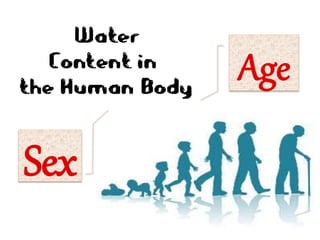
Age
Sex
Sex
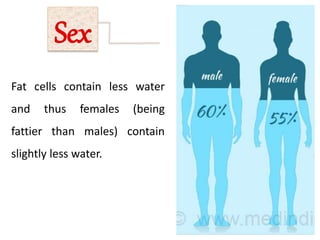
Fat cells contain less water
and thus females (being
fattier than males) contain
slightly less water.
Age
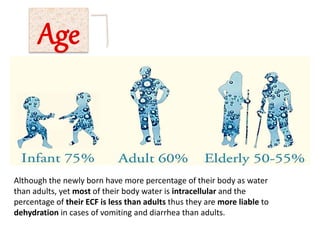
Although the newly born have more percentage of their body as water
than adults, yet most of their body water is intracellular and the
percentage of their ECF is less than adults thus they are more liable to
dehydration in cases of vomiting and diarrhea than adults.
Composition
& distribution
of body fluids
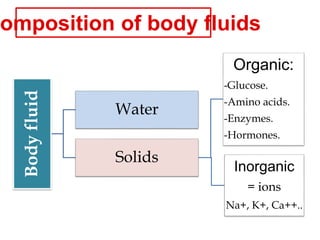
Body
fluid
Water
Solids
Organic:
-Glucose.
-Amino acids.
-Enzymes.
-Hormones.
Inorganic
= ions
Na+, K+, Ca++..
Composition of body fluids
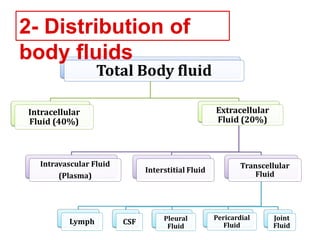
Total Body fluid
Intracellular
Fluid (40%)
Extracellular
Fluid (20%)
Intravascular Fluid
(Plasma)
Interstitial Fluid
Transcellular
Fluid
Lymph CSF Pleural
Fluid
Pericardial
Fluid
Joint
Fluid
2- Distribution of
body fluids
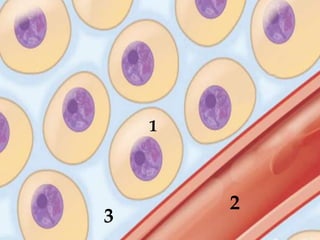
1
2
3
What is the importance
of body fluid ?
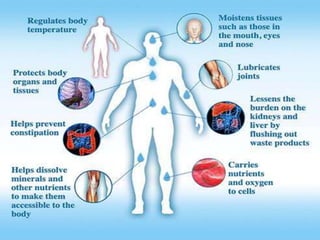
Water is the origin of life, and there is no form
of life can be maintained without water.
Moreover, all the chemical & biological
reactions in the body must be performed in an
aqueous media.
Some other vital functions of water are:
1. It favors ionization of dissolved salts.
2. It regulates body temperature via both heat
loss and heat gain balance.
3. It gives the blood its fluidity to reach all cells
and to maintain BP.
Body water balance
 It is the balance between water intake and water loss.
 In comfortable zone of body temperature (22oC ) it was estimated that water
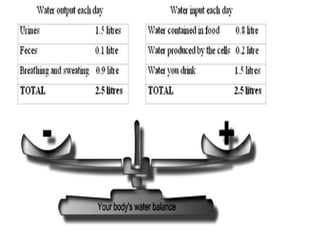
intake by normal adult 70kg male= 2500 ml/day which distributed as follow: 1500
ml is taken as pure water and beverages (tea for example), 800 ml from food as
fruits and vegetables and 200ml from metabolic processes.
 The water loss normally = 2500ml/day which distributed as follow:
1500 ml excreted as urine, 900ml evaporated from the skin and lungs and 100 ml
excreted in feces.
 The amount of water lost by sweating is highly variable, depending on physical
activity and environmental temperature.
• The volume of sweat normally is about 100 ml/day.
Obligatory water loss = 1 L/day. So, minimal intake of 1 L/day is essential for life as
there is No reserve of water in the body.
The stimuli of thirst sensations are:
1. Increased plasma osmolarity either due to pure water
loss or excessive intake of salts.
2. Loss of large amount of ECF fluid (following vomiting or
diarrhea).
3. Hemorrhage and shock.
4. Dryness of mouth (from inhibition of salivary secretion).
5. Increased angiotensin II secretion.
Thirst center located in the hypothalamus.
Regulation of Water Intake (Thirst Sensation)
 A serious problem that faces us that there is no reserve of
water in our bodies despite the large amount present.
 A reduction of 5% of water content makes the person very
thirsty, a loss of 10% makes him very ill while a reduction of
20% will kill him.
 without water intake there is obligatory water loss = 1 liter/day
(in urine, insensible perspiration and in expired air) thus death
occurs even in cool climate if water is not totally taken after 4-
6 days.
 A minimal intake of liter/day is essential for life.
 Antidiuretic hormone “ADH” controls water loss by the
kidney.
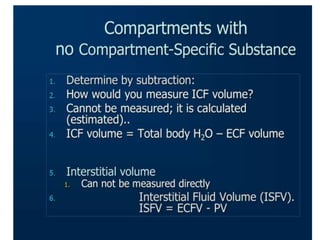
How can we measure body
fluid volume??
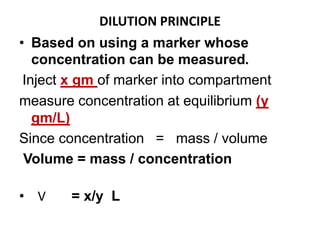
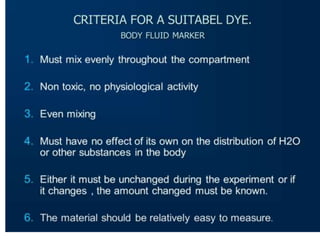
DILUTION PRINCIPLE
• Based on using a marker whose
concentration can be measured.
Inject x gm of marker into compartment
measure concentration at equilibrium (y
gm/L)
Since concentration = mass / volume
Volume = mass / concentration
• V = x/y L
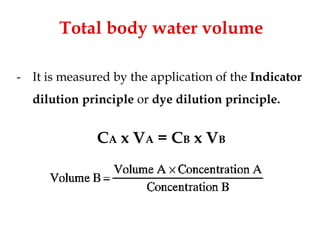
Total body water volume
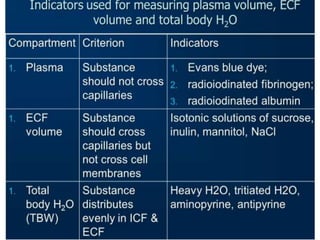
- It is measured by the application of the Indicator
dilution principle or dye dilution principle.
CA x VA = CB x VB
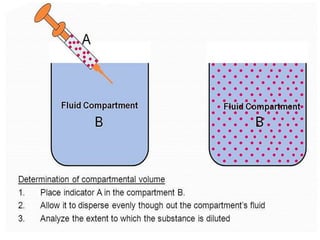
Activity time!
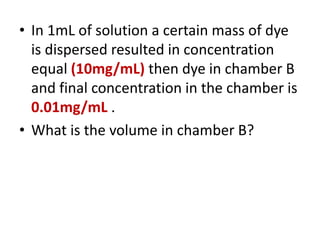
• In 1mL of solution a certain mass of dye
is dispersed resulted in concentration
equal (10mg/mL) then dye in chamber B
and final concentration in the chamber is
0.01mg/mL .
• What is the volume in chamber B?
Body fluids & fluids compartments.pptx

Body fluids & fluids compartments.pptx

  • 1.
    Body fluids and itscompartments BY Dr. Nour A. Mohammed MUTAH SCHOOL OF MEDICINE
  • 2.
    Water 60 % Body weight 70 Kg -Wateris the most abundant constituent in our bodies. - It forms 60% of total body weight of normal adult male weighing 70 Kg.
  • 3.
  • 4.
    Sex Fat cells containless water and thus females (being fattier than males) contain slightly less water.
  • 5.
    Age Although the newlyborn have more percentage of their body as water than adults, yet most of their body water is intracellular and the percentage of their ECF is less than adults thus they are more liable to dehydration in cases of vomiting and diarrhea than adults.
  • 6.
  • 7.
  • 8.
    Total Body fluid Intracellular Fluid(40%) Extracellular Fluid (20%) Intravascular Fluid (Plasma) Interstitial Fluid Transcellular Fluid Lymph CSF Pleural Fluid Pericardial Fluid Joint Fluid 2- Distribution of body fluids
  • 10.
  • 11.
    What is theimportance of body fluid ?
  • 12.
    Water is theorigin of life, and there is no form of life can be maintained without water. Moreover, all the chemical & biological reactions in the body must be performed in an aqueous media. Some other vital functions of water are: 1. It favors ionization of dissolved salts. 2. It regulates body temperature via both heat loss and heat gain balance. 3. It gives the blood its fluidity to reach all cells and to maintain BP.
  • 14.
    Body water balance It is the balance between water intake and water loss.  In comfortable zone of body temperature (22oC ) it was estimated that water intake by normal adult 70kg male= 2500 ml/day which distributed as follow: 1500 ml is taken as pure water and beverages (tea for example), 800 ml from food as fruits and vegetables and 200ml from metabolic processes.  The water loss normally = 2500ml/day which distributed as follow: 1500 ml excreted as urine, 900ml evaporated from the skin and lungs and 100 ml excreted in feces.  The amount of water lost by sweating is highly variable, depending on physical activity and environmental temperature. • The volume of sweat normally is about 100 ml/day. Obligatory water loss = 1 L/day. So, minimal intake of 1 L/day is essential for life as there is No reserve of water in the body.
  • 15.
    The stimuli ofthirst sensations are: 1. Increased plasma osmolarity either due to pure water loss or excessive intake of salts. 2. Loss of large amount of ECF fluid (following vomiting or diarrhea). 3. Hemorrhage and shock. 4. Dryness of mouth (from inhibition of salivary secretion). 5. Increased angiotensin II secretion. Thirst center located in the hypothalamus. Regulation of Water Intake (Thirst Sensation)
  • 17.
     A seriousproblem that faces us that there is no reserve of water in our bodies despite the large amount present.  A reduction of 5% of water content makes the person very thirsty, a loss of 10% makes him very ill while a reduction of 20% will kill him.  without water intake there is obligatory water loss = 1 liter/day (in urine, insensible perspiration and in expired air) thus death occurs even in cool climate if water is not totally taken after 4- 6 days.  A minimal intake of liter/day is essential for life.  Antidiuretic hormone “ADH” controls water loss by the kidney.
  • 18.
    How can wemeasure body fluid volume??
  • 19.
    DILUTION PRINCIPLE • Basedon using a marker whose concentration can be measured. Inject x gm of marker into compartment measure concentration at equilibrium (y gm/L) Since concentration = mass / volume Volume = mass / concentration • V = x/y L
  • 20.
    Total body watervolume - It is measured by the application of the Indicator dilution principle or dye dilution principle. CA x VA = CB x VB
  • 25.
  • 26.
    • In 1mLof solution a certain mass of dye is dispersed resulted in concentration equal (10mg/mL) then dye in chamber B and final concentration in the chamber is 0.01mg/mL . • What is the volume in chamber B?

Editor's Notes

  • #4 Water body content differs according age & sex
  • #5  Male= 60%, Female = 55%
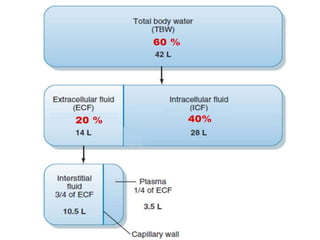
  • #10 total body water volume is 42L: there are 14L of extracellular fluid and 28L of intracellular fluid. Extracellular fluid comprises the blood plasma (3.5L), interstitial fluid (including bone and connective tissues, 10.5L) one liter represented as other fluids e.g. lymph, C.S.F, pericardial, pleural, and joints fluid.
  • #11 Intracellular = (1) Extracellular = Plasma (2) + Interstitial fluid (3)
  • #21 Heavy water= deuterium used to caculate toody water volume