Introduction to Bluetooth® low energy
A brief insight into the ultra low power technology at the core of the nRF51 series
October 2012Vinayak Kariappa Chettimada
2Introduction to Bluetooth low energy
Bluetooth: essentials
 Standard for Personal Area Network based on Ericsson research
 Short range, low-power
 Frequency hopping spread spectrum (FHSS)
 2.4 GHz ISM band
 Bluetooth Special Interest Group formed in 1998
 16000+ SIG member companies
 Billions of products shipped
 Nordic Semiconductor is one 9 SIG Board members
4Introduction to Bluetooth low energy
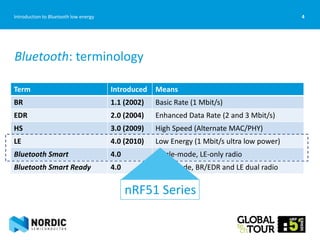
Bluetooth: terminology
Term Introduced Means
BR 1.1 (2002) Basic Rate (1 Mbit/s)
EDR 2.0 (2004) Enhanced Data Rate (2 and 3 Mbit/s)
HS 3.0 (2009) High Speed (Alternate MAC/PHY)
LE 4.0 (2010) Low Energy (1 Mbit/s ultra low power)
Bluetooth Smart 4.0 Single-mode, LE-only radio
Bluetooth Smart Ready 4.0 Dual-mode, BR/EDR and LE dual radio
nRF51 Series
5Introduction to Bluetooth low energy
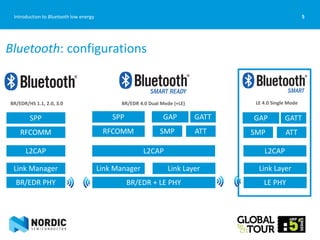
Bluetooth: configurations
BR/EDR/HS 1.1, 2.0, 3.0
Link Manager
BR/EDR PHY
L2CAP
SPP
RFCOMM
BR/EDR 4.0 Dual Mode (+LE)
L2CAP
GATT
ATTSMP
GAPSPP
RFCOMM
Link LayerLink Manager
BR/EDR + LE PHY
LE 4.0 Single Mode
GA
P
GATT
ATTSMP
L2CAP
GAP
Link Layer
LE PHY
6Introduction to Bluetooth low energy
Bluetooth LE: key features
 Following goals and rules of ULP wireless pioneered by Nordic
 PHY compatible with all 4.0 Bluetooth devices
 Ultra Low Power
 Small packets
 Short RX and TX windows
 Race to idle
 Turn radio on as seldom as possible
 Turn radio off as soon as possible
 Coin-cell battery 1+ year
 Low memory footprint
 Fast connection in 6 ms and teardown
 Simple stateless operation, data in form of parameter-value
7Introduction to Bluetooth low energy
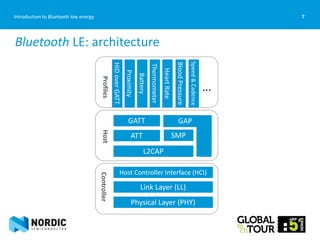
Bluetooth LE: architecture
Host
GAPGATT
ATT SMP
L2CAP
Controller
Host Controller Interface (HCI)
Link Layer (LL)
Physical Layer (PHY)
…
Profiles
HIDoverGATT
Proximity
Battery
Thermometer
HeartRate
BloodPressure
Speed&Cadence
8Introduction to Bluetooth low energy
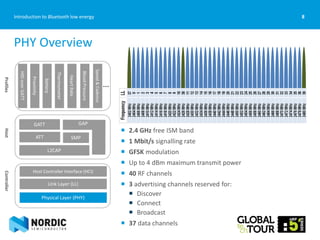
 2.4 GHz free ISM band
 1 Mbit/s signalling rate
 GFSK modulation
 Up to 4 dBm maximum transmit power
 40 RF channels
 3 advertising channels reserved for:
 Discover
 Connect
 Broadcast
 37 data channels
PHY Overview
…
ControllerHostProfiles
GAPGATT
ATT SMP
L2CAP
Host Controller Interface (HCI)
Link Layer (LL)
Physical Layer (PHY)
HIDoverGATT
Proximity
Battery
Thermometer
HeartRate
BloodPressure
Speed&Cadence
9Introduction to Bluetooth low energy
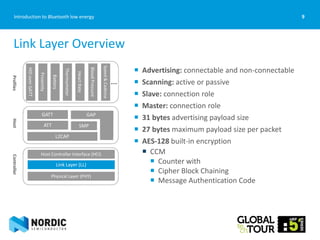
 Advertising: connectable and non-connectable
 Scanning: active or passive
 Slave: connection role
 Master: connection role
 31 bytes advertising payload size
 27 bytes maximum payload size per packet
 AES-128 built-in encryption
 CCM
 Counter with
 Cipher Block Chaining
 Message Authentication Code
Link Layer Overview
…
ControllerHostProfiles
GAPGATT
ATT SMP
L2CAP
Host Controller Interface (HCI)
Link Layer (LL)
Physical Layer (PHY)
HIDoverGATT
Proximity
Battery
Thermometer
HeartRate
BloodPressure
Speed&Cadence
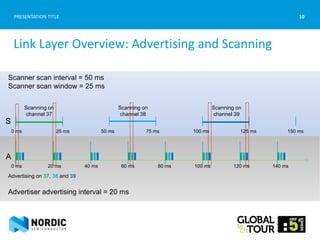
Scanning on
channel 37
0 ms
S
25 ms 50 ms 100 ms75 ms 125 ms 150 ms
Scanning on
channel 38
Scanning on
channel 39
Advertising on 37, 38 and 39
0 ms 20 ms 40 ms 60 ms 80 ms 100 ms 120 ms 140 ms
A
10PRESENTATION TITLE
Scanner scan interval = 50 ms
Scanner scan window = 25 ms
Link Layer Overview: Advertising and Scanning
Advertiser advertising interval = 20 ms
11PRESENTATION TITLE
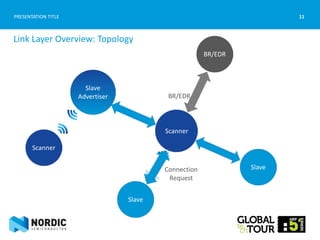
Link Layer Overview: Topology
Master
Advertiser
SlaveConnection
Request
Scanner
BR/EDR
BR/EDR
Slave
Scanner
Slave
Slave
Advertiser
12PRESENTATION TITLE
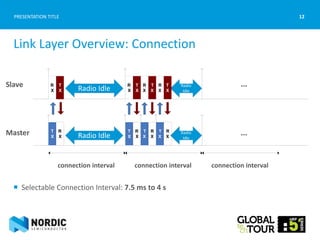
 Selectable Connection Interval: 7.5 ms to 4 s
Radio
Idle
Radio Idle
Radio Idle
Radio
Idle
Link Layer Overview: Connection
T
X
T
X
Slave
connection interval
T
X
T
X
Master
R
X
R
X
R
X
R
X
connection interval connection interval
T
X
T
X
R
X
R
X
T
X
T
X
R
X
R
X
...
...
15Introduction to Bluetooth low energy
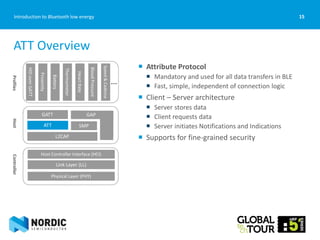
 Attribute Protocol
 Mandatory and used for all data transfers in BLE
 Fast, simple, independent of connection logic
 Client – Server architecture
 Server stores data
 Client requests data
 Server initiates Notifications and Indications
 Supports for fine-grained security
ATT Overview
…
ControllerHostProfiles
GAPGATT
ATT SMP
L2CAP
Host Controller Interface (HCI)
Link Layer (LL)
Physical Layer (PHY)
HIDoverGATT
Proximity
Battery
Thermometer
HeartRate
BloodPressure
Speed&Cadence
16Introduction to Bluetooth low energy
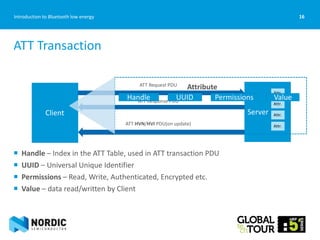
ATT Transaction
Client
ATT Request PDU
ATT Response PDU
ATT HVN/HVI PDU(on update)
Server
Attr.
Attr.
Attr.
Attr.
Handle UUID Permissions Value
Attribute
 Handle – Index in the ATT Table, used in ATT transaction PDU
 UUID – Universal Unique Identifier
 Permissions – Read, Write, Authenticated, Encrypted etc.
 Value – data read/written by Client
18Introduction to Bluetooth low energy
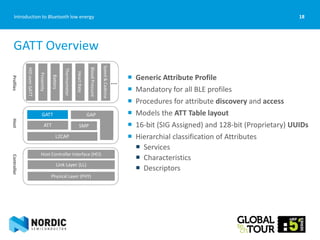
 Generic Attribute Profile
 Mandatory for all BLE profiles
 Procedures for attribute discovery and access
 Models the ATT Table layout
 16-bit (SIG Assigned) and 128-bit (Proprietary) UUIDs
 Hierarchial classification of Attributes
 Services
 Characteristics
 Descriptors
GATT Overview
…
ControllerHostProfiles
GAPGATT
ATT SMP
L2CAP
Host Controller Interface (HCI)
Link Layer (LL)
Physical Layer (PHY)
HIDoverGATT
Proximity
Battery
Thermometer
HeartRate
BloodPressure
Speed&Cadence
19Introduction to Bluetooth low energy
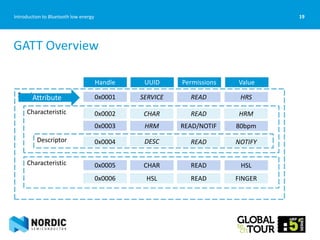
GATT Overview
Handle UUID Value
0x0005 CHAR HSL
0x0006 HSL FINGER
0x0002 CHAR HRM
0x0003 HRM 80bpm
0x0001 SERVICE HRSService
Permissions
READ
READ
READ
READ/NOTIF
READ
0x0004 DESC NOTIFYREAD
Characteristic
Characteristic
Descriptor
Attribute
21Introduction to Bluetooth low energy
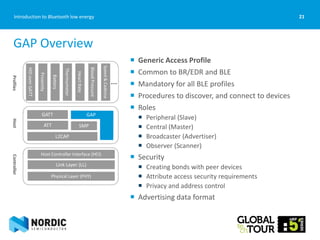
 Generic Access Profile
 Common to BR/EDR and BLE
 Mandatory for all BLE profiles
 Procedures to discover, and connect to devices
 Roles
 Peripheral (Slave)
 Central (Master)
 Broadcaster (Advertiser)
 Observer (Scanner)
 Security
 Creating bonds with peer devices
 Attribute access security requirements
 Privacy and address control
 Advertising data format
GAP Overview
…
ControllerHostProfiles
GAPGATT
ATT SMP
L2CAP
Host Controller Interface (HCI)
Link Layer (LL)
Physical Layer (PHY)
HIDoverGATT
Proximity
Battery
Thermometer
HeartRate
BloodPressure
Speed&Cadence
22Introduction to Bluetooth low energy
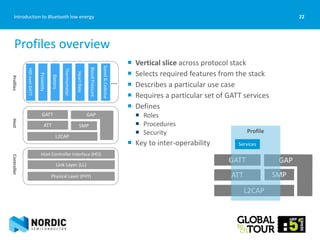
 Vertical slice across protocol stack
 Selects required features from the stack
 Describes a particular use case
 Requires a particular set of GATT services
 Defines
 Roles
 Procedures
 Security
 Key to inter-operability
Profiles overview
GAPGATT
ATT SMP
L2CAP
Profile
Services
…
ControllerHostProfiles
GAPGATT
ATT SMP
L2CAP
Host Controller Interface (HCI)
Link Layer (LL)
Physical Layer (PHY)
HIDoverGATT
Proximity
Battery
Thermometer
HeartRate
BloodPressure
Speed&Cadence
23Introduction to Bluetooth low energy
Profiles overview: Examples and roles
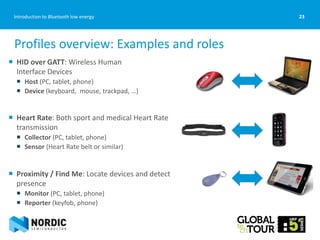
 HID over GATT: Wireless Human
Interface Devices
 Host (PC, tablet, phone)
 Device (keyboard, mouse, trackpad, …)
 Heart Rate: Both sport and medical Heart Rate
transmission
 Collector (PC, tablet, phone)
 Sensor (Heart Rate belt or similar)
 Proximity / Find Me: Locate devices and detect
presence
 Monitor (PC, tablet, phone)
 Reporter (keyfob, phone)
24Introduction to Bluetooth low energy
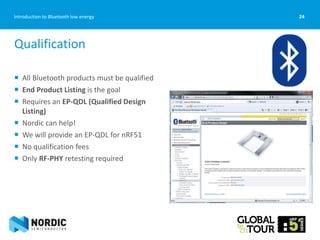
 All Bluetooth products must be qualified
 End Product Listing is the goal
 Requires an EP-QDL (Qualified Design
Listing)
 Nordic can help!
 We will provide an EP-QDL for nRF51
 No qualification fees
 Only RF-PHY retesting required
Qualification
25Introduction to Bluetooth low energy
Qualification
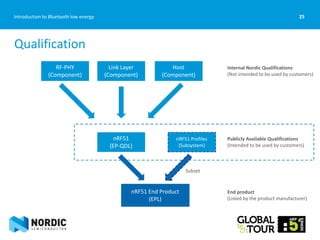
RF-PHY
(Component)
Link Layer
(Component)
Host
(Component)
nRF51
(EP-QDL)
nRF51 Profiles
(Subsystem)
Internal Nordic Qualifications
(Not intended to be used by customers)
Publicly Available Qualifications
(Intended to be used by customers)
nRF51 End Product
(EPL)
End product
(Listed by the product manufacturer)
Subset
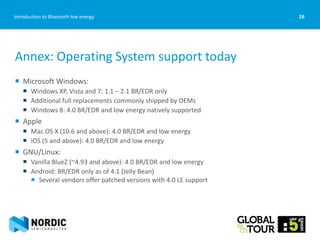
26Introduction to Bluetooth low energy
Annex: Operating System support today
 Microsoft Windows:
 Windows XP, Vista and 7: 1.1 – 2.1 BR/EDR only
 Additional full replacements commonly shipped by OEMs
 Windows 8: 4.0 BR/EDR and low energy natively supported
 Apple
 Mac OS X (10.6 and above): 4.0 BR/EDR and low energy
 iOS (5 and above): 4.0 BR/EDR and low energy
 GNU/Linux:
 Vanilla BlueZ (~4.93 and above): 4.0 BR/EDR and low energy
 Android: BR/EDR only as of 4.1 (Jelly Bean)
 Several vendors offer patched versions with 4.0 LE support
Thank you for your attention
Questions
October 2012Vinayak Kariappa Chettimada

05 ble intro

  • 1.
    Introduction to Bluetooth®low energy A brief insight into the ultra low power technology at the core of the nRF51 series October 2012Vinayak Kariappa Chettimada
  • 2.
    2Introduction to Bluetoothlow energy Bluetooth: essentials  Standard for Personal Area Network based on Ericsson research  Short range, low-power  Frequency hopping spread spectrum (FHSS)  2.4 GHz ISM band  Bluetooth Special Interest Group formed in 1998  16000+ SIG member companies  Billions of products shipped  Nordic Semiconductor is one 9 SIG Board members
  • 3.
    4Introduction to Bluetoothlow energy Bluetooth: terminology Term Introduced Means BR 1.1 (2002) Basic Rate (1 Mbit/s) EDR 2.0 (2004) Enhanced Data Rate (2 and 3 Mbit/s) HS 3.0 (2009) High Speed (Alternate MAC/PHY) LE 4.0 (2010) Low Energy (1 Mbit/s ultra low power) Bluetooth Smart 4.0 Single-mode, LE-only radio Bluetooth Smart Ready 4.0 Dual-mode, BR/EDR and LE dual radio nRF51 Series
  • 4.
    5Introduction to Bluetoothlow energy Bluetooth: configurations BR/EDR/HS 1.1, 2.0, 3.0 Link Manager BR/EDR PHY L2CAP SPP RFCOMM BR/EDR 4.0 Dual Mode (+LE) L2CAP GATT ATTSMP GAPSPP RFCOMM Link LayerLink Manager BR/EDR + LE PHY LE 4.0 Single Mode GA P GATT ATTSMP L2CAP GAP Link Layer LE PHY
  • 5.
    6Introduction to Bluetoothlow energy Bluetooth LE: key features  Following goals and rules of ULP wireless pioneered by Nordic  PHY compatible with all 4.0 Bluetooth devices  Ultra Low Power  Small packets  Short RX and TX windows  Race to idle  Turn radio on as seldom as possible  Turn radio off as soon as possible  Coin-cell battery 1+ year  Low memory footprint  Fast connection in 6 ms and teardown  Simple stateless operation, data in form of parameter-value
  • 6.
    7Introduction to Bluetoothlow energy Bluetooth LE: architecture Host GAPGATT ATT SMP L2CAP Controller Host Controller Interface (HCI) Link Layer (LL) Physical Layer (PHY) … Profiles HIDoverGATT Proximity Battery Thermometer HeartRate BloodPressure Speed&Cadence
  • 7.
    8Introduction to Bluetoothlow energy  2.4 GHz free ISM band  1 Mbit/s signalling rate  GFSK modulation  Up to 4 dBm maximum transmit power  40 RF channels  3 advertising channels reserved for:  Discover  Connect  Broadcast  37 data channels PHY Overview … ControllerHostProfiles GAPGATT ATT SMP L2CAP Host Controller Interface (HCI) Link Layer (LL) Physical Layer (PHY) HIDoverGATT Proximity Battery Thermometer HeartRate BloodPressure Speed&Cadence
  • 8.
    9Introduction to Bluetoothlow energy  Advertising: connectable and non-connectable  Scanning: active or passive  Slave: connection role  Master: connection role  31 bytes advertising payload size  27 bytes maximum payload size per packet  AES-128 built-in encryption  CCM  Counter with  Cipher Block Chaining  Message Authentication Code Link Layer Overview … ControllerHostProfiles GAPGATT ATT SMP L2CAP Host Controller Interface (HCI) Link Layer (LL) Physical Layer (PHY) HIDoverGATT Proximity Battery Thermometer HeartRate BloodPressure Speed&Cadence
  • 9.
    Scanning on channel 37 0ms S 25 ms 50 ms 100 ms75 ms 125 ms 150 ms Scanning on channel 38 Scanning on channel 39 Advertising on 37, 38 and 39 0 ms 20 ms 40 ms 60 ms 80 ms 100 ms 120 ms 140 ms A 10PRESENTATION TITLE Scanner scan interval = 50 ms Scanner scan window = 25 ms Link Layer Overview: Advertising and Scanning Advertiser advertising interval = 20 ms
  • 10.
    11PRESENTATION TITLE Link LayerOverview: Topology Master Advertiser SlaveConnection Request Scanner BR/EDR BR/EDR Slave Scanner Slave Slave Advertiser
  • 11.
    12PRESENTATION TITLE  SelectableConnection Interval: 7.5 ms to 4 s Radio Idle Radio Idle Radio Idle Radio Idle Link Layer Overview: Connection T X T X Slave connection interval T X T X Master R X R X R X R X connection interval connection interval T X T X R X R X T X T X R X R X ... ...
  • 12.
    15Introduction to Bluetoothlow energy  Attribute Protocol  Mandatory and used for all data transfers in BLE  Fast, simple, independent of connection logic  Client – Server architecture  Server stores data  Client requests data  Server initiates Notifications and Indications  Supports for fine-grained security ATT Overview … ControllerHostProfiles GAPGATT ATT SMP L2CAP Host Controller Interface (HCI) Link Layer (LL) Physical Layer (PHY) HIDoverGATT Proximity Battery Thermometer HeartRate BloodPressure Speed&Cadence
  • 13.
    16Introduction to Bluetoothlow energy ATT Transaction Client ATT Request PDU ATT Response PDU ATT HVN/HVI PDU(on update) Server Attr. Attr. Attr. Attr. Handle UUID Permissions Value Attribute  Handle – Index in the ATT Table, used in ATT transaction PDU  UUID – Universal Unique Identifier  Permissions – Read, Write, Authenticated, Encrypted etc.  Value – data read/written by Client
  • 14.
    18Introduction to Bluetoothlow energy  Generic Attribute Profile  Mandatory for all BLE profiles  Procedures for attribute discovery and access  Models the ATT Table layout  16-bit (SIG Assigned) and 128-bit (Proprietary) UUIDs  Hierarchial classification of Attributes  Services  Characteristics  Descriptors GATT Overview … ControllerHostProfiles GAPGATT ATT SMP L2CAP Host Controller Interface (HCI) Link Layer (LL) Physical Layer (PHY) HIDoverGATT Proximity Battery Thermometer HeartRate BloodPressure Speed&Cadence
  • 15.
    19Introduction to Bluetoothlow energy GATT Overview Handle UUID Value 0x0005 CHAR HSL 0x0006 HSL FINGER 0x0002 CHAR HRM 0x0003 HRM 80bpm 0x0001 SERVICE HRSService Permissions READ READ READ READ/NOTIF READ 0x0004 DESC NOTIFYREAD Characteristic Characteristic Descriptor Attribute
  • 16.
    21Introduction to Bluetoothlow energy  Generic Access Profile  Common to BR/EDR and BLE  Mandatory for all BLE profiles  Procedures to discover, and connect to devices  Roles  Peripheral (Slave)  Central (Master)  Broadcaster (Advertiser)  Observer (Scanner)  Security  Creating bonds with peer devices  Attribute access security requirements  Privacy and address control  Advertising data format GAP Overview … ControllerHostProfiles GAPGATT ATT SMP L2CAP Host Controller Interface (HCI) Link Layer (LL) Physical Layer (PHY) HIDoverGATT Proximity Battery Thermometer HeartRate BloodPressure Speed&Cadence
  • 17.
    22Introduction to Bluetoothlow energy  Vertical slice across protocol stack  Selects required features from the stack  Describes a particular use case  Requires a particular set of GATT services  Defines  Roles  Procedures  Security  Key to inter-operability Profiles overview GAPGATT ATT SMP L2CAP Profile Services … ControllerHostProfiles GAPGATT ATT SMP L2CAP Host Controller Interface (HCI) Link Layer (LL) Physical Layer (PHY) HIDoverGATT Proximity Battery Thermometer HeartRate BloodPressure Speed&Cadence
  • 18.
    23Introduction to Bluetoothlow energy Profiles overview: Examples and roles  HID over GATT: Wireless Human Interface Devices  Host (PC, tablet, phone)  Device (keyboard, mouse, trackpad, …)  Heart Rate: Both sport and medical Heart Rate transmission  Collector (PC, tablet, phone)  Sensor (Heart Rate belt or similar)  Proximity / Find Me: Locate devices and detect presence  Monitor (PC, tablet, phone)  Reporter (keyfob, phone)
  • 19.
    24Introduction to Bluetoothlow energy  All Bluetooth products must be qualified  End Product Listing is the goal  Requires an EP-QDL (Qualified Design Listing)  Nordic can help!  We will provide an EP-QDL for nRF51  No qualification fees  Only RF-PHY retesting required Qualification
  • 20.
    25Introduction to Bluetoothlow energy Qualification RF-PHY (Component) Link Layer (Component) Host (Component) nRF51 (EP-QDL) nRF51 Profiles (Subsystem) Internal Nordic Qualifications (Not intended to be used by customers) Publicly Available Qualifications (Intended to be used by customers) nRF51 End Product (EPL) End product (Listed by the product manufacturer) Subset
  • 21.
    26Introduction to Bluetoothlow energy Annex: Operating System support today  Microsoft Windows:  Windows XP, Vista and 7: 1.1 – 2.1 BR/EDR only  Additional full replacements commonly shipped by OEMs  Windows 8: 4.0 BR/EDR and low energy natively supported  Apple  Mac OS X (10.6 and above): 4.0 BR/EDR and low energy  iOS (5 and above): 4.0 BR/EDR and low energy  GNU/Linux:  Vanilla BlueZ (~4.93 and above): 4.0 BR/EDR and low energy  Android: BR/EDR only as of 4.1 (Jelly Bean)  Several vendors offer patched versions with 4.0 LE support
  • 22.
    Thank you foryour attention Questions October 2012Vinayak Kariappa Chettimada