Blood Transfusion-
Ensuring Quality Runs in
the Veins of Our Clients
Paddington T Mundagowa, MPH, BScN, Cert. M&E
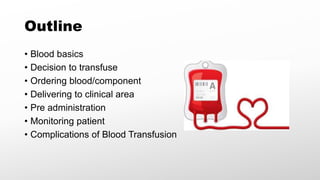
Outline
• Blood basics
• Decision to transfuse
• Ordering blood/component
• Delivering to clinical area
• Pre administration
• Monitoring patient
• Complications of Blood Transfusion
Note!
This presentation aims at:
Ensuring proper:
• Collection
• Administration
• Monitoring of blood for transfusion
Promoting safe & effective blood transfusion practice
Highlighting key aspects of safe transfusion practices
• for qualified transfusionists
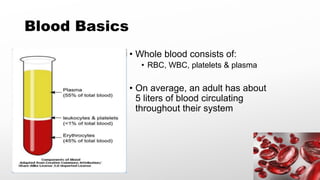
Blood Basics
• Whole blood consists of:
• RBC, WBC, platelets & plasma
• On average, an adult has about
5 liters of blood circulating
throughout their system
Blood Transfusion
• Def: is the transfusion of the whole blood or its component e.g.
blood cells or plasma from one person to another
Involves 2 procedures
Collection from donor
Administration to recipient
Blood/Component can be:
• Whole blood,
• Packed cell volume,
• Fresh frozen plasma,
• Platelets,
• Cryoprecipitate
Decision to Transfuse
• Patient’s record/ notes must contain order to transfuse
• Prescribed by the Doctor
• Prescription must specify
• blood component
• No. of units
• Any special requirements/instructions
• Explain & discuss reasons for transfusion with patient
• Obtain informed consent from client
• Where pre-transfusion is not possible
• Clinician can consent based on condition, risks &benefits
Ordering blood/component
• Clinician correctly identifies patient
• Take blood sample for grouping & crossmatch
• Label blood tube correctly
• Complete a Lab request form
• Record in the Lab samples register
• Ensure a patent IV catheter
• Send sample to lab & communicate
Delivering to clinical area
• Executed by qualified practitioner
• Take patient’s notes & clean receiver to the Lab
• Check & match patient identifiers
• on pack & notes/prescription
• Check for leaks, unusual discoloration, cloudiness/clots
• Record in the Transfusion register in Lab
• Deliver in a clean receiver
• Maintain storage conditions until transfusion (+2 to +60C)
Pre-Administration
• Practitioner who collected the blood & another qualified
practitioner correctly identifies the patient
• At bedside
• Check instruction & inform the patient
• Check & record
• Patient identifiers
• Blood groups
• Donation & expiry date on pack
• Pack No.
• Take & record baseline vital obs.
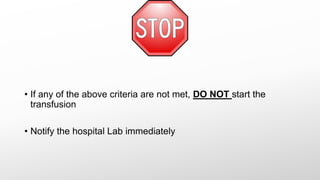
STOP!
• If any of the above criteria are not met, DO NOT start the
transfusion
• Notify the hospital Lab immediately
• Both practitioners sign on chart
• May prime using 0.9% Sodium Chloride ONLY
• DO NOT use if container is not intact or if the appearance is not
normal
• return to Lab
• Note & record time put up
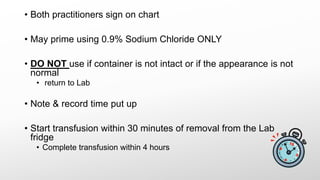
• Start transfusion within 30 minutes of removal from the Lab
fridge
• Complete transfusion within 4 hours
Monitoring Patient
• Monitor Vital signs
• Quarter hourly (1st hour)
• Half hourly thereafter
• Monitor infusion rate
• Critically observe patient for adverse reactions
• Diagnose & swiftly respond to adverse reactions
• Record, report adverse reactions to the doctor
• assess need for further transfusion
Post Transfusion
• Record time of completion of transfusion
• Continue monitoring 6 hours post transfusion
• Keep used pack 24 hour post transfusion
• Report & document adverse reactions/incident
• Discard empty pack & giving set in a Biohazard container
Complications of Blood
Transfusion
• Circulatory overload
• Hyperkalemia
• Hypocalcemia
• Haemosiderosis
• Hematoma
• Thrombophlebitis
• Pulmonary embolism
?
Thank You

Blood transfusion

  • 1.
    Blood Transfusion- Ensuring QualityRuns in the Veins of Our Clients Paddington T Mundagowa, MPH, BScN, Cert. M&E
  • 2.
    Outline • Blood basics •Decision to transfuse • Ordering blood/component • Delivering to clinical area • Pre administration • Monitoring patient • Complications of Blood Transfusion
  • 3.
    Note! This presentation aimsat: Ensuring proper: • Collection • Administration • Monitoring of blood for transfusion Promoting safe & effective blood transfusion practice Highlighting key aspects of safe transfusion practices • for qualified transfusionists
  • 4.
    Blood Basics • Wholeblood consists of: • RBC, WBC, platelets & plasma • On average, an adult has about 5 liters of blood circulating throughout their system
  • 5.
    Blood Transfusion • Def:is the transfusion of the whole blood or its component e.g. blood cells or plasma from one person to another Involves 2 procedures Collection from donor Administration to recipient Blood/Component can be: • Whole blood, • Packed cell volume, • Fresh frozen plasma, • Platelets, • Cryoprecipitate
  • 6.
    Decision to Transfuse •Patient’s record/ notes must contain order to transfuse • Prescribed by the Doctor • Prescription must specify • blood component • No. of units • Any special requirements/instructions • Explain & discuss reasons for transfusion with patient • Obtain informed consent from client • Where pre-transfusion is not possible • Clinician can consent based on condition, risks &benefits
  • 7.
    Ordering blood/component • Cliniciancorrectly identifies patient • Take blood sample for grouping & crossmatch • Label blood tube correctly • Complete a Lab request form • Record in the Lab samples register • Ensure a patent IV catheter • Send sample to lab & communicate
  • 8.
    Delivering to clinicalarea • Executed by qualified practitioner • Take patient’s notes & clean receiver to the Lab • Check & match patient identifiers • on pack & notes/prescription • Check for leaks, unusual discoloration, cloudiness/clots • Record in the Transfusion register in Lab • Deliver in a clean receiver • Maintain storage conditions until transfusion (+2 to +60C)
  • 9.
    Pre-Administration • Practitioner whocollected the blood & another qualified practitioner correctly identifies the patient • At bedside • Check instruction & inform the patient • Check & record • Patient identifiers • Blood groups • Donation & expiry date on pack • Pack No. • Take & record baseline vital obs.
  • 10.
    STOP! • If anyof the above criteria are not met, DO NOT start the transfusion • Notify the hospital Lab immediately
  • 11.
    • Both practitionerssign on chart • May prime using 0.9% Sodium Chloride ONLY • DO NOT use if container is not intact or if the appearance is not normal • return to Lab • Note & record time put up • Start transfusion within 30 minutes of removal from the Lab fridge • Complete transfusion within 4 hours
  • 12.
    Monitoring Patient • MonitorVital signs • Quarter hourly (1st hour) • Half hourly thereafter • Monitor infusion rate • Critically observe patient for adverse reactions • Diagnose & swiftly respond to adverse reactions • Record, report adverse reactions to the doctor • assess need for further transfusion
  • 13.
    Post Transfusion • Recordtime of completion of transfusion • Continue monitoring 6 hours post transfusion • Keep used pack 24 hour post transfusion • Report & document adverse reactions/incident • Discard empty pack & giving set in a Biohazard container
  • 14.
    Complications of Blood Transfusion •Circulatory overload • Hyperkalemia • Hypocalcemia • Haemosiderosis • Hematoma • Thrombophlebitis • Pulmonary embolism
  • 16.
  • 17.

Editor's Notes

  • #4 At every stage of the transfusion process Qualified RN, Laboratory scientists, anaesthetist, midwife, doctor
  • #6 Purposes for Blood Transfusion Restore blood volume lost due to hemorrhage Raise Hemoglobin levels in severe anemia. To treat deficiencies of plasma protein, clotting factors, hemophilic globulin Provide antibodies To combat infection e.g. in leucopenia
  • #7 This includes discussion of valid alternatives to transfusion and the option to refuse. Clinician assess
  • #8 Lab samples register in ward/ department Communicate with the scientist on duty IV Catheter 20-22G for adults based on vein size & patient preference -f0r rapid admin 14-18G
  • #9 Identifiers: patient details which include forename, surname, age, sex, hospital number, ward/department name and medical diagnosis.
  • #10 Check, Check, Check! Record on a conventional Transfusion Chart Blood warmer - recommended for massive bleeds -not exceed 420C -Adhere to BW manufacturer guidelines
  • #12 •NB If at any time you are interrupted or distracted, you must recommence the patient identification checks from the beginning. Because changes in the composition may occur due to red cell metabolism. Immediately stop transfusion if serious signs and symptoms develop
  • #13 Infusion rates(slower rates may be necessary for elderly, cardiovascular compromise or at risk for fluid overload) Red cells are started at 2 mL/minute (120 mL/hr) for first 15 minutes Blood transfusion reaction is a systemic response by the body to blood incompatible with that of the recipient. E.g. ABO incompatibility, reaction to WBC, platelets or plasma protein; potassium or citrate presevative in the blood In case of reactions, investigations should follow up Stop transfusion immediately Notify Dr Connect 0.9% NS IV line Observe & monitor Vital Signs Organize for emergency drugs e.g. vasopressors, antihistamine, steroids & fluids Prepare for CPR Obtain a urine specimen & send to lab Document the reactions & measures carried out Return blood pack & giving set to lab Ensure patient identifiers and blood pack match and verify blood type
  • #15 Circulatory Overload- esp. after giving whole blood to pt who require RBCs, pt with heart failure Haemosiderosis: Iron Overload