Blood Groups & Transfusion
Dr. Maria idrees; PT
„INTRODUCTION
• When blood from two individuals is mixed,
sometimes clumping (agglutination) of RBCs
occurs. This clumping is because of the
immunological reactions.
• But, why clumping occurs in some cases and not
in other cases remained a mystery until the
discovery of blood groups by the Austrian
Scientist Karl Landsteiner, in 1901.
• He was honored with Nobel Prize in 1930 for this
discovery.
ABO BLOOD GROUPS
• Determination of ABO blood groups depends
upon the immunological reaction between
antigen and antibody. Landsteiner found two
antigens on the surface of RBCs and named
them as A antigen and B antigen. These
antigens are also called agglutinogens because
of their capacity to cause agglutination of
RBCs.
• He noticed the corresponding antibodies or
agglutinins in the plasma and named them
anti-A or α-antibody and anti-B or β-antibody.
However, a particular agglutinogen and the
corresponding agglutinin cannot be present
together. If present, it causes clumping of the
blood. Based on this, Karl Landsteiner
classified the blood groups. Later it became
the ‘Landsteiner Law’ for grouping the blood.
LANDSTEINER LAW
• Landsteiner law states that:
1. If a particular agglutinogen (antigen) is
present in the RBCs, corresponding agglutinin
(antibody) must be absent in the serum.
2. If a particular agglutinogen is absent in the
RBCs, the corresponding agglutinin must be
present in the serum.
BLOOD GROUP SYSTEMS
• More than 20 genetically determined blood
group systems are known today. But,
Landsteiner discovered two blood group
systems called the ABO system and the Rh
system. These two blood group systems are
the most important ones that are determined
before blood transfusions.
ABO SYSTEM
• Based on the presence or absence of antigen
A and antigen B, blood is divided into four
groups:
1. ‘A’ group
2. ‘B’ group
3. ‘AB’ group
4. ‘O’ group.
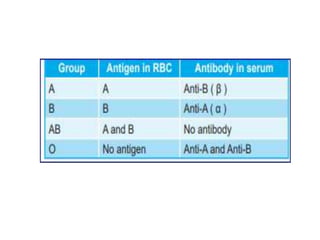
• Blood having antigen A belongs to ‘A’ group.
This blood has β-antibody in the serum. Blood
with antigen B and α-antibody belongs to ‘B’
group. If both the antigens are present, blood
group is called ‘AB’ group and serum of this
group does not contain any antibody. If both
antigens are absent, the blood group is called
‘O’ group and both α and β antibodies are
present in the serum. Antigens and antibodies
present in different groups of ABO system
IMPORTANCE OF ABO GROUPS IN
BLOOD TRANSFUSION
• During blood transfusion, only compatible
blood must be used. The one who gives blood
is called the ‘donor’ and the one who receives
the blood is called ‘recipient’. While
transfusing the blood, antigen of the donor
and the antibody of the recipient are
considered. The antibody of the donor and
antigen of the recipient are ignored mostly.
• Thus, RBC of ‘O’ group has no antigen and so
agglutination does not occur with any other
group of blood. So, ‘O’ group blood can be given
to any blood group persons and the people with
this blood group are called ‘universal donors’.
• Plasma of AB group blood has no antibody. This
does not cause agglutination of RBC from any
other group of blood. People with AB group can
receive blood from any blood group persons. So,
people with this blood group are called ‘universal
recipients’.
MATCHING AND CROSS-MATCHING
• Blood matching (typing) is a laboratory test
done to determine the blood group of a
person. When the person needs blood
transfusion, another test called cross-
matching is done after the blood is typed. It is
done to find out whether the person’s body
will accept the donor’s blood or not.
• For blood matching, RBC of the individual
(recipient) and test sera are used. Cross-
matching is done by mixing the serum of the
recipient and the RBCs of donor. Cross-
matching is always done before blood
transfusion. If agglutination of RBCs from a
donor occurs during cross-matching, the blood
from that person is not used for transfusion.
Matching = Recipient’s RBC + Test sera.
• Cross-matching = Recipient’s serum + Donor’s
RBC.
TRANSFUSION REACTIONS DUE TO
ABO INCOMPATIBILITY
• Transfusion reactions are the adverse
reactions in the body, which occur due to
transfusion error that involves transfusion of
incompatible (mismatched) blood. The
reactions may be mild causing only fever and
hives (skin disorder characterized by itching)
or may be severe leading to renal failure,
shock and death.
• In mismatched transfusion, the transfusion
reactions occur between donor’s RBC and
recipient’s plasma. So, if the donor’s plasma
contains agglutinins against recipient’s RBC,
agglutination does not occur because these
antibodies are diluted in the recipient’s blood.
But, if recipient’s plasma contains agglutinins
against donor’s RBCs, the immune system
launches a response against the new blood
cells. Donor RBCs are agglutinated resulting in
transfusion reactions.
Severity of Transfusion Reactions
• Severity of transfusion reactions varies from
mild (fever and chills) to severe (acute kidney
failure, shock and death). Severity depends
upon the amount of blood transfused, type of
reaction and general health of the patient.
Cause for Transfusion Reactions
• Transfusion of incompatible blood produces
hemolytic reactions. The recipient’s antibodies
(IgG or IgM) adhere to the donor RBCs, which
are agglutinated and destroyed. Large amount
of free hemoglobin is liberated into plasma.
This leads to transfusion reactions.
Signs and Symptoms of Transfusion
Reactions
Non-hemolytic transfusion reaction
• Non-hemolytic transfusion reaction develops
within a few minutes to hours after the
commencement of blood transfusion.
Common symptoms are fever, difficulty in
breathing and itching.
Hemolytic transfusion reaction
• Hemolytic transfusion reaction may be acute or
delayed. The acute hemolytic reaction occurs within
few minutes of transfusion. It develops because of
rapid hemolysis of donor’s RBCs. Symptoms include
fever, chills, increased heart rate, low blood pressure,
shortness of breath, bronchospasm, nausea, vomiting,
red urine, chest pain, back pain and rigor. Some
patients may develop pulmonary edema and
congestive cardiac failure. Delayed hemolytic reaction
occurs from 1 to 5 days after transfusion. The
hemolysis of RBCs results in release of large amount of
hemoglobin into the plasma. This leads to the following
complications.
1. Jaundice
• Normally, hemoglobin released from destroyed
RBC is degraded and bilirubin is formed from it.
When the serum bilirubin level increases above 2
mg/dL, jaundice occurs
2. Cardiac Shock
• Simultaneously, hemoglobin released into the
plasma increases the viscosity of blood. This
increases the workload on the heart leading to
heart failure. Moreover, toxic substances released
from hemolyzed cells reduce the arterial blood
pressure and develop circulatory shock.
3. Renal Shutdown
• Dysfunction of kidneys is called renal shutdown.
The toxic substances from hemolyzed cells cause
constriction of blood vessels in kidney. In
addition, the toxic substances along with free
hemoglobin are filtered through glomerular
membrane and enter renal tubules.
• Because of poor rate of reabsorption from renal
tubules, all these substances precipitate and
obstruct the renal tubule.
• This suddenly stops the formation of urine
(anuria). If not treated with artificial kidney, the
person dies within 10 to 12 days because of
jaundice, circulatory shock and more specifically
due to renal shutdown and anuria.
Rh FACTOR
• Rh factor is an antigen present in RBC. This
antigen was discovered by Landsteiner and
Wiener. It was first discovered in Rhesus
monkey and hence the name ‘Rh factor’.
There are many Rh antigens but only the D
antigen is more antigenic in human.
TRANSFUSION REACTIONS DUE TO Rh
INCOMPATIBILITY
• When a Rh negative person receives Rh
positive blood for the first time, he is not
affected much, since the reactions do not
occur immediately. But, the Rh antibodies
develop within one month. The transfused
RBCs, which are still present in the recipient’s
blood, are agglutinated. These agglutinated
cells are lysed by macrophages. So, a delayed
transfusion reaction occurs.
• But, it is usually mild and does not affect the
recipient. However, antibodies developed in
the recipient remain in the body forever. So,
when this person receives Rh positive blood
for the second time, the donor RBCs are
agglutinated and severe transfusion reactions
occur immediately. These reactions are similar
to the reactions of ABO incompatibility
HEMOLYTIC DISEASE OF FETUS AND NEWBORN
– ERYTHROBLASTOSIS FETALIS
• Hemolytic disease is the disease in fetus and
newborn, characterized by abnormal
hemolysis of RBCs. It is due to Rh
incompatibility, i.e. the difference between
the Rh blood group of the mother and baby.
Hemolytic disease leads to erythroblastosis
fetalis.
• Rh antibody which enters the fetus causes
agglutination of fetal RBCs resulting in hemolysis.
Severe hemolysis in the fetus causes jaundice.
• To compensate the hemolysis of more and more
number of RBCs, there is rapid production of RBCs, not
only from bone marrow, but also from spleen and liver.
Now, many large and immature cells in
proerythroblastic stage are released into circulation.
Because of this, the disease is called erythroblastosis
fetalis. Ultimately due to excessive hemolysis severe
complica tions develop, viz.
1. Severe anemia
2. Hydrops fetalis
3. Kernicterus.
1. Severe Anemia
• Excessive hemolysis results in anemia and the
infant dies when anemia becomes severe.
2. Hydrops Fetalis
• Hydrops fetails is a serious condition in fetus,
characterized by edema. Severe hemolysis results
in the develop ment of edema, enlargement of
liver and spleen and cardiac failure. When this
condition becomes more severe, it may lead to
intrauterine death of fetus.
3. Kernicterus
• Kernicterus is the form of brain damage in
infants caused by severe jaundice. If the baby
survives anemia in erythroblastosis fetalis (see
above), then kernicterus develops because of
high bilirubin content.
• The blood-brain barrier is not well developed in
infants as in the adults. So, the bilirubin enters
the brain and causes permanent brain damage.
• Most commonly affected parts of brain are basal
ganglia, hippocampus, geniculate bodies,
cerebellum and cranial nerve nuclei.
• The features of this disease are:
i. When brain damage starts, the babies
become lethargic and sleepy. They have high-
pitched cry, hypotonia and arching of head
backwards.
ii. As the disease progresses, they develop
hypertonia and opisthotonus.
iii. Advanced signs of the disease are inability to
suckle milk, irritability and crying, bicycling
movements, choreoathetosis, spasticity,
seizures, fever and coma.
Prevention or treatment for
erythroblastosis fetalis
i. If mother is found to be Rh negative and fetus is
Rh positive, anti D (antibody against D antigen)
should be administered to the mother at 28th
and 34th weeks of gestation, as prophylactic
measure. If Rh negative mother delivers Rh
positive baby, then anti D should be administered
to the mother within 48 hours of delivery. This
develops passive immunity and prevents the
formation of Rh antibodies in mother’s blood. So,
the hemolytic disease of newborn does not occur
in a subsequent pregnancy.
ii. If the baby is born with erythroblastosis
fetalis, the treatment is given by means of
exchange transfusion. Rh negative blood is
transfused into the infant, replacing infant’s
own Rh positive blood. It will now take at least
6 months for the infant’s new Rh positive
blood to replace the transfused Rh negative
blood. By this time, all the molecules of Rh
antibody derived from the mother get
destroyed.
OTHER BLOOD GROUPS
• LEWIS BLOOD GROUP
• MNS BLOOD GROUP

8.blood transfusion & cmplications

  • 1.
    Blood Groups &Transfusion Dr. Maria idrees; PT
  • 2.
    „INTRODUCTION • When bloodfrom two individuals is mixed, sometimes clumping (agglutination) of RBCs occurs. This clumping is because of the immunological reactions. • But, why clumping occurs in some cases and not in other cases remained a mystery until the discovery of blood groups by the Austrian Scientist Karl Landsteiner, in 1901. • He was honored with Nobel Prize in 1930 for this discovery.
  • 3.
    ABO BLOOD GROUPS •Determination of ABO blood groups depends upon the immunological reaction between antigen and antibody. Landsteiner found two antigens on the surface of RBCs and named them as A antigen and B antigen. These antigens are also called agglutinogens because of their capacity to cause agglutination of RBCs.
  • 4.
    • He noticedthe corresponding antibodies or agglutinins in the plasma and named them anti-A or α-antibody and anti-B or β-antibody. However, a particular agglutinogen and the corresponding agglutinin cannot be present together. If present, it causes clumping of the blood. Based on this, Karl Landsteiner classified the blood groups. Later it became the ‘Landsteiner Law’ for grouping the blood.
  • 5.
    LANDSTEINER LAW • Landsteinerlaw states that: 1. If a particular agglutinogen (antigen) is present in the RBCs, corresponding agglutinin (antibody) must be absent in the serum. 2. If a particular agglutinogen is absent in the RBCs, the corresponding agglutinin must be present in the serum.
  • 6.
    BLOOD GROUP SYSTEMS •More than 20 genetically determined blood group systems are known today. But, Landsteiner discovered two blood group systems called the ABO system and the Rh system. These two blood group systems are the most important ones that are determined before blood transfusions.
  • 7.
    ABO SYSTEM • Basedon the presence or absence of antigen A and antigen B, blood is divided into four groups: 1. ‘A’ group 2. ‘B’ group 3. ‘AB’ group 4. ‘O’ group.
  • 8.
    • Blood havingantigen A belongs to ‘A’ group. This blood has β-antibody in the serum. Blood with antigen B and α-antibody belongs to ‘B’ group. If both the antigens are present, blood group is called ‘AB’ group and serum of this group does not contain any antibody. If both antigens are absent, the blood group is called ‘O’ group and both α and β antibodies are present in the serum. Antigens and antibodies present in different groups of ABO system
  • 10.
    IMPORTANCE OF ABOGROUPS IN BLOOD TRANSFUSION • During blood transfusion, only compatible blood must be used. The one who gives blood is called the ‘donor’ and the one who receives the blood is called ‘recipient’. While transfusing the blood, antigen of the donor and the antibody of the recipient are considered. The antibody of the donor and antigen of the recipient are ignored mostly.
  • 11.
    • Thus, RBCof ‘O’ group has no antigen and so agglutination does not occur with any other group of blood. So, ‘O’ group blood can be given to any blood group persons and the people with this blood group are called ‘universal donors’. • Plasma of AB group blood has no antibody. This does not cause agglutination of RBC from any other group of blood. People with AB group can receive blood from any blood group persons. So, people with this blood group are called ‘universal recipients’.
  • 12.
    MATCHING AND CROSS-MATCHING •Blood matching (typing) is a laboratory test done to determine the blood group of a person. When the person needs blood transfusion, another test called cross- matching is done after the blood is typed. It is done to find out whether the person’s body will accept the donor’s blood or not.
  • 13.
    • For bloodmatching, RBC of the individual (recipient) and test sera are used. Cross- matching is done by mixing the serum of the recipient and the RBCs of donor. Cross- matching is always done before blood transfusion. If agglutination of RBCs from a donor occurs during cross-matching, the blood from that person is not used for transfusion. Matching = Recipient’s RBC + Test sera. • Cross-matching = Recipient’s serum + Donor’s RBC.
  • 14.
    TRANSFUSION REACTIONS DUETO ABO INCOMPATIBILITY • Transfusion reactions are the adverse reactions in the body, which occur due to transfusion error that involves transfusion of incompatible (mismatched) blood. The reactions may be mild causing only fever and hives (skin disorder characterized by itching) or may be severe leading to renal failure, shock and death.
  • 15.
    • In mismatchedtransfusion, the transfusion reactions occur between donor’s RBC and recipient’s plasma. So, if the donor’s plasma contains agglutinins against recipient’s RBC, agglutination does not occur because these antibodies are diluted in the recipient’s blood. But, if recipient’s plasma contains agglutinins against donor’s RBCs, the immune system launches a response against the new blood cells. Donor RBCs are agglutinated resulting in transfusion reactions.
  • 16.
    Severity of TransfusionReactions • Severity of transfusion reactions varies from mild (fever and chills) to severe (acute kidney failure, shock and death). Severity depends upon the amount of blood transfused, type of reaction and general health of the patient.
  • 17.
    Cause for TransfusionReactions • Transfusion of incompatible blood produces hemolytic reactions. The recipient’s antibodies (IgG or IgM) adhere to the donor RBCs, which are agglutinated and destroyed. Large amount of free hemoglobin is liberated into plasma. This leads to transfusion reactions.
  • 18.
    Signs and Symptomsof Transfusion Reactions Non-hemolytic transfusion reaction • Non-hemolytic transfusion reaction develops within a few minutes to hours after the commencement of blood transfusion. Common symptoms are fever, difficulty in breathing and itching.
  • 19.
    Hemolytic transfusion reaction •Hemolytic transfusion reaction may be acute or delayed. The acute hemolytic reaction occurs within few minutes of transfusion. It develops because of rapid hemolysis of donor’s RBCs. Symptoms include fever, chills, increased heart rate, low blood pressure, shortness of breath, bronchospasm, nausea, vomiting, red urine, chest pain, back pain and rigor. Some patients may develop pulmonary edema and congestive cardiac failure. Delayed hemolytic reaction occurs from 1 to 5 days after transfusion. The hemolysis of RBCs results in release of large amount of hemoglobin into the plasma. This leads to the following complications.
  • 20.
    1. Jaundice • Normally,hemoglobin released from destroyed RBC is degraded and bilirubin is formed from it. When the serum bilirubin level increases above 2 mg/dL, jaundice occurs 2. Cardiac Shock • Simultaneously, hemoglobin released into the plasma increases the viscosity of blood. This increases the workload on the heart leading to heart failure. Moreover, toxic substances released from hemolyzed cells reduce the arterial blood pressure and develop circulatory shock.
  • 21.
    3. Renal Shutdown •Dysfunction of kidneys is called renal shutdown. The toxic substances from hemolyzed cells cause constriction of blood vessels in kidney. In addition, the toxic substances along with free hemoglobin are filtered through glomerular membrane and enter renal tubules. • Because of poor rate of reabsorption from renal tubules, all these substances precipitate and obstruct the renal tubule. • This suddenly stops the formation of urine (anuria). If not treated with artificial kidney, the person dies within 10 to 12 days because of jaundice, circulatory shock and more specifically due to renal shutdown and anuria.
  • 22.
    Rh FACTOR • Rhfactor is an antigen present in RBC. This antigen was discovered by Landsteiner and Wiener. It was first discovered in Rhesus monkey and hence the name ‘Rh factor’. There are many Rh antigens but only the D antigen is more antigenic in human.
  • 23.
    TRANSFUSION REACTIONS DUETO Rh INCOMPATIBILITY • When a Rh negative person receives Rh positive blood for the first time, he is not affected much, since the reactions do not occur immediately. But, the Rh antibodies develop within one month. The transfused RBCs, which are still present in the recipient’s blood, are agglutinated. These agglutinated cells are lysed by macrophages. So, a delayed transfusion reaction occurs.
  • 24.
    • But, itis usually mild and does not affect the recipient. However, antibodies developed in the recipient remain in the body forever. So, when this person receives Rh positive blood for the second time, the donor RBCs are agglutinated and severe transfusion reactions occur immediately. These reactions are similar to the reactions of ABO incompatibility
  • 25.
    HEMOLYTIC DISEASE OFFETUS AND NEWBORN – ERYTHROBLASTOSIS FETALIS • Hemolytic disease is the disease in fetus and newborn, characterized by abnormal hemolysis of RBCs. It is due to Rh incompatibility, i.e. the difference between the Rh blood group of the mother and baby. Hemolytic disease leads to erythroblastosis fetalis.
  • 26.
    • Rh antibodywhich enters the fetus causes agglutination of fetal RBCs resulting in hemolysis. Severe hemolysis in the fetus causes jaundice. • To compensate the hemolysis of more and more number of RBCs, there is rapid production of RBCs, not only from bone marrow, but also from spleen and liver. Now, many large and immature cells in proerythroblastic stage are released into circulation. Because of this, the disease is called erythroblastosis fetalis. Ultimately due to excessive hemolysis severe complica tions develop, viz. 1. Severe anemia 2. Hydrops fetalis 3. Kernicterus.
  • 27.
    1. Severe Anemia •Excessive hemolysis results in anemia and the infant dies when anemia becomes severe. 2. Hydrops Fetalis • Hydrops fetails is a serious condition in fetus, characterized by edema. Severe hemolysis results in the develop ment of edema, enlargement of liver and spleen and cardiac failure. When this condition becomes more severe, it may lead to intrauterine death of fetus.
  • 28.
    3. Kernicterus • Kernicterusis the form of brain damage in infants caused by severe jaundice. If the baby survives anemia in erythroblastosis fetalis (see above), then kernicterus develops because of high bilirubin content. • The blood-brain barrier is not well developed in infants as in the adults. So, the bilirubin enters the brain and causes permanent brain damage. • Most commonly affected parts of brain are basal ganglia, hippocampus, geniculate bodies, cerebellum and cranial nerve nuclei.
  • 29.
    • The featuresof this disease are: i. When brain damage starts, the babies become lethargic and sleepy. They have high- pitched cry, hypotonia and arching of head backwards. ii. As the disease progresses, they develop hypertonia and opisthotonus. iii. Advanced signs of the disease are inability to suckle milk, irritability and crying, bicycling movements, choreoathetosis, spasticity, seizures, fever and coma.
  • 30.
    Prevention or treatmentfor erythroblastosis fetalis i. If mother is found to be Rh negative and fetus is Rh positive, anti D (antibody against D antigen) should be administered to the mother at 28th and 34th weeks of gestation, as prophylactic measure. If Rh negative mother delivers Rh positive baby, then anti D should be administered to the mother within 48 hours of delivery. This develops passive immunity and prevents the formation of Rh antibodies in mother’s blood. So, the hemolytic disease of newborn does not occur in a subsequent pregnancy.
  • 31.
    ii. If thebaby is born with erythroblastosis fetalis, the treatment is given by means of exchange transfusion. Rh negative blood is transfused into the infant, replacing infant’s own Rh positive blood. It will now take at least 6 months for the infant’s new Rh positive blood to replace the transfused Rh negative blood. By this time, all the molecules of Rh antibody derived from the mother get destroyed.
  • 32.
    OTHER BLOOD GROUPS •LEWIS BLOOD GROUP • MNS BLOOD GROUP