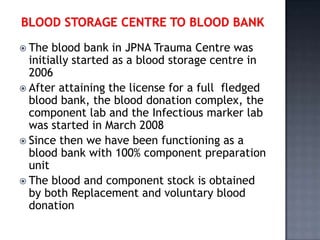
 The  blood bank in JPNA Trauma Centre was
  initially started as a blood storage centre in
  2006
 After attaining the license for a full fledged
  blood bank, the blood donation complex, the
  component lab and the Infectious marker lab
  was started in March 2008
 Since then we have been functioning as a
  blood bank with 100% component preparation
  unit
 The blood and component stock is obtained
  by both Replacement and voluntary blood
  donation
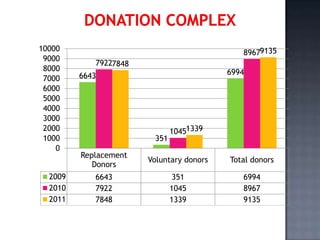
10000                                         89679135
 9000
             79227848
 8000                                      6994
 7000    6643
 6000
 5000
 4000
 3000
 2000                          10451339
 1000                    351
    0
         Replacement
                        Voluntary donors   Total donors
            Donors
  2009      6643                351           6994
  2010      7922               1045           8967
  2011      7848               1339           9135
Replacement donors
            3000

            2500

            2000

            1500

            1000

             500

               0
                         Casu
                   OPD        TC1   TC2   TC3   TC4 TC 5 TC 6 TC 7
                         alty
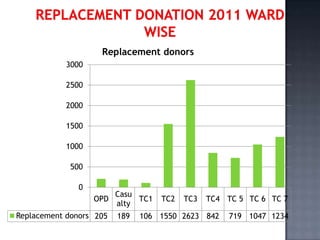
Replacement donors 205   189   106 1550 2623 842     719 1047 1234
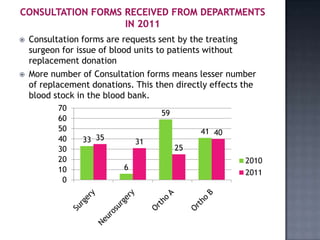
   Consultation forms are requests sent by the treating
    surgeon for issue of blood units to patients without
    replacement donation
   More number of Consultation forms means lesser number
    of replacement donations. This then directly effects the
    blood stock in the blood bank.
           70
                                    59
           60
           50                                 41 40
           40    33 35         31
           30                            25
           20                                            2010
           10              6
                                                         2011
            0
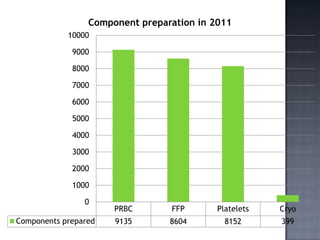
Component preparation in 2011
            10000

             9000

             8000

             7000

             6000

             5000

             4000

             3000

             2000

             1000

                0
                      PRBC       FFP       Platelets   Cryo
Components prepared   9135       8604        8152      399
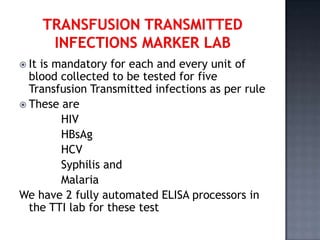
 Itis mandatory for each and every unit of
  blood collected to be tested for five
  Transfusion Transmitted infections as per rule
 These are
        HIV
        HBsAg
        HCV
        Syphilis and
        Malaria
We have 2 fully automated ELISA processors in
  the TTI lab for these test
12000

        10000

         8000

         6000

         4000

         2000

             0
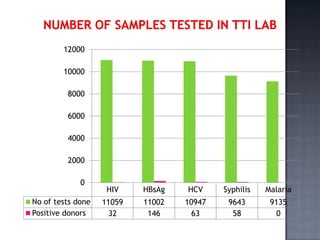
                    HIV    HBsAg   HCV     Syphilis   Malaria
No of tests done   11059   11002   10947    9643       9135
Positive donors      32     146      63      58         0
 Counseling  of blood donors tested positive
  for the TTI was started in June 2009
 285 blood donors who had donated in JPNATC
  blood bank in 2010, were called for
  counseling out of which 82 donors reported
  and were counseled for their respective
  infectious state
 After a repeat test of these donors they are
  referred to the respective departments in
  Main AIIMS for further treatment. 6 donors
  were referred to the ICTC in main AIIMS
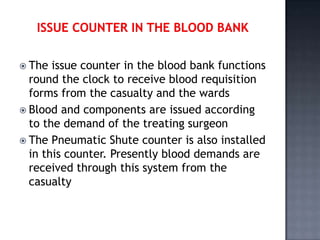
 The  issue counter in the blood bank functions
  round the clock to receive blood requisition
  forms from the casualty and the wards
 Blood and components are issued according
  to the demand of the treating surgeon
 The Pneumatic Shute counter is also installed
  in this counter. Presently blood demands are
  received through this system from the
  casualty
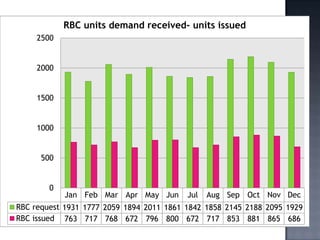
RBC units demand received- units issued
     2500


     2000


     1500


     1000


      500


        0
            Jan Feb Mar Apr May Jun       Jul   Aug Sep Oct Nov Dec
RBC request 1931 1777 2059 1894 2011 1861 1842 1858 2145 2188 2095 1929
RBC issued 763 717 768 672 796 800 672 717 853 881 865 686
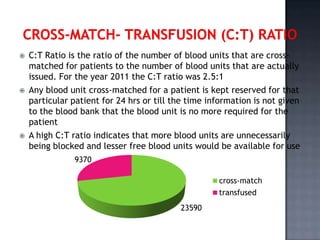
   C:T Ratio is the ratio of the number of blood units that are cross-
    matched for patients to the number of blood units that are actually
    issued. For the year 2011 the C:T ratio was 2.5:1
   Any blood unit cross-matched for a patient is kept reserved for that
    particular patient for 24 hrs or till the time information is not given
    to the blood bank that the blood unit is no more required for the
    patient
   A high C:T ratio indicates that more blood units are unnecessarily
    being blocked and lesser free blood units would be available for use
                9370

                                                     cross-match
                                                     transfused
                                           23590
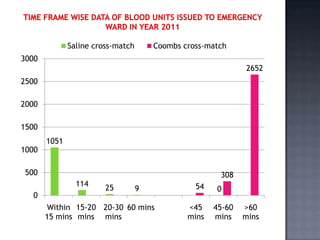
Saline cross-match       Coombs cross-match
3000
                                                              2652
2500

2000

1500
       1051
1000

500                                                    308
                114                              54
                        25         9                  0
  0
       Within 15-20 20-30 60 mins              <45    45-60   >60
       15 mins mins mins                       mins   mins    mins
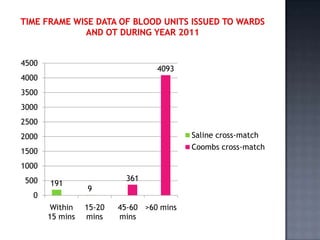
4500
                                  4093
4000
3500
3000
2500
2000                                      Saline cross-match
                                          Coombs cross-match
1500
1000
500                       361
       191
                 9
  0
       Within    15-20   45-60 >60 mins
       15 mins   mins    mins
1000
          900
          800
          700
          600
          500
          400
          300
          200
          100
            0
                Ja Fe Ma     Ma Ju     Au Se Oc No De
                         Apr       Jul
                n b r         y n       g p t v c
Platelets issued 583 588 654 543 669 551 445 552 705 603 753 644
FFP issued       633 381 601 441 510 425 590 721 630 720 755 946
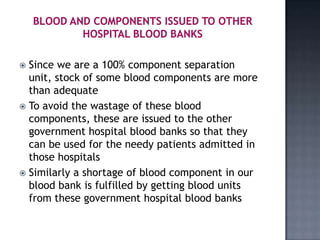
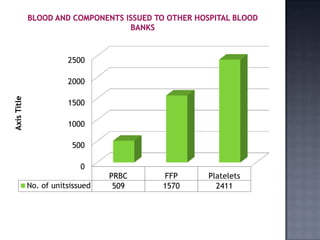
 Since we are a 100% component separation
  unit, stock of some blood components are more
  than adequate
 To avoid the wastage of these blood
  components, these are issued to the other
  government hospital blood banks so that they
  can be used for the needy patients admitted in
  those hospitals
 Similarly a shortage of blood component in our
  blood bank is fulfilled by getting blood units
  from these government hospital blood banks
2500

                        2000
Axis Title


                        1500

                        1000

                         500

                            0
                                  PRBC   FFP    Platelets
             No. of unitsissued    509   1570     2411
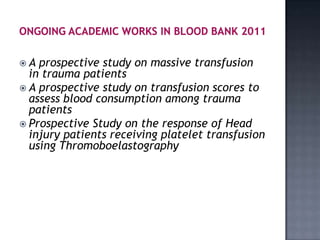
A  prospective study on massive transfusion
  in trauma patients
 A prospective study on transfusion scores to
  assess blood consumption among trauma
  patients
 Prospective Study on the response of Head
  injury patients receiving platelet transfusion
  using Thromoboelastography
 The blood bank in JPNATC has been
  designated as a ‘District level blood bank’ by
  NACO and will be supported by the same
 DSCAS and NACO have been supporting the
  blood bank by providing some consumables
  and also by posting 1 technician and a
  counselor in the department
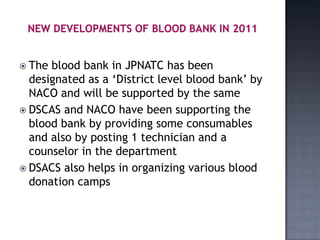
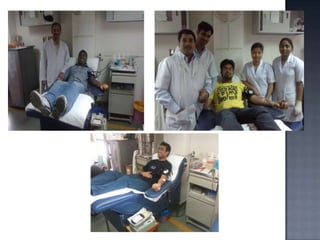
 DSACS also helps in organizing various blood
  donation camps
THANK YOU

Blood bank audit 2011

  • 2.
     The blood bank in JPNA Trauma Centre was initially started as a blood storage centre in 2006  After attaining the license for a full fledged blood bank, the blood donation complex, the component lab and the Infectious marker lab was started in March 2008  Since then we have been functioning as a blood bank with 100% component preparation unit  The blood and component stock is obtained by both Replacement and voluntary blood donation
  • 3.
    10000 89679135 9000 79227848 8000 6994 7000 6643 6000 5000 4000 3000 2000 10451339 1000 351 0 Replacement Voluntary donors Total donors Donors 2009 6643 351 6994 2010 7922 1045 8967 2011 7848 1339 9135
  • 4.
    Replacement donors 3000 2500 2000 1500 1000 500 0 Casu OPD TC1 TC2 TC3 TC4 TC 5 TC 6 TC 7 alty Replacement donors 205 189 106 1550 2623 842 719 1047 1234
  • 5.
    Consultation forms are requests sent by the treating surgeon for issue of blood units to patients without replacement donation  More number of Consultation forms means lesser number of replacement donations. This then directly effects the blood stock in the blood bank. 70 59 60 50 41 40 40 33 35 31 30 25 20 2010 10 6 2011 0
  • 6.
    Component preparation in2011 10000 9000 8000 7000 6000 5000 4000 3000 2000 1000 0 PRBC FFP Platelets Cryo Components prepared 9135 8604 8152 399
  • 7.
     Itis mandatoryfor each and every unit of blood collected to be tested for five Transfusion Transmitted infections as per rule  These are HIV HBsAg HCV Syphilis and Malaria We have 2 fully automated ELISA processors in the TTI lab for these test
  • 8.
    12000 10000 8000 6000 4000 2000 0 HIV HBsAg HCV Syphilis Malaria No of tests done 11059 11002 10947 9643 9135 Positive donors 32 146 63 58 0
  • 9.
     Counseling of blood donors tested positive for the TTI was started in June 2009  285 blood donors who had donated in JPNATC blood bank in 2010, were called for counseling out of which 82 donors reported and were counseled for their respective infectious state  After a repeat test of these donors they are referred to the respective departments in Main AIIMS for further treatment. 6 donors were referred to the ICTC in main AIIMS
  • 10.
     The issue counter in the blood bank functions round the clock to receive blood requisition forms from the casualty and the wards  Blood and components are issued according to the demand of the treating surgeon  The Pneumatic Shute counter is also installed in this counter. Presently blood demands are received through this system from the casualty
  • 11.
    RBC units demandreceived- units issued 2500 2000 1500 1000 500 0 Jan Feb Mar Apr May Jun Jul Aug Sep Oct Nov Dec RBC request 1931 1777 2059 1894 2011 1861 1842 1858 2145 2188 2095 1929 RBC issued 763 717 768 672 796 800 672 717 853 881 865 686
  • 12.
    C:T Ratio is the ratio of the number of blood units that are cross- matched for patients to the number of blood units that are actually issued. For the year 2011 the C:T ratio was 2.5:1  Any blood unit cross-matched for a patient is kept reserved for that particular patient for 24 hrs or till the time information is not given to the blood bank that the blood unit is no more required for the patient  A high C:T ratio indicates that more blood units are unnecessarily being blocked and lesser free blood units would be available for use 9370 cross-match transfused 23590
  • 13.
    Saline cross-match Coombs cross-match 3000 2652 2500 2000 1500 1051 1000 500 308 114 54 25 9 0 0 Within 15-20 20-30 60 mins <45 45-60 >60 15 mins mins mins mins mins mins
  • 14.
    4500 4093 4000 3500 3000 2500 2000 Saline cross-match Coombs cross-match 1500 1000 500 361 191 9 0 Within 15-20 45-60 >60 mins 15 mins mins mins
  • 15.
    1000 900 800 700 600 500 400 300 200 100 0 Ja Fe Ma Ma Ju Au Se Oc No De Apr Jul n b r y n g p t v c Platelets issued 583 588 654 543 669 551 445 552 705 603 753 644 FFP issued 633 381 601 441 510 425 590 721 630 720 755 946
  • 16.
     Since weare a 100% component separation unit, stock of some blood components are more than adequate  To avoid the wastage of these blood components, these are issued to the other government hospital blood banks so that they can be used for the needy patients admitted in those hospitals  Similarly a shortage of blood component in our blood bank is fulfilled by getting blood units from these government hospital blood banks
  • 17.
    2500 2000 Axis Title 1500 1000 500 0 PRBC FFP Platelets No. of unitsissued 509 1570 2411
  • 18.
    A prospectivestudy on massive transfusion in trauma patients  A prospective study on transfusion scores to assess blood consumption among trauma patients  Prospective Study on the response of Head injury patients receiving platelet transfusion using Thromoboelastography
  • 19.
     The bloodbank in JPNATC has been designated as a ‘District level blood bank’ by NACO and will be supported by the same  DSCAS and NACO have been supporting the blood bank by providing some consumables and also by posting 1 technician and a counselor in the department  DSACS also helps in organizing various blood donation camps
  • 21.