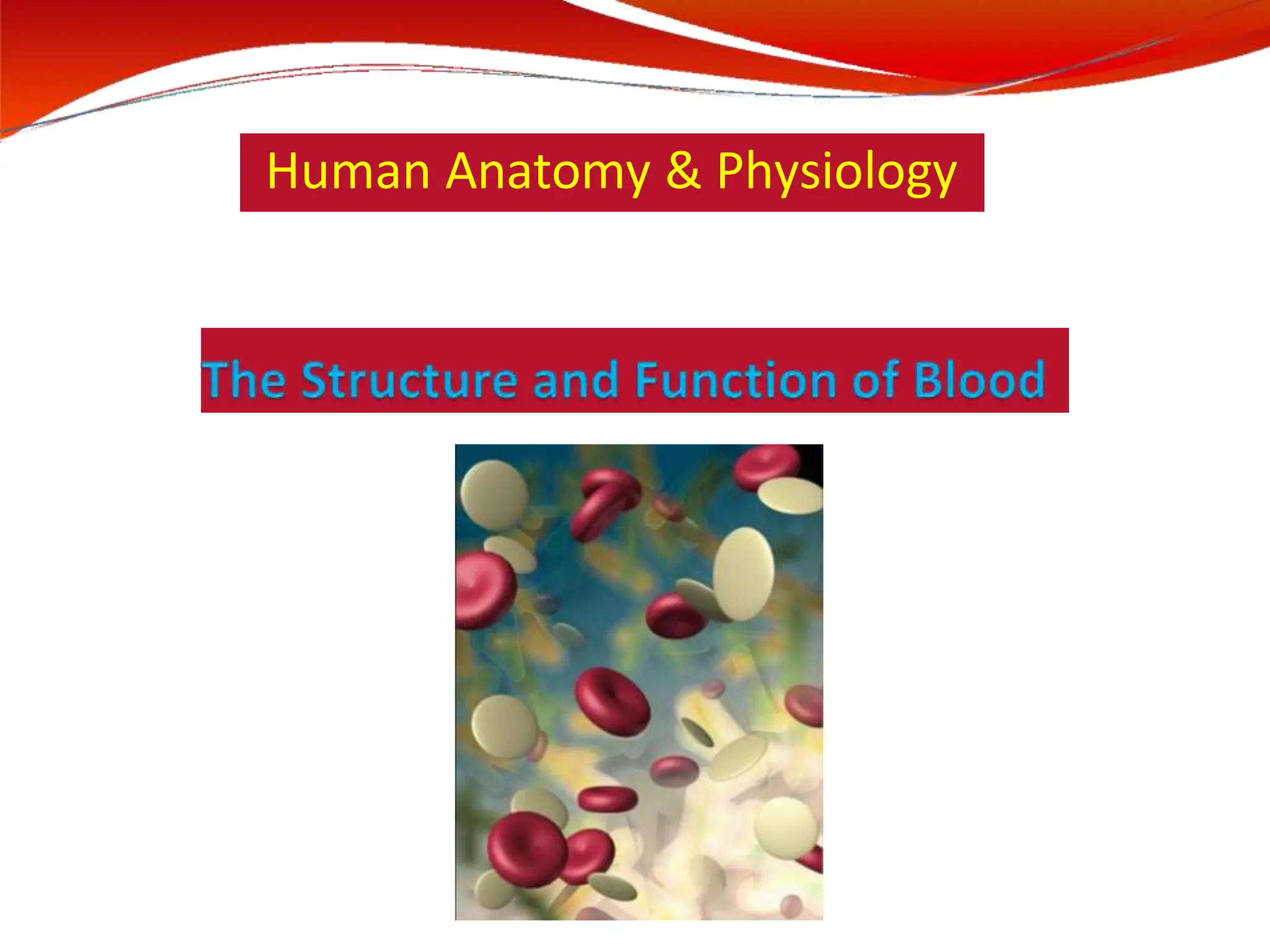
Human Anatomy & Physiology
Composition of Blood
⚫Blood is responsible for…..
⚫Transporting gases (oxygen & carbon dioxide)
⚫Transporting waste products
⚫Transporting nutrients
⚫Helping remove toxins from the body
• Blood makes up 6–8% of our
total body weight.
• Normal adult blood volume is 5 L.
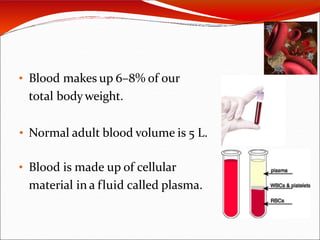
• Blood is made up of cellular
material in a fluid called plasma.
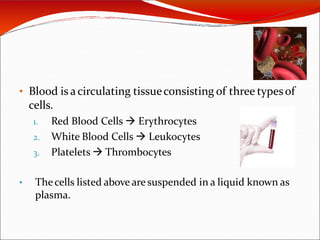
• Blood is acirculating tissueconsisting of three typesof
cells.
1. Red Blood Cells  Erythrocytes
2. White Blood Cells  Leukocytes
3. Platelets  Thrombocytes
• Thecells listed above are suspended in a liquid known as
plasma.
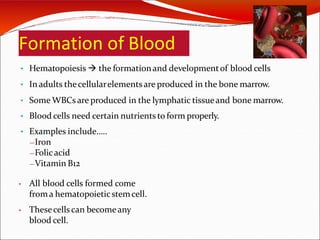
Formation of Blood
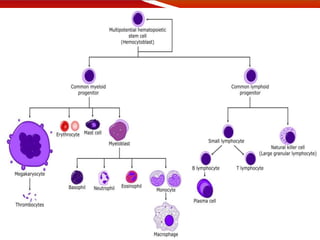
• Hematopoiesis  the formationand developmentof blood cells
• In adults thecellularelementsare produced in the bone marrow.
• Some WBCs are produced in the lymphatic tissueand bone marrow.
• Blood cells need certain nutrients to form properly.
• Examples include…..
—Iron
—Folicacid
—Vitamin B12
• All blood cells formed come
froma hematopoieticstemcell.
• Thesecells can becomeany
blood cell.
Composition of Blood
• The blood is made up of cells
that are suspended in liquid
called plasma.
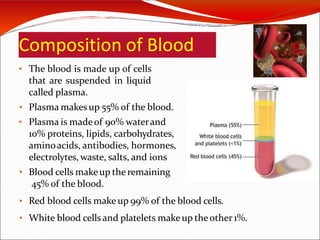
• Plasma makesup 55% of the blood.
• Plasma is madeof 90% waterand
10% proteins, lipids, carbohydrates,
aminoacids, antibodies, hormones,
electrolytes, waste, salts, and ions
• Blood cells makeup the remaining
45% of the blood.
• Red blood cells make up 99% of the blood cells.
• White blood cells and platelets makeup theother 1%.
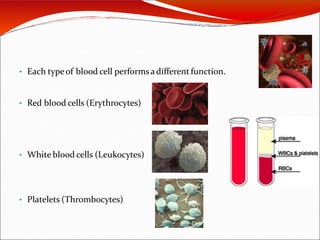
• Each typeof blood cell performsadifferent function.
• Red blood cells (Erythrocytes)
• White blood cells (Leukocytes)
• Platelets (Thrombocytes)
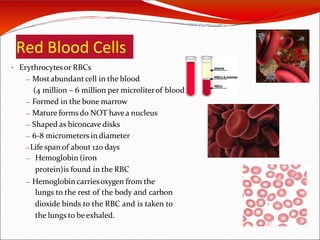
Red Blood Cells
• Erythrocytesor RBCs
— Mostabundantcell in the blood
(4 million – 6 million per microliterof blood)
— Formed in the bone marrow
— Mature formsdo NOT havea nucleus
— Shaped as biconcave disks
— 6-8 micrometers in diameter
—Life span of about 120 days
— Hemoglobin (iron
protein)is found in the RBC
— Hemoglobincarriesoxygen from the
lungs to the rest of the body and carbon
dioxide binds to the RBC and is taken to
the lungs to beexhaled.
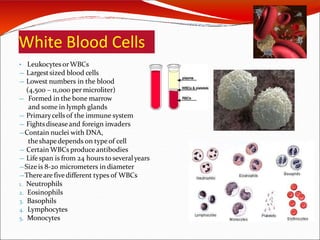
White Blood Cells
• Leukocytes orWBCs
— Largestsized blood cells
— Lowest numbers in the blood
(4,500 – 11,000 per microliter)
— Formed in the bone marrow
and some in lymph glands
— Primarycells of the immune system
— Fightsdiseaseand foreign invaders
—Contain nuclei with DNA,
theshapedepends on type of cell
— Certain WBCs produce antibodies
— Life span is from 24 hours to severalyears
—Size is 8-20 micrometers in diameter
—Thereare five different types of WBCs
1. Neutrophils
2. Eosinophils
3. Basophils
4. Lymphocytes
5. Monocytes
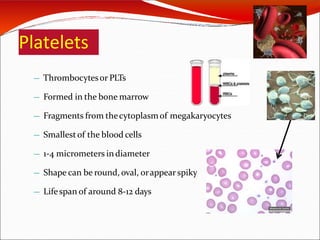
Platelets
— Thrombocytesor PLTs
— Formed in the bone marrow
— Fragments from thecytoplasmof megakaryocytes
— Smallestof the blood cells
— 1-4 micrometers indiameter
— Shape can be round, oval, orappear spiky
— Lifespan of around 8-12 days
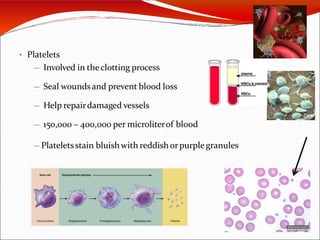
• Platelets
— Involved in theclotting process
— Seal woundsand prevent blood loss
— Help repairdamaged vessels
— 150,000 – 400,000 per microliterof blood
— Plateletsstain bluishwith reddishorpurple granules

lecture_24_physiology-4_3-converted.pptx

  • 1.
    Human Anatomy &Physiology
  • 2.
    Composition of Blood ⚫Bloodis responsible for….. ⚫Transporting gases (oxygen & carbon dioxide) ⚫Transporting waste products ⚫Transporting nutrients ⚫Helping remove toxins from the body
  • 3.
    • Blood makesup 6–8% of our total body weight. • Normal adult blood volume is 5 L. • Blood is made up of cellular material in a fluid called plasma.
  • 4.
    • Blood isacirculating tissueconsisting of three typesof cells. 1. Red Blood Cells  Erythrocytes 2. White Blood Cells  Leukocytes 3. Platelets  Thrombocytes • Thecells listed above are suspended in a liquid known as plasma.
  • 5.
    Formation of Blood •Hematopoiesis  the formationand developmentof blood cells • In adults thecellularelementsare produced in the bone marrow. • Some WBCs are produced in the lymphatic tissueand bone marrow. • Blood cells need certain nutrients to form properly. • Examples include….. —Iron —Folicacid —Vitamin B12 • All blood cells formed come froma hematopoieticstemcell. • Thesecells can becomeany blood cell.
  • 7.
    Composition of Blood •The blood is made up of cells that are suspended in liquid called plasma. • Plasma makesup 55% of the blood. • Plasma is madeof 90% waterand 10% proteins, lipids, carbohydrates, aminoacids, antibodies, hormones, electrolytes, waste, salts, and ions • Blood cells makeup the remaining 45% of the blood. • Red blood cells make up 99% of the blood cells. • White blood cells and platelets makeup theother 1%.
  • 8.
    • Each typeofblood cell performsadifferent function. • Red blood cells (Erythrocytes) • White blood cells (Leukocytes) • Platelets (Thrombocytes)
  • 9.
    Red Blood Cells •Erythrocytesor RBCs — Mostabundantcell in the blood (4 million – 6 million per microliterof blood) — Formed in the bone marrow — Mature formsdo NOT havea nucleus — Shaped as biconcave disks — 6-8 micrometers in diameter —Life span of about 120 days — Hemoglobin (iron protein)is found in the RBC — Hemoglobincarriesoxygen from the lungs to the rest of the body and carbon dioxide binds to the RBC and is taken to the lungs to beexhaled.
  • 10.
    White Blood Cells •Leukocytes orWBCs — Largestsized blood cells — Lowest numbers in the blood (4,500 – 11,000 per microliter) — Formed in the bone marrow and some in lymph glands — Primarycells of the immune system — Fightsdiseaseand foreign invaders —Contain nuclei with DNA, theshapedepends on type of cell — Certain WBCs produce antibodies — Life span is from 24 hours to severalyears —Size is 8-20 micrometers in diameter —Thereare five different types of WBCs 1. Neutrophils 2. Eosinophils 3. Basophils 4. Lymphocytes 5. Monocytes
  • 11.
    Platelets — Thrombocytesor PLTs —Formed in the bone marrow — Fragments from thecytoplasmof megakaryocytes — Smallestof the blood cells — 1-4 micrometers indiameter — Shape can be round, oval, orappear spiky — Lifespan of around 8-12 days
  • 12.
    • Platelets — Involvedin theclotting process — Seal woundsand prevent blood loss — Help repairdamaged vessels — 150,000 – 400,000 per microliterof blood — Plateletsstain bluishwith reddishorpurple granules