
SWITZERLAND
Economic Perfomance Review
HISTORY OF
SWITZERLAND
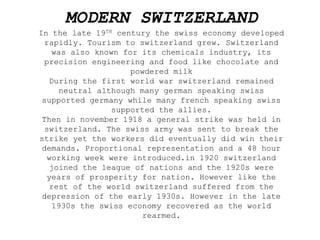
MODERN SWITZERLAND
In the late 19TH century the swiss economy developed
rapidly. Tourism to switzerland grew. Switzerland
was also known for its chemicals industry, its
precision engineering and food like chocolate and
powdered milk
During the first world war switzerland remained
neutral although many german speaking swiss
supported germany while many french speaking swiss
supported the allies.
Then in november 1918 a general strike was held in
switzerland. The swiss army was sent to break the
strike yet the workers did eventually did win their
demands. Proportional representation and a 48 hour
working week were introduced.in 1920 switzerland
joined the league of nations and the 1920s were
years of prosperity for nation. However like the
rest of the world switzerland suffered from the
depression of the early 1930s. However in the late
1930s the swiss economy recovered as the world
rearmed.
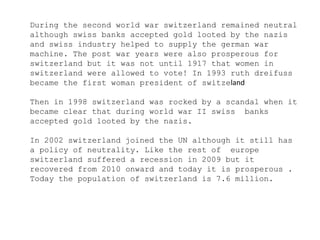
During the second world war switzerland remained neutral
although swiss banks accepted gold looted by the nazis
and swiss industry helped to supply the german war
machine. The post war years were also prosperous for
switzerland but it was not until 1917 that women in
switzerland were allowed to vote! In 1993 ruth dreifuss
became the first woman president of switzeland
Then in 1998 switzerland was rocked by a scandal when it
became clear that during world war II swiss banks
accepted gold looted by the nazis.
In 2002 switzerland joined the UN although it still has
a policy of neutrality. Like the rest of europe
switzerland suffered a recession in 2009 but it
recovered from 2010 onward and today it is prosperous .
Today the population of switzerland is 7.6 million.
GENERAL FACTS
Switzerland is a small country (41,285 km
=15,940 square miles ), but densely populated
(7 million inhabitants,170 per km=440 per
sq.mi.) situated in the heart of western
europe. It shares much of its history and of
its culture with its neighbours Germany,
Austria,Italy and France.
Some 60% of switzerland are in the alpine
region, with high mountains (12 peaks above
4,000 m = 13,000 ft above sea level and many
more between 2,000 and 4,000 m ) and narrow
valleys. 30% are hills and reletively flat
valleys carved out by glaciers called
“Mitteland – this means that the actual
destiny of population in this part of the
country is somewhere near 500 inhabitants per
km (1300 per sq. mile)
TOP 12
THINGS
SWITZERLAND
IS FAMOUS
FOR :
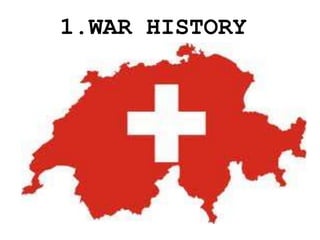
1.WAR HISTORY
Switzerland is famous for its no-
interference policy. They have
stood as a neutral nation for the
longest time. Interesting fact-
Switzerland has not been at war
since 1505. Even in the World
Wars, they provided a safe passage
for both the warring sides. This
neutral stand has appreciably
helped Switzerland in keeping a
stable economy in all times.
2.RED CROSS
The International Committee of
Red Cross (ICRC), for
protecting and assisting
victims of war was first
established in Geneva in 1863
by the effects of a Swiss
entrepreneur Henry Dunant’s
book A Memoire of
Solferino. Since then the Red
Cross Society has been working
for the welfare of the war
victims worldwide.
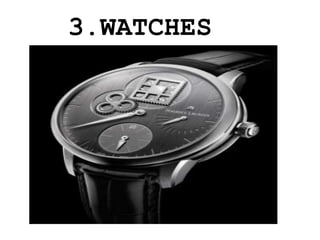
3.WATCHES
It is a well known fact that the Swiss
Watches dominate the Wachmaking
industry. These watches are an
excellent combination of both
aesthetics and technology. Anyone’s
personality shoots up to a dozen
measures by these watches. Swiss
Watches are known for their accuracy
and wide range. Most of the well known
watch brands like Tag Heuer, Rolex,
Rado, Omega, etc are all from
Switzerland.
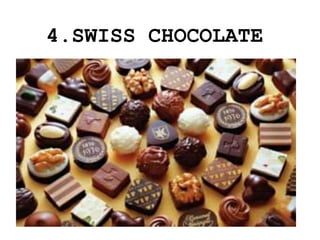
4.SWISS CHOCOLATE
If you tell me you don’t
like Swiss chocolate, I
would seriously believe you
haven’t tasted it yet.
Switzerland is famous for
the art of chocolate making.
They have world’s best milk
chocolate made of finest
milk and cream. Once tasted,
it is hard to resist this
delicious to the core Swiss
Chocolate.
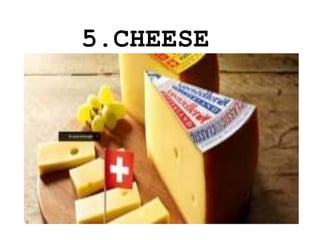
5.CHEESE
Switzerland is the place where you can
find the finest quality of cheese. It
is home to about 450 varieties of
cheese. Did you know there are even so
many varieties of cheese? In
Switzerland, you do not have to go to
a specific place to get their
specialty cheese. It is everywhere.
Also, in America, a special type of
cheese is called Swiss cheese because
it resembles Switzerland’s Emmental
cheese but Swiss people believe all
the 450 varieties of cheese made in
Switzerland are Swiss Cheese. Well,
because that is made in Switzerland,
so it is.
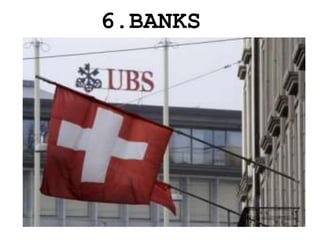
6.BANKS
Swiss banks are famous for their
privacy policy. They do not
disclose the account holder’s name
even to the government except at
the extreme cases like criminal or
terrorist activities. Contrary to
the popular belief, the Swiss
banks are not only for tax evasion
and money laundering by
politicians, criminals, etc but
they are also popular among the
commoners. With the best banking
strategy and most stable economy
in the past years, Switzerland has
emerged as the best option for
banking service.
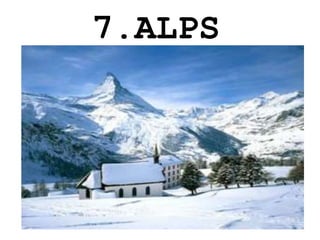
7.ALPS
Swiss Alps, also known as Central
Alps, is the region of Alpine
mountain ranges that lie in
Switzerland. Around 65% of
Switzerland is covered by Alps,
one of the most beautiful mountain
ranges. No doubt, Switzerland is
the place where one can find the
highest peaks and glaciers. Skiing
and hiking are way of Swiss life.
Some of the famous Alpine
Mountains in Switzerland are the
Matterhorn, the Eiger and the
Jungfrau.
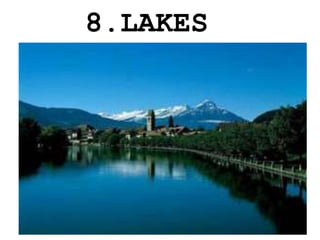
8.LAKES
Switzerland is home to a large
number of small and large
lakes. There is a scenic beauty
in Switzerland with all the
lakes, mountain ranges and
meadows. One can easily fall in
love with the beauty of Lake
Geneva, Lake Zurich and Lake
Neuchatel. These crystal clear
mountain lakes make the world’s
best Lake views.
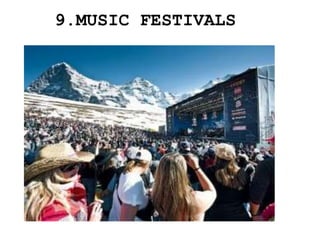
9.MUSIC FESTIVALS
Switzerland is famous for its music
festivals ranging from Classical to rock.
There is a music fest for every season in
Switzerland.
Every August, The Rock Oz’Arènes festival
takes place in the Roman amphitheatre in
Avenches.
In addition to the Annual Classical Music
Festival, summer sees various Rock and Pop
open-air concerts that attract fans both
from home and other countries.
Even Winter has open air rock concerts:
the SnowpenAir on the Kleine Scheidegg in
the Bernese Oberland.
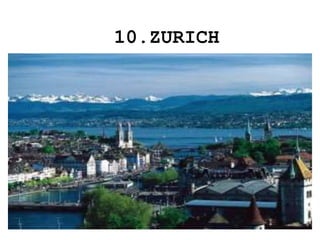
10.ZURICH
This most desirable city in the world is
pride of Switzerland. According to some
surveys it is the city with best quality
of life in the world and the wealthiest
city of Europe. This city is well known
for luxurious shopping, lodging and
cuisine. Founded by the Romans, Zurich
lies in north central part of the
country. Being the most popular city of
the country it attracted many notable
artists and writers in 19th and 20th
century. Also, the Dada Movement is said
to have been born in this city in 1916.
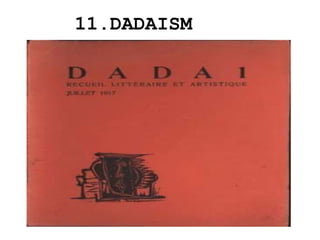
11.DADAISM
Dadaism was an art movement in Europe in
earlier 20th century. Dada was born out
of the reactions to the horrors of World
War I. This International movement was
begun by the poets and artists in
Zurich’s Cabaret Voltaire. Dada rejected
reason and logic, prizing nonsense,
irrationality and intuition. The anti-war
logic was concentrated in visual arts,
literature, poetry and other artistic
mediums through rejection of prevailing
standards in art through anti-cultural
works.
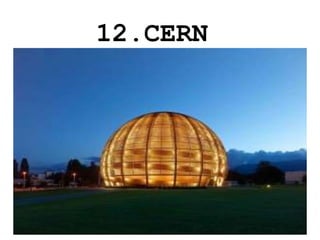
12.CERN
CERN, European Organization for
Physics Research that lies near
Geneva is World’s largest Particle
Physics Laboratory. Lying 100
meters below ground, CERN enables
scientist from all over the world
to study the structure of matter.
World’s most powerful particle
accelerator, Large Hadron Collider
(LHC) was created in 2008 to
further the understanding of Big
Bang and the beginning of
Universe.
WILLIAM TELL – Swiss
legendary hero who
symbolized the
struggle for
political and
individual freedom.
ECONOMIC STATUS
The economy of Switzerland is one of the world's most stable economies. Its policy of
long-term monetary security and political stability has made Switzerland a safe haven
for investors, creating an economy that is increasingly dependent on a steady tide
of foreign investment. Because of the country's small size and high labor
specialisation, industry and trade are the keys to Switzerland's economic livelihood.
Switzerland has achieved one of the highest per capita incomes in the world with low
unemployment rates and a low budget deficit. The service sector has also come to
play a significant economic role.
Switzerland economy is based on a highly qualified labour force performing highly
skilled work. The main areas include micro technology, hitech, biotechnology and
pharmaceuticals, well as the greatest number of people.
Most of the people working in switzerland are employed by small and medium sized
enterprises, which play an extremely important role in the swiss economy
The swiss are concerned that economic activity should have as little impact as
possible on the enviroment. Switzerland’s energy and transport policies aim to be
enviromentally friendly.
Thhe age of unlimited economic growth in switzerland is over. Fear of unemployment
has been one of the main concerns of the swiss for several years.
Switzerland’s economic freedom score is 81.6, maki8ng its
economy the 4th freest for the first time ever in the 2014
index. Its score is 0.6 point higher than last year, with
improvements in trade freedom and the management of public
spending partially offset by declines in monetary freedom
and labor freedom. Switzerland is ranked 1st out of 43
countries in the europe region. Switzerland was first
graded in the 1996 index, and its economic freedom score
has advanced since then by 4.8 points. Improved ratings
for six of the 10 economic freedoms, led by the sound
management for public spending and notable enhancements in
the area of market openness as measured through trade
freedom And financial freedom, have enabled switzerland to
have advance to economically “free” since 2010.as
reflected in the steady rise of its economic freedom over
the 19 years it has been graded, switzerland’s strong
competitiveness is built on flexibility and openness. The
sound regulatory enviroment encourages entrepreneurial
activity and innovation and sensible. The judicial system,
independent and free of corruption, provides strong
protection of property rigths.
Switzerland is a peaceful, prosperous,
and modern market economy with low
unemployment, a highly skilled labor
force, and a per capital GDP among the
highest in the world. Switzerland’s
economy benefits from a highly developed
service sector, led by financial
services, and a manufacturing industry
that specializes in high-technology,
knowledge-based production. Its economic
and political stability, transparent
legal system, exceptional infrastructure,
efficient capital markets, and low
corporate tax rates also make switzerland
one of the world’s most competitive
economies.
PERFORMANCE
Switzerland leads the world in addressing enviromental
challenges, according to the 2014 enviromental
performance index ( EPI ). Luxembourg, Australia,
Singapore, and Czech republic round out the top five
positions of the index, which ranks countries on high-
priority enviroment concerns including air quality,
water management, and climate change.
While reinforcing the challenges nations face in
promoting sustainable development, the 2014 EPI shows
that top countries have relatively strong performance
across the board and have advanced on a range of
enviromental issues over the last decade. But the
scoprecard reveals weaknesses for many countries and
areas of concern for even the best performers.
Switzerland. For example, is only Average on forest
protection, demonstrating that all countries-
regardless of rank- can improve.
PARTICIPATION OF GLOBAL ECONOMY
The world Economic forum ( WEF ) is a Swiss nonprofit
foundation based in cologny, geneva. It describes
itself as an independent international organization
committed to improving the state of the world by
engaging business, political, academic, and other
leaders of society to shape global, regional, and
industry agendas. The forum is best known for its
annual winter meeting in Davos, a mountain resort in
Graubünden, in the eastern Alps region of switzerland.
The meeting brings together some 2,500 top business
leaders, international political leaders, selected
intellectuals, and journalism to discuss the most
pressing issues facing the world, including health and
the enviroment. Often this location alone is used to
identify meetings, participation, and participants
with such phrases as, “a Davos panel “ “a Davos Man “
The organization also convenes some six to eight
regional meetings each year in location such as
Latin America and east Asia, as well as undertaking
two further annual meetings in china and the united
Arab emirates. Beside meetings, the foundation
produces a series of research reports and engages
its members in sectors specific initiatives. The
2011 annual meeting in Davos was held from 26 to 30
January. The 2012 meeting was held on 25-29 January
2012, with the theme “The Great Transformation :
Shaping new Models” the 2013 meeting was held from
23 January to 27 January, with the theme of
“Resilient Dynamism”, following founder Klaus
Schwab’s declaration that “The need for global
cooperation has never been quarter” the 2014 meeting
was held from 22 January to 25 January, with the
theme “The Reshaping of the world : Consequences for
society, politics and business
SWITZERLAND NATURAL RESOURCES
Waterpower is the chief natural resources of
switzerland. The principal source of water is runoff
from the considerable annual precipitation that falls on
the alps. An important complement is melt water from the
country’s hundreds of glaciers. The Swiss have long
harnessed the energy of falling water for productive
uses. Long ago, torrents turned waterwheels that powered
preindustrial mills and machinery. Today, the flow is
captured by hundreds of hydroelectric power facilities,
which provide 59
Percent of the country’s domestic electricity,
Mineral resources are not plentiful in switzerland.
Granite, limestone, other building stones, and salt are
the only abundant mineral resources with commercial
value. Small deposits of iron and manganese ores also
Are found.
About 11 percent of
switzerland’s land is used for
agriculture. While another 30
percent is covered by forests.
Steep terrain is the principal
obstacle to agricultural
expansion. The mountainous
landscape is, however, central
to the country’s famous tourism
industry, one of switzerland’s
most important revenue sources.
GLOBAL ORGANIZATION’S OF
SWITZERLAND
• World Trade Organization
• Organization for economic Co-Operation
and development
• Council of Europe
• Organization for security and
Cooperation in Europe
• International Atomic Energy Agency
THANK
YOU!

switzerland

  • 1.
  • 2.
  • 3.
    MODERN SWITZERLAND In thelate 19TH century the swiss economy developed rapidly. Tourism to switzerland grew. Switzerland was also known for its chemicals industry, its precision engineering and food like chocolate and powdered milk During the first world war switzerland remained neutral although many german speaking swiss supported germany while many french speaking swiss supported the allies. Then in november 1918 a general strike was held in switzerland. The swiss army was sent to break the strike yet the workers did eventually did win their demands. Proportional representation and a 48 hour working week were introduced.in 1920 switzerland joined the league of nations and the 1920s were years of prosperity for nation. However like the rest of the world switzerland suffered from the depression of the early 1930s. However in the late 1930s the swiss economy recovered as the world rearmed.
  • 4.
    During the secondworld war switzerland remained neutral although swiss banks accepted gold looted by the nazis and swiss industry helped to supply the german war machine. The post war years were also prosperous for switzerland but it was not until 1917 that women in switzerland were allowed to vote! In 1993 ruth dreifuss became the first woman president of switzeland Then in 1998 switzerland was rocked by a scandal when it became clear that during world war II swiss banks accepted gold looted by the nazis. In 2002 switzerland joined the UN although it still has a policy of neutrality. Like the rest of europe switzerland suffered a recession in 2009 but it recovered from 2010 onward and today it is prosperous . Today the population of switzerland is 7.6 million.
  • 5.
    GENERAL FACTS Switzerland isa small country (41,285 km =15,940 square miles ), but densely populated (7 million inhabitants,170 per km=440 per sq.mi.) situated in the heart of western europe. It shares much of its history and of its culture with its neighbours Germany, Austria,Italy and France. Some 60% of switzerland are in the alpine region, with high mountains (12 peaks above 4,000 m = 13,000 ft above sea level and many more between 2,000 and 4,000 m ) and narrow valleys. 30% are hills and reletively flat valleys carved out by glaciers called “Mitteland – this means that the actual destiny of population in this part of the country is somewhere near 500 inhabitants per km (1300 per sq. mile)
  • 6.
  • 7.
  • 8.
    Switzerland is famousfor its no- interference policy. They have stood as a neutral nation for the longest time. Interesting fact- Switzerland has not been at war since 1505. Even in the World Wars, they provided a safe passage for both the warring sides. This neutral stand has appreciably helped Switzerland in keeping a stable economy in all times.
  • 9.
  • 10.
    The International Committeeof Red Cross (ICRC), for protecting and assisting victims of war was first established in Geneva in 1863 by the effects of a Swiss entrepreneur Henry Dunant’s book A Memoire of Solferino. Since then the Red Cross Society has been working for the welfare of the war victims worldwide.
  • 11.
  • 12.
    It is awell known fact that the Swiss Watches dominate the Wachmaking industry. These watches are an excellent combination of both aesthetics and technology. Anyone’s personality shoots up to a dozen measures by these watches. Swiss Watches are known for their accuracy and wide range. Most of the well known watch brands like Tag Heuer, Rolex, Rado, Omega, etc are all from Switzerland.
  • 13.
  • 14.
    If you tellme you don’t like Swiss chocolate, I would seriously believe you haven’t tasted it yet. Switzerland is famous for the art of chocolate making. They have world’s best milk chocolate made of finest milk and cream. Once tasted, it is hard to resist this delicious to the core Swiss Chocolate.
  • 15.
  • 16.
    Switzerland is theplace where you can find the finest quality of cheese. It is home to about 450 varieties of cheese. Did you know there are even so many varieties of cheese? In Switzerland, you do not have to go to a specific place to get their specialty cheese. It is everywhere. Also, in America, a special type of cheese is called Swiss cheese because it resembles Switzerland’s Emmental cheese but Swiss people believe all the 450 varieties of cheese made in Switzerland are Swiss Cheese. Well, because that is made in Switzerland, so it is.
  • 17.
  • 18.
    Swiss banks arefamous for their privacy policy. They do not disclose the account holder’s name even to the government except at the extreme cases like criminal or terrorist activities. Contrary to the popular belief, the Swiss banks are not only for tax evasion and money laundering by politicians, criminals, etc but they are also popular among the commoners. With the best banking strategy and most stable economy in the past years, Switzerland has emerged as the best option for banking service.
  • 19.
  • 20.
    Swiss Alps, alsoknown as Central Alps, is the region of Alpine mountain ranges that lie in Switzerland. Around 65% of Switzerland is covered by Alps, one of the most beautiful mountain ranges. No doubt, Switzerland is the place where one can find the highest peaks and glaciers. Skiing and hiking are way of Swiss life. Some of the famous Alpine Mountains in Switzerland are the Matterhorn, the Eiger and the Jungfrau.
  • 21.
  • 22.
    Switzerland is hometo a large number of small and large lakes. There is a scenic beauty in Switzerland with all the lakes, mountain ranges and meadows. One can easily fall in love with the beauty of Lake Geneva, Lake Zurich and Lake Neuchatel. These crystal clear mountain lakes make the world’s best Lake views.
  • 23.
  • 24.
    Switzerland is famousfor its music festivals ranging from Classical to rock. There is a music fest for every season in Switzerland. Every August, The Rock Oz’Arènes festival takes place in the Roman amphitheatre in Avenches. In addition to the Annual Classical Music Festival, summer sees various Rock and Pop open-air concerts that attract fans both from home and other countries. Even Winter has open air rock concerts: the SnowpenAir on the Kleine Scheidegg in the Bernese Oberland.
  • 25.
  • 26.
    This most desirablecity in the world is pride of Switzerland. According to some surveys it is the city with best quality of life in the world and the wealthiest city of Europe. This city is well known for luxurious shopping, lodging and cuisine. Founded by the Romans, Zurich lies in north central part of the country. Being the most popular city of the country it attracted many notable artists and writers in 19th and 20th century. Also, the Dada Movement is said to have been born in this city in 1916.
  • 27.
  • 28.
    Dadaism was anart movement in Europe in earlier 20th century. Dada was born out of the reactions to the horrors of World War I. This International movement was begun by the poets and artists in Zurich’s Cabaret Voltaire. Dada rejected reason and logic, prizing nonsense, irrationality and intuition. The anti-war logic was concentrated in visual arts, literature, poetry and other artistic mediums through rejection of prevailing standards in art through anti-cultural works.
  • 29.
  • 30.
    CERN, European Organizationfor Physics Research that lies near Geneva is World’s largest Particle Physics Laboratory. Lying 100 meters below ground, CERN enables scientist from all over the world to study the structure of matter. World’s most powerful particle accelerator, Large Hadron Collider (LHC) was created in 2008 to further the understanding of Big Bang and the beginning of Universe.
  • 31.
    WILLIAM TELL –Swiss legendary hero who symbolized the struggle for political and individual freedom.
  • 32.
    ECONOMIC STATUS The economyof Switzerland is one of the world's most stable economies. Its policy of long-term monetary security and political stability has made Switzerland a safe haven for investors, creating an economy that is increasingly dependent on a steady tide of foreign investment. Because of the country's small size and high labor specialisation, industry and trade are the keys to Switzerland's economic livelihood. Switzerland has achieved one of the highest per capita incomes in the world with low unemployment rates and a low budget deficit. The service sector has also come to play a significant economic role. Switzerland economy is based on a highly qualified labour force performing highly skilled work. The main areas include micro technology, hitech, biotechnology and pharmaceuticals, well as the greatest number of people. Most of the people working in switzerland are employed by small and medium sized enterprises, which play an extremely important role in the swiss economy The swiss are concerned that economic activity should have as little impact as possible on the enviroment. Switzerland’s energy and transport policies aim to be enviromentally friendly. Thhe age of unlimited economic growth in switzerland is over. Fear of unemployment has been one of the main concerns of the swiss for several years.
  • 33.
    Switzerland’s economic freedomscore is 81.6, maki8ng its economy the 4th freest for the first time ever in the 2014 index. Its score is 0.6 point higher than last year, with improvements in trade freedom and the management of public spending partially offset by declines in monetary freedom and labor freedom. Switzerland is ranked 1st out of 43 countries in the europe region. Switzerland was first graded in the 1996 index, and its economic freedom score has advanced since then by 4.8 points. Improved ratings for six of the 10 economic freedoms, led by the sound management for public spending and notable enhancements in the area of market openness as measured through trade freedom And financial freedom, have enabled switzerland to have advance to economically “free” since 2010.as reflected in the steady rise of its economic freedom over the 19 years it has been graded, switzerland’s strong competitiveness is built on flexibility and openness. The sound regulatory enviroment encourages entrepreneurial activity and innovation and sensible. The judicial system, independent and free of corruption, provides strong protection of property rigths.
  • 34.
    Switzerland is apeaceful, prosperous, and modern market economy with low unemployment, a highly skilled labor force, and a per capital GDP among the highest in the world. Switzerland’s economy benefits from a highly developed service sector, led by financial services, and a manufacturing industry that specializes in high-technology, knowledge-based production. Its economic and political stability, transparent legal system, exceptional infrastructure, efficient capital markets, and low corporate tax rates also make switzerland one of the world’s most competitive economies.
  • 35.
    PERFORMANCE Switzerland leads theworld in addressing enviromental challenges, according to the 2014 enviromental performance index ( EPI ). Luxembourg, Australia, Singapore, and Czech republic round out the top five positions of the index, which ranks countries on high- priority enviroment concerns including air quality, water management, and climate change. While reinforcing the challenges nations face in promoting sustainable development, the 2014 EPI shows that top countries have relatively strong performance across the board and have advanced on a range of enviromental issues over the last decade. But the scoprecard reveals weaknesses for many countries and areas of concern for even the best performers. Switzerland. For example, is only Average on forest protection, demonstrating that all countries- regardless of rank- can improve.
  • 36.
    PARTICIPATION OF GLOBALECONOMY The world Economic forum ( WEF ) is a Swiss nonprofit foundation based in cologny, geneva. It describes itself as an independent international organization committed to improving the state of the world by engaging business, political, academic, and other leaders of society to shape global, regional, and industry agendas. The forum is best known for its annual winter meeting in Davos, a mountain resort in Graubünden, in the eastern Alps region of switzerland. The meeting brings together some 2,500 top business leaders, international political leaders, selected intellectuals, and journalism to discuss the most pressing issues facing the world, including health and the enviroment. Often this location alone is used to identify meetings, participation, and participants with such phrases as, “a Davos panel “ “a Davos Man “
  • 37.
    The organization alsoconvenes some six to eight regional meetings each year in location such as Latin America and east Asia, as well as undertaking two further annual meetings in china and the united Arab emirates. Beside meetings, the foundation produces a series of research reports and engages its members in sectors specific initiatives. The 2011 annual meeting in Davos was held from 26 to 30 January. The 2012 meeting was held on 25-29 January 2012, with the theme “The Great Transformation : Shaping new Models” the 2013 meeting was held from 23 January to 27 January, with the theme of “Resilient Dynamism”, following founder Klaus Schwab’s declaration that “The need for global cooperation has never been quarter” the 2014 meeting was held from 22 January to 25 January, with the theme “The Reshaping of the world : Consequences for society, politics and business
  • 38.
    SWITZERLAND NATURAL RESOURCES Waterpoweris the chief natural resources of switzerland. The principal source of water is runoff from the considerable annual precipitation that falls on the alps. An important complement is melt water from the country’s hundreds of glaciers. The Swiss have long harnessed the energy of falling water for productive uses. Long ago, torrents turned waterwheels that powered preindustrial mills and machinery. Today, the flow is captured by hundreds of hydroelectric power facilities, which provide 59 Percent of the country’s domestic electricity, Mineral resources are not plentiful in switzerland. Granite, limestone, other building stones, and salt are the only abundant mineral resources with commercial value. Small deposits of iron and manganese ores also Are found.
  • 39.
    About 11 percentof switzerland’s land is used for agriculture. While another 30 percent is covered by forests. Steep terrain is the principal obstacle to agricultural expansion. The mountainous landscape is, however, central to the country’s famous tourism industry, one of switzerland’s most important revenue sources.
  • 40.
    GLOBAL ORGANIZATION’S OF SWITZERLAND •World Trade Organization • Organization for economic Co-Operation and development • Council of Europe • Organization for security and Cooperation in Europe • International Atomic Energy Agency
  • 41.