By Mr. Jack
 299-303
 Why study Western Europe?
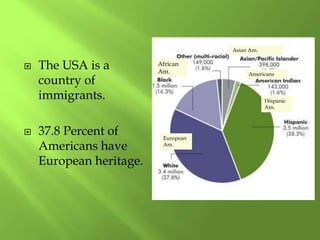
 The USA is a
country of
immigrants.
 37.8 Percent of
Americans have
European heritage.
African
Am.
European
Am.
Hispanic
Am.
Americans
Asian Am.
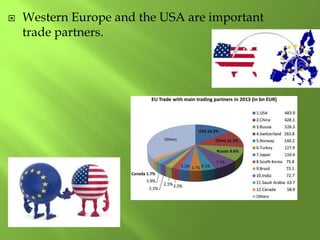
 Western Europe and the USA are important
trade partners.
 Las Vegas is a favorite destination for
Europeans. Western Europe, the city’s second
biggest international market — up 81.7 percent
since 2003.
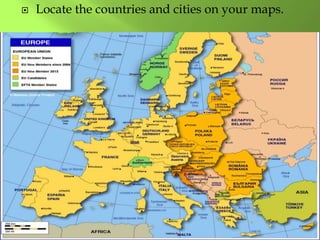
 Locate the countries and cities on your maps.
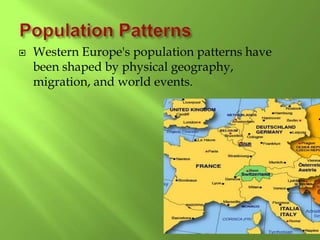
 Western Europe's population patterns have
been shaped by physical geography,
migration, and world events.
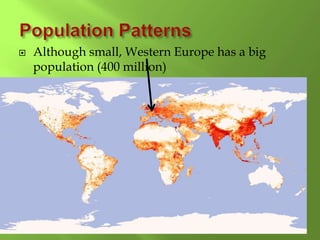
 Although small, Western Europe has a big
population (400 million)
 The distance from the Pyrenees to the
German/Polish boarder is only 800-1000 miles.
 1016 miles, distance Los Angles to Denver via Las Vegas
 Switzerland is a blended European cultures.
It has 3 official languages German, French,
and Italian.
 Geneva is the capital, famous for banking.
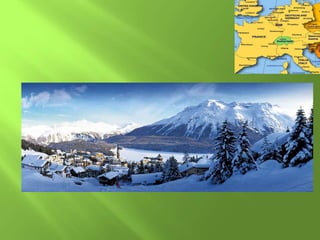
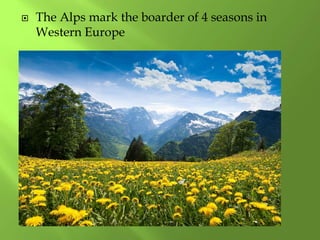
 The Alps mark the boarder of 4 seasons in
Western Europe
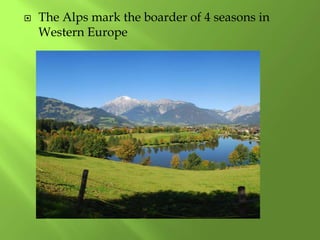
 The Alps mark the boarder of 4 seasons in
Western Europe
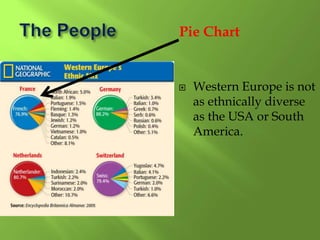
 Western Europe is not
as ethnically diverse
as the USA or South
America.
Pie Chart
 Western Europe is not
as ethnically diverse
as the USA or South
America.
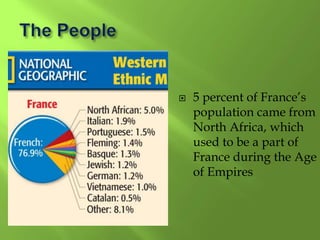
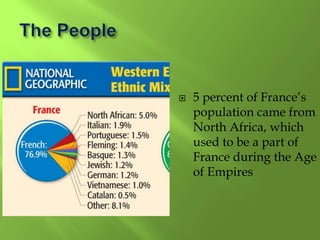
Ethnic composition, language, religion
Ethnic groups:
Arab/North African 5%;
Breton 1%;
Catalan .5%
Fleming 1.5
French 76.9
German 1.4
Portugues1.5
Vietnamese 1.0
 Western Europe is not
as ethnically diverse
as the USA or South
America.
Pie Chart
 A pie chart is a circle divided into color parts to
show proportions.
African
Am.
European
Am.
Hispanic
Am.
Americans
Asian Am.
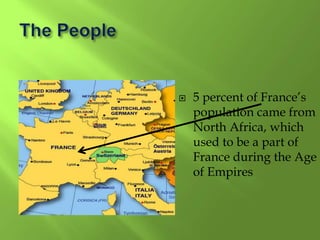
 5 percent of France’s
population came from
North Africa, which
used to be a part of
France during the Age
of Empires
 5 percent of France’s
population came from
North Africa, which
used to be a part of
France during the Age
of Empires
 5 percent of France’s
population came from
North Africa, which
used to be a part of
France during the Age
of Empires
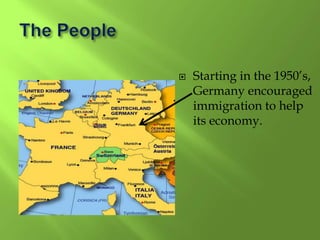
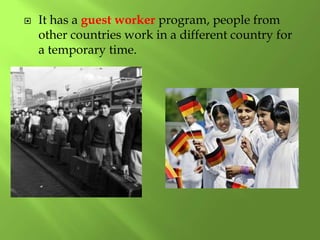
 Starting in the 1950’s,
Germany encouraged
immigration to help
its economy.
 It has a guest worker program, people from
other countries work in a different country for
a temporary time.
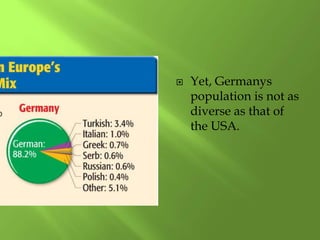
 Yet, Germanys
population is not as
diverse as that of
the USA.
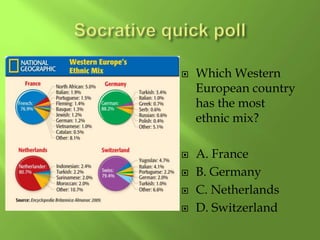
 Which Western
European country
has the most
ethnic mix?
 A. France
 B. Germany
 C. Netherlands
 D. Switzerland
 In Western Europe, most of the population is
urban.
 Germany has the most people in Europe (82
million).
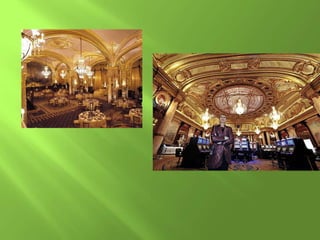
 Monaco is the smallest only 0.78 sq mi , with a
population of 36,371.
 Monaco is the smallest only 0.78 sq mi , with a
population of 36,371.
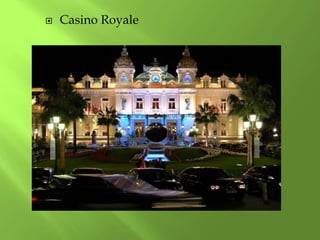
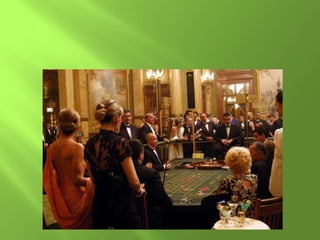
 Casino Royale
 Most people in France live in
Paris, or along the Southern
Coast.
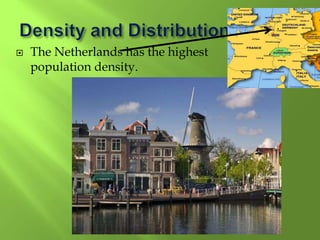
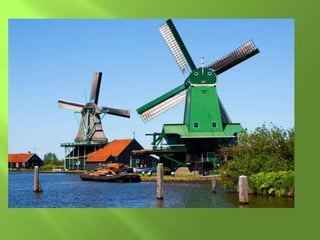
 The Netherlands has the highest
population density.
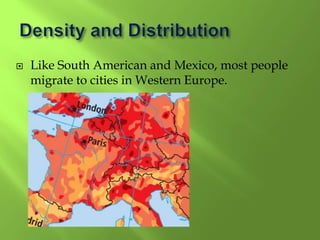
 Like South American and Mexico, most people
migrate to cities in Western Europe.
 Some people work in the cities, but live
outside the city called suburbanization.
 Suburbanization is the growth of areas on the
edge of cities
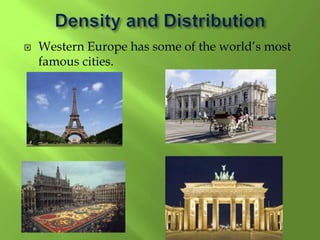
 Western Europe has some of the world’s most
famous cities.
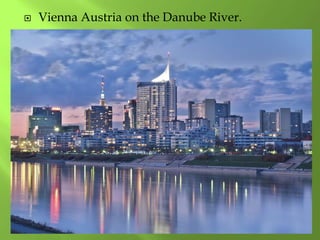
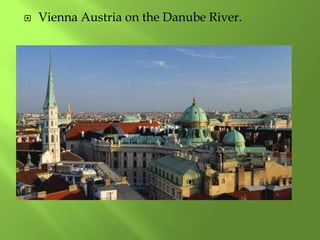
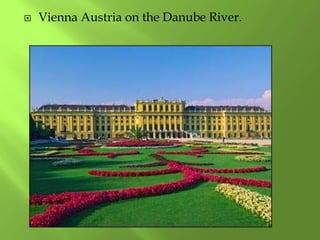
 Vienna
 Vienna Austria on the Danube River.
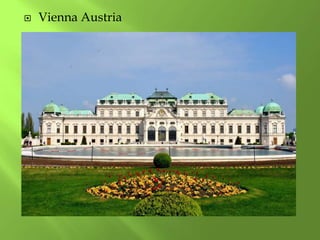
 Vienna Austria
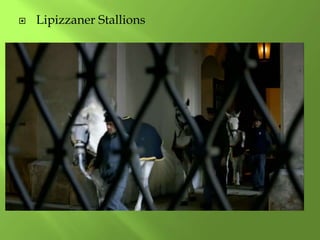
 Lipizzaner Stallions
 Berlin
 Berlin
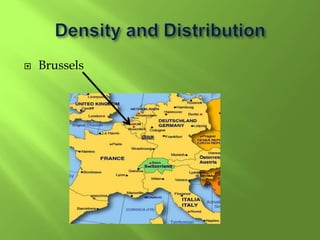
 Brussels
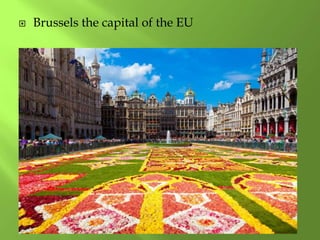
 Brussels the capital of the EU
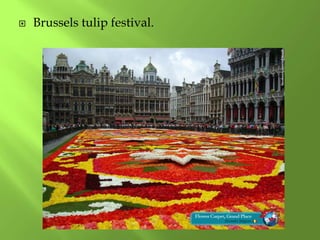
 Brussels tulip festival.
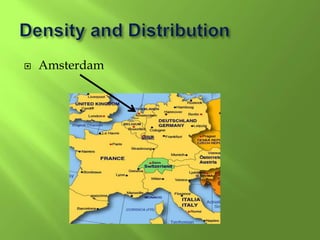
 Amsterdam
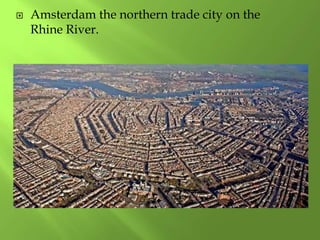
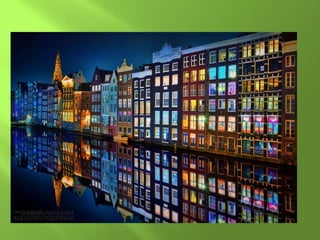
 Amsterdam the northern trade city on the
Rhine River.
 Amsterdam the northern trade city on the
Rhine River.
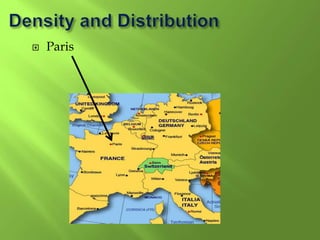
 Paris
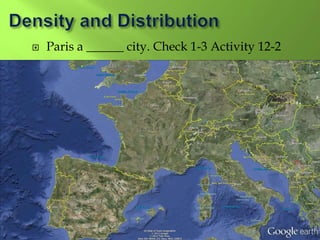
 Paris a ______ city. Check 1-3 Activity 12-2
 Check 1-3 Activity 12-2
 700’s BCE-476 Classical Greece, Alexander, Rome
 500-800 Dark Ages, Vikings
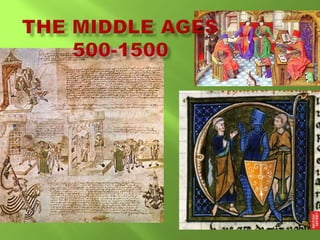
 800-1500 Middle Ages, Crusades, Reformation
 1400-1600’s Renaissance, Age of Exploration
 1700-1900 Age of Empires, Industrial Revolution
 1900’s World Wars, Cold War
 Middle Ages and Reformation created many of
the religions still practiced today and in the
USA.
 The Crusades (Wars of Christians vs. Muslims)
a conflict that many in the middle east see as
continuing up to today.
 Page 301-302
 Early Peoples
 Celts, Frisians and Basque prehistoric people
settled Western Europe thousands of years ago.
Frisians
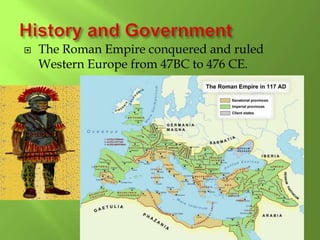
 The Roman Empire conquered and ruled
Western Europe from 47BC to 476 CE.
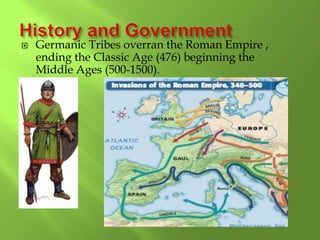
 Germanic Tribes overran the Roman Empire ,
ending the Classic Age (476) beginning the
Middle Ages (500-1500).
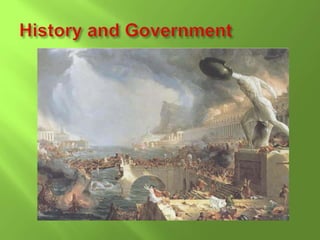
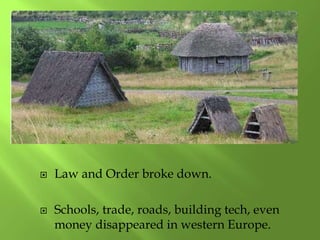
 Urban life , education, trade all disappeared.
 Law and Order broke down.
 Schools, trade, roads, building tech, even
money disappeared in western Europe.
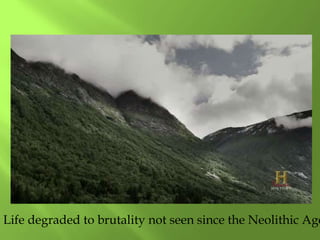
Life degraded to brutality not seen since the Neolithic Age
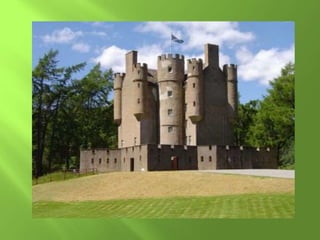
 Local strongmen built castles, people who could
not fight looked to them for protection.
 The Rise of Western Europe
 The Franks (a Germanic tribe) conquered western
Europe.
 The Franks accepted Christianity and
protected the Roman Catholic Church.
 Charlemagne (768-814) expanded the Frankish
Kingdom.
 Pope Leo III crowned Charlemagne Holy
Roman Emperor on Christmas day 800.
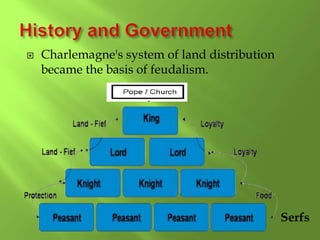
 Charlemagne's system of land distribution
became the basis of feudalism.
Serfs
 In 843, Charlemagne’s
Empire was divided
among his sons.
 The Western part
became France,
 The Eastern part called
the German States or
Holy Roman Empire .
 The middle fought over
as the neither lands.
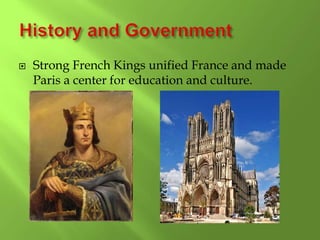
 Strong French Kings unified France and made
Paris a center for education and culture.
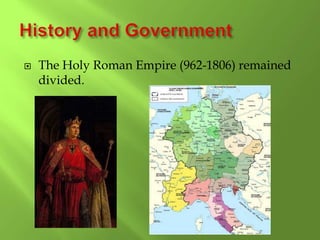
 The Holy Roman Empire (962-1806) remained
divided.
 The German emperor, nobles and popes all
fought for control
 The Netherlands became a center for trade,
merchants usually ran the city governments.
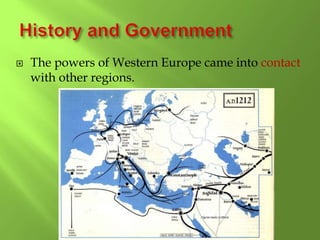
 The powers of Western Europe came into contact
with other regions.
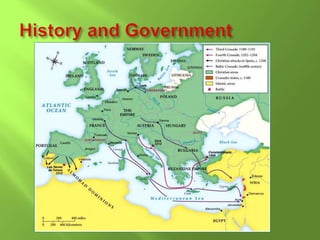
 From 1089 - 1291, the Christian Europeans fought
Crusades to take Jerusalem from Muslim rule.
Pope Urban II calls for
The First Crusade.
 The Crusades were military campaigns started
by the Roman Catholic Church to take land
around Jerusalem from the Muslims.
 The Christian Crusaders took Jerusalem in the first
Crusade, but eventually the Muslim leader Saladin
drove them out.
 Page 301-302
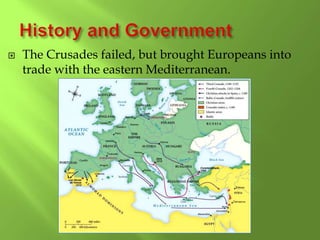
 The Crusades failed, but brought Europeans into
trade with the eastern Mediterranean.
 Medieval paintings
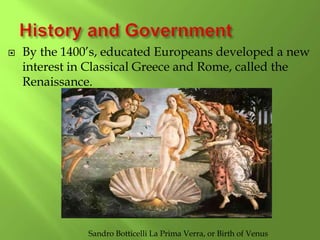
 By the 1400’s, educated Europeans developed a new
interest in Classical Greece and Rome, called the
Renaissance.
Sandro Botticelli La Prima Verra, or Birth of Venus
Perspective
 By the 1400’s, educated Europeans developed a
new interest in Classical Greece and Rome, called
the Renaissance.
Leonardo da Vinci, started in Florence Italy, but moved to Paris France
 By the 1400’s, educated Europeans developed a
new interest in Classical Greece and Rome, called
the Renaissance.
Michelangelo’s David (Florence) and Pieta (Vatican City)
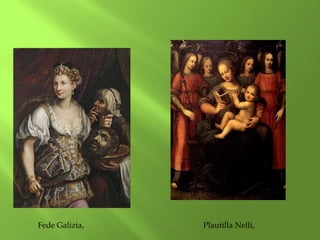
Fede Galizia, Plautilla Nelli,
 Merchants from Italy spread these ideas which
became popular throughout Europe.
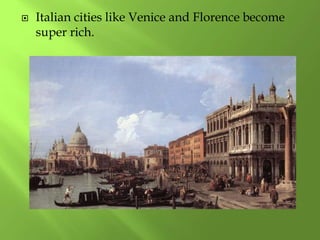
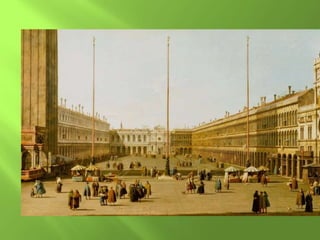
 Italian cities like Venice and Florence become
super rich.
 Many people and kings resented the Pope and Roman
Catholic Church, who had become super powerful.
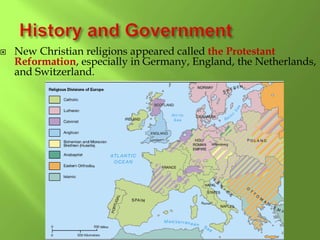
 New Christian religions appeared called the Protestant
Reformation, especially in Germany, England, the Netherlands,
and Switzerland.
 Protestant Reformation, [a] a movement against
what the Protestants considered to be errors in
the Roman Catholic Church. It is one of the
major divisions of Christianity.
 Martin Luther rejected the RCC and started the
Lutheran Church in Germany.
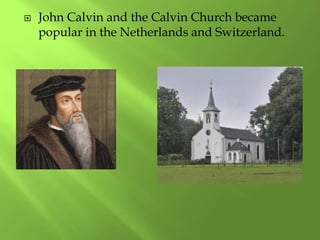
 John Calvin and the Calvin Church became
popular in the Netherlands and Switzerland.
 From 1524 to 1648, they fought religious wars
Protestants vs. Catholics.
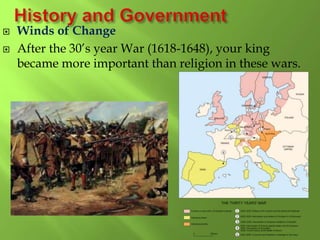
 Winds of Change
 After the 30’s year War (1618-1648), your king
became more important than religion in these wars.
 What class did this benefit?
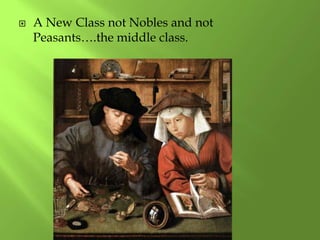
 A New Class not Nobles and not
Peasants….the middle class.
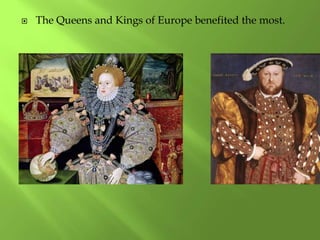
 The Queens and Kings of Europe benefited the most.
 Winds of Change
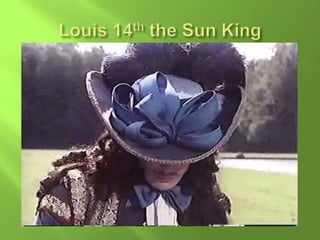
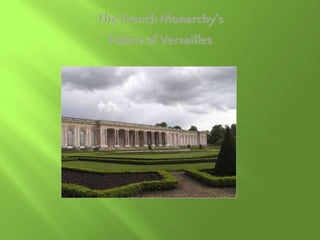
 France became a major world power
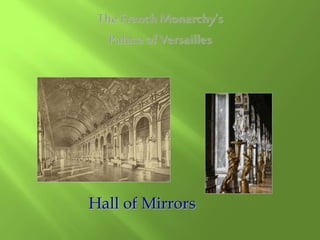
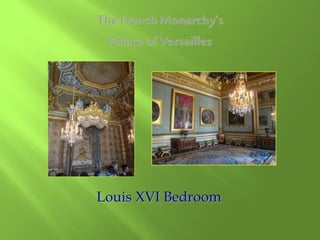
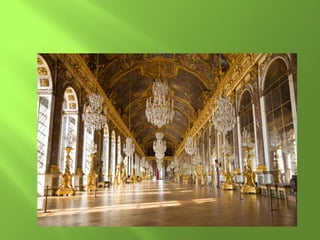
Louis 14th of France builds the Palace of Versailles
Hall of Mirrors
Louis XVI Bedroom
Drawing Room
 Winds of Change
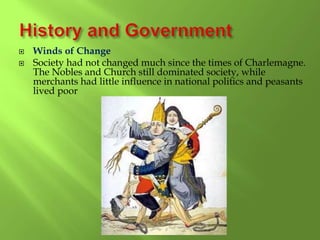
 Society had not changed much since the times of Charlemagne.
The Nobles and Church still dominated society, while
merchants had little influence in national politics and peasants
lived poor
 Winds of Change
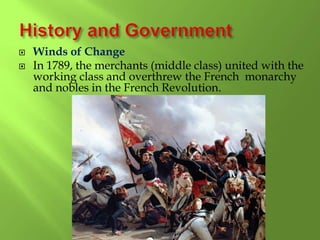
 In 1789, the merchants (middle class) united with the
working class and overthrew the French monarchy
and nobles in the French Revolution.
 Winds of Change
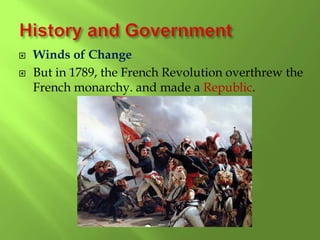
 But in 1789, the French Revolution overthrew the
French monarchy. and made a Republic.
 republic; plural noun: republics
 a state in which supreme power is held by the
people and their elected representatives, and
which has an elected or nominated president
rather than a monarch.
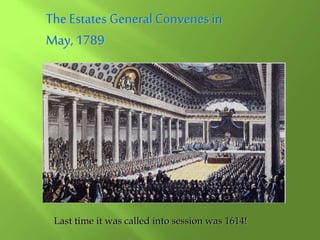
The Estates General Convenes in
May, 1789
Last time it was called into session was 1614!
Storming theBastille, July 14, 1789
Celebrated today as France’s day of independence.
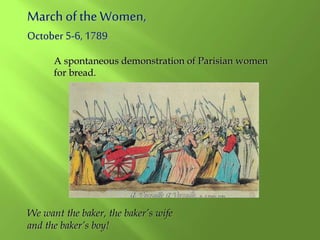
March of the Women,
October 5-6, 1789
We want the baker, the baker’s wife
and the baker’s boy!
A spontaneous demonstration of Parisian women
for bread.
 Winds of Change
 During the French Revolution, nationalism
became the most important factor.
 Nationalism: loyalty and devotion to a country.
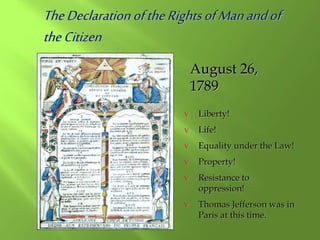
TheDeclarationoftheRightsofManandof
theCitizen
August 26,
1789
V Liberty!
V Life!
V Equality under the Law!
V Property!
V Resistance to
oppression!
V Thomas Jefferson was in
Paris at this time.
Olympe deGouges(1745-1793)
Declaration of the
Rights of Woman
and of the Citizen
(1791)
V Women played a vital
role in the Revolution.
V But, The Declaration of
the Rights of Man did
NOT extend the rights
and protections of
citizenship to women.
The Tricolor (1789)
The WHITE of the
Bourbons + the RED &
BLUE of Paris.
Citizen!
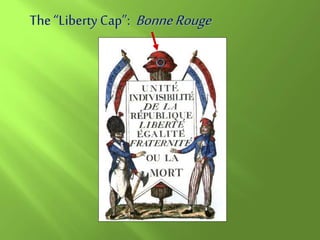
The “Liberty Cap”: BonneRouge
Revolutionary Symbols
Cockade
Revolutionary
Clock
La Republic
Liberté
TheRoyal FamilyAttempts
to Flee
June, 1791
Helped by the Swedish Count Hans Axel von
Fusen [Marie Antoinette’s lover].
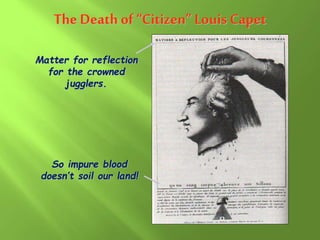
The Death of “Citizen” Louis Capet
Matter for reflection
for the crowned
jugglers.
So impure blood
doesn’t soil our land!
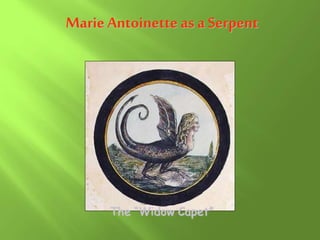
Marie Antoinette as a Serpent
The “Widow Capet”
Marie Antoinette
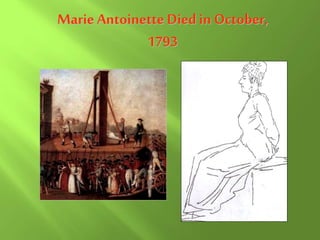
in Prison remembering Bastille Dayon her way to the guillotin
Marie Antoinette Died in October,
1793
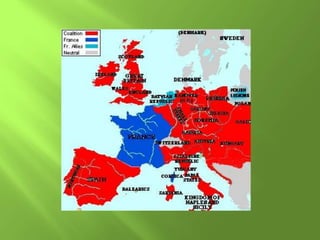
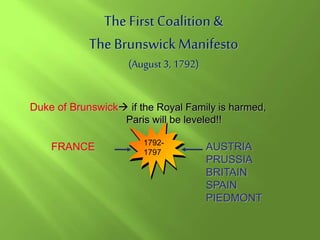
The First Coalition &
The Brunswick Manifesto
(August 3, 1792)
FRANCE 1792-
1797
AUSTRIA
PRUSSIA
BRITAIN
SPAIN
PIEDMONT
Duke of Brunswick if the Royal Family is harmed,
Paris will be leveled!!
 Winds of Change
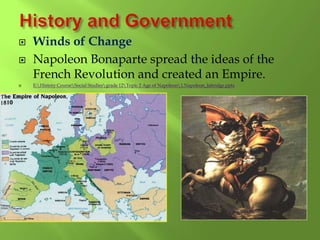
 Napoleon Bonaparte spread the ideas of the
French Revolution and created an Empire.
 E:History CourseSocial Studiesgrade 12Topic 2 Age of Napoleon1.Napoleon_Iabridge.pptx
 Winds of Change
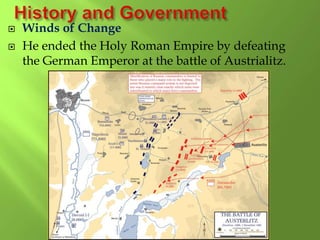
 He ended the Holy Roman Empire by defeating
the German Emperor at the battle of Austrialitz.
Napoleon’s Defeat at Waterloo
(June 18,1815)
Duke
of
Wellington
Prussian
General
Blücher
Battle of Waterloo Napoleon commits the Guard.flv
 Winds of Change
 Prussia (a German state) unified Germany under a
new emperor the czar.
 Winds of Change
 Germany prospered and built up its military.
 Winds of Change
 Rivalries between the Central Powers (Imperial
Germany, Austria, Russia) and Allies (France,
England, Italy)led Europe into World War I
(1914-1918) .
 Winds of Change
 Western Europe suffered enormous casualties.
 Winds of Change
 The Germans were found guilty of starting the
war and France and England made it pay
reparations for damages.
 Winds of Change
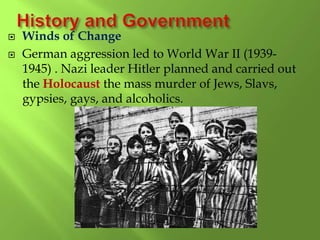
 German aggression led to World War II (1939-
1945) . Nazi leader Hitler planned and carried out
the Holocaust the mass murder of Jews, Slavs,
gypsies, gays, and alcoholics.
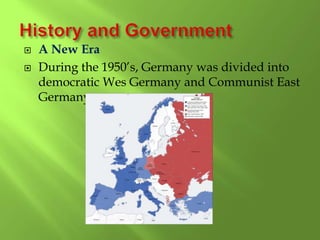
 A New Era
 During the 1950’s, Germany was divided into
democratic Wes Germany and Communist East
Germany.
 A New Era
 This division remained until the end of the
Cold War and fall of the Soviet Union in 1991.
 A New Era
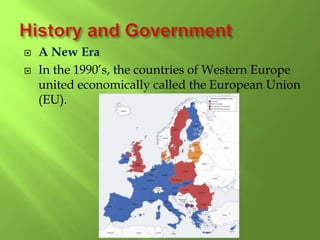
 In the 1990’s, the countries of Western Europe
united economically called the European Union
(EU).
 The Arts
 France has been world leaders in literature,
architecture, music and visual arts.
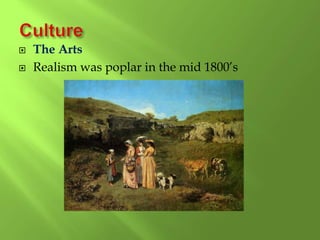
 The Arts
 Realism was poplar in the mid 1800’s
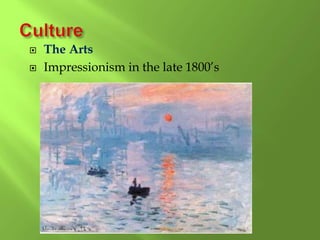
 The Arts
 Impressionism in the late 1800’s
 The Arts
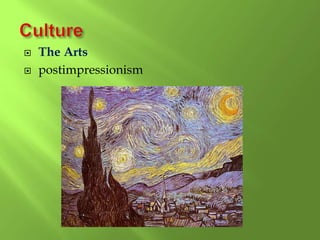
 postimpressionism
 The Arts
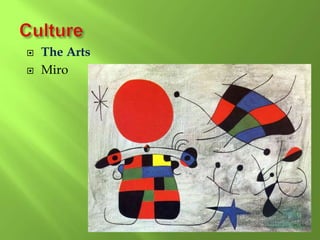
 Miro
 Language and Religions
 Most western Europeans speak Indo European
languages, like French and German. Many
countries have one or more official languages.
 Language and Religions
 Christianity is the main religion of Western
Europe.
 Catholic Protestants
 Education and Health Care
 All children are educated. 98-100 percent can
read.
 Everyone has health care. Germany funds
heath, education, unemployment .
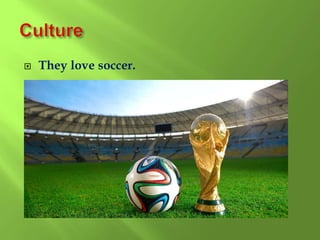
 They love soccer.

19.western europe

  • 1.
  • 2.
  • 3.
     Why studyWestern Europe?
  • 4.
     The USAis a country of immigrants.  37.8 Percent of Americans have European heritage. African Am. European Am. Hispanic Am. Americans Asian Am.
  • 5.
     Western Europeand the USA are important trade partners.
  • 6.
     Las Vegasis a favorite destination for Europeans. Western Europe, the city’s second biggest international market — up 81.7 percent since 2003.
  • 7.
     Locate thecountries and cities on your maps.
  • 8.
     Western Europe'spopulation patterns have been shaped by physical geography, migration, and world events.
  • 9.
     Although small,Western Europe has a big population (400 million)
  • 10.
     The distancefrom the Pyrenees to the German/Polish boarder is only 800-1000 miles.
  • 11.
     1016 miles,distance Los Angles to Denver via Las Vegas
  • 12.
     Switzerland isa blended European cultures. It has 3 official languages German, French, and Italian.
  • 14.
     Geneva isthe capital, famous for banking.
  • 15.
     Geneva isthe capital, famous for banking.
  • 16.
     The Alpsmark the boarder of 4 seasons in Western Europe
  • 17.
     The Alpsmark the boarder of 4 seasons in Western Europe
  • 20.
     Western Europeis not as ethnically diverse as the USA or South America. Pie Chart
  • 21.
     Western Europeis not as ethnically diverse as the USA or South America. Ethnic composition, language, religion Ethnic groups: Arab/North African 5%; Breton 1%; Catalan .5% Fleming 1.5 French 76.9 German 1.4 Portugues1.5 Vietnamese 1.0
  • 22.
     Western Europeis not as ethnically diverse as the USA or South America. Pie Chart
  • 23.
     A piechart is a circle divided into color parts to show proportions.
  • 24.
  • 25.
     5 percentof France’s population came from North Africa, which used to be a part of France during the Age of Empires
  • 26.
     5 percentof France’s population came from North Africa, which used to be a part of France during the Age of Empires
  • 27.
     5 percentof France’s population came from North Africa, which used to be a part of France during the Age of Empires
  • 28.
     Starting inthe 1950’s, Germany encouraged immigration to help its economy.
  • 29.
     It hasa guest worker program, people from other countries work in a different country for a temporary time.
  • 30.
     Yet, Germanys populationis not as diverse as that of the USA.
  • 31.
     Which Western Europeancountry has the most ethnic mix?  A. France  B. Germany  C. Netherlands  D. Switzerland
  • 32.
     In WesternEurope, most of the population is urban.
  • 33.
     Germany hasthe most people in Europe (82 million).
  • 34.
     Monaco isthe smallest only 0.78 sq mi , with a population of 36,371.
  • 35.
     Monaco isthe smallest only 0.78 sq mi , with a population of 36,371.
  • 36.
  • 40.
     Most peoplein France live in Paris, or along the Southern Coast.
  • 41.
     The Netherlandshas the highest population density.
  • 42.
     Like SouthAmerican and Mexico, most people migrate to cities in Western Europe.
  • 43.
     Some peoplework in the cities, but live outside the city called suburbanization.
  • 44.
     Suburbanization isthe growth of areas on the edge of cities
  • 45.
     Western Europehas some of the world’s most famous cities.
  • 46.
  • 47.
     Vienna Austriaon the Danube River.
  • 48.
     Vienna Austriaon the Danube River.
  • 49.
     Vienna Austriaon the Danube River.
  • 50.
  • 53.
  • 54.
  • 55.
  • 56.
  • 57.
  • 58.
     Brussels thecapital of the EU
  • 59.
     Brussels thecapital of the EU
  • 60.
  • 61.
  • 62.
     Amsterdam thenorthern trade city on the Rhine River.
  • 63.
     Amsterdam thenorthern trade city on the Rhine River.
  • 67.
  • 68.
     Paris a______ city. Check 1-3 Activity 12-2
  • 69.
     Check 1-3Activity 12-2
  • 70.
     700’s BCE-476Classical Greece, Alexander, Rome  500-800 Dark Ages, Vikings  800-1500 Middle Ages, Crusades, Reformation  1400-1600’s Renaissance, Age of Exploration  1700-1900 Age of Empires, Industrial Revolution  1900’s World Wars, Cold War
  • 71.
     Middle Agesand Reformation created many of the religions still practiced today and in the USA.  The Crusades (Wars of Christians vs. Muslims) a conflict that many in the middle east see as continuing up to today.
  • 72.
  • 73.
     Early Peoples Celts, Frisians and Basque prehistoric people settled Western Europe thousands of years ago. Frisians
  • 74.
     The RomanEmpire conquered and ruled Western Europe from 47BC to 476 CE.
  • 75.
     Germanic Tribesoverran the Roman Empire , ending the Classic Age (476) beginning the Middle Ages (500-1500).
  • 78.
     Urban life, education, trade all disappeared.
  • 79.
     Law andOrder broke down.  Schools, trade, roads, building tech, even money disappeared in western Europe.
  • 80.
    Life degraded tobrutality not seen since the Neolithic Age
  • 81.
     Local strongmenbuilt castles, people who could not fight looked to them for protection.
  • 82.
     The Riseof Western Europe  The Franks (a Germanic tribe) conquered western Europe.
  • 83.
     The Franksaccepted Christianity and protected the Roman Catholic Church.
  • 84.
     Charlemagne (768-814)expanded the Frankish Kingdom.
  • 85.
     Pope LeoIII crowned Charlemagne Holy Roman Emperor on Christmas day 800.
  • 86.
     Charlemagne's systemof land distribution became the basis of feudalism. Serfs
  • 96.
     In 843,Charlemagne’s Empire was divided among his sons.  The Western part became France,  The Eastern part called the German States or Holy Roman Empire .  The middle fought over as the neither lands.
  • 97.
     Strong FrenchKings unified France and made Paris a center for education and culture.
  • 98.
     The HolyRoman Empire (962-1806) remained divided.
  • 99.
     The Germanemperor, nobles and popes all fought for control
  • 100.
     The Netherlandsbecame a center for trade, merchants usually ran the city governments.
  • 101.
     The powersof Western Europe came into contact with other regions.
  • 102.
     From 1089- 1291, the Christian Europeans fought Crusades to take Jerusalem from Muslim rule. Pope Urban II calls for The First Crusade.
  • 103.
     The Crusadeswere military campaigns started by the Roman Catholic Church to take land around Jerusalem from the Muslims.
  • 105.
     The ChristianCrusaders took Jerusalem in the first Crusade, but eventually the Muslim leader Saladin drove them out.
  • 106.
  • 107.
     The Crusadesfailed, but brought Europeans into trade with the eastern Mediterranean.
  • 108.
  • 109.
     By the1400’s, educated Europeans developed a new interest in Classical Greece and Rome, called the Renaissance. Sandro Botticelli La Prima Verra, or Birth of Venus
  • 110.
  • 111.
     By the1400’s, educated Europeans developed a new interest in Classical Greece and Rome, called the Renaissance. Leonardo da Vinci, started in Florence Italy, but moved to Paris France
  • 112.
     By the1400’s, educated Europeans developed a new interest in Classical Greece and Rome, called the Renaissance. Michelangelo’s David (Florence) and Pieta (Vatican City)
  • 113.
  • 114.
     Merchants fromItaly spread these ideas which became popular throughout Europe.
  • 115.
     Italian citieslike Venice and Florence become super rich.
  • 117.
     Many peopleand kings resented the Pope and Roman Catholic Church, who had become super powerful.
  • 118.
     New Christianreligions appeared called the Protestant Reformation, especially in Germany, England, the Netherlands, and Switzerland.
  • 119.
     Protestant Reformation,[a] a movement against what the Protestants considered to be errors in the Roman Catholic Church. It is one of the major divisions of Christianity.
  • 120.
     Martin Lutherrejected the RCC and started the Lutheran Church in Germany.
  • 121.
     John Calvinand the Calvin Church became popular in the Netherlands and Switzerland.
  • 123.
     From 1524to 1648, they fought religious wars Protestants vs. Catholics.
  • 124.
     Winds ofChange  After the 30’s year War (1618-1648), your king became more important than religion in these wars.
  • 125.
     What classdid this benefit?
  • 126.
     A NewClass not Nobles and not Peasants….the middle class.
  • 127.
     The Queensand Kings of Europe benefited the most.
  • 128.
     Winds ofChange  France became a major world power Louis 14th of France builds the Palace of Versailles
  • 132.
  • 133.
  • 134.
  • 138.
     Winds ofChange  Society had not changed much since the times of Charlemagne. The Nobles and Church still dominated society, while merchants had little influence in national politics and peasants lived poor
  • 139.
     Winds ofChange  In 1789, the merchants (middle class) united with the working class and overthrew the French monarchy and nobles in the French Revolution.
  • 140.
     Winds ofChange  But in 1789, the French Revolution overthrew the French monarchy. and made a Republic.
  • 141.
     republic; pluralnoun: republics  a state in which supreme power is held by the people and their elected representatives, and which has an elected or nominated president rather than a monarch.
  • 142.
    The Estates GeneralConvenes in May, 1789 Last time it was called into session was 1614!
  • 143.
    Storming theBastille, July14, 1789 Celebrated today as France’s day of independence.
  • 144.
    March of theWomen, October 5-6, 1789 We want the baker, the baker’s wife and the baker’s boy! A spontaneous demonstration of Parisian women for bread.
  • 145.
     Winds ofChange  During the French Revolution, nationalism became the most important factor.
  • 146.
     Nationalism: loyaltyand devotion to a country.
  • 147.
    TheDeclarationoftheRightsofManandof theCitizen August 26, 1789 V Liberty! VLife! V Equality under the Law! V Property! V Resistance to oppression! V Thomas Jefferson was in Paris at this time.
  • 148.
    Olympe deGouges(1745-1793) Declaration ofthe Rights of Woman and of the Citizen (1791) V Women played a vital role in the Revolution. V But, The Declaration of the Rights of Man did NOT extend the rights and protections of citizenship to women.
  • 149.
    The Tricolor (1789) TheWHITE of the Bourbons + the RED & BLUE of Paris. Citizen!
  • 150.
  • 151.
  • 152.
    TheRoyal FamilyAttempts to Flee June,1791 Helped by the Swedish Count Hans Axel von Fusen [Marie Antoinette’s lover].
  • 153.
    The Death of“Citizen” Louis Capet Matter for reflection for the crowned jugglers. So impure blood doesn’t soil our land!
  • 154.
    Marie Antoinette asa Serpent The “Widow Capet”
  • 155.
    Marie Antoinette in Prisonremembering Bastille Dayon her way to the guillotin
  • 156.
    Marie Antoinette Diedin October, 1793
  • 158.
    The First Coalition& The Brunswick Manifesto (August 3, 1792) FRANCE 1792- 1797 AUSTRIA PRUSSIA BRITAIN SPAIN PIEDMONT Duke of Brunswick if the Royal Family is harmed, Paris will be leveled!!
  • 159.
     Winds ofChange  Napoleon Bonaparte spread the ideas of the French Revolution and created an Empire.  E:History CourseSocial Studiesgrade 12Topic 2 Age of Napoleon1.Napoleon_Iabridge.pptx
  • 160.
     Winds ofChange  He ended the Holy Roman Empire by defeating the German Emperor at the battle of Austrialitz.
  • 161.
    Napoleon’s Defeat atWaterloo (June 18,1815) Duke of Wellington Prussian General Blücher Battle of Waterloo Napoleon commits the Guard.flv
  • 162.
     Winds ofChange  Prussia (a German state) unified Germany under a new emperor the czar.
  • 163.
     Winds ofChange  Germany prospered and built up its military.
  • 164.
     Winds ofChange  Rivalries between the Central Powers (Imperial Germany, Austria, Russia) and Allies (France, England, Italy)led Europe into World War I (1914-1918) .
  • 165.
     Winds ofChange  Western Europe suffered enormous casualties.
  • 166.
     Winds ofChange  The Germans were found guilty of starting the war and France and England made it pay reparations for damages.
  • 167.
     Winds ofChange  German aggression led to World War II (1939- 1945) . Nazi leader Hitler planned and carried out the Holocaust the mass murder of Jews, Slavs, gypsies, gays, and alcoholics.
  • 168.
     A NewEra  During the 1950’s, Germany was divided into democratic Wes Germany and Communist East Germany.
  • 169.
     A NewEra  This division remained until the end of the Cold War and fall of the Soviet Union in 1991.
  • 170.
     A NewEra  In the 1990’s, the countries of Western Europe united economically called the European Union (EU).
  • 171.
     The Arts France has been world leaders in literature, architecture, music and visual arts.
  • 172.
     The Arts Realism was poplar in the mid 1800’s
  • 173.
     The Arts Impressionism in the late 1800’s
  • 174.
     The Arts postimpressionism
  • 175.
  • 176.
     Language andReligions  Most western Europeans speak Indo European languages, like French and German. Many countries have one or more official languages.
  • 177.
     Language andReligions  Christianity is the main religion of Western Europe.  Catholic Protestants
  • 178.
     Education andHealth Care  All children are educated. 98-100 percent can read.  Everyone has health care. Germany funds heath, education, unemployment .
  • 179.