GERMANY
Sarina Delavari
Derakhshesh high school
9/3
By:
GERMANY
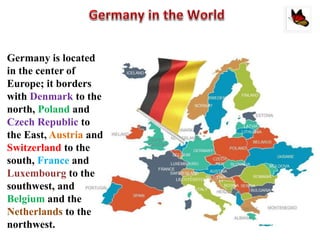
Germany is located
in the center of
Europe; it borders
with Denmark to the
north, Poland and
Czech Republic to
the East, Austria and
Switzerland to the
south, France and
Luxembourg to the
southwest, and
Belgium and the
Netherlands to the
northwest.
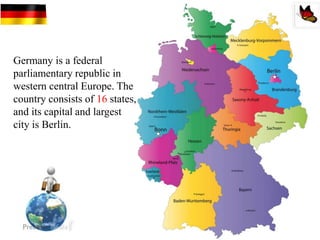
Germany is a federal
parliamentary republic in
western central Europe. The
country consists of 16 states,
and its capital and largest
city is Berlin.
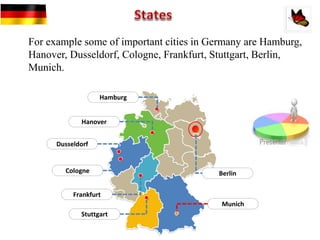
For example some of important cities in Germany are Hamburg,
Hanover, Dusseldorf, Cologne, Frankfurt, Stuttgart, Berlin,
Munich.
Dusseldorf
Hamburg
Stuttgart
Frankfurt
Cologne
Hanover
Berlin
Munich
Berlin is the capital city of Germany. It is also the biggest city
in Germany. About 3,700,000 people live there. Flag of Berlin
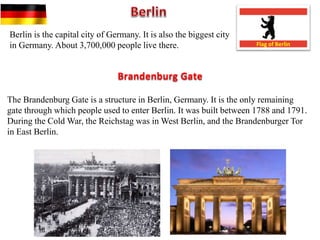
The Brandenburg Gate is a structure in Berlin, Germany. It is the only remaining
gate through which people used to enter Berlin. It was built between 1788 and 1791.
During the Cold War, the Reichstag was in West Berlin, and the Brandenburger Tor
in East Berlin.
Brandenburg Gate
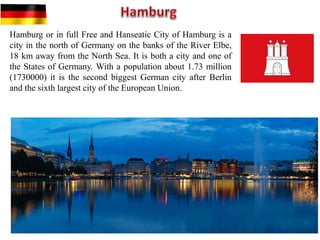
Hamburg or in full Free and Hanseatic City of Hamburg is a
city in the north of Germany on the banks of the River Elbe,
18 km away from the North Sea. It is both a city and one of
the States of Germany. With a population about 1.73 million
(1730000) it is the second biggest German city after Berlin
and the sixth largest city of the European Union.
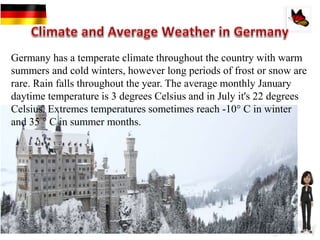
Munich (German: München) is the third biggest city of
Germany (after Berlin and Hamburg). It has a population of
1,407,000. It is one of the most important centres of the
economy in Germany and an oceanic climate.
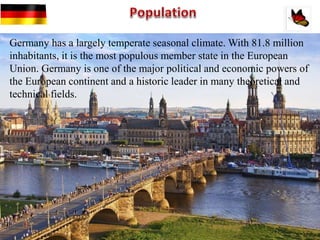
The city was founded by the Romans in the year 50.
Before that, it was a Roman castle and a town
inhabited by a local German tribe named Ubier at
least for 100 years.
Germany has a temperate climate throughout the country with warm
summers and cold winters, however long periods of frost or snow are
rare. Rain falls throughout the year. The average monthly January
daytime temperature is 3 degrees Celsius and in July it's 22 degrees
Celsius. Extremes temperatures sometimes reach -10° C in winter
and 35 ° C in summer months.
Germany has a largely temperate seasonal climate. With 81.8 million
inhabitants, it is the most populous member state in the European
Union. Germany is one of the major political and economic powers of
the European continent and a historic leader in many theoretical and
technical fields.
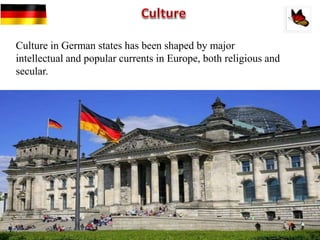
Culture in German states has been shaped by major
intellectual and popular currents in Europe, both religious and
secular.
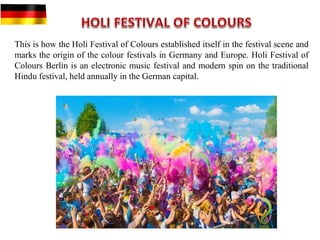
This is how the Holi Festival of Colours established itself in the festival scene and
marks the origin of the colour festivals in Germany and Europe. Holi Festival of
Colours Berlin is an electronic music festival and modern spin on the traditional
Hindu festival, held annually in the German capital.
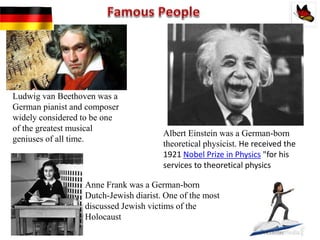
Ludwig van Beethoven was a
German pianist and composer
widely considered to be one
of the greatest musical
geniuses of all time.
Albert Einstein was a German-born
theoretical physicist. He received the
1921 Nobel Prize in Physics "for his
services to theoretical physics
Anne Frank was a German-born
Dutch-Jewish diarist. One of the most
discussed Jewish victims of the
Holocaust
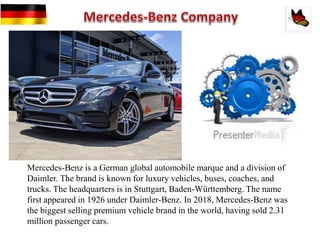
Mercedes-Benz is a German global automobile marque and a division of
Daimler. The brand is known for luxury vehicles, buses, coaches, and
trucks. The headquarters is in Stuttgart, Baden-Württemberg. The name
first appeared in 1926 under Daimler-Benz. In 2018, Mercedes-Benz was
the biggest selling premium vehicle brand in the world, having sold 2.31
million passenger cars.
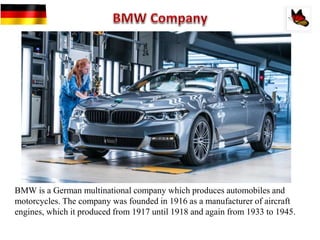
BMW is a German multinational company which produces automobiles and
motorcycles. The company was founded in 1916 as a manufacturer of aircraft
engines, which it produced from 1917 until 1918 and again from 1933 to 1945.
Germany Country Description

Germany Country Description

  • 1.
  • 2.
  • 3.
    Germany is located inthe center of Europe; it borders with Denmark to the north, Poland and Czech Republic to the East, Austria and Switzerland to the south, France and Luxembourg to the southwest, and Belgium and the Netherlands to the northwest.
  • 4.
    Germany is afederal parliamentary republic in western central Europe. The country consists of 16 states, and its capital and largest city is Berlin.
  • 5.
    For example someof important cities in Germany are Hamburg, Hanover, Dusseldorf, Cologne, Frankfurt, Stuttgart, Berlin, Munich. Dusseldorf Hamburg Stuttgart Frankfurt Cologne Hanover Berlin Munich
  • 6.
    Berlin is thecapital city of Germany. It is also the biggest city in Germany. About 3,700,000 people live there. Flag of Berlin The Brandenburg Gate is a structure in Berlin, Germany. It is the only remaining gate through which people used to enter Berlin. It was built between 1788 and 1791. During the Cold War, the Reichstag was in West Berlin, and the Brandenburger Tor in East Berlin. Brandenburg Gate
  • 7.
    Hamburg or infull Free and Hanseatic City of Hamburg is a city in the north of Germany on the banks of the River Elbe, 18 km away from the North Sea. It is both a city and one of the States of Germany. With a population about 1.73 million (1730000) it is the second biggest German city after Berlin and the sixth largest city of the European Union.
  • 8.
    Munich (German: München)is the third biggest city of Germany (after Berlin and Hamburg). It has a population of 1,407,000. It is one of the most important centres of the economy in Germany and an oceanic climate.
  • 9.
    The city wasfounded by the Romans in the year 50. Before that, it was a Roman castle and a town inhabited by a local German tribe named Ubier at least for 100 years.
  • 10.
    Germany has atemperate climate throughout the country with warm summers and cold winters, however long periods of frost or snow are rare. Rain falls throughout the year. The average monthly January daytime temperature is 3 degrees Celsius and in July it's 22 degrees Celsius. Extremes temperatures sometimes reach -10° C in winter and 35 ° C in summer months.
  • 11.
    Germany has alargely temperate seasonal climate. With 81.8 million inhabitants, it is the most populous member state in the European Union. Germany is one of the major political and economic powers of the European continent and a historic leader in many theoretical and technical fields.
  • 12.
    Culture in Germanstates has been shaped by major intellectual and popular currents in Europe, both religious and secular.
  • 14.
    This is howthe Holi Festival of Colours established itself in the festival scene and marks the origin of the colour festivals in Germany and Europe. Holi Festival of Colours Berlin is an electronic music festival and modern spin on the traditional Hindu festival, held annually in the German capital.
  • 17.
    Ludwig van Beethovenwas a German pianist and composer widely considered to be one of the greatest musical geniuses of all time. Albert Einstein was a German-born theoretical physicist. He received the 1921 Nobel Prize in Physics "for his services to theoretical physics Anne Frank was a German-born Dutch-Jewish diarist. One of the most discussed Jewish victims of the Holocaust
  • 18.
    Mercedes-Benz is aGerman global automobile marque and a division of Daimler. The brand is known for luxury vehicles, buses, coaches, and trucks. The headquarters is in Stuttgart, Baden-Württemberg. The name first appeared in 1926 under Daimler-Benz. In 2018, Mercedes-Benz was the biggest selling premium vehicle brand in the world, having sold 2.31 million passenger cars.
  • 19.
    BMW is aGerman multinational company which produces automobiles and motorcycles. The company was founded in 1916 as a manufacturer of aircraft engines, which it produced from 1917 until 1918 and again from 1933 to 1945.