GERMAN MEDIA
Germany, officially the Federal Republic of Germany or FRG is a federal parliamentary
republic in West-Central Europe.
Germany is the country located in the centre of the continent, in the “heart of Europe” some
may say it includes 16 constituent states, and has a largely temperate seasonal climate.
Its capital and largest city is Berlin. Germany is the most populous member state of the
European Union. After the United States, it is the second most popular migration destination
in the world. Germany was a founding member of the European Union in 1993 and a leading
member.
• Capital : Berlin
• Language: German
• Population: 81,459,000
• Literacy rate: 99.0%
• Number of Daily Newspapers: 382
• Germany looks back at a long history of mass
media. Some of the first newspapers started
here roughly 400 years ago. During the years
of the Nazi domain the mass media had
become a tool of the dictatorship. In 1945 the
media experienced an "hour zero" and started
nearly completely anew. The post-war media
system was based on the principle of press
freedom as stipulated in the basic law
(constitution) of 1949.
• Now - in Germany there is a variety of media
corporations: publishing houses, radio and tv
stations, news agencies and free lancers.
• The freedom of the press is guaranteed by the federal republic of Germany’s constitution.
Germany's competitive television market is the largest in Europe, with some 34 million TV
households.
• The many regional and national public broadcasters - organised in line with the federal
political structure - vie for audiences with powerful commercial operators. Each of the 16
regions regulates its own private and public broadcasting.
• Around 90% of German households have cable or satellite tv, and viewers enjoy a
comprehensive mix of free-to-view public and commercial channels. This has acted as a
brake on the development of pay-tv.
Germany is home to some of the world's largest media conglomerates, including Bertelsmann
and the publisher Axel Springer.
Germany has many different tv channels that cover all kinds of entertainment. there are also some
channels that only report on one topic, e.g. sport or politics.
There are two public broadcasters in Germany: “ARD” (“Allgemeine Rundfunkanstalten
Deutschlands”) and “ZDF” (“Zweites Deutsches Fernsehen”).
• ARD : As “ARD” was the first tv channel in Germany it is also called “das erste” (the first). All
regional channels also belong to “ARD”. These “dritten programme” (third channels) mainly focus on
regional topics, e.g. “MDR” reports on issues happening in saxony, thuringia and saxony-anhalt. If
you have a cable connection or a satellite dish you can watch the channels for each region from all
over Germany. The public radio stations of each individual German state also belong to “ARD”.
• ZDF: (second German television), usually shortened to ZDF, is a German public-service
television broadcaster based in Mainz. It is run as an independent nonprofit institution,
which was founded by all federal states of Germany. ZDF is financed by television licence
fees and advertising revenues.The ZDF is well known for its famous TV programmes
heute.
• RTL : RTL Television (originally Radio Télévisioun Lëtzebuerg), or simply RTL, is a
German commercial television station distributed via cable and satellite, as well as via
digital terrestrial (DVB-T) in more highly populated areas. It is owned by the RTL Group
and is, in terms of market share, Germany's largest private free-to-air broadcaster.
• The current slogan is "Mein RTL"
• It earned quite a lot of criticism, the channel is accused of faking and scripting reality and
live shows.
PROSIEBEN: Prosieben (sieben is German for seven) is a commercial television station
in Germany. It is largely distributed by cable and satellite. Prosieben is Germany's second
largest privately owned television company. There are three different variants of the channel:
Prosieben (for Germany), Prosieben Austria (for Austria) and Prosieben Schweiz (for
Switzerland). The main difference is that they have different adverts and news for each target
country. The channel uses an English slogan.
PRESS
NEWSPAPERS AND MAGAZINES
In addition to books, newspapers and magazines have
been in existence for 500 years and play a very
important role in daily news coverage. There are several
kinds of newspapers: daily papers, weekly papers,
tabloids, trade journals and many more.
The most important daily newspapers with nationwide
distribution are: the “Süddeutsche Zeitung”, the
“Frankfurter Allgemeine Zeitung”, “Die Welt” and “Die
Tageszeitung”. The most successful tabloid is called
“BILD”.
“Der Spiegel”, “Focus” and “Stern” are important
magazines which concentrate on political and financial
subjects. Due to the importance of these periodicals
readers base their opinions on the published articles.
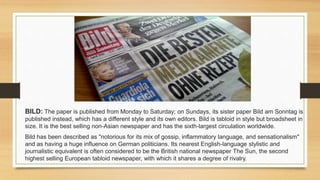
BILD: The paper is published from Monday to Saturday; on Sundays, its sister paper Bild am Sonntag is
published instead, which has a different style and its own editors. Bild is tabloid in style but broadsheet in
size. It is the best selling non-Asian newspaper and has the sixth-largest circulation worldwide.
Bild has been described as "notorious for its mix of gossip, inflammatory language, and sensationalism"
and as having a huge influence on German politicians. Its nearest English-language stylistic and
journalistic equivalent is often considered to be the British national newspaper The Sun, the second
highest selling European tabloid newspaper, with which it shares a degree of rivalry.
FRANKFURTER ALLGEMEINE ZEITUNG :
FAZ, is a centre-right,liberal-conservative German-
newspaper, founded in 1949. It is published daily in
Frankfurt am Main. Its Sunday edition is the
Frankfurter Allgemeine Sonntagszeitung (F.A.S.).
The FAZ. runs its own correspondent network. Its
editorial policy is not determined by a single editor,
but cooperatively by five editors. It is the German
newspaper with the widest circulation abroad, with
its editors claiming to deliver the newspaper to 148
countries every day.
DIE WELT : Die Welt is a German national daily newspaper
published by Axel Springer SE.
• SUDDEUTSCHE ZEITUNG : The Süddeutsche Zeitung
(German for South German Newspaper), published in Munich, is
the largest German national subscription daily newspaper.
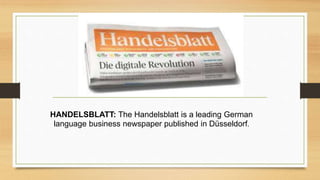
HANDELSBLATT: The Handelsblatt is a leading German
language business newspaper published in Düsseldorf.
DER SPIEGEL: Der Spiegel ("The Mirror")
is a German weekly news magazine published in
Hamburg. It is one of Europe's largest
publications of its kind, with a weekly circulation
of 840,000. Der Spiegel is known in German-
speaking countries mostly for its investigative
journalism. It has played a key role in uncovering
many political scandals such as the Spiegel
scandal in 1962 and the Flick affair in the 1980s.
According to The Economist, Der Spiegel is one
of continental Europe's most influential
magazines.
FOCUS: Focus is a German weekly news
magazine published in Münich and distributed
throughout Germany. It is the third-largest
weekly news magazine in Germany. It is
considered conservative and leans towards
economic liberalism.
Press Council: Germany
A press council, in its ideal form, gathers and represents all three major actors
of social communication: media owners, editors and the public. This body is in
effect responsible for investigating potential breaches in the ethical codes of
conduct adopted by media. While press councils are very popular in Europe,
they are capable of adapting to various cultural contexts at various levels of
society.
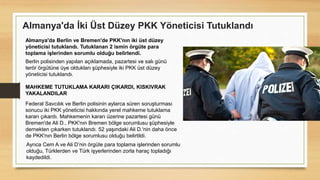
Almanya'da İki Üst Düzey PKK Yöneticisi Tutuklandı
Almanya'da Berlin ve Bremen'de PKK'nın iki üst düzey
yöneticisi tutuklandı. Tutuklanan 2 ismin örgüte para
toplama işlerinden sorumlu olduğu belirlendi.
Berlin polisinden yapılan açıklamada, pazartesi ve salı günü
terör örgütüne üye oldukları şüphesiyle iki PKK üst düzey
yöneticisi tutuklandı.
MAHKEME TUTUKLAMA KARARI ÇIKARDI, KISKIVRAK
YAKALANDILAR
Federal Savcılık ve Berlin polisinin aylarca süren soruşturması
sonucu iki PKK yöneticisi hakkında yerel mahkeme tutuklama
kararı çıkardı. Mahkemenin kararı üzerine pazartesi günü
Bremen'de Ali D., PKK'nın Bremen bölge sorumlusu şüphesiyle
dernekten çıkarken tutuklandı. 52 yaşındaki Ali D.'nin daha önce
de PKK'nın Berlin bölge sorumlusu olduğu belirtildi.
Ayrıca Cem A ve Ali D’nin örgüte para toplama işlerinden sorumlu
olduğu, Türklerden ve Türk işyerlerinden zorla haraç topladığı
kaydedildi.
Migrant Crisis: Changing attitudes of a
German city
"When the first refugees arrived here in Oberhausen we had a
big welcome culture," says Joerg Fischer, manager of a Red
Cross refugee transit camp in Oberhausen in Germany.
In the six months since BBC News first visited Oberhausen,
the mood here has changed.
The majority of people still welcome new arrivals, but there
are some who say they are creating a strain on a local
economy with an 11% rate of unemployment.
Oberhausen lies in the western region of North Rhine-
Westphalia, which took in an estimated 21% of asylum
seekers in 2015, more than anywhere else in the country.
Nearly 3,000 refugees, many fleeing conflict in Iraq, Syria and
Afghanistan, settled in Oberhausen last year.
A BBC team first visited in October 2015 and has returned to
speak to aid workers, residents and the asylum seekers
themselves.
Almanya Oberhausen kentindeki Kızıl Haç sığınma kampı müdürü
Joerg Fischer ‘İlk mülteciler Oberhausen’e geldiğinde onları içtenlikle
karşıladık, diye ifade etti.
BBC News’un Oberhausen’i ilk ziyaretinden beri kentteki atmosfer
değişti. Halkın büyük çoğunluğu yeni gelen mültecileri hala içtenlikle
karşılarken bazıları mültecilerin %11 işsizlik oranıyla yerel
ekonomide bir gerilme yarattığını söylüyor.
2015’te sığınmacıların %21’ine ev sahipliği yapan Oberhausen,
Kuzey Ren-Vestfalya’nın batı bölgesinde yer alıyor.
Çoğu Irak, Suriye ve Afganistan’daki iç savaştan kaçan yaklaşık
3.000 mülteci geçtiğimiz yıl Oberhausen’e yerleşti.
BBC ekibi ilk kez Ekim 2015’te kente gelmişti ve yardım görevlileri,
bölge sakinleri ve sığınmacılarla konuşmak için tekrardan
Oberhausen’de.
Mülteci Krizi: Bir Alman kentinin değişen tutumu
HAZIRLAYANLAR
BÜŞRA YILMAZ
ELİF ŞENYILDIZ

Germany

  • 1.
  • 2.
    Germany, officially theFederal Republic of Germany or FRG is a federal parliamentary republic in West-Central Europe. Germany is the country located in the centre of the continent, in the “heart of Europe” some may say it includes 16 constituent states, and has a largely temperate seasonal climate. Its capital and largest city is Berlin. Germany is the most populous member state of the European Union. After the United States, it is the second most popular migration destination in the world. Germany was a founding member of the European Union in 1993 and a leading member. • Capital : Berlin • Language: German • Population: 81,459,000 • Literacy rate: 99.0% • Number of Daily Newspapers: 382
  • 4.
    • Germany looksback at a long history of mass media. Some of the first newspapers started here roughly 400 years ago. During the years of the Nazi domain the mass media had become a tool of the dictatorship. In 1945 the media experienced an "hour zero" and started nearly completely anew. The post-war media system was based on the principle of press freedom as stipulated in the basic law (constitution) of 1949. • Now - in Germany there is a variety of media corporations: publishing houses, radio and tv stations, news agencies and free lancers.
  • 5.
    • The freedomof the press is guaranteed by the federal republic of Germany’s constitution. Germany's competitive television market is the largest in Europe, with some 34 million TV households. • The many regional and national public broadcasters - organised in line with the federal political structure - vie for audiences with powerful commercial operators. Each of the 16 regions regulates its own private and public broadcasting. • Around 90% of German households have cable or satellite tv, and viewers enjoy a comprehensive mix of free-to-view public and commercial channels. This has acted as a brake on the development of pay-tv. Germany is home to some of the world's largest media conglomerates, including Bertelsmann and the publisher Axel Springer.
  • 6.
    Germany has manydifferent tv channels that cover all kinds of entertainment. there are also some channels that only report on one topic, e.g. sport or politics. There are two public broadcasters in Germany: “ARD” (“Allgemeine Rundfunkanstalten Deutschlands”) and “ZDF” (“Zweites Deutsches Fernsehen”).
  • 7.
    • ARD :As “ARD” was the first tv channel in Germany it is also called “das erste” (the first). All regional channels also belong to “ARD”. These “dritten programme” (third channels) mainly focus on regional topics, e.g. “MDR” reports on issues happening in saxony, thuringia and saxony-anhalt. If you have a cable connection or a satellite dish you can watch the channels for each region from all over Germany. The public radio stations of each individual German state also belong to “ARD”.
  • 8.
    • ZDF: (secondGerman television), usually shortened to ZDF, is a German public-service television broadcaster based in Mainz. It is run as an independent nonprofit institution, which was founded by all federal states of Germany. ZDF is financed by television licence fees and advertising revenues.The ZDF is well known for its famous TV programmes heute.
  • 9.
    • RTL :RTL Television (originally Radio Télévisioun Lëtzebuerg), or simply RTL, is a German commercial television station distributed via cable and satellite, as well as via digital terrestrial (DVB-T) in more highly populated areas. It is owned by the RTL Group and is, in terms of market share, Germany's largest private free-to-air broadcaster. • The current slogan is "Mein RTL" • It earned quite a lot of criticism, the channel is accused of faking and scripting reality and live shows.
  • 10.
    PROSIEBEN: Prosieben (siebenis German for seven) is a commercial television station in Germany. It is largely distributed by cable and satellite. Prosieben is Germany's second largest privately owned television company. There are three different variants of the channel: Prosieben (for Germany), Prosieben Austria (for Austria) and Prosieben Schweiz (for Switzerland). The main difference is that they have different adverts and news for each target country. The channel uses an English slogan.
  • 11.
  • 12.
    In addition tobooks, newspapers and magazines have been in existence for 500 years and play a very important role in daily news coverage. There are several kinds of newspapers: daily papers, weekly papers, tabloids, trade journals and many more. The most important daily newspapers with nationwide distribution are: the “Süddeutsche Zeitung”, the “Frankfurter Allgemeine Zeitung”, “Die Welt” and “Die Tageszeitung”. The most successful tabloid is called “BILD”. “Der Spiegel”, “Focus” and “Stern” are important magazines which concentrate on political and financial subjects. Due to the importance of these periodicals readers base their opinions on the published articles.
  • 13.
    BILD: The paperis published from Monday to Saturday; on Sundays, its sister paper Bild am Sonntag is published instead, which has a different style and its own editors. Bild is tabloid in style but broadsheet in size. It is the best selling non-Asian newspaper and has the sixth-largest circulation worldwide. Bild has been described as "notorious for its mix of gossip, inflammatory language, and sensationalism" and as having a huge influence on German politicians. Its nearest English-language stylistic and journalistic equivalent is often considered to be the British national newspaper The Sun, the second highest selling European tabloid newspaper, with which it shares a degree of rivalry.
  • 14.
    FRANKFURTER ALLGEMEINE ZEITUNG: FAZ, is a centre-right,liberal-conservative German- newspaper, founded in 1949. It is published daily in Frankfurt am Main. Its Sunday edition is the Frankfurter Allgemeine Sonntagszeitung (F.A.S.). The FAZ. runs its own correspondent network. Its editorial policy is not determined by a single editor, but cooperatively by five editors. It is the German newspaper with the widest circulation abroad, with its editors claiming to deliver the newspaper to 148 countries every day.
  • 15.
    DIE WELT :Die Welt is a German national daily newspaper published by Axel Springer SE.
  • 16.
    • SUDDEUTSCHE ZEITUNG: The Süddeutsche Zeitung (German for South German Newspaper), published in Munich, is the largest German national subscription daily newspaper.
  • 17.
    HANDELSBLATT: The Handelsblattis a leading German language business newspaper published in Düsseldorf.
  • 18.
    DER SPIEGEL: DerSpiegel ("The Mirror") is a German weekly news magazine published in Hamburg. It is one of Europe's largest publications of its kind, with a weekly circulation of 840,000. Der Spiegel is known in German- speaking countries mostly for its investigative journalism. It has played a key role in uncovering many political scandals such as the Spiegel scandal in 1962 and the Flick affair in the 1980s. According to The Economist, Der Spiegel is one of continental Europe's most influential magazines.
  • 19.
    FOCUS: Focus isa German weekly news magazine published in Münich and distributed throughout Germany. It is the third-largest weekly news magazine in Germany. It is considered conservative and leans towards economic liberalism.
  • 21.
    Press Council: Germany Apress council, in its ideal form, gathers and represents all three major actors of social communication: media owners, editors and the public. This body is in effect responsible for investigating potential breaches in the ethical codes of conduct adopted by media. While press councils are very popular in Europe, they are capable of adapting to various cultural contexts at various levels of society.
  • 22.
    Almanya'da İki ÜstDüzey PKK Yöneticisi Tutuklandı Almanya'da Berlin ve Bremen'de PKK'nın iki üst düzey yöneticisi tutuklandı. Tutuklanan 2 ismin örgüte para toplama işlerinden sorumlu olduğu belirlendi. Berlin polisinden yapılan açıklamada, pazartesi ve salı günü terör örgütüne üye oldukları şüphesiyle iki PKK üst düzey yöneticisi tutuklandı. MAHKEME TUTUKLAMA KARARI ÇIKARDI, KISKIVRAK YAKALANDILAR Federal Savcılık ve Berlin polisinin aylarca süren soruşturması sonucu iki PKK yöneticisi hakkında yerel mahkeme tutuklama kararı çıkardı. Mahkemenin kararı üzerine pazartesi günü Bremen'de Ali D., PKK'nın Bremen bölge sorumlusu şüphesiyle dernekten çıkarken tutuklandı. 52 yaşındaki Ali D.'nin daha önce de PKK'nın Berlin bölge sorumlusu olduğu belirtildi. Ayrıca Cem A ve Ali D’nin örgüte para toplama işlerinden sorumlu olduğu, Türklerden ve Türk işyerlerinden zorla haraç topladığı kaydedildi.
  • 23.
    Migrant Crisis: Changingattitudes of a German city "When the first refugees arrived here in Oberhausen we had a big welcome culture," says Joerg Fischer, manager of a Red Cross refugee transit camp in Oberhausen in Germany. In the six months since BBC News first visited Oberhausen, the mood here has changed. The majority of people still welcome new arrivals, but there are some who say they are creating a strain on a local economy with an 11% rate of unemployment. Oberhausen lies in the western region of North Rhine- Westphalia, which took in an estimated 21% of asylum seekers in 2015, more than anywhere else in the country. Nearly 3,000 refugees, many fleeing conflict in Iraq, Syria and Afghanistan, settled in Oberhausen last year. A BBC team first visited in October 2015 and has returned to speak to aid workers, residents and the asylum seekers themselves.
  • 24.
    Almanya Oberhausen kentindekiKızıl Haç sığınma kampı müdürü Joerg Fischer ‘İlk mülteciler Oberhausen’e geldiğinde onları içtenlikle karşıladık, diye ifade etti. BBC News’un Oberhausen’i ilk ziyaretinden beri kentteki atmosfer değişti. Halkın büyük çoğunluğu yeni gelen mültecileri hala içtenlikle karşılarken bazıları mültecilerin %11 işsizlik oranıyla yerel ekonomide bir gerilme yarattığını söylüyor. 2015’te sığınmacıların %21’ine ev sahipliği yapan Oberhausen, Kuzey Ren-Vestfalya’nın batı bölgesinde yer alıyor. Çoğu Irak, Suriye ve Afganistan’daki iç savaştan kaçan yaklaşık 3.000 mülteci geçtiğimiz yıl Oberhausen’e yerleşti. BBC ekibi ilk kez Ekim 2015’te kente gelmişti ve yardım görevlileri, bölge sakinleri ve sığınmacılarla konuşmak için tekrardan Oberhausen’de. Mülteci Krizi: Bir Alman kentinin değişen tutumu
  • 25.