Western Europe Regional
Pankaj Kumar Singh
Physiography
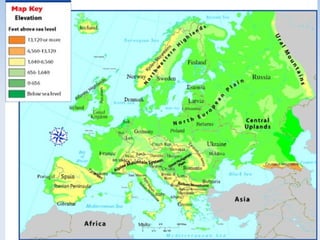
The physiography of Western Europe can be divided into four parts.
1. the Northwestern Highlands
2. the Great European Plain
3. the Central Uplands
4. the Alpine mountain system of southern Europe
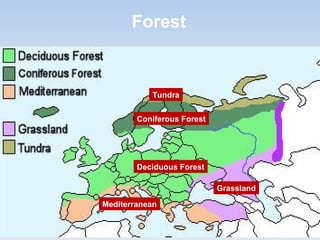
Forest
Deciduous Forest
Tundra
Coniferous Forest
Mediterranean
Grassland
7
Fisheries
Fishing
• High degree of commercialization
• North sea countries and Iceland
• Dogger Bank in the North Sea is a famous fishing ground.
• Norway is the European leader in quantity of fish caught.
Europe depends heavily on food imports.
• It is self-sufficient in milk, potatoes and rye.
• It imports wheat, corn, oil cake, soybeans, vegetable fats and oils,
chilled and frozen meats, cane sugar, cocoa, coffee and tobacco; fibers
(cotton and wool predominantly) and natural rubber.
Climates
For Western Europe, the Alps can be viewed as a climatic divide. To the
north, area enjoys a temperate and moist marine climate. South of the
Alps is the dramatically different dry summer subtropical climate. The
marine climate in the north normally produces a lush, green landscape.
Factors influencing the Europe's Climate
(i) Latitudinal influences
(ii)Relief: absence of mountain system from north to south, allow the on
shore westerlies to blow deeper in to the land and modify the temperature
(iii) Proximity to the seas: keep the winters very mild and summers cool.
(iv) Westerlies: under the permanent influence of westerlies, fairly well
distributed rainfall throughout the year, rainfall heavy in the west and
decreases towards the east.
(v) North Atlantic Drift: The warm waters of the North Atlantic Drift keep the
seas along the western Europe ice free.
Cool Temperate Marine Type
Oceanic influence on both the temperature and precipitation of North-western
Europe is such that the climate is also referred as the north-west
European Maritime climate.
Characteristics
(i) Equable climate with moderately warms summers and fairly mild winters.
(ii)Fairly well distributed rainfall throughout the year with a tendency towards
a slight winter or autumn maximum from cyclonic sources.
(iii) Continental climate in central and Eastern Europe.
The little influence of ocean towards the east in the central and eastern
Europe, make the climate, thus continental with extremes of temperature
Warm Temperate Western Margin
The southern margins of Europe share a climate that is common to the
Mediterranean Basin and is thus often called the Mediterranean climate.
Characteristics - Clear, dry. hot summers and moderately moist, mild
winters.
Tundra Climate
The type of climate found to the north of the Arctic circle in Europe is
called Tundra climate.
Characteristics
(i) Winters are long and very severe, summers are cool and brief,
(ii) Precipitation is mainly in the form of snow.
Agriculture
Despite Western Europe's high state of industrial and
associated development, agriculture remains the
dominant form of land use.
Three fairly distinctive types of agricultural systems can
be identified:
1.Mediterranean polyculture
2.dairy farming
3.mixed livestock.
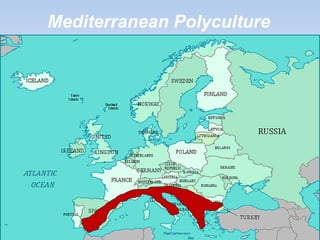
Mediterranean Polyculture
Drought Resistant - along the Mediterranean coast, Several drought-resistant,
deeply rooted vines, citrus fruits and trees, particularly grape and olive.
Countries - Most of the activity is extremely labor intensive. For countries like
Portugal, Spain, Italy, and Greece,
Specialization -This region is accelerating specialization and commercialization.
Vineyards are dominant within the French Mediterranean belt, citrus
orchads in coastal plain, Tobacco in Italy and Greece
Improved transportation - facilities make it possible for Mediterranean growers
to supply highly perishable fruits and early vegetables to the affluent markets
of Britain, France, Germany. and Scandinavia.
Transhumance - involves the grazing of animals in high mountain pastures
during dry summers and in the lower areas during moist winters,
The future of Mediterranean agriculture - They are close to the rich and
growing markets of urbanized northern Europe,
Dairy Farming
Dairy Farming
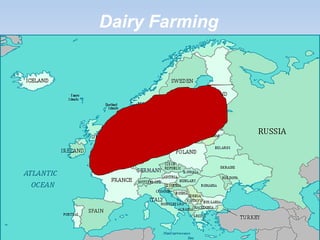
A considerable area to the north of the Mediterranean is devoted to dairy
farming, which is usually associated with rich urban populations of the
Western World.
The dairy belt stretches from the British Isles and along the shores of the
North and Baltic seas to Finland. A second large area of dairying has
developed in the Alps of France, Switzerland, and Austria.
• Denmark, for example, has developed a strong specialization in the
production of butter. Almost one-fifth of the butter in international trade
originates in Denmark.
• Netherlands - Much grazing takes place on land reclaimed from the sea,
land where water table is too high for the cultivation of many crops. There,
specialization in the'-production of cheese, condensed and powdered milk
allows the Dutch to export much of their output to markets of the world.
• United Kingdom much fluid milk is produced but is marketed locally for
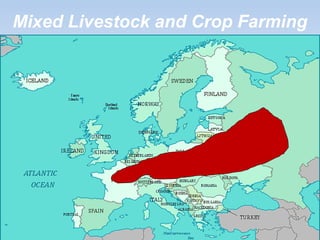
Mixed Livestock and Crop Farming
The intensive crop specialization of the Mediterranean polyculture region is
generally separated from the animal-dominated dairy farming belts to the
north by a broad zone in which a mixed form of farming characterizes the
landscape.
Factors facilitating Mixed farming
Environmental conditions, there facilitate a wide range of agricultural
activities, and the agricultural landscape is extremely mixed and varied.
Diversity in the area is also promoted by political fragmentation, which
discouraged the evolution of vast regional belts of agricultural
specialization such as those found in the United States and Canada, the
Soviet Union, and Australia.
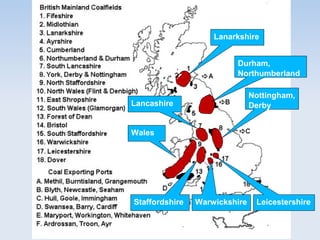
Lanarkshire
Lancashire
Durham,
Northumberland
Nottingham,
Derby
Wales
LeicestershireWarwickshireStaffordshire
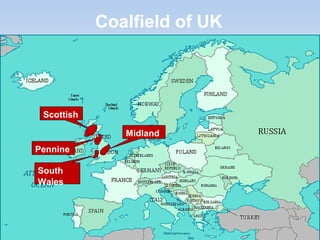
Coalfield of UK
Scottish
Pennine
South
Wales
Midland
Coal
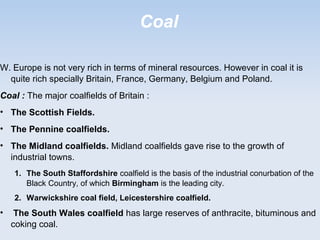
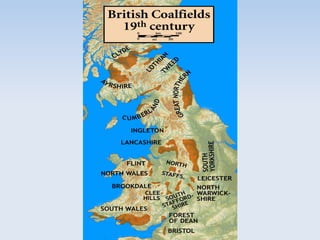
W. Europe is not very rich in terms of mineral resources. However in coal it is
quite rich specially Britain, France, Germany, Belgium and Poland.
Coal : The major coalfields of Britain :
• The Scottish Fields.
• The Pennine coalfields.
• The Midland coalfields. Midland coalfields gave rise to the growth of
industrial towns.
1. The South Staffordshire coalfield is the basis of the industrial conurbation of the
Black Country, of which Birmingham is the leading city.
2. Warwickshire coal field, Leicestershire coalfield.
• The South Wales coalfield has large reserves of anthracite, bituminous and
coking coal.
Ruhr – Westphalia
Coalfield
Franco - Belgian
Coalfield
Alsace - Lorraine
Coalfield
Saar Coalfield
Central Massif
Coal
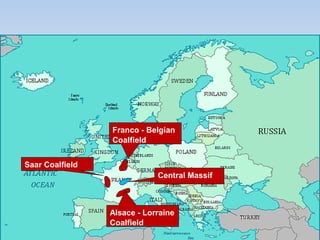
Germany is the 2nd
richest coal nation in Western Europe after the U.K.
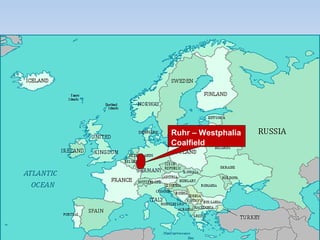
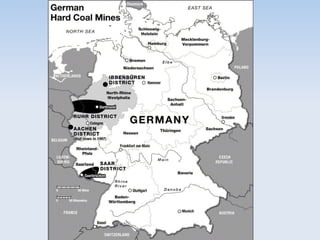
The largest and most important coalfield is the Ruhr-Westphalia coalfield,
which accounts for three quarters of Germany's output and 90 per cent of
its reserves. It is along the German-French border.
France: French coal output is small and is declining only available in north-
eastern France coalfield, the continuation of the Franco-Belgian coalfield
from Belgium. It forms development of North-East Industrial Region which
also drew coal supplies from the smaller Alsace-Lorraine fields, a north-
westerly extension of the Saar coalfield. Minor coal deposits are found in
the Central Massif
Belgium: Belgium's coal production is less than half what it was only ten
years ago. The older field and also the larger one is the Franco-Belgian
Coalfield.
1. Lorraine
3. Pyrennes
Central Massif
Gallivare
Kiruna
Iron Ore
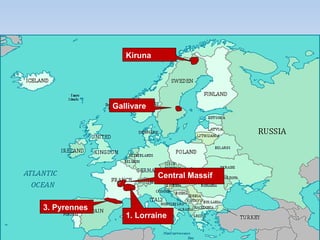
Sweden - is the leading European producer of iron ore. The deposits at
Kiruna and Gallivare being of high quality. Reserves are large and ores
are easily mined by open-cast methods.
France - is the next largest producer, the main iron fields being in Lorraine.
These have a relatively low iron content, less than 40 per cent,
Metz-Thionville a little ore, the Pyreness and scattered fields of the Central
Massif.
Britain – Less reserve and importing
Germany - Ores from Sicgerland originally supplied the Ruhr but output has
declined.
Hydel Power
Europe ranks 2nd
in the output of H.E.P., most of its production coming from
six countries: Italy, France, Norway, Sweden, West Germany, Switzerland.
Italy: Lack of coal and oil in Italy has encouraged the Italians to develop
much of their water-power potential. Half of Italy's electricity output.
France: The power stations are located mainly in the rugged upland regions
of the Pyrenees, the Central Massif and the French Alps. There are, also
several large dams on the Saone and Rhone Rivers,
Norway: In terms of per capita water power, Norway is the greatest in the
world. Major H.E.P.
Sweden: Sweden enjoys many advantages in H.E.P. development, as does
Norway, except that in the north of the country heavy snow accumulation
and river freezing
Industry
Coal has played a much less significant locational role in countries and regions
more recently industrialized.
Italy and Sweden are among the best examples of industrialization in the
absence of local supplies of coal. In both countries, hydroelectricity, a more
recently perfected energy source, has played a strong role in industrial
location.
But the discovery of coal and steam technology by the early nineteenth century,
which started proliferating throughout Europe, the industrial production
reached a new peak of efficiency. Throughout Europe, high quality coal was
available in plenty. Therefore, these sources of cheap fuel became the
locating points of industries.
Major industrial centres of Italy are
Milan (Manchester of Italy)-Textile industry Turin (Detroit of Italy)-
Automobiles Industry.
Great Britain
The most notable feature of Britain's economy is the importance of industry,
services and trade. But owing to cheaper and more efficient production in
other American, European and Asian countries like Japan; old
equipments, labour problems and world recession, Great Britain's
industrial prowess nowhere near to its past.
Coal was the most important source of energy for the early industrialisation of
Britain. But this importance gradually declined during the twentieth century
and an alarming reliance on imported petroleum developed, which
attracted the industries to coastal areas. However, huge deposits of
petroleum and natural gas were discovered under the bed of the North
Sea in the mid 1960s. This improved the situation. Britain not only became
self-sufficient in petroleum production but it also became an oil-exporting
nation.
4. Lancashire
2. North East
England
3. Nottingham,
Derby
6.South
Wales
1. Midland
6. Great
London
Industrial region of Britain
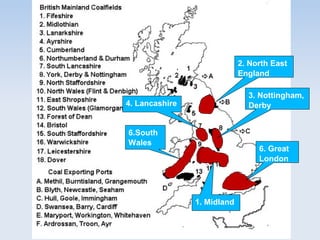
The Midlands - Centred at Birmingham, this is the largest industrial belt of
Britain. Factors for the development this region:
(i) Central location
(ii)Presence of coal fields and
(iii) Also dense network of road and railways:
Northeast England
• This industrial region developed on the coalfields of Northumberland and
Durham and has the advantage of proximity to iron ore deposits.
• Situated near the coasts, this region specialises in iron and steel industry,
with related marine, mechanical and constructional engineering, shipbuilding,
chemicals and glass industry.
Industrial region of Britain
Nottinghamshire and Derby
The whole region is very important for woollen textile industries, which are
based upon local coal, soft water from the Pennine streams for washing,
bleaching and dyeing and local wool from the sheep-rearing region of
Pennine. These textile mills are now highly mechanised and mostly make
use of imported wool. The region has a long history of cutlery making.
The Lancashire Region
One of the important regions of the cotton textile. Advantageous factors for
the localisation and growth of the industry
(i)Availability of coal, (ii) traditional skilled labour, (iii) humid climate
suitable for cotton textiles, (iv) availability of soft water from the Pennine
streams, and (v) facility of import of cotton from the U.S.A. and Egypt
through the port of Liverpool.
Industrial region of Britain
Greater London Industrial Region - Advantages for the development of
industries—
(i) It is the capital city, (ii) a leading seaport, (iii) a financial centre of international
importance and (iv) its large population provided both labour and readymade
market.
Important industries—Near Thames estuary cement, oil refineries Dagenham.
Other market-based industries.
South Wales
South Wales is an example of older industrial region, which has undergone
modernisation. Very foundation of the industrial development of the region
was availability of coal (both anthracite and bituminous). Some amount of iron
ore was also found in the region. Both coal mining and extraction of iron ore
was labour intensive and attracted a large population to this valley. Based
Ruhr – Westphalia ( Germany )
Germany ( The Ruhr-Westphalia
Region )
• The German industries are mainly coalfield based. Thus, the industries are
mostly found concentrated in and around the coal resources.
The Ruhr-Westphalia Region – factors for development of this region
Local iron ore, charcoal, water and wind power provided the basis for
establishment of an iron and steel industry.
Later, with new findings of coal in the region, heavy industries on modern
lines came up.
Also the development of canals such as the Lippe and Dortmund Ems and
railways provided additional stimuli for the movement of bulky goods within
the Ruhr.
During the same period, German Banks began their association with the
industries and provided capital.
The Middle Rhine Industrial Area
The Middle Rhine Industrial Area - Factors for the Industrial Development
The Rhine River forms the main waterway of European commerce. At the
confluence of Rhine and Main Rivers, a widespread industrial complex has
developed.
Besides the availability of cheap water transport, there is also the
convergence of rail and road routes in this region.
Other industrial regions in erstwhile West Germany
Though concentration of industries is not found in a particular place, this
region includes wide range of industries scattered in several large cities.
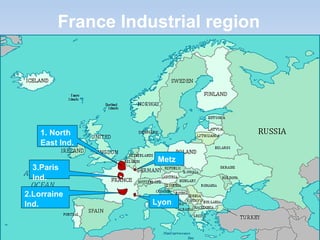
France Industrial region
1. North
East Ind.
3.Paris
Ind.
2.Lorraine
Ind.
Metz
Lyon
France
Compared to Britain, France is far less urbanised and industrialised. The major
industrial regions of France may be divided into—
The Northeast Industrial Region - The presence of coalfields of and the
relative ease with which iron ore can be brought from Lorraine or imported
from Sweden have formed the very foundation of industrial growth in the
region.
Lorraine - Lorraine the most important producer of steel in France, Iron and
steel industries are based on local Iron ores but coal is imported. The labour
force is made of local people, as well as by those who migrated from Italy,
Belgium, Poland and other European countries. The transportation network is
very well developed.
Metz and Lyon are the most important industrial centres.
Greater Paris Paris -Densely populated city and thus is a source of cheap
labour as well as vast market.Market based Industries
Italy
Venice
Genoa
Po River
Italy
Lombardy Plain
Genoa
Milan
Turin
Italy
It has the deposits of neither coal nor iron ore and most other important industrial
mineral deposits that are found are widely dispersed and generally of poor or
inferior quality. Much of the country has a mountainous terrain and dry climate,
which is unsuitable for agriculture in the region. However, industrial growth,
which mainly started in the nineteenth century, has concentrated in the north
rather than the south.
Industrial Regions of Italy
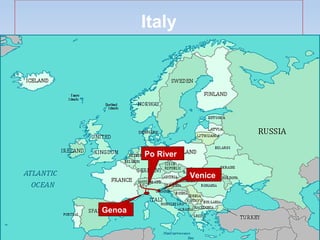
1. Po River Valley (in northern Italy) most developed region includes only one-
fourth of Italy's land but more than 70 per cent of its industries and 50 per cent
of its population.
Factors : (i) A large supply of cheap labour (ii) Inexpensive sources of
hydroelectricity from the nearby Alpine regions. (iii) The Po River, the ports of
Genoa and Venice and the close network of railways in the Lombardy plain
allow smooth movement of goods and workers within the region.
The Lombardy plain
The largest industrial region comprising of major industrial cities of Milan,
Turin and Genoa.
Milan: industrial capital of the region and is important for textiles (silk in
particular) and engineering works
Turin: noted for automobiles (Fiat), rail coaches and aircraft;
Genoa : shipbuilding and repairing industries are important.
Belgium
Based on the Franco-Belgian coalfields and some
amount of local ore; heavy industries including iron
and steel, manufacture of armaments, heavy
chemicals have developed.
Industial Region Brussels & Antwerp
Luxembourg
Luxembourg is the iron and steel industry based upon the Minette iron ore
deposits, a continuation of the Lorraine iron ore deposits of France.
Netherlands
Imported oil became more important and supplemented coal.
Rotterdam became the most important European port through which oil
imports entered Europe. Part of it is forwarded to Germany and other
European countries as crude oil, while part of it is refined at or near
Rotterdam before forwarding. Therefore, world's'largest concentration of
refineries is found in this region. Oil refineries are also found at
Amsterdam, Pernis. Along with oil refineries, petrochemical units have also
developed here.
Sweden
Sweden has the richest iron ore resources of Europe at Kiruna and
Gallivare.
Apart from iron ore, the region has a developed hydro-electric power; high
technological skills; well developed communication links—railways, roads
and inland waterways; and a coastal location that facilitates imports and
exports.
The problem posed by the absence of any major coal resources was solved
by availability of electricity from hydel power.
Norway
The most important natural resources of Norway include spectacular
scenery, hydel power, fish, forests and a variety of minerals. Based on
these resources many kinds of industries have developed in Norway.
The recently discovered resources of large oil and natural gas in the
Norwegian sector of the North Sea floor have made Norway a net
exporter of crude oil and gas.
Hydel power is most important and accounts for 99.7 per cent of all
electricity generated here.
Denmark - is a country in which agriculture plays the most important role in
its economy. Danish agriculture is highly specialised and animal
husbandry is well developed. Denmark thus, has industries based on
agricultural and dairy products like grain milling, sugar refining, food

Western europe regional

  • 1.
  • 4.
    Physiography The physiography ofWestern Europe can be divided into four parts. 1. the Northwestern Highlands 2. the Great European Plain 3. the Central Uplands 4. the Alpine mountain system of southern Europe
  • 6.
  • 7.
    7 Fisheries Fishing • High degreeof commercialization • North sea countries and Iceland • Dogger Bank in the North Sea is a famous fishing ground. • Norway is the European leader in quantity of fish caught. Europe depends heavily on food imports. • It is self-sufficient in milk, potatoes and rye. • It imports wheat, corn, oil cake, soybeans, vegetable fats and oils, chilled and frozen meats, cane sugar, cocoa, coffee and tobacco; fibers (cotton and wool predominantly) and natural rubber.
  • 8.
    Climates For Western Europe,the Alps can be viewed as a climatic divide. To the north, area enjoys a temperate and moist marine climate. South of the Alps is the dramatically different dry summer subtropical climate. The marine climate in the north normally produces a lush, green landscape. Factors influencing the Europe's Climate (i) Latitudinal influences (ii)Relief: absence of mountain system from north to south, allow the on shore westerlies to blow deeper in to the land and modify the temperature (iii) Proximity to the seas: keep the winters very mild and summers cool. (iv) Westerlies: under the permanent influence of westerlies, fairly well distributed rainfall throughout the year, rainfall heavy in the west and decreases towards the east. (v) North Atlantic Drift: The warm waters of the North Atlantic Drift keep the seas along the western Europe ice free.
  • 9.
    Cool Temperate MarineType Oceanic influence on both the temperature and precipitation of North-western Europe is such that the climate is also referred as the north-west European Maritime climate. Characteristics (i) Equable climate with moderately warms summers and fairly mild winters. (ii)Fairly well distributed rainfall throughout the year with a tendency towards a slight winter or autumn maximum from cyclonic sources. (iii) Continental climate in central and Eastern Europe. The little influence of ocean towards the east in the central and eastern Europe, make the climate, thus continental with extremes of temperature
  • 10.
    Warm Temperate WesternMargin Warm Temperate Western Margin The southern margins of Europe share a climate that is common to the Mediterranean Basin and is thus often called the Mediterranean climate. Characteristics - Clear, dry. hot summers and moderately moist, mild winters. Tundra Climate The type of climate found to the north of the Arctic circle in Europe is called Tundra climate. Characteristics (i) Winters are long and very severe, summers are cool and brief, (ii) Precipitation is mainly in the form of snow.
  • 12.
    Agriculture Despite Western Europe'shigh state of industrial and associated development, agriculture remains the dominant form of land use. Three fairly distinctive types of agricultural systems can be identified: 1.Mediterranean polyculture 2.dairy farming 3.mixed livestock.
  • 13.
  • 14.
    Mediterranean Polyculture Drought Resistant- along the Mediterranean coast, Several drought-resistant, deeply rooted vines, citrus fruits and trees, particularly grape and olive. Countries - Most of the activity is extremely labor intensive. For countries like Portugal, Spain, Italy, and Greece, Specialization -This region is accelerating specialization and commercialization. Vineyards are dominant within the French Mediterranean belt, citrus orchads in coastal plain, Tobacco in Italy and Greece Improved transportation - facilities make it possible for Mediterranean growers to supply highly perishable fruits and early vegetables to the affluent markets of Britain, France, Germany. and Scandinavia. Transhumance - involves the grazing of animals in high mountain pastures during dry summers and in the lower areas during moist winters, The future of Mediterranean agriculture - They are close to the rich and growing markets of urbanized northern Europe,
  • 15.
  • 16.
    Dairy Farming A considerablearea to the north of the Mediterranean is devoted to dairy farming, which is usually associated with rich urban populations of the Western World. The dairy belt stretches from the British Isles and along the shores of the North and Baltic seas to Finland. A second large area of dairying has developed in the Alps of France, Switzerland, and Austria. • Denmark, for example, has developed a strong specialization in the production of butter. Almost one-fifth of the butter in international trade originates in Denmark. • Netherlands - Much grazing takes place on land reclaimed from the sea, land where water table is too high for the cultivation of many crops. There, specialization in the'-production of cheese, condensed and powdered milk allows the Dutch to export much of their output to markets of the world. • United Kingdom much fluid milk is produced but is marketed locally for
  • 17.
    Mixed Livestock andCrop Farming
  • 18.
    Mixed Livestock andCrop Farming The intensive crop specialization of the Mediterranean polyculture region is generally separated from the animal-dominated dairy farming belts to the north by a broad zone in which a mixed form of farming characterizes the landscape. Factors facilitating Mixed farming Environmental conditions, there facilitate a wide range of agricultural activities, and the agricultural landscape is extremely mixed and varied. Diversity in the area is also promoted by political fragmentation, which discouraged the evolution of vast regional belts of agricultural specialization such as those found in the United States and Canada, the Soviet Union, and Australia.
  • 19.
  • 20.
  • 21.
    Coal W. Europe isnot very rich in terms of mineral resources. However in coal it is quite rich specially Britain, France, Germany, Belgium and Poland. Coal : The major coalfields of Britain : • The Scottish Fields. • The Pennine coalfields. • The Midland coalfields. Midland coalfields gave rise to the growth of industrial towns. 1. The South Staffordshire coalfield is the basis of the industrial conurbation of the Black Country, of which Birmingham is the leading city. 2. Warwickshire coal field, Leicestershire coalfield. • The South Wales coalfield has large reserves of anthracite, bituminous and coking coal.
  • 22.
  • 23.
    Franco - Belgian Coalfield Alsace- Lorraine Coalfield Saar Coalfield Central Massif
  • 24.
    Coal Germany is the2nd richest coal nation in Western Europe after the U.K. The largest and most important coalfield is the Ruhr-Westphalia coalfield, which accounts for three quarters of Germany's output and 90 per cent of its reserves. It is along the German-French border. France: French coal output is small and is declining only available in north- eastern France coalfield, the continuation of the Franco-Belgian coalfield from Belgium. It forms development of North-East Industrial Region which also drew coal supplies from the smaller Alsace-Lorraine fields, a north- westerly extension of the Saar coalfield. Minor coal deposits are found in the Central Massif Belgium: Belgium's coal production is less than half what it was only ten years ago. The older field and also the larger one is the Franco-Belgian Coalfield.
  • 25.
    1. Lorraine 3. Pyrennes CentralMassif Gallivare Kiruna
  • 26.
    Iron Ore Sweden -is the leading European producer of iron ore. The deposits at Kiruna and Gallivare being of high quality. Reserves are large and ores are easily mined by open-cast methods. France - is the next largest producer, the main iron fields being in Lorraine. These have a relatively low iron content, less than 40 per cent, Metz-Thionville a little ore, the Pyreness and scattered fields of the Central Massif. Britain – Less reserve and importing Germany - Ores from Sicgerland originally supplied the Ruhr but output has declined.
  • 27.
    Hydel Power Europe ranks2nd in the output of H.E.P., most of its production coming from six countries: Italy, France, Norway, Sweden, West Germany, Switzerland. Italy: Lack of coal and oil in Italy has encouraged the Italians to develop much of their water-power potential. Half of Italy's electricity output. France: The power stations are located mainly in the rugged upland regions of the Pyrenees, the Central Massif and the French Alps. There are, also several large dams on the Saone and Rhone Rivers, Norway: In terms of per capita water power, Norway is the greatest in the world. Major H.E.P. Sweden: Sweden enjoys many advantages in H.E.P. development, as does Norway, except that in the north of the country heavy snow accumulation and river freezing
  • 28.
    Industry Coal has playeda much less significant locational role in countries and regions more recently industrialized. Italy and Sweden are among the best examples of industrialization in the absence of local supplies of coal. In both countries, hydroelectricity, a more recently perfected energy source, has played a strong role in industrial location. But the discovery of coal and steam technology by the early nineteenth century, which started proliferating throughout Europe, the industrial production reached a new peak of efficiency. Throughout Europe, high quality coal was available in plenty. Therefore, these sources of cheap fuel became the locating points of industries. Major industrial centres of Italy are Milan (Manchester of Italy)-Textile industry Turin (Detroit of Italy)- Automobiles Industry.
  • 31.
    Great Britain The mostnotable feature of Britain's economy is the importance of industry, services and trade. But owing to cheaper and more efficient production in other American, European and Asian countries like Japan; old equipments, labour problems and world recession, Great Britain's industrial prowess nowhere near to its past. Coal was the most important source of energy for the early industrialisation of Britain. But this importance gradually declined during the twentieth century and an alarming reliance on imported petroleum developed, which attracted the industries to coastal areas. However, huge deposits of petroleum and natural gas were discovered under the bed of the North Sea in the mid 1960s. This improved the situation. Britain not only became self-sufficient in petroleum production but it also became an oil-exporting nation.
  • 32.
    4. Lancashire 2. NorthEast England 3. Nottingham, Derby 6.South Wales 1. Midland 6. Great London
  • 33.
    Industrial region ofBritain The Midlands - Centred at Birmingham, this is the largest industrial belt of Britain. Factors for the development this region: (i) Central location (ii)Presence of coal fields and (iii) Also dense network of road and railways: Northeast England • This industrial region developed on the coalfields of Northumberland and Durham and has the advantage of proximity to iron ore deposits. • Situated near the coasts, this region specialises in iron and steel industry, with related marine, mechanical and constructional engineering, shipbuilding, chemicals and glass industry.
  • 34.
    Industrial region ofBritain Nottinghamshire and Derby The whole region is very important for woollen textile industries, which are based upon local coal, soft water from the Pennine streams for washing, bleaching and dyeing and local wool from the sheep-rearing region of Pennine. These textile mills are now highly mechanised and mostly make use of imported wool. The region has a long history of cutlery making. The Lancashire Region One of the important regions of the cotton textile. Advantageous factors for the localisation and growth of the industry (i)Availability of coal, (ii) traditional skilled labour, (iii) humid climate suitable for cotton textiles, (iv) availability of soft water from the Pennine streams, and (v) facility of import of cotton from the U.S.A. and Egypt through the port of Liverpool.
  • 35.
    Industrial region ofBritain Greater London Industrial Region - Advantages for the development of industries— (i) It is the capital city, (ii) a leading seaport, (iii) a financial centre of international importance and (iv) its large population provided both labour and readymade market. Important industries—Near Thames estuary cement, oil refineries Dagenham. Other market-based industries. South Wales South Wales is an example of older industrial region, which has undergone modernisation. Very foundation of the industrial development of the region was availability of coal (both anthracite and bituminous). Some amount of iron ore was also found in the region. Both coal mining and extraction of iron ore was labour intensive and attracted a large population to this valley. Based
  • 36.
  • 38.
    Germany ( TheRuhr-Westphalia Region ) • The German industries are mainly coalfield based. Thus, the industries are mostly found concentrated in and around the coal resources. The Ruhr-Westphalia Region – factors for development of this region Local iron ore, charcoal, water and wind power provided the basis for establishment of an iron and steel industry. Later, with new findings of coal in the region, heavy industries on modern lines came up. Also the development of canals such as the Lippe and Dortmund Ems and railways provided additional stimuli for the movement of bulky goods within the Ruhr. During the same period, German Banks began their association with the industries and provided capital.
  • 39.
    The Middle RhineIndustrial Area The Middle Rhine Industrial Area - Factors for the Industrial Development The Rhine River forms the main waterway of European commerce. At the confluence of Rhine and Main Rivers, a widespread industrial complex has developed. Besides the availability of cheap water transport, there is also the convergence of rail and road routes in this region. Other industrial regions in erstwhile West Germany Though concentration of industries is not found in a particular place, this region includes wide range of industries scattered in several large cities.
  • 40.
    France Industrial region 1.North East Ind. 3.Paris Ind. 2.Lorraine Ind. Metz Lyon
  • 41.
    France Compared to Britain,France is far less urbanised and industrialised. The major industrial regions of France may be divided into— The Northeast Industrial Region - The presence of coalfields of and the relative ease with which iron ore can be brought from Lorraine or imported from Sweden have formed the very foundation of industrial growth in the region. Lorraine - Lorraine the most important producer of steel in France, Iron and steel industries are based on local Iron ores but coal is imported. The labour force is made of local people, as well as by those who migrated from Italy, Belgium, Poland and other European countries. The transportation network is very well developed. Metz and Lyon are the most important industrial centres. Greater Paris Paris -Densely populated city and thus is a source of cheap labour as well as vast market.Market based Industries
  • 42.
  • 43.
  • 44.
    Italy It has thedeposits of neither coal nor iron ore and most other important industrial mineral deposits that are found are widely dispersed and generally of poor or inferior quality. Much of the country has a mountainous terrain and dry climate, which is unsuitable for agriculture in the region. However, industrial growth, which mainly started in the nineteenth century, has concentrated in the north rather than the south. Industrial Regions of Italy 1. Po River Valley (in northern Italy) most developed region includes only one- fourth of Italy's land but more than 70 per cent of its industries and 50 per cent of its population. Factors : (i) A large supply of cheap labour (ii) Inexpensive sources of hydroelectricity from the nearby Alpine regions. (iii) The Po River, the ports of Genoa and Venice and the close network of railways in the Lombardy plain allow smooth movement of goods and workers within the region.
  • 45.
    The Lombardy plain Thelargest industrial region comprising of major industrial cities of Milan, Turin and Genoa. Milan: industrial capital of the region and is important for textiles (silk in particular) and engineering works Turin: noted for automobiles (Fiat), rail coaches and aircraft; Genoa : shipbuilding and repairing industries are important.
  • 47.
    Belgium Based on theFranco-Belgian coalfields and some amount of local ore; heavy industries including iron and steel, manufacture of armaments, heavy chemicals have developed. Industial Region Brussels & Antwerp
  • 48.
    Luxembourg Luxembourg is theiron and steel industry based upon the Minette iron ore deposits, a continuation of the Lorraine iron ore deposits of France. Netherlands Imported oil became more important and supplemented coal. Rotterdam became the most important European port through which oil imports entered Europe. Part of it is forwarded to Germany and other European countries as crude oil, while part of it is refined at or near Rotterdam before forwarding. Therefore, world's'largest concentration of refineries is found in this region. Oil refineries are also found at Amsterdam, Pernis. Along with oil refineries, petrochemical units have also developed here.
  • 49.
    Sweden Sweden has therichest iron ore resources of Europe at Kiruna and Gallivare. Apart from iron ore, the region has a developed hydro-electric power; high technological skills; well developed communication links—railways, roads and inland waterways; and a coastal location that facilitates imports and exports. The problem posed by the absence of any major coal resources was solved by availability of electricity from hydel power.
  • 50.
    Norway The most importantnatural resources of Norway include spectacular scenery, hydel power, fish, forests and a variety of minerals. Based on these resources many kinds of industries have developed in Norway. The recently discovered resources of large oil and natural gas in the Norwegian sector of the North Sea floor have made Norway a net exporter of crude oil and gas. Hydel power is most important and accounts for 99.7 per cent of all electricity generated here. Denmark - is a country in which agriculture plays the most important role in its economy. Danish agriculture is highly specialised and animal husbandry is well developed. Denmark thus, has industries based on agricultural and dairy products like grain milling, sugar refining, food