Germany
Location
• Germany is located in central Europe.
• Germany is bordered by Poland, Czech
Republic, Austria, Switzerland, Luxembourg,
France, Belgium. The Netherlands, and
Denmark.
TheLand
Germany is the largest country in central Europe.
It has three main geographic areas. These are the
northern plains that stretch from the Baltic and
and forests of southern Germany. This area
extends to the Alps Mountains on the borders of
Austria and Switzerland. Germany has several
important rivers. The Rhine River is the busiest
waterway in Europe, and is an important tourist
attraction because of the castles and villages
along its banks.
THE CLIMATE
• Cold winters and cool summers. In the center
temperatures are more extreme but
prolonged periods of frost or snow are not
common. Rain falls through the year.
• Extremes commonly reach -10°C in winter and
35°C in the summer months.
THE POPULATION
• The population of Germany represents 1.18
percent of the world's total population,
which arguably means that one person in
every 85 people on the planet is a resident of
Germany.
• It has a population of 82.5 million
CITYThe CAPITAL
The capital of Germany is the city state of “Berlin”.
It is the seat of the President of Germany, whose
official residence is Schloss Bellevue. The
Bundesrat (federal council) is the representation
of the Federal States of Germany and has its seat
at the former Prussian Herrenhaus (House of
Lords). Though most of the ministries are seated
in Berlin, some of them, as well as some minor
departments, are seated in Bonn, the former
capital of West Germany.
The meaning of the colors of the flag
Red: Hardness, bravery, valor, strength
Yellow (gold): Generosity
Federal President ofthe Federal Republic of
Germany
- since 19 March 2017 -
- Frank-Walter Steinmeier -
Economy
• Germany has a social market economy with a
highly skilled labour force
• large capital stock
• low level of corruption
• high level of innovation
• the world's third largest exporter of goods
• largest national economy in Europe which is
also the world's fourth largest by nominal GDP
NaturalResources
In Germany Some of Natural Resources include:
- Natural gas.
- Iron ore.
- Coal.
-Timber.
- Nickel.
Languages of Germany
• The official language of Germany is Standard
German .
• Recognised minority languages:
-Upper Sorbian and Lower Sorbian.
- Romani.
- Danish.
- North Frisian and Saterland Frisian.
• Immigrant languages:
-Turkish. -Kurdish. -Tamil. -Russian.
-Arabic. -Greek. -Dutch. -Italian.
Culture
Culture in German states has been shaped by
major intellectual and popular currents in
Europe, both religious and secular. Historically,
Germany has been called Das Land der Dichter
und Denker (the land of poets and thinkers),
because of the major role its writers and
philosophers have played in the development
of Western thought .
Music ofGermany
• Germany claims some of the renowned
composers, singers, producers and performers
of the world.
• Germany is the largest music market in
Europe, and third largest in the world.
• The most popular music in Germany :
-Classical music.
-Folk music.
Sportin Germany
• Sport in Germany is an important part of
German culture and society. In 2006 about
27.5 million people were members of the
more than 91,000 sport clubs in Germany.
• all sports clubs are represented by the
German Olympic Sports Federation.
• In Germany you can do many sports like
football , Bandy , Ice hockey , Motorsport .
Germanfood
German cuisine varies from region to region and
often neighbouring regions share some
culinary similarities (e.g. the southern regions
of Bavaria and Swabia share some traditions
with Switzerland and Austria). International
varieties such as pizza, sushi, Chinese food,
Greek food, Indian cuisine and doner kebab
are also popular and available, thanks to
diverse ethnic communities.
POPULAR TRADITIONS
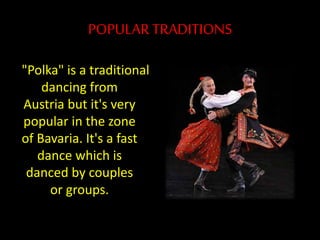
"Polka" is a traditional
dancing from
Austria but it's very
popular in the zone
of Bavaria. It's a fast
dance which is
danced by couples
or groups.
POPULAR TRADITIONS
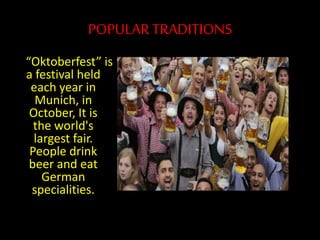
“Oktoberfest” is
a festival held
each year in
Munich, in
October, It is
the world's
largest fair.
People drink
beer and eat
German
specialities.
UNESCOWorld Heritageand otherfamous
sights:
The UNESCO lists
33 German
contributions
to world
heritage:
31 world cultural
heritage and 2
natural
heritage which
are spread
over 15 of the 16
German states.
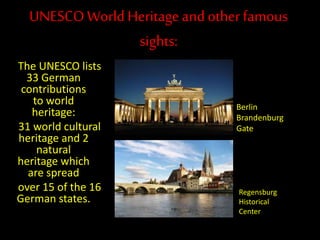
Berlin
Brandenburg
Gate
Regensburg
Historical
Center
Thank you for your
attention !
Resources
• http://worldpopulationreview.com/countries/
germany-population/
• https://en.wikipedia.org/wiki/Germany
• Course book – Grade 12B . Pages (28,29)

short presentation about Germany

  • 1.
  • 2.
    Location • Germany islocated in central Europe. • Germany is bordered by Poland, Czech Republic, Austria, Switzerland, Luxembourg, France, Belgium. The Netherlands, and Denmark.
  • 3.
    TheLand Germany is thelargest country in central Europe. It has three main geographic areas. These are the northern plains that stretch from the Baltic and and forests of southern Germany. This area extends to the Alps Mountains on the borders of Austria and Switzerland. Germany has several important rivers. The Rhine River is the busiest waterway in Europe, and is an important tourist attraction because of the castles and villages along its banks.
  • 4.
    THE CLIMATE • Coldwinters and cool summers. In the center temperatures are more extreme but prolonged periods of frost or snow are not common. Rain falls through the year. • Extremes commonly reach -10°C in winter and 35°C in the summer months.
  • 5.
    THE POPULATION • Thepopulation of Germany represents 1.18 percent of the world's total population, which arguably means that one person in every 85 people on the planet is a resident of Germany. • It has a population of 82.5 million
  • 7.
    CITYThe CAPITAL The capitalof Germany is the city state of “Berlin”. It is the seat of the President of Germany, whose official residence is Schloss Bellevue. The Bundesrat (federal council) is the representation of the Federal States of Germany and has its seat at the former Prussian Herrenhaus (House of Lords). Though most of the ministries are seated in Berlin, some of them, as well as some minor departments, are seated in Bonn, the former capital of West Germany.
  • 8.
    The meaning ofthe colors of the flag Red: Hardness, bravery, valor, strength Yellow (gold): Generosity
  • 9.
    Federal President oftheFederal Republic of Germany - since 19 March 2017 - - Frank-Walter Steinmeier -
  • 10.
    Economy • Germany hasa social market economy with a highly skilled labour force • large capital stock • low level of corruption • high level of innovation • the world's third largest exporter of goods • largest national economy in Europe which is also the world's fourth largest by nominal GDP
  • 11.
    NaturalResources In Germany Someof Natural Resources include: - Natural gas. - Iron ore. - Coal. -Timber. - Nickel.
  • 12.
    Languages of Germany •The official language of Germany is Standard German . • Recognised minority languages: -Upper Sorbian and Lower Sorbian. - Romani. - Danish. - North Frisian and Saterland Frisian. • Immigrant languages: -Turkish. -Kurdish. -Tamil. -Russian. -Arabic. -Greek. -Dutch. -Italian.
  • 13.
    Culture Culture in Germanstates has been shaped by major intellectual and popular currents in Europe, both religious and secular. Historically, Germany has been called Das Land der Dichter und Denker (the land of poets and thinkers), because of the major role its writers and philosophers have played in the development of Western thought .
  • 14.
    Music ofGermany • Germanyclaims some of the renowned composers, singers, producers and performers of the world. • Germany is the largest music market in Europe, and third largest in the world. • The most popular music in Germany : -Classical music. -Folk music.
  • 15.
    Sportin Germany • Sportin Germany is an important part of German culture and society. In 2006 about 27.5 million people were members of the more than 91,000 sport clubs in Germany. • all sports clubs are represented by the German Olympic Sports Federation. • In Germany you can do many sports like football , Bandy , Ice hockey , Motorsport .
  • 16.
    Germanfood German cuisine variesfrom region to region and often neighbouring regions share some culinary similarities (e.g. the southern regions of Bavaria and Swabia share some traditions with Switzerland and Austria). International varieties such as pizza, sushi, Chinese food, Greek food, Indian cuisine and doner kebab are also popular and available, thanks to diverse ethnic communities.
  • 17.
    POPULAR TRADITIONS "Polka" isa traditional dancing from Austria but it's very popular in the zone of Bavaria. It's a fast dance which is danced by couples or groups.
  • 18.
    POPULAR TRADITIONS “Oktoberfest” is afestival held each year in Munich, in October, It is the world's largest fair. People drink beer and eat German specialities.
  • 19.
    UNESCOWorld Heritageand otherfamous sights: TheUNESCO lists 33 German contributions to world heritage: 31 world cultural heritage and 2 natural heritage which are spread over 15 of the 16 German states. Berlin Brandenburg Gate Regensburg Historical Center
  • 20.
    Thank you foryour attention !
  • 21.