A FEDERAL COUNTRY
presented by
KARE RAMAKRISHNA
18382022
GERMANY
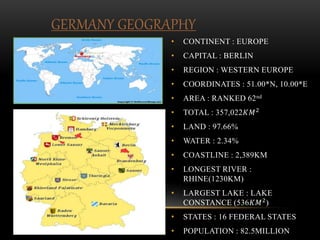
• CONTINENT : EUROPE
• CAPITAL : BERLIN
• REGION : WESTERN EUROPE
• COORDINATES : 51.00*N, 10.00*E
• AREA : RANKED 62nd
• TOTAL : 357,022𝐾𝑀2
• LAND : 97.66%
• WATER : 2.34%
• COASTLINE : 2,389KM
• LONGEST RIVER :
RHINE(1230KM)
• LARGEST LAKE : LAKE
CONSTANCE (536𝐾𝑀2)
• STATES : 16 FEDERAL STATES
• POPULATION : 82.5MILLION
GERMANY GEOGRAPHY
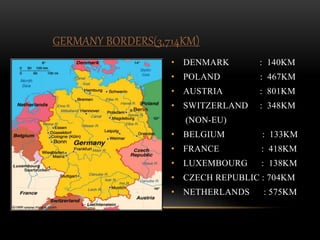
• DENMARK : 140KM
• POLAND : 467KM
• AUSTRIA : 801KM
• SWITZERLAND : 348KM
(NON-EU)
• BELGIUM : 133KM
• FRANCE : 418KM
• LUXEMBOURG : 138KM
• CZECH REPUBLIC : 704KM
• NETHERLANDS : 575KM
GERMANY BORDERS(3,714KM)
THE CLIMATE :
• Cold winters and cool summers. In the centre temperatures are more
extreme but prolonged periods of frost or snow are not common. Rain
falls through the year.
• Extremes commonly reach −100
C in winter and 350
C in the summer
months.
ATTRACTIONS :
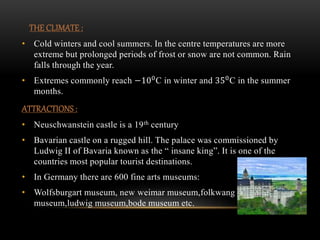
• Neuschwanstein castle is a 19th century
• Bavarian castle on a rugged hill. The palace was commissioned by
Ludwig II of Bavaria known as the “ insane king”. It is one of the
countries most popular tourist destinations.
• In Germany there are 600 fine arts museums:
• Wolfsburgart museum, new weimar museum,folkwang
museum,ludwig museum,bode museum etc.
GERMAN FOOD :
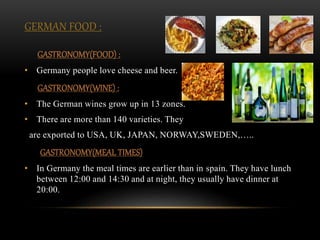
GASTRONOMY(FOOD) :
• Germany people love cheese and beer.
GASTRONOMY(WINE) :
• The German wines grow up in 13 zones.
• There are more than 140 varieties. They
are exported to USA, UK, JAPAN, NORWAY,SWEDEN,…..
GASTRONOMY(MEAL TIMES)
• In Germany the meal times are earlier than in spain. They have lunch
between 12:00 and 14:30 and at night, they usually have dinner at
20:00.
Popular traditions :
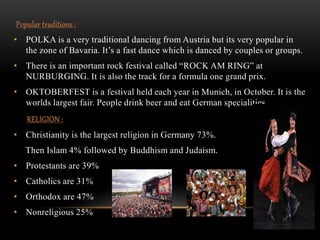
• POLKA is a very traditional dancing from Austria but its very popular in
the zone of Bavaria. It’s a fast dance which is danced by couples or groups.
• There is an important rock festival called “ROCK AM RING” at
NURBURGING. It is also the track for a formula one grand prix.
• OKTOBERFEST is a festival held each year in Munich, in October. It is the
worlds largest fair. People drink beer and eat German specialities.
RELIGION :
• Christianity is the largest religion in Germany 73%.
Then Islam 4% followed by Buddhism and Judaism.
• Protestants are 39%
• Catholics are 31%
• Orthodox are 47%
• Nonreligious 25%
CLICHES OR STEREOTYPES
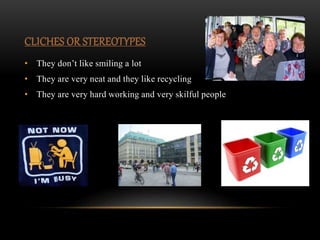
• They don’t like smiling a lot
• They are very neat and they like recycling
• They are very hard working and very skilful people
GERMAN HISTORY
• 1814 : The Congress of Vienna established the German
Confederation of 39 independent German states.
• 1864 : War; Prussia and Austria vs. Denmark.
• 1914 : Archduke Franz Ferdinand of Austria-Hungary and his wife
were assassinated in Sarajevo, Bosnia-Herzegovina provoking
WWI.
• 1918 : Armistice ending World War.
• 1918 : The Treaty of Versailles ended World War I and the
Rhineland was placed under Allied occupation for 15 years
• 1918 : Germany was declared a republic.
• 1933 : Adolf Hitler appointed chancellor by President Paul von
Hindenburg.
• 1933 : The Third Reich
• 1938 : Annexation of Austria.
• 1938 : Sudetenland (largely German-speaking) portion of
Czechoslovakia occupied.
• 1939 : Germany occupies Czechoslovakia.
• 1939 : Invasion of Poland and the beginning of World War II in
Europe (two days later).
• 1945 : Germany surrenders.
• 1955 : West Germany obtains independence.
• 1961 : The Berlin Wall was built.
• 1972 : Munich, West Germany (now Germany) hosts Summer
Olympic Games.
• 1989 : The Berlin Wall was demolished and Communist East
Germans were able to travel to the West.
• 1990 : East and West Germany
• World War II destroyed 20% of housing
(Scorched earth policy)
• Food production per capita in 1947 was 51% of its level in
1938
(Food rations set by occupying powers
varied between 1,040 and 1,550 calories per day)
• Industrial output in 1947 was 33% of 1938 level
How would West Germany recover?
 Elimination of price controls
• Price controls are an attempt to regulate inflation
 Reduction of marginal tax rates
• The amount of tax paid for earnings above a certain level
• For the median-income German in 1950, with an annual
income of a little less than DM2,400, the marginal tax rate was
18%. That same person, had he earned thereichsmark
equivalent in 1948, would have been in an 85% tax bracket.
POST WORLD WAR II ECONOMICS
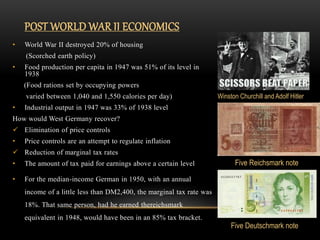
Winston Churchill and Adolf Hitler
Five Reichsmark note
Five Deutschmark note
Marshall Plan :
• Aid programs only totalled $2 billion through 1954
• When aid was at its peak in 1948 and 1949, aid was less than
5% of German national income
• Other countries that received more aid exhibited lower growth than Germany
SOLIDARITY IN OBERHAUSEN
• $11,000 debt per capita, Higher than anywhere else in Germany
• Borrows $500,000 a day to stay afloat
• Taxpayers in western Germany have paid more than 1 trillion euros since
reunification
• Solidarity Payments continue into 2019
• Oberhausen’s current debt $350 million
• Oberhausen is now receiving loan offers from some cities in eastern Germany
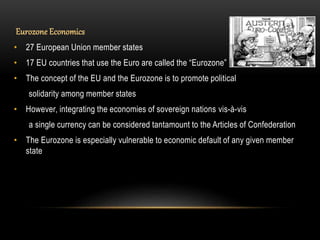
Eurozone Economics
• 27 European Union member states
• 17 EU countries that use the Euro are called the “Eurozone”
• The concept of the EU and the Eurozone is to promote political
solidarity among member states
• However, integrating the economies of sovereign nations vis-à-vis
a single currency can be considered tantamount to the Articles of Confederation
• The Eurozone is especially vulnerable to economic default of any given member
state
ABOUT GERMAN CULTURE
• German living and working is defined by structure (laws, rules,
procedures)
• For decision-making and problem-solving Germans focus on
objective facts
• Interpersonal relationships do not play an important role in business
dealings. Instead focus on achieving your tasks
• Focus on direct communication style
• Germans are individualistic
• The business culture has a well-defined hierarchy which includes
clear responsibilities and distinctions between roles
• Status and academic titles are quite important to Germans – address
people by their full and correct titles
• In formal business meetings, the highest-ranking person usually
enters the room first
• A separation between private life and work is quite common in
Germany
• First names are used in more private situations. Use the formal
version of „Sie“ unless you are invited to the informal „Du“
• Germans dress quite conservative in business (dark suits, blouses, ties
etc.)
• Punctuality is essential (in business and social situations)
• Appointments are made for almost every situation
• Germans plan ahead (book meetings some weeks in advance)
• In business situations, hands are shaken at the beginning and at the
end
• Germans keep a larger personal space around them
• Decisions are made slowly and methodically
DEMOGRAPHICS OF GERMANY
• Population : 82,887,000
• Growth rate : 0.4
• Birth rate : 8.6 births/ 1000
• Death rate : 11.8 deaths / 1000
• Life expectancy : 80.9 years
• male : 78.6 years
• female : 83.4 years
• Fertility rate : 1.59 children born / woman
• Infant morality rate : 3.46 deaths / 1000 live births
• Net migration rate : 1.5 migrants / 1000 population
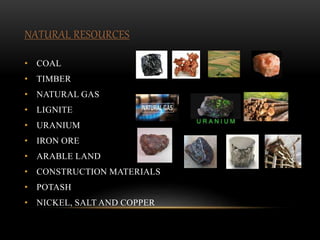
• COAL
• TIMBER
• NATURAL GAS
• LIGNITE
• URANIUM
• IRON ORE
• ARABLE LAND
• CONSTRUCTION MATERIALS
• POTASH
• NICKEL, SALT AND COPPER
NATURAL RESOURCES
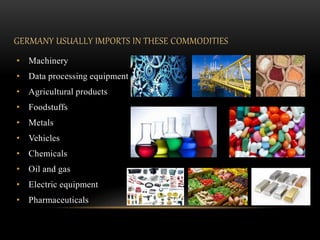
GERMANY USUALLY IMPORTS IN THESE COMMODITIES
• Machinery
• Data processing equipment
• Agricultural products
• Foodstuffs
• Metals
• Vehicles
• Chemicals
• Oil and gas
• Electric equipment
• Pharmaceuticals
• Cars : $58.5 billion
• Automobile parts / : $41.8 billion
accessories
• Crude oil : $36.2 billion
• Petroleum gasses : $ 28.2 billion
• Medication mixes in dosage : $26
billion
• Blood fractions : $23 billion
• Computers, optical readers : $22.9
billion
• Phone system devices : $22.4 billion
• Processed petroleum oils : $20.3
billion
• Integrated circuits / : 17.3 billion
micro assemblies
• CARS : $157.4 billion
• Automobile parts / : $62.5 billion
accessories
• Medication mixes : $52.7 billion
in dosage
• Aircraft, spacecraft : $30.8 billion
• Blood fractions : $24.9 billion
• Miscellaneous machinery : $16.1 billion
• Integrated circuits / : $15.1 billion
micro assemblies
• Computers, optical readers : $14.9 billion
• Lower voltage switches, ; $14 billion
fuses
TOP EXPORTS AND IMPORTS OF GERMANY
TOP EXPORTS TOP IMPORTS
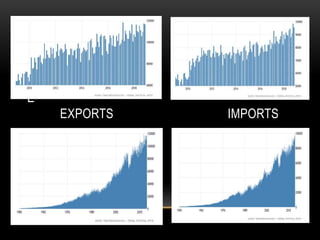
E
EXPORTS IMPORTS
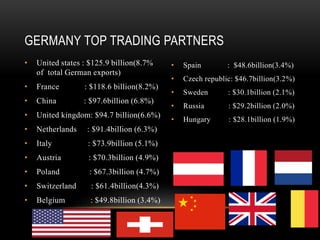
• United states : $125.9 billion(8.7%
of total German exports)
• France : $118.6 billion(8.2%)
• China : $97.6billion (6.8%)
• United kingdom: $94.7 billion(6.6%)
• Netherlands : $91.4billion (6.3%)
• Italy : $73.9billion (5.1%)
• Austria : $70.3billion (4.9%)
• Poland : $67.3billion (4.7%)
• Switzerland : $61.4billion(4.3%)
• Belgium : $49.8billion (3.4%)
• Spain : $48.6billion(3.4%)
• Czech republic: $46.7billion(3.2%)
• Sweden : $30.1billion (2.1%)
• Russia : $29.2billion (2.0%)
• Hungary : $28.1billion (1.9%)
GERMANY TOP TRADING PARTNERS
INTERESTING FACTS ABOUT GERMANY
• Germany was the first country in the world to adopt daylight saving time
• Prison escape is not punishable by law in Germany
• Its illegal to run out of fuel in the German Autobahn
• Germany has legal say on what babies can be named
• Fanta originated in Germany as a result of the world war-II
• College education is free in Germany even for internationals
• Over 800 million currywurst are eaten in Germany each year
• Germany was once a cluster of small kingdoms, duchies and principalities
• German remains the language with the most native speakers in Europe
• Germanys capital centre has shifted seven times
• Germany is sometimes known as “the land of poets and thinkers
• Germany is ranked 24 among 190 economies in ease of doing business.
• Germany ranked 25 among 180 countries in economic freedom(74.2)
• Germany is the second most popular expat destination in the world
• Germany is rated highly as a place to grow old (83 for women & 78 for men)
• Germanys education system produces top performance
• Germany has high levels of employment
• Germany is the EU’s largest economy
• German SME’s account for around 52% of Germanys entire economic output
• Germany is one of the worlds largest car producers
• Germany is one of the worlds leading book nations
• Germany is Europe's second largest beer consumer
• Smoking is banned in public places but drinking is still legal
• Germany is a leader in climate and energy policies
• Angela Merkel, chancellor of Germany since 2005, was ranked as the worlds
2nd most powerful person
• Munichs oktoberfest is the worlds biggest folk festival
MERCANTILISM THEORY
• Mercantilism suggests, among other things, that Germany is the world’s
strongest economy, because it has the largest current-account surplus.
• In 2016, Germany ran a current-account surplus of roughly €270bn
(£228bn), or 8.6% of GDP, making it an obvious target of Trump’s ire. And
its bilateral trade surplus of £51bn with the US presumably makes it an
even more irresistible target. Never mind that, as a member of the
Eurozone, Germany has no exchange rate to manipulate. Forget that
Germany is relatively open to US exports, or that its policymakers are
subject to the EU’s anti-subsidy regulations. Ignore the fact that bilateral
balances are irrelevant for welfare when countries run surpluses with some
trade partners and deficits with others.
• Back in the real world, the explanation for Germany’s external surplus is
not that it manipulates its currency or discriminates against imports, but
that it saves more than it invests. The correspondence of savings minus
investment with exports minus imports is not an economic theory; it’s an
accounting identity. Germans collectively spend less than they produce, and
the difference necessarily shows up as net exports.
Germany

Germany

  • 1.
    A FEDERAL COUNTRY presentedby KARE RAMAKRISHNA 18382022 GERMANY
  • 2.
    • CONTINENT :EUROPE • CAPITAL : BERLIN • REGION : WESTERN EUROPE • COORDINATES : 51.00*N, 10.00*E • AREA : RANKED 62nd • TOTAL : 357,022𝐾𝑀2 • LAND : 97.66% • WATER : 2.34% • COASTLINE : 2,389KM • LONGEST RIVER : RHINE(1230KM) • LARGEST LAKE : LAKE CONSTANCE (536𝐾𝑀2) • STATES : 16 FEDERAL STATES • POPULATION : 82.5MILLION GERMANY GEOGRAPHY
  • 3.
    • DENMARK :140KM • POLAND : 467KM • AUSTRIA : 801KM • SWITZERLAND : 348KM (NON-EU) • BELGIUM : 133KM • FRANCE : 418KM • LUXEMBOURG : 138KM • CZECH REPUBLIC : 704KM • NETHERLANDS : 575KM GERMANY BORDERS(3,714KM)
  • 4.
    THE CLIMATE : •Cold winters and cool summers. In the centre temperatures are more extreme but prolonged periods of frost or snow are not common. Rain falls through the year. • Extremes commonly reach −100 C in winter and 350 C in the summer months. ATTRACTIONS : • Neuschwanstein castle is a 19th century • Bavarian castle on a rugged hill. The palace was commissioned by Ludwig II of Bavaria known as the “ insane king”. It is one of the countries most popular tourist destinations. • In Germany there are 600 fine arts museums: • Wolfsburgart museum, new weimar museum,folkwang museum,ludwig museum,bode museum etc.
  • 5.
    GERMAN FOOD : GASTRONOMY(FOOD): • Germany people love cheese and beer. GASTRONOMY(WINE) : • The German wines grow up in 13 zones. • There are more than 140 varieties. They are exported to USA, UK, JAPAN, NORWAY,SWEDEN,….. GASTRONOMY(MEAL TIMES) • In Germany the meal times are earlier than in spain. They have lunch between 12:00 and 14:30 and at night, they usually have dinner at 20:00.
  • 6.
    Popular traditions : •POLKA is a very traditional dancing from Austria but its very popular in the zone of Bavaria. It’s a fast dance which is danced by couples or groups. • There is an important rock festival called “ROCK AM RING” at NURBURGING. It is also the track for a formula one grand prix. • OKTOBERFEST is a festival held each year in Munich, in October. It is the worlds largest fair. People drink beer and eat German specialities. RELIGION : • Christianity is the largest religion in Germany 73%. Then Islam 4% followed by Buddhism and Judaism. • Protestants are 39% • Catholics are 31% • Orthodox are 47% • Nonreligious 25%
  • 7.
    CLICHES OR STEREOTYPES •They don’t like smiling a lot • They are very neat and they like recycling • They are very hard working and very skilful people
  • 8.
    GERMAN HISTORY • 1814: The Congress of Vienna established the German Confederation of 39 independent German states. • 1864 : War; Prussia and Austria vs. Denmark. • 1914 : Archduke Franz Ferdinand of Austria-Hungary and his wife were assassinated in Sarajevo, Bosnia-Herzegovina provoking WWI. • 1918 : Armistice ending World War. • 1918 : The Treaty of Versailles ended World War I and the Rhineland was placed under Allied occupation for 15 years • 1918 : Germany was declared a republic. • 1933 : Adolf Hitler appointed chancellor by President Paul von Hindenburg. • 1933 : The Third Reich
  • 9.
    • 1938 :Annexation of Austria. • 1938 : Sudetenland (largely German-speaking) portion of Czechoslovakia occupied. • 1939 : Germany occupies Czechoslovakia. • 1939 : Invasion of Poland and the beginning of World War II in Europe (two days later). • 1945 : Germany surrenders. • 1955 : West Germany obtains independence. • 1961 : The Berlin Wall was built. • 1972 : Munich, West Germany (now Germany) hosts Summer Olympic Games. • 1989 : The Berlin Wall was demolished and Communist East Germans were able to travel to the West. • 1990 : East and West Germany
  • 10.
    • World WarII destroyed 20% of housing (Scorched earth policy) • Food production per capita in 1947 was 51% of its level in 1938 (Food rations set by occupying powers varied between 1,040 and 1,550 calories per day) • Industrial output in 1947 was 33% of 1938 level How would West Germany recover?  Elimination of price controls • Price controls are an attempt to regulate inflation  Reduction of marginal tax rates • The amount of tax paid for earnings above a certain level • For the median-income German in 1950, with an annual income of a little less than DM2,400, the marginal tax rate was 18%. That same person, had he earned thereichsmark equivalent in 1948, would have been in an 85% tax bracket. POST WORLD WAR II ECONOMICS Winston Churchill and Adolf Hitler Five Reichsmark note Five Deutschmark note
  • 11.
    Marshall Plan : •Aid programs only totalled $2 billion through 1954 • When aid was at its peak in 1948 and 1949, aid was less than 5% of German national income • Other countries that received more aid exhibited lower growth than Germany SOLIDARITY IN OBERHAUSEN • $11,000 debt per capita, Higher than anywhere else in Germany • Borrows $500,000 a day to stay afloat • Taxpayers in western Germany have paid more than 1 trillion euros since reunification • Solidarity Payments continue into 2019 • Oberhausen’s current debt $350 million • Oberhausen is now receiving loan offers from some cities in eastern Germany
  • 12.
    Eurozone Economics • 27European Union member states • 17 EU countries that use the Euro are called the “Eurozone” • The concept of the EU and the Eurozone is to promote political solidarity among member states • However, integrating the economies of sovereign nations vis-à-vis a single currency can be considered tantamount to the Articles of Confederation • The Eurozone is especially vulnerable to economic default of any given member state
  • 13.
    ABOUT GERMAN CULTURE •German living and working is defined by structure (laws, rules, procedures) • For decision-making and problem-solving Germans focus on objective facts • Interpersonal relationships do not play an important role in business dealings. Instead focus on achieving your tasks • Focus on direct communication style • Germans are individualistic • The business culture has a well-defined hierarchy which includes clear responsibilities and distinctions between roles • Status and academic titles are quite important to Germans – address people by their full and correct titles • In formal business meetings, the highest-ranking person usually enters the room first
  • 14.
    • A separationbetween private life and work is quite common in Germany • First names are used in more private situations. Use the formal version of „Sie“ unless you are invited to the informal „Du“ • Germans dress quite conservative in business (dark suits, blouses, ties etc.) • Punctuality is essential (in business and social situations) • Appointments are made for almost every situation • Germans plan ahead (book meetings some weeks in advance) • In business situations, hands are shaken at the beginning and at the end • Germans keep a larger personal space around them • Decisions are made slowly and methodically
  • 15.
    DEMOGRAPHICS OF GERMANY •Population : 82,887,000 • Growth rate : 0.4 • Birth rate : 8.6 births/ 1000 • Death rate : 11.8 deaths / 1000 • Life expectancy : 80.9 years • male : 78.6 years • female : 83.4 years • Fertility rate : 1.59 children born / woman • Infant morality rate : 3.46 deaths / 1000 live births • Net migration rate : 1.5 migrants / 1000 population
  • 16.
    • COAL • TIMBER •NATURAL GAS • LIGNITE • URANIUM • IRON ORE • ARABLE LAND • CONSTRUCTION MATERIALS • POTASH • NICKEL, SALT AND COPPER NATURAL RESOURCES
  • 17.
    GERMANY USUALLY IMPORTSIN THESE COMMODITIES • Machinery • Data processing equipment • Agricultural products • Foodstuffs • Metals • Vehicles • Chemicals • Oil and gas • Electric equipment • Pharmaceuticals
  • 18.
    • Cars :$58.5 billion • Automobile parts / : $41.8 billion accessories • Crude oil : $36.2 billion • Petroleum gasses : $ 28.2 billion • Medication mixes in dosage : $26 billion • Blood fractions : $23 billion • Computers, optical readers : $22.9 billion • Phone system devices : $22.4 billion • Processed petroleum oils : $20.3 billion • Integrated circuits / : 17.3 billion micro assemblies • CARS : $157.4 billion • Automobile parts / : $62.5 billion accessories • Medication mixes : $52.7 billion in dosage • Aircraft, spacecraft : $30.8 billion • Blood fractions : $24.9 billion • Miscellaneous machinery : $16.1 billion • Integrated circuits / : $15.1 billion micro assemblies • Computers, optical readers : $14.9 billion • Lower voltage switches, ; $14 billion fuses TOP EXPORTS AND IMPORTS OF GERMANY TOP EXPORTS TOP IMPORTS
  • 19.
  • 20.
    • United states: $125.9 billion(8.7% of total German exports) • France : $118.6 billion(8.2%) • China : $97.6billion (6.8%) • United kingdom: $94.7 billion(6.6%) • Netherlands : $91.4billion (6.3%) • Italy : $73.9billion (5.1%) • Austria : $70.3billion (4.9%) • Poland : $67.3billion (4.7%) • Switzerland : $61.4billion(4.3%) • Belgium : $49.8billion (3.4%) • Spain : $48.6billion(3.4%) • Czech republic: $46.7billion(3.2%) • Sweden : $30.1billion (2.1%) • Russia : $29.2billion (2.0%) • Hungary : $28.1billion (1.9%) GERMANY TOP TRADING PARTNERS
  • 22.
    INTERESTING FACTS ABOUTGERMANY • Germany was the first country in the world to adopt daylight saving time • Prison escape is not punishable by law in Germany • Its illegal to run out of fuel in the German Autobahn • Germany has legal say on what babies can be named • Fanta originated in Germany as a result of the world war-II • College education is free in Germany even for internationals • Over 800 million currywurst are eaten in Germany each year • Germany was once a cluster of small kingdoms, duchies and principalities • German remains the language with the most native speakers in Europe • Germanys capital centre has shifted seven times • Germany is sometimes known as “the land of poets and thinkers • Germany is ranked 24 among 190 economies in ease of doing business. • Germany ranked 25 among 180 countries in economic freedom(74.2)
  • 23.
    • Germany isthe second most popular expat destination in the world • Germany is rated highly as a place to grow old (83 for women & 78 for men) • Germanys education system produces top performance • Germany has high levels of employment • Germany is the EU’s largest economy • German SME’s account for around 52% of Germanys entire economic output • Germany is one of the worlds largest car producers • Germany is one of the worlds leading book nations • Germany is Europe's second largest beer consumer • Smoking is banned in public places but drinking is still legal • Germany is a leader in climate and energy policies • Angela Merkel, chancellor of Germany since 2005, was ranked as the worlds 2nd most powerful person • Munichs oktoberfest is the worlds biggest folk festival
  • 24.
    MERCANTILISM THEORY • Mercantilismsuggests, among other things, that Germany is the world’s strongest economy, because it has the largest current-account surplus. • In 2016, Germany ran a current-account surplus of roughly €270bn (£228bn), or 8.6% of GDP, making it an obvious target of Trump’s ire. And its bilateral trade surplus of £51bn with the US presumably makes it an even more irresistible target. Never mind that, as a member of the Eurozone, Germany has no exchange rate to manipulate. Forget that Germany is relatively open to US exports, or that its policymakers are subject to the EU’s anti-subsidy regulations. Ignore the fact that bilateral balances are irrelevant for welfare when countries run surpluses with some trade partners and deficits with others. • Back in the real world, the explanation for Germany’s external surplus is not that it manipulates its currency or discriminates against imports, but that it saves more than it invests. The correspondence of savings minus investment with exports minus imports is not an economic theory; it’s an accounting identity. Germans collectively spend less than they produce, and the difference necessarily shows up as net exports.