+ 
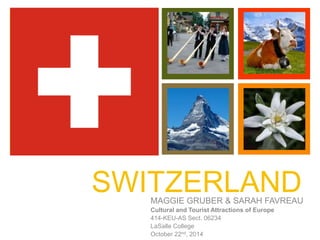
SWITZERLAND 
MAGGIE GRUBER & SARAH FAVREAU 
Cultural and Tourist Attractions of Europe 
414-KEU-AS Sect. 06234 
LaSalle College 
October 22nd, 2014
+ 2 
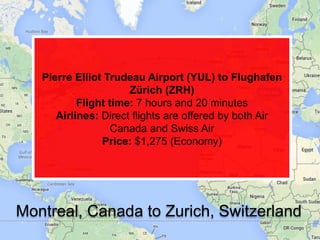
Pierre Elliot Trudeau Airport (YUL) to Flughafen 
Zürich (ZRH) 
Flight time: 7 hours and 20 minutes 
Airlines: Direct flights are offered by both Air 
Canada and Swiss Air 
Price: $1,275 (Economy) 
Montreal, Canada to Zurich, Switzerland
+ 
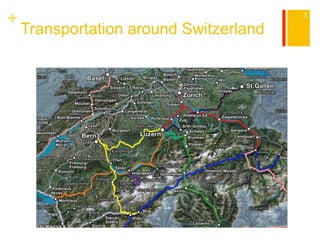
Transportation around Switzerland 
3
+ 
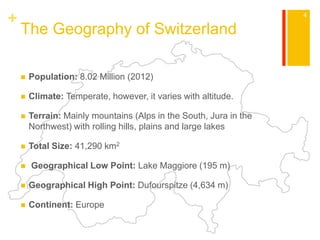
The Geography of Switzerland 
 Population: 8.02 Million (2012) 
 Climate: Temperate, however, it varies with altitude. 
 Terrain: Mainly mountains (Alps in the South, Jura in the 
Northwest) with rolling hills, plains and large lakes 
 Total Size: 41,290 km2 
 Geographical Low Point: Lake Maggiore (195 m) 
 Geographical High Point: Dufourspitze (4,634 m) 
 Continent: Europe 
4
+ 
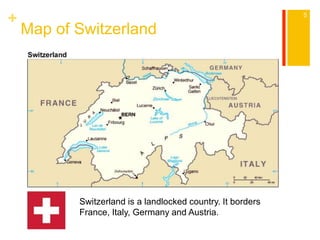
Map of Switzerland 
5 
Switzerland is a landlocked country. It borders 
France, Italy, Germany and Austria.
+ 
History of Switzerland 
 Around 1500 BC Celtic Helvetian’s entered Switzerland and 
colonized the land. 
 By 58 BC the Romans took reign of the area and built a capital at 
Aventicum (Avenches). In the Following centuries, the Romans 
continued to build roads and other towns. 
 However, the region was attacked by a tribe called Alemanii and 
Switzerland never recovered. This resulted in the Romans 
withdrawing their army from Switzerland altogether in 400AD 
 Afterwards, the Germanic Tribes (Alamanii and Burgundians) took 
rule of the area forcing the remaining Roman’s to retreat into the 
mountains. Despite this, the area remained a part of the Holy 
Roman Empire for many years afterwards. 
6
+ 
History of Switzerland 
 In the 12th Century, the Dukes of Zahringen, A German nobel 
family, were given authority over part of the Burgundy territories 
(the western part of Switzerland) and were responsible for 
founding many of Switzerland’s cities, such as Fribourg in 1157 
and Bern in 1191. 
 In 1291, the Unterwalden, Schwyz, and Uri families signed a 
charter making Switzerland an independent country. However, 
formal independence wasn’t acquired from the Holy Roman 
Empire until 1499. 
 Switzerland’s goal was to be a neutral country, meaning they 
intended not to be involved in any wars. After the defeat of 
Napolean when he invaded the country in 1797, the congress of 
Vienna gave Switzerland in 1815, permanent armed neutrality, 
which they maintained through both World Wars and the Cold War 
despite being centrally located in the heart of Europe. 
7
+ 
The People of Switzerland 
8 
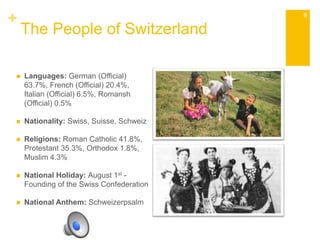
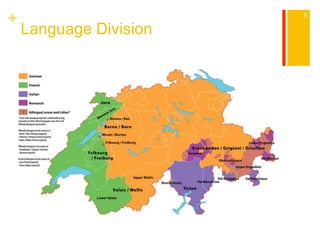
 Languages: German (Official) 
63.7%, French (Official) 20.4%, 
Italian (Official) 6.5%, Romansh 
(Official) 0.5% 
 Nationality: Swiss, Suisse, Schweiz 
 Religions: Roman Catholic 41.8%, 
Protestant 35.3%, Orthodox 1.8%, 
Muslim 4.3% 
 National Holiday: August 1st - 
Founding of the Swiss Confederation 
 National Anthem: Schweizerpsalm
+ 
Language Division 
9
+ 
German Lesson 
 Guten Morgen................................................Good Morning 
 Gute Nacht...................................................... Good Night 
 Guten Tag........................................................ Hello/Good Day 
 Danke............................................................... Thank You 
 Bitte.................................................................. Please 
 Bitte Schön........................................................ You’re Welcome 
 Ja / Nein............................................................ Yes / NO 
 Das ist Gut......................................................... That is good 
 Wunderbar........................................................ Wonderful 
10
+ 
Switzerland’s Economy 
 Major Industries: machinery, chemicals, watches, textiles, 
precision instruments 
 Agriculture Products: grains, fruits, vegetables, meat, eggs 
 Natural Resources: Hydropower, potential, timber, salt 
 Major Exports: Machinery, chemicals, metals, watches, 
agricultural products 
 Major Imports: Machinery, chemicals, vehicles, metals, 
agricultural products, textiles 
11
+ 
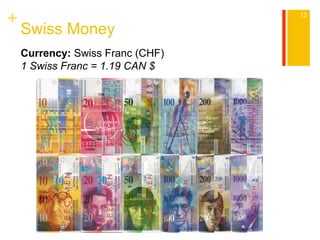
Swiss Money 
12 
Currency: Swiss Franc (CHF) 
1 Swiss Franc = 1.19 CAN $
+ 
Swiss Cuisine 
 Breakfast in Switzerland typically includes bread with butter or 
margarine, marmalade or honey along with maybe some 
cheese or cereal and milk, tea or coffee. 
 For Lunch, the Swiss usually enjoy something small and 
simple, such as birchemüesli or a sandwich. 
 Dinner is typically the biggest meal of the day. However, if they 
had a large lunch, dinner could simply consist of bread, 
cheese, and dried or light meat. 
13
+ 
Traditional Foods 
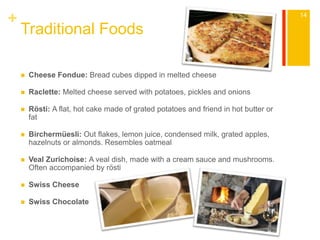
 Cheese Fondue: Bread cubes dipped in melted cheese 
 Raclette: Melted cheese served with potatoes, pickles and onions 
 Rösti: A flat, hot cake made of grated potatoes and friend in hot butter or 
fat 
 Birchermüesli: Out flakes, lemon juice, condensed milk, grated apples, 
hazelnuts or almonds. Resembles oatmeal 
 Veal Zurichoise: A veal dish, made with a cream sauce and mushrooms. 
Often accompanied by rösti 
 Swiss Cheese 
 Swiss Chocolate 
14
+ 
Swiss Etiquette 
 Meeting and Greeting – 
 Shake hands with everyone present – men women and children at business or 
social meetings. Shake hands when leaving. 
 When greeting family, the Swiss give three kisses on the cheeks. Left, right then 
left again. 
 The Swiss take punctuality for business and social meetings very seriously. The 
Swiss are always on time! So if you aren’t going to on time, you need to call with 
an explanation. 
 Dress – 
 Appearance should always be clean and neat. The Swiss are known for 
conservative and near attire. 
 Dining and Entertainment – 
 Cut potatoes, soft foods, and salads with a fork, not a knife 
 Break bread with your hands if possible, not a knife. 
 Beckon a waiter by saying Herr or Ober, and a waitress by saying Fräulein 
15
+ 
The Music of Switzerland 
 Switzerland is known for its 
traditional folklore music, although 
nowadays pop and rock music are 
more common among the Swiss 
population. Traditional folklore 
music was developed by the alpine 
herdsmen. The music style can 
include: 
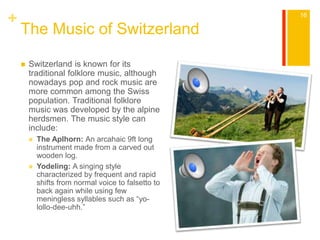
 The Aplhorn: An arcahaic 9ft long 
instrument made from a carved out 
wooden log. 
 Yodeling: A singing style 
characterized by frequent and rapid 
shifts from normal voice to falsetto to 
back again while using few 
meningless syllables such as “yo-lollo- 
dee-uhh.” 
16
+ 
Switzerland 
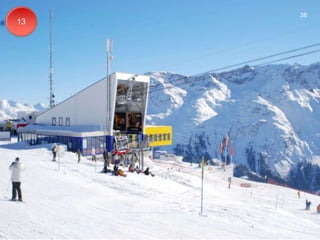
Zurich, St. Moritz, Lugano, Luzern, Bern, 
Interlaken, Zermatt, Lausanne, Geneva 
Main 
Attractions
+ 
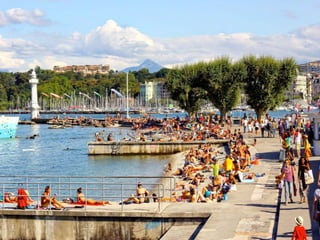
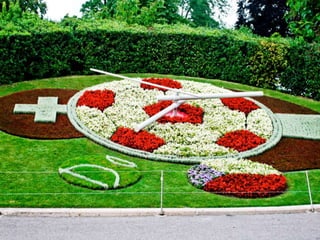
Geneva 
 Gevena is the French speaking part of 
Switzerland also known to be the 
“smallest of big city" or “city of parks" 
Geneva has 20% of its territory that 
consists of natural parks 
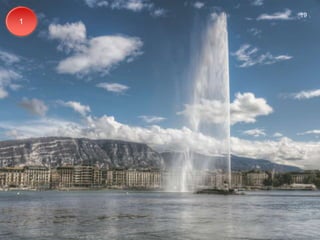
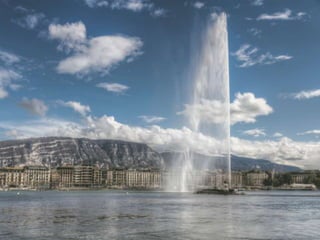
 One of Geneva's popular attractions is 
the “Jet d'eau” situated on the Lake 
Geneva, it's a bursting 140meter high 
water fountain one of use worlds tallest 
and symbolizes Geneva's hydraulic 
power. 
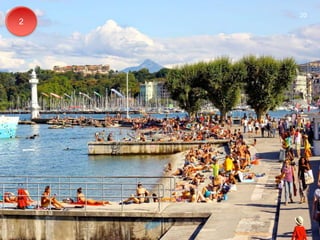
 Located towards the left and right side of 
the fountain is 'The Promenades' filled 
with cafe's, parks, street markets, lakes 
cruises, amusement rides and lots of 
water skiing 
Switzerland
19 
1
20 
2
21 
3
22 
4
23 
4
24 
5
25 
5
+ 
Lausanne 
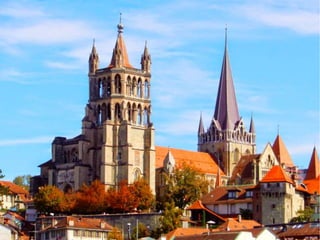
 Lausanne is the second largest city on 
the Lake Geneva, capital of the canton of 
Vaud. it is also a French speaking 
destination in Switzerland and home of 
the Olympic committee since 1914. 
 It is a lively destination for universities 
and conventions. 
 Lausanne is built on 3 hills, surrounded 
by vineyard covered slopes and of 
course the Lake Geneva 
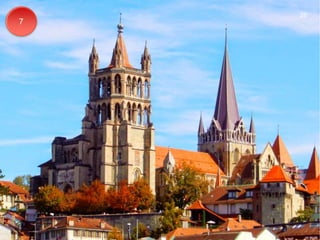
 The old town of Lausanne is largely car-free 
and dominated by what is known to 
be the most impressive piece of gothic 
architecture: the Lausanne cathedral. It 
began to be built in 1170 but completed 
in 1235 
A must see attraction that is also 
surrounded by shopping streets, 
Switzerland
27 
6
28 
7
+ 
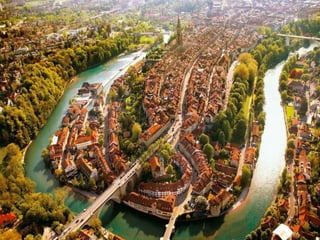
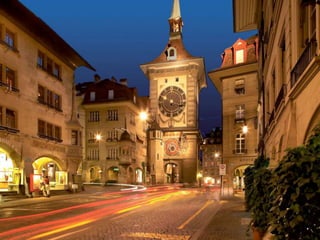
Bern 
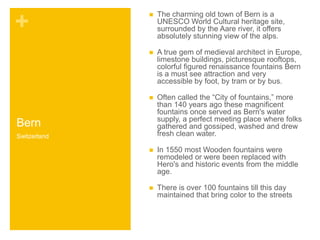
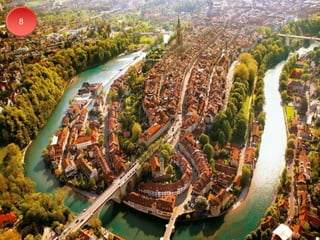
 The charming old town of Bern is a 
UNESCO World Cultural heritage site, 
surrounded by the Aare river, it offers 
absolutely stunning view of the alps. 
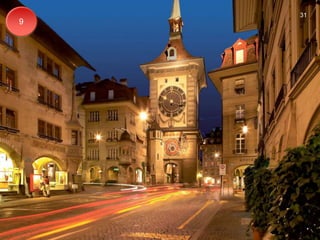
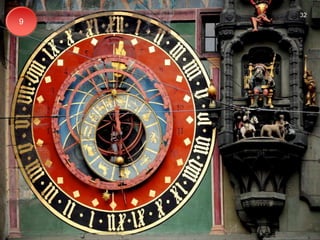
 A true gem of medieval architect in Europe, 
limestone buildings, picturesque rooftops, 
colorful figured renaissance fountains Bern 
is a must see attraction and very 
accessible by foot, by tram or by bus. 
 Often called the “City of fountains,” more 
than 140 years ago these magnificent 
fountains once served as Bern's water 
supply, a perfect meeting place where folks 
gathered and gossiped, washed and drew 
fresh clean water. 
 In 1550 most Wooden fountains were 
remodeled or were been replaced with 
Hero's and historic events from the middle 
age. 
 There is over 100 fountains till this day 
maintained that bring color to the streets 
Switzerland
30 
8
31 
9
32 
9
+ 
Zurich 
 Zurich is located in north-central 
Switzerland at the northwestern tip of 
Lake Zurich, and it is the largest city in 
the country. 
 With a population of approximately 400 
thousand, Zurich is a hub for railways, 
roads, and air traffic. Both Zurich airport 
and railway station are the largest and 
busiest in the country. 
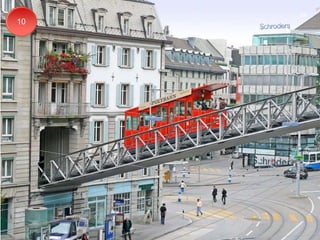
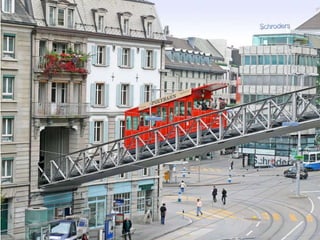
 The Polybahn funicular railway can be 
found in the center of the city. The rail 
line carries passengers up to the terrace 
by the main building of ETH Zurich 
University. 
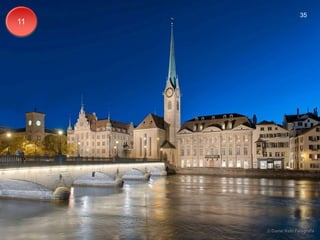
 Most of Zurich’s sites-to-see are located 
on either side of the Limmat River 
between the main rail station and Lake 
Zurich. These sites include churches, 
museums and parks. 
Switzerland
34 
10
35 
11
+ 
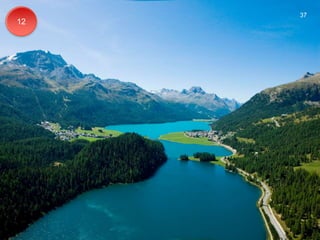
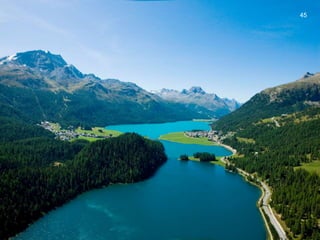
St. Moritz 
 St. Moritz is known as a resort town 
located in the Engadine valley of 
Switzerland. 
 Not far from the Piz Bernina, the highest 
summit in the Eastern Alps, St. Moritz 
was the host of the 1928 and 1948 
Winter Olympics. 
 It is a popular destination for upper class 
travelers and international jet setters as it 
is one of the most expensive ski resort in 
the world. 
 St. Moritz also has amazing weather 
conditions with 300 days of sunshine per 
year. 
 Every winter a variety of activities take 
place in St. Moritz, such as the “white 
Turf” horse race over the frozen Lake St. 
Moritz. 
Switzerland
37 
12
38 
13
+ 
What Am I? 
Memory Game 
39
40
41
42
43
44
45
46
47
48
49
50
51
52
53
54
55
56
57
58
59
60
61
+ 
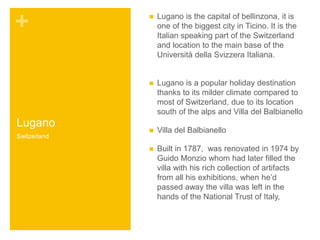
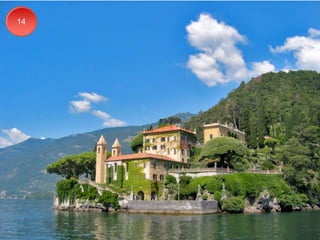
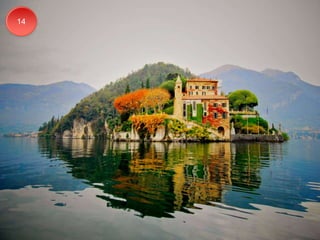
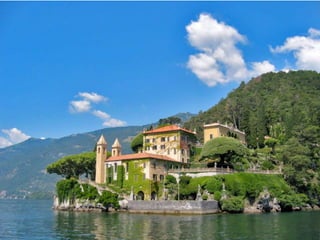
Lugano 
 Lugano is the capital of bellinzona, it is 
one of the biggest city in Ticino. It is the 
Italian speaking part of the Switzerland 
and location to the main base of the 
Università della Svizzera Italiana. 
 Lugano is a popular holiday destination 
thanks to its milder climate compared to 
most of Switzerland, due to its location 
south of the alps and Villa del Balbianello 
 Villa del Balbianello 
 Built in 1787, was renovated in 1974 by 
Guido Monzio whom had later filled the 
villa with his rich collection of artifacts 
from all his exhibitions, when he’d 
passed away the villa was left in the 
hands of the National Trust of Italy, 
Switzerland
63 
14
64 
14
65 
15
+ 
Lucerne 
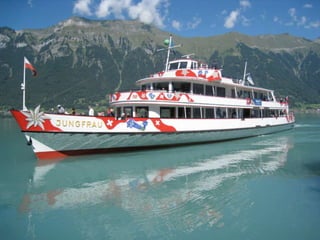
 Lucerne has long been a destination for 
tourists, ranked one of the prettiest cities 
and most popular city in central 
Switzerland, 
 Lucerne is the capital of canton Lucerne, 
with a population of around 76,200 and a 
German speaking city 
 Lake Lucerne in the past, until 1863 was 
the only trade route to the Gotthard pass, 
today it is no doubt an unforgettable 
experience and a must see natural 
attraction. With a steamer cruise visiting 
the lake throughout all seasons visitors 
will have a spectacular scenery to 
appreciate. 
Switzerland
67 
16
68 
17
+ 
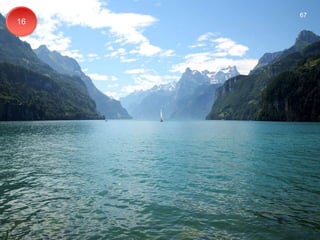
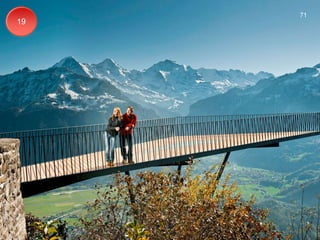
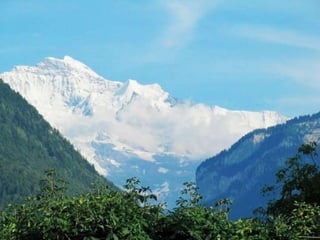
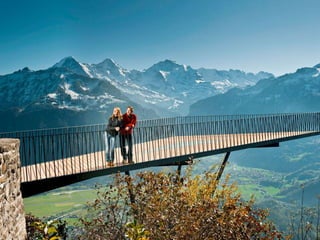
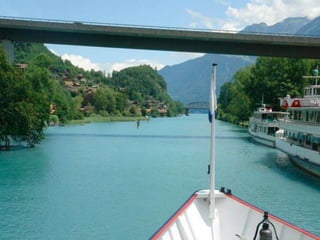
Interlaken 
 Interlaken is a town and municipality in the 
Interlaken-Oberhasil administrative district 
in the Swiss Canton of Bern area. 
 It is a well-known tourist destination located 
in the Swiss Alps. It is the main transport 
gateway to the mountains as well as the 
lake of the region. 
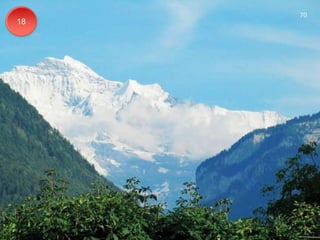
 Interlaken has a variety of beautiful 
mountains such as the Jungfrau, the 
Mönch and the Eiger. Although only directly 
accessible to mountain climbers, you can 
reach as high as the Jungfraujoch, a coll 
between the Jungfrau and the Mönch. It is 
the highest point in Europe accessible by 
train and it offers the best view of the two 
mountains. 
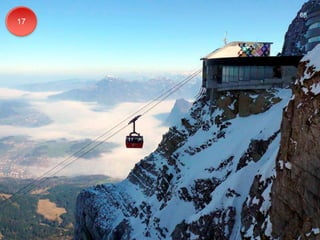
 The Harder Kulm and schynige Platte are 
also accessible by railway and offer 
spectacular views of the higher mountains. 
Switzerland
70 
18
71 
19
72 
20
73 
20
+ 
Zermatt 
 Zermatt is a municipality located in the 
District of Visp in the canton of Valais in 
Switzerland. 
 Zermatt like St. Moritz, is a ski resort 
destination and apart of the Swiss Alps. 
 The ski village was discovered around the 
mid-nineteenth-century by British 
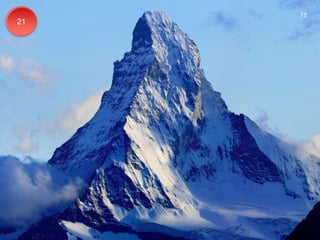
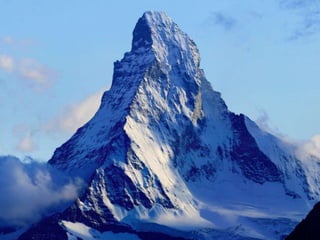
mountaineers. The Matterhorn was the last 
of the alpine mountains to be conquered in 
1865, however, it was not reached without 
casualties. Only 3 of the 7 climbers 
survived the descent. 
 Skiers and hikers can access the 
mountains in Zermatt, Klein Matterhorn 
being the highest, by cable cars and chair 
lifts. 
 It’s possible to cross into Italy via the 
cervinia cable car station as well as access 
the Gornegrat summit through an amazing 
rack railway line. Zermatt is also thw wester 
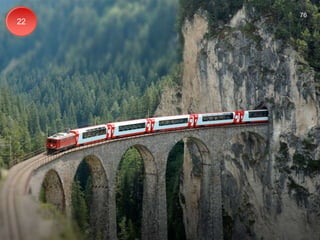
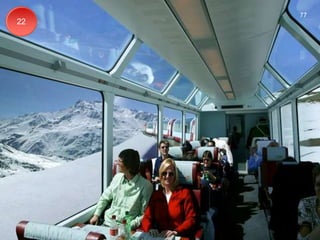
terminus for the Glacier express connecting 
to St. Moritz and the MGB (Matterhorn- 
Gottard-Bahn) 
Switzerland
75 
21
76 
22
77 
22
+ Before you go... 
78 
Travel Restrictions 
Passport requirments 
Canadians must present a passport which must be valid for at least three months beyond the 
date of their expected departure 
Visa’s are not required for stays up to 90 days 
Crime 
Petty crime has increased and occurs in most public areas, particularly in Berne, Zurich and 
Geneva. Pickpockets are active in public places, such as airports and railway stations. Exercise 
caution on trains, especially on overnight trips to neighbouring countries 
Vaccination 
Some countries require proof of yellow fever vaccination before allowing entry 
Driving in Switzerland 
You must be at least 18 years old to drive in Switzerland. You can drive with a Canadian driver’s 
licence, but you are advised to obtain an International Driving permit in order to meet the 
requirements of some car rental agencies.
+ Before you go... 79 
Travel Restrictions 
Just like in Canada cell phones are prohibited while driving 
Legal alcohol limit is 0.05 , 
It is compulsory for all vehicles to be equipped with a warning triangle in case of breakdown 
Automated banking machines (ABMs) are known as Bancomat 
In case of emergency 
According to the travel government of Canada 
For emergency assistance after hours, call the Embassy of Canada in Berne or, if you are in the 
canton of Geneva, the Permanent Mission, and follow the instructions. You may also call the 
Emergency Watch and Response Centre in Ottawa toll-free at 00 800 2326-6831. 
Before traveling a visitor should visit the below link 
http://travel.gc.ca/destinations/switzerland
+ 
What Am I? 
Memory Game 
80
81
82
83
84
85
86
87
88
89
90
91
92
93
94
95
96
97
98
99
100
101
102
103
104
+ 
Bibliography 
 http://www.ducksters.com/geography/country.php?country=Swit 
zerland 
 http://www.about.ch/culture/food/index.html 
 http://www.myswitzerland.com/en-ca/typical-food.html 
 http://swiss-music.all-about-switzerland.info/traditional-swiss-folklore- 
music.html 
 http://en.wikipedia.org/wiki/Switzerland 
 http://www.myswitzerland.com/en-ca/home.html 
105

Switzerland

  • 1.
    + SWITZERLAND MAGGIEGRUBER & SARAH FAVREAU Cultural and Tourist Attractions of Europe 414-KEU-AS Sect. 06234 LaSalle College October 22nd, 2014
  • 2.
    + 2 PierreElliot Trudeau Airport (YUL) to Flughafen Zürich (ZRH) Flight time: 7 hours and 20 minutes Airlines: Direct flights are offered by both Air Canada and Swiss Air Price: $1,275 (Economy) Montreal, Canada to Zurich, Switzerland
  • 3.
  • 4.
    + The Geographyof Switzerland  Population: 8.02 Million (2012)  Climate: Temperate, however, it varies with altitude.  Terrain: Mainly mountains (Alps in the South, Jura in the Northwest) with rolling hills, plains and large lakes  Total Size: 41,290 km2  Geographical Low Point: Lake Maggiore (195 m)  Geographical High Point: Dufourspitze (4,634 m)  Continent: Europe 4
  • 5.
    + Map ofSwitzerland 5 Switzerland is a landlocked country. It borders France, Italy, Germany and Austria.
  • 6.
    + History ofSwitzerland  Around 1500 BC Celtic Helvetian’s entered Switzerland and colonized the land.  By 58 BC the Romans took reign of the area and built a capital at Aventicum (Avenches). In the Following centuries, the Romans continued to build roads and other towns.  However, the region was attacked by a tribe called Alemanii and Switzerland never recovered. This resulted in the Romans withdrawing their army from Switzerland altogether in 400AD  Afterwards, the Germanic Tribes (Alamanii and Burgundians) took rule of the area forcing the remaining Roman’s to retreat into the mountains. Despite this, the area remained a part of the Holy Roman Empire for many years afterwards. 6
  • 7.
    + History ofSwitzerland  In the 12th Century, the Dukes of Zahringen, A German nobel family, were given authority over part of the Burgundy territories (the western part of Switzerland) and were responsible for founding many of Switzerland’s cities, such as Fribourg in 1157 and Bern in 1191.  In 1291, the Unterwalden, Schwyz, and Uri families signed a charter making Switzerland an independent country. However, formal independence wasn’t acquired from the Holy Roman Empire until 1499.  Switzerland’s goal was to be a neutral country, meaning they intended not to be involved in any wars. After the defeat of Napolean when he invaded the country in 1797, the congress of Vienna gave Switzerland in 1815, permanent armed neutrality, which they maintained through both World Wars and the Cold War despite being centrally located in the heart of Europe. 7
  • 8.
    + The Peopleof Switzerland 8  Languages: German (Official) 63.7%, French (Official) 20.4%, Italian (Official) 6.5%, Romansh (Official) 0.5%  Nationality: Swiss, Suisse, Schweiz  Religions: Roman Catholic 41.8%, Protestant 35.3%, Orthodox 1.8%, Muslim 4.3%  National Holiday: August 1st - Founding of the Swiss Confederation  National Anthem: Schweizerpsalm
  • 9.
  • 10.
    + German Lesson  Guten Morgen................................................Good Morning  Gute Nacht...................................................... Good Night  Guten Tag........................................................ Hello/Good Day  Danke............................................................... Thank You  Bitte.................................................................. Please  Bitte Schön........................................................ You’re Welcome  Ja / Nein............................................................ Yes / NO  Das ist Gut......................................................... That is good  Wunderbar........................................................ Wonderful 10
  • 11.
    + Switzerland’s Economy  Major Industries: machinery, chemicals, watches, textiles, precision instruments  Agriculture Products: grains, fruits, vegetables, meat, eggs  Natural Resources: Hydropower, potential, timber, salt  Major Exports: Machinery, chemicals, metals, watches, agricultural products  Major Imports: Machinery, chemicals, vehicles, metals, agricultural products, textiles 11
  • 12.
    + Swiss Money 12 Currency: Swiss Franc (CHF) 1 Swiss Franc = 1.19 CAN $
  • 13.
    + Swiss Cuisine  Breakfast in Switzerland typically includes bread with butter or margarine, marmalade or honey along with maybe some cheese or cereal and milk, tea or coffee.  For Lunch, the Swiss usually enjoy something small and simple, such as birchemüesli or a sandwich.  Dinner is typically the biggest meal of the day. However, if they had a large lunch, dinner could simply consist of bread, cheese, and dried or light meat. 13
  • 14.
    + Traditional Foods  Cheese Fondue: Bread cubes dipped in melted cheese  Raclette: Melted cheese served with potatoes, pickles and onions  Rösti: A flat, hot cake made of grated potatoes and friend in hot butter or fat  Birchermüesli: Out flakes, lemon juice, condensed milk, grated apples, hazelnuts or almonds. Resembles oatmeal  Veal Zurichoise: A veal dish, made with a cream sauce and mushrooms. Often accompanied by rösti  Swiss Cheese  Swiss Chocolate 14
  • 15.
    + Swiss Etiquette  Meeting and Greeting –  Shake hands with everyone present – men women and children at business or social meetings. Shake hands when leaving.  When greeting family, the Swiss give three kisses on the cheeks. Left, right then left again.  The Swiss take punctuality for business and social meetings very seriously. The Swiss are always on time! So if you aren’t going to on time, you need to call with an explanation.  Dress –  Appearance should always be clean and neat. The Swiss are known for conservative and near attire.  Dining and Entertainment –  Cut potatoes, soft foods, and salads with a fork, not a knife  Break bread with your hands if possible, not a knife.  Beckon a waiter by saying Herr or Ober, and a waitress by saying Fräulein 15
  • 16.
    + The Musicof Switzerland  Switzerland is known for its traditional folklore music, although nowadays pop and rock music are more common among the Swiss population. Traditional folklore music was developed by the alpine herdsmen. The music style can include:  The Aplhorn: An arcahaic 9ft long instrument made from a carved out wooden log.  Yodeling: A singing style characterized by frequent and rapid shifts from normal voice to falsetto to back again while using few meningless syllables such as “yo-lollo- dee-uhh.” 16
  • 17.
    + Switzerland Zurich,St. Moritz, Lugano, Luzern, Bern, Interlaken, Zermatt, Lausanne, Geneva Main Attractions
  • 18.
    + Geneva Gevena is the French speaking part of Switzerland also known to be the “smallest of big city" or “city of parks" Geneva has 20% of its territory that consists of natural parks  One of Geneva's popular attractions is the “Jet d'eau” situated on the Lake Geneva, it's a bursting 140meter high water fountain one of use worlds tallest and symbolizes Geneva's hydraulic power.  Located towards the left and right side of the fountain is 'The Promenades' filled with cafe's, parks, street markets, lakes cruises, amusement rides and lots of water skiing Switzerland
  • 19.
  • 20.
  • 21.
  • 22.
  • 23.
  • 24.
  • 25.
  • 26.
    + Lausanne Lausanne is the second largest city on the Lake Geneva, capital of the canton of Vaud. it is also a French speaking destination in Switzerland and home of the Olympic committee since 1914.  It is a lively destination for universities and conventions.  Lausanne is built on 3 hills, surrounded by vineyard covered slopes and of course the Lake Geneva  The old town of Lausanne is largely car-free and dominated by what is known to be the most impressive piece of gothic architecture: the Lausanne cathedral. It began to be built in 1170 but completed in 1235 A must see attraction that is also surrounded by shopping streets, Switzerland
  • 27.
  • 28.
  • 29.
    + Bern The charming old town of Bern is a UNESCO World Cultural heritage site, surrounded by the Aare river, it offers absolutely stunning view of the alps.  A true gem of medieval architect in Europe, limestone buildings, picturesque rooftops, colorful figured renaissance fountains Bern is a must see attraction and very accessible by foot, by tram or by bus.  Often called the “City of fountains,” more than 140 years ago these magnificent fountains once served as Bern's water supply, a perfect meeting place where folks gathered and gossiped, washed and drew fresh clean water.  In 1550 most Wooden fountains were remodeled or were been replaced with Hero's and historic events from the middle age.  There is over 100 fountains till this day maintained that bring color to the streets Switzerland
  • 30.
  • 31.
  • 32.
  • 33.
    + Zurich Zurich is located in north-central Switzerland at the northwestern tip of Lake Zurich, and it is the largest city in the country.  With a population of approximately 400 thousand, Zurich is a hub for railways, roads, and air traffic. Both Zurich airport and railway station are the largest and busiest in the country.  The Polybahn funicular railway can be found in the center of the city. The rail line carries passengers up to the terrace by the main building of ETH Zurich University.  Most of Zurich’s sites-to-see are located on either side of the Limmat River between the main rail station and Lake Zurich. These sites include churches, museums and parks. Switzerland
  • 34.
  • 35.
  • 36.
    + St. Moritz  St. Moritz is known as a resort town located in the Engadine valley of Switzerland.  Not far from the Piz Bernina, the highest summit in the Eastern Alps, St. Moritz was the host of the 1928 and 1948 Winter Olympics.  It is a popular destination for upper class travelers and international jet setters as it is one of the most expensive ski resort in the world.  St. Moritz also has amazing weather conditions with 300 days of sunshine per year.  Every winter a variety of activities take place in St. Moritz, such as the “white Turf” horse race over the frozen Lake St. Moritz. Switzerland
  • 37.
  • 38.
  • 39.
    + What AmI? Memory Game 39
  • 40.
  • 41.
  • 42.
  • 43.
  • 44.
  • 45.
  • 46.
  • 47.
  • 48.
  • 49.
  • 50.
  • 51.
  • 52.
  • 53.
  • 54.
  • 55.
  • 56.
  • 57.
  • 58.
  • 59.
  • 60.
  • 61.
  • 62.
    + Lugano Lugano is the capital of bellinzona, it is one of the biggest city in Ticino. It is the Italian speaking part of the Switzerland and location to the main base of the Università della Svizzera Italiana.  Lugano is a popular holiday destination thanks to its milder climate compared to most of Switzerland, due to its location south of the alps and Villa del Balbianello  Villa del Balbianello  Built in 1787, was renovated in 1974 by Guido Monzio whom had later filled the villa with his rich collection of artifacts from all his exhibitions, when he’d passed away the villa was left in the hands of the National Trust of Italy, Switzerland
  • 63.
  • 64.
  • 65.
  • 66.
    + Lucerne Lucerne has long been a destination for tourists, ranked one of the prettiest cities and most popular city in central Switzerland,  Lucerne is the capital of canton Lucerne, with a population of around 76,200 and a German speaking city  Lake Lucerne in the past, until 1863 was the only trade route to the Gotthard pass, today it is no doubt an unforgettable experience and a must see natural attraction. With a steamer cruise visiting the lake throughout all seasons visitors will have a spectacular scenery to appreciate. Switzerland
  • 67.
  • 68.
  • 69.
    + Interlaken Interlaken is a town and municipality in the Interlaken-Oberhasil administrative district in the Swiss Canton of Bern area.  It is a well-known tourist destination located in the Swiss Alps. It is the main transport gateway to the mountains as well as the lake of the region.  Interlaken has a variety of beautiful mountains such as the Jungfrau, the Mönch and the Eiger. Although only directly accessible to mountain climbers, you can reach as high as the Jungfraujoch, a coll between the Jungfrau and the Mönch. It is the highest point in Europe accessible by train and it offers the best view of the two mountains.  The Harder Kulm and schynige Platte are also accessible by railway and offer spectacular views of the higher mountains. Switzerland
  • 70.
  • 71.
  • 72.
  • 73.
  • 74.
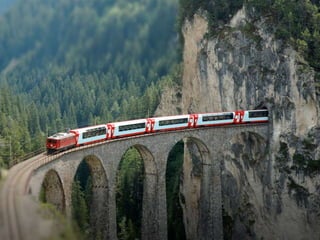
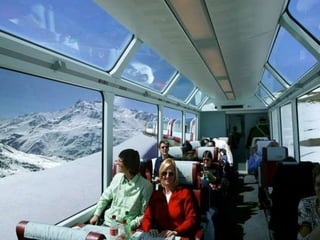
    + Zermatt Zermatt is a municipality located in the District of Visp in the canton of Valais in Switzerland.  Zermatt like St. Moritz, is a ski resort destination and apart of the Swiss Alps.  The ski village was discovered around the mid-nineteenth-century by British mountaineers. The Matterhorn was the last of the alpine mountains to be conquered in 1865, however, it was not reached without casualties. Only 3 of the 7 climbers survived the descent.  Skiers and hikers can access the mountains in Zermatt, Klein Matterhorn being the highest, by cable cars and chair lifts.  It’s possible to cross into Italy via the cervinia cable car station as well as access the Gornegrat summit through an amazing rack railway line. Zermatt is also thw wester terminus for the Glacier express connecting to St. Moritz and the MGB (Matterhorn- Gottard-Bahn) Switzerland
  • 75.
  • 76.
  • 77.
  • 78.
    + Before yougo... 78 Travel Restrictions Passport requirments Canadians must present a passport which must be valid for at least three months beyond the date of their expected departure Visa’s are not required for stays up to 90 days Crime Petty crime has increased and occurs in most public areas, particularly in Berne, Zurich and Geneva. Pickpockets are active in public places, such as airports and railway stations. Exercise caution on trains, especially on overnight trips to neighbouring countries Vaccination Some countries require proof of yellow fever vaccination before allowing entry Driving in Switzerland You must be at least 18 years old to drive in Switzerland. You can drive with a Canadian driver’s licence, but you are advised to obtain an International Driving permit in order to meet the requirements of some car rental agencies.
  • 79.
    + Before yougo... 79 Travel Restrictions Just like in Canada cell phones are prohibited while driving Legal alcohol limit is 0.05 , It is compulsory for all vehicles to be equipped with a warning triangle in case of breakdown Automated banking machines (ABMs) are known as Bancomat In case of emergency According to the travel government of Canada For emergency assistance after hours, call the Embassy of Canada in Berne or, if you are in the canton of Geneva, the Permanent Mission, and follow the instructions. You may also call the Emergency Watch and Response Centre in Ottawa toll-free at 00 800 2326-6831. Before traveling a visitor should visit the below link http://travel.gc.ca/destinations/switzerland
  • 80.
    + What AmI? Memory Game 80
  • 81.
  • 82.
  • 83.
  • 84.
  • 85.
  • 86.
  • 87.
  • 88.
  • 89.
  • 90.
  • 91.
  • 92.
  • 93.
  • 94.
  • 95.
  • 96.
  • 97.
  • 98.
  • 99.
  • 100.
  • 101.
  • 102.
  • 103.
  • 104.
  • 105.
    + Bibliography http://www.ducksters.com/geography/country.php?country=Swit zerland  http://www.about.ch/culture/food/index.html  http://www.myswitzerland.com/en-ca/typical-food.html  http://swiss-music.all-about-switzerland.info/traditional-swiss-folklore- music.html  http://en.wikipedia.org/wiki/Switzerland  http://www.myswitzerland.com/en-ca/home.html 105

Editor's Notes