SWITZERLAND
A country overview : PESTEL Analysis
Presented by
- Dhaval Bhatkar
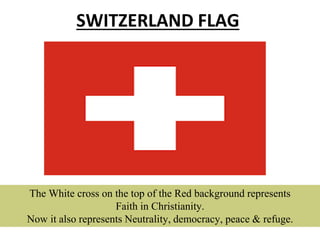
SWITZERLAND FLAG
The White cross on the top of the Red background represents
Faith in Christianity.
Now it also represents Neutrality, democracy, peace & refuge.
• Switzerland is a mountainous Central European
country, home to numerous lakes, villages & the
high peaks of the Alps.
• Its cities contain medieval quarters, with
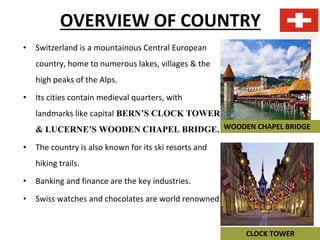
landmarks like capital BERN’S CLOCK TOWER
& LUCERNE’S WOODEN CHAPEL BRIDGE.
• The country is also known for its ski resorts and
hiking trails.
• Banking and finance are the key industries.
• Swiss watches and chocolates are world renowned.
OVERVIEW OF COUNTRY
WOODEN CHAPEL BRIDGE
CLOCK TOWER
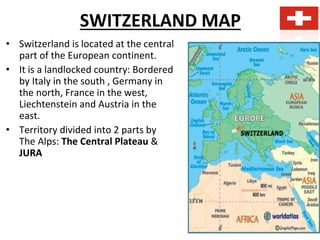
SWITZERLAND MAP
• Switzerland is located at the central
part of the European continent.
• It is a landlocked country: Bordered
by Italy in the south , Germany in
the north, France in the west,
Liechtenstein and Austria in the
east.
• Territory divided into 2 parts by
The Alps: The Central Plateau &
JURA
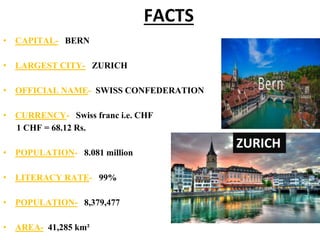
• CAPITAL- BERN
• LARGEST CITY- ZURICH
• OFFICIAL NAME- SWISS CONFEDERATION
• CURRENCY- Swiss franc i.e. CHF
1 CHF = 68.12 Rs.
• POPULATION- 8.081 million
• LITERACY RATE- 99%
• POPULATION- 8,379,477
• AREA- 41,285 km²
ZURICH
FACTS
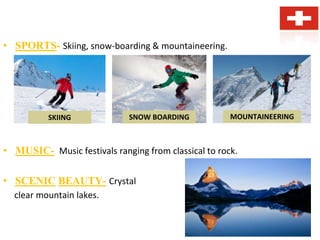
• SPORTS- Skiing, snow-boarding & mountaineering.
• MUSIC- Music festivals ranging from classical to rock.
• SCENIC BEAUTY- Crystal
clear mountain lakes.
SKIING SNOW BOARDING MOUNTAINEERING
•OFFICIAL LANGUAGES- French, German, Romansch, Italian.
•GOVERNMENT- Federal state with parliamentary system & direct
democracy.
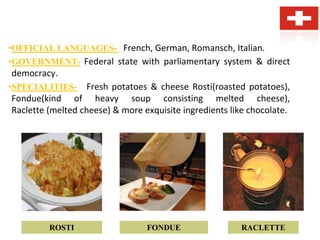
•SPECIALITIES- Fresh potatoes & cheese Rosti(roasted potatoes),
Fondue(kind of heavy soup consisting melted cheese),
Raclette (melted cheese) & more exquisite ingredients like chocolate.
ROSTI FONDUE RACLETTE
SOCIO-CULTURAL FACTORS
Demographic Analysis
• Switzerland ranks number 97 in the list of countries by
population.
• Population :- Growth rate is 0.71 %.
73.4 % of the population is urban .
• Official Languages :- French, German, Romansh, Italian.
although English is becoming increasingly popular.
• Religion :- 38% are Roman Catholic, 27% Protestant,7.5% Old
Catholics, 5% Muslim, 0.5% Buddhist,0.5% Hindus, 0.3% Jewish
0.2% Non-christians, & 22% are unaffiliated with any religion.
• Life expectancy :- 82.5 years
• According to WHO, Swiss men have the longest life expectancy
in the world.
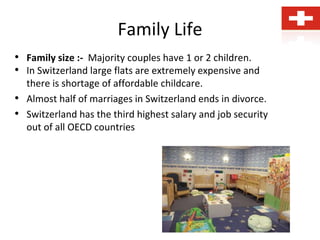
Family Life
• Family size :- Majority couples have 1 or 2 children.
• In Switzerland large flats are extremely expensive and
there is shortage of affordable childcare.
• Almost half of marriages in Switzerland ends in divorce.
• Switzerland has the third highest salary and job security
out of all OECD countries
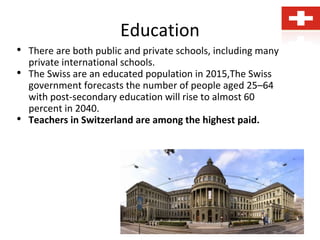
Education
• There are both public and private schools, including many
private international schools.
• The Swiss are an educated population in 2015,The Swiss
government forecasts the number of people aged 25–64
with post-secondary education will rise to almost 60
percent in 2040.
• Teachers in Switzerland are among the highest paid.
Culture
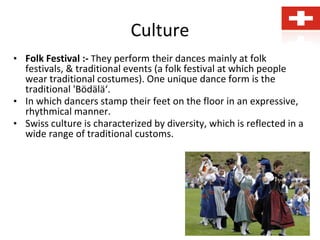
• Folk Festival :- They perform their dances mainly at folk
festivals, & traditional events (a folk festival at which people
wear traditional costumes). One unique dance form is the
traditional 'Bödälä‘.
• In which dancers stamp their feet on the floor in an expressive,
rhythmical manner.
• Swiss culture is characterized by diversity, which is reflected in a
wide range of traditional customs.
National Taste
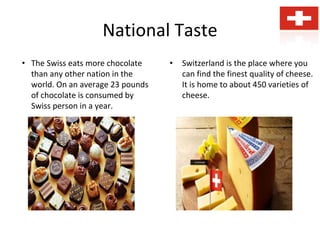
• The Swiss eats more chocolate
than any other nation in the
world. On an average 23 pounds
of chocolate is consumed by
Swiss person in a year.
• Switzerland is the place where you
can find the finest quality of cheese.
It is home to about 450 varieties of
cheese.
Buying Behavior
• Swiss luxury shoppers are less interested in buying new
brands and they are more likely wanting to support their
local economy.
• Quality is key : The Swiss are more likely to look for value for
money rather than design or brand reputation.
Female work force:-
• Women earn on average 20% less than men in Switzerland,
• Seco encouraging business companies to "appoint more
women to top-level positions".
TECHNOLOGICAL
FACTORS
Technological Facts
• Switzerland invests over 3% of its GDP in R&D.
• Big technology companies such as Google has set up its
European engineering headquarters in Zurich, and Yahoo
also.
• World class institutes such as European Organization for
Nuclear Research (CERN) and Paul Scherrer Institute (PSI) are
based in Switzerland.
• Switzerland ranks within top 10 in the Global Technology
Index, which is a broad assessment of the technological and
innovative capabilities of the world’s leading nations.
More facts…
• It has highest number of Nobel prizes – 25 Nobel Laureates
with Swiss citizenship which marked the history of Scientific
Research.
• The Swiss National Science Foundation is Switzerland’s
foremost institution I the promotion of Scientific Research
and for the support of scientists and projects.
ECONOMIC FACTORS
• The Swiss economy benefits from high levels of flexibility and
institutional strengths that include strong protection of
property rights and minimum tolerance for corruption.
• An independent and corruption-free judiciary enforces
contracts effectively.
• Openness to global trade and investment has enabled
Switzerland to become one the world’s most competitive and
innovative economies.
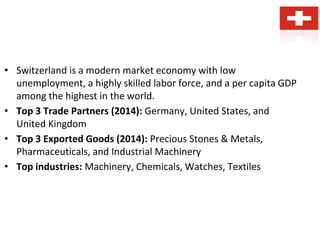
• Switzerland is a modern market economy with low
unemployment, a highly skilled labor force, and a per capita GDP
among the highest in the world.
• Top 3 Trade Partners (2014): Germany, United States, and
United Kingdom
• Top 3 Exported Goods (2014): Precious Stones & Metals,
Pharmaceuticals, and Industrial Machinery
• Top industries: Machinery, Chemicals, Watches, Textiles
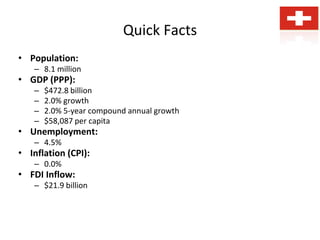
Quick Facts
• Population:
– 8.1 million
• GDP (PPP):
– $472.8 billion
– 2.0% growth
– 2.0% 5-year compound annual growth
– $58,087 per capita
• Unemployment:
– 4.5%
• Inflation (CPI):
– 0.0%
• FDI Inflow:
– $21.9 billion
POLITICAL & GOVERNMENT
FACTORS
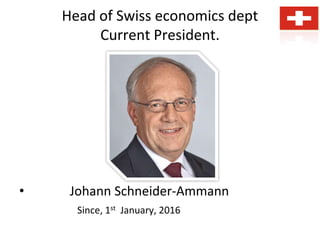
Head of Swiss economics dept
Current President.
• Johann Schneider-Ammann
Since, 1st January, 2016
Switzerland's Constitution &
Federalism
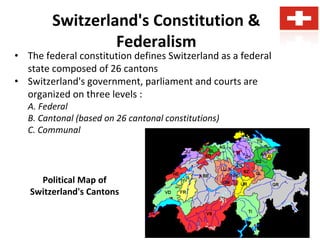
• The federal constitution defines Switzerland as a federal
state composed of 26 cantons
• Switzerland's government, parliament and courts are
organized on three levels :
A. Federal
B. Cantonal (based on 26 cantonal constitutions)
C. Communal
Political Map of
Switzerland's Cantons
Switzerland's Federal
Two-Chamber Parliament
• National Council:-
National Council is
Switzerland's "house of
representatives". The 200
members are elected every
four years according to a
refined proportional election
system, but since every canton
forms a constituency and
cantons have extremely
different numbers of
inhabitants, a few smaller
cantons may only send one
member to the national
council, which results in
majority elections for these
council.
• Council of States: -
Council of States represents
the cantons (like the U.S.
senate). Full cantons send two
members, half cantons one,
giving a total of 46 members.
The rules how to elect the
members are made under
cantonal legislation, so they
may differ from canton to
canton. A majority of cantons
does elect their members of
the Council of States every
four years on the same day as
the members of the National
Council.
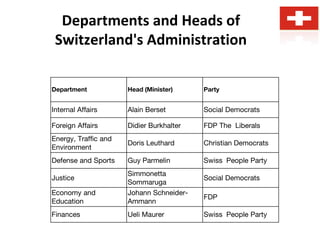
Departments and Heads of
Switzerland's Administration
Department Head (Minister) Party
Internal Affairs Alain Berset Social Democrats
Foreign Affairs Didier Burkhalter FDP The Liberals
Energy, Traffic and
Environment
Doris Leuthard Christian Democrats
Defense and Sports Guy Parmelin Swiss People Party
Justice
Simmonetta
Sommaruga
Social Democrats
Economy and
Education
Johann Schneider-
Ammann
FDP
Finances Ueli Maurer Swiss People Party
INTERNATIONAL TRADING
FACTORS
Trade Agreements
●The Free Trade Agreement, 1972
●The Insurance Agreement, 1989
●The Bilateral Agreement, 1999
Imports & Exports
Swiss Imports
● Mineral Resources
● Machinery
● Agricultural products
● Cars
● Chemicals
● Raw materials
Swiss Exports
● Watches & clocks
● Chocolates
● Cheese
● Gold
● Wine
● Medical products
● Jewellery
NATURAL FACTORS
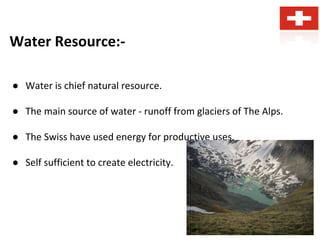
Water Resource:-
● Water is chief natural resource.
● The main source of water - runoff from glaciers of The Alps.
● The Swiss have used energy for productive uses.
● Self sufficient to create electricity.
Animal Resource:-
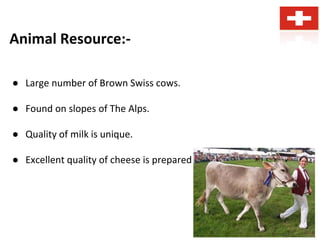
● Large number of Brown Swiss cows.
● Found on slopes of The Alps.
● Quality of milk is unique.
● Excellent quality of cheese is prepared
Land Resource :-
● 11% used for agriculture.
● 30% covered by forests.
● The mountainous landscape is used by tourism industry.
● Lifetime experiences to tourists by adventure sports.
Mineral Resource :-
● Mineral resources are limited.
● Granite, limestone, marbel, gravel & salt are available
● Small deposits of iron and manganese ores are found
RECOMMENDATIONS
● Swiss companies could set up their cheese & chocolate
manufacturing units in the state of Gujarat which would help the
farmers in Gujarat.
● Indians will get good quality of cheese and chocolates at an
reasonable price.
● Production of hydroelectricity power could also be learnt from the
Swiss people as India has enough water bodies to produce
hydroelectricity.
● The adventure sports could also be promoted in the states like
Himachal Pradesh, Uttarakhand so that would help in increasing
tourists in India, thus generating income in the country.
● All this factors could help to generate good employment
opportunities in our country.
THANK YOU

Switzerland : A country overview

  • 1.
    SWITZERLAND A country overview: PESTEL Analysis Presented by - Dhaval Bhatkar
  • 2.
    SWITZERLAND FLAG The Whitecross on the top of the Red background represents Faith in Christianity. Now it also represents Neutrality, democracy, peace & refuge.
  • 3.
    • Switzerland isa mountainous Central European country, home to numerous lakes, villages & the high peaks of the Alps. • Its cities contain medieval quarters, with landmarks like capital BERN’S CLOCK TOWER & LUCERNE’S WOODEN CHAPEL BRIDGE. • The country is also known for its ski resorts and hiking trails. • Banking and finance are the key industries. • Swiss watches and chocolates are world renowned. OVERVIEW OF COUNTRY WOODEN CHAPEL BRIDGE CLOCK TOWER
  • 4.
    SWITZERLAND MAP • Switzerlandis located at the central part of the European continent. • It is a landlocked country: Bordered by Italy in the south , Germany in the north, France in the west, Liechtenstein and Austria in the east. • Territory divided into 2 parts by The Alps: The Central Plateau & JURA
  • 5.
    • CAPITAL- BERN •LARGEST CITY- ZURICH • OFFICIAL NAME- SWISS CONFEDERATION • CURRENCY- Swiss franc i.e. CHF 1 CHF = 68.12 Rs. • POPULATION- 8.081 million • LITERACY RATE- 99% • POPULATION- 8,379,477 • AREA- 41,285 km² ZURICH FACTS
  • 6.
    • SPORTS- Skiing,snow-boarding & mountaineering. • MUSIC- Music festivals ranging from classical to rock. • SCENIC BEAUTY- Crystal clear mountain lakes. SKIING SNOW BOARDING MOUNTAINEERING
  • 7.
    •OFFICIAL LANGUAGES- French,German, Romansch, Italian. •GOVERNMENT- Federal state with parliamentary system & direct democracy. •SPECIALITIES- Fresh potatoes & cheese Rosti(roasted potatoes), Fondue(kind of heavy soup consisting melted cheese), Raclette (melted cheese) & more exquisite ingredients like chocolate. ROSTI FONDUE RACLETTE
  • 8.
  • 9.
    Demographic Analysis • Switzerlandranks number 97 in the list of countries by population. • Population :- Growth rate is 0.71 %. 73.4 % of the population is urban . • Official Languages :- French, German, Romansh, Italian. although English is becoming increasingly popular. • Religion :- 38% are Roman Catholic, 27% Protestant,7.5% Old Catholics, 5% Muslim, 0.5% Buddhist,0.5% Hindus, 0.3% Jewish 0.2% Non-christians, & 22% are unaffiliated with any religion. • Life expectancy :- 82.5 years • According to WHO, Swiss men have the longest life expectancy in the world.
  • 10.
    Family Life • Familysize :- Majority couples have 1 or 2 children. • In Switzerland large flats are extremely expensive and there is shortage of affordable childcare. • Almost half of marriages in Switzerland ends in divorce. • Switzerland has the third highest salary and job security out of all OECD countries
  • 11.
    Education • There areboth public and private schools, including many private international schools. • The Swiss are an educated population in 2015,The Swiss government forecasts the number of people aged 25–64 with post-secondary education will rise to almost 60 percent in 2040. • Teachers in Switzerland are among the highest paid.
  • 12.
    Culture • Folk Festival:- They perform their dances mainly at folk festivals, & traditional events (a folk festival at which people wear traditional costumes). One unique dance form is the traditional 'Bödälä‘. • In which dancers stamp their feet on the floor in an expressive, rhythmical manner. • Swiss culture is characterized by diversity, which is reflected in a wide range of traditional customs.
  • 13.
    National Taste • TheSwiss eats more chocolate than any other nation in the world. On an average 23 pounds of chocolate is consumed by Swiss person in a year. • Switzerland is the place where you can find the finest quality of cheese. It is home to about 450 varieties of cheese.
  • 14.
    Buying Behavior • Swissluxury shoppers are less interested in buying new brands and they are more likely wanting to support their local economy. • Quality is key : The Swiss are more likely to look for value for money rather than design or brand reputation. Female work force:- • Women earn on average 20% less than men in Switzerland, • Seco encouraging business companies to "appoint more women to top-level positions".
  • 15.
  • 16.
    Technological Facts • Switzerlandinvests over 3% of its GDP in R&D. • Big technology companies such as Google has set up its European engineering headquarters in Zurich, and Yahoo also. • World class institutes such as European Organization for Nuclear Research (CERN) and Paul Scherrer Institute (PSI) are based in Switzerland. • Switzerland ranks within top 10 in the Global Technology Index, which is a broad assessment of the technological and innovative capabilities of the world’s leading nations.
  • 17.
    More facts… • Ithas highest number of Nobel prizes – 25 Nobel Laureates with Swiss citizenship which marked the history of Scientific Research. • The Swiss National Science Foundation is Switzerland’s foremost institution I the promotion of Scientific Research and for the support of scientists and projects.
  • 18.
  • 19.
    • The Swisseconomy benefits from high levels of flexibility and institutional strengths that include strong protection of property rights and minimum tolerance for corruption. • An independent and corruption-free judiciary enforces contracts effectively. • Openness to global trade and investment has enabled Switzerland to become one the world’s most competitive and innovative economies.
  • 20.
    • Switzerland isa modern market economy with low unemployment, a highly skilled labor force, and a per capita GDP among the highest in the world. • Top 3 Trade Partners (2014): Germany, United States, and United Kingdom • Top 3 Exported Goods (2014): Precious Stones & Metals, Pharmaceuticals, and Industrial Machinery • Top industries: Machinery, Chemicals, Watches, Textiles
  • 21.
    Quick Facts • Population: –8.1 million • GDP (PPP): – $472.8 billion – 2.0% growth – 2.0% 5-year compound annual growth – $58,087 per capita • Unemployment: – 4.5% • Inflation (CPI): – 0.0% • FDI Inflow: – $21.9 billion
  • 22.
  • 23.
    Head of Swisseconomics dept Current President. • Johann Schneider-Ammann Since, 1st January, 2016
  • 24.
    Switzerland's Constitution & Federalism •The federal constitution defines Switzerland as a federal state composed of 26 cantons • Switzerland's government, parliament and courts are organized on three levels : A. Federal B. Cantonal (based on 26 cantonal constitutions) C. Communal Political Map of Switzerland's Cantons
  • 25.
    Switzerland's Federal Two-Chamber Parliament •National Council:- National Council is Switzerland's "house of representatives". The 200 members are elected every four years according to a refined proportional election system, but since every canton forms a constituency and cantons have extremely different numbers of inhabitants, a few smaller cantons may only send one member to the national council, which results in majority elections for these council. • Council of States: - Council of States represents the cantons (like the U.S. senate). Full cantons send two members, half cantons one, giving a total of 46 members. The rules how to elect the members are made under cantonal legislation, so they may differ from canton to canton. A majority of cantons does elect their members of the Council of States every four years on the same day as the members of the National Council.
  • 26.
    Departments and Headsof Switzerland's Administration Department Head (Minister) Party Internal Affairs Alain Berset Social Democrats Foreign Affairs Didier Burkhalter FDP The Liberals Energy, Traffic and Environment Doris Leuthard Christian Democrats Defense and Sports Guy Parmelin Swiss People Party Justice Simmonetta Sommaruga Social Democrats Economy and Education Johann Schneider- Ammann FDP Finances Ueli Maurer Swiss People Party
  • 27.
  • 28.
    Trade Agreements ●The FreeTrade Agreement, 1972 ●The Insurance Agreement, 1989 ●The Bilateral Agreement, 1999
  • 29.
    Imports & Exports SwissImports ● Mineral Resources ● Machinery ● Agricultural products ● Cars ● Chemicals ● Raw materials Swiss Exports ● Watches & clocks ● Chocolates ● Cheese ● Gold ● Wine ● Medical products ● Jewellery
  • 30.
  • 31.
    Water Resource:- ● Wateris chief natural resource. ● The main source of water - runoff from glaciers of The Alps. ● The Swiss have used energy for productive uses. ● Self sufficient to create electricity.
  • 32.
    Animal Resource:- ● Largenumber of Brown Swiss cows. ● Found on slopes of The Alps. ● Quality of milk is unique. ● Excellent quality of cheese is prepared
  • 33.
    Land Resource :- ●11% used for agriculture. ● 30% covered by forests. ● The mountainous landscape is used by tourism industry. ● Lifetime experiences to tourists by adventure sports. Mineral Resource :- ● Mineral resources are limited. ● Granite, limestone, marbel, gravel & salt are available ● Small deposits of iron and manganese ores are found
  • 34.
    RECOMMENDATIONS ● Swiss companiescould set up their cheese & chocolate manufacturing units in the state of Gujarat which would help the farmers in Gujarat. ● Indians will get good quality of cheese and chocolates at an reasonable price. ● Production of hydroelectricity power could also be learnt from the Swiss people as India has enough water bodies to produce hydroelectricity. ● The adventure sports could also be promoted in the states like Himachal Pradesh, Uttarakhand so that would help in increasing tourists in India, thus generating income in the country. ● All this factors could help to generate good employment opportunities in our country.
  • 35.