IntroductionIntroduction
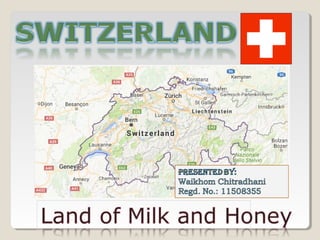
Switzerland is located in Europe.
It’s capital is Bern.
It’s currency is Swiss franc (CHF).
1 CHF = 1.03 USD
The total area is 41,285 km2
.
It’s neighbouring countries are Italy,
Germany, Austria, Liechtenstein.
There are 26 cantons.
GeographyGeography
Switzerland lies between latitudes 45°
and 48° N, and longitudes 5° and 11° E.
It contains three basic topographical
areas: the Swiss Alps to the south, the
Swiss Plateau or Central Plateau, and the
Jura mountains on the west.
The majority of the Swiss population live
in the Swiss Plateau.
PopulationPopulation
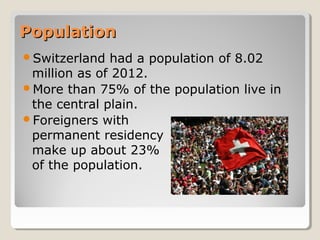
Switzerland had a population of 8.02
million as of 2012.
More than 75% of the population live in
the central plain.
Foreigners with
permanent residency
make up about 23%
of the population.
HistoryHistory
Since 1848, the Swiss Confederation has
been a federal state of relatively
autonomous cantons, some of which have
a history of confederacy that goes back
more than 700 years, putting them
among the world's oldest surviving
republics.
History 2History 2
Archaeological evidence suggests that
hunter-gatherers were already settled in
the lowlands north of the Alps in the
Middle Palaeolithic period 150,000 years
ago.
The major powers respected Switzerland's
neutrality during World War I.
ClimateClimate
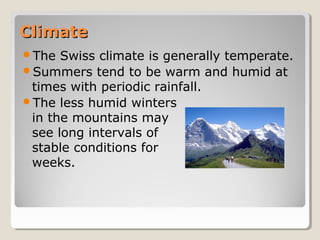
The Swiss climate is generally temperate.
Summers tend to be warm and humid at
times with periodic rainfall.
The less humid winters
in the mountains may
see long intervals of
stable conditions for
weeks.
PoliticsPolitics
Federal Constitution is adopted in
Switzerland.
The Swiss Parliament consists of two
houses: the Council of States and the
National Council.
The Federal Council constitutes the
federal government, directs the federal
administration and serves as collective
Head of State.
EconomyEconomy
Switzerland has a stable, prosperous and
high-tech economy and enjoys great
wealth.
Switzerland ranks 8th in the world in
terms of GDP per capita, according to the
World Bank and IMF.
Switzerland's most important economic
sector is manufacturing.
EducationEducation
Education in Switzerland is very diverse
because the constitution of Switzerland
delegates the authority for the school system
to the cantons.
The minimum age for primary school is about
six years.
There are 12 universities in Switzerland.
Many Nobel Prize laureates have been Swiss
scientists.
They include the world-famous physicist
Albert Einstein.
LanguageLanguage
Switzerland has four official languages:
German, French, and Italian, and
Romansh.
The languages most spoken at home
among permanent residents aged 15 and
older were Swiss German.
The federal government is obliged to
communicate in the official languages.
ReligionReligion
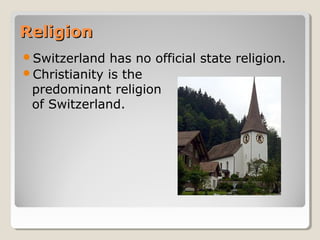
Switzerland has no official state religion.
Christianity is the
predominant religion
of Switzerland.
CultureCulture
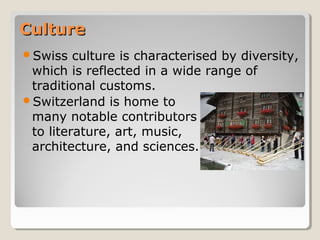
Swiss culture is characterised by diversity,
which is reflected in a wide range of
traditional customs.
Switzerland is home to
many notable contributors
to literature, art, music,
architecture, and sciences.
ConclusionConclusion
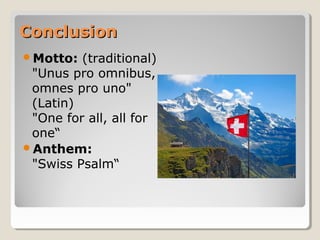
Motto: (traditional)
"Unus pro omnibus,
omnes pro uno"
(Latin)
"One for all, all for
one“
Anthem:             
"Swiss Psalm“
Switzerland

Switzerland

  • 2.
    IntroductionIntroduction Switzerland is locatedin Europe. It’s capital is Bern. It’s currency is Swiss franc (CHF). 1 CHF = 1.03 USD The total area is 41,285 km2 . It’s neighbouring countries are Italy, Germany, Austria, Liechtenstein. There are 26 cantons.
  • 3.
    GeographyGeography Switzerland lies betweenlatitudes 45° and 48° N, and longitudes 5° and 11° E. It contains three basic topographical areas: the Swiss Alps to the south, the Swiss Plateau or Central Plateau, and the Jura mountains on the west. The majority of the Swiss population live in the Swiss Plateau.
  • 4.
    PopulationPopulation Switzerland had apopulation of 8.02 million as of 2012. More than 75% of the population live in the central plain. Foreigners with permanent residency make up about 23% of the population.
  • 5.
    HistoryHistory Since 1848, theSwiss Confederation has been a federal state of relatively autonomous cantons, some of which have a history of confederacy that goes back more than 700 years, putting them among the world's oldest surviving republics.
  • 6.
    History 2History 2 Archaeologicalevidence suggests that hunter-gatherers were already settled in the lowlands north of the Alps in the Middle Palaeolithic period 150,000 years ago. The major powers respected Switzerland's neutrality during World War I.
  • 7.
    ClimateClimate The Swiss climateis generally temperate. Summers tend to be warm and humid at times with periodic rainfall. The less humid winters in the mountains may see long intervals of stable conditions for weeks.
  • 8.
    PoliticsPolitics Federal Constitution isadopted in Switzerland. The Swiss Parliament consists of two houses: the Council of States and the National Council. The Federal Council constitutes the federal government, directs the federal administration and serves as collective Head of State.
  • 9.
    EconomyEconomy Switzerland has astable, prosperous and high-tech economy and enjoys great wealth. Switzerland ranks 8th in the world in terms of GDP per capita, according to the World Bank and IMF. Switzerland's most important economic sector is manufacturing.
  • 10.
    EducationEducation Education in Switzerlandis very diverse because the constitution of Switzerland delegates the authority for the school system to the cantons. The minimum age for primary school is about six years. There are 12 universities in Switzerland. Many Nobel Prize laureates have been Swiss scientists. They include the world-famous physicist Albert Einstein.
  • 11.
    LanguageLanguage Switzerland has fourofficial languages: German, French, and Italian, and Romansh. The languages most spoken at home among permanent residents aged 15 and older were Swiss German. The federal government is obliged to communicate in the official languages.
  • 12.
    ReligionReligion Switzerland has noofficial state religion. Christianity is the predominant religion of Switzerland.
  • 13.
    CultureCulture Swiss culture ischaracterised by diversity, which is reflected in a wide range of traditional customs. Switzerland is home to many notable contributors to literature, art, music, architecture, and sciences.
  • 14.
    ConclusionConclusion Motto: (traditional) "Unus pro omnibus, omnespro uno" (Latin) "One for all, all for one“ Anthem:              "Swiss Psalm“