Blog Management System
Shivani Yadav (2214058360058)
Rupali Singh (2214058360053)
Anjali Singh (2214058360045)
Mr. Anshuman Srivastava
(Assistant Professor)
Bachelors of Computer Application
ITM COLLEGE OF MANAGEMENT GIDA, GORAKHPUR- 273209
DEEN DAYAL UPADHAYAY UNIVERSITY OF GORAKHPUR-273009
JUNE-2022
2021-22
Outline
 Introduction
 System Module
 Objectives
 Requirement Specification
 Use Case Diagram
 Data Flow Diagram
 Testing Report
 Project Screen
 Conclusion
Introduction
 The "Blog Management System" has been developed to override the
problems prevailing in the practicing manual system. This software is
supported to eliminate and in some cases reduce the hardships faced by this
existing system. No formal knowledge is needed for the user to use this
system. Thus by this all it proves it is user-friendly. Thus it will help
organization in better utilization of resources. Every organization, whether
big or small, has challenges to overcome and managing the information of
Idea, Blogs, Entries, Content, Views. Every Blog Management System has
different Blogs needs.
 This is designed to assist in strategic planning, and will help you ensure
that organization is equipped with the right level of information and details
for future goals. Also, for those busy executive who are always on the go,
our systems come with remote access features, which will allow you to
manage your workforce anytime, at all times. These systems will ultimately
allow you to better manage resources.
System Module
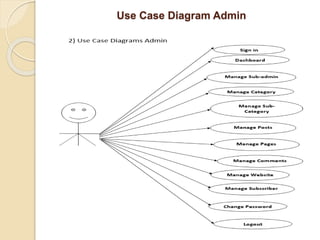
Admin Module
 Admin: will be the user of this project who can control the whole website.
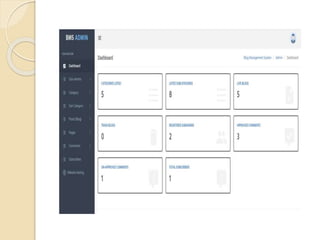
 Dashboard: In this section, admin can briefly view information about categories,
subcategories, Live Blogs, Trash blogs, registered sub-admin, approved comments,
unapproved comments and Total subscribers.
 Sub-admins: In this section, admin can mange sub-admins(Add/Update/Delete).
 Category: In this section, admin can mange Category(Add/Update/Delete).
 Sub Category: In this section, admin can mange sub-category(Add/Update/Delete).
 Posts(Blog): In this section, admin can mange Posts(Add/Update/Delete).
 Pages: In this section, admin update the about us and contact us page.
 Comments: In this section, admin can view the comments which is given by readers and
approve and unapproved those comments.
 Subscribers: I this section, admin can view subscriber lists.
 Website Setting: In this section, admin changes the setting of web site like logos contents
etc.
Reader/User Module
 Home: In this section, user can view home page of website.
 Visitor or Readers can visit the website and reads the blogs ,subscribe itself, and also
comment on the particular post.
Objectives
 The main objective of Blog Management System is to manage the details of
Blogs, Idea, Topic, Entries, Views. The purpose of the project is to build an
application program to reduce the manual work for managing the Blogs, Idea,
Content, Topic. It tracks all the details about the Topic, Entries, Views.
Functionalities provided by Blog Management System are as follows:
Provides the searching facilities based on various factors. Such as Blogs, Topic,
Blog Management System also manage the Content details online for Entries
details, Views details, Blogs. It tracks all the information of Idea, Content, Entries
etc.
 Manage the information of Idea.
 To increase efficiency of managing the Blogs, Idea.
 It deals with monitoring the information and transactions of Entries.
 Editing, adding and updating of Records is improved which results in proper
resource management of Blogs data. Manage the information of Entries.
 Manage the information of Entries.
 Integration of all records of Views.
Requirement Specification
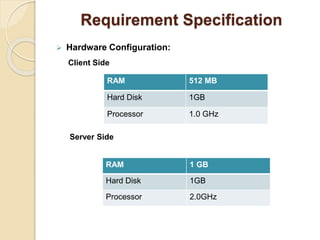
 Hardware Configuration:
Client Side
Server Side
RAM 1 GB
Hard Disk 1GB
Processor 2.0GHz
RAM 512 MB
Hard Disk 1GB
Processor 1.0 GHz
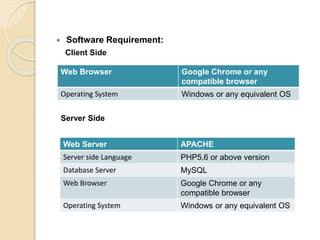
 Software Requirement:
Client Side
Server Side
Web Browser Google Chrome or any
compatible browser
Operating System Windows or any equivalent OS
Web Server APACHE
Server side Language PHP5.6 or above version
Database Server MySQL
Web Browser Google Chrome or any
compatible browser
Operating System Windows or any equivalent OS
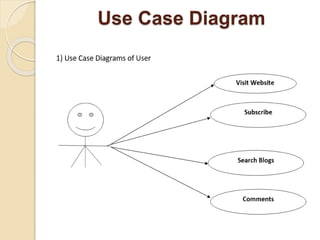
Use Case Diagram
Use Case Diagram Admin
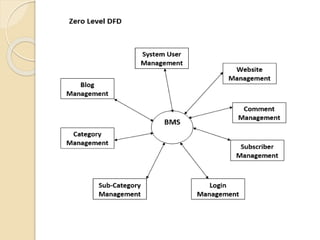
Data Flow Diagram
 A data flow diagram is graphical tool used to describe and analyze
movement of data through a system. These are the central tool and the
basis from which the other components are developed. The
transformation of data from input to output, through processed, may be
described logically and independently of physical components
associated with the system.
 These are known as the logical data flow diagrams. The physical data
flow diagrams show the actual implements and movement of data
between people, departments and workstations.
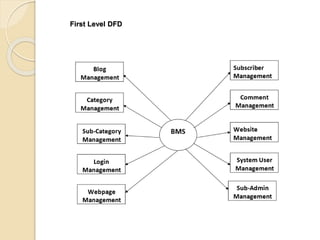
First Level DFD
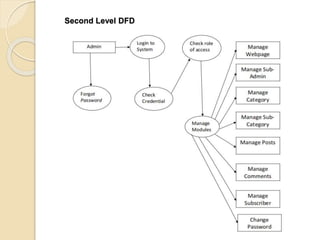
Second Level DFD
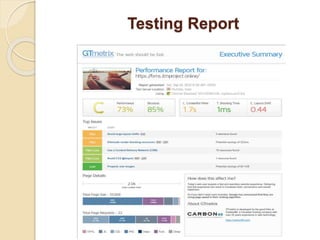
Testing Report
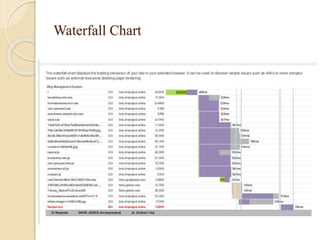
Waterfall Chart
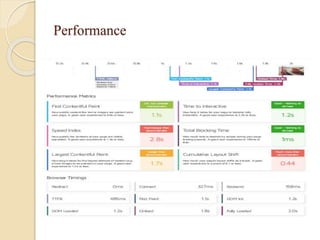
Performance
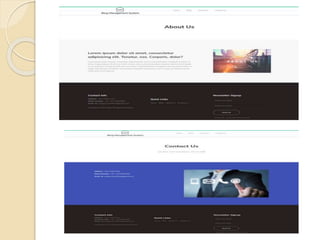
Project Screens
Conclusion
 Our project is only a humble venture to satisfy the needs to manage their
project work. Several user friendly coding have also adopted. The details
should be updated regularly as the project progresses.
 At the end it is concluded that we have made effort on following points…
 A description of the background and context of the project and its relation
to work already done in the area.
 Made statement of the aims and objectives of the project.
 The description of Purpose, Scope, and applicability.
 We define the problem on which we are working in the project.
 We describe the requirement Specifications of the system and the actions
that can be done on these things.
 We understand the problem domain and produce a model of the system,
which describes operations that can be performed on the system.
 We included features and operations in detail, including screen layouts.
 We designed user interface and security issues related to system.
 Finally the system is implemented and tested according to test cases.
Thank You

Blog Management System

  • 1.
    Blog Management System ShivaniYadav (2214058360058) Rupali Singh (2214058360053) Anjali Singh (2214058360045) Mr. Anshuman Srivastava (Assistant Professor) Bachelors of Computer Application ITM COLLEGE OF MANAGEMENT GIDA, GORAKHPUR- 273209 DEEN DAYAL UPADHAYAY UNIVERSITY OF GORAKHPUR-273009 JUNE-2022 2021-22
  • 2.
    Outline  Introduction  SystemModule  Objectives  Requirement Specification  Use Case Diagram  Data Flow Diagram  Testing Report  Project Screen  Conclusion
  • 3.
    Introduction  The "BlogManagement System" has been developed to override the problems prevailing in the practicing manual system. This software is supported to eliminate and in some cases reduce the hardships faced by this existing system. No formal knowledge is needed for the user to use this system. Thus by this all it proves it is user-friendly. Thus it will help organization in better utilization of resources. Every organization, whether big or small, has challenges to overcome and managing the information of Idea, Blogs, Entries, Content, Views. Every Blog Management System has different Blogs needs.  This is designed to assist in strategic planning, and will help you ensure that organization is equipped with the right level of information and details for future goals. Also, for those busy executive who are always on the go, our systems come with remote access features, which will allow you to manage your workforce anytime, at all times. These systems will ultimately allow you to better manage resources.
  • 4.
    System Module Admin Module Admin: will be the user of this project who can control the whole website.  Dashboard: In this section, admin can briefly view information about categories, subcategories, Live Blogs, Trash blogs, registered sub-admin, approved comments, unapproved comments and Total subscribers.  Sub-admins: In this section, admin can mange sub-admins(Add/Update/Delete).  Category: In this section, admin can mange Category(Add/Update/Delete).  Sub Category: In this section, admin can mange sub-category(Add/Update/Delete).  Posts(Blog): In this section, admin can mange Posts(Add/Update/Delete).  Pages: In this section, admin update the about us and contact us page.  Comments: In this section, admin can view the comments which is given by readers and approve and unapproved those comments.  Subscribers: I this section, admin can view subscriber lists.  Website Setting: In this section, admin changes the setting of web site like logos contents etc. Reader/User Module  Home: In this section, user can view home page of website.  Visitor or Readers can visit the website and reads the blogs ,subscribe itself, and also comment on the particular post.
  • 5.
    Objectives  The mainobjective of Blog Management System is to manage the details of Blogs, Idea, Topic, Entries, Views. The purpose of the project is to build an application program to reduce the manual work for managing the Blogs, Idea, Content, Topic. It tracks all the details about the Topic, Entries, Views. Functionalities provided by Blog Management System are as follows: Provides the searching facilities based on various factors. Such as Blogs, Topic, Blog Management System also manage the Content details online for Entries details, Views details, Blogs. It tracks all the information of Idea, Content, Entries etc.  Manage the information of Idea.  To increase efficiency of managing the Blogs, Idea.  It deals with monitoring the information and transactions of Entries.  Editing, adding and updating of Records is improved which results in proper resource management of Blogs data. Manage the information of Entries.  Manage the information of Entries.  Integration of all records of Views.
  • 6.
    Requirement Specification  HardwareConfiguration: Client Side Server Side RAM 1 GB Hard Disk 1GB Processor 2.0GHz RAM 512 MB Hard Disk 1GB Processor 1.0 GHz
  • 7.
     Software Requirement: ClientSide Server Side Web Browser Google Chrome or any compatible browser Operating System Windows or any equivalent OS Web Server APACHE Server side Language PHP5.6 or above version Database Server MySQL Web Browser Google Chrome or any compatible browser Operating System Windows or any equivalent OS
  • 8.
  • 9.
  • 10.
    Data Flow Diagram A data flow diagram is graphical tool used to describe and analyze movement of data through a system. These are the central tool and the basis from which the other components are developed. The transformation of data from input to output, through processed, may be described logically and independently of physical components associated with the system.  These are known as the logical data flow diagrams. The physical data flow diagrams show the actual implements and movement of data between people, departments and workstations.
  • 12.
  • 13.
  • 14.
  • 15.
  • 16.
  • 17.
  • 21.
    Conclusion  Our projectis only a humble venture to satisfy the needs to manage their project work. Several user friendly coding have also adopted. The details should be updated regularly as the project progresses.  At the end it is concluded that we have made effort on following points…  A description of the background and context of the project and its relation to work already done in the area.  Made statement of the aims and objectives of the project.  The description of Purpose, Scope, and applicability.  We define the problem on which we are working in the project.  We describe the requirement Specifications of the system and the actions that can be done on these things.  We understand the problem domain and produce a model of the system, which describes operations that can be performed on the system.  We included features and operations in detail, including screen layouts.  We designed user interface and security issues related to system.  Finally the system is implemented and tested according to test cases.
  • 22.

Editor's Notes

  • #9   USECASE DIAGRAM: A Use case is a description of set of sequence of actions. Graphically it is rendered as an ellipse with solid line including only its name. Use case diagram is a behavioral diagram that shows a set of use cases and actors and their relationship. It is an association between the use cases and actors. An actor represents a real-world object. Primary Actor – Sender, Secondary Actor Receiver.