©InstitutoInternacionalSanTelmo,2012
BALANCE SHEET Forecasting
E-LEARNING COURSE: ACCOUNTING & FINANCES
BALANCE SHEET Forecasting
Cash
Account
Receivables
Inventory
(or Stock)
Fixed Assets
Account
Payables
Short-Term
Debt
Long-Term
Debt
Equity
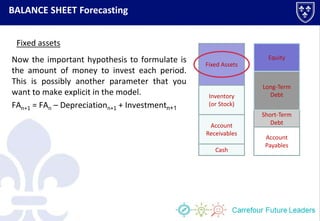
Fixed assets
Now the important hypothesis to formulate is
the amount of money to invest each period.
This is possibly another parameter that you
want to make explicit in the model.
FAn+1 = FAn – Depreciationn+1 + Investmentn+1
BALANCE SHEET Forecasting
Cash
Account
Receivables
Inventory
(or Stock)
Fixed Assets
Account
Payables
Short-Term
Debt
Long-Term
Debt
Equity
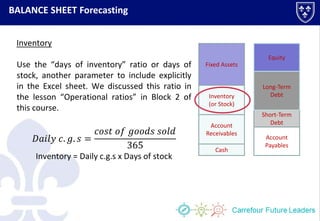
Inventory
Use the “days of inventory” ratio or days of
stock, another parameter to include explicitly
in the Excel sheet. We discussed this ratio in
the lesson “Operational ratios” in Block 2 of
this course.
𝐷𝑎𝑖𝑙𝑦 𝑐. 𝑔. 𝑠 =
𝑐𝑜𝑠𝑡 𝑜𝑓 𝑔𝑜𝑜𝑑𝑠 𝑠𝑜𝑙𝑑
365
Inventory = Daily c.g.s x Days of stock
BALANCE SHEET Forecasting
Cash
Account
Receivables
Inventory
(or Stock)
Fixed Assets
Account
Payables
Short-Term
Debt
Long-Term
Debt
Equity
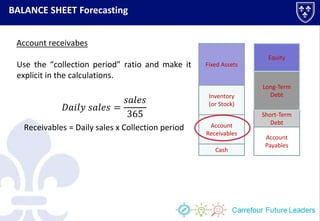
Account receivabes
Use the “collection period” ratio and make it
explicit in the calculations.
𝐷𝑎𝑖𝑙𝑦 𝑠𝑎𝑙𝑒𝑠 =
𝑠𝑎𝑙𝑒𝑠
365
Receivables = Daily sales x Collection period
BALANCE SHEET Forecasting
Cash
Account
Receivables
Inventory
(or Stock)
Fixed Assets
Account
Payables
Short-Term
Debt
Long-Term
Debt
Equity
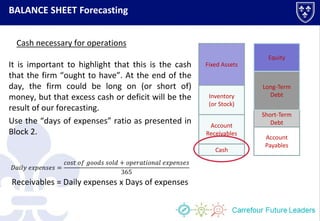
Cash necessary for operations
It is important to highlight that this is the cash
that the firm “ought to have”. At the end of the
day, the firm could be long on (or short of)
money, but that excess cash or deficit will be the
result of our forecasting.
Use the “days of expenses” ratio as presented in
Block 2.
𝐷𝑎𝑖𝑙𝑦 𝑒𝑥𝑝𝑒𝑛𝑠𝑒𝑠 =
𝑐𝑜𝑠𝑡 𝑜𝑓 𝑔𝑜𝑜𝑑𝑠 𝑠𝑜𝑙𝑑 + 𝑜𝑝𝑒𝑟𝑎𝑡𝑖𝑜𝑛𝑎𝑙 𝑒𝑥𝑝𝑒𝑛𝑠𝑒𝑠
365
Receivables = Daily expenses x Days of expenses
BALANCE SHEET Forecasting
Cash
Account
Receivables
Inventory
(or Stock)
Fixed Assets
Account
Payables
Short-Term
Debt
Long-Term
Debt
Equity
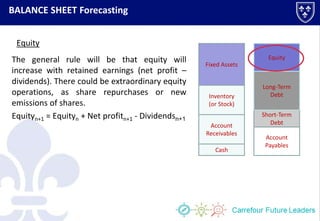
Equity
The general rule will be that equity will
increase with retained earnings (net profit –
dividends). There could be extraordinary equity
operations, as share repurchases or new
emissions of shares.
Equityn+1 = Equityn + Net profitn+1 - Dividendsn+1
BALANCE SHEET Forecasting
Cash
Account
Receivables
Inventory
(or Stock)
Fixed Assets
Account
Payables
Short-Term
Debt
Long-Term
Debt
Equity
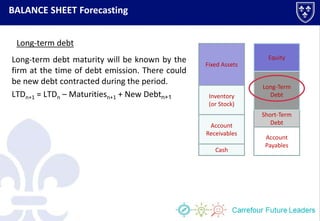
Long-term debt
Long-term debt maturity will be known by the
firm at the time of debt emission. There could
be new debt contracted during the period.
LTDn+1 = LTDn – Maturitiesn+1 + New Debtn+1
BALANCE SHEET Forecasting
Cash
Account
Receivables
Inventory
(or Stock)
Fixed Assets
Account
Payables
Short-Term
Debt
Long-Term
Debt
Equity
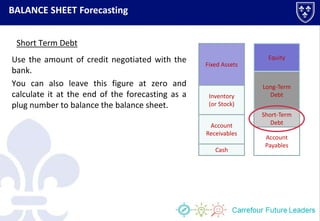
Short Term Debt
Use the amount of credit negotiated with the
bank.
You can also leave this figure at zero and
calculate it at the end of the forecasting as a
plug number to balance the balance sheet.
BALANCE SHEET Forecasting
Cash
Account
Receivables
Inventory
(or Stock)
Fixed Assets
Account
Payables
Short-Term
Debt
Long-Term
Debt
Equity
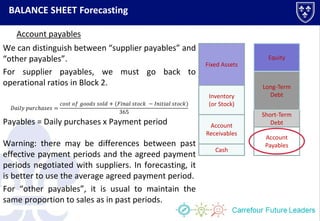
Account payables
We can distinguish between “supplier payables” and
“other payables”.
For supplier payables, we must go back to
operational ratios in Block 2.
𝐷𝑎𝑖𝑙𝑦 𝑝𝑢𝑟𝑐ℎ𝑎𝑠𝑒𝑠 =
𝑐𝑜𝑠𝑡 𝑜𝑓 𝑔𝑜𝑜𝑑𝑠 𝑠𝑜𝑙𝑑 + (𝐹𝑖𝑛𝑎𝑙 𝑠𝑡𝑜𝑐𝑘 − 𝐼𝑛𝑖𝑡𝑖𝑎𝑙 𝑠𝑡𝑜𝑐𝑘)
365
Payables = Daily purchases x Payment period
Warning: there may be differences between past
effective payment periods and the agreed payment
periods negotiated with suppliers. In forecasting, it
is better to use the average agreed payment period.
For “other payables”, it is usual to maintain the
same proportion to sales as in past periods.
BALANCE SHEET Forecasting
Cash
Account
Receivables
Inventory
(or Stock)
Fixed Assets
Account
Payables
Short-Term
Debt
Long-Term
Debt
Equity
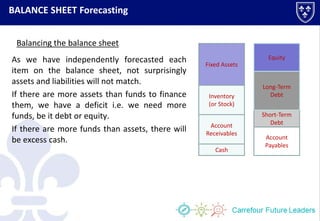
Balancing the balance sheet
As we have independently forecasted each
item on the balance sheet, not surprisingly
assets and liabilities will not match.
If there are more assets than funds to finance
them, we have a deficit i.e. we need more
funds, be it debt or equity.
If there are more funds than assets, there will
be excess cash.
©InstitutoInternacionalSanTelmo,2012

Block4 2balancesheetforecasting

  • 1.
  • 2.
    BALANCE SHEET Forecasting Cash Account Receivables Inventory (orStock) Fixed Assets Account Payables Short-Term Debt Long-Term Debt Equity Fixed assets Now the important hypothesis to formulate is the amount of money to invest each period. This is possibly another parameter that you want to make explicit in the model. FAn+1 = FAn – Depreciationn+1 + Investmentn+1
  • 3.
    BALANCE SHEET Forecasting Cash Account Receivables Inventory (orStock) Fixed Assets Account Payables Short-Term Debt Long-Term Debt Equity Inventory Use the “days of inventory” ratio or days of stock, another parameter to include explicitly in the Excel sheet. We discussed this ratio in the lesson “Operational ratios” in Block 2 of this course. 𝐷𝑎𝑖𝑙𝑦 𝑐. 𝑔. 𝑠 = 𝑐𝑜𝑠𝑡 𝑜𝑓 𝑔𝑜𝑜𝑑𝑠 𝑠𝑜𝑙𝑑 365 Inventory = Daily c.g.s x Days of stock
  • 4.
    BALANCE SHEET Forecasting Cash Account Receivables Inventory (orStock) Fixed Assets Account Payables Short-Term Debt Long-Term Debt Equity Account receivabes Use the “collection period” ratio and make it explicit in the calculations. 𝐷𝑎𝑖𝑙𝑦 𝑠𝑎𝑙𝑒𝑠 = 𝑠𝑎𝑙𝑒𝑠 365 Receivables = Daily sales x Collection period
  • 5.
    BALANCE SHEET Forecasting Cash Account Receivables Inventory (orStock) Fixed Assets Account Payables Short-Term Debt Long-Term Debt Equity Cash necessary for operations It is important to highlight that this is the cash that the firm “ought to have”. At the end of the day, the firm could be long on (or short of) money, but that excess cash or deficit will be the result of our forecasting. Use the “days of expenses” ratio as presented in Block 2. 𝐷𝑎𝑖𝑙𝑦 𝑒𝑥𝑝𝑒𝑛𝑠𝑒𝑠 = 𝑐𝑜𝑠𝑡 𝑜𝑓 𝑔𝑜𝑜𝑑𝑠 𝑠𝑜𝑙𝑑 + 𝑜𝑝𝑒𝑟𝑎𝑡𝑖𝑜𝑛𝑎𝑙 𝑒𝑥𝑝𝑒𝑛𝑠𝑒𝑠 365 Receivables = Daily expenses x Days of expenses
  • 6.
    BALANCE SHEET Forecasting Cash Account Receivables Inventory (orStock) Fixed Assets Account Payables Short-Term Debt Long-Term Debt Equity Equity The general rule will be that equity will increase with retained earnings (net profit – dividends). There could be extraordinary equity operations, as share repurchases or new emissions of shares. Equityn+1 = Equityn + Net profitn+1 - Dividendsn+1
  • 7.
    BALANCE SHEET Forecasting Cash Account Receivables Inventory (orStock) Fixed Assets Account Payables Short-Term Debt Long-Term Debt Equity Long-term debt Long-term debt maturity will be known by the firm at the time of debt emission. There could be new debt contracted during the period. LTDn+1 = LTDn – Maturitiesn+1 + New Debtn+1
  • 8.
    BALANCE SHEET Forecasting Cash Account Receivables Inventory (orStock) Fixed Assets Account Payables Short-Term Debt Long-Term Debt Equity Short Term Debt Use the amount of credit negotiated with the bank. You can also leave this figure at zero and calculate it at the end of the forecasting as a plug number to balance the balance sheet.
  • 9.
    BALANCE SHEET Forecasting Cash Account Receivables Inventory (orStock) Fixed Assets Account Payables Short-Term Debt Long-Term Debt Equity Account payables We can distinguish between “supplier payables” and “other payables”. For supplier payables, we must go back to operational ratios in Block 2. 𝐷𝑎𝑖𝑙𝑦 𝑝𝑢𝑟𝑐ℎ𝑎𝑠𝑒𝑠 = 𝑐𝑜𝑠𝑡 𝑜𝑓 𝑔𝑜𝑜𝑑𝑠 𝑠𝑜𝑙𝑑 + (𝐹𝑖𝑛𝑎𝑙 𝑠𝑡𝑜𝑐𝑘 − 𝐼𝑛𝑖𝑡𝑖𝑎𝑙 𝑠𝑡𝑜𝑐𝑘) 365 Payables = Daily purchases x Payment period Warning: there may be differences between past effective payment periods and the agreed payment periods negotiated with suppliers. In forecasting, it is better to use the average agreed payment period. For “other payables”, it is usual to maintain the same proportion to sales as in past periods.
  • 10.
    BALANCE SHEET Forecasting Cash Account Receivables Inventory (orStock) Fixed Assets Account Payables Short-Term Debt Long-Term Debt Equity Balancing the balance sheet As we have independently forecasted each item on the balance sheet, not surprisingly assets and liabilities will not match. If there are more assets than funds to finance them, we have a deficit i.e. we need more funds, be it debt or equity. If there are more funds than assets, there will be excess cash.
  • 11.