
© Instituto Internacional San Telmo, 2012

OPERATIONAL RATIOS
OPERATIONAL RATIOS
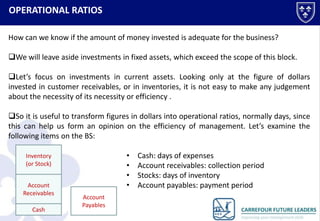
How can we know if the amount of money invested is adequate for the business?
We will leave aside investments in fixed assets, which exceed the scope of this block.
Let’s focus on investments in current assets. Looking only at the figure of dollars
invested in customer receivables, or in inventories, it is not easy to make any judgement
about the necessity of its necessity or efficiency .
So it is useful to transform figures in dollars into operational ratios, normally days, since
this can help us form an opinion on the efficiency of management. Let’s examine the
following items on the BS:
•
•
•
•

Inventory
(or Stock)
Account
Receivables

Cash

Account
Payables

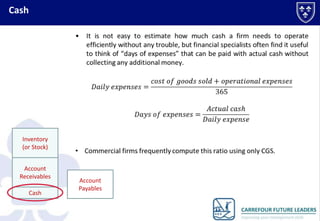
Cash: days of expenses
Account receivables: collection period
Stocks: days of inventory
Account payables: payment period
Cash

Inventory
(or Stock)
Account
Receivables
Cash

Account
Payables
Cash

Inventory
(or Stock)
Account
Receivables
Cash

Account
Payables

Note:
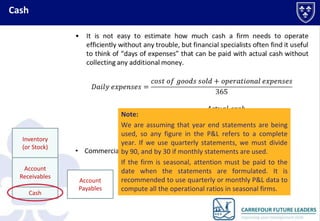
We are assuming that year end statements are being
used, so any figure in the P&L refers to a complete
year. If we use quarterly statements, we must divide
by 90, and by 30 if monthly statements are used.
If the firm is seasonal, attention must be paid to the
date when the statements are formulated. It is
recommended to use quarterly or monthly P&L data to
compute all the operational ratios in seasonal firms.
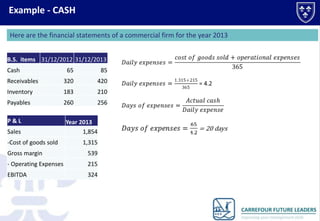
Example - CASH
Here are the financial statements of a commercial firm for the year 2013
B.S. items 31/12/2012 31/12/2013
Cash

65

85

Receivables

320

420

Inventory

183

210

Payables

260

256

P&L
Sales
-Cost of goods sold

Year 2013
1,854
1,315

Gross margin

539

- Operating Expenses

215

EBITDA

324
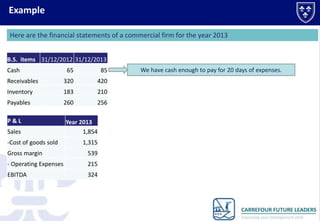
Example
Here are the financial statements of a commercial firm for the year 2013
B.S. items 31/12/2012 31/12/2013
Cash

65

85

Receivables

320

420

Inventory

183

210

Payables

260

256

P&L
Sales
-Cost of goods sold

Year 2013
1,854
1,315

Gross margin

539

- Operating Expenses

215

EBITDA

324

We have cash enough to pay for 20 days of expenses.
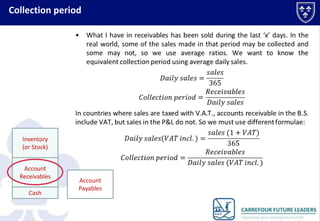
Collection period

Inventory
(or Stock)
Account
Receivables
Cash

Account
Payables
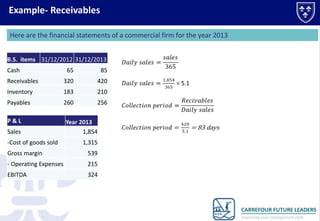
Example- Receivables
Here are the financial statements of a commercial firm for the year 2013
B.S. items 31/12/2012 31/12/2013
Cash

65

85

Receivables

320

420

Inventory

183

210

Payables

260

256

P&L
Sales
-Cost of goods sold

Year 2013
1,854
1,315

Gross margin

539

- Operating Expenses

215

EBITDA

324
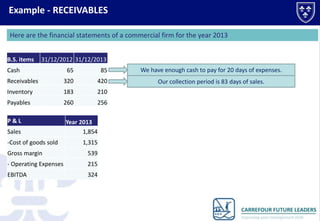
Example - RECEIVABLES
Here are the financial statements of a commercial firm for the year 2013
B.S. items

31/12/2012 31/12/2013
65

85

We have enough cash to pay for 20 days of expenses.

Receivables

320

420

Our collection period is 83 days of sales.

Inventory

183

210

Payables

260

256

Cash

P&L
Sales
-Cost of goods sold

Year 2013
1,854
1,315

Gross margin

539

- Operating Expenses

215

EBITDA

324
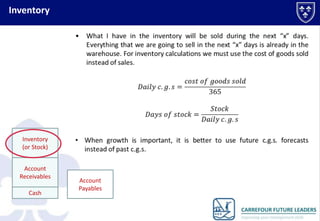
Inventory

Inventory
(or Stock)
Account
Receivables
Cash

Account
Payables
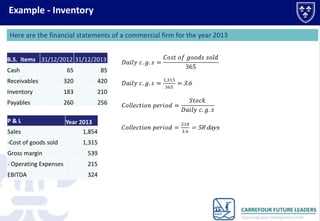
Example - Inventory
Here are the financial statements of a commercial firm for the year 2013
B.S. items 31/12/2012 31/12/2013
Cash

65

85

Receivables

320

420

Inventory

183

210

Payables

260

256

P&L
Sales
-Cost of goods sold

Year 2013
1,854
1,315

Gross margin

539

- Operating Expenses

215

EBITDA

324
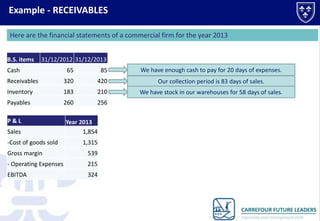
Example - RECEIVABLES
Here are the financial statements of a commercial firm for the year 2013
B.S. items

31/12/2012 31/12/2013
65

85

We have enough cash to pay for 20 days of expenses.

Receivables

320

420

Our collection period is 83 days of sales.

Inventory

183

210

We have stock in our warehouses for 58 days of sales.

Payables

260

256

Cash

P&L
Sales
-Cost of goods sold

Year 2013
1,854
1,315

Gross margin

539

- Operating Expenses

215

EBITDA

324
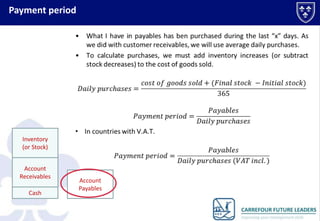
Payment period

Inventory
(or Stock)
Account
Receivables
Cash

Account
Payables
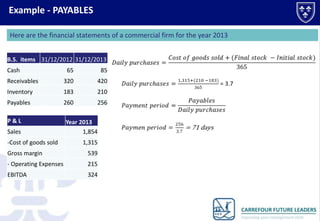
Example - PAYABLES
Here are the financial statements of a commercial firm for the year 2013
B.S. items 31/12/2012 31/12/2013
Cash

65

85

Receivables

320

420

Inventory

183

210

Payables

260

256

P&L
Sales
-Cost of goods sold

Year 2013
1,854
1,315

Gross margin

539

- Operating Expenses

215

EBITDA

324
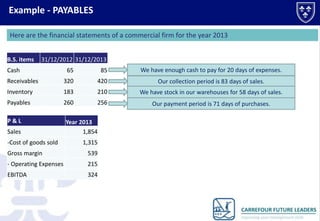
Example - PAYABLES
Here are the financial statements of a commercial firm for the year 2013
B.S. items

31/12/2012 31/12/2013
65

85

We have enough cash to pay for 20 days of expenses.

Receivables

320

420

Our collection period is 83 days of sales.

Inventory

183

210

We have stock in our warehouses for 58 days of sales.

Payables

260

256

Our payment period is 71 days of purchases.

Cash

P&L
Sales
-Cost of goods sold

Year 2013
1,854
1,315

Gross margin

539

- Operating Expenses

215

EBITDA

324
© Instituto Internacional San Telmo, 2012

Operational ratios

  • 1.
    © Instituto InternacionalSan Telmo, 2012 OPERATIONAL RATIOS
  • 2.
    OPERATIONAL RATIOS How canwe know if the amount of money invested is adequate for the business? We will leave aside investments in fixed assets, which exceed the scope of this block. Let’s focus on investments in current assets. Looking only at the figure of dollars invested in customer receivables, or in inventories, it is not easy to make any judgement about the necessity of its necessity or efficiency . So it is useful to transform figures in dollars into operational ratios, normally days, since this can help us form an opinion on the efficiency of management. Let’s examine the following items on the BS: • • • • Inventory (or Stock) Account Receivables Cash Account Payables Cash: days of expenses Account receivables: collection period Stocks: days of inventory Account payables: payment period
  • 3.
  • 4.
    Cash Inventory (or Stock) Account Receivables Cash Account Payables Note: We areassuming that year end statements are being used, so any figure in the P&L refers to a complete year. If we use quarterly statements, we must divide by 90, and by 30 if monthly statements are used. If the firm is seasonal, attention must be paid to the date when the statements are formulated. It is recommended to use quarterly or monthly P&L data to compute all the operational ratios in seasonal firms.
  • 5.
    Example - CASH Hereare the financial statements of a commercial firm for the year 2013 B.S. items 31/12/2012 31/12/2013 Cash 65 85 Receivables 320 420 Inventory 183 210 Payables 260 256 P&L Sales -Cost of goods sold Year 2013 1,854 1,315 Gross margin 539 - Operating Expenses 215 EBITDA 324
  • 6.
    Example Here are thefinancial statements of a commercial firm for the year 2013 B.S. items 31/12/2012 31/12/2013 Cash 65 85 Receivables 320 420 Inventory 183 210 Payables 260 256 P&L Sales -Cost of goods sold Year 2013 1,854 1,315 Gross margin 539 - Operating Expenses 215 EBITDA 324 We have cash enough to pay for 20 days of expenses.
  • 7.
  • 8.
    Example- Receivables Here arethe financial statements of a commercial firm for the year 2013 B.S. items 31/12/2012 31/12/2013 Cash 65 85 Receivables 320 420 Inventory 183 210 Payables 260 256 P&L Sales -Cost of goods sold Year 2013 1,854 1,315 Gross margin 539 - Operating Expenses 215 EBITDA 324
  • 9.
    Example - RECEIVABLES Hereare the financial statements of a commercial firm for the year 2013 B.S. items 31/12/2012 31/12/2013 65 85 We have enough cash to pay for 20 days of expenses. Receivables 320 420 Our collection period is 83 days of sales. Inventory 183 210 Payables 260 256 Cash P&L Sales -Cost of goods sold Year 2013 1,854 1,315 Gross margin 539 - Operating Expenses 215 EBITDA 324
  • 10.
  • 11.
    Example - Inventory Hereare the financial statements of a commercial firm for the year 2013 B.S. items 31/12/2012 31/12/2013 Cash 65 85 Receivables 320 420 Inventory 183 210 Payables 260 256 P&L Sales -Cost of goods sold Year 2013 1,854 1,315 Gross margin 539 - Operating Expenses 215 EBITDA 324
  • 12.
    Example - RECEIVABLES Hereare the financial statements of a commercial firm for the year 2013 B.S. items 31/12/2012 31/12/2013 65 85 We have enough cash to pay for 20 days of expenses. Receivables 320 420 Our collection period is 83 days of sales. Inventory 183 210 We have stock in our warehouses for 58 days of sales. Payables 260 256 Cash P&L Sales -Cost of goods sold Year 2013 1,854 1,315 Gross margin 539 - Operating Expenses 215 EBITDA 324
  • 13.
  • 14.
    Example - PAYABLES Hereare the financial statements of a commercial firm for the year 2013 B.S. items 31/12/2012 31/12/2013 Cash 65 85 Receivables 320 420 Inventory 183 210 Payables 260 256 P&L Sales -Cost of goods sold Year 2013 1,854 1,315 Gross margin 539 - Operating Expenses 215 EBITDA 324
  • 15.
    Example - PAYABLES Hereare the financial statements of a commercial firm for the year 2013 B.S. items 31/12/2012 31/12/2013 65 85 We have enough cash to pay for 20 days of expenses. Receivables 320 420 Our collection period is 83 days of sales. Inventory 183 210 We have stock in our warehouses for 58 days of sales. Payables 260 256 Our payment period is 71 days of purchases. Cash P&L Sales -Cost of goods sold Year 2013 1,854 1,315 Gross margin 539 - Operating Expenses 215 EBITDA 324
  • 16.