L- 11
The Forecasting Function
Developed by Dr. IKRAM CPA,
Ph.D.
Financial Forecasting
& its Related Problems
Pronóstico financiero
Forecasting is the process of
making predictions of the
future based on past and
present data and most
commonly by analysis of
trends.
A commonplace example might
be estimation of some variable
of interest at some specified
future date.
Prediction is a similar, but more general
term. Both might refer to formal statistical
methods employing time series, cross-
sectional or longitudinal data, or
alternatively to less formal judgmental
methods.
"forecast" and "forecasting" are sometimes
reserved for estimates of values at certain
specific future times, while the term
"prediction" is used for more general estimates,
such as the number of times floods will occur
over a long period.
Risk and uncertainty are central to forecasting
and prediction; it is generally considered
good practice to indicate the degree of
uncertainty attaching to forecasts.
In any case, the data must be up to date in
order for the forecast to be as accurate as
possible. In some cases the data used to
predict the independent variable is itself
forecasted.
The use of historic data to determine the
direction of future trends. Forecasting is used
by companies to determine how to allocate
their budgets for an upcoming period of time.
This is typically based on demand for the
goods and services it offers, compared to the
cost of producing them.
Forecasting
A planning tool that helps management in its
attempts to cope with the uncertainty of the
future, relying mainly on data from the past
and present and analysis of trends.
Forecasting starts with certain assumptions
based on the management's experience,
knowledge, and judgment.
These estimates are projected into the coming
months or years using one or more techniques such
as Box-Jenkins models,
Delphi method, exponential smoothing, moving
averages, regression analysis, and trend projection.
Since any error in the assumptions will result in a
similar or magnified error in forecasting, the
technique of sensitivity analysis is used
which assigns a range of values to the uncertain
factors (variables).
Financial planning
 Financial planning indicates a firm’s
growth, performance, investments and
requirements of funds during a given
period of time, usually three to five years.
 It involves the preparation of projected or
pro forma profit and loss account,
balance sheet and other statements.
 Financial planning help a firm’s financial
manager to regulate flows of funds which
is his primary concern.
Financial Planning
Financing planning process involves the following facets:
 Evaluating the current financial condition of the firm.
 Analyzing the future growth prospects and options.
 Appraising the investment options to achieve the stated growth
objective.
 Projecting the future growth and profitability.
 Estimating funds requirement and considering alternative
financing options.
 Comparing and choosing from alternative growth plans and
financing options.
 Measuring actual performance with the planned performance.
Financial Forecasting and
Modeling
•Financial forecasting is a planning process with
respect to company’s management positions, the firm’s
future activities relative to the expected economic,
technical, competitive and social environment.
•A financial planning model establishes the relationship
between financial variables and targets, and facilitates
the financial forecasting and planning process.
•A financial planning model has the following three
components:
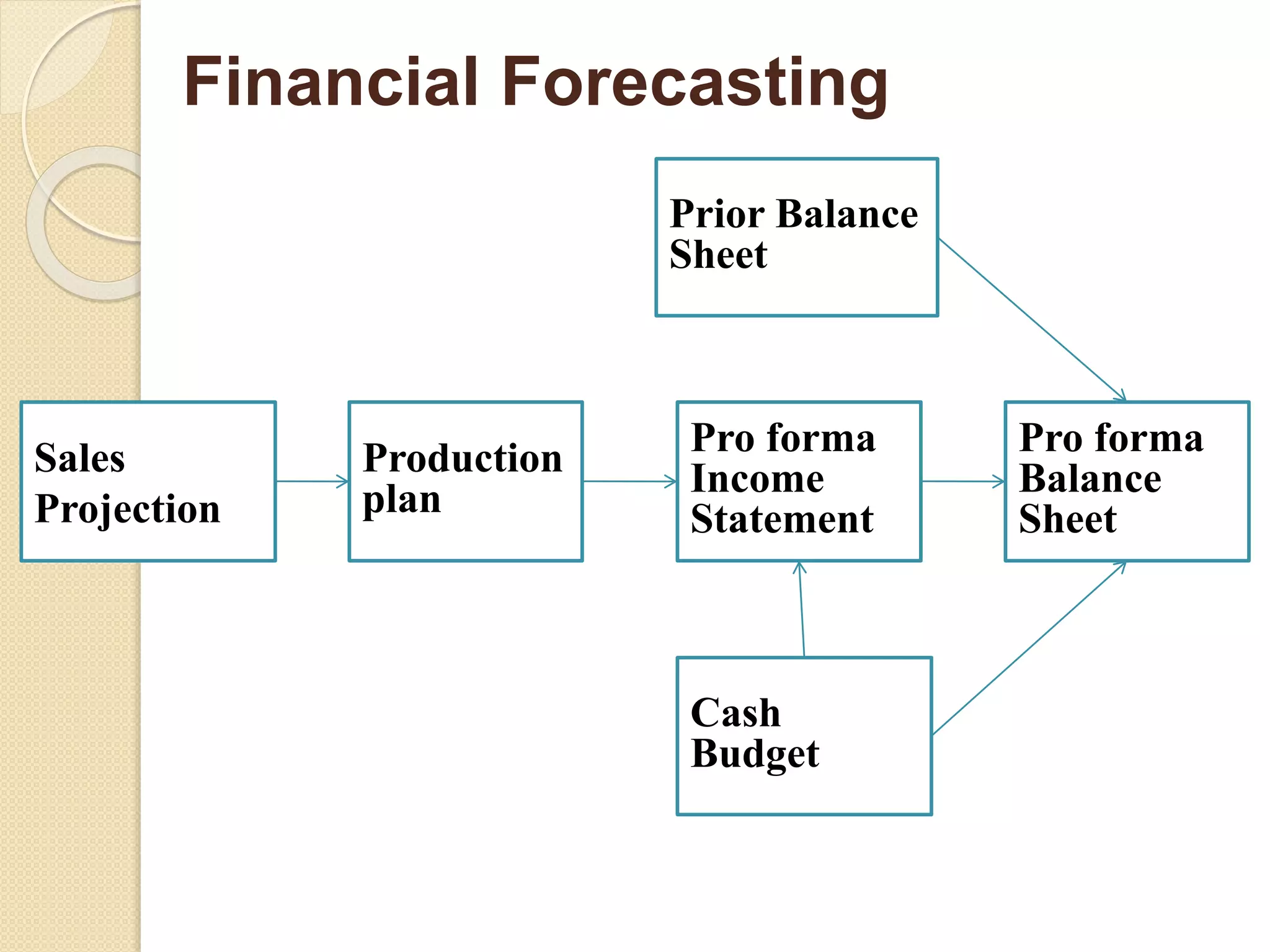
Inputs
Model
Output
Sales
Projection
Production
plan
Prior Balance
Sheet
Cash
Budget
Pro forma
Income
Statement
Pro forma
Balance
Sheet
Financial Forecasting
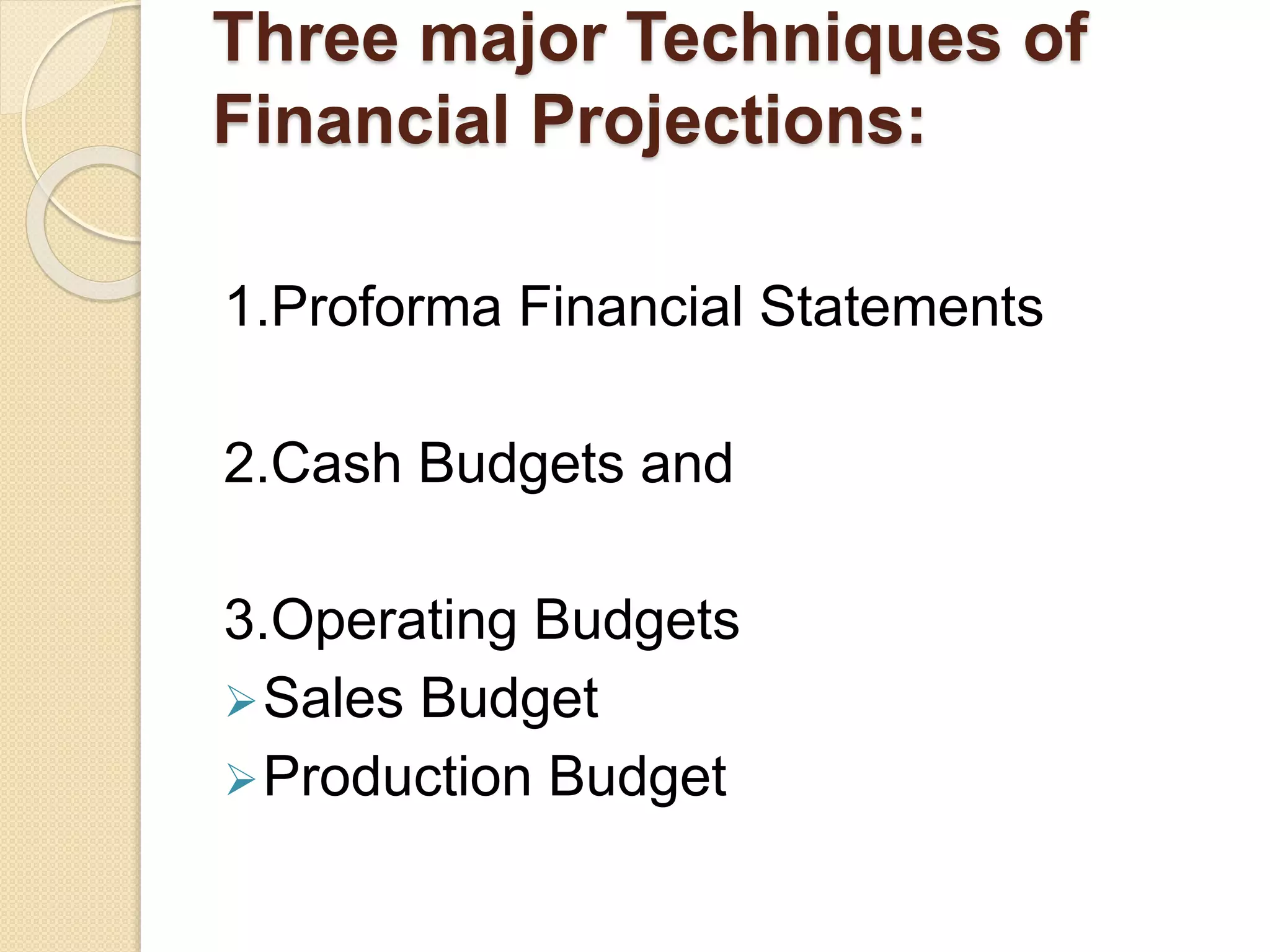
Three major Techniques of
Financial Projections:
1.Proforma Financial Statements
2.Cash Budgets and
3.Operating Budgets
Sales Budget
Production Budget
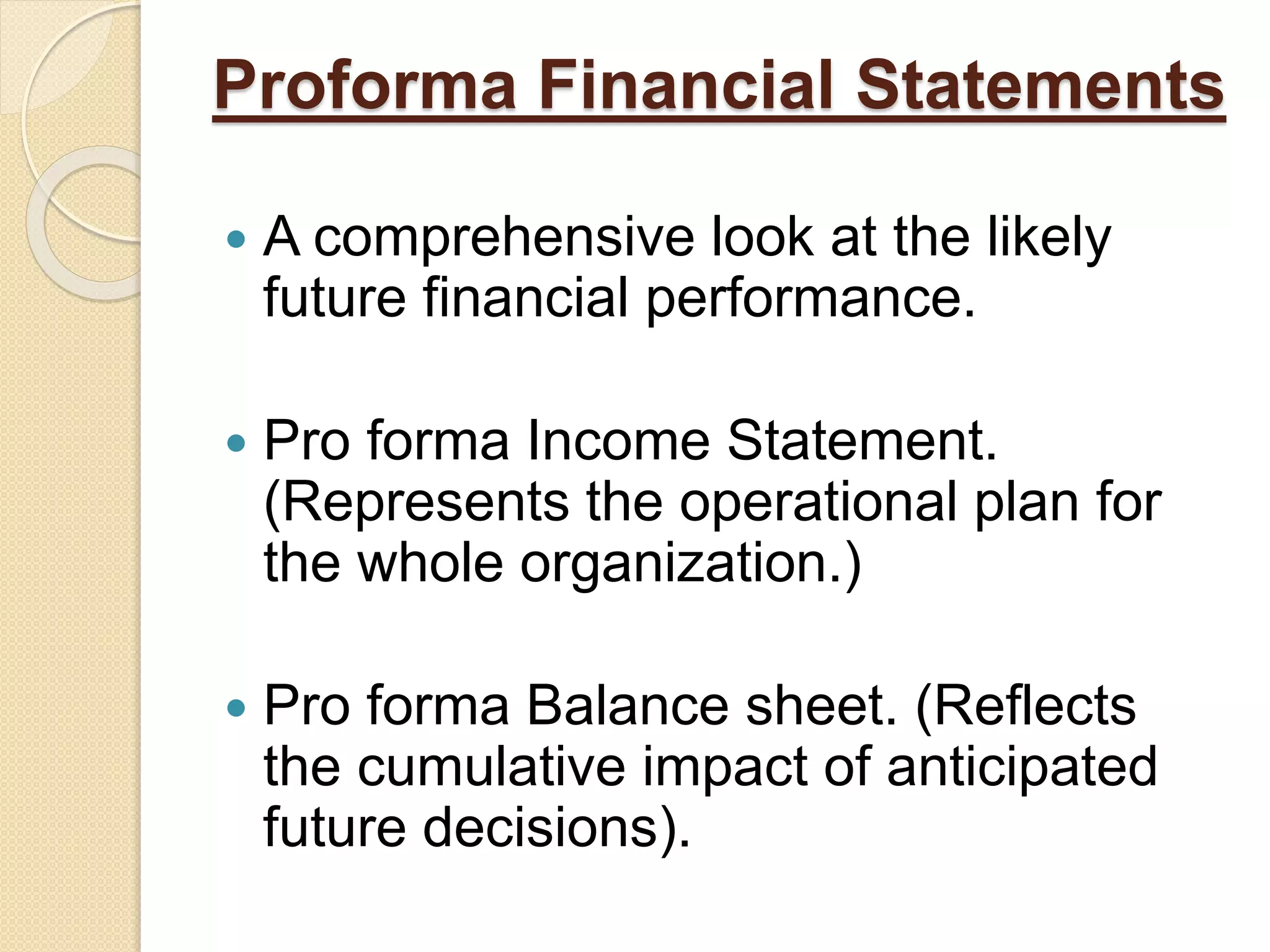
Proforma Financial Statements
 A comprehensive look at the likely
future financial performance.
 Pro forma Income Statement.
(Represents the operational plan for
the whole organization.)
 Pro forma Balance sheet. (Reflects
the cumulative impact of anticipated
future decisions).
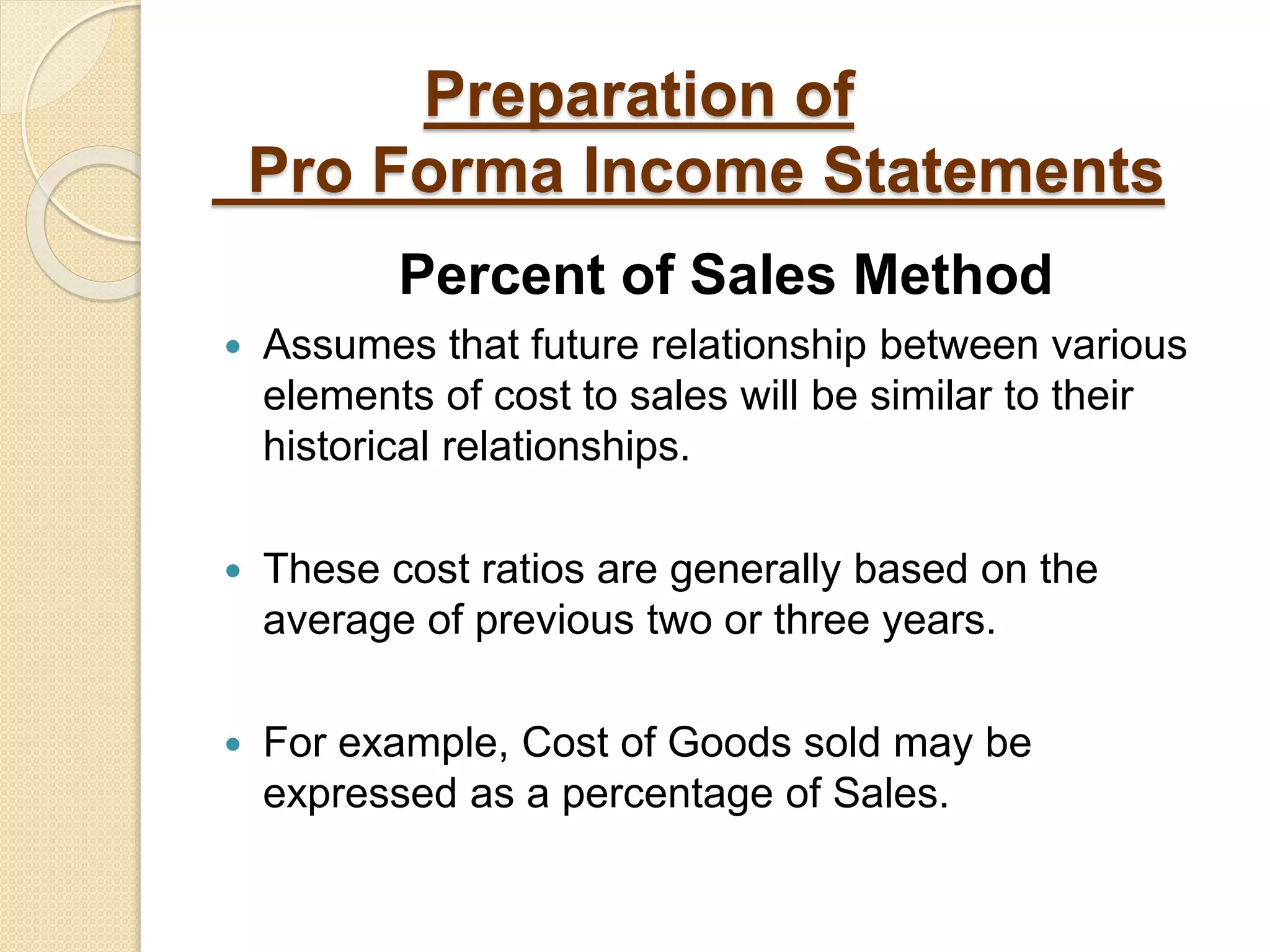
Preparation of
Pro Forma Income Statements
Percent of Sales Method
 Assumes that future relationship between various
elements of cost to sales will be similar to their
historical relationships.
 These cost ratios are generally based on the
average of previous two or three years.
 For example, Cost of Goods sold may be
expressed as a percentage of Sales.
2. Budgeted Expense
Method.
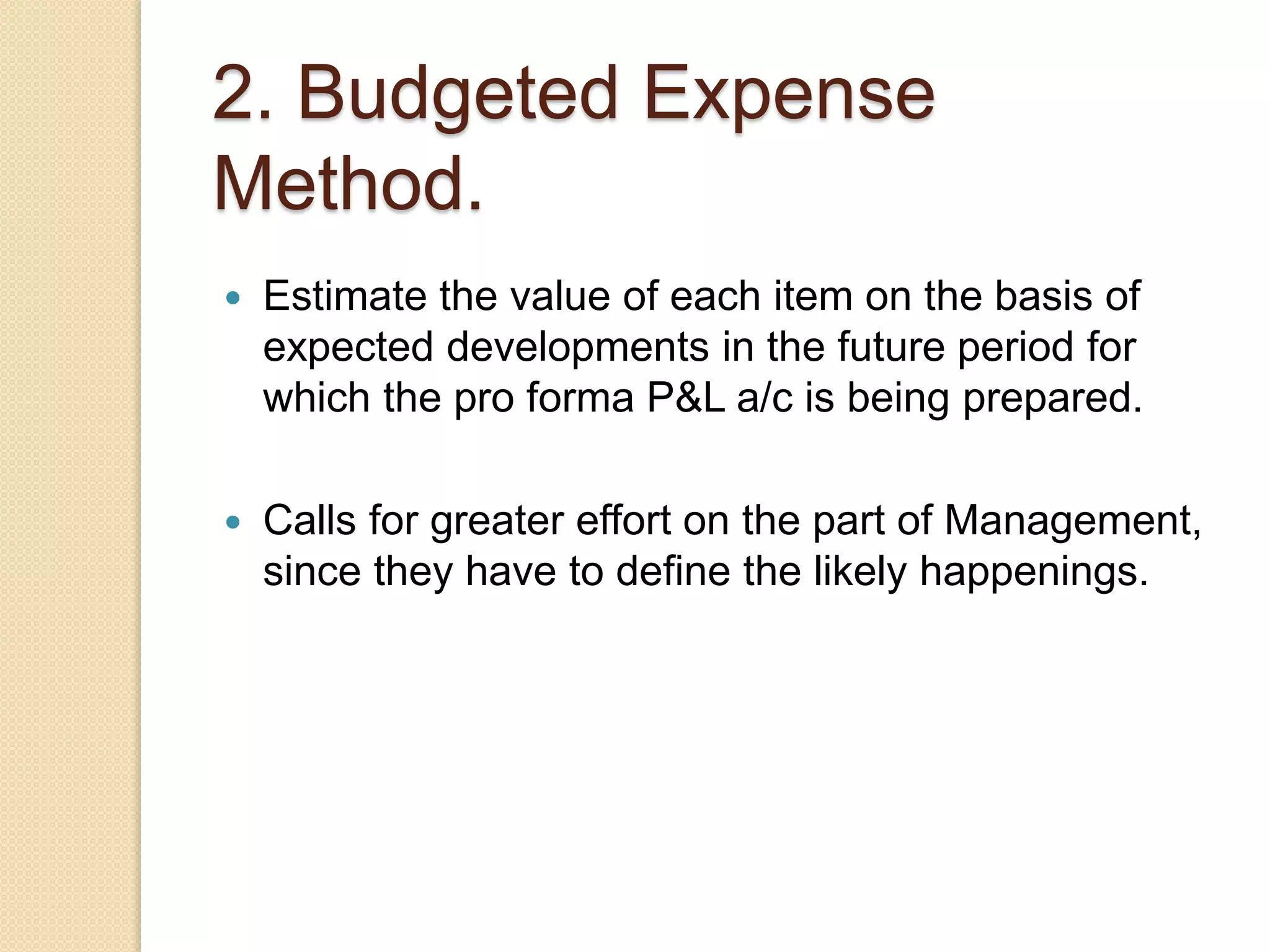
 Estimate the value of each item on the basis of
expected developments in the future period for
which the pro forma P&L a/c is being prepared.
 Calls for greater effort on the part of Management,
since they have to define the likely happenings.
3. Combination method
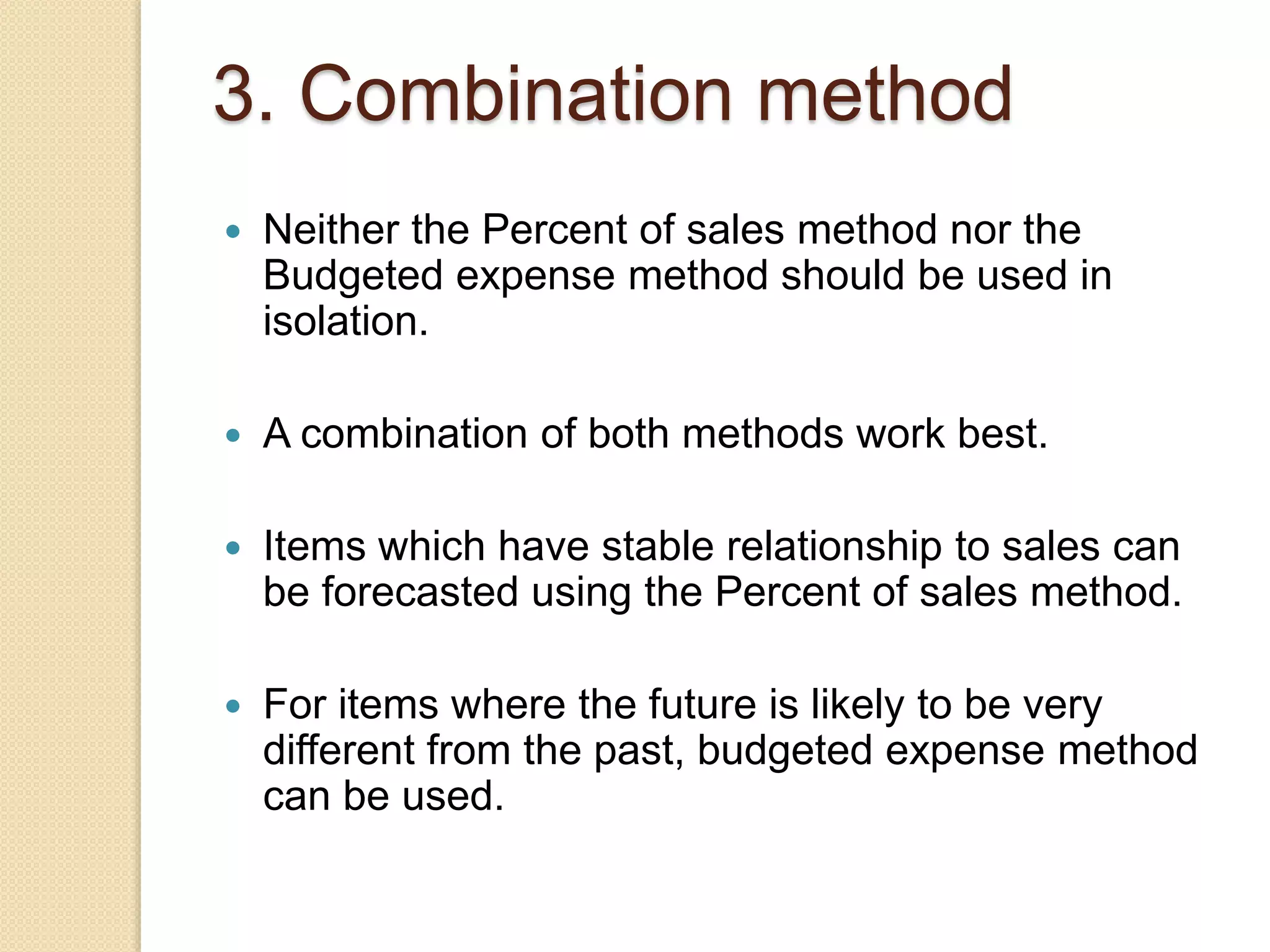
 Neither the Percent of sales method nor the
Budgeted expense method should be used in
isolation.
 A combination of both methods work best.
 Items which have stable relationship to sales can
be forecasted using the Percent of sales method.
 For items where the future is likely to be very
different from the past, budgeted expense method
can be used.
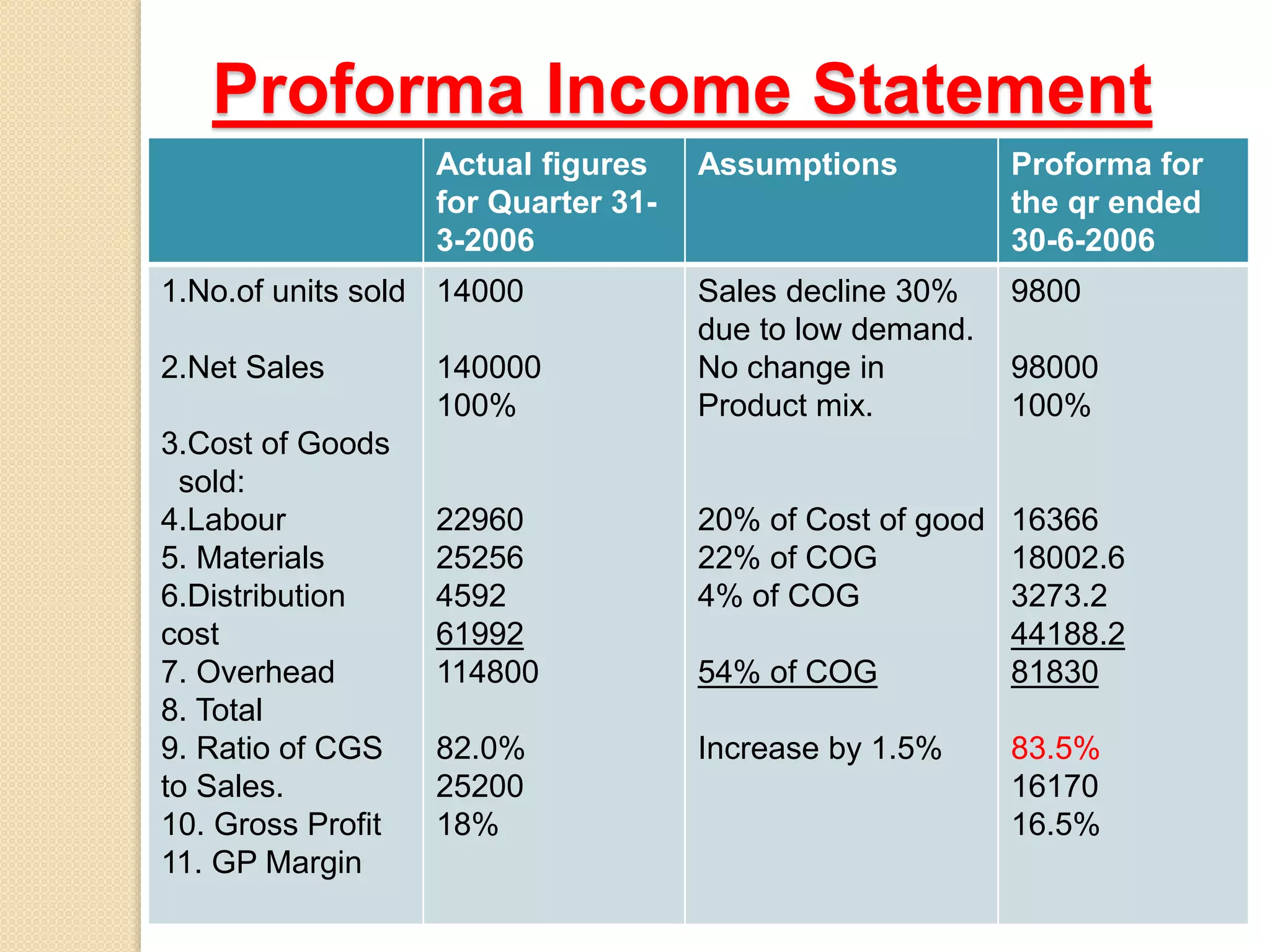
Proforma Income Statement
Actual figures
for Quarter 31-
3-2006
Assumptions Proforma for
the qr ended
30-6-2006
1.No.of units sold
2.Net Sales
3.Cost of Goods
sold:
4.Labour
5. Materials
6.Distribution
cost
7. Overhead
8. Total
9. Ratio of CGS
to Sales.
10. Gross Profit
11. GP Margin
14000
140000
100%
22960
25256
4592
61992
114800
82.0%
25200
18%
Sales decline 30%
due to low demand.
No change in
Product mix.
20% of Cost of good
22% of COG
4% of COG
54% of COG
Increase by 1.5%
9800
98000
100%
16366
18002.6
3273.2
44188.2
81830
83.5%
16170
16.5%
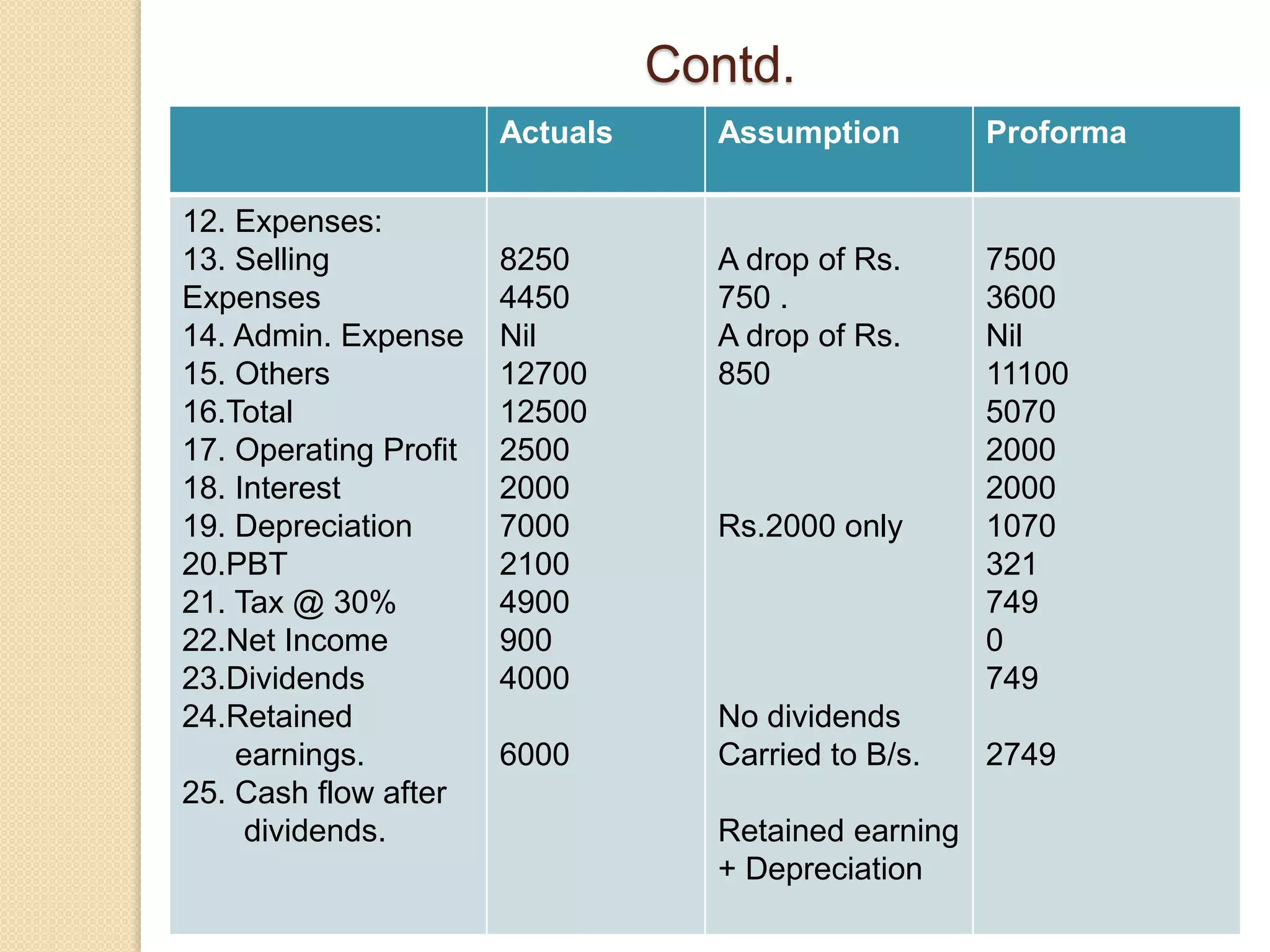
Contd.
Actuals Assumption Proforma
12. Expenses:
13. Selling
Expenses
14. Admin. Expense
15. Others
16.Total
17. Operating Profit
18. Interest
19. Depreciation
20.PBT
21. Tax @ 30%
22.Net Income
23.Dividends
24.Retained
earnings.
25. Cash flow after
dividends.
8250
4450
Nil
12700
12500
2500
2000
7000
2100
4900
900
4000
6000
A drop of Rs.
750 .
A drop of Rs.
850
Rs.2000 only
No dividends
Carried to B/s.
Retained earning
+ Depreciation
7500
3600
Nil
11100
5070
2000
2000
1070
321
749
0
749
2749
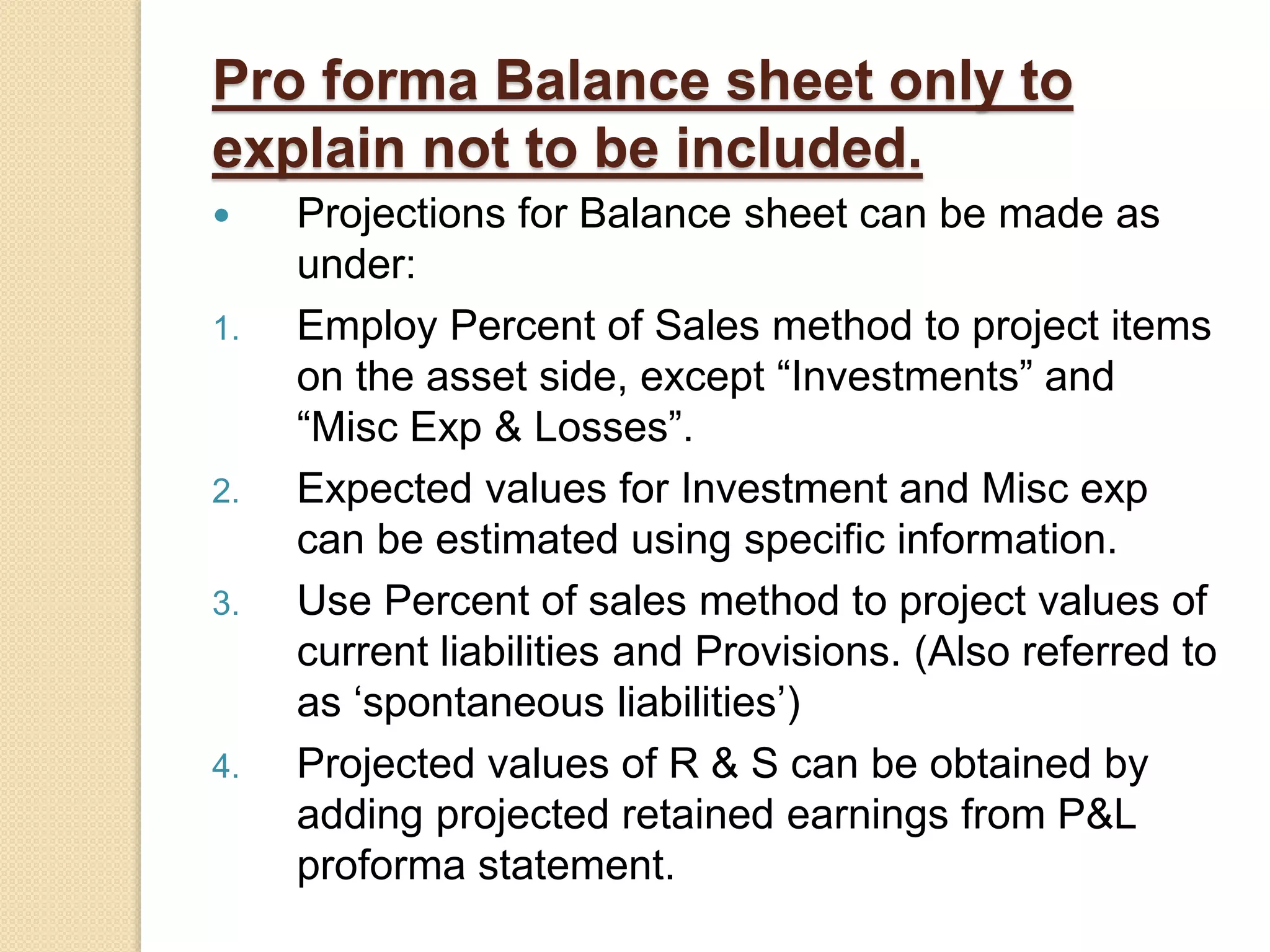
Pro forma Balance sheet only to
explain not to be included.
 Projections for Balance sheet can be made as
under:
1. Employ Percent of Sales method to project items
on the asset side, except “Investments” and
“Misc Exp & Losses”.
2. Expected values for Investment and Misc exp
can be estimated using specific information.
3. Use Percent of sales method to project values of
current liabilities and Provisions. (Also referred to
as ‘spontaneous liabilities’)
4. Projected values of R & S can be obtained by
adding projected retained earnings from P&L
proforma statement.
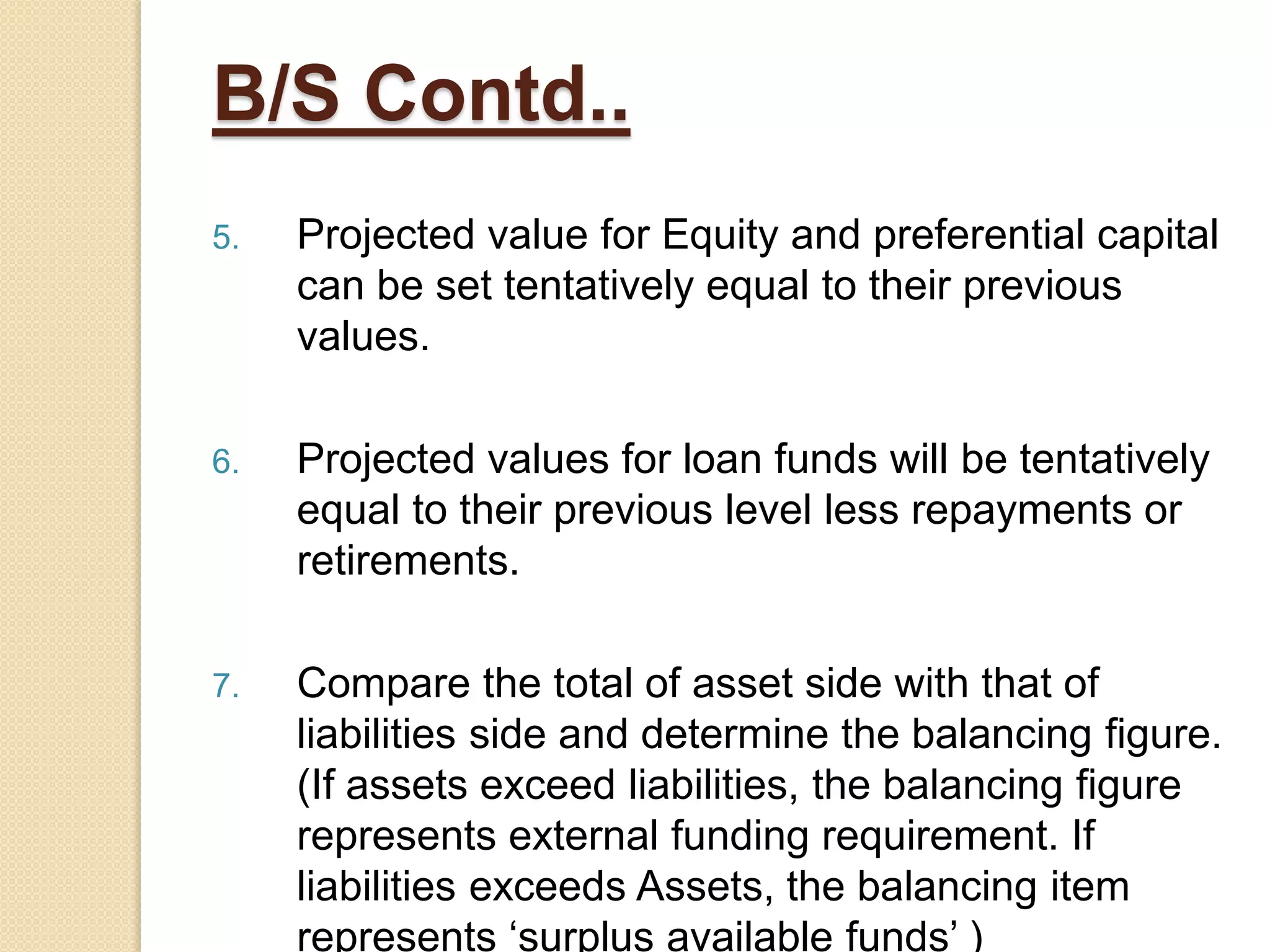
B/S Contd..
5. Projected value for Equity and preferential capital
can be set tentatively equal to their previous
values.
6. Projected values for loan funds will be tentatively
equal to their previous level less repayments or
retirements.
7. Compare the total of asset side with that of
liabilities side and determine the balancing figure.
(If assets exceed liabilities, the balancing figure
represents external funding requirement. If
liabilities exceeds Assets, the balancing item
represents ‘surplus available funds’ )
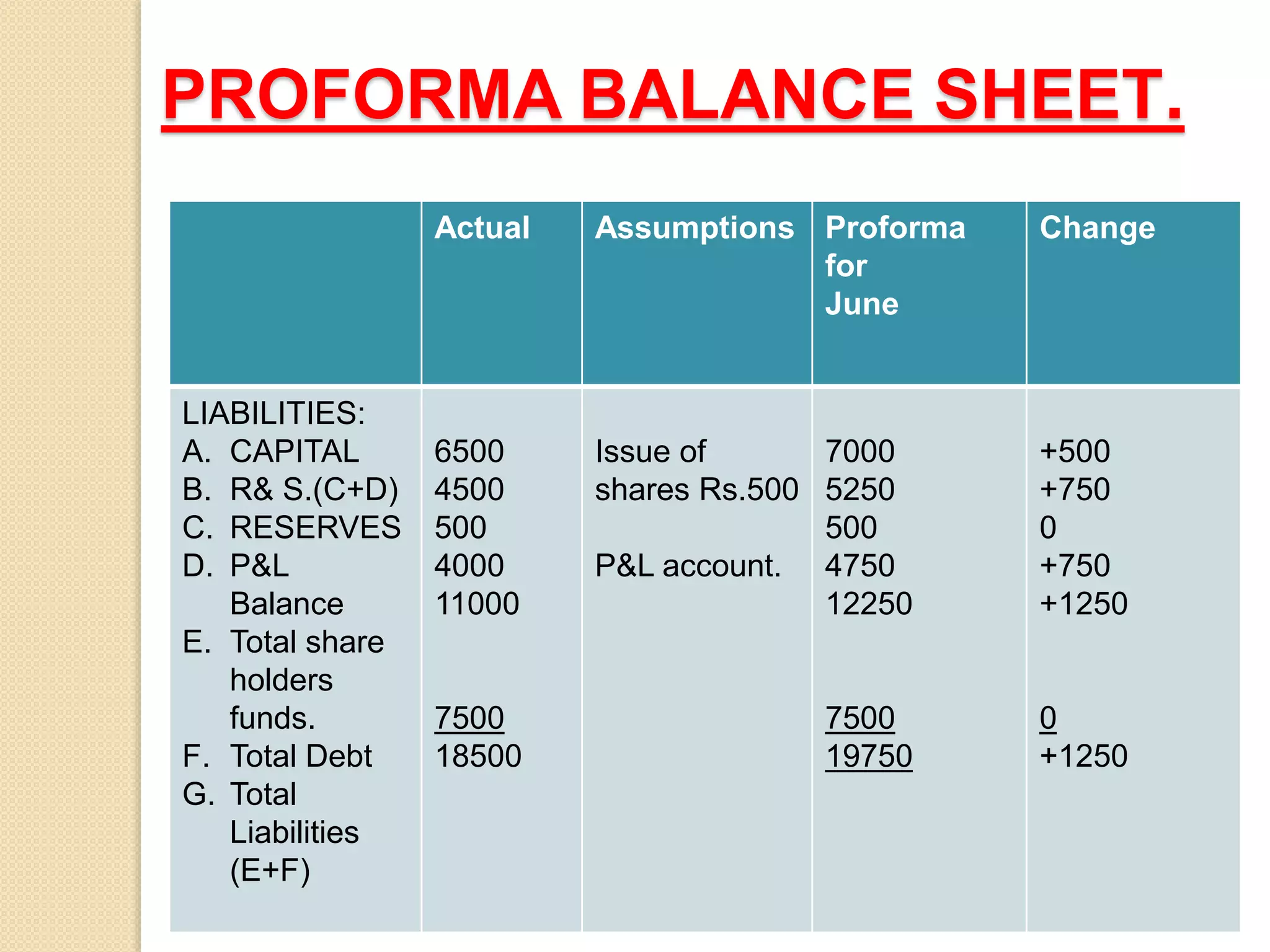
PROFORMA BALANCE SHEET.
Actual Assumptions Proforma
for
June
Change
LIABILITIES:
A. CAPITAL
B. R& S.(C+D)
C. RESERVES
D. P&L
Balance
E. Total share
holders
funds.
F. Total Debt
G. Total
Liabilities
(E+F)
6500
4500
500
4000
11000
7500
18500
Issue of
shares Rs.500
P&L account.
7000
5250
500
4750
12250
7500
19750
+500
+750
0
+750
+1250
0
+1250
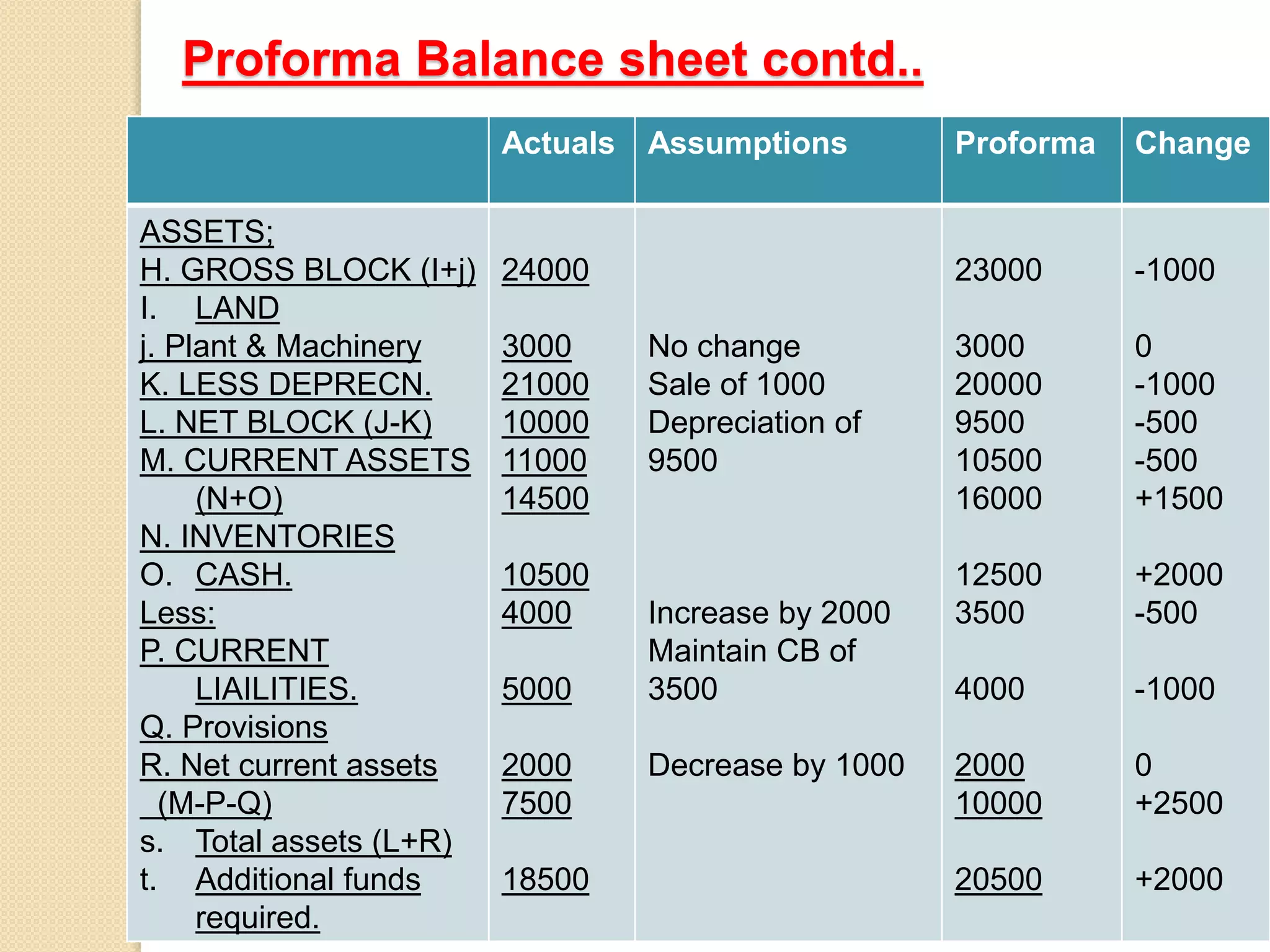
Proforma Balance sheet contd..
Actuals Assumptions Proforma Change
ASSETS;
H. GROSS BLOCK (I+j)
I. LAND
j. Plant & Machinery
K. LESS DEPRECN.
L. NET BLOCK (J-K)
M. CURRENT ASSETS
(N+O)
N. INVENTORIES
O. CASH.
Less:
P. CURRENT
LIAILITIES.
Q. Provisions
R. Net current assets
(M-P-Q)
s. Total assets (L+R)
t. Additional funds
required.
24000
3000
21000
10000
11000
14500
10500
4000
5000
2000
7500
18500
No change
Sale of 1000
Depreciation of
9500
Increase by 2000
Maintain CB of
3500
Decrease by 1000
23000
3000
20000
9500
10500
16000
12500
3500
4000
2000
10000
20500
-1000
0
-1000
-500
-500
+1500
+2000
-500
-1000
0
+2500
+2000
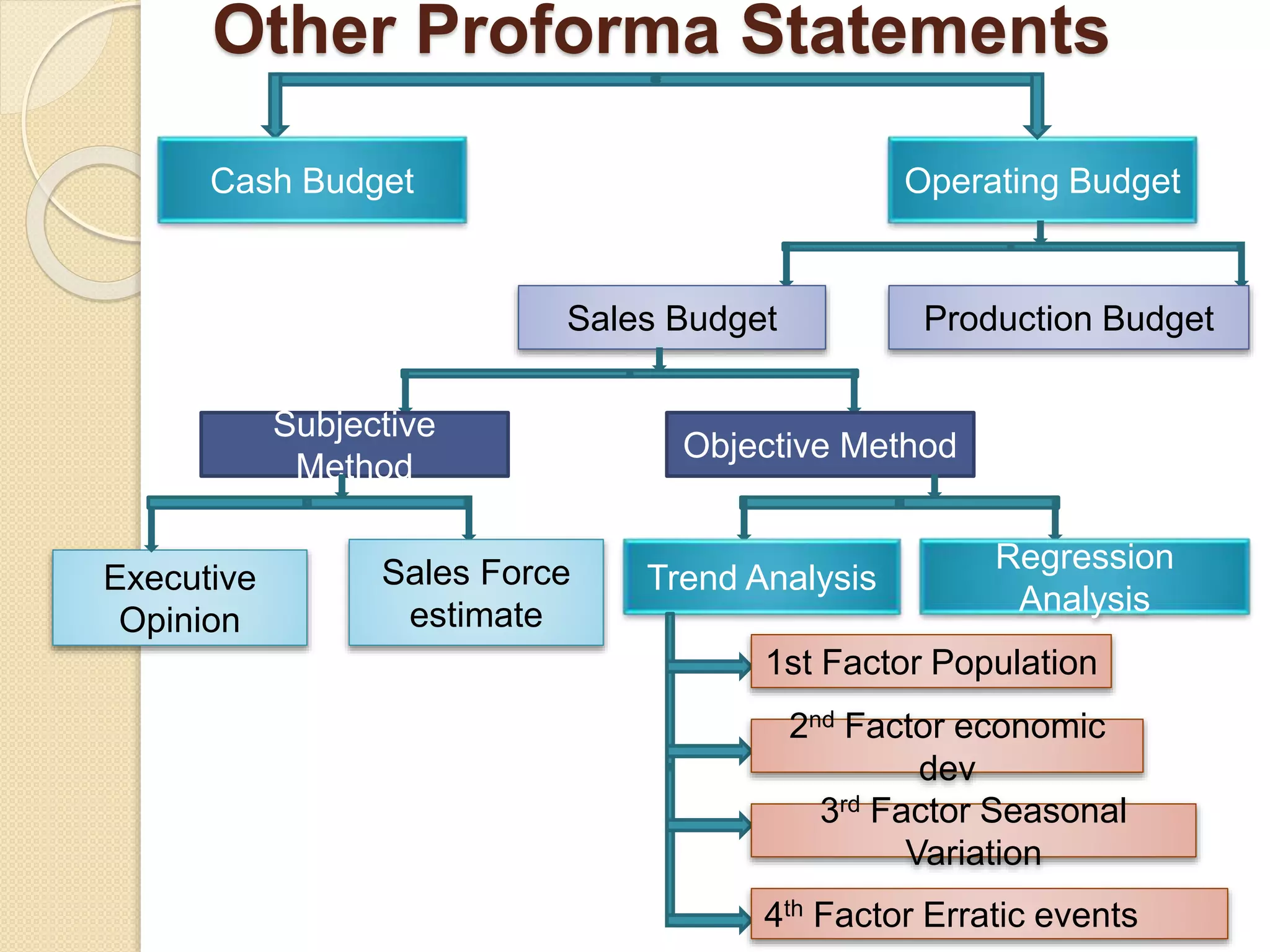
Other Proforma Statements
Cash Budget Operating Budget
Sales Budget Production Budget
Subjective
Method
Objective Method
Executive
Opinion
Sales Force
estimate
Trend Analysis
Regression
Analysis
2nd Factor economic
dev
3rd Factor Seasonal
Variation
4th Factor Erratic events
1st Factor Population
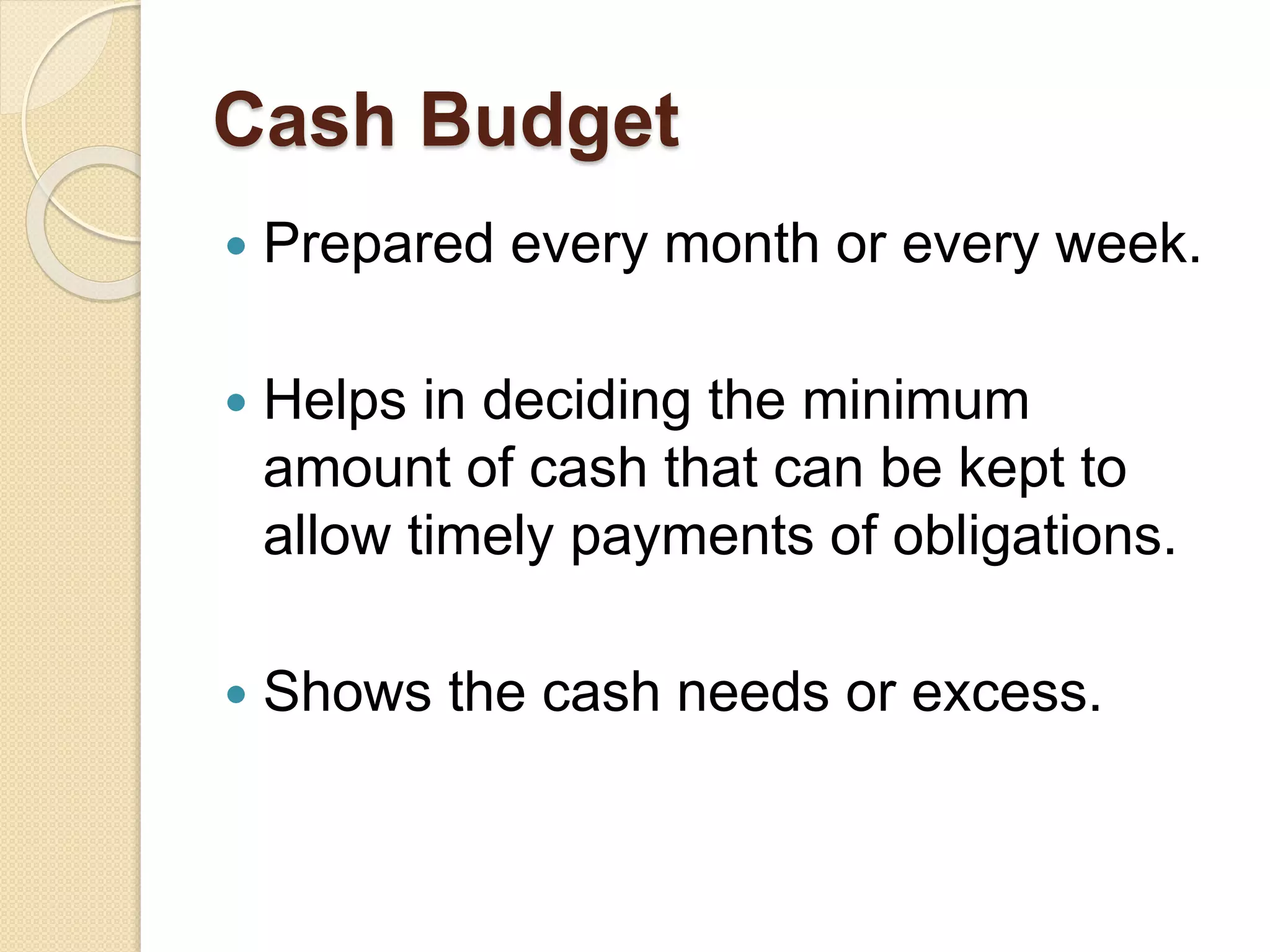
Cash Budget
 Prepared every month or every week.
 Helps in deciding the minimum
amount of cash that can be kept to
allow timely payments of obligations.
 Shows the cash needs or excess.
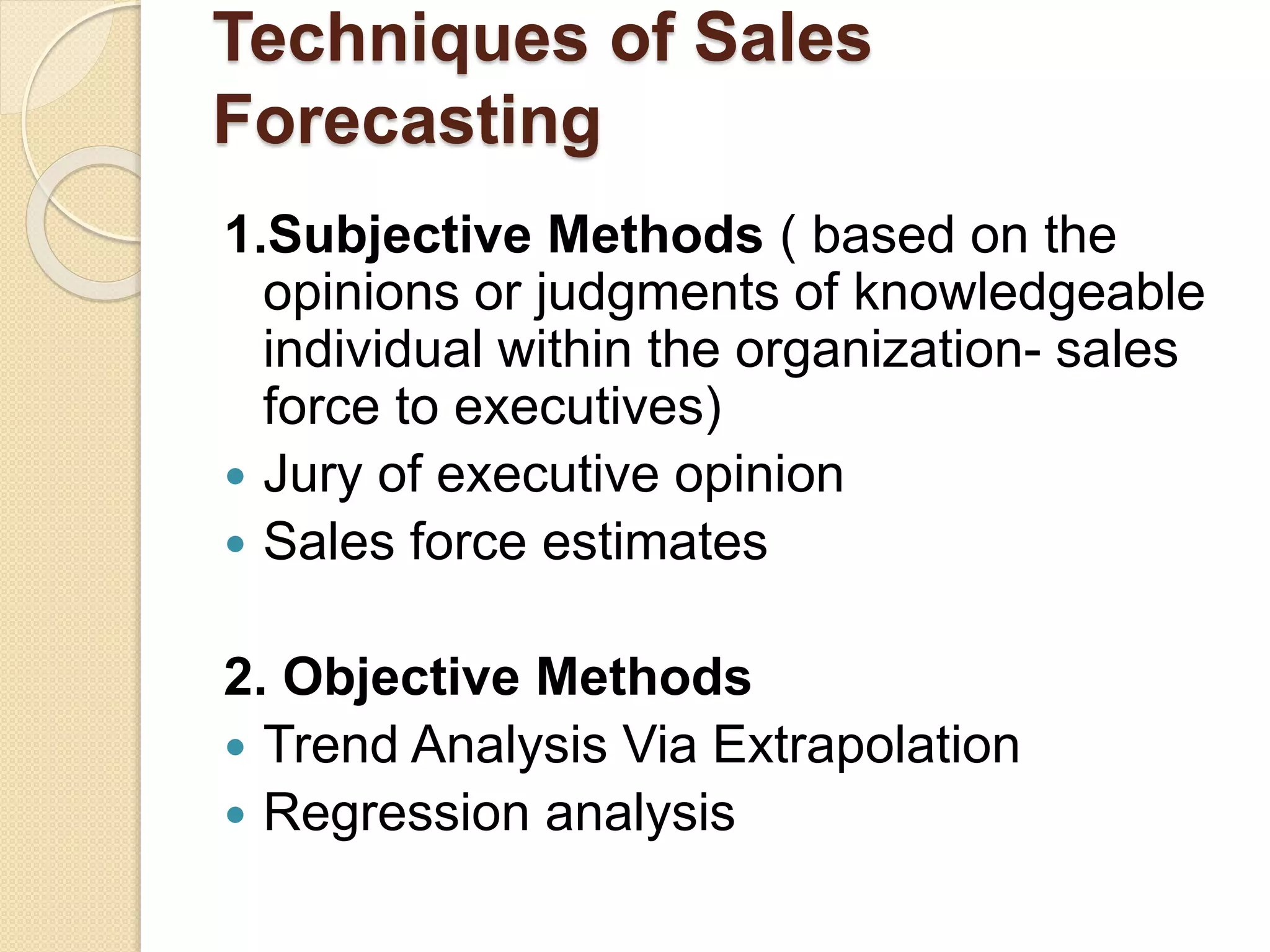
Techniques of Sales
Forecasting
1.Subjective Methods ( based on the
opinions or judgments of knowledgeable
individual within the organization- sales
force to executives)
 Jury of executive opinion
 Sales force estimates
2. Objective Methods
 Trend Analysis Via Extrapolation
 Regression analysis
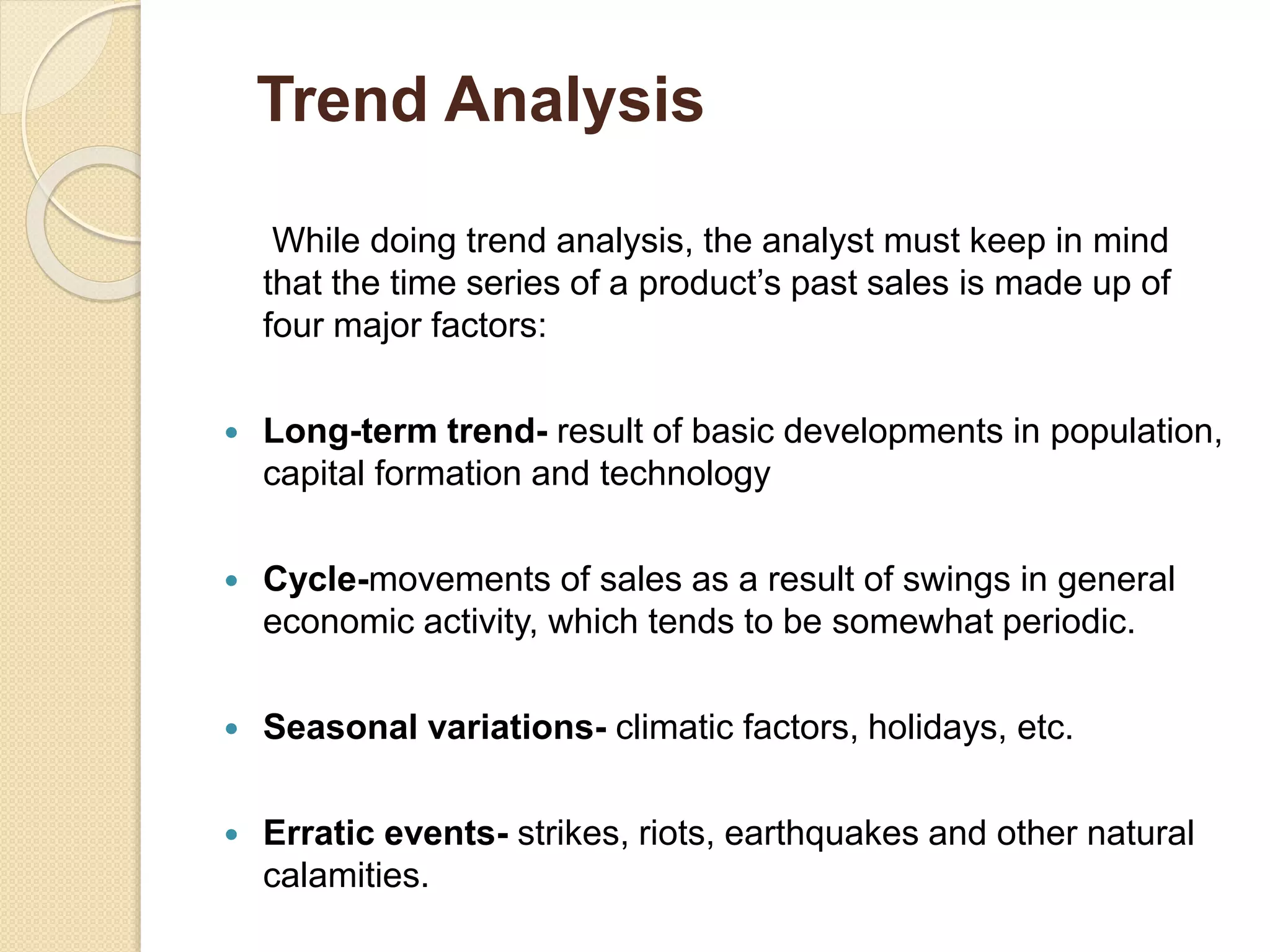
While doing trend analysis, the analyst must keep in mind
that the time series of a product’s past sales is made up of
four major factors:
 Long-term trend- result of basic developments in population,
capital formation and technology
 Cycle-movements of sales as a result of swings in general
economic activity, which tends to be somewhat periodic.
 Seasonal variations- climatic factors, holidays, etc.
 Erratic events- strikes, riots, earthquakes and other natural
calamities.
Trend Analysis
Growth and External
Financing
Requirement
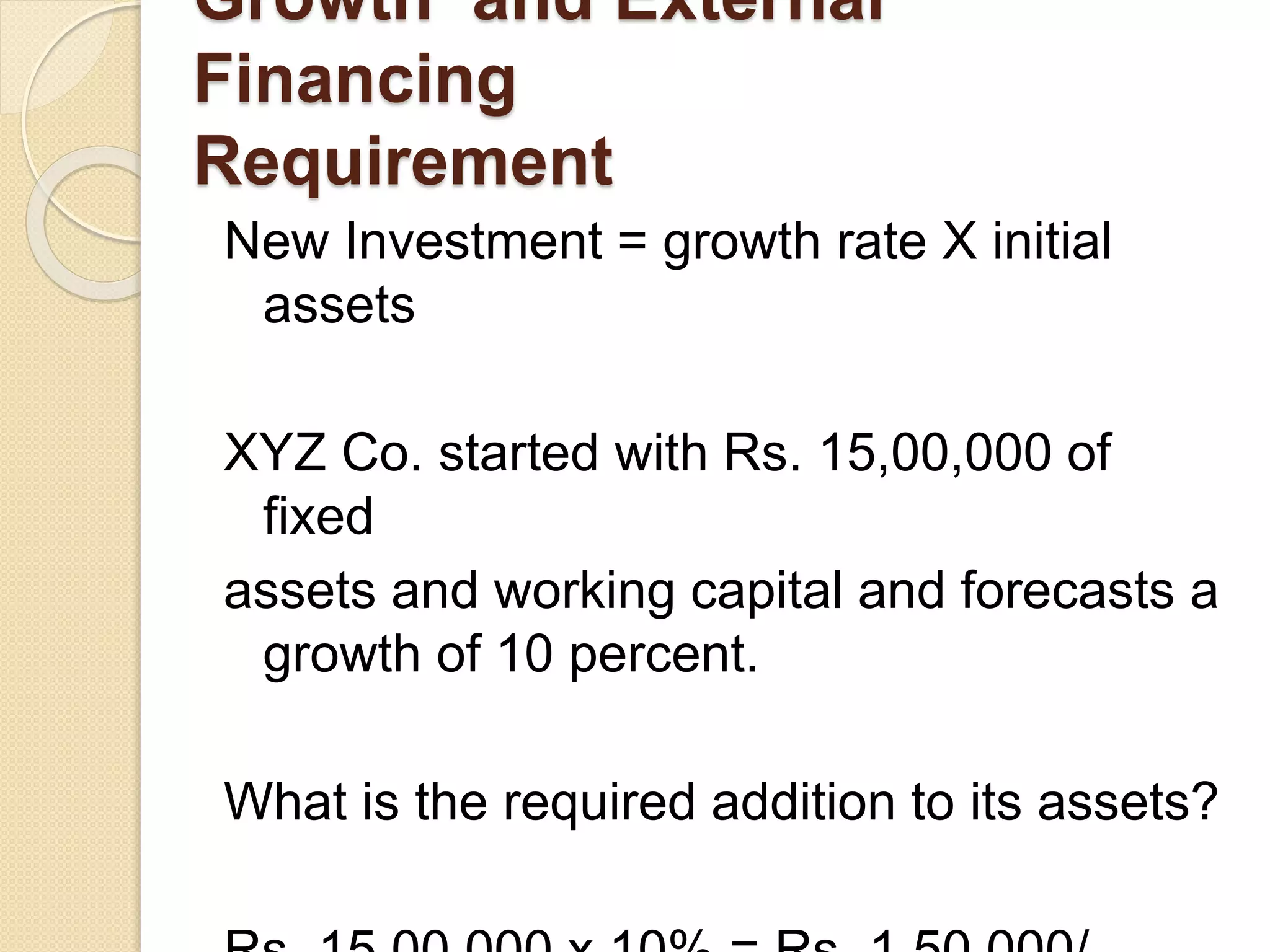
New Investment = growth rate X initial
assets
XYZ Co. started with Rs. 15,00,000 of
fixed
assets and working capital and forecasts a
growth of 10 percent.
What is the required addition to its assets?
External Financing
Requirement
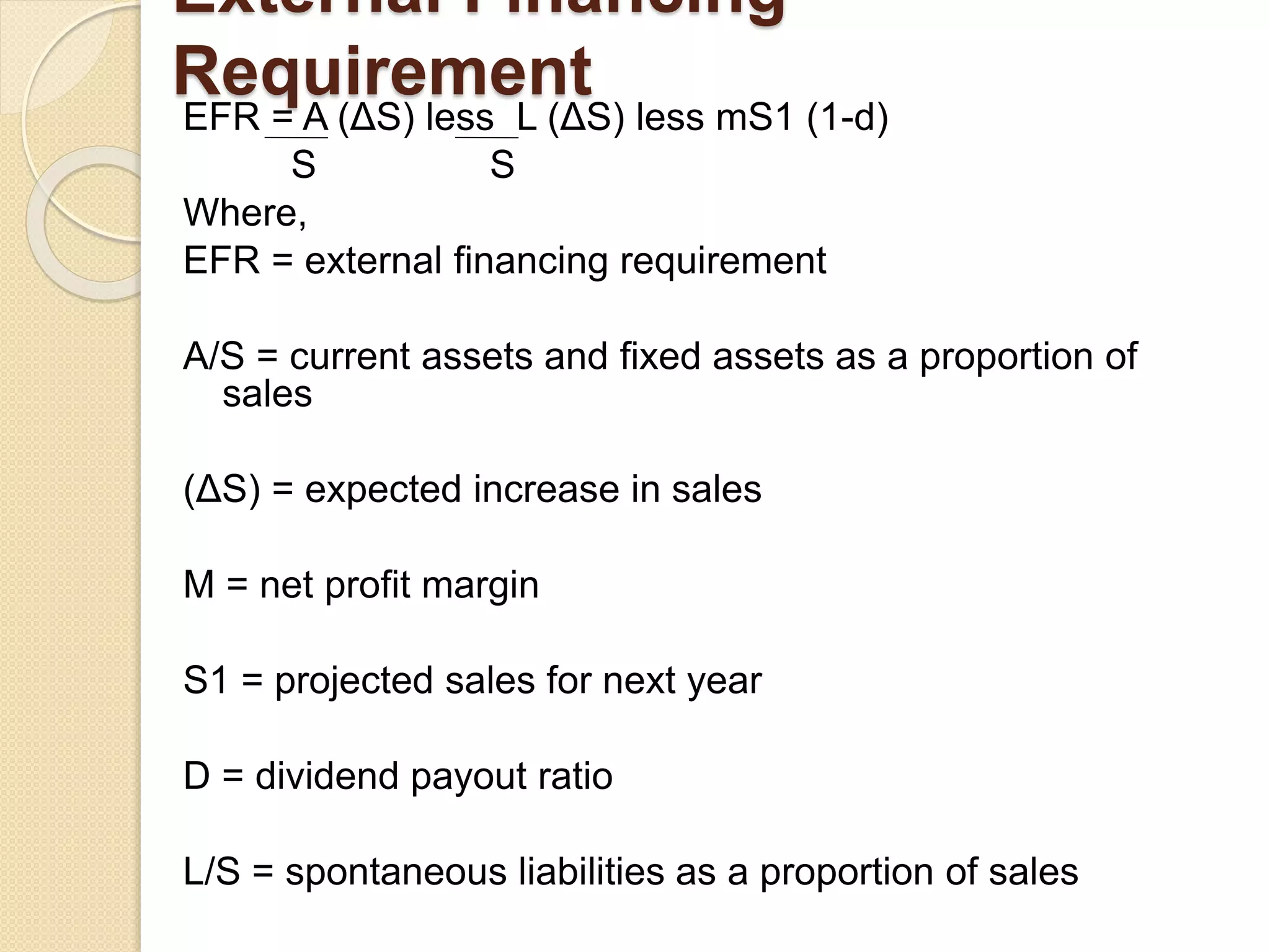
EFR = A (ΔS) less L (ΔS) less mS1 (1-d)
S S
Where,
EFR = external financing requirement
A/S = current assets and fixed assets as a proportion of
sales
(ΔS) = expected increase in sales
M = net profit margin
S1 = projected sales for next year
D = dividend payout ratio
L/S = spontaneous liabilities as a proportion of sales
Or
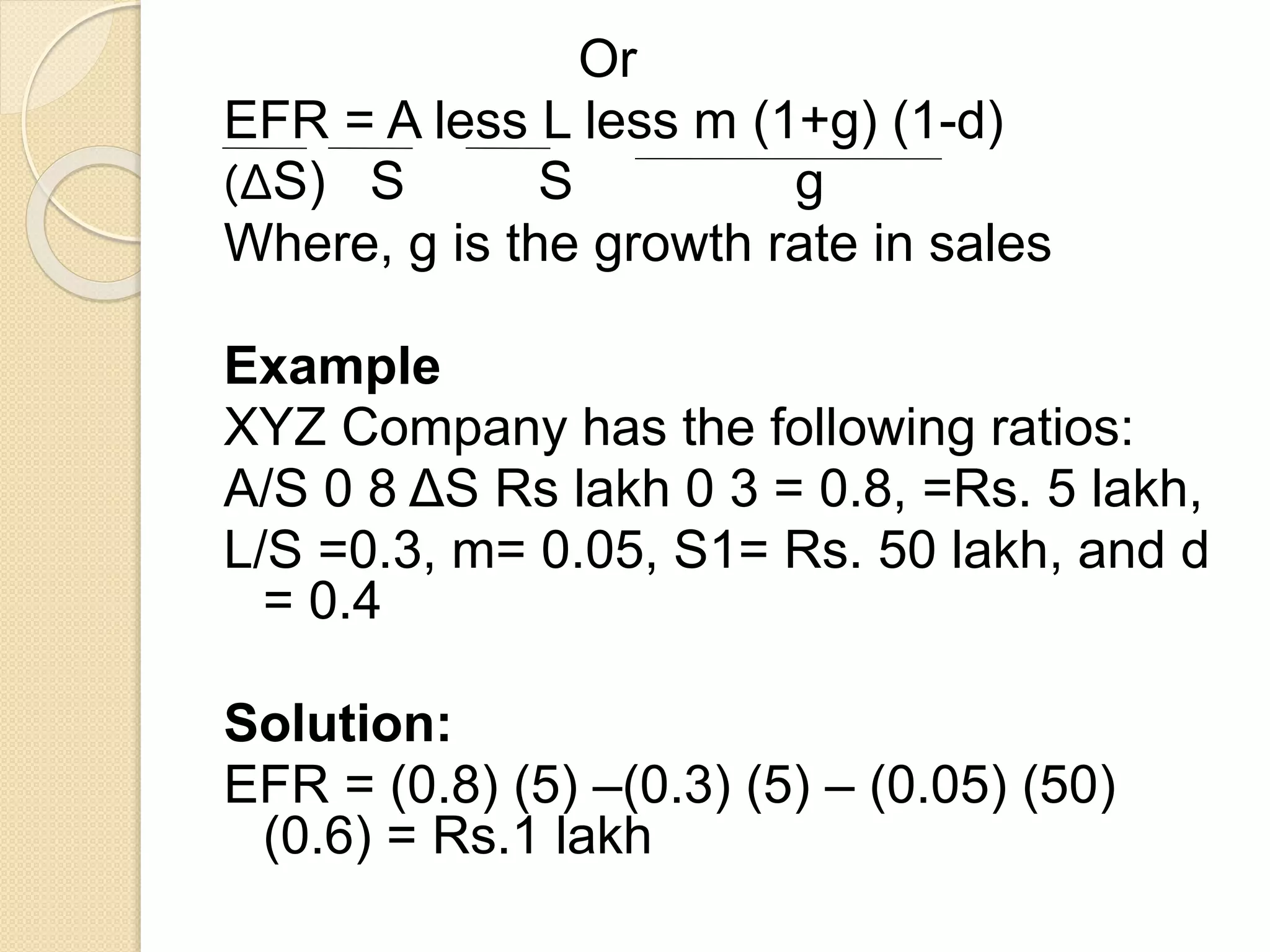
EFR = A less L less m (1+g) (1-d)
(ΔS) S S g
Where, g is the growth rate in sales
Example
XYZ Company has the following ratios:
A/S 0 8 ΔS Rs lakh 0 3 = 0.8, =Rs. 5 lakh,
L/S =0.3, m= 0.05, S1= Rs. 50 lakh, and d
= 0.4
Solution:
EFR = (0.8) (5) –(0.3) (5) – (0.05) (50)
(0.6) = Rs.1 lakh
The equation highlights that :
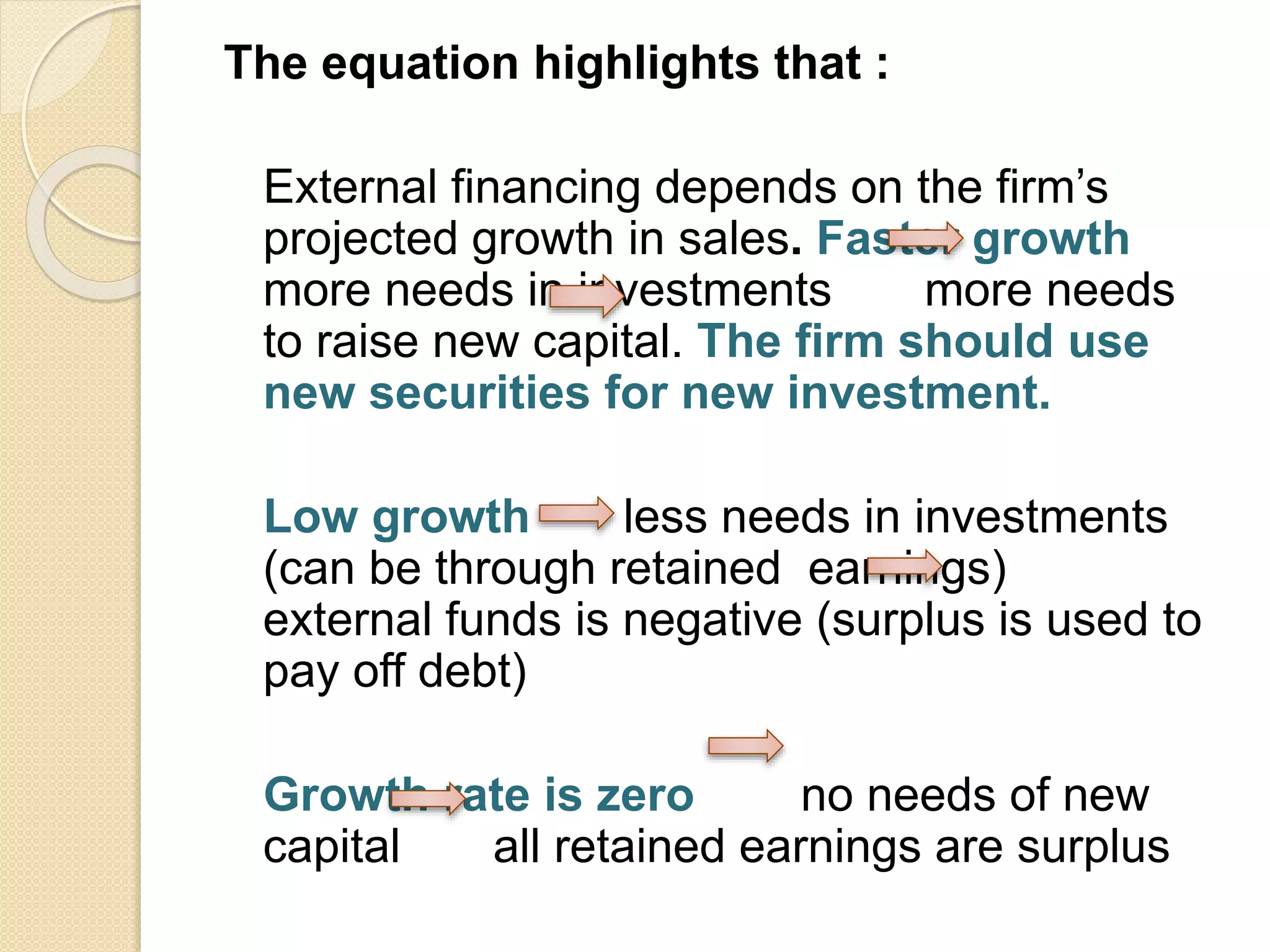
External financing depends on the firm’s
projected growth in sales. Faster growth
more needs in investments more needs
to raise new capital. The firm should use
new securities for new investment.
Low growth less needs in investments
(can be through retained earnings)
external funds is negative (surplus is used to
pay off debt)
Growth rate is zero no needs of new
capital all retained earnings are surplus
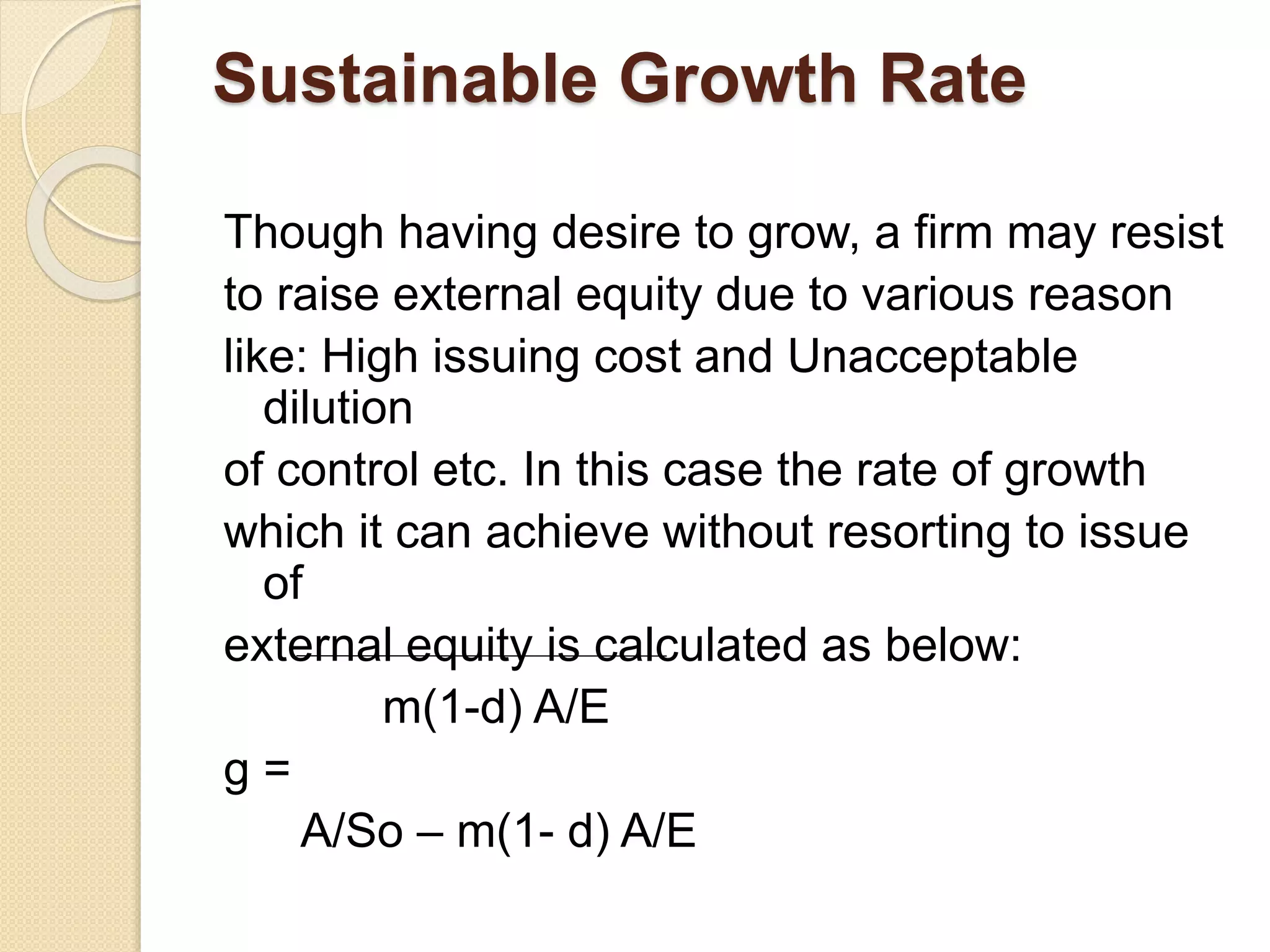
Sustainable Growth Rate
Though having desire to grow, a firm may resist
to raise external equity due to various reason
like: High issuing cost and Unacceptable
dilution
of control etc. In this case the rate of growth
which it can achieve without resorting to issue
of
external equity is calculated as below:
m(1-d) A/E
g =
A/So – m(1- d) A/E
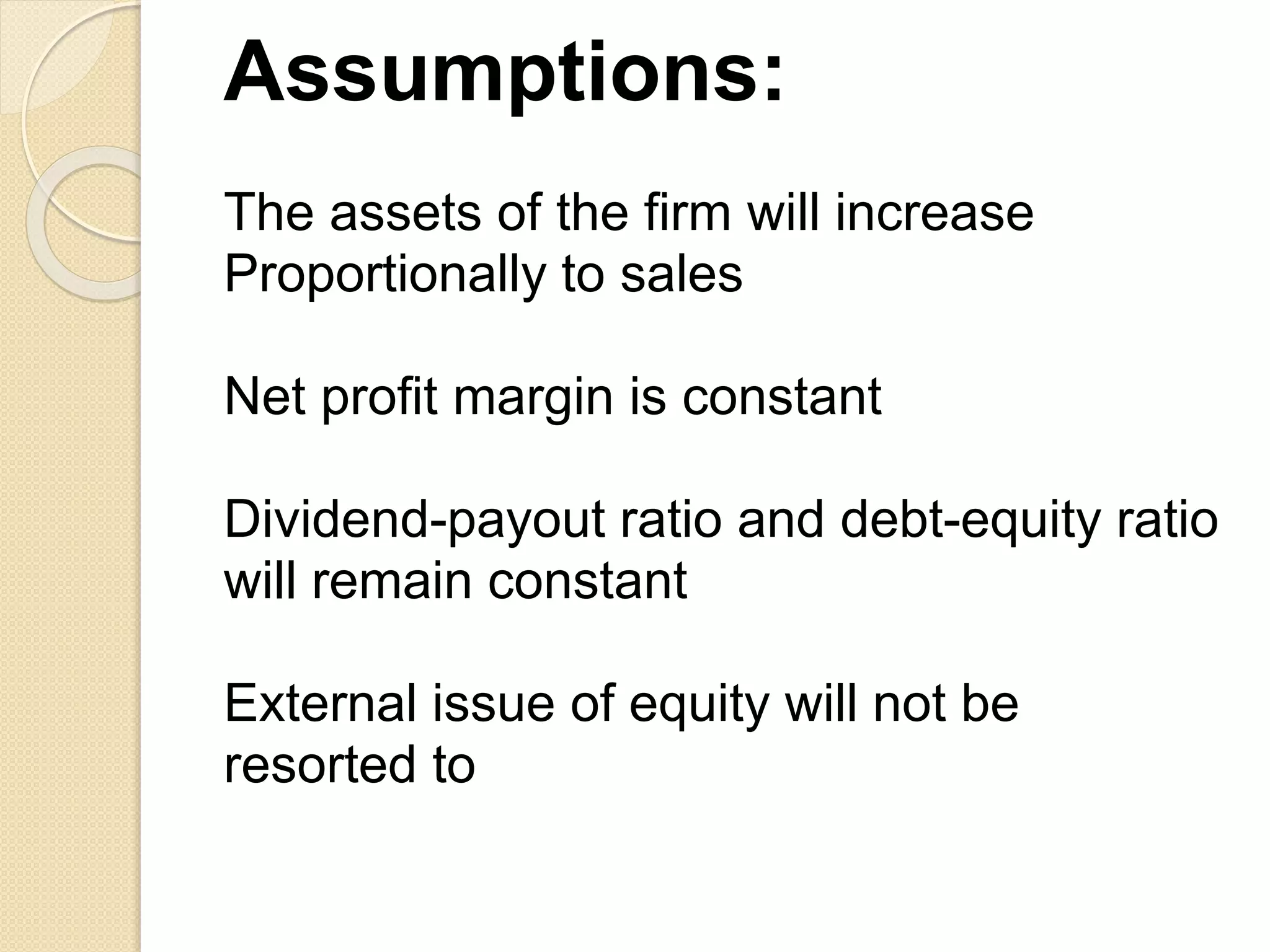
Assumptions:
The assets of the firm will increase
Proportionally to sales
Net profit margin is constant
Dividend-payout ratio and debt-equity ratio
will remain constant
External issue of equity will not be
resorted to
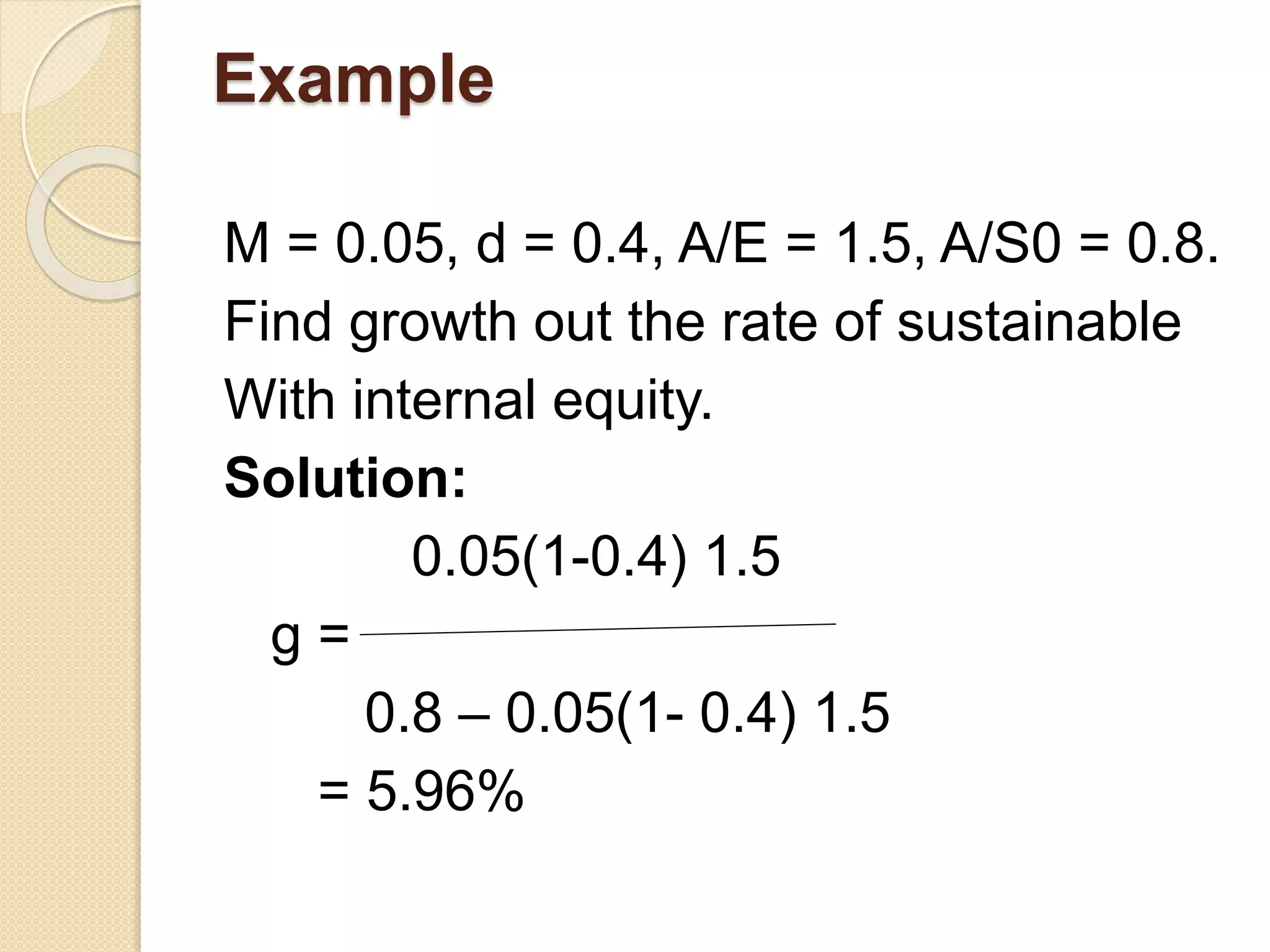
Example
M = 0.05, d = 0.4, A/E = 1.5, A/S0 = 0.8.
Find growth out the rate of sustainable
With internal equity.
Solution:
0.05(1-0.4) 1.5
g =
0.8 – 0.05(1- 0.4) 1.5
= 5.96%
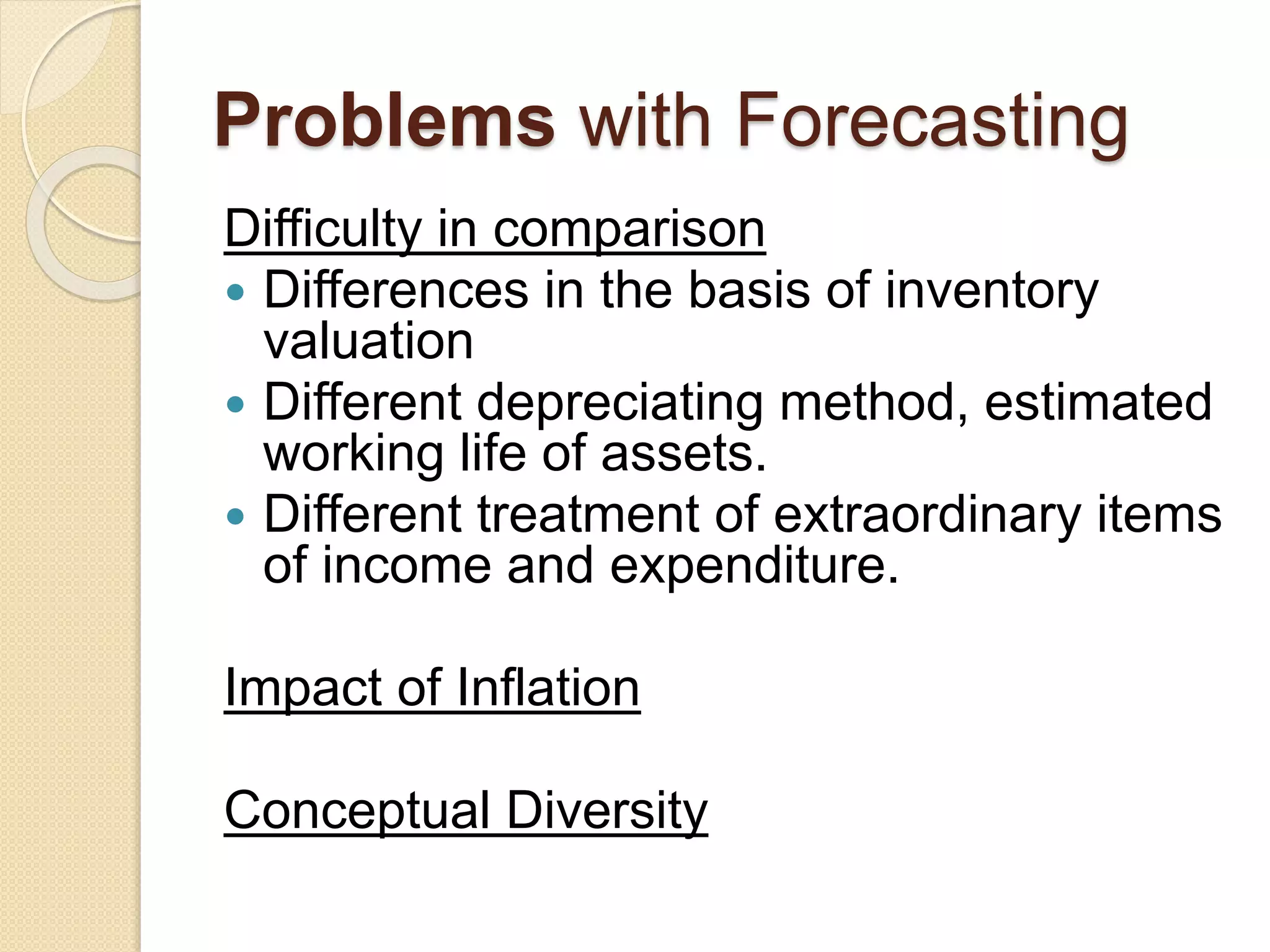
Problems with Forecasting
Difficulty in comparison
 Differences in the basis of inventory
valuation
 Different depreciating method, estimated
working life of assets.
 Different treatment of extraordinary items
of income and expenditure.
Impact of Inflation
Conceptual Diversity

L 11 the forecasting function

  • 1.
    L- 11 The ForecastingFunction Developed by Dr. IKRAM CPA, Ph.D.
  • 2.
    Financial Forecasting & itsRelated Problems Pronóstico financiero
  • 3.
    Forecasting is theprocess of making predictions of the future based on past and present data and most commonly by analysis of trends. A commonplace example might be estimation of some variable of interest at some specified future date.
  • 4.
    Prediction is asimilar, but more general term. Both might refer to formal statistical methods employing time series, cross- sectional or longitudinal data, or alternatively to less formal judgmental methods.
  • 5.
    "forecast" and "forecasting"are sometimes reserved for estimates of values at certain specific future times, while the term "prediction" is used for more general estimates, such as the number of times floods will occur over a long period.
  • 6.
    Risk and uncertaintyare central to forecasting and prediction; it is generally considered good practice to indicate the degree of uncertainty attaching to forecasts. In any case, the data must be up to date in order for the forecast to be as accurate as possible. In some cases the data used to predict the independent variable is itself forecasted.
  • 7.
    The use ofhistoric data to determine the direction of future trends. Forecasting is used by companies to determine how to allocate their budgets for an upcoming period of time. This is typically based on demand for the goods and services it offers, compared to the cost of producing them.
  • 8.
    Forecasting A planning toolthat helps management in its attempts to cope with the uncertainty of the future, relying mainly on data from the past and present and analysis of trends. Forecasting starts with certain assumptions based on the management's experience, knowledge, and judgment.
  • 9.
    These estimates areprojected into the coming months or years using one or more techniques such as Box-Jenkins models, Delphi method, exponential smoothing, moving averages, regression analysis, and trend projection. Since any error in the assumptions will result in a similar or magnified error in forecasting, the technique of sensitivity analysis is used which assigns a range of values to the uncertain factors (variables).
  • 10.
    Financial planning  Financialplanning indicates a firm’s growth, performance, investments and requirements of funds during a given period of time, usually three to five years.  It involves the preparation of projected or pro forma profit and loss account, balance sheet and other statements.  Financial planning help a firm’s financial manager to regulate flows of funds which is his primary concern.
  • 11.
    Financial Planning Financing planningprocess involves the following facets:  Evaluating the current financial condition of the firm.  Analyzing the future growth prospects and options.  Appraising the investment options to achieve the stated growth objective.  Projecting the future growth and profitability.  Estimating funds requirement and considering alternative financing options.  Comparing and choosing from alternative growth plans and financing options.  Measuring actual performance with the planned performance.
  • 12.
    Financial Forecasting and Modeling •Financialforecasting is a planning process with respect to company’s management positions, the firm’s future activities relative to the expected economic, technical, competitive and social environment. •A financial planning model establishes the relationship between financial variables and targets, and facilitates the financial forecasting and planning process. •A financial planning model has the following three components: Inputs Model Output
  • 13.
  • 14.
    Three major Techniquesof Financial Projections: 1.Proforma Financial Statements 2.Cash Budgets and 3.Operating Budgets Sales Budget Production Budget
  • 15.
    Proforma Financial Statements A comprehensive look at the likely future financial performance.  Pro forma Income Statement. (Represents the operational plan for the whole organization.)  Pro forma Balance sheet. (Reflects the cumulative impact of anticipated future decisions).
  • 16.
    Preparation of Pro FormaIncome Statements Percent of Sales Method  Assumes that future relationship between various elements of cost to sales will be similar to their historical relationships.  These cost ratios are generally based on the average of previous two or three years.  For example, Cost of Goods sold may be expressed as a percentage of Sales.
  • 17.
    2. Budgeted Expense Method. Estimate the value of each item on the basis of expected developments in the future period for which the pro forma P&L a/c is being prepared.  Calls for greater effort on the part of Management, since they have to define the likely happenings.
  • 18.
    3. Combination method Neither the Percent of sales method nor the Budgeted expense method should be used in isolation.  A combination of both methods work best.  Items which have stable relationship to sales can be forecasted using the Percent of sales method.  For items where the future is likely to be very different from the past, budgeted expense method can be used.
  • 19.
    Proforma Income Statement Actualfigures for Quarter 31- 3-2006 Assumptions Proforma for the qr ended 30-6-2006 1.No.of units sold 2.Net Sales 3.Cost of Goods sold: 4.Labour 5. Materials 6.Distribution cost 7. Overhead 8. Total 9. Ratio of CGS to Sales. 10. Gross Profit 11. GP Margin 14000 140000 100% 22960 25256 4592 61992 114800 82.0% 25200 18% Sales decline 30% due to low demand. No change in Product mix. 20% of Cost of good 22% of COG 4% of COG 54% of COG Increase by 1.5% 9800 98000 100% 16366 18002.6 3273.2 44188.2 81830 83.5% 16170 16.5%
  • 20.
    Contd. Actuals Assumption Proforma 12.Expenses: 13. Selling Expenses 14. Admin. Expense 15. Others 16.Total 17. Operating Profit 18. Interest 19. Depreciation 20.PBT 21. Tax @ 30% 22.Net Income 23.Dividends 24.Retained earnings. 25. Cash flow after dividends. 8250 4450 Nil 12700 12500 2500 2000 7000 2100 4900 900 4000 6000 A drop of Rs. 750 . A drop of Rs. 850 Rs.2000 only No dividends Carried to B/s. Retained earning + Depreciation 7500 3600 Nil 11100 5070 2000 2000 1070 321 749 0 749 2749
  • 21.
    Pro forma Balancesheet only to explain not to be included.  Projections for Balance sheet can be made as under: 1. Employ Percent of Sales method to project items on the asset side, except “Investments” and “Misc Exp & Losses”. 2. Expected values for Investment and Misc exp can be estimated using specific information. 3. Use Percent of sales method to project values of current liabilities and Provisions. (Also referred to as ‘spontaneous liabilities’) 4. Projected values of R & S can be obtained by adding projected retained earnings from P&L proforma statement.
  • 22.
    B/S Contd.. 5. Projectedvalue for Equity and preferential capital can be set tentatively equal to their previous values. 6. Projected values for loan funds will be tentatively equal to their previous level less repayments or retirements. 7. Compare the total of asset side with that of liabilities side and determine the balancing figure. (If assets exceed liabilities, the balancing figure represents external funding requirement. If liabilities exceeds Assets, the balancing item represents ‘surplus available funds’ )
  • 23.
    PROFORMA BALANCE SHEET. ActualAssumptions Proforma for June Change LIABILITIES: A. CAPITAL B. R& S.(C+D) C. RESERVES D. P&L Balance E. Total share holders funds. F. Total Debt G. Total Liabilities (E+F) 6500 4500 500 4000 11000 7500 18500 Issue of shares Rs.500 P&L account. 7000 5250 500 4750 12250 7500 19750 +500 +750 0 +750 +1250 0 +1250
  • 24.
    Proforma Balance sheetcontd.. Actuals Assumptions Proforma Change ASSETS; H. GROSS BLOCK (I+j) I. LAND j. Plant & Machinery K. LESS DEPRECN. L. NET BLOCK (J-K) M. CURRENT ASSETS (N+O) N. INVENTORIES O. CASH. Less: P. CURRENT LIAILITIES. Q. Provisions R. Net current assets (M-P-Q) s. Total assets (L+R) t. Additional funds required. 24000 3000 21000 10000 11000 14500 10500 4000 5000 2000 7500 18500 No change Sale of 1000 Depreciation of 9500 Increase by 2000 Maintain CB of 3500 Decrease by 1000 23000 3000 20000 9500 10500 16000 12500 3500 4000 2000 10000 20500 -1000 0 -1000 -500 -500 +1500 +2000 -500 -1000 0 +2500 +2000
  • 25.
    Other Proforma Statements CashBudget Operating Budget Sales Budget Production Budget Subjective Method Objective Method Executive Opinion Sales Force estimate Trend Analysis Regression Analysis 2nd Factor economic dev 3rd Factor Seasonal Variation 4th Factor Erratic events 1st Factor Population
  • 26.
    Cash Budget  Preparedevery month or every week.  Helps in deciding the minimum amount of cash that can be kept to allow timely payments of obligations.  Shows the cash needs or excess.
  • 27.
    Techniques of Sales Forecasting 1.SubjectiveMethods ( based on the opinions or judgments of knowledgeable individual within the organization- sales force to executives)  Jury of executive opinion  Sales force estimates 2. Objective Methods  Trend Analysis Via Extrapolation  Regression analysis
  • 28.
    While doing trendanalysis, the analyst must keep in mind that the time series of a product’s past sales is made up of four major factors:  Long-term trend- result of basic developments in population, capital formation and technology  Cycle-movements of sales as a result of swings in general economic activity, which tends to be somewhat periodic.  Seasonal variations- climatic factors, holidays, etc.  Erratic events- strikes, riots, earthquakes and other natural calamities. Trend Analysis
  • 29.
    Growth and External Financing Requirement NewInvestment = growth rate X initial assets XYZ Co. started with Rs. 15,00,000 of fixed assets and working capital and forecasts a growth of 10 percent. What is the required addition to its assets?
  • 30.
    External Financing Requirement EFR =A (ΔS) less L (ΔS) less mS1 (1-d) S S Where, EFR = external financing requirement A/S = current assets and fixed assets as a proportion of sales (ΔS) = expected increase in sales M = net profit margin S1 = projected sales for next year D = dividend payout ratio L/S = spontaneous liabilities as a proportion of sales
  • 31.
    Or EFR = Aless L less m (1+g) (1-d) (ΔS) S S g Where, g is the growth rate in sales Example XYZ Company has the following ratios: A/S 0 8 ΔS Rs lakh 0 3 = 0.8, =Rs. 5 lakh, L/S =0.3, m= 0.05, S1= Rs. 50 lakh, and d = 0.4 Solution: EFR = (0.8) (5) –(0.3) (5) – (0.05) (50) (0.6) = Rs.1 lakh
  • 32.
    The equation highlightsthat : External financing depends on the firm’s projected growth in sales. Faster growth more needs in investments more needs to raise new capital. The firm should use new securities for new investment. Low growth less needs in investments (can be through retained earnings) external funds is negative (surplus is used to pay off debt) Growth rate is zero no needs of new capital all retained earnings are surplus
  • 33.
    Sustainable Growth Rate Thoughhaving desire to grow, a firm may resist to raise external equity due to various reason like: High issuing cost and Unacceptable dilution of control etc. In this case the rate of growth which it can achieve without resorting to issue of external equity is calculated as below: m(1-d) A/E g = A/So – m(1- d) A/E
  • 34.
    Assumptions: The assets ofthe firm will increase Proportionally to sales Net profit margin is constant Dividend-payout ratio and debt-equity ratio will remain constant External issue of equity will not be resorted to
  • 35.
    Example M = 0.05,d = 0.4, A/E = 1.5, A/S0 = 0.8. Find growth out the rate of sustainable With internal equity. Solution: 0.05(1-0.4) 1.5 g = 0.8 – 0.05(1- 0.4) 1.5 = 5.96%
  • 36.
    Problems with Forecasting Difficultyin comparison  Differences in the basis of inventory valuation  Different depreciating method, estimated working life of assets.  Different treatment of extraordinary items of income and expenditure. Impact of Inflation Conceptual Diversity