
© Instituto Internacional San Telmo, 2012

UNDERSTANDING THE P&L STATEMENT
P&L Statement
The Profit & Loss Statement, P&L account, or simply P&L, contains
four different parts:
PROFIT & LOSS account
Sales
- Cost of goods sold
= Gross margin
- Operating Expenses
= EBITDA
- Depreciation
= EBIT
- Interest
= EBT
- Taxes
= Net Profit

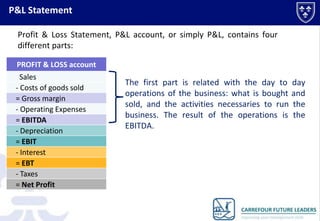
The first part is related to the day-to-day
operations of the business: what is bought and
sold, and the activities necessary to run the
business. The result of operations is the EBITDA.
P&L Statement
The Profit & Loss Statement, P&L account, or simply P&L, contains
four different parts:
PROFIT & LOSS account
Sales
- Cost of goods sold
= Gross margin
- Operating Expenses
= EBITDA
- Depreciation
= EBIT
- Interest
= EBT
- Taxes
= Net Profit

Ordinary Operations
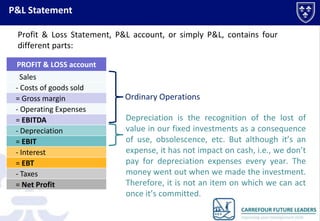
Depreciation is the recognition of the loss of
value of our fixed investments as a consequence
of use, obsolescence, etc. But although it is an
expense, it does not have an impact on cash, i.e.
we do not pay for depreciation expenses every
year. The money went out when we made the
investment. Therefore, it is not an item on which
we can act once it has been committed.
P&L Statement
The Profit & Loss Statement, P&L account, or simply P&L, contains
four different parts:
PROFIT & LOSS account
Sales
- Costs of goods sold
= Gross margin
- Operating Expenses
= EBITDA
- Depreciation
= EBIT
- Interest
= EBT
- Taxes
= Net Profit

Ordinary Operations

Consequence of investment decisions
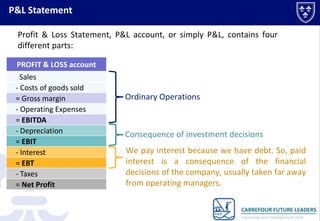
We pay interest because we have debt. So, paid
interest is a consequence of the financial
decisions adopted by the company, which are
usually taken without input from operating
managers.
P&L Statement
The Profit & Loss Statement, P&L account, or simply P&L, contains
four different parts:
PROFIT & LOSS account
Sales
- Cost of goods sold
= Gross margin
- Operating Expenses
= EBITDA
- Depreciation
= EBIT
- Interest
= EBT
- Taxes
= Net Profit

Ordinary Operations

Consequence of investment decisions
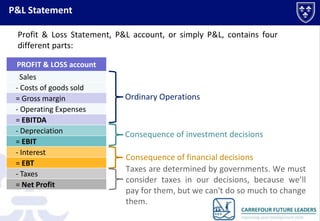
Consequence of financial decisions
Taxes are determined by governments. We must
consider taxes in our decisions because we have
to pay taxes but we cannot do that much to
change them.
P&L Statement
The Profit & Loss Statement, P&L account, or simply P&L, contains
four different parts:
PROFIT & LOSS account
Sales
- Cost of goods sold
= Gross margin
- Operating Expenses
= EBITDA
- Depreciation
= EBIT
- Interest
= EBT
- Taxes
= Net Profit

Ordinary Operations

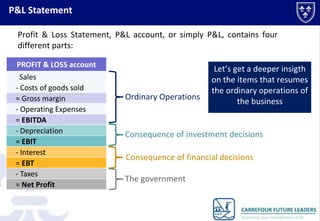
Let’s look in greater detail
at the items that
summarise the ordinary
operations of the business

Consequence of investment decisions
Consequence of financial decisions
The government
Ordinary Operations
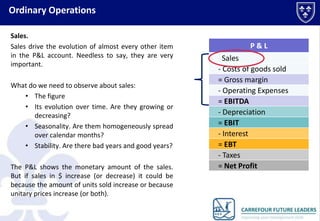
Sales.
Sales drive the evolution of almost every other item
in the P&L account. Needless to say, they are very
important.
What do we need to observe about sales:
• The figure
• Their evolution over time. Are they growing
or decreasing?
• Seasonality. Are they homogeneously spread
over calendar months?
• Stability. Are there bad years and good years?
The P&L shows the monetary amount of sales. But if
sales in $ increase (or decrease), this may be because
the amount of units sold increases or because unitary
prices increase (or both).

P&L

Sales
- Cost of goods sold
= Gross margin
- Operating Expenses
= EBITDA
- Depreciation
= EBIT
- Interest
= EBT
- Taxes
= Net Profit
Ordinary Operations
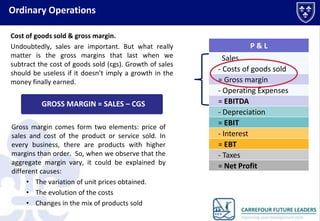
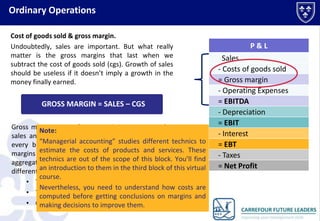
Cost of goods sold & gross margin.
Undoubtedly, sales are important. But what really
matters are the gross margins obtained when we
subtract the cost of goods sold (CGS). Growth of sales
is worthless if it does not imply growth in the money
finally earned.

GROSS MARGIN = SALES – CGS
Gross margin comes form two elements: price of
sales and cost of the product or service sold. In
every business, there are products with higher
margins than orders. So, whenever aggregate
margins are seen to vary, this may be explained by
different causes:
• The variation in the unit prices obtained.
• The evolution of costs.
• Changes in the mix of products sold.

P&L

Sales
- Cost of goods sold
= Gross margin
- Operating Expenses
= EBITDA
- Depreciation
= EBIT
- Interest
= EBT
- Taxes
= Net Profit
Ordinary Operations
Cost of goods sold & gross margin.
Undoubtedly, sales are important. But what really
matters are the gross margins obtained when we
subtract the cost of goods sold (CGS). Growth of sales
is worthless if it does not imply growth in the money
finally earned.

GROSS MARGIN = SALES – CGS
GrossNote: comes form two elements: price of
margin
sales “Managerial accounting” studies different In
and cost of the product or service sold. techniques
everyfor estimating the costs of products and services.
business, there are products with higher
margins than orders. exceed the scope of this block. You
These techniques So, whenever aggregate
margins are seen introduction may be explained by block of
will find an to vary, this to them in the third
different causes: course.
this on-line
•Nevertheless, you the unit prices obtained. costs are
The variation in need to understand how
•computed before reaching conclusions on margins and
The evolution of costs.
•making decisions to improve them.
Changes in the mix of products sold.

P&L

Sales
- Cost of goods sold
= Gross margin
- Operating Expenses
= EBITDA
- Depreciation
= EBIT
- Interest
= EBT
- Taxes
= Net Profit
Ordinary Operations
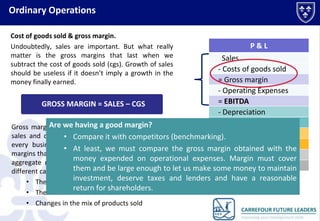
Cost of goods sold & gross margin.
Undoubtedly, sales are important. But what really
matters are the gross margins obtained when we
subtract the cost of goods sold (CGS). Growth of sales
is worthless if it does not imply growth in the money
finally earned.

P&L

Sales
- Cost of goods sold
= Gross margin
- Operating Expenses
= EBITDA
GROSS MARGIN = SALES – CGS
- Depreciation
= EBIT
Gross margin margins good? elements: price of
comes form two
Are our
- Interest
sales and cost of the product or service sold. In
• Compare them with those of competitors (benchmarking).
= EBT
every business, there are products with higher
margins • We must at least compare the gross margin obtained with the
than orders. So, whenever aggregate
- Taxes
margins are seen to vary, this may be explained byexpenses. The margin does not
money expended on operational
= Net Profit
different causes: to cover them but must be large enough to let us make some
need
• The variationin order toprices obtained.
money in the unit maintain investment, pay taxes and lenders and
have a reasonable
• The evolution of costs. return for shareholders.
• Changes in the mix of products sold.
Ordinary Operations
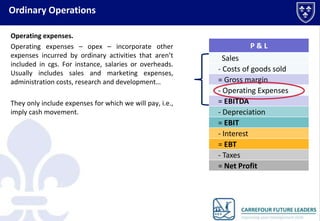
Operating expenses.
Operating expenses – OPEX – incorporate other
expenses incurred by ordinary activities that are not
included in CGS, e.g. salaries or overheads. They
normally include sales and marketing expenses,
administration costs, research and development
expenses, etc.
They only include expenses which we will pay, i.e.
they imply cash movement.

P&L

Sales
- Cost of goods sold
= Gross margin
- Operating Expenses
= EBITDA
- Depreciation
= EBIT
- Interest
= EBT
- Taxes
= Net Profit
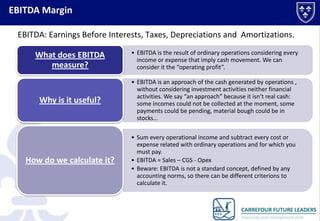
EBITDA Margin
EBITDA: Earnings Before Interest, Taxes, Depreciation and Amortization.
What does EBITDA
measure?

• EBITDA is the result of ordinary operations considering every
element of income or expense that implies cash movement. It
may be considered as “operating profit”.

Why is it useful?

• EBITDA is a proxy of the cash generated by operations
without considering investment activities or financial
activities. We say “a proxy” because it is not real cash: certain
income cannot be collected currently, some payments may be
pending, purchased material may be in stocks, etc.

How do we calculate it?

• Calculate total operating income and subtract every cost or
expense related with ordinary operations and which you
must pay.
• EBITDA = Sales – CGS - OPEX
• Beware: EBITDA is not a standard concept, defined by any
accounting standards, hence different criteria exist for its
calculation.
© Instituto Internacional San Telmo, 2012

P&l satement

  • 1.
    © Instituto InternacionalSan Telmo, 2012 UNDERSTANDING THE P&L STATEMENT
  • 2.
    P&L Statement The Profit& Loss Statement, P&L account, or simply P&L, contains four different parts: PROFIT & LOSS account Sales - Cost of goods sold = Gross margin - Operating Expenses = EBITDA - Depreciation = EBIT - Interest = EBT - Taxes = Net Profit The first part is related to the day-to-day operations of the business: what is bought and sold, and the activities necessary to run the business. The result of operations is the EBITDA.
  • 3.
    P&L Statement The Profit& Loss Statement, P&L account, or simply P&L, contains four different parts: PROFIT & LOSS account Sales - Cost of goods sold = Gross margin - Operating Expenses = EBITDA - Depreciation = EBIT - Interest = EBT - Taxes = Net Profit Ordinary Operations Depreciation is the recognition of the loss of value of our fixed investments as a consequence of use, obsolescence, etc. But although it is an expense, it does not have an impact on cash, i.e. we do not pay for depreciation expenses every year. The money went out when we made the investment. Therefore, it is not an item on which we can act once it has been committed.
  • 4.
    P&L Statement The Profit& Loss Statement, P&L account, or simply P&L, contains four different parts: PROFIT & LOSS account Sales - Costs of goods sold = Gross margin - Operating Expenses = EBITDA - Depreciation = EBIT - Interest = EBT - Taxes = Net Profit Ordinary Operations Consequence of investment decisions We pay interest because we have debt. So, paid interest is a consequence of the financial decisions adopted by the company, which are usually taken without input from operating managers.
  • 5.
    P&L Statement The Profit& Loss Statement, P&L account, or simply P&L, contains four different parts: PROFIT & LOSS account Sales - Cost of goods sold = Gross margin - Operating Expenses = EBITDA - Depreciation = EBIT - Interest = EBT - Taxes = Net Profit Ordinary Operations Consequence of investment decisions Consequence of financial decisions Taxes are determined by governments. We must consider taxes in our decisions because we have to pay taxes but we cannot do that much to change them.
  • 6.
    P&L Statement The Profit& Loss Statement, P&L account, or simply P&L, contains four different parts: PROFIT & LOSS account Sales - Cost of goods sold = Gross margin - Operating Expenses = EBITDA - Depreciation = EBIT - Interest = EBT - Taxes = Net Profit Ordinary Operations Let’s look in greater detail at the items that summarise the ordinary operations of the business Consequence of investment decisions Consequence of financial decisions The government
  • 7.
    Ordinary Operations Sales. Sales drivethe evolution of almost every other item in the P&L account. Needless to say, they are very important. What do we need to observe about sales: • The figure • Their evolution over time. Are they growing or decreasing? • Seasonality. Are they homogeneously spread over calendar months? • Stability. Are there bad years and good years? The P&L shows the monetary amount of sales. But if sales in $ increase (or decrease), this may be because the amount of units sold increases or because unitary prices increase (or both). P&L Sales - Cost of goods sold = Gross margin - Operating Expenses = EBITDA - Depreciation = EBIT - Interest = EBT - Taxes = Net Profit
  • 8.
    Ordinary Operations Cost ofgoods sold & gross margin. Undoubtedly, sales are important. But what really matters are the gross margins obtained when we subtract the cost of goods sold (CGS). Growth of sales is worthless if it does not imply growth in the money finally earned. GROSS MARGIN = SALES – CGS Gross margin comes form two elements: price of sales and cost of the product or service sold. In every business, there are products with higher margins than orders. So, whenever aggregate margins are seen to vary, this may be explained by different causes: • The variation in the unit prices obtained. • The evolution of costs. • Changes in the mix of products sold. P&L Sales - Cost of goods sold = Gross margin - Operating Expenses = EBITDA - Depreciation = EBIT - Interest = EBT - Taxes = Net Profit
  • 9.
    Ordinary Operations Cost ofgoods sold & gross margin. Undoubtedly, sales are important. But what really matters are the gross margins obtained when we subtract the cost of goods sold (CGS). Growth of sales is worthless if it does not imply growth in the money finally earned. GROSS MARGIN = SALES – CGS GrossNote: comes form two elements: price of margin sales “Managerial accounting” studies different In and cost of the product or service sold. techniques everyfor estimating the costs of products and services. business, there are products with higher margins than orders. exceed the scope of this block. You These techniques So, whenever aggregate margins are seen introduction may be explained by block of will find an to vary, this to them in the third different causes: course. this on-line •Nevertheless, you the unit prices obtained. costs are The variation in need to understand how •computed before reaching conclusions on margins and The evolution of costs. •making decisions to improve them. Changes in the mix of products sold. P&L Sales - Cost of goods sold = Gross margin - Operating Expenses = EBITDA - Depreciation = EBIT - Interest = EBT - Taxes = Net Profit
  • 10.
    Ordinary Operations Cost ofgoods sold & gross margin. Undoubtedly, sales are important. But what really matters are the gross margins obtained when we subtract the cost of goods sold (CGS). Growth of sales is worthless if it does not imply growth in the money finally earned. P&L Sales - Cost of goods sold = Gross margin - Operating Expenses = EBITDA GROSS MARGIN = SALES – CGS - Depreciation = EBIT Gross margin margins good? elements: price of comes form two Are our - Interest sales and cost of the product or service sold. In • Compare them with those of competitors (benchmarking). = EBT every business, there are products with higher margins • We must at least compare the gross margin obtained with the than orders. So, whenever aggregate - Taxes margins are seen to vary, this may be explained byexpenses. The margin does not money expended on operational = Net Profit different causes: to cover them but must be large enough to let us make some need • The variationin order toprices obtained. money in the unit maintain investment, pay taxes and lenders and have a reasonable • The evolution of costs. return for shareholders. • Changes in the mix of products sold.
  • 11.
    Ordinary Operations Operating expenses. Operatingexpenses – OPEX – incorporate other expenses incurred by ordinary activities that are not included in CGS, e.g. salaries or overheads. They normally include sales and marketing expenses, administration costs, research and development expenses, etc. They only include expenses which we will pay, i.e. they imply cash movement. P&L Sales - Cost of goods sold = Gross margin - Operating Expenses = EBITDA - Depreciation = EBIT - Interest = EBT - Taxes = Net Profit
  • 12.
    EBITDA Margin EBITDA: EarningsBefore Interest, Taxes, Depreciation and Amortization. What does EBITDA measure? • EBITDA is the result of ordinary operations considering every element of income or expense that implies cash movement. It may be considered as “operating profit”. Why is it useful? • EBITDA is a proxy of the cash generated by operations without considering investment activities or financial activities. We say “a proxy” because it is not real cash: certain income cannot be collected currently, some payments may be pending, purchased material may be in stocks, etc. How do we calculate it? • Calculate total operating income and subtract every cost or expense related with ordinary operations and which you must pay. • EBITDA = Sales – CGS - OPEX • Beware: EBITDA is not a standard concept, defined by any accounting standards, hence different criteria exist for its calculation.
  • 13.