Financial Management - I
Financial Planning and Forecasting Financial
Statements
1
Topics
2
 Financial planning
 Additional Funds Needed (AFN) formula
 Pro forma financial statements
 Sales forecasts
 Percent of sales method
Financial Planning and Pro Forma
Statements3
 Three important uses:
 Forecast the amount of external financing
 Impact of new operating plan on firm’s value
 Dividend pay out ratio
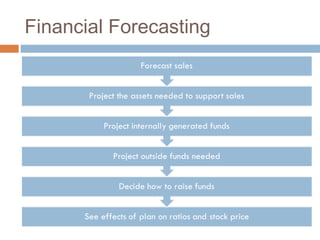
Financial Forecasting
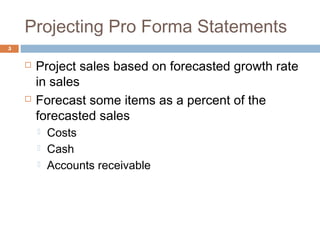
Projecting Pro Forma Statements
5
 Project sales based on forecasted growth rate
in sales
 Forecast some items as a percent of the
forecasted sales
 Costs
 Cash
 Accounts receivable
6
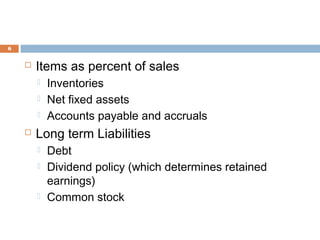
 Items as percent of sales
 Inventories
 Net fixed assets
 Accounts payable and accruals
 Long term Liabilities
 Debt
 Dividend policy (which determines retained
earnings)
 Common stock
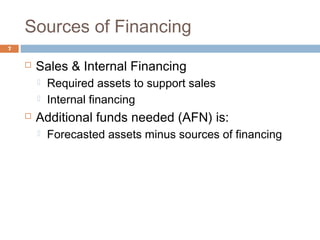
Sources of Financing
7
 Sales & Internal Financing
 Required assets to support sales
 Internal financing
 Additional funds needed (AFN) is:
 Forecasted assets minus sources of financing
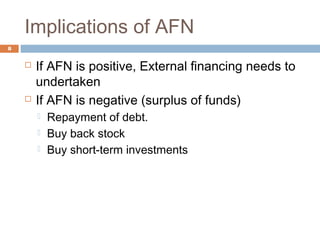
Implications of AFN
8
 If AFN is positive, External financing needs to
undertaken
 If AFN is negative (surplus of funds)
 Repayment of debt.
 Buy back stock
 Buy short-term investments
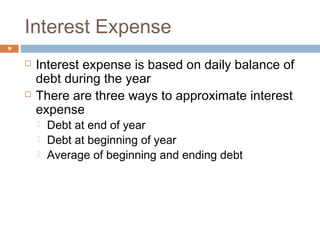
Interest Expense
9
 Interest expense is based on daily balance of
debt during the year
 There are three ways to approximate interest
expense
 Debt at end of year
 Debt at beginning of year
 Average of beginning and ending debt
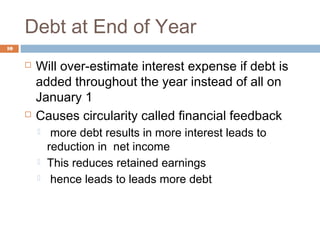
Debt at End of Year
10
 Will over-estimate interest expense if debt is
added throughout the year instead of all on
January 1
 Causes circularity called financial feedback
 more debt results in more interest leads to
reduction in net income
 This reduces retained earnings
 hence leads to leads more debt
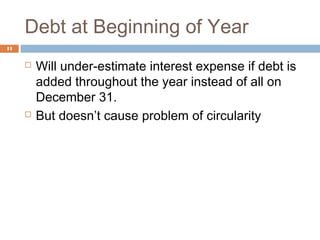
Debt at Beginning of Year
11
 Will under-estimate interest expense if debt is
added throughout the year instead of all on
December 31.
 But doesn’t cause problem of circularity
Average of Beginning and Ending Debt
12
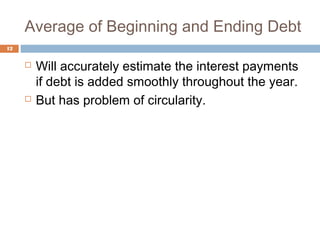
 Will accurately estimate the interest payments
if debt is added smoothly throughout the year.
 But has problem of circularity.
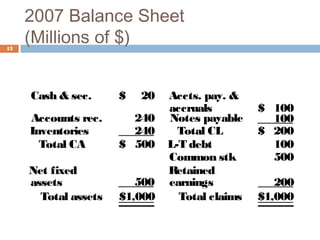
2007 Balance Sheet
(Millions of $)13
Cash & sec. $ 20 Accts. pay. &
accruals $ 100
Accounts rec. 240 Notes payable 100
Inventories 240 Total CL $ 200
Total CA $ 500 L-T debt 100
Common stk 500
Net fixed
assets
Retained
earnings 200
Total assets $1,000 Total claims $1,000
500
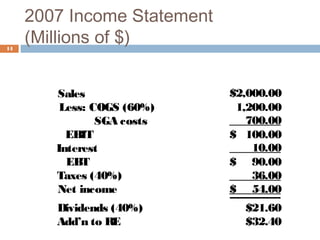
2007 Income Statement
(Millions of $)14
Sales $2,000.00
Less: COGS (60%) 1,200.00
SGA costs 700.00
EBIT $ 100.00
Interest 10.00
EBT $ 90.00
Taxes (40%) 36.00
Net income $ 54.00
Dividends (40%) $21.60
Add’n to RE $32.40
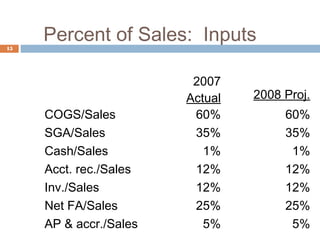
Percent of Sales: Inputs
2007
Actual 2008 Proj.
COGS/Sales 60% 60%
SGA/Sales 35% 35%
Cash/Sales 1% 1%
Acct. rec./Sales 12% 12%
Inv./Sales 12% 12%
Net FA/Sales 25% 25%
AP & accr./Sales 5% 5%
15
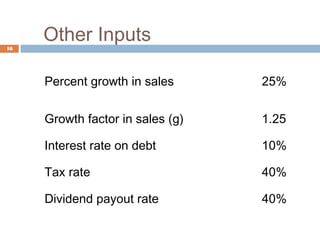
Other Inputs
Percent growth in sales 25%
Growth factor in sales (g) 1.25
Interest rate on debt 10%
Tax rate 40%
Dividend payout rate 40%
16
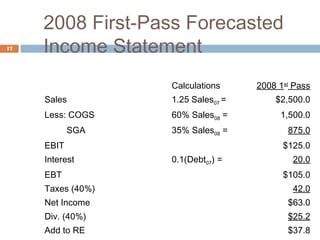
2008 First-Pass Forecasted
Income Statement
Calculations 2008 1st
Pass
Sales 1.25 Sales07 = $2,500.0
Less: COGS 60% Sales08 = 1,500.0
SGA 35% Sales08 = 875.0
EBIT $125.0
Interest 0.1(Debt07) = 20.0
EBT $105.0
Taxes (40%) 42.0
Net Income $63.0
Div. (40%) $25.2
Add to RE $37.8
17
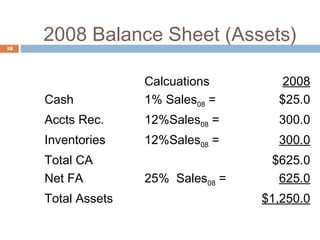
2008 Balance Sheet (Assets)
Calcuations 2008
Cash 1% Sales08 = $25.0
Accts Rec. 12%Sales08 = 300.0
Inventories 12%Sales08 = 300.0
Total CA $625.0
Net FA 25% Sales08 = 625.0
Total Assets $1,250.0
18
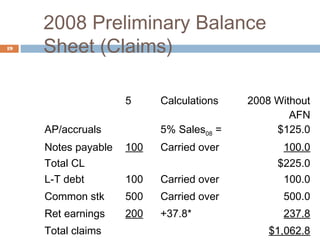
2008 Preliminary Balance
Sheet (Claims)
5 Calculations 2008 Without
AFN
AP/accruals 5% Sales08 = $125.0
Notes payable 100 Carried over 100.0
Total CL $225.0
L-T debt 100 Carried over 100.0
Common stk 500 Carried over 500.0
Ret earnings 200 +37.8* 237.8
Total claims $1,062.8
19
Additional funds needed
20
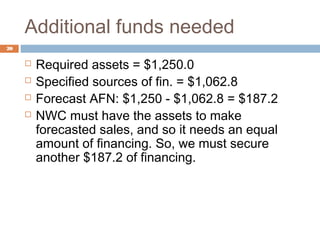
 Required assets = $1,250.0
 Specified sources of fin. = $1,062.8
 Forecast AFN: $1,250 - $1,062.8 = $187.2
 NWC must have the assets to make
forecasted sales, and so it needs an equal
amount of financing. So, we must secure
another $187.2 of financing.
Assumptions about how AFN will
be raised
21
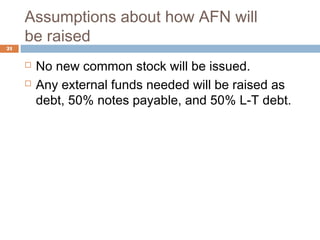
 No new common stock will be issued.
 Any external funds needed will be raised as
debt, 50% notes payable, and 50% L-T debt.
How will the AFN be financed?
22
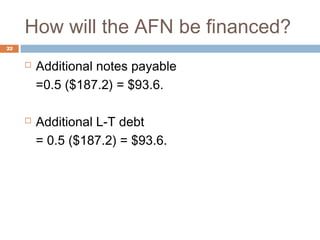
 Additional notes payable
=0.5 ($187.2) = $93.6.
 Additional L-T debt
= 0.5 ($187.2) = $93.6.
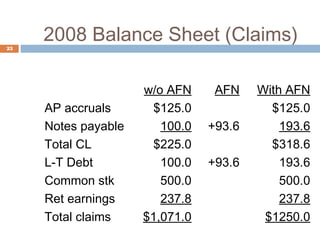
2008 Balance Sheet (Claims)
w/o AFN AFN With AFN
AP accruals $125.0 $125.0
Notes payable 100.0 +93.6 193.6
Total CL $225.0 $318.6
L-T Debt 100.0 +93.6 193.6
Common stk 500.0 500.0
Ret earnings 237.8 237.8
Total claims $1,071.0 $1250.0
23
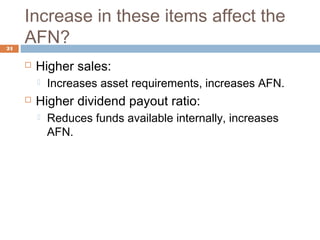
Increase in these items affect the
AFN?24
 Higher sales:
 Increases asset requirements, increases AFN.
 Higher dividend payout ratio:
 Reduces funds available internally, increases
AFN.
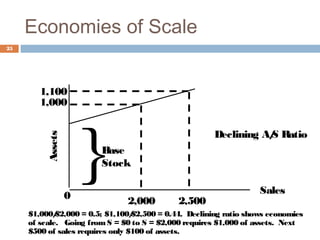
Economies of Scale
25
Assets
Sales
0
1,100
1,000
2,000 2,500
Declining A/S Ratio
$1,000/$2,000 = 0.5; $1,100/$2,500 = 0.44. Declining ratio shows economies
of scale. Going fromS = $0 to S = $2,000 requires $1,000 of assets. Next
$500 of sales requires only $100 of assets.
Base
Stock
}
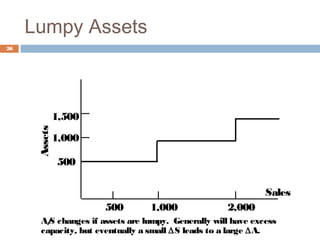
Lumpy Assets
26 Assets
Sales
1,000 2,000500
A/S changes if assets are lumpy. Generally will have excess
capacity, but eventually a small ∆S leads to a large ∆A.
500
1,000
1,500
Different factors affect the AFN
forecast.
27
 Excess capacity: lowers AFN
 Economies of scale: leads to less-than-
proportional asset increases
 Lumpy assets: leads to large periodic AFN
requirements, recurring excess capacity
Thanks…. 

Financial Management

  • 1.
    Financial Management -I Financial Planning and Forecasting Financial Statements 1
  • 2.
    Topics 2  Financial planning Additional Funds Needed (AFN) formula  Pro forma financial statements  Sales forecasts  Percent of sales method
  • 3.
    Financial Planning andPro Forma Statements3  Three important uses:  Forecast the amount of external financing  Impact of new operating plan on firm’s value  Dividend pay out ratio
  • 4.
  • 5.
    Projecting Pro FormaStatements 5  Project sales based on forecasted growth rate in sales  Forecast some items as a percent of the forecasted sales  Costs  Cash  Accounts receivable
  • 6.
    6  Items aspercent of sales  Inventories  Net fixed assets  Accounts payable and accruals  Long term Liabilities  Debt  Dividend policy (which determines retained earnings)  Common stock
  • 7.
    Sources of Financing 7 Sales & Internal Financing  Required assets to support sales  Internal financing  Additional funds needed (AFN) is:  Forecasted assets minus sources of financing
  • 8.
    Implications of AFN 8 If AFN is positive, External financing needs to undertaken  If AFN is negative (surplus of funds)  Repayment of debt.  Buy back stock  Buy short-term investments
  • 9.
    Interest Expense 9  Interestexpense is based on daily balance of debt during the year  There are three ways to approximate interest expense  Debt at end of year  Debt at beginning of year  Average of beginning and ending debt
  • 10.
    Debt at Endof Year 10  Will over-estimate interest expense if debt is added throughout the year instead of all on January 1  Causes circularity called financial feedback  more debt results in more interest leads to reduction in net income  This reduces retained earnings  hence leads to leads more debt
  • 11.
    Debt at Beginningof Year 11  Will under-estimate interest expense if debt is added throughout the year instead of all on December 31.  But doesn’t cause problem of circularity
  • 12.
    Average of Beginningand Ending Debt 12  Will accurately estimate the interest payments if debt is added smoothly throughout the year.  But has problem of circularity.
  • 13.
    2007 Balance Sheet (Millionsof $)13 Cash & sec. $ 20 Accts. pay. & accruals $ 100 Accounts rec. 240 Notes payable 100 Inventories 240 Total CL $ 200 Total CA $ 500 L-T debt 100 Common stk 500 Net fixed assets Retained earnings 200 Total assets $1,000 Total claims $1,000 500
  • 14.
    2007 Income Statement (Millionsof $)14 Sales $2,000.00 Less: COGS (60%) 1,200.00 SGA costs 700.00 EBIT $ 100.00 Interest 10.00 EBT $ 90.00 Taxes (40%) 36.00 Net income $ 54.00 Dividends (40%) $21.60 Add’n to RE $32.40
  • 15.
    Percent of Sales:Inputs 2007 Actual 2008 Proj. COGS/Sales 60% 60% SGA/Sales 35% 35% Cash/Sales 1% 1% Acct. rec./Sales 12% 12% Inv./Sales 12% 12% Net FA/Sales 25% 25% AP & accr./Sales 5% 5% 15
  • 16.
    Other Inputs Percent growthin sales 25% Growth factor in sales (g) 1.25 Interest rate on debt 10% Tax rate 40% Dividend payout rate 40% 16
  • 17.
    2008 First-Pass Forecasted IncomeStatement Calculations 2008 1st Pass Sales 1.25 Sales07 = $2,500.0 Less: COGS 60% Sales08 = 1,500.0 SGA 35% Sales08 = 875.0 EBIT $125.0 Interest 0.1(Debt07) = 20.0 EBT $105.0 Taxes (40%) 42.0 Net Income $63.0 Div. (40%) $25.2 Add to RE $37.8 17
  • 18.
    2008 Balance Sheet(Assets) Calcuations 2008 Cash 1% Sales08 = $25.0 Accts Rec. 12%Sales08 = 300.0 Inventories 12%Sales08 = 300.0 Total CA $625.0 Net FA 25% Sales08 = 625.0 Total Assets $1,250.0 18
  • 19.
    2008 Preliminary Balance Sheet(Claims) 5 Calculations 2008 Without AFN AP/accruals 5% Sales08 = $125.0 Notes payable 100 Carried over 100.0 Total CL $225.0 L-T debt 100 Carried over 100.0 Common stk 500 Carried over 500.0 Ret earnings 200 +37.8* 237.8 Total claims $1,062.8 19
  • 20.
    Additional funds needed 20 Required assets = $1,250.0  Specified sources of fin. = $1,062.8  Forecast AFN: $1,250 - $1,062.8 = $187.2  NWC must have the assets to make forecasted sales, and so it needs an equal amount of financing. So, we must secure another $187.2 of financing.
  • 21.
    Assumptions about howAFN will be raised 21  No new common stock will be issued.  Any external funds needed will be raised as debt, 50% notes payable, and 50% L-T debt.
  • 22.
    How will theAFN be financed? 22  Additional notes payable =0.5 ($187.2) = $93.6.  Additional L-T debt = 0.5 ($187.2) = $93.6.
  • 23.
    2008 Balance Sheet(Claims) w/o AFN AFN With AFN AP accruals $125.0 $125.0 Notes payable 100.0 +93.6 193.6 Total CL $225.0 $318.6 L-T Debt 100.0 +93.6 193.6 Common stk 500.0 500.0 Ret earnings 237.8 237.8 Total claims $1,071.0 $1250.0 23
  • 24.
    Increase in theseitems affect the AFN?24  Higher sales:  Increases asset requirements, increases AFN.  Higher dividend payout ratio:  Reduces funds available internally, increases AFN.
  • 25.
    Economies of Scale 25 Assets Sales 0 1,100 1,000 2,0002,500 Declining A/S Ratio $1,000/$2,000 = 0.5; $1,100/$2,500 = 0.44. Declining ratio shows economies of scale. Going fromS = $0 to S = $2,000 requires $1,000 of assets. Next $500 of sales requires only $100 of assets. Base Stock }
  • 26.
    Lumpy Assets 26 Assets Sales 1,0002,000500 A/S changes if assets are lumpy. Generally will have excess capacity, but eventually a small ∆S leads to a large ∆A. 500 1,000 1,500
  • 27.
    Different factors affectthe AFN forecast. 27  Excess capacity: lowers AFN  Economies of scale: leads to less-than- proportional asset increases  Lumpy assets: leads to large periodic AFN requirements, recurring excess capacity
  • 28.