B l o c k
C h a i n
Basics
Peter Cochrane
cochrane.org.uk
B l o c k C h a i n
A v e r y b r i e f h i s t o r y
•BC is a distributed ledger
•2009 saw the first manifestations
•No one knows the inventor/origins for sure
•Designs, protocols and code are open source
•Security agencies suspected to be on a similar tack
•Specialised Block Chains dedicated to just one task
•Generalised Block Chains will likely become a platform
•A next step in the logical progression toward decentralisation
•Inherently more secure than any previously realised transaction system
•Sidelines institutions and centralised control making all transactions simpler
The technology to hack and crack Block Chains is not yet available
A D i s t r i b u t e d L e d g e R
Digital, Encrypted, Highly Complex
•Distributed attack virtually impossible
•Obscuration through complexity
•Impervious to focussed attack
•Spread over many machines
•Geographically distributed
•Inherently secure
•Format variable
•Vastly scaleable
•Multiple forms
•Multi-key
Yet to be cracked!
N O T J U S T C U R R E N C Y
All forms of transaction and record
•Every variety of value exchange
•Legal documents of every form
•Property, Deeds ,Ownership
•Ultra secure communication
•Licences and permissions
•R&D, production detail
•Patents and copyright
•Multi-media vault
•Medical records
•Voting
++++++++
N O C e n t r a l i s e d C o n t r o l
Sans Institutions - Banks and Companies
•Beyond the reach of governments
•Confounding for regulators
•Available to everyone
•Multi-species
•Truly global
++++++++
•User driven
•Open or closed
•Public or private
•No external controls
•A universal application
•Freedom of use and application
++++++++
T e c h n o l o g y F r i e n d l y
Agnostic, adaptive & broadly applicable
•IoT
•Mobile
•Fixed
•Mobile
•Clouds
•Internet
•Big
•Vast
•Small
•Groups
•Military
•Personal
•Corporate
•Government
I M P l i c a t i o n s
Expansive & confounding
•Greater and easier access to financial services and funds
•Openly available to be used by anyone for any purpose
•Greater security of records and personal information
•Improved book keeping and asset management
•The sidelining of established institutions
•Far easier access to global markets
•The potential to by-pass regulation
•An enabler of distributed teams
•Allows new business models
•Extremely disruptive
H o w d o e s i t a l l w o r k
Shrouded in complexity and jargon !
Demystification of the complex
is often very difficult,
but not in this case
if we address each
step one at a time
…each step is a known
process and not a giant leap !
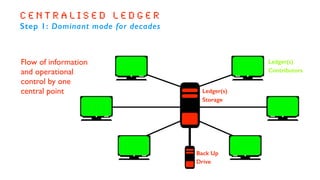
C e n t r a l i s e d L e d g e r
Step 1: Dominant mode for decades
Back Up
Drive
Ledger(s)
Storage
Ledger(s)
Contributors
Flow of information
and operational
control by one
central point
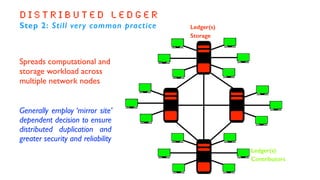
D i s t r i b u t e d L e d g e r
Step 2: Still very common practice Ledger(s)
Storage
Spreads computational and
storage workload across
multiple network nodes
Ledger(s)
Contributors
Generally employ ‘mirror site’
dependent decision to ensure
distributed duplication and
greater security and reliability
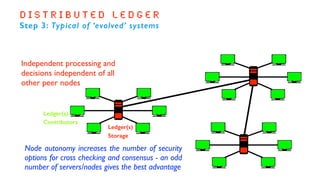
D i s t r i b u t e d L e d g e r
Step 3: Typical of ‘evolved’ systems
Independent processing and
decisions independent of all
other peer nodes
Ledger(s)
Storage
Ledger(s)
Contributors
Node autonomy increases the number of security
options for cross checking and consensus - an odd
number of servers/nodes gives the best advantage
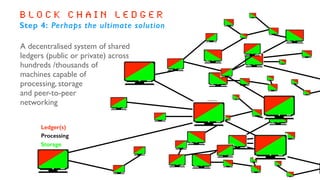
b l o c k c h a i n L e d g e r
Step 4: Perhaps the ultimate solution
Ledger(s)
Processing
Storage
A decentralised system of shared
ledgers (public or private) across
hundreds /thousands of
machines capable of
processing, storage
and peer-to-peer
networking
• An immutable record of any form of transaction
•No middle man, institutions, government, regulator
•A highly scalable, decentralised peer-to-peer (P2P) network
•File integrity based on a consensus, rather than a trust-basis
•A ‘proof-of-work’ system model renders transactions irreversible
•Individuals or groups are unable to control the infrastructure or processes
•All participants (people and machines) are equal and use to the same protocols
•The system creates a chronological time stamp of all peer-to-peer transactions
•Encryption and hash value creation per file is followed by consensus before decode
block chain Ledger
V e r y b r i e f l y s t a t e d
block chain Ledger
Operation and security basis
• All machines can create, process and store a ledger file
• Any ledger created is agreed between two or more parties
• The ledger files are encrypted by one or more of the parties
• Created files share a common time stamp to aid later verification
• The ‘bona fide’ data files are ‘hashed’ to create a unique numerical identity
• Encrypted data files are then distributed for storage across many machines
• The precise number, location and identities of the storage machines are hidden
• The ‘hash’ identity is used to verify all copies before storage and after recovery
• Any attempt to tamper with a file, now matter how small, will change the hash value
• Recovery and decode of a ledger involves a hash check a consensus across many copies
Security is assured through encryption, distribution, hash, consensus and combinatorial complexity
All macHines
ARE Equal
H U H
? ?
PROOF OF WORK & HASH
Simply put - proven algorithms
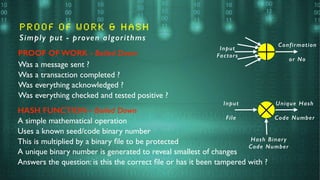
PROOF OF WORK - Boiled Down
Was a message sent ?
Was a transaction completed ?
Was everything acknowledged ?
Was everything checked and tested positive ?
HASH FUNCTION - Boiled Down
A simple mathematical operation
Uses a known seed/code binary number
This is multiplied by a binary file to be protected
A unique binary number is generated to reveal smallest of changes
Answers the question: is this the correct file or has it been tampered with ?
Hash Binary
Code Number
Unique Hash
Code Number
Input
File
Input
Factors
Confirmation
or No
block chain Ledger
Security by option choices
• Machine types, system software and apps
• Fixed and mobile device choice uncertainty
• Encryption type, algorithm and choice of seed
• The choice of hash type, value and depth of application
• Public or private key, mode of communication, encryptions
• Chronological time stamp of file creation and network actions
• Variation in machines allocated to create files, process and store
• Random (or otherwise) rotation of machines used to perform consensus
• Hash word identity used to verify all copies before storage and after recovery
• Positioning and order of hashed files in an accumulated ‘chain’ of stored ledgers
• Recovery of a ledger involves a hash check and consensus across numerous copies
block chain
Simple analogies
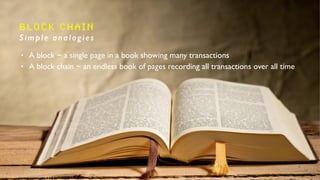
• A block ~ a single page in a book showing many transactions
• A block chain ~ an endless book of pages recording all transactions over all time
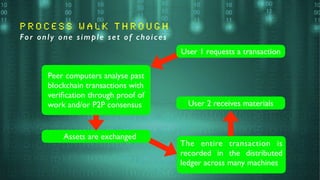
P r o c e s s W a l k T h r o u g h
For only one simple set of choices
The entire transaction is
recorded in the distributed
ledger across many machines
User 1 requests a transaction
Assets are exchanged
Peer computers analyse past
blockchain transactions with
verification through proof of
work and/or P2P consensus User 2 receives materials
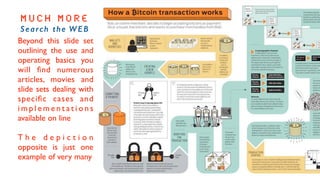
M u c h m o r e
Search the WEBt
Beyond this slide set
outlining the use and
operating basics you
will find numerous
articles, movies and
slide sets dealing with
specific cases and
i m p l e m e n t a t i o n s
available on line
T h e d e p i c t i o n
opposite is just one
example of very many
Thank You
ca-global.org

cochrane.org.uk

Block Chain Basics

  • 1.
    B l oc k C h a i n Basics Peter Cochrane cochrane.org.uk
  • 2.
    B l oc k C h a i n A v e r y b r i e f h i s t o r y •BC is a distributed ledger •2009 saw the first manifestations •No one knows the inventor/origins for sure •Designs, protocols and code are open source •Security agencies suspected to be on a similar tack •Specialised Block Chains dedicated to just one task •Generalised Block Chains will likely become a platform •A next step in the logical progression toward decentralisation •Inherently more secure than any previously realised transaction system •Sidelines institutions and centralised control making all transactions simpler The technology to hack and crack Block Chains is not yet available
  • 3.
    A D is t r i b u t e d L e d g e R Digital, Encrypted, Highly Complex •Distributed attack virtually impossible •Obscuration through complexity •Impervious to focussed attack •Spread over many machines •Geographically distributed •Inherently secure •Format variable •Vastly scaleable •Multiple forms •Multi-key Yet to be cracked!
  • 4.
    N O TJ U S T C U R R E N C Y All forms of transaction and record •Every variety of value exchange •Legal documents of every form •Property, Deeds ,Ownership •Ultra secure communication •Licences and permissions •R&D, production detail •Patents and copyright •Multi-media vault •Medical records •Voting ++++++++
  • 5.
    N O Ce n t r a l i s e d C o n t r o l Sans Institutions - Banks and Companies •Beyond the reach of governments •Confounding for regulators •Available to everyone •Multi-species •Truly global ++++++++ •User driven •Open or closed •Public or private •No external controls •A universal application •Freedom of use and application ++++++++
  • 6.
    T e ch n o l o g y F r i e n d l y Agnostic, adaptive & broadly applicable •IoT •Mobile •Fixed •Mobile •Clouds •Internet •Big •Vast •Small •Groups •Military •Personal •Corporate •Government
  • 7.
    I M Pl i c a t i o n s Expansive & confounding •Greater and easier access to financial services and funds •Openly available to be used by anyone for any purpose •Greater security of records and personal information •Improved book keeping and asset management •The sidelining of established institutions •Far easier access to global markets •The potential to by-pass regulation •An enabler of distributed teams •Allows new business models •Extremely disruptive
  • 8.
    H o wd o e s i t a l l w o r k Shrouded in complexity and jargon ! Demystification of the complex is often very difficult, but not in this case if we address each step one at a time …each step is a known process and not a giant leap !
  • 9.
    C e nt r a l i s e d L e d g e r Step 1: Dominant mode for decades Back Up Drive Ledger(s) Storage Ledger(s) Contributors Flow of information and operational control by one central point
  • 10.
    D i st r i b u t e d L e d g e r Step 2: Still very common practice Ledger(s) Storage Spreads computational and storage workload across multiple network nodes Ledger(s) Contributors Generally employ ‘mirror site’ dependent decision to ensure distributed duplication and greater security and reliability
  • 11.
    D i st r i b u t e d L e d g e r Step 3: Typical of ‘evolved’ systems Independent processing and decisions independent of all other peer nodes Ledger(s) Storage Ledger(s) Contributors Node autonomy increases the number of security options for cross checking and consensus - an odd number of servers/nodes gives the best advantage
  • 12.
    b l oc k c h a i n L e d g e r Step 4: Perhaps the ultimate solution Ledger(s) Processing Storage A decentralised system of shared ledgers (public or private) across hundreds /thousands of machines capable of processing, storage and peer-to-peer networking
  • 13.
    • An immutablerecord of any form of transaction •No middle man, institutions, government, regulator •A highly scalable, decentralised peer-to-peer (P2P) network •File integrity based on a consensus, rather than a trust-basis •A ‘proof-of-work’ system model renders transactions irreversible •Individuals or groups are unable to control the infrastructure or processes •All participants (people and machines) are equal and use to the same protocols •The system creates a chronological time stamp of all peer-to-peer transactions •Encryption and hash value creation per file is followed by consensus before decode block chain Ledger V e r y b r i e f l y s t a t e d
  • 14.
    block chain Ledger Operationand security basis • All machines can create, process and store a ledger file • Any ledger created is agreed between two or more parties • The ledger files are encrypted by one or more of the parties • Created files share a common time stamp to aid later verification • The ‘bona fide’ data files are ‘hashed’ to create a unique numerical identity • Encrypted data files are then distributed for storage across many machines • The precise number, location and identities of the storage machines are hidden • The ‘hash’ identity is used to verify all copies before storage and after recovery • Any attempt to tamper with a file, now matter how small, will change the hash value • Recovery and decode of a ledger involves a hash check a consensus across many copies Security is assured through encryption, distribution, hash, consensus and combinatorial complexity All macHines ARE Equal H U H ? ?
  • 15.
    PROOF OF WORK& HASH Simply put - proven algorithms PROOF OF WORK - Boiled Down Was a message sent ? Was a transaction completed ? Was everything acknowledged ? Was everything checked and tested positive ? HASH FUNCTION - Boiled Down A simple mathematical operation Uses a known seed/code binary number This is multiplied by a binary file to be protected A unique binary number is generated to reveal smallest of changes Answers the question: is this the correct file or has it been tampered with ? Hash Binary Code Number Unique Hash Code Number Input File Input Factors Confirmation or No
  • 16.
    block chain Ledger Securityby option choices • Machine types, system software and apps • Fixed and mobile device choice uncertainty • Encryption type, algorithm and choice of seed • The choice of hash type, value and depth of application • Public or private key, mode of communication, encryptions • Chronological time stamp of file creation and network actions • Variation in machines allocated to create files, process and store • Random (or otherwise) rotation of machines used to perform consensus • Hash word identity used to verify all copies before storage and after recovery • Positioning and order of hashed files in an accumulated ‘chain’ of stored ledgers • Recovery of a ledger involves a hash check and consensus across numerous copies
  • 17.
    block chain Simple analogies •A block ~ a single page in a book showing many transactions • A block chain ~ an endless book of pages recording all transactions over all time
  • 18.
    P r oc e s s W a l k T h r o u g h For only one simple set of choices The entire transaction is recorded in the distributed ledger across many machines User 1 requests a transaction Assets are exchanged Peer computers analyse past blockchain transactions with verification through proof of work and/or P2P consensus User 2 receives materials
  • 19.
    M u ch m o r e Search the WEBt Beyond this slide set outlining the use and operating basics you will find numerous articles, movies and slide sets dealing with specific cases and i m p l e m e n t a t i o n s available on line T h e d e p i c t i o n opposite is just one example of very many
  • 20.