Blended by Design: Designing and Developing a Blended Course Veronica Diaz, PhD,  [email_address]   Jennifer Strickland, PhD,  [email_address]   Laura Ballard,  [email_address]
Day 3: Online assessment, student success, and collaboration
Objectives  Describe the importance and value of interaction in the blended course.  List various types of student interactions for blended learning environments.  List strategies to assess student readiness for blended learning environments. List ways to utilize teams in blended learning environments.
Figure out what your assessing Good ole’  Bloom’s Taxonomy
Benefits of Assessing Online Automatic grading & instant feedback Anytime, any place Easily randomize question sequence Can randomly pull certain categories of question so no two tests are alike Can build and track portfolio and project based assessments Instant access to resources
Limits to Online Assessment Cheating Quirkiness of technology Access to online resources & paper mills
How do you build a foolproof online assessment? ?????
Suggestions for Better Assessment Build multiple “check point” assessments Allow open note/book timed tests Have in class quizzes and tests as well Project-based assessments Portfolio assessments Assign group work in a wiki area that tracks student participation Provide best practice guidelines for taking exams online (See handouts)
Don’t forget formative assessment! In any technology mediated course, you MUST check frequently for comprehension – this helps with retention & success
Brainstorm ideas for formatively assessing student learning…
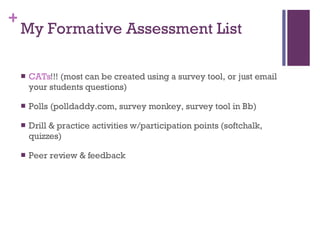
My Formative Assessment List CATs !!! (most can be created using a survey tool, or just email your students questions) Polls (polldaddy.com, survey monkey, survey tool in Bb) Drill & practice activities w/participation points (softchalk, quizzes) Peer review & feedback
Student Readiness
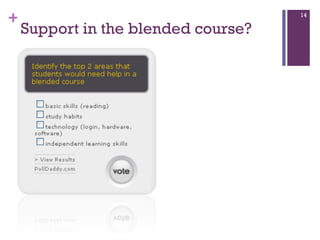
Support in the blended course?
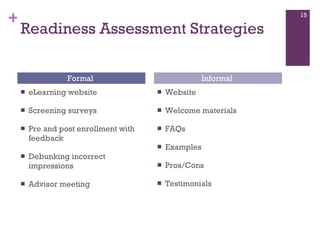
Readiness Assessment Strategies eLearning website  Screening surveys  Pre and post enrollment with feedback Debunking incorrect impressions  Advisor meeting  Website Welcome materials  FAQs  Examples  Pros/Cons  Testimonials Formal  Informal
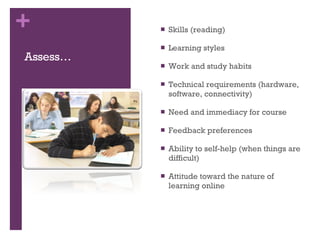
Assess… Skills (reading)  Learning styles Work and study habits Technical requirements (hardware, software, connectivity)  Need and immediacy for course Feedback preferences  Ability to self-help (when things are difficult)  Attitude toward the nature of learning online
Readiness Means… Determining who is ready  Ready now = start course  Not ready now =  Tutorials Support Advisor meeting  UCF  Learning Online
Are you ready for MY course? Take a moment to review some of the course readiness surveys Identify 2 areas where your students might struggle Come up with a strategy that you would offer to support students with these  How would you customize these readiness surveys for your course to further communicate to students specific success requirements
Student Crisis Points
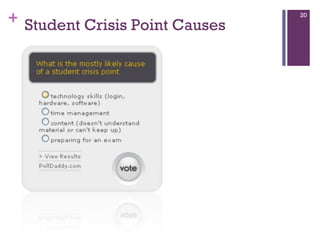
Student Crisis Point Causes
What are they? Moments during your course when students are most likely to need support and assistance Example: The first time a student logs in to your course web site and cannot successfully locate the address and insert the username and password?  Identify crisis points in advance, so you can make sure that you have a plan in place to mitigate student problems and avoid frustration
How do you identify them? Review the sequence of learning activities and course modules you have planned What student skills will be required to be successful  Technological skills  Using course management system (tests, finding materials, email, groups, web 2.0 tools, etc.)  Learning skills  Time management Ability to retain and use your course content
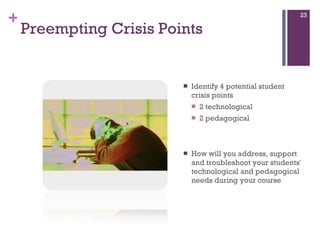
Preempting Crisis Points Identify 4 potential student crisis points 2 technological  2 pedagogical  How will you address, support and troubleshoot your students' technological and pedagogical needs during your course
Utilizing Student Teams and Community Building
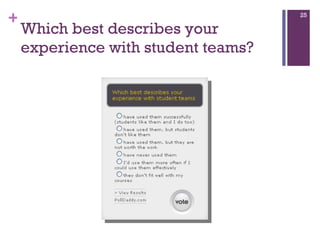
Which best describes your experience with student teams?
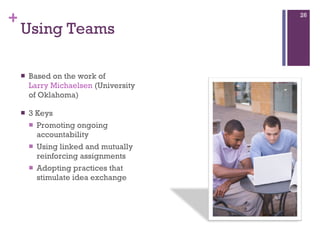
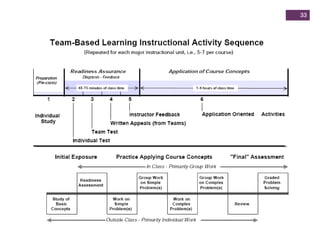
Using Teams  Based on the work of  Larry Michaelsen  (University of Oklahoma)  3 Keys Promoting ongoing accountability  Using linked and mutually reinforcing assignments  Adopting practices that stimulate idea exchange
Promoting Ongoing Accountability  Require pre-group work  Require group members to express individual opinions and monitor via another member Include peer evaluation in grading Readiness Assurance Process  Test over readings  Group: Test, discuss, reach consensus and retest Provide information for peer feedback process
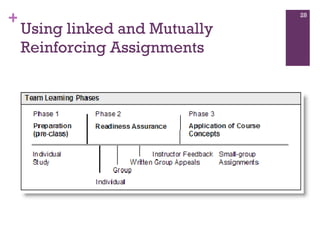
Using linked and Mutually Reinforcing Assignments
Adopting Practices that Stimulate Idea Exchange Use of assignments that create conditions that foster give-and-take interaction  Assign roles  Use permanent groups Allow some in-class group work  Size: 4-7 Diversity of opinion, ideas, and perspectives Not too easy Not too much writing  Employ, select, apply concepts from the course
Team Teaching Tips Outline learning goals Teach team skills  Clear and detailed instructions Rubric  Stages of team development  Forming - polite but untrusting  Storming - testing others  Norming - valuing other types  Performing - flexibility from trust
Team Contracts  Purpose, goals, and missions  Expectations  Roles Conflict resolution strategies  Meetings Communication  Decision-making policy  Agendas Record-keeping
Other Resources Team Based Learning (Michaelsen)  http://www.ou.edu/pii/teamlearning/index.htm Video Demonstrations http://www.ou.edu/pii/teamlearning/video.htm
4 Questions What do I want students to be able to DO after this unit of instruction (behavioral outcomes)  What will students have to KNOW to do XYZ (learning outcomes)  How can I ASSESS whether or not students have successfully mastered key course concepts?  How can I tell if students will be able to USE their knowledge of key course concepts? (application)
Activity Using the 4 questions, develop some type of team activity for a unit in your course Report out

Blended by Design: Day 3

  • 1.
    Blended by Design:Designing and Developing a Blended Course Veronica Diaz, PhD, [email_address] Jennifer Strickland, PhD, [email_address] Laura Ballard, [email_address]
  • 2.
    Day 3: Onlineassessment, student success, and collaboration
  • 3.
    Objectives Describethe importance and value of interaction in the blended course. List various types of student interactions for blended learning environments. List strategies to assess student readiness for blended learning environments. List ways to utilize teams in blended learning environments.
  • 4.
    Objectives Describethe importance and value of interaction in the blended course. List various types of student interactions for blended learning environments. List strategies to assess student readiness for blended learning environments. List ways to utilize teams in blended learning environments.
  • 5.
    Figure out whatyour assessing Good ole’ Bloom’s Taxonomy
  • 6.
    Benefits of AssessingOnline Automatic grading & instant feedback Anytime, any place Easily randomize question sequence Can randomly pull certain categories of question so no two tests are alike Can build and track portfolio and project based assessments Instant access to resources
  • 7.
    Limits to OnlineAssessment Cheating Quirkiness of technology Access to online resources & paper mills
  • 8.
    How do youbuild a foolproof online assessment? ?????
  • 9.
    Suggestions for BetterAssessment Build multiple “check point” assessments Allow open note/book timed tests Have in class quizzes and tests as well Project-based assessments Portfolio assessments Assign group work in a wiki area that tracks student participation Provide best practice guidelines for taking exams online (See handouts)
  • 10.
    Don’t forget formativeassessment! In any technology mediated course, you MUST check frequently for comprehension – this helps with retention & success
  • 11.
    Brainstorm ideas forformatively assessing student learning…
  • 12.
    My Formative AssessmentList CATs !!! (most can be created using a survey tool, or just email your students questions) Polls (polldaddy.com, survey monkey, survey tool in Bb) Drill & practice activities w/participation points (softchalk, quizzes) Peer review & feedback
  • 13.
  • 14.
    Support in theblended course?
  • 15.
    Readiness Assessment StrategieseLearning website Screening surveys Pre and post enrollment with feedback Debunking incorrect impressions Advisor meeting Website Welcome materials FAQs Examples Pros/Cons Testimonials Formal Informal
  • 16.
    Assess… Skills (reading) Learning styles Work and study habits Technical requirements (hardware, software, connectivity) Need and immediacy for course Feedback preferences Ability to self-help (when things are difficult) Attitude toward the nature of learning online
  • 17.
    Readiness Means… Determiningwho is ready Ready now = start course Not ready now = Tutorials Support Advisor meeting UCF Learning Online
  • 18.
    Are you readyfor MY course? Take a moment to review some of the course readiness surveys Identify 2 areas where your students might struggle Come up with a strategy that you would offer to support students with these How would you customize these readiness surveys for your course to further communicate to students specific success requirements
  • 19.
  • 20.
  • 21.
    What are they?Moments during your course when students are most likely to need support and assistance Example: The first time a student logs in to your course web site and cannot successfully locate the address and insert the username and password? Identify crisis points in advance, so you can make sure that you have a plan in place to mitigate student problems and avoid frustration
  • 22.
    How do youidentify them? Review the sequence of learning activities and course modules you have planned What student skills will be required to be successful Technological skills Using course management system (tests, finding materials, email, groups, web 2.0 tools, etc.) Learning skills Time management Ability to retain and use your course content
  • 23.
    Preempting Crisis PointsIdentify 4 potential student crisis points 2 technological 2 pedagogical How will you address, support and troubleshoot your students' technological and pedagogical needs during your course
  • 24.
    Utilizing Student Teamsand Community Building
  • 25.
    Which best describesyour experience with student teams?
  • 26.
    Using Teams Based on the work of Larry Michaelsen (University of Oklahoma) 3 Keys Promoting ongoing accountability Using linked and mutually reinforcing assignments Adopting practices that stimulate idea exchange
  • 27.
    Promoting Ongoing Accountability Require pre-group work Require group members to express individual opinions and monitor via another member Include peer evaluation in grading Readiness Assurance Process Test over readings Group: Test, discuss, reach consensus and retest Provide information for peer feedback process
  • 28.
    Using linked andMutually Reinforcing Assignments
  • 29.
    Adopting Practices thatStimulate Idea Exchange Use of assignments that create conditions that foster give-and-take interaction Assign roles Use permanent groups Allow some in-class group work Size: 4-7 Diversity of opinion, ideas, and perspectives Not too easy Not too much writing Employ, select, apply concepts from the course
  • 30.
    Team Teaching TipsOutline learning goals Teach team skills Clear and detailed instructions Rubric Stages of team development Forming - polite but untrusting Storming - testing others Norming - valuing other types Performing - flexibility from trust
  • 31.
    Team Contracts Purpose, goals, and missions Expectations Roles Conflict resolution strategies Meetings Communication Decision-making policy Agendas Record-keeping
  • 32.
    Other Resources TeamBased Learning (Michaelsen) http://www.ou.edu/pii/teamlearning/index.htm Video Demonstrations http://www.ou.edu/pii/teamlearning/video.htm
  • 34.
    4 Questions Whatdo I want students to be able to DO after this unit of instruction (behavioral outcomes) What will students have to KNOW to do XYZ (learning outcomes) How can I ASSESS whether or not students have successfully mastered key course concepts? How can I tell if students will be able to USE their knowledge of key course concepts? (application)
  • 35.
    Activity Using the4 questions, develop some type of team activity for a unit in your course Report out