The Law of conservation of energy tells us we can't get something for nothing, but we refuse to
believe it.
-Isaac Asimov
INTRODUCTION
Bleeding
symptoms
Bleeding disorder
Platelet defects
Clotting factor deficiencies (eg, factor VIII
or factor IX deficiencies)
Bleeding events Mucocutaneous bleeding Deep tissue bleeding
Excessive bleeding
after minor cuts
Yes Not usually
Petechiae Common Uncommon
Ecchymoses Generally small and superficial May develop large subcutaneous and soft tissue
hematomas
Hemarthroses,
muscle hematomas
Uncommon Common
- Created with love
by Dr. Eashan Srivastava
The Law of conservation of energy tells us we can't get something for nothing, but we refuse to
believe it.
-Isaac Asimov
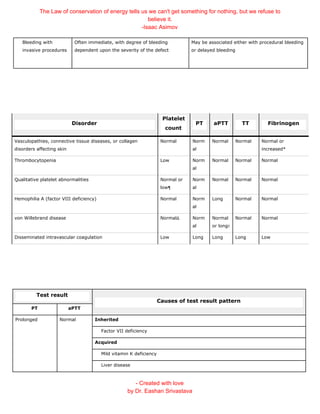
Bleeding with
invasive procedures
Often immediate, with degree of bleeding
dependent upon the severity of the defect
May be associated either with procedural bleeding
or delayed bleeding
Disorder
Platelet
count
PT aPTT TT Fibrinogen
Vasculopathies, connective tissue diseases, or collagen
disorders affecting skin
Normal Norm
al
Normal Normal Normal or
increased*
Thrombocytopenia Low Norm
al
Normal Normal Normal
Qualitative platelet abnormalities Normal or
low​
Norm
al
Normal Normal Normal
Hemophilia A (factor VIII deficiency) Normal Norm
al
Long Normal Normal
von Willebrand disease Normal​Δ Norm
al
Normal
or long​◊
Normal Normal
Disseminated intravascular coagulation Low Long Long Long Low
Test result
Causes of test result pattern
PT aPTT
Prolonged Normal Inherited
Factor VII deficiency
Acquired
Mild vitamin K deficiency
Liver disease
- Created with love
by Dr. Eashan Srivastava
The Law of conservation of energy tells us we can't get something for nothing, but we refuse to
believe it.
-Isaac Asimov
Warfarin administration*
Acquired inhibitor of factor VII
Lupus anticoagulant (more commonly causes isolated prolonged aPTT; may be associated
with thrombosis rather than bleeding)
Normal Prolonged Inherited
Deficiency of factors VIII, IX, or XI
Deficiency of factor XII, prekallikrein, or HMW kininogen (not associated with a bleeding
diathesis)
von Willebrand disease (variable)
Acquired
Heparin administration*
Inhibitor of factors VIII, IX, XI, or XII
Acquired von Willebrand disease
Lupus anticoagulant (may be associated with thrombosis rather than bleeding)
Prolonged Prolonged Inherited
Deficiency of prothrombin, fibrinogen, or factors V or X
Combined factor deficiencies
Acquired
Liver disease
Disseminated intravascular coagulation
Supratherapeutic doses of anticoagulants
Severe vitamin K deficiency
Combined heparin and warfarin administration
Direct thrombin inhibitor administration (eg, argatroban, dabigatran)*
Direct factor Xa inhibitor administration (eg, rivaroxaban, apixaban, edoxaban)
Fondaparinux administration (slight prolongation)
Inhibitor of prothrombin, fibrinogen, or factors V or X
Primary amyloidosis-associated factor X deficiency
Anticoagulant rodenticide poisoning
- Created with love
by Dr. Eashan Srivastava
The Law of conservation of energy tells us we can't get something for nothing, but we refuse to
believe it.
-Isaac Asimov
PATIENT HISTORY
● Inherited or acquired
○ Family history
○ Onset of bleeding since birth
● Bleeding history
○ past bleeding problems
○ Past Sx
○ H/O iron-responsive anemia
○ H/O transfusion
○ Character of menses
○ Dietary habits
○ Comorbidities - CKD
○ The response to trauma
● Medication use
○ Aspirin
○ Herbal products
○ OAC
CLINICAL MANIFESTATIONS
● Disorders of platelets or blood vessels
○ a/w mucosal and cutaneous bleeding
○ Epistaxis
○ Oro-gingival bleeding
○ Bullous hemorrhages
○ Superficial ecchymoses
○ Tend to bleed immediately after vascular trauma
○ Petechiae
■ In areas of increased venous pressure, such as the dependent parts
- Created with love
by Dr. Eashan Srivastava
The Law of conservation of energy tells us we can't get something for nothing, but we refuse to
believe it.
-Isaac Asimov
■ Asymptomatic
■ Not palpable
○ Ecchymoses
■ Multiple
■ Superficial
■ Develop without noticeable trauma
● Coagulation disorders
○ Ecchymoses
○ Soft tissue hematomas
○ Hemarthrosis
LABORATORY TESTING
● General screening tests
○ Platelet count
○ Bleeding time
○ PT
○ aPTT
● Specific tests
○ Peripheral blood smear
○ Platelet aggregation in response to ADP, epinephrine, collagen, and ristocetin;
○ Platelet release assays
○ Coagulation factor assays
○ D Dimer
Platelet counting and the peripheral smear
● Examination of the peripheral blood smear is essential in patients with low platelet
counts to exclude the presence of pseudothrombocytopenia due to in vitro platelet
agglutination in the presence of EDTA
● Result from a "naturally occurring" platelet autoantibody directed against a normally
concealed epitope on the platelet membrane, which becomes exposed by EDTA
- Created with love
by Dr. Eashan Srivastava
The Law of conservation of energy tells us we can't get something for nothing, but we refuse to
believe it.
-Isaac Asimov
Bleeding time
● Measure of the interaction of platelets with the blood vessel wall
● Prolonged
○ Thrombocytopenia
○ Platelet abnormalities (eg, uremia)
○ von Willebrand disease
● BT is ​not recommended​​ as a preoperative screening test
● The Platelet Function Analyzer​​ (PFA-100)
○ Technology
○ Assesses platelet function
○ Greater sensitivity and reproducibility than BT
○ Faster to perform
○ Does not provide a measure of vascular function
Prothrombin time
● Extrinsic pathway and the final common pathway
● Require
○ Tissue factor
○ Factor VII
○ Factors X, V, prothrombin (factor II), and fibrinogen
Activated partial thromboplastin time
● Measures the intrinsic and common pathways
● Called partial since
○ Platelet substitutes are used which are only partial thromboplastins
○ Incapable of activating the extrinsic pathway
● In the original method, a glass test tube provided contact activation
● Nowadays
- Created with love
by Dr. Eashan Srivastava
The Law of conservation of energy tells us we can't get something for nothing, but we refuse to
believe it.
-Isaac Asimov
○ Ellagic acid
○ Particulate silicates
Thrombin time and reptilase time
● Measure conversion of fibrinogen to fibrin monomers and the formation of initial clot
● If activator
○ Thrombin = Thrombin time
○ Reptilase = Retiplase time
● Reptilase
○ Similar to thrombin
○ Derived from snake
○ Resists inhibition by heparin via antithrombin
● Prolonged TT/RT
○ Hypofibrinogenemia
○ Structurally abnormal fibrinogens (dysfibrinogens)
○ Heparin prolongs the TT but not the RT
Factor deficiencies and inhibitors
● Deficiency should be correctable by addition of normal plasma to the test reaction tube
● Inhibitor is suspected when the abnormal test does not correct, or only partially corrects,
following an immediate assay of a 1:1 mixture of patient and normal plasma
Fibrinogen
● Fibrinogen's functional activity is measured as thrombin-coagulable protein
● Levels are measured by immunologic assays
Urea clot solubility
- Created with love
by Dr. Eashan Srivastava
The Law of conservation of energy tells us we can't get something for nothing, but we refuse to
believe it.
-Isaac Asimov
● The initial fibrin clot, held together by noncovalent bonds, is soluble in urea
● Factor XIII covalently crosslinks overlapping fibrin strands, which then become resistant
to solubilization
● Ability of 5M urea or monochloroacetic acid to solubilize the clot reflects deficiency of
factor XIII
Tests for fibrinolysis
● Elevated levels are seen in states of fibrinolysis such as DIC
● FDP assays do not differentiate between fibrin degradation products and fibrinogen
degradation products
● D-dimers
○ Degradation products of cross-linked fibrin
○ Because D-dimers specifically reflect fibrinolysis of cross-linked fibrin (ie, the
fibrin clot), assessment of D-dimer levels suggests thrombosis more reliably
- Created with love
by Dr. Eashan Srivastava

Bleeding disorders

  • 1.
    The Law ofconservation of energy tells us we can't get something for nothing, but we refuse to believe it. -Isaac Asimov INTRODUCTION Bleeding symptoms Bleeding disorder Platelet defects Clotting factor deficiencies (eg, factor VIII or factor IX deficiencies) Bleeding events Mucocutaneous bleeding Deep tissue bleeding Excessive bleeding after minor cuts Yes Not usually Petechiae Common Uncommon Ecchymoses Generally small and superficial May develop large subcutaneous and soft tissue hematomas Hemarthroses, muscle hematomas Uncommon Common - Created with love by Dr. Eashan Srivastava
  • 2.
    The Law ofconservation of energy tells us we can't get something for nothing, but we refuse to believe it. -Isaac Asimov Bleeding with invasive procedures Often immediate, with degree of bleeding dependent upon the severity of the defect May be associated either with procedural bleeding or delayed bleeding Disorder Platelet count PT aPTT TT Fibrinogen Vasculopathies, connective tissue diseases, or collagen disorders affecting skin Normal Norm al Normal Normal Normal or increased* Thrombocytopenia Low Norm al Normal Normal Normal Qualitative platelet abnormalities Normal or low​¶ Norm al Normal Normal Normal Hemophilia A (factor VIII deficiency) Normal Norm al Long Normal Normal von Willebrand disease Normal​Δ Norm al Normal or long​◊ Normal Normal Disseminated intravascular coagulation Low Long Long Long Low Test result Causes of test result pattern PT aPTT Prolonged Normal Inherited Factor VII deficiency Acquired Mild vitamin K deficiency Liver disease - Created with love by Dr. Eashan Srivastava
  • 3.
    The Law ofconservation of energy tells us we can't get something for nothing, but we refuse to believe it. -Isaac Asimov Warfarin administration* Acquired inhibitor of factor VII Lupus anticoagulant (more commonly causes isolated prolonged aPTT; may be associated with thrombosis rather than bleeding) Normal Prolonged Inherited Deficiency of factors VIII, IX, or XI Deficiency of factor XII, prekallikrein, or HMW kininogen (not associated with a bleeding diathesis) von Willebrand disease (variable) Acquired Heparin administration* Inhibitor of factors VIII, IX, XI, or XII Acquired von Willebrand disease Lupus anticoagulant (may be associated with thrombosis rather than bleeding) Prolonged Prolonged Inherited Deficiency of prothrombin, fibrinogen, or factors V or X Combined factor deficiencies Acquired Liver disease Disseminated intravascular coagulation Supratherapeutic doses of anticoagulants Severe vitamin K deficiency Combined heparin and warfarin administration Direct thrombin inhibitor administration (eg, argatroban, dabigatran)* Direct factor Xa inhibitor administration (eg, rivaroxaban, apixaban, edoxaban) Fondaparinux administration (slight prolongation) Inhibitor of prothrombin, fibrinogen, or factors V or X Primary amyloidosis-associated factor X deficiency Anticoagulant rodenticide poisoning - Created with love by Dr. Eashan Srivastava
  • 4.
    The Law ofconservation of energy tells us we can't get something for nothing, but we refuse to believe it. -Isaac Asimov PATIENT HISTORY ● Inherited or acquired ○ Family history ○ Onset of bleeding since birth ● Bleeding history ○ past bleeding problems ○ Past Sx ○ H/O iron-responsive anemia ○ H/O transfusion ○ Character of menses ○ Dietary habits ○ Comorbidities - CKD ○ The response to trauma ● Medication use ○ Aspirin ○ Herbal products ○ OAC CLINICAL MANIFESTATIONS ● Disorders of platelets or blood vessels ○ a/w mucosal and cutaneous bleeding ○ Epistaxis ○ Oro-gingival bleeding ○ Bullous hemorrhages ○ Superficial ecchymoses ○ Tend to bleed immediately after vascular trauma ○ Petechiae ■ In areas of increased venous pressure, such as the dependent parts - Created with love by Dr. Eashan Srivastava
  • 5.
    The Law ofconservation of energy tells us we can't get something for nothing, but we refuse to believe it. -Isaac Asimov ■ Asymptomatic ■ Not palpable ○ Ecchymoses ■ Multiple ■ Superficial ■ Develop without noticeable trauma ● Coagulation disorders ○ Ecchymoses ○ Soft tissue hematomas ○ Hemarthrosis LABORATORY TESTING ● General screening tests ○ Platelet count ○ Bleeding time ○ PT ○ aPTT ● Specific tests ○ Peripheral blood smear ○ Platelet aggregation in response to ADP, epinephrine, collagen, and ristocetin; ○ Platelet release assays ○ Coagulation factor assays ○ D Dimer Platelet counting and the peripheral smear ● Examination of the peripheral blood smear is essential in patients with low platelet counts to exclude the presence of pseudothrombocytopenia due to in vitro platelet agglutination in the presence of EDTA ● Result from a "naturally occurring" platelet autoantibody directed against a normally concealed epitope on the platelet membrane, which becomes exposed by EDTA - Created with love by Dr. Eashan Srivastava
  • 6.
    The Law ofconservation of energy tells us we can't get something for nothing, but we refuse to believe it. -Isaac Asimov Bleeding time ● Measure of the interaction of platelets with the blood vessel wall ● Prolonged ○ Thrombocytopenia ○ Platelet abnormalities (eg, uremia) ○ von Willebrand disease ● BT is ​not recommended​​ as a preoperative screening test ● The Platelet Function Analyzer​​ (PFA-100) ○ Technology ○ Assesses platelet function ○ Greater sensitivity and reproducibility than BT ○ Faster to perform ○ Does not provide a measure of vascular function Prothrombin time ● Extrinsic pathway and the final common pathway ● Require ○ Tissue factor ○ Factor VII ○ Factors X, V, prothrombin (factor II), and fibrinogen Activated partial thromboplastin time ● Measures the intrinsic and common pathways ● Called partial since ○ Platelet substitutes are used which are only partial thromboplastins ○ Incapable of activating the extrinsic pathway ● In the original method, a glass test tube provided contact activation ● Nowadays - Created with love by Dr. Eashan Srivastava
  • 7.
    The Law ofconservation of energy tells us we can't get something for nothing, but we refuse to believe it. -Isaac Asimov ○ Ellagic acid ○ Particulate silicates Thrombin time and reptilase time ● Measure conversion of fibrinogen to fibrin monomers and the formation of initial clot ● If activator ○ Thrombin = Thrombin time ○ Reptilase = Retiplase time ● Reptilase ○ Similar to thrombin ○ Derived from snake ○ Resists inhibition by heparin via antithrombin ● Prolonged TT/RT ○ Hypofibrinogenemia ○ Structurally abnormal fibrinogens (dysfibrinogens) ○ Heparin prolongs the TT but not the RT Factor deficiencies and inhibitors ● Deficiency should be correctable by addition of normal plasma to the test reaction tube ● Inhibitor is suspected when the abnormal test does not correct, or only partially corrects, following an immediate assay of a 1:1 mixture of patient and normal plasma Fibrinogen ● Fibrinogen's functional activity is measured as thrombin-coagulable protein ● Levels are measured by immunologic assays Urea clot solubility - Created with love by Dr. Eashan Srivastava
  • 8.
    The Law ofconservation of energy tells us we can't get something for nothing, but we refuse to believe it. -Isaac Asimov ● The initial fibrin clot, held together by noncovalent bonds, is soluble in urea ● Factor XIII covalently crosslinks overlapping fibrin strands, which then become resistant to solubilization ● Ability of 5M urea or monochloroacetic acid to solubilize the clot reflects deficiency of factor XIII Tests for fibrinolysis ● Elevated levels are seen in states of fibrinolysis such as DIC ● FDP assays do not differentiate between fibrin degradation products and fibrinogen degradation products ● D-dimers ○ Degradation products of cross-linked fibrin ○ Because D-dimers specifically reflect fibrinolysis of cross-linked fibrin (ie, the fibrin clot), assessment of D-dimer levels suggests thrombosis more reliably - Created with love by Dr. Eashan Srivastava