Carcinoma urinary bladder
- Isha Shah
Points to be covered
Anatomy
Lymphatic supply
Epidemiology and etiology
Pathology
Pathogenesis and mode of spread
Symptoms and signs
Work up and staging
Treatment
Anatomy
● Four surfaces: two anterolateral, a superior, and a posterior (base) surface.
● Other named areas include the apex (dome) of the bladder and the neck.
● Urachus - At the apex, a short fibrous cord ;
runs from the apex to the umbilicus between the transversalis
fascia and the peritoneum, raising a ridge of peritoneum called
the median umbilical ligament.
Clinical importance-
The urachus should be removed in continuity with the bladder during radical
cystectomy for bladder cancer.As it can also be the original site of malignancy, in which
case the lesion is usually an adenocarcinoma as opposed to a transitional cell lesion.
Mucosa-mucosal surface - transitional epithelium
•The underlying connective tissue allows considerable stretching of the mucosa except in the trigonal area
Muscles of the bladder –
•no particular layering arrangement except in the area of the bladder neck and outlet - circular layer
between two longitudinal layers
Blood Supply :
•superior, middle, and inferior vesical arteries - branches of anterior division of the internal iliac artery.
•During cystectomy - prevent high ligation of the anterior division, which may result in buttock claudication
secondary to ligation of one of the main gluteal arteries, which also originate in this area.
•In the female, the uterine and vaginal vessels also contribute.
•Lymphatic Drainage :
•Regional nodes –
-Primary drainage
•Perivesical pelvic
•External and the internal iliac
•Sacral
•Obturator
- Secondary drainage
•common iliac lymph nodes
Epidemiology & Etiology –
● As per the GLOBOCAN 2020, bladder cancer was estimated to have 573 278
new cases and 2,12,536 deaths per year and was ranked 13th among all
cancers in the world.
● Whites than Africans or Hispanics
● Higher socioeconomic status
● M > F (3 times)
● 60-70 yrs age
● Incidence doubles in men > 75 yrs age v/s young men
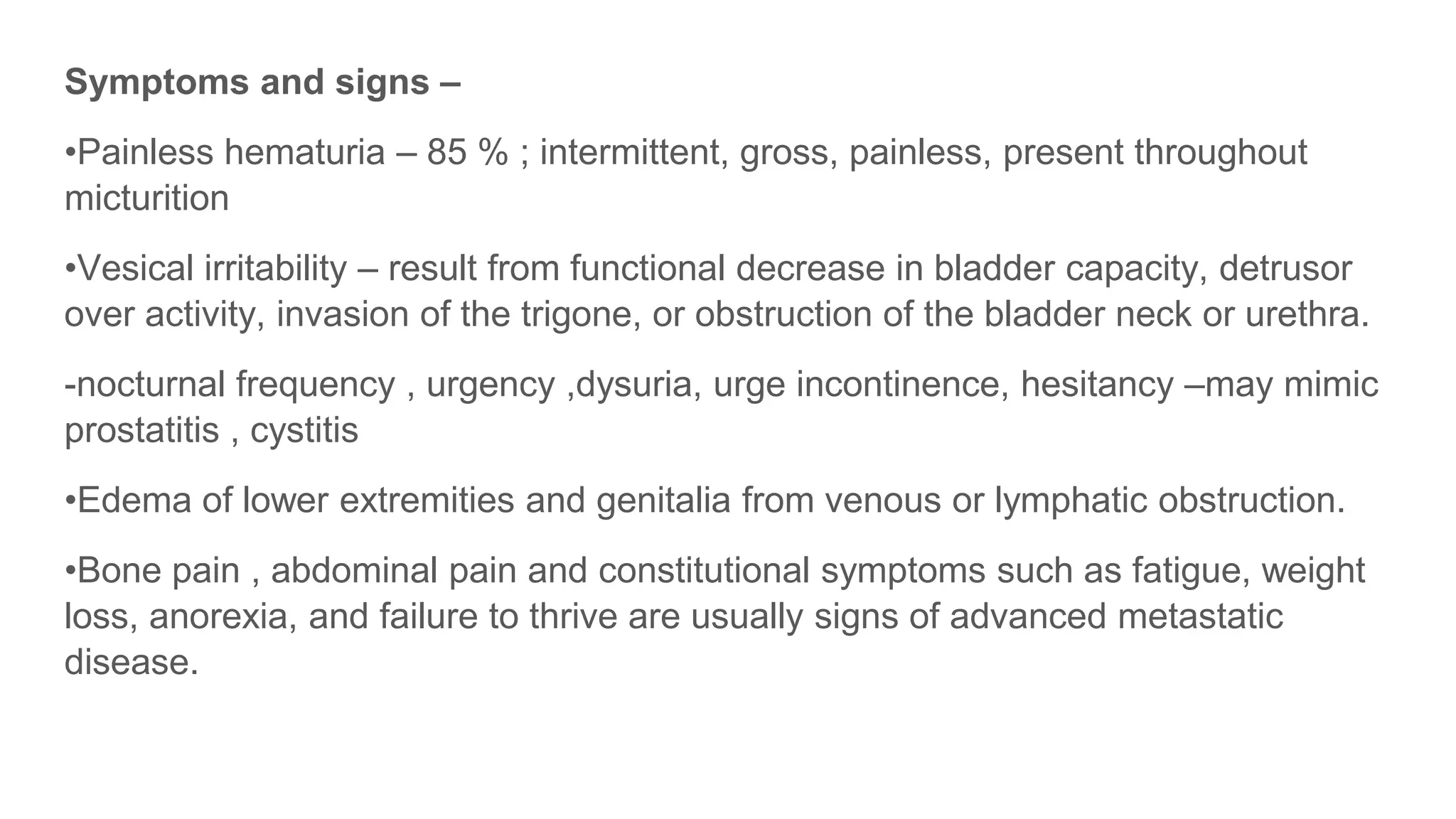
Pathology :-
•Histology -
Main three-TCC(~93%), SCC, AC
Others- sarcomas, lymphomas, melanomas, carcinoid tumor-
rare
•Sites of involvement –
- carcinogens in urine believed to produce a field change in
urothelium
- TCC can develop in any part of urinary collecting system –
renal pelvis, ureter but bladder – m/c – due to it’s greatest
contact time with urine
- m/c site – trigone and adjacent postero-lateral wall
•Grossly -
- single papillary – m/c , least likely to infiltrate
- diffuse papillary growth – min. invasion
- sessile cancers- high gr , invasive
- CIS – flat intraepithelial growth –red velvety patch -if left
untreated 80% will develop invasive disease within 10years.
•Field effect-
-Whole urothelium is exposed to common carcinogen
-Bladder cancer associated with premalignant changes throughout mucosa
- ~ 80 % pt treated for superficial tumors develop recurrence at different site in
urinary tract
- Multiple primary sites are present in ~25 % patient
- Random biopsy of apparently normal looking areas of mucosa frequently shows
CIS
- Patients with bladder CIS also have ureteral CIS (10-60 % cases) and uretharal
CIS (30 % cases)
Pathogenesis- Two different pathways
•NMIBC- develop from benign urothelium through a process of urothelial hyperplasia
•MIBC- progression of dysplasia to flat carcinoma in situ (CIS) and high-grade
noninvasive lesions to Invasive lesions
Mode of spread-
•High grade lesion are more likely to metastasize
•Hematogenous – liver > lung , bone , brain and less commonly skin and other organs
•Lymphatics- pelvic LNs (Obturator m/c)
Symptoms and signs –
•Painless hematuria – 85 % ; intermittent, gross, painless, present throughout
micturition
•Vesical irritability – result from functional decrease in bladder capacity, detrusor
over activity, invasion of the trigone, or obstruction of the bladder neck or urethra.
-nocturnal frequency , urgency ,dysuria, urge incontinence, hesitancy –may mimic
prostatitis , cystitis
•Edema of lower extremities and genitalia from venous or lymphatic obstruction.
•Bone pain , abdominal pain and constitutional symptoms such as fatigue, weight
loss, anorexia, and failure to thrive are usually signs of advanced metastatic
disease.
Diagnosis and staging
Routine investigations
Cystoscopy and EUA
Fluorescence endoscopy
Urinary cytopathology
USG / MRI / CT scan abdomen and pelvis to look for primary disease and lymphatic spread
CT urogram to rule out other synchronous tumor previously done
CT thorax, bone scan and FDG PET as and when needed.
DIAGNOSTIC APPROACH
CYSTOSCOPY
•All patients suspected of having bladder cancer should have careful
cystoscopy.
•If a suspicious lesion is seen, biopsy should be taken from that.Random
biopsies from areas adjacent to the tumor as well as from the opposite
bladder wall, bladder dome, triagone, and prostatic urethra have been
recommended at time of resection of the primary tumor. Sample from the
base of the tumor to be taken separately to assess muscle invasion and LVI.
•Information, such as number, size, shape, and location of tumors, is easily
obtained. Cystoscopically, the appearance of the bladder tumor can be
classified according to characteristics of the surface and the base of the
tumor.
•In general, low-grade, non-invasive tumors are papillary with a narrow stalk.
High-grade, invasive tumors frequently can appear sessile, solid, or nodular.
EUA
•A bimanual examination under anesthesia (EUA) to determine whether or not a
palpable mass is present and, if present, whether it is mobile or fixed. If mobile it is
considered as T3 disease and if fixed it should be considered as T4 disease
•An EUA during cystoscopy is effective at identifying locally advanced disease,
which may present as gross extravesical extension.
Fluorescence Endoscopy
•White light endoscopy of the lower urinary tract is limited in detection of bladder cancer.
•Flat neoplastic urothelial lesions, such as dysplasia and CIS, can be concealed in normal-appearing mucosa or
nonspecific inflammatory-appearing mucosa.
•Fluorescent photodetection of neoplastic urothelial lesions using 5-aminolevulinic acid (5-ALA) was first
described in 1994.
•5-ALA is a precursor of heme biosynthesis. After intravesical instillation, 5-ALA induces selective enhancement
of protoporphyrin IX with a strongly fluorescent dye in the mucosa of neoplastic lesions.
•The fluorescence is excited with blue light (375 to 440 nm) and becomes visible using an observation filter in the
eyepiece of the endoscope for color contrast enhancement.
Photodetection using 5-ALA has a high sensitivity for detecting early stage bladder cancer, ranging from 87% to
96%. Specificity is less because of inflammatory lesions.
•Detection of flat neoplastic lesions that can easily be missed during white light endoscopy was significantly
enhanced by using 5-ALA photo-detection.
•Photodetection of neoplasms that were missed under white light cystoscopy resulted in a change in treatment
strategy in 9% patients.
URINARY CYTOPATHOLOGY
•The most important clinical application is the detection of
bladder neoplasms.
•Using UC, cytopathologists can detect squamous, glandular,
small cell, and even sarcomatous lesions.
•UC is not particularly suited for screening.
•UC is most efficacious for monitoring patients for the
appearance of high-grade neoplasms (including CIS).
•It is especially useful for patients treated with topical agents,
where the effects of therapy tend to confound cystoscopic
examination, and for recognizing the presence of persistent or
recurrent carcinomas that may be confined to the prostatic ducts,
urethra, or distal ureters. It helps urologists in timing a
cystoscopy during patient monitoring.
Ultrasonography
Sonographic detection of bladder tumors depends on the size and location of the neoplasm . Bladder tumors less
than 0.5 cm in size and tumors located in the bladder neck or dome areas are difficult to detect . On the other
hand, diagnostic accuracy may approach 95% for tumors more than 0.5 cm in size situated on the posterior or
lateral walls of the bladder.
Bladder cancer on ultrasound appears as an intraluminal non mobile mass or focal area of bladder wall thickening
.
Doppler flow should be used to establish flow within the mass, differentiating the mass from sludge and clot.
It is important to evaluate the bladder when it is fully distended.
The extent of invasion of the bladder wall and extravesicular extension cannot be assessed accurately by
transabdominal ultrasound. Edema, intravesical clot, and tumor calcification can cause over staging of tumors.
CT SCAN
On CT examinations, bladder cancer may manifest various
patterns of tumor growth along the bladder wall, including
papillary, sessile, infiltrating, mixed, or flat intraepithelial
growth.
Overall accuracy for local bladder cancer staging in the
literature is near 60%, with a tendency to over stage.
For lymph node evaluation, the accuracy of CT ranges from
73% to 92%, with a tendency to understage nodal
involvement, particularly when based on criteria for short axis
nodal enlargement of near 1 cm.
CTU has limited ability to detect normal-sized lymph nodes
that harbor low-volume metastatic disease, or to differentiate
lymph nodes enlarged by a benign process from those
enlarged by metastatic involvement.
MR Imaging
● It has many advantages over other modalities for detecting and staging bladder neoplasms because of
- Its intrinsic high soft tissue contrast,
- Direct multiplanar imaging capabilities,
- The availability of a non-nephrotoxic, renally excreted contrast agent.
- Lack of ionizing radiation,
● It also has numerous disadvantages in the evaluation of the urinary system.
- These include poor detection of calcifications and air, limiting its ability to evaluate patients with hematuria,
- Inferior spatial resolution compared with CT, limiting the ability to detect small, subtle disease.
MR performs equally well for detecting bladder tumors compared to CT scan (MRI sensitivity and positive
predictive value >90%), and better in the staging of bladder tumors (accuracy of around 62% to 85% versus
approximately 50% to 55%).For these reasons, MR imaging is considered by some to be the modality of choice
for primary staging of urinary bladder cancer.
Urine biomarkers
Urine biomarkers have potential applications in individuals in whom bladder
cancer is suspected based upon the presence of hematuria, symptoms, or in
whom there is an unusually high risk of tumor.
Urine biomarkers may also have a role in detecting recurrences in patients who
have been treated for non-muscle-invasive disease.
Eg. Bladder tumor antigen, nuclear matrix protein, cytokeratin etc.
Staging
T Primary Tumor
Tx- Primary tumor cannot be assessed
T0- No evidence of primary tumor
Ta- Noninvasive papillary carcinoma
Tis- Urothelial carcinoma in situ: “flat tumor”
T1- Tumor invades lamina propria (subepithelial connective tissue)
T2- Tumor invades muscularis propria
pT2a- Tumor invades superficial muscularis propria (inner half)
pT2b- Tumor invades deep muscularis propria (outer half)
T3- Tumor invades perivesical tissue
pT3a- Microscopically
pT3b- Macroscopically (extravesical mass)
T4- Extravesical tumor directly invades any of the following: prostatic stroma, seminal vesicles, uterus, vagina, pelvic wall, abdominal wall
T4a- Extravesical tumor invades prostatic stroma, seminal vesicles, uterus, vagina
T4b- Extravesical tumor invades pelvic wall, abdominal wall
NX Lymph nodes cannot be assessed
N0- No lymph node metastasis
N1- Single regional lymph node metastasis in the true pelvis (perivesical,
obturator, internal and external iliac, or sacral lymph node)
N2- Multiple regional lymph node metastasis in the true pelvis (perivesical,
obturator, internal and external iliac, or sacral lymph node metastasis)
N3- Lymph node metastasis to the common iliac lymph nodes
M0- No distant metastasis
M1- Distant metastasis
M1a- Distant metastasis limited to lymph nodes beyond the common iliacs
M1b- Non-lymph-node distant metastases
Stage T N M
Oa Ta No Mo
Ois Tis No Mo
I T1 No Mo
II T2 No Mo
III A T3-T4a No Mo
T1-T4a N1 Mo
III B T1-T4a N2-N3 Mo
IV A T4b Any N Mo
Any T Any N M1a
IV B Any T Any N M1b
Classification
● NMIBC- Ta Tis T1
● MIBC- T2 onwards, any N
● Metastatic disease- M1
TURBT
TURBT provides diagnostic information and often
achieves therapeutic benefit.
The goals of TURBT are to determine the stage and
grade of the tumor (diagnostic) and to resect or
fulgurate all grossly visible tumors when indicated
(therapeutic).
There are 2 basic techniques for performing TURBT:
staged and en bloc
Staged Resection
consist of several phases-
The first phase is resection of tumor that protrudes into the bladder lumen. The surgeon begins resecting
superficially, starting at one side of the tumor and gradually progressing to the other side. Resection of the next
layer of tumor is done in the same fashion. This process is continued until the base of the tumor is reached.
The second phase is resection of the base of the tumor and of a portion of the underlying bladder. Tissue
removed during the second phase determines the depth of invasion and the status of the deep margins of
resection.
The third phase is resection of tissue surrounding the tumor base. Tissue removed during the third phase
determines the status of the lateral margins of resection.
The resected tissue may be combined and sent to the pathologist as a single specimen so that the tissue
fragments are analyzed together (collective analysis), or the tissue from each phase may be isolated and sent as
a distinct specimen so that each phase is analyzed separately (differential analysis). Some believe that differential
analysis achieves more accurate characterization of the cancer.
En Bloc Resection.
The resection loop is approximately 1 cm in diameter. Therefore, tumors 1 cm
may be resected in a whole specimen (en bloc resection) using the standard loop.
Techniques for en bloc resection of tumors that are up to 3 cm in greatest
dimension have also been described.
Proponents of en bloc resection believe that it may permit more accurate
pathologic assessment by preventing tumor fragmentation, preserving the
orientation of the tumor relative to the bladder wall, and decreasing cautery artifact
at the tumor base.
However, data to support this concept are less.
After resection, obtain hemostasis. Then, inspect the bladder and the ureteral
orifices and ensure that all tumor chips have been removed.
The operative report should include a detailed description of the procedure
including:
(1) appearance (flat, papillary, sessile), number, approximate size, and location
of the tumors (the size of a tumor can be estimated by using the 1-cm width of
the resection loop as a reference);
(2) location and approximate depth of resection (superficial, into muscle, into
perivesical fat);
(3) whether all gross tumor was removed or whether residual gross tumor
remained;
(4) whether bladder perforation occurred;
(5) whether the ureteral orifice was resected or intact at the end of the procedure;
and
(6) results of the bimanual examination.
Indications for adjuvant intravesical therapy after TURBT
● CIS
● Multifocal Ta/T1
● Grade 3
● Rapid recurrence after TURBT
● Benefits- decrease recurrence and progression
NMIBC
● It accounts for nearly 75% of bladder cancer.
● Removal of all the visible tumor by TURBT is the mainstay of treatment.
● NMIBC is further divided in three risk groups on the basis of recurrence-
1) low risk group-
- Papillary urothelial neoplasm of low malignant potential
- Solitary tumor
- Low grade
- <3cm size
- Ta
Treatment-
- TURBT f/b immediate single intravesical instillation of mitomycin-c, epirubicin, gemcitabine within
24hrs.
- 12% decrease in risk of relapse by intravesical chemotherapy.
- Repeat at every 6wks if high risk of recurrence.
- Cystoscopy at 3 monthly for 2 years.
2) Intermediate risk group
- between low and high grade
3) High risk group
- T1 tumor
- High grade
- CIS
- multiple tumor
- large >3cm
Treatment of intermediate and high risk group-
- Intravesical BCG, 1-2 wks after resection, given for 6wks followed by maintenance therapy
according to the southwest oncology group schedule.
- Intravesical BCG decrease risk of recurrence at 12 months from 56 to 29%.
- It also decrease rate of progression to MIBC by 27%.
- Cystoscopy at 3 monthly interval.
- If NMIBC recurs long after initial BCG treatment, a repeat course of BCG can
be considered.
- For whom recurrence occurs after a second induction course of BCG or with
relapsed NMIBC within 6 months of initial BCG exposure, surgical removal of
the entire bladder by cystectomy is recommended due to higher risk of
progression to MIBC and metastatic disease.
- If not fit for cystectomy, non-BCG alternative intravesical agents such as
mitomycin c, gemcitabine, docetaxel, valrubicin to be used.
Intravesical Immunotherapy- BCG
- Bacillus calmette guerin, attenuated from M. Bovis.
- Acts as immune stimulant
- Stimulates cytokines,IL-1,2,6,8, IFN gamma
- Given 1-2wk after resection.
- Patient dehydrated overnight. Urine is voided completely.
- 50mg of BCG in 50cc of 0.9%NS installed via catheter.
- Patient is asked to void after 2 hours.
- Weekly for 6 weeks.
- Maintenance is 3 weekly for a year for high risk and CIS.
- Side effects - urinary frequency, dysuria, hematuria, arthralgia, rash, fever,
pneumonitis, hepatitis, sepsis
Chemotherapy
- Mitomycin C-40mg in 20cc sterile water.
- Given immediately after resection and then 6
weeks later.
- Other agents- doxorubicin, epirubicin,
valrubicin, thiotepa, interferon alpha.
- Side effects- bladder perforation,
myelosuppression, skin rash, irritative
bladder symptoms.
Chemotherapy vs Immunotherapy
Chemotherapy Immunotherapy
Directly kills tumor cells Stimulates immune response of patient
Increase dose increase cell killing Increasing dose suppresses patients
immune response
Penetrates bladder by diffusion Attaches by receptors
When given within 6hrs of resection
prevent seeding
Immediately after resection very toxic
Low grade more response High grade more response
Surveillance
- Cystoscopy and urine cytology
- Low grade Ta- cystoscopy at 9months and then annually
- High grade Ta and T1- cystoscopy at 3-6monthly for 2years and then
increasing intervals.
MIBC
- Start treatment after full metastatic work up
- Treatment options-
1. Radical cystectomy
2. Partial cystectomy
3. Neoadjuvant or adjuvant chemotherapy
4. Definitive chemoradiotherapy
Bladder sparing approaches are partial cystectomy and definitive
chemoradiotherapy.
Radical cystectomy
Any MIBC patient
Cystoprostatectomy+ urinary diversion+ pelvic lymph node dissection
Advantage of surgery- good long term survival rate, morbidity and mortality
decreases, accurate pathological T and N staging
Structures to be removed-
Males- urinary bladder, prostate, seminal vesicles, visceral peritonium, perivesical
adipose tissue, lower ureter
Females- urinary bladder, uterus, cervix, vaginal cuff, fallopian tubes, ovaries,
anterior peritoneum
Urinary diversion-
Incontinent- Ileal conduit- 15cm of distal ileum to which both uterus are
anastomoses, stoma is attached to the anterior abdominal wall.
Continent- ureters are connected to a portion of ileum that has been separated on
both ends from the rest of the small bowel. Remaining bowel reanastomosed.
Urine is cathetarized by small stoma tract. The ileal pouch made this way is known
as Indiana pouch or Koch pouch.
If that reservoir is anastomosed to the remaining urethra and patient can void
through urethra it is known as neobladder.
Extended PLND
Remove hypogastric, obturator, internal and external iliac, presciatic, presacral
lymph nodes.
Extended to include common iliac, lower para-aortic, paracaval, intravesical-aortic
lymph nodes.
Disadvantages of surgery
Early- urinary leakage, lymphatic leakage
Late- recurrent UTI, stoma, infection, strictures, retraction, parastomal hernia,
ureteric ischemic stricture, hypocholeremic metabolic acidosis
NACT
- In vivo drug sensitivity test
- Trials for NACT f/b surgery vs surgery alone showed 5% overall survival advantage. So T2
and beyond NACT f/b cystectomy is preferred.
- Shrinks down tumor
- Delivers full dose of systemic chemotherapy up front thus addressing micro mets early
- Dose dense MVAC chemo at every 14 days for 3 cycles
- Methotrexate- 30mg IV push over 2-3min on D1
- Vinblastin- 3mg per meter square slow IV push D1
- Doxorubicin- 30mg per meter square slow IV push over 15min D1
- Cisplatin- 70mg per meter square infusion over 4hrs D1
- Pegfilgastrim 24-48hrs later
Adjuvant Therapy
Adjuvant chemotherapy
In a patient with high risk of relapse in whom NACT was not given.
>/= T3 disease
Node positive
LVI positive
>20% cells positive for p53
Adjuvant RT
High risk for locoregional
relapse
Positive surgical margins
Tumor spillage
40-45Gy +/- cisplatin
Ideal Candidate for Bladder Preservation :
Primary T2 to T3a tumors that are unifocal
Tumor size less than 5 cm in maximum diameter
Tumor not associated with extensive CIS
No Ureteral obstruction or tumor-associated Hydronephrosis
Good capacity of the bladder
Visibly complete TURBT
Adequate RFT to allow cisplatin to be given concurrently with irradiation
Definitive CT-RT
CT- systemic control
RT- local control
● RT up to 60Gy
● after 40-45Gy cystoscopy-
1. complete response- continue
RT
2. Incomplete response- Surgery
● RT up to 60Gy without any gap
to be given, at the end of
treatment restaging cystoscopy,
1. Partial response- Cystectomy
2. Complete response- Follow up
Indication of definitive CT RT
T2 or T3a
Node negative
No HUN
No triagone involvement
Unifocal disease
No extensive CIS
Complete TURBT
Good bladder function
RT planning techniques
Conventional
● 2D 2 field and 4 field technique
Conformal
● 3DCRT
● IMRT/IGRT
RT-Planning
• Explain patient about the procedure
• Positioning
• Immobilization
• Simulation
• Prescription of dose
• Treatment
• Patient care during RT
Target
• Primary tumor & its local extension,
• Whole bladder ,
• Prostate with prostatic urethra in males.
• In female proximal 2 Cm of urethra.
• Regional LNs: External iliac, Internal iliac, Hypogastric & Obturator LNs.
2D 2 field technique
Patient position
Supine
– Easier For Setup,
– More Comfortable To pt.
– More Reproducible For Daily
Setup.
Immobilization
• Knee rest – relaxes lower back
muscles on rigid treatment couch
• Vac lock, Thermoplastic cast
– Reproducibility Of Patient
Setup
– Limits Pts.Movement During
Treatment
Empty bladder :
– More Reproducible
– More Comfortable To
Patient
– Overall Irradiated
Volume Is Smaller
Full bladder:
Displaces small
intestine & some part
of rectum out of
radiation portals
Parallel opposed
100cm SSD
Pelvis region
AP-PA
0-180 degree gantry
100 cGy from each side and
prescription at mid point of
IFD as per our institute
protocol
• Give oral contrast 1 hr before.
• Ask patient to void urine.
• Foley’s catheter inserted immediately after voiding urine and measure the residual volume of
urine.
• 7CC Hypaque solution to inflate balloon and pull down at base of bladder
• This volume is replaced by an equal volume of hypaque solution plus an additional 25 ml and
then insert 10-15 ml of air then clamp the catheter.
• Air will rise to the top & define the anterior extension of bladder.
• Rectal rod or contrast inserted.
• Pt then transferred to simulator couch & positioned.
• Pt is adjusted so that pelvis is straight, relative to the axes of treatment couch.
• After that anterior field and lateral field simulation is exposed.
2 phases-
Phase I:
• The whole pelvis, encompassing the pelvic lymph nodes, bladder, and proximal
urethra
• Elective irradiation of the pelvic lymph nodes
Phase II (Boost)
• Then cone-down to boost the bladder alone / partial bladder (where the primary
tumor was present- cystoscopy and radiology)
Phase 1
AP-PA field
• Superior :at the
L5-S1 disc space
• Inferior : below
obturator foramen.
• Laterally:1.5-2 cm
to the bony pelvis at
its widest section
Lateral field
• Superior & Inferior border same as in
AP-PA portal
• Anterior : anterior to bladder with a
margin with 1.5 – 2cm
• Posterior : 2-3 cm posterior to bladder
Phase II (Boost)
PORTALS :
• Anterior –Bladder with a margin of 1-1.5cm
• Lateral – Bladder with a margin of 1-1.5cm
• Oblique– Selected at an angle which spares
the rectum completely and encompasses the
bladder with 1.5 cm margin
FIELDS : 3 fields
2 laterals and one anterior / 2 obliques and
one anterior
Conformal Radiotherapy (3D-CRT) :
PLANNING CT :
• Supine, arms on chest
• Knee and Ankle immobilization
• Empty Rectum
• Empty Bladder 15 minutes before
• Scan is performed with 2-3 mm slices from the upper border of liver to the mid
thigh.
• All planning and treatment should be carried out with the bladder empty.
Different Target Volume Contouring :
• GTV = Primary Bladder tumour
• CTV Tumour –Whole bladder and any extra-vesical extension
• Men : entire prostate & Seminal Vesicles
• Women : Proximal 2 cm of urethra is also considered
as part of the target field
• CTV Nodal
• CTV Total = CTV Tumour + CTV Nodal
• PTV 1= 1.5-2 cm around CTV total
• PTV Boost= CTV Tumour + 1 cm
Radiation Dose :
Phase I :40 to 46 Gy at 1.8 – 2 Gy per fraction.
Phase II (Boost): 14-20 Gy at 1.8-2 Gy per fraction
Total Dose : 60-66 Gy
Energy : 6-15MV
At our institute
Phase I :40 Gy at 2 Gy per fraction.
Phase II (Boost): 20 Gy at 2 Gy per fraction
Total Dose : 60 Gy
Problems in Bladder Radiation:
• Organ motion
• Delineation errors
• Set up errors
• Treatment verification
• Reproducibility of bladder volume
IGRT
• Patient-specific direct anatomic or surrogate variations are assessed before
treatment delivery and are used to modify the patient setup and treatment plan
potentially multiple times during the treatment course.
• Goal: Accurate dose delivery to targeted areas and avoidance of normal
structures by reducing the margins around the CTV.
• Patient-specific variations assessed at treatment console with volumetric 3D
imaging modalities fitted to treatment machines, such as kilovoltage CBCT.
Adaptive Planning
• Treatment planning was performed in order to determine the changes of volume
and shape of the bladder due to filling.
• The images were acquired by using four to five repeated planning CTs.
• The patients emptied their bladder and drank 2–8 dl of water before the
scanning.
• The first series of CT images was acquired shortly (with in 3–15 min).
• The following 3–4 scans were taken with a time interval of 15–30 min between
the successive scans to get a sufficient range of bladder volume changes for
treatment planning.
• CTVs were then anisotropically expanded with anterior and cranial margins of 10
mm and lateral, posterior and caudal margins of 15 mm to create 3–4 elective
PTVs.
• Depending on the range of bladder volumes, 3–4 treatment plans for whole
bladder PTVs and 2–4 plans for boost PTVs were created.
• The bladder volume in every day CBCT images was compared to different PTV
contours in the planning CT images by the physicist and the oncologist who had
performed contouring.
• The plan with the smallest PTV was chosen so that the bladder visible in the
CBCT image fitted inside the PTV with margins of at least 3 mm in every direction
after optimal matching.
• This additional margin was estimated to account for filling of the bladder during
the registration and treatment delivery.
Dose Constraints
• Small bowel V45 < 195cc
• Femoral head D max < 45GY
• Rectum V40 < 40%
Without IGRT, generous margins in the range of 2–3 cm have to be applied in
order to account for organ motion, implying large treatment volumes and dose-
limiting toxicity.
Disadvantage
• IMRT offers increased conformity and potential dosimetric improvements to
organs at risk (Van Rooijen et al. Turgeon et al. )
• IMRT can be used in selected cases to boost defined gross disease.
• Organ motion is the dominant source of error in the planning and delivery
of radiotherapy to the bladder
• Disadvantages include prolonged treatment delivery time, increased MU, the
close delineation of the radiation field to the tumor might lead to higher risk of
geographic miss.
Radiation toxicity
Palliative RT-
Mainly to palliate the severe discomforting pain and hematuria.
High dose per fraction
30Gy/10#
Palliative chemotherapy-
Dose dense MVAC or combination of gemcitabine and cisplatin
Summary of treatment
NMIBC- Ta, Tis, T1
● TURBT
● Intravesical therapy
● Close follow up
● Cystectomy in selected cases
MIBC-
● T2, T3, T4a
- NACT f/b cystectomy
- Definitive CT-RT
- Adjuvant CT/RT
- Poor PS- TURBT alone, CTRT, CT alone
● T4b / N positive
- NACT, response assessment, further CT/
RT/Cystectomy
Thank you

Carcinoma urinary bladder

  • 1.
  • 2.
    Points to becovered Anatomy Lymphatic supply Epidemiology and etiology Pathology Pathogenesis and mode of spread Symptoms and signs Work up and staging Treatment
  • 3.
    Anatomy ● Four surfaces:two anterolateral, a superior, and a posterior (base) surface. ● Other named areas include the apex (dome) of the bladder and the neck. ● Urachus - At the apex, a short fibrous cord ; runs from the apex to the umbilicus between the transversalis fascia and the peritoneum, raising a ridge of peritoneum called the median umbilical ligament. Clinical importance- The urachus should be removed in continuity with the bladder during radical cystectomy for bladder cancer.As it can also be the original site of malignancy, in which case the lesion is usually an adenocarcinoma as opposed to a transitional cell lesion.
  • 4.
    Mucosa-mucosal surface -transitional epithelium •The underlying connective tissue allows considerable stretching of the mucosa except in the trigonal area Muscles of the bladder – •no particular layering arrangement except in the area of the bladder neck and outlet - circular layer between two longitudinal layers Blood Supply : •superior, middle, and inferior vesical arteries - branches of anterior division of the internal iliac artery. •During cystectomy - prevent high ligation of the anterior division, which may result in buttock claudication secondary to ligation of one of the main gluteal arteries, which also originate in this area. •In the female, the uterine and vaginal vessels also contribute.
  • 5.
    •Lymphatic Drainage : •Regionalnodes – -Primary drainage •Perivesical pelvic •External and the internal iliac •Sacral •Obturator - Secondary drainage •common iliac lymph nodes
  • 6.
    Epidemiology & Etiology– ● As per the GLOBOCAN 2020, bladder cancer was estimated to have 573 278 new cases and 2,12,536 deaths per year and was ranked 13th among all cancers in the world. ● Whites than Africans or Hispanics ● Higher socioeconomic status ● M > F (3 times) ● 60-70 yrs age ● Incidence doubles in men > 75 yrs age v/s young men
  • 8.
    Pathology :- •Histology - Mainthree-TCC(~93%), SCC, AC Others- sarcomas, lymphomas, melanomas, carcinoid tumor- rare •Sites of involvement – - carcinogens in urine believed to produce a field change in urothelium - TCC can develop in any part of urinary collecting system – renal pelvis, ureter but bladder – m/c – due to it’s greatest contact time with urine - m/c site – trigone and adjacent postero-lateral wall •Grossly - - single papillary – m/c , least likely to infiltrate - diffuse papillary growth – min. invasion - sessile cancers- high gr , invasive - CIS – flat intraepithelial growth –red velvety patch -if left untreated 80% will develop invasive disease within 10years.
  • 9.
    •Field effect- -Whole urotheliumis exposed to common carcinogen -Bladder cancer associated with premalignant changes throughout mucosa - ~ 80 % pt treated for superficial tumors develop recurrence at different site in urinary tract - Multiple primary sites are present in ~25 % patient - Random biopsy of apparently normal looking areas of mucosa frequently shows CIS - Patients with bladder CIS also have ureteral CIS (10-60 % cases) and uretharal CIS (30 % cases)
  • 10.
    Pathogenesis- Two differentpathways •NMIBC- develop from benign urothelium through a process of urothelial hyperplasia •MIBC- progression of dysplasia to flat carcinoma in situ (CIS) and high-grade noninvasive lesions to Invasive lesions Mode of spread- •High grade lesion are more likely to metastasize •Hematogenous – liver > lung , bone , brain and less commonly skin and other organs •Lymphatics- pelvic LNs (Obturator m/c)
  • 11.
    Symptoms and signs– •Painless hematuria – 85 % ; intermittent, gross, painless, present throughout micturition •Vesical irritability – result from functional decrease in bladder capacity, detrusor over activity, invasion of the trigone, or obstruction of the bladder neck or urethra. -nocturnal frequency , urgency ,dysuria, urge incontinence, hesitancy –may mimic prostatitis , cystitis •Edema of lower extremities and genitalia from venous or lymphatic obstruction. •Bone pain , abdominal pain and constitutional symptoms such as fatigue, weight loss, anorexia, and failure to thrive are usually signs of advanced metastatic disease.
  • 12.
    Diagnosis and staging Routineinvestigations Cystoscopy and EUA Fluorescence endoscopy Urinary cytopathology USG / MRI / CT scan abdomen and pelvis to look for primary disease and lymphatic spread CT urogram to rule out other synchronous tumor previously done CT thorax, bone scan and FDG PET as and when needed.
  • 13.
    DIAGNOSTIC APPROACH CYSTOSCOPY •All patientssuspected of having bladder cancer should have careful cystoscopy. •If a suspicious lesion is seen, biopsy should be taken from that.Random biopsies from areas adjacent to the tumor as well as from the opposite bladder wall, bladder dome, triagone, and prostatic urethra have been recommended at time of resection of the primary tumor. Sample from the base of the tumor to be taken separately to assess muscle invasion and LVI. •Information, such as number, size, shape, and location of tumors, is easily obtained. Cystoscopically, the appearance of the bladder tumor can be classified according to characteristics of the surface and the base of the tumor. •In general, low-grade, non-invasive tumors are papillary with a narrow stalk. High-grade, invasive tumors frequently can appear sessile, solid, or nodular.
  • 14.
    EUA •A bimanual examinationunder anesthesia (EUA) to determine whether or not a palpable mass is present and, if present, whether it is mobile or fixed. If mobile it is considered as T3 disease and if fixed it should be considered as T4 disease •An EUA during cystoscopy is effective at identifying locally advanced disease, which may present as gross extravesical extension.
  • 15.
    Fluorescence Endoscopy •White lightendoscopy of the lower urinary tract is limited in detection of bladder cancer. •Flat neoplastic urothelial lesions, such as dysplasia and CIS, can be concealed in normal-appearing mucosa or nonspecific inflammatory-appearing mucosa. •Fluorescent photodetection of neoplastic urothelial lesions using 5-aminolevulinic acid (5-ALA) was first described in 1994. •5-ALA is a precursor of heme biosynthesis. After intravesical instillation, 5-ALA induces selective enhancement of protoporphyrin IX with a strongly fluorescent dye in the mucosa of neoplastic lesions. •The fluorescence is excited with blue light (375 to 440 nm) and becomes visible using an observation filter in the eyepiece of the endoscope for color contrast enhancement. Photodetection using 5-ALA has a high sensitivity for detecting early stage bladder cancer, ranging from 87% to 96%. Specificity is less because of inflammatory lesions. •Detection of flat neoplastic lesions that can easily be missed during white light endoscopy was significantly enhanced by using 5-ALA photo-detection. •Photodetection of neoplasms that were missed under white light cystoscopy resulted in a change in treatment strategy in 9% patients.
  • 16.
    URINARY CYTOPATHOLOGY •The mostimportant clinical application is the detection of bladder neoplasms. •Using UC, cytopathologists can detect squamous, glandular, small cell, and even sarcomatous lesions. •UC is not particularly suited for screening. •UC is most efficacious for monitoring patients for the appearance of high-grade neoplasms (including CIS). •It is especially useful for patients treated with topical agents, where the effects of therapy tend to confound cystoscopic examination, and for recognizing the presence of persistent or recurrent carcinomas that may be confined to the prostatic ducts, urethra, or distal ureters. It helps urologists in timing a cystoscopy during patient monitoring.
  • 17.
    Ultrasonography Sonographic detection ofbladder tumors depends on the size and location of the neoplasm . Bladder tumors less than 0.5 cm in size and tumors located in the bladder neck or dome areas are difficult to detect . On the other hand, diagnostic accuracy may approach 95% for tumors more than 0.5 cm in size situated on the posterior or lateral walls of the bladder. Bladder cancer on ultrasound appears as an intraluminal non mobile mass or focal area of bladder wall thickening . Doppler flow should be used to establish flow within the mass, differentiating the mass from sludge and clot. It is important to evaluate the bladder when it is fully distended. The extent of invasion of the bladder wall and extravesicular extension cannot be assessed accurately by transabdominal ultrasound. Edema, intravesical clot, and tumor calcification can cause over staging of tumors.
  • 18.
    CT SCAN On CTexaminations, bladder cancer may manifest various patterns of tumor growth along the bladder wall, including papillary, sessile, infiltrating, mixed, or flat intraepithelial growth. Overall accuracy for local bladder cancer staging in the literature is near 60%, with a tendency to over stage. For lymph node evaluation, the accuracy of CT ranges from 73% to 92%, with a tendency to understage nodal involvement, particularly when based on criteria for short axis nodal enlargement of near 1 cm. CTU has limited ability to detect normal-sized lymph nodes that harbor low-volume metastatic disease, or to differentiate lymph nodes enlarged by a benign process from those enlarged by metastatic involvement.
  • 19.
    MR Imaging ● Ithas many advantages over other modalities for detecting and staging bladder neoplasms because of - Its intrinsic high soft tissue contrast, - Direct multiplanar imaging capabilities, - The availability of a non-nephrotoxic, renally excreted contrast agent. - Lack of ionizing radiation, ● It also has numerous disadvantages in the evaluation of the urinary system. - These include poor detection of calcifications and air, limiting its ability to evaluate patients with hematuria, - Inferior spatial resolution compared with CT, limiting the ability to detect small, subtle disease. MR performs equally well for detecting bladder tumors compared to CT scan (MRI sensitivity and positive predictive value >90%), and better in the staging of bladder tumors (accuracy of around 62% to 85% versus approximately 50% to 55%).For these reasons, MR imaging is considered by some to be the modality of choice for primary staging of urinary bladder cancer.
  • 20.
    Urine biomarkers Urine biomarkershave potential applications in individuals in whom bladder cancer is suspected based upon the presence of hematuria, symptoms, or in whom there is an unusually high risk of tumor. Urine biomarkers may also have a role in detecting recurrences in patients who have been treated for non-muscle-invasive disease. Eg. Bladder tumor antigen, nuclear matrix protein, cytokeratin etc.
  • 21.
    Staging T Primary Tumor Tx-Primary tumor cannot be assessed T0- No evidence of primary tumor Ta- Noninvasive papillary carcinoma Tis- Urothelial carcinoma in situ: “flat tumor” T1- Tumor invades lamina propria (subepithelial connective tissue) T2- Tumor invades muscularis propria pT2a- Tumor invades superficial muscularis propria (inner half) pT2b- Tumor invades deep muscularis propria (outer half) T3- Tumor invades perivesical tissue pT3a- Microscopically pT3b- Macroscopically (extravesical mass) T4- Extravesical tumor directly invades any of the following: prostatic stroma, seminal vesicles, uterus, vagina, pelvic wall, abdominal wall T4a- Extravesical tumor invades prostatic stroma, seminal vesicles, uterus, vagina T4b- Extravesical tumor invades pelvic wall, abdominal wall
  • 22.
    NX Lymph nodescannot be assessed N0- No lymph node metastasis N1- Single regional lymph node metastasis in the true pelvis (perivesical, obturator, internal and external iliac, or sacral lymph node) N2- Multiple regional lymph node metastasis in the true pelvis (perivesical, obturator, internal and external iliac, or sacral lymph node metastasis) N3- Lymph node metastasis to the common iliac lymph nodes M0- No distant metastasis M1- Distant metastasis M1a- Distant metastasis limited to lymph nodes beyond the common iliacs M1b- Non-lymph-node distant metastases
  • 23.
    Stage T NM Oa Ta No Mo Ois Tis No Mo I T1 No Mo II T2 No Mo III A T3-T4a No Mo T1-T4a N1 Mo III B T1-T4a N2-N3 Mo IV A T4b Any N Mo Any T Any N M1a IV B Any T Any N M1b
  • 24.
    Classification ● NMIBC- TaTis T1 ● MIBC- T2 onwards, any N ● Metastatic disease- M1
  • 25.
    TURBT TURBT provides diagnosticinformation and often achieves therapeutic benefit. The goals of TURBT are to determine the stage and grade of the tumor (diagnostic) and to resect or fulgurate all grossly visible tumors when indicated (therapeutic). There are 2 basic techniques for performing TURBT: staged and en bloc
  • 26.
    Staged Resection consist ofseveral phases- The first phase is resection of tumor that protrudes into the bladder lumen. The surgeon begins resecting superficially, starting at one side of the tumor and gradually progressing to the other side. Resection of the next layer of tumor is done in the same fashion. This process is continued until the base of the tumor is reached. The second phase is resection of the base of the tumor and of a portion of the underlying bladder. Tissue removed during the second phase determines the depth of invasion and the status of the deep margins of resection. The third phase is resection of tissue surrounding the tumor base. Tissue removed during the third phase determines the status of the lateral margins of resection. The resected tissue may be combined and sent to the pathologist as a single specimen so that the tissue fragments are analyzed together (collective analysis), or the tissue from each phase may be isolated and sent as a distinct specimen so that each phase is analyzed separately (differential analysis). Some believe that differential analysis achieves more accurate characterization of the cancer.
  • 27.
    En Bloc Resection. Theresection loop is approximately 1 cm in diameter. Therefore, tumors 1 cm may be resected in a whole specimen (en bloc resection) using the standard loop. Techniques for en bloc resection of tumors that are up to 3 cm in greatest dimension have also been described. Proponents of en bloc resection believe that it may permit more accurate pathologic assessment by preventing tumor fragmentation, preserving the orientation of the tumor relative to the bladder wall, and decreasing cautery artifact at the tumor base. However, data to support this concept are less.
  • 28.
    After resection, obtainhemostasis. Then, inspect the bladder and the ureteral orifices and ensure that all tumor chips have been removed. The operative report should include a detailed description of the procedure including: (1) appearance (flat, papillary, sessile), number, approximate size, and location of the tumors (the size of a tumor can be estimated by using the 1-cm width of the resection loop as a reference); (2) location and approximate depth of resection (superficial, into muscle, into perivesical fat); (3) whether all gross tumor was removed or whether residual gross tumor remained; (4) whether bladder perforation occurred; (5) whether the ureteral orifice was resected or intact at the end of the procedure; and (6) results of the bimanual examination.
  • 29.
    Indications for adjuvantintravesical therapy after TURBT ● CIS ● Multifocal Ta/T1 ● Grade 3 ● Rapid recurrence after TURBT ● Benefits- decrease recurrence and progression
  • 30.
    NMIBC ● It accountsfor nearly 75% of bladder cancer. ● Removal of all the visible tumor by TURBT is the mainstay of treatment. ● NMIBC is further divided in three risk groups on the basis of recurrence- 1) low risk group- - Papillary urothelial neoplasm of low malignant potential - Solitary tumor - Low grade - <3cm size - Ta Treatment- - TURBT f/b immediate single intravesical instillation of mitomycin-c, epirubicin, gemcitabine within 24hrs. - 12% decrease in risk of relapse by intravesical chemotherapy. - Repeat at every 6wks if high risk of recurrence. - Cystoscopy at 3 monthly for 2 years.
  • 31.
    2) Intermediate riskgroup - between low and high grade 3) High risk group - T1 tumor - High grade - CIS - multiple tumor - large >3cm Treatment of intermediate and high risk group- - Intravesical BCG, 1-2 wks after resection, given for 6wks followed by maintenance therapy according to the southwest oncology group schedule. - Intravesical BCG decrease risk of recurrence at 12 months from 56 to 29%. - It also decrease rate of progression to MIBC by 27%. - Cystoscopy at 3 monthly interval.
  • 32.
    - If NMIBCrecurs long after initial BCG treatment, a repeat course of BCG can be considered. - For whom recurrence occurs after a second induction course of BCG or with relapsed NMIBC within 6 months of initial BCG exposure, surgical removal of the entire bladder by cystectomy is recommended due to higher risk of progression to MIBC and metastatic disease. - If not fit for cystectomy, non-BCG alternative intravesical agents such as mitomycin c, gemcitabine, docetaxel, valrubicin to be used.
  • 33.
    Intravesical Immunotherapy- BCG -Bacillus calmette guerin, attenuated from M. Bovis. - Acts as immune stimulant - Stimulates cytokines,IL-1,2,6,8, IFN gamma - Given 1-2wk after resection. - Patient dehydrated overnight. Urine is voided completely. - 50mg of BCG in 50cc of 0.9%NS installed via catheter. - Patient is asked to void after 2 hours. - Weekly for 6 weeks. - Maintenance is 3 weekly for a year for high risk and CIS. - Side effects - urinary frequency, dysuria, hematuria, arthralgia, rash, fever, pneumonitis, hepatitis, sepsis
  • 34.
    Chemotherapy - Mitomycin C-40mgin 20cc sterile water. - Given immediately after resection and then 6 weeks later. - Other agents- doxorubicin, epirubicin, valrubicin, thiotepa, interferon alpha. - Side effects- bladder perforation, myelosuppression, skin rash, irritative bladder symptoms.
  • 35.
    Chemotherapy vs Immunotherapy ChemotherapyImmunotherapy Directly kills tumor cells Stimulates immune response of patient Increase dose increase cell killing Increasing dose suppresses patients immune response Penetrates bladder by diffusion Attaches by receptors When given within 6hrs of resection prevent seeding Immediately after resection very toxic Low grade more response High grade more response
  • 36.
    Surveillance - Cystoscopy andurine cytology - Low grade Ta- cystoscopy at 9months and then annually - High grade Ta and T1- cystoscopy at 3-6monthly for 2years and then increasing intervals.
  • 37.
    MIBC - Start treatmentafter full metastatic work up - Treatment options- 1. Radical cystectomy 2. Partial cystectomy 3. Neoadjuvant or adjuvant chemotherapy 4. Definitive chemoradiotherapy Bladder sparing approaches are partial cystectomy and definitive chemoradiotherapy.
  • 39.
    Radical cystectomy Any MIBCpatient Cystoprostatectomy+ urinary diversion+ pelvic lymph node dissection Advantage of surgery- good long term survival rate, morbidity and mortality decreases, accurate pathological T and N staging Structures to be removed- Males- urinary bladder, prostate, seminal vesicles, visceral peritonium, perivesical adipose tissue, lower ureter Females- urinary bladder, uterus, cervix, vaginal cuff, fallopian tubes, ovaries, anterior peritoneum
  • 40.
    Urinary diversion- Incontinent- Ilealconduit- 15cm of distal ileum to which both uterus are anastomoses, stoma is attached to the anterior abdominal wall. Continent- ureters are connected to a portion of ileum that has been separated on both ends from the rest of the small bowel. Remaining bowel reanastomosed. Urine is cathetarized by small stoma tract. The ileal pouch made this way is known as Indiana pouch or Koch pouch. If that reservoir is anastomosed to the remaining urethra and patient can void through urethra it is known as neobladder.
  • 42.
    Extended PLND Remove hypogastric,obturator, internal and external iliac, presciatic, presacral lymph nodes. Extended to include common iliac, lower para-aortic, paracaval, intravesical-aortic lymph nodes. Disadvantages of surgery Early- urinary leakage, lymphatic leakage Late- recurrent UTI, stoma, infection, strictures, retraction, parastomal hernia, ureteric ischemic stricture, hypocholeremic metabolic acidosis
  • 43.
    NACT - In vivodrug sensitivity test - Trials for NACT f/b surgery vs surgery alone showed 5% overall survival advantage. So T2 and beyond NACT f/b cystectomy is preferred. - Shrinks down tumor - Delivers full dose of systemic chemotherapy up front thus addressing micro mets early - Dose dense MVAC chemo at every 14 days for 3 cycles - Methotrexate- 30mg IV push over 2-3min on D1 - Vinblastin- 3mg per meter square slow IV push D1 - Doxorubicin- 30mg per meter square slow IV push over 15min D1 - Cisplatin- 70mg per meter square infusion over 4hrs D1 - Pegfilgastrim 24-48hrs later
  • 44.
    Adjuvant Therapy Adjuvant chemotherapy Ina patient with high risk of relapse in whom NACT was not given. >/= T3 disease Node positive LVI positive >20% cells positive for p53
  • 45.
    Adjuvant RT High riskfor locoregional relapse Positive surgical margins Tumor spillage 40-45Gy +/- cisplatin
  • 47.
    Ideal Candidate forBladder Preservation : Primary T2 to T3a tumors that are unifocal Tumor size less than 5 cm in maximum diameter Tumor not associated with extensive CIS No Ureteral obstruction or tumor-associated Hydronephrosis Good capacity of the bladder Visibly complete TURBT Adequate RFT to allow cisplatin to be given concurrently with irradiation
  • 48.
    Definitive CT-RT CT- systemiccontrol RT- local control ● RT up to 60Gy ● after 40-45Gy cystoscopy- 1. complete response- continue RT 2. Incomplete response- Surgery ● RT up to 60Gy without any gap to be given, at the end of treatment restaging cystoscopy, 1. Partial response- Cystectomy 2. Complete response- Follow up
  • 49.
    Indication of definitiveCT RT T2 or T3a Node negative No HUN No triagone involvement Unifocal disease No extensive CIS Complete TURBT Good bladder function
  • 50.
    RT planning techniques Conventional ●2D 2 field and 4 field technique Conformal ● 3DCRT ● IMRT/IGRT
  • 51.
    RT-Planning • Explain patientabout the procedure • Positioning • Immobilization • Simulation • Prescription of dose • Treatment • Patient care during RT
  • 52.
    Target • Primary tumor& its local extension, • Whole bladder , • Prostate with prostatic urethra in males. • In female proximal 2 Cm of urethra. • Regional LNs: External iliac, Internal iliac, Hypogastric & Obturator LNs.
  • 53.
    2D 2 fieldtechnique Patient position Supine – Easier For Setup, – More Comfortable To pt. – More Reproducible For Daily Setup. Immobilization • Knee rest – relaxes lower back muscles on rigid treatment couch • Vac lock, Thermoplastic cast – Reproducibility Of Patient Setup – Limits Pts.Movement During Treatment Empty bladder : – More Reproducible – More Comfortable To Patient – Overall Irradiated Volume Is Smaller Full bladder: Displaces small intestine & some part of rectum out of radiation portals Parallel opposed 100cm SSD Pelvis region AP-PA 0-180 degree gantry 100 cGy from each side and prescription at mid point of IFD as per our institute protocol
  • 54.
    • Give oralcontrast 1 hr before. • Ask patient to void urine. • Foley’s catheter inserted immediately after voiding urine and measure the residual volume of urine. • 7CC Hypaque solution to inflate balloon and pull down at base of bladder • This volume is replaced by an equal volume of hypaque solution plus an additional 25 ml and then insert 10-15 ml of air then clamp the catheter. • Air will rise to the top & define the anterior extension of bladder. • Rectal rod or contrast inserted. • Pt then transferred to simulator couch & positioned. • Pt is adjusted so that pelvis is straight, relative to the axes of treatment couch. • After that anterior field and lateral field simulation is exposed.
  • 55.
    2 phases- Phase I: •The whole pelvis, encompassing the pelvic lymph nodes, bladder, and proximal urethra • Elective irradiation of the pelvic lymph nodes Phase II (Boost) • Then cone-down to boost the bladder alone / partial bladder (where the primary tumor was present- cystoscopy and radiology)
  • 56.
    Phase 1 AP-PA field •Superior :at the L5-S1 disc space • Inferior : below obturator foramen. • Laterally:1.5-2 cm to the bony pelvis at its widest section
  • 57.
    Lateral field • Superior& Inferior border same as in AP-PA portal • Anterior : anterior to bladder with a margin with 1.5 – 2cm • Posterior : 2-3 cm posterior to bladder
  • 58.
    Phase II (Boost) PORTALS: • Anterior –Bladder with a margin of 1-1.5cm • Lateral – Bladder with a margin of 1-1.5cm • Oblique– Selected at an angle which spares the rectum completely and encompasses the bladder with 1.5 cm margin FIELDS : 3 fields 2 laterals and one anterior / 2 obliques and one anterior
  • 59.
    Conformal Radiotherapy (3D-CRT): PLANNING CT : • Supine, arms on chest • Knee and Ankle immobilization • Empty Rectum • Empty Bladder 15 minutes before • Scan is performed with 2-3 mm slices from the upper border of liver to the mid thigh. • All planning and treatment should be carried out with the bladder empty.
  • 60.
    Different Target VolumeContouring : • GTV = Primary Bladder tumour • CTV Tumour –Whole bladder and any extra-vesical extension • Men : entire prostate & Seminal Vesicles • Women : Proximal 2 cm of urethra is also considered as part of the target field • CTV Nodal • CTV Total = CTV Tumour + CTV Nodal • PTV 1= 1.5-2 cm around CTV total • PTV Boost= CTV Tumour + 1 cm
  • 62.
    Radiation Dose : PhaseI :40 to 46 Gy at 1.8 – 2 Gy per fraction. Phase II (Boost): 14-20 Gy at 1.8-2 Gy per fraction Total Dose : 60-66 Gy Energy : 6-15MV At our institute Phase I :40 Gy at 2 Gy per fraction. Phase II (Boost): 20 Gy at 2 Gy per fraction Total Dose : 60 Gy
  • 63.
    Problems in BladderRadiation: • Organ motion • Delineation errors • Set up errors • Treatment verification • Reproducibility of bladder volume
  • 64.
    IGRT • Patient-specific directanatomic or surrogate variations are assessed before treatment delivery and are used to modify the patient setup and treatment plan potentially multiple times during the treatment course. • Goal: Accurate dose delivery to targeted areas and avoidance of normal structures by reducing the margins around the CTV. • Patient-specific variations assessed at treatment console with volumetric 3D imaging modalities fitted to treatment machines, such as kilovoltage CBCT.
  • 65.
    Adaptive Planning • Treatmentplanning was performed in order to determine the changes of volume and shape of the bladder due to filling. • The images were acquired by using four to five repeated planning CTs. • The patients emptied their bladder and drank 2–8 dl of water before the scanning. • The first series of CT images was acquired shortly (with in 3–15 min). • The following 3–4 scans were taken with a time interval of 15–30 min between the successive scans to get a sufficient range of bladder volume changes for treatment planning.
  • 66.
    • CTVs werethen anisotropically expanded with anterior and cranial margins of 10 mm and lateral, posterior and caudal margins of 15 mm to create 3–4 elective PTVs. • Depending on the range of bladder volumes, 3–4 treatment plans for whole bladder PTVs and 2–4 plans for boost PTVs were created. • The bladder volume in every day CBCT images was compared to different PTV contours in the planning CT images by the physicist and the oncologist who had performed contouring. • The plan with the smallest PTV was chosen so that the bladder visible in the CBCT image fitted inside the PTV with margins of at least 3 mm in every direction after optimal matching. • This additional margin was estimated to account for filling of the bladder during the registration and treatment delivery.
  • 67.
    Dose Constraints • Smallbowel V45 < 195cc • Femoral head D max < 45GY • Rectum V40 < 40% Without IGRT, generous margins in the range of 2–3 cm have to be applied in order to account for organ motion, implying large treatment volumes and dose- limiting toxicity.
  • 68.
    Disadvantage • IMRT offersincreased conformity and potential dosimetric improvements to organs at risk (Van Rooijen et al. Turgeon et al. ) • IMRT can be used in selected cases to boost defined gross disease. • Organ motion is the dominant source of error in the planning and delivery of radiotherapy to the bladder • Disadvantages include prolonged treatment delivery time, increased MU, the close delineation of the radiation field to the tumor might lead to higher risk of geographic miss.
  • 69.
  • 70.
    Palliative RT- Mainly topalliate the severe discomforting pain and hematuria. High dose per fraction 30Gy/10# Palliative chemotherapy- Dose dense MVAC or combination of gemcitabine and cisplatin
  • 71.
    Summary of treatment NMIBC-Ta, Tis, T1 ● TURBT ● Intravesical therapy ● Close follow up ● Cystectomy in selected cases MIBC- ● T2, T3, T4a - NACT f/b cystectomy - Definitive CT-RT - Adjuvant CT/RT - Poor PS- TURBT alone, CTRT, CT alone ● T4b / N positive - NACT, response assessment, further CT/ RT/Cystectomy
  • 72.