SURGERY
BLADDER CARCINOMA
DR. CHONGO SHAPI (BSc. HB, MBChB)
BLADDER CARCINOMA
Introduction
-Bladder cancer is a common urologic cancer.
-4th
most common tumour in men after lung, prostate and
colorectal cancer.
-Most cases are transitional cell carcinoma (TCC)
worldwide, often described as polyclonal field change
defects. In Kenya the TCC and SCC are thought to be about
50% each.
-Urothelium in the entire urinary tract may be involved,
including the renal pelvis, ureter, bladder, and urethra.
-Nonurothelial primary bladder tumors are rare and may
include
1) Rhabdomyosarcoma
2) Small cell carcinoma
3) Carcinosarcoma
4) Sarcoma
5) Primary lymphoma
Sex and Age
-The male-to-female ratio is 3:1.
-Women generally have a worse prognosis than men.
-The median age at diagnosis is 68 years, and the incidence
increases directly with age
Race:
-Bladder cancer is more common in whites than blacks;
however, blacks have a worse prognosis
Pathophysiology:
Predisposing factors below.
-Adenocarcinomas account for less than 2% of primary
bladder tumors.
-These tumors are observed most commonly in exstrophic
bladders and are poorly responsive to radiation and
chemotherapy. Radical cystectomy is the treatment of
choice. Also develop in persistent urachus.
-Most squamous cell carcinomas of the bladder in are
associated with persistent inflammations from
1) Chronic cystitis-schistosomiasis
2) Long-term indwelling Foley catheters
3) Bladder stones.
-Small cell carcinomas are thought to arise from
neuroendocrine stem cells and are aggressive tumors that
carry a poor prognosis.
-Carcinosarcomas are highly malignant tumors that contain
both mesenchymal and epithelial elements.
-Primary bladder lymphomas arise in the submucosa of the
bladder and are treated with radiation therapy.
Leiomyosarcoma is the most common sarcoma of the
bladder.
Rhabdomyosarcomas most commonly occur in children and
carry a poor prognosis
Predisposing factors :Environmental
1. Cigarette Smoking-Nitrosamine, 2-naphthylamine, and 4-
aminobiphenyl are possible carcinogenic agents
2.Industrial exposure to aromatic amines in dyes, paints,
solvents, leather dust, inks, combustion products, rubber, and
textiles
3.Prior radiation treatments to the pelvis
4. Exposure to acrolein, a urinary metabolite of
cyclophosphamide, increases the risk of bladder cancer.
5.Artificial sweeteners (eg, saccharin, cyclamate)
SCC
1)chronic cystitis-schistosomiasis
2)long-term indwelling Foley catheters
3)bladder stone
Genetic
1. Mutations of the tumor suppressor gene p53, found on
chromosome 17 and Rb gene in chromosome 13.
2. Mutations of the tumor suppressor genes p15 and p16,
found on chromosome 9.
Clinical presentation
History
1. Painless global hematuria mostly gross hematuria but may
be microscopic
2.Irritative symptoms-dysuria, frequency, urgency
3.Obstructive symptoms especially around the bladder neck.-
poor stream, straining, incomplete emptying
4.Passage of tissue particles
5.Mucosuria-Adenocarcinoma
6.Renal failure signs -oedema
-Inquiry of signs of advanced disease
➢ Back pains
➢ Hematochizia
➢ Pain on defecation
-Any other bleeding from rest of the body
-.Inquiry of predisposing factors-above
Physical examination
Clinical examination is usually normal, although an
abdominal or pelvic mass may be palpable in those with
advanced disease.
Anemia -hematuria
DDX-Causes of heamaturaia
1.Hemorrhagic Cystitis: Noninfectious
2.Nephrolithiasis
3.Renal Cell Carcinoma
4.Transitional Cell Carcinoma, Renal
5.Ureteral Trauma
6.UTI
Investigations
1.FHG-Hb-Anaemia,WBC-UTI, Platelates-Hemorrhage
2.Urinalysis-Nitrites-UTI
Microscopy-Microscopic hematuria.In surgical hematuria
the RBC are not dysmorphic but in medical RBC may
appear dysmorphic.
3.Urine cytology -for malignant cells
4.U/E/C- Upper tract involvement
5.Tumour markers
-Bladder tumor antigen [BTA-Stat]
-Nuclear matrix protein [NMP-22]
-Fibrin/fibrinogen degradation products [FDP])
-Telomerase
6. Flexible cystoscopy
-Urine for cytology
-Biopsy of the areas with lesions or just sampled biopsy.
-Resection of superficial tumors.
Chemotherapy for metastatic cancer
-The Methotrexate, Vinblastine, Adriamycin, and Cisplatin
(M-VAC) or (MAC-V ) combination is the standard
treatment of metastatic bladder cancer.
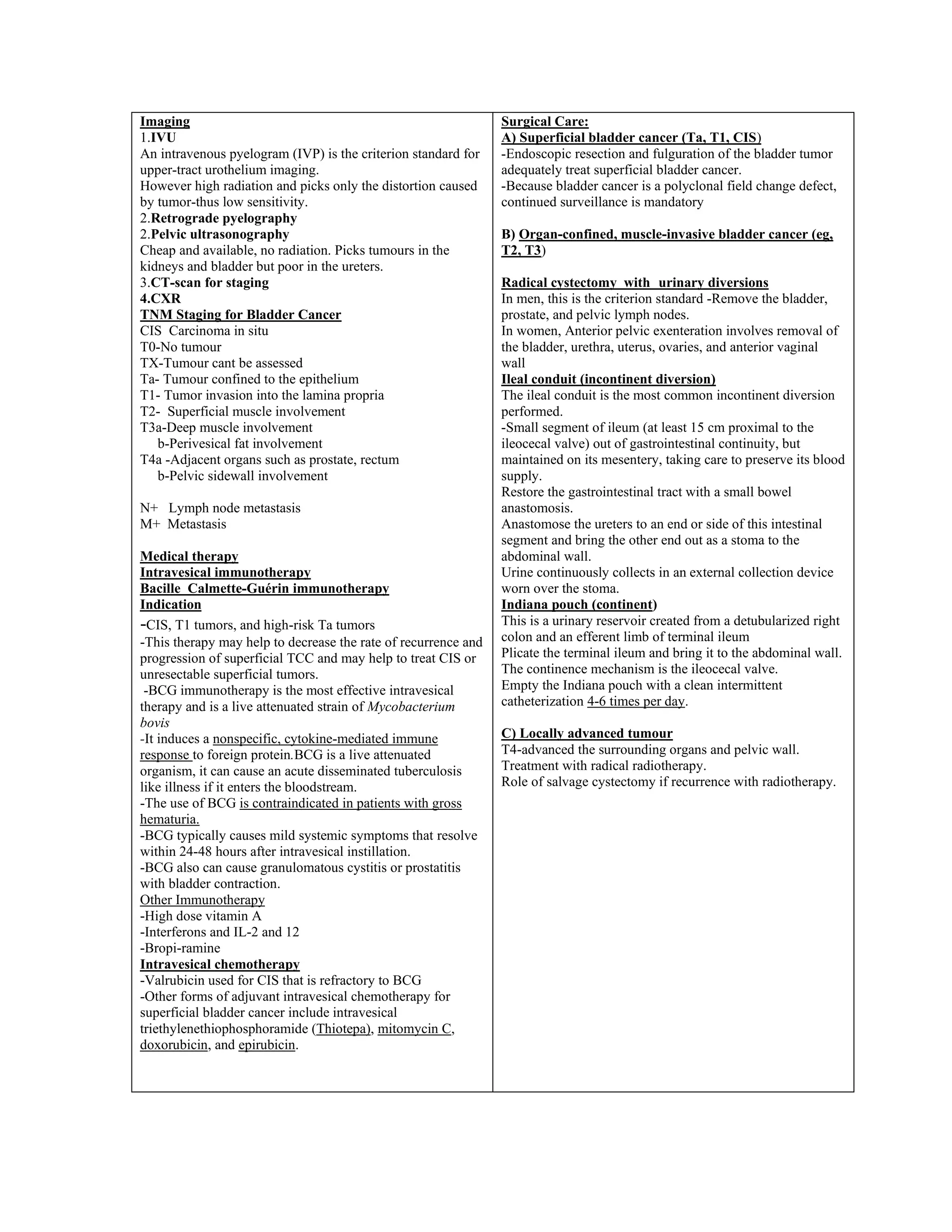
Imaging
1.IVU
An intravenous pyelogram (IVP) is the criterion standard for
upper-tract urothelium imaging.
However high radiation and picks only the distortion caused
by tumor-thus low sensitivity.
2.Retrograde pyelography
2.Pelvic ultrasonography
Cheap and available, no radiation. Picks tumours in the
kidneys and bladder but poor in the ureters.
3.CT-scan for staging
4.CXR
TNM Staging for Bladder Cancer
CIS Carcinoma in situ
T0-No tumour
TX-Tumour cant be assessed
Ta- Tumour confined to the epithelium
T1- Tumor invasion into the lamina propria
T2- Superficial muscle involvement
T3a-Deep muscle involvement
b-Perivesical fat involvement
T4a -Adjacent organs such as prostate, rectum
b-Pelvic sidewall involvement
N+ Lymph node metastasis
M+ Metastasis
Medical therapy
Intravesical immunotherapy
Bacille Calmette-Guérin immunotherapy
Indication
-CIS, T1 tumors, and high-risk Ta tumors
-This therapy may help to decrease the rate of recurrence and
progression of superficial TCC and may help to treat CIS or
unresectable superficial tumors.
-BCG immunotherapy is the most effective intravesical
therapy and is a live attenuated strain of Mycobacterium
bovis
-It induces a nonspecific, cytokine-mediated immune
response to foreign protein.BCG is a live attenuated
organism, it can cause an acute disseminated tuberculosis
like illness if it enters the bloodstream.
-The use of BCG is contraindicated in patients with gross
hematuria.
-BCG typically causes mild systemic symptoms that resolve
within 24-48 hours after intravesical instillation.
-BCG also can cause granulomatous cystitis or prostatitis
with bladder contraction.
Other Immunotherapy
-High dose vitamin A
-Interferons and IL-2 and 12
-Bropi-ramine
Intravesical chemotherapy
-Valrubicin used for CIS that is refractory to BCG
-Other forms of adjuvant intravesical chemotherapy for
superficial bladder cancer include intravesical
triethylenethiophosphoramide (Thiotepa), mitomycin C,
doxorubicin, and epirubicin.
Surgical Care:
A) Superficial bladder cancer (Ta, T1, CIS)
-Endoscopic resection and fulguration of the bladder tumor
adequately treat superficial bladder cancer.
-Because bladder cancer is a polyclonal field change defect,
continued surveillance is mandatory
B) Organ-confined, muscle-invasive bladder cancer (eg,
T2, T3)
Radical cystectomy with urinary diversions
In men, this is the criterion standard -Remove the bladder,
prostate, and pelvic lymph nodes.
In women, Anterior pelvic exenteration involves removal of
the bladder, urethra, uterus, ovaries, and anterior vaginal
wall
Ileal conduit (incontinent diversion)
The ileal conduit is the most common incontinent diversion
performed.
-Small segment of ileum (at least 15 cm proximal to the
ileocecal valve) out of gastrointestinal continuity, but
maintained on its mesentery, taking care to preserve its blood
supply.
Restore the gastrointestinal tract with a small bowel
anastomosis.
Anastomose the ureters to an end or side of this intestinal
segment and bring the other end out as a stoma to the
abdominal wall.
Urine continuously collects in an external collection device
worn over the stoma.
Indiana pouch (continent)
This is a urinary reservoir created from a detubularized right
colon and an efferent limb of terminal ileum
Plicate the terminal ileum and bring it to the abdominal wall.
The continence mechanism is the ileocecal valve.
Empty the Indiana pouch with a clean intermittent
catheterization 4-6 times per day.
C) Locally advanced tumour
T4-advanced the surrounding organs and pelvic wall.
Treatment with radical radiotherapy.
Role of salvage cystectomy if recurrence with radiotherapy.
BLADDER CARCINOMA.pdf

BLADDER CARCINOMA.pdf

  • 1.
  • 2.
    BLADDER CARCINOMA Introduction -Bladder canceris a common urologic cancer. -4th most common tumour in men after lung, prostate and colorectal cancer. -Most cases are transitional cell carcinoma (TCC) worldwide, often described as polyclonal field change defects. In Kenya the TCC and SCC are thought to be about 50% each. -Urothelium in the entire urinary tract may be involved, including the renal pelvis, ureter, bladder, and urethra. -Nonurothelial primary bladder tumors are rare and may include 1) Rhabdomyosarcoma 2) Small cell carcinoma 3) Carcinosarcoma 4) Sarcoma 5) Primary lymphoma Sex and Age -The male-to-female ratio is 3:1. -Women generally have a worse prognosis than men. -The median age at diagnosis is 68 years, and the incidence increases directly with age Race: -Bladder cancer is more common in whites than blacks; however, blacks have a worse prognosis Pathophysiology: Predisposing factors below. -Adenocarcinomas account for less than 2% of primary bladder tumors. -These tumors are observed most commonly in exstrophic bladders and are poorly responsive to radiation and chemotherapy. Radical cystectomy is the treatment of choice. Also develop in persistent urachus. -Most squamous cell carcinomas of the bladder in are associated with persistent inflammations from 1) Chronic cystitis-schistosomiasis 2) Long-term indwelling Foley catheters 3) Bladder stones. -Small cell carcinomas are thought to arise from neuroendocrine stem cells and are aggressive tumors that carry a poor prognosis. -Carcinosarcomas are highly malignant tumors that contain both mesenchymal and epithelial elements. -Primary bladder lymphomas arise in the submucosa of the bladder and are treated with radiation therapy. Leiomyosarcoma is the most common sarcoma of the bladder. Rhabdomyosarcomas most commonly occur in children and carry a poor prognosis Predisposing factors :Environmental 1. Cigarette Smoking-Nitrosamine, 2-naphthylamine, and 4- aminobiphenyl are possible carcinogenic agents 2.Industrial exposure to aromatic amines in dyes, paints, solvents, leather dust, inks, combustion products, rubber, and textiles 3.Prior radiation treatments to the pelvis 4. Exposure to acrolein, a urinary metabolite of cyclophosphamide, increases the risk of bladder cancer. 5.Artificial sweeteners (eg, saccharin, cyclamate) SCC 1)chronic cystitis-schistosomiasis 2)long-term indwelling Foley catheters 3)bladder stone Genetic 1. Mutations of the tumor suppressor gene p53, found on chromosome 17 and Rb gene in chromosome 13. 2. Mutations of the tumor suppressor genes p15 and p16, found on chromosome 9. Clinical presentation History 1. Painless global hematuria mostly gross hematuria but may be microscopic 2.Irritative symptoms-dysuria, frequency, urgency 3.Obstructive symptoms especially around the bladder neck.- poor stream, straining, incomplete emptying 4.Passage of tissue particles 5.Mucosuria-Adenocarcinoma 6.Renal failure signs -oedema -Inquiry of signs of advanced disease ➢ Back pains ➢ Hematochizia ➢ Pain on defecation -Any other bleeding from rest of the body -.Inquiry of predisposing factors-above Physical examination Clinical examination is usually normal, although an abdominal or pelvic mass may be palpable in those with advanced disease. Anemia -hematuria DDX-Causes of heamaturaia 1.Hemorrhagic Cystitis: Noninfectious 2.Nephrolithiasis 3.Renal Cell Carcinoma 4.Transitional Cell Carcinoma, Renal 5.Ureteral Trauma 6.UTI Investigations 1.FHG-Hb-Anaemia,WBC-UTI, Platelates-Hemorrhage 2.Urinalysis-Nitrites-UTI Microscopy-Microscopic hematuria.In surgical hematuria the RBC are not dysmorphic but in medical RBC may appear dysmorphic. 3.Urine cytology -for malignant cells 4.U/E/C- Upper tract involvement 5.Tumour markers -Bladder tumor antigen [BTA-Stat] -Nuclear matrix protein [NMP-22] -Fibrin/fibrinogen degradation products [FDP]) -Telomerase 6. Flexible cystoscopy -Urine for cytology -Biopsy of the areas with lesions or just sampled biopsy. -Resection of superficial tumors. Chemotherapy for metastatic cancer -The Methotrexate, Vinblastine, Adriamycin, and Cisplatin (M-VAC) or (MAC-V ) combination is the standard treatment of metastatic bladder cancer.
  • 3.
    Imaging 1.IVU An intravenous pyelogram(IVP) is the criterion standard for upper-tract urothelium imaging. However high radiation and picks only the distortion caused by tumor-thus low sensitivity. 2.Retrograde pyelography 2.Pelvic ultrasonography Cheap and available, no radiation. Picks tumours in the kidneys and bladder but poor in the ureters. 3.CT-scan for staging 4.CXR TNM Staging for Bladder Cancer CIS Carcinoma in situ T0-No tumour TX-Tumour cant be assessed Ta- Tumour confined to the epithelium T1- Tumor invasion into the lamina propria T2- Superficial muscle involvement T3a-Deep muscle involvement b-Perivesical fat involvement T4a -Adjacent organs such as prostate, rectum b-Pelvic sidewall involvement N+ Lymph node metastasis M+ Metastasis Medical therapy Intravesical immunotherapy Bacille Calmette-Guérin immunotherapy Indication -CIS, T1 tumors, and high-risk Ta tumors -This therapy may help to decrease the rate of recurrence and progression of superficial TCC and may help to treat CIS or unresectable superficial tumors. -BCG immunotherapy is the most effective intravesical therapy and is a live attenuated strain of Mycobacterium bovis -It induces a nonspecific, cytokine-mediated immune response to foreign protein.BCG is a live attenuated organism, it can cause an acute disseminated tuberculosis like illness if it enters the bloodstream. -The use of BCG is contraindicated in patients with gross hematuria. -BCG typically causes mild systemic symptoms that resolve within 24-48 hours after intravesical instillation. -BCG also can cause granulomatous cystitis or prostatitis with bladder contraction. Other Immunotherapy -High dose vitamin A -Interferons and IL-2 and 12 -Bropi-ramine Intravesical chemotherapy -Valrubicin used for CIS that is refractory to BCG -Other forms of adjuvant intravesical chemotherapy for superficial bladder cancer include intravesical triethylenethiophosphoramide (Thiotepa), mitomycin C, doxorubicin, and epirubicin. Surgical Care: A) Superficial bladder cancer (Ta, T1, CIS) -Endoscopic resection and fulguration of the bladder tumor adequately treat superficial bladder cancer. -Because bladder cancer is a polyclonal field change defect, continued surveillance is mandatory B) Organ-confined, muscle-invasive bladder cancer (eg, T2, T3) Radical cystectomy with urinary diversions In men, this is the criterion standard -Remove the bladder, prostate, and pelvic lymph nodes. In women, Anterior pelvic exenteration involves removal of the bladder, urethra, uterus, ovaries, and anterior vaginal wall Ileal conduit (incontinent diversion) The ileal conduit is the most common incontinent diversion performed. -Small segment of ileum (at least 15 cm proximal to the ileocecal valve) out of gastrointestinal continuity, but maintained on its mesentery, taking care to preserve its blood supply. Restore the gastrointestinal tract with a small bowel anastomosis. Anastomose the ureters to an end or side of this intestinal segment and bring the other end out as a stoma to the abdominal wall. Urine continuously collects in an external collection device worn over the stoma. Indiana pouch (continent) This is a urinary reservoir created from a detubularized right colon and an efferent limb of terminal ileum Plicate the terminal ileum and bring it to the abdominal wall. The continence mechanism is the ileocecal valve. Empty the Indiana pouch with a clean intermittent catheterization 4-6 times per day. C) Locally advanced tumour T4-advanced the surrounding organs and pelvic wall. Treatment with radical radiotherapy. Role of salvage cystectomy if recurrence with radiotherapy.