IN THE NAME OF ALLAH , THE MOST GRACIOUS AND MERCIFUL
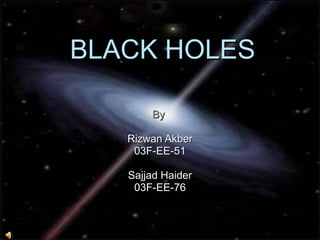
BLACK HOLES By   Rizwan Akber 03F-EE-51 Sajjad Haider 03F-EE-76
Introduction Black holes:  BUT  have been  thought as far as the  XVIII th   century… are until fascinating  and mysterious! Foundation of  the study= Albert EINSTEIN’s  Theory of General Relativity four  dimensionnal space: space-time
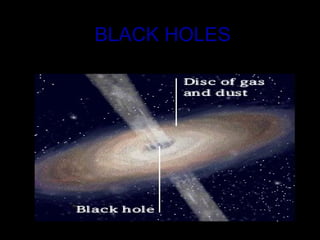
BLACK   HOLES
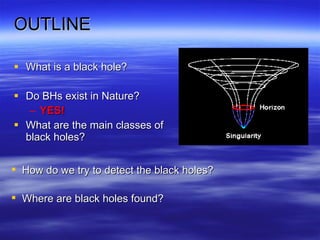
OUTLINE What is a black hole? Do BHs exist in Nature? YES! What are the main classes of black holes? How do we try to detect the black holes? Where are black holes found?
What is a black hole ? 2. Definition 3. Structure of black holes 4. Properties and representations of black holes History
1. History The concept of an object from which light could not escape (e.g., black hole) was originally proposed by Pierre Simon Laplace in 1795. Using Newton's Theory of  Gravity , Laplace calculated that if an object were compressed into a small enough radius, then the escape velocity of that object would be faster than the speed of light
Schwarzschild found an exact solution to general relativity in 1916 that predicted black holes. Not much interest until the 30’s when supporting evidence is discovered Many great physicists since then have worked on black holes
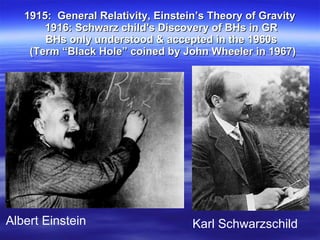
1915:  General Relativity, Einstein’s Theory of Gravity  1916: Schwarz child's Discovery of BHs in GR BHs only understood & accepted in the 1960s  (Term “Black Hole” coined by John Wheeler in 1967) Karl Schwarzschild Albert Einstein
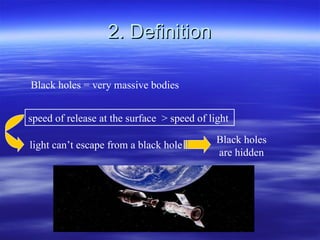
2. Definition Black holes = very massive bodies speed of release at the surface  > speed of light  light can’t escape from a black hole Black holes are hidden
 
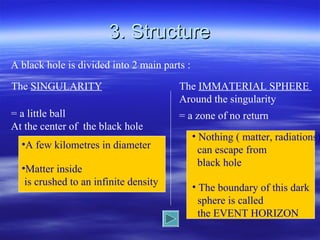
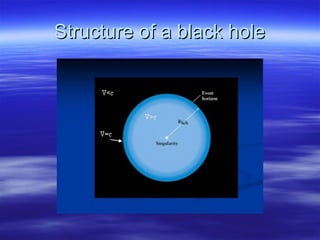
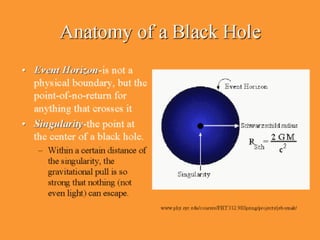
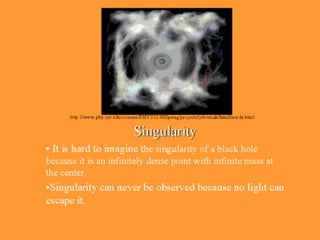
3. Structure A black hole is divided into 2 main parts :  The  SINGULARITY = a little ball  At the center of  the black hole  A few kilometres in diameter Matter inside  is crushed to an infinite density The  IMMATERIAL SPHERE  Around the singularity = a zone of no return  Nothing ( matter, radiations) can escape from  black hole The boundary of this dark sphere is called  the EVENT HORIZON
Structure of a black hole
 
 
4.Properties and representations Black holes, unlike most objects can only have three  characteristics Mass Angular momentum or spin Electric charge
Black Holes: Do They Really Exist? We cannot see black holes directly, so we have to look for indirect evidences… What would you look for to find a stellar-massed black hole, like those formed after the death of high mass stars? To look for black holes formed by the death of  high mass stars, we can look for binary systems that allows us to determine the mass of the objects. If we find an object with mass exceeding 3 M ⊙  , but is neither a regular star, nor a neutron star, then we can argue that it may well be a black hole .
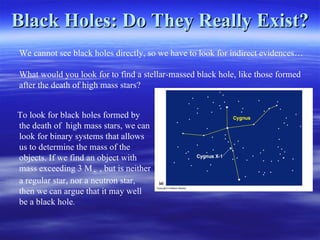
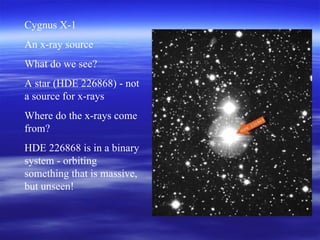
Cygnus X-1 An x-ray source What do we see? A star (HDE 226868) - not a source for x-rays Where do the x-rays come from? HDE 226868 is in a binary system - orbiting something that is massive, but unseen!
Black hole classifications Black holes are theorized to come in three different sizes Steller Supermassive Primordial
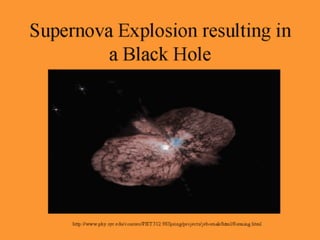
1. Stellar black holes One class of black-hole candidates are stellar-mass black holes, which are thought to form when a massive star ends its life in a supernova explosion.  Created from stars of more than ~30 M solar Detectable in binary systems
 
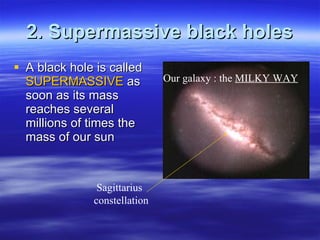
2. Supermassive black holes A black hole is called  SUPERMASSIVE  as  soon as its mass  reaches several millions of times the mass of our sun Our galaxy : the  MILKY WAY Sagittarius constellation
Supermassive black holes These are also called as quasi-stellar radio sources – quasars, for short – because they looked like stars, and produced large amounts of radio waves as well as light.
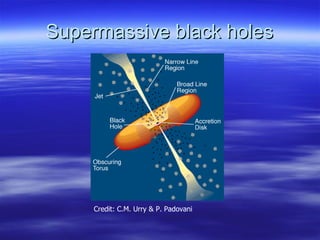
Supermassive black holes Credit: C.M. Urry & P. Padovani
Observations of supermassive black holes Many galaxies have been observed to contain such massive dark objects in their centers.  The masses of the cores of these galaxies range from one million to several billion times the mass of the Sun.
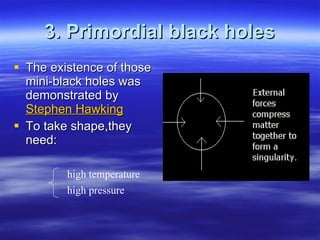
3. Primordial black holes The existence of those mini-black holes was demonstrated by  Stephen Hawking To take shape,they need: high temperature high pressure
How We Detect Black Holes Black holes and neutron stars don't give off light, so we can't just look for them. However, astronomers can find black holes and neutron stars by observing the gravitational effects on other objects nearby. X-rays Rotating Stars Gravity Lenses
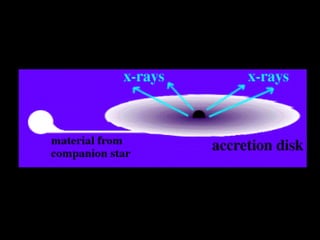
X-rays Astronomers can discover some black holes and neutron stars because they are sources of x-rays.  The intense gravity from a black hole or a neutron star will pull in dust particles from a surrounding cloud of dust or a nearby star.  As the particles speed up and heat up, they emit x-rays. So the x-rays don't come directly from the black hole or neutron star, but from its effect on the dust around it.  Although x-rays don't penetrate our atmosphere, astronomers use satellites to observe x-ray sources in the sky.
 
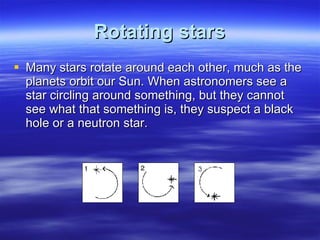
Rotating stars Many stars rotate around each other, much as the planets orbit our Sun. When astronomers see a star circling around something, but they cannot see what that something is, they suspect a black hole or a neutron star.
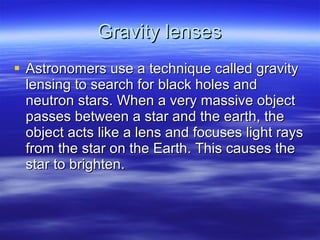
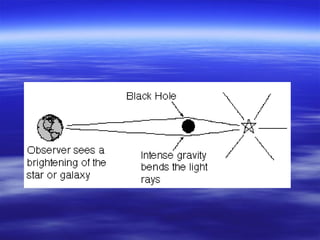
Gravity lenses Astronomers use a technique called gravity lensing to search for black holes and neutron stars. When a very massive object passes between a star and the earth, the object acts like a lens and focuses light rays from the star on the Earth. This causes the star to brighten.
 
Observations of black holes How can you check whether something is a black hole or not?  The first thing you’d like to do is measure how much mass there is in that region.  If you've found a large mass concentrated in a small volume, and if the mass is dark, then it's a good guess that there's a black hole there.
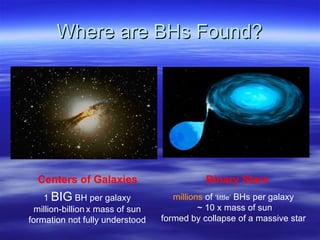
Where are BHs Found? Centers of Galaxies Binary Stars 1  BIG  BH per galaxy million-billion   x mass of sun formation not fully understood millions  of  ‘little’  BHs per galaxy ~ 10 x mass of sun formed by collapse of a massive star


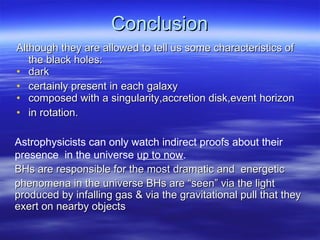
Conclusion Although they are allowed to tell us some characteristics of the black holes: dark  certainly present in each galaxy composed with a singularity,accretion disk,event horizon in rotation. Astrophysicists can only watch indirect proofs about their presence  in the universe  up to now . BHs are responsible for the most dramatic and  energetic phenomena in the universe BHs are “seen” via the light produced by infalling gas & via the gravitational pull that they exert on nearby objects
THE END!

Black holes

  • 1.
    IN THE NAMEOF ALLAH , THE MOST GRACIOUS AND MERCIFUL
  • 2.
    BLACK HOLES By Rizwan Akber 03F-EE-51 Sajjad Haider 03F-EE-76
  • 3.
    Introduction Black holes: BUT have been thought as far as the XVIII th century… are until fascinating and mysterious! Foundation of the study= Albert EINSTEIN’s Theory of General Relativity four dimensionnal space: space-time
  • 4.
    BLACK HOLES
  • 5.
    OUTLINE What isa black hole? Do BHs exist in Nature? YES! What are the main classes of black holes? How do we try to detect the black holes? Where are black holes found?
  • 6.
    What is ablack hole ? 2. Definition 3. Structure of black holes 4. Properties and representations of black holes History
  • 7.
    1. History Theconcept of an object from which light could not escape (e.g., black hole) was originally proposed by Pierre Simon Laplace in 1795. Using Newton's Theory of Gravity , Laplace calculated that if an object were compressed into a small enough radius, then the escape velocity of that object would be faster than the speed of light
  • 8.
    Schwarzschild found anexact solution to general relativity in 1916 that predicted black holes. Not much interest until the 30’s when supporting evidence is discovered Many great physicists since then have worked on black holes
  • 9.
    1915: GeneralRelativity, Einstein’s Theory of Gravity 1916: Schwarz child's Discovery of BHs in GR BHs only understood & accepted in the 1960s (Term “Black Hole” coined by John Wheeler in 1967) Karl Schwarzschild Albert Einstein
  • 10.
    2. Definition Blackholes = very massive bodies speed of release at the surface > speed of light light can’t escape from a black hole Black holes are hidden
  • 11.
  • 12.
    3. Structure Ablack hole is divided into 2 main parts : The SINGULARITY = a little ball At the center of the black hole A few kilometres in diameter Matter inside is crushed to an infinite density The IMMATERIAL SPHERE Around the singularity = a zone of no return Nothing ( matter, radiations) can escape from black hole The boundary of this dark sphere is called the EVENT HORIZON
  • 13.
    Structure of ablack hole
  • 14.
  • 15.
  • 16.
    4.Properties and representationsBlack holes, unlike most objects can only have three characteristics Mass Angular momentum or spin Electric charge
  • 17.
    Black Holes: DoThey Really Exist? We cannot see black holes directly, so we have to look for indirect evidences… What would you look for to find a stellar-massed black hole, like those formed after the death of high mass stars? To look for black holes formed by the death of high mass stars, we can look for binary systems that allows us to determine the mass of the objects. If we find an object with mass exceeding 3 M ⊙ , but is neither a regular star, nor a neutron star, then we can argue that it may well be a black hole .
  • 18.
    Cygnus X-1 Anx-ray source What do we see? A star (HDE 226868) - not a source for x-rays Where do the x-rays come from? HDE 226868 is in a binary system - orbiting something that is massive, but unseen!
  • 19.
    Black hole classificationsBlack holes are theorized to come in three different sizes Steller Supermassive Primordial
  • 20.
    1. Stellar blackholes One class of black-hole candidates are stellar-mass black holes, which are thought to form when a massive star ends its life in a supernova explosion. Created from stars of more than ~30 M solar Detectable in binary systems
  • 21.
  • 22.
    2. Supermassive blackholes A black hole is called SUPERMASSIVE as soon as its mass reaches several millions of times the mass of our sun Our galaxy : the MILKY WAY Sagittarius constellation
  • 23.
    Supermassive black holesThese are also called as quasi-stellar radio sources – quasars, for short – because they looked like stars, and produced large amounts of radio waves as well as light.
  • 24.
    Supermassive black holesCredit: C.M. Urry & P. Padovani
  • 25.
    Observations of supermassiveblack holes Many galaxies have been observed to contain such massive dark objects in their centers. The masses of the cores of these galaxies range from one million to several billion times the mass of the Sun.
  • 26.
    3. Primordial blackholes The existence of those mini-black holes was demonstrated by Stephen Hawking To take shape,they need: high temperature high pressure
  • 27.
    How We DetectBlack Holes Black holes and neutron stars don't give off light, so we can't just look for them. However, astronomers can find black holes and neutron stars by observing the gravitational effects on other objects nearby. X-rays Rotating Stars Gravity Lenses
  • 28.
    X-rays Astronomers candiscover some black holes and neutron stars because they are sources of x-rays. The intense gravity from a black hole or a neutron star will pull in dust particles from a surrounding cloud of dust or a nearby star. As the particles speed up and heat up, they emit x-rays. So the x-rays don't come directly from the black hole or neutron star, but from its effect on the dust around it. Although x-rays don't penetrate our atmosphere, astronomers use satellites to observe x-ray sources in the sky.
  • 29.
  • 30.
    Rotating stars Manystars rotate around each other, much as the planets orbit our Sun. When astronomers see a star circling around something, but they cannot see what that something is, they suspect a black hole or a neutron star.
  • 31.
    Gravity lenses Astronomersuse a technique called gravity lensing to search for black holes and neutron stars. When a very massive object passes between a star and the earth, the object acts like a lens and focuses light rays from the star on the Earth. This causes the star to brighten.
  • 32.
  • 33.
    Observations of blackholes How can you check whether something is a black hole or not? The first thing you’d like to do is measure how much mass there is in that region. If you've found a large mass concentrated in a small volume, and if the mass is dark, then it's a good guess that there's a black hole there.
  • 34.
    Where are BHsFound? Centers of Galaxies Binary Stars 1 BIG BH per galaxy million-billion x mass of sun formation not fully understood millions of ‘little’ BHs per galaxy ~ 10 x mass of sun formed by collapse of a massive star
  • 35.
  • 36.
  • 37.
  • 38.
  • 39.
    Conclusion Although theyare allowed to tell us some characteristics of the black holes: dark certainly present in each galaxy composed with a singularity,accretion disk,event horizon in rotation. Astrophysicists can only watch indirect proofs about their presence in the universe up to now . BHs are responsible for the most dramatic and energetic phenomena in the universe BHs are “seen” via the light produced by infalling gas & via the gravitational pull that they exert on nearby objects
  • 40.