By: Shane Ruangdet
• Pulsars powered by the loss of rotational energy.
  The rotation rate diminishes which provides the power.
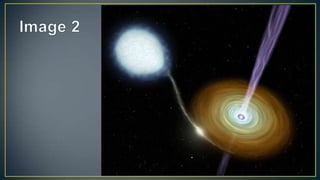
• Pulsars powered by accretion (X-ray pulsars): the
  gravitational energy of the infalling matter is the source of
  power.
• Magnetars, pulsars with a very strong magnetic field that
  provides the power.
• "Silent" neutron stars, that have a binary partner, whose
  rotation indicates the present of a neutron star that is
  either old and silent, or not sweeping its beam in our
• A neutron star is a type of stellar remnant that can result from
  the gravitational collapse.
• Color: bright white.
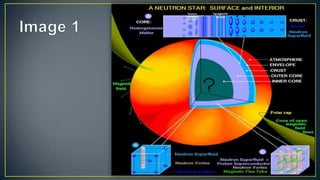
• A neutron star is about 20 km in diameter and has the mass of
  about 1.4 times that of our Sun.
• Neutron star is so dense that on Earth, one teaspoonful would
  weigh a billion tons!
• Neutron Stars results from massive stars which have mass
  greater than 4 to 8 times that of our Sun. After these stars
  have finished burning their nuclear fuel, they undergo a
  supernova explosion.
1. It starts from Stella Nebula - Massive Star – Red Giant
   – Supernova.
2. Then medium-size star runs out of fuel, it will collapse
   on itself.
3. It has a large enough mass that it can push past the
   resistance from electron degeneracy pressure.
4. When it collapses more, it will stopped by neutron
   pressure.
5. The star fuses protons with electrons.
6. Finally it forms into a neutron star.
• http://www3.amherst.edu/~gsgreenstein/progs/animation
  s/pulsar_beacon/pulsar.gif
• http://en.wikipedia.org/wiki/Neutron_star
• http://imagine.gsfc.nasa.gov/docs/science/know_l1/pulsar
  s.html
• http://www.astro.umd.edu/~miller/nstar.html
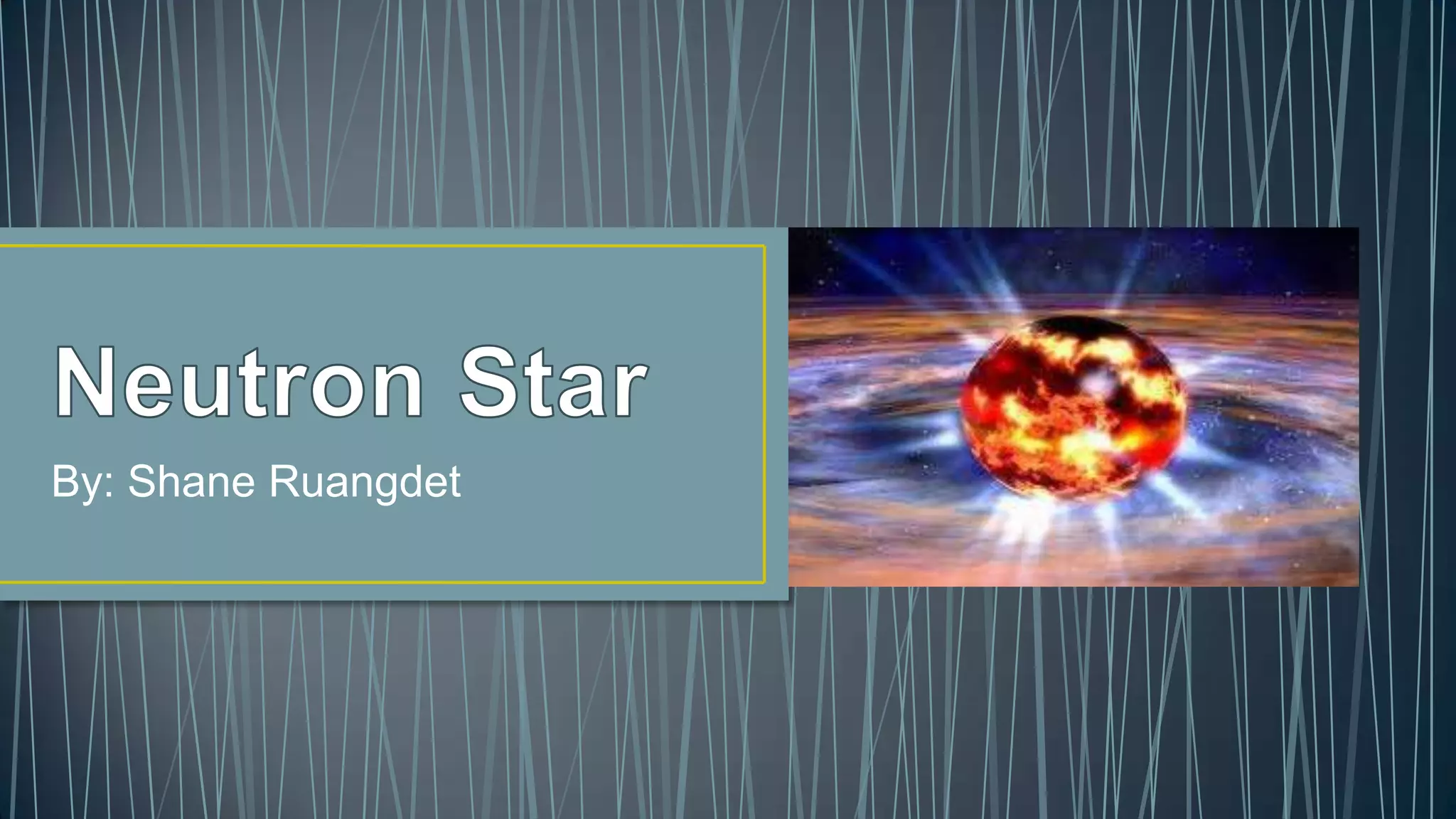
Neutron Star

Neutron Star

  • 1.
  • 2.
    • Pulsars poweredby the loss of rotational energy. The rotation rate diminishes which provides the power. • Pulsars powered by accretion (X-ray pulsars): the gravitational energy of the infalling matter is the source of power. • Magnetars, pulsars with a very strong magnetic field that provides the power. • "Silent" neutron stars, that have a binary partner, whose rotation indicates the present of a neutron star that is either old and silent, or not sweeping its beam in our
  • 3.
    • A neutronstar is a type of stellar remnant that can result from the gravitational collapse. • Color: bright white. • A neutron star is about 20 km in diameter and has the mass of about 1.4 times that of our Sun. • Neutron star is so dense that on Earth, one teaspoonful would weigh a billion tons! • Neutron Stars results from massive stars which have mass greater than 4 to 8 times that of our Sun. After these stars have finished burning their nuclear fuel, they undergo a supernova explosion.
  • 4.
    1. It startsfrom Stella Nebula - Massive Star – Red Giant – Supernova. 2. Then medium-size star runs out of fuel, it will collapse on itself. 3. It has a large enough mass that it can push past the resistance from electron degeneracy pressure. 4. When it collapses more, it will stopped by neutron pressure. 5. The star fuses protons with electrons. 6. Finally it forms into a neutron star.
  • 7.
  • 8.