BLACK HOLE
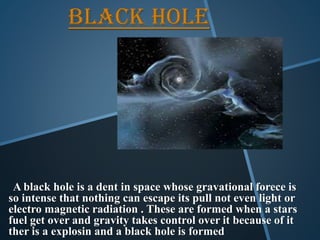
A black hole is a dent in space whose gravational forece is
so intense that nothing can escape its pull not even light or
electro magnetic radiation . These are formed when a stars
fuel get over and gravity takes control over it because of it
ther is a explosin and a black hole is formed
HOW MANY TYPES OF BLACK HOLES ARE THERE ?
there are 2 types of confirmed black holes and one theoretical type
1. STEELAR BLACK HOLE: these black holes are mostly found inside the galaxy . When this
star dies the explosion is called supernova
2. SUPER MASSIVE BLACK HOLE: Thes black holes are formed when a very big star approx
200 million times the size of sun dies . The explosion of this star is called a hypernova the
black hole are most;y at the centre of every galaxy and are very important for the existence
of galaxies
 PIN POINT BLACK HOLE: this is a therotical type .
Stephen hawkings gave the theory but in present
this blach hole is not confirmed
 Formation of a black hole
 When a gigantic star reaches the final stage of its life and is about to go supernova
(which normally takes billions of years), it spends all the nuclear fuel by then. So it
stops burning and heating up and cannot create the nuclear energy required to feed
the star and let it make a pivotal balance to support its own gravitational draw
against the intense pressures brewing inside.
 its stability cracks under its own gravity.
 The radius of the star shrinks to a critical size, called the Schwarzschild radius .
 The outer shells of the star explode into the space. They may even fall into the
already dense black hole making it even heavier and denser. And that’s how you get
a stellar mass black hole.
HOW BIG ARE BLACK HOLES
 Black holes can be big or small. Scientists think the smallest black holes are as
small as just one atom. These black holes are very tiny but have the mass of a large
mountain. Mass is the amount of matter, or "stuff," in an object.
 Another kind of black hole is called "stellar." Its mass can be up to 20 times more
than the mass of the sun. There may be many, many stellar mass black holes in
Earth's galaxy. Earth's galaxy is called the Milky Way.
 The largest black holes are called "supermassive." These black holes have masses
that are more than 1 million suns together. Scientists have found proof that every
large galaxy contains a supermassive black hole at its center. The supermassive
black hole at the center of the Milky Way galaxy is called Sagittarius A. It has a
mass equal to about 4 million suns and would fit inside a very large ball that could
hold a few million Earths.
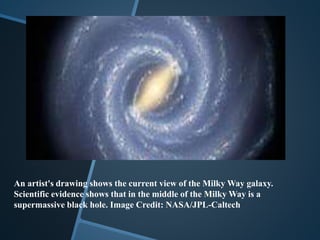
An artist's drawing shows the current view of the Milky Way galaxy.
Scientific evidence shows that in the middle of the Milky Way is a
supermassive black hole. Image Credit: NASA/JPL-Caltech
iF BLACK HOLES ARE “BLACK” HOW DO SCIENTISTS
KNOW THEY ARE THERE ?
 A black hole can not be seen because strong
gravity pulls all of the light into the middle of the
black hole. But scientists can see how the strong
gravity affects the stars and gas around the black
hole. Scientists can study stars to find out if they are
flying around, or orbiting, a black hole.
 When a black hole and a star are close together,
high-energy light is made. This kind of light can not
be seen with human eyes. Scientists use satellites
and telescopes in space to see the high-energy light.
COULD A BLACK HOLE DISTROY EARTH
 Black holes do not go around in space eating stars, moons and planets.
Earth will not fall into a black hole because no black hole is close enough to
the solar system for Earth to do that.
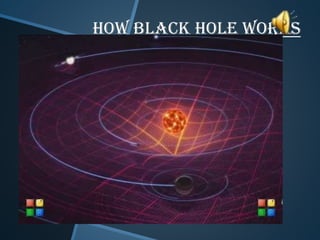
 Even if a black hole the same mass as the sun were to take the place of the
sun, Earth still would not fall in. The black hole would have the same gravity as
the sun. Earth and the other planets would orbit the black hole as they orbit the
sun now.
 The sun will never turn into a black hole. The sun is not a big enough star to
make a black hole.
HOW BLACK HOLE WORKS
THE END

BLACK HOLE FOR FYBA STUDENTS

  • 2.
    BLACK HOLE A blackhole is a dent in space whose gravational forece is so intense that nothing can escape its pull not even light or electro magnetic radiation . These are formed when a stars fuel get over and gravity takes control over it because of it ther is a explosin and a black hole is formed
  • 3.
    HOW MANY TYPESOF BLACK HOLES ARE THERE ? there are 2 types of confirmed black holes and one theoretical type 1. STEELAR BLACK HOLE: these black holes are mostly found inside the galaxy . When this star dies the explosion is called supernova 2. SUPER MASSIVE BLACK HOLE: Thes black holes are formed when a very big star approx 200 million times the size of sun dies . The explosion of this star is called a hypernova the black hole are most;y at the centre of every galaxy and are very important for the existence of galaxies  PIN POINT BLACK HOLE: this is a therotical type . Stephen hawkings gave the theory but in present this blach hole is not confirmed
  • 4.
     Formation ofa black hole  When a gigantic star reaches the final stage of its life and is about to go supernova (which normally takes billions of years), it spends all the nuclear fuel by then. So it stops burning and heating up and cannot create the nuclear energy required to feed the star and let it make a pivotal balance to support its own gravitational draw against the intense pressures brewing inside.  its stability cracks under its own gravity.  The radius of the star shrinks to a critical size, called the Schwarzschild radius .  The outer shells of the star explode into the space. They may even fall into the already dense black hole making it even heavier and denser. And that’s how you get a stellar mass black hole.
  • 6.
    HOW BIG AREBLACK HOLES  Black holes can be big or small. Scientists think the smallest black holes are as small as just one atom. These black holes are very tiny but have the mass of a large mountain. Mass is the amount of matter, or "stuff," in an object.  Another kind of black hole is called "stellar." Its mass can be up to 20 times more than the mass of the sun. There may be many, many stellar mass black holes in Earth's galaxy. Earth's galaxy is called the Milky Way.  The largest black holes are called "supermassive." These black holes have masses that are more than 1 million suns together. Scientists have found proof that every large galaxy contains a supermassive black hole at its center. The supermassive black hole at the center of the Milky Way galaxy is called Sagittarius A. It has a mass equal to about 4 million suns and would fit inside a very large ball that could hold a few million Earths.
  • 7.
    An artist's drawingshows the current view of the Milky Way galaxy. Scientific evidence shows that in the middle of the Milky Way is a supermassive black hole. Image Credit: NASA/JPL-Caltech
  • 8.
    iF BLACK HOLESARE “BLACK” HOW DO SCIENTISTS KNOW THEY ARE THERE ?  A black hole can not be seen because strong gravity pulls all of the light into the middle of the black hole. But scientists can see how the strong gravity affects the stars and gas around the black hole. Scientists can study stars to find out if they are flying around, or orbiting, a black hole.  When a black hole and a star are close together, high-energy light is made. This kind of light can not be seen with human eyes. Scientists use satellites and telescopes in space to see the high-energy light.
  • 9.
    COULD A BLACKHOLE DISTROY EARTH  Black holes do not go around in space eating stars, moons and planets. Earth will not fall into a black hole because no black hole is close enough to the solar system for Earth to do that.  Even if a black hole the same mass as the sun were to take the place of the sun, Earth still would not fall in. The black hole would have the same gravity as the sun. Earth and the other planets would orbit the black hole as they orbit the sun now.  The sun will never turn into a black hole. The sun is not a big enough star to make a black hole.
  • 10.
  • 12.