Distribution of stars
and
Globular cluster
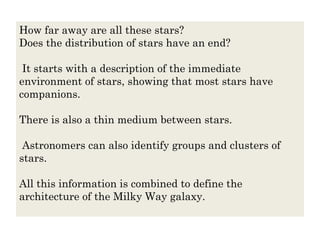
How far away are all these stars?
Does the distribution of stars have an end?
It starts with a description of the immediate
environment of stars, showing that most stars have
companions.
There is also a thin medium between stars.
Astronomers can also identify groups and clusters of
stars.
All this information is combined to define the
architecture of the Milky Way galaxy.
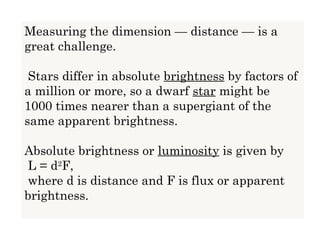
Measuring the dimension — distance — is a
great challenge.
Stars differ in absolute brightness by factors of
a million or more, so a dwarf star might be
1000 times nearer than a supergiant of the
same apparent brightness.
Absolute brightness or luminosity is given by
L = d2F,
where d is distance and F is flux or apparent
brightness.
Remember that L is the true brightness
of an object, or the number of photons it
emits each second, while F is the
brightness we measure on Earth, or the
number of photons per second we collect
with our telescope.
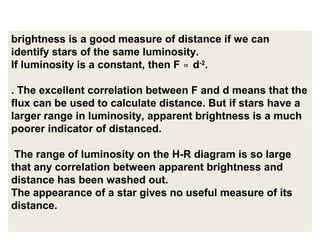
brightness is a good measure of distance if we can
identify stars of the same luminosity.
If luminosity is a constant, then F ∝ d-2.
. The excellent correlation between F and d means that the
flux can be used to calculate distance. But if stars have a
larger range in luminosity, apparent brightness is a much
poorer indicator of distanced.
The range of luminosity on the H-R diagram is so large
that any correlation between apparent brightness and
distance has been washed out.
The appearance of a star gives no useful measure of its
distance.
As early as 1767,
John Mitchell — who was the father of the idea
of black holes — decided that there were too
many alignments to be caused by chance.

He believed that the stars in each pair were
close enough in space to orbit each other by
gravity.
Uniform, Random, and Clustered
Distributions of Stars.
To understand how John Mitchell deduced that some
stars are double,
Two types of distribution
uniform and random.
Imagine that stars are distributed in only two dimensions,
on a plane.
A uniform distribution refers to objects that
are separated by equal distances.

A uniform distribution of stars would be spread out in
a regular grid with equal distances between each one.
The distance from any star to its nearest neighbor is
always the same.
A uniform distribution may be realistic to describe the
way atoms are laid out in a crystal, but it is not
realistic to describe the way stars are laid out in space
random distribution
refers to objects that are separated by random
distances.
In this case, the distance between a star and its
nearest neighbor star can vary quite widely.
However, the average distance between stars is the
same as for a uniform distribution. To see that this
must be true, remember that the number of stars
and the total area are unchanged, so the average
spacing is unchanged too.
Stars in the real universe show clustering.
A clustered distribution refers to objects that are separated
by distances that tend to be smaller than for a random
distribution.
When stars are clustered on the plane of the sky, the
nearest neighbors tend to be separated by small angles.
Clustering is revealed by the higher probability of any star
having a neighbor at a small separation, compared to a
random distribution.
An open cluster of

stars is one that can contain
about a dozen to a few hundred members. In
addition, they are spaced loosely and are generally younger,
hot stars.
Open clusters are commonly found in the disk of a galaxy.
Examples of Open Clusters:
The Pleiades open cluster is a group of newly formed B-type
stars. This 115 million year-old open cluster is easily visible
with the naked eye. The brightest stars have a surface
temperature of 30,000 Kelvin, however there are other stars
that are a part of the cluster that have a variety of
temperatures much cooler than these.
The Persius double-cluster is a remarkable site. This is actually a
two open clusters.
Star clusters give astronomers a unique opportunity. All we know
about stellar evolution come from star clusters (both open and closed).
Stars in a cluster form at different times because of a variety of
masses, but all contain nearly the same spectroscopic data. By careful
observation, a Color-Magnitude Diagram can be created to plot the
progression of evolution. A Color-Magnitude Diagram (or CMD) is
really a specialized H-R diagram:
The organization of stars on the diagram give us the age of the cluster.
Sometimes the mutual gravity of a cluster cannot hold the cluster together.

Here is a summary chart of star clusters:
Characteristic:

Number of Stars:
Mass (Solar):

OB Associations:

Globular Clusters:

<10

30 - 200

20 - 100

50- 1000

10 - 100

104 - 106

100 - 1000

100 - 1000

104 - 106

0.1 - 10

Diameter (pc):

Open Clusters:

<0.01

0.5 - 1000

Irregular

Irregular

Spherical

Red or Blue

Blue

Red

High

High

Low

Disk of Galaxy

Disk of Galaxy

Halo of Galaxy

Density (Solar
Mass/pc3):
Shape:
Color (Common):
Metallicity:
Location:
globular clusters give astronomers a unique insight to how
stars evolve.
Globular star clusters are found orbiting the center of our
galaxy in the halo.
The yellow dots are the distribution of globular
clusters.
They are generally comprised of old, metal
poor stars - that is contain little elements
heavier than helium. This means globular
clusters formed a long time ago, before our
galaxy contained more heavy stars. By
contrast, open clusters have more heavier
metals.
Here are some examples of globular clusters:
The image above is of one of the most dramatic clusters around Omega Centauri.
This Hubble Space Telescope image of M15 shows
what appears to be a concentration of stars at the very
center. This has led some to suggest that a black hole is
at the heart of this (and others) cluster.
What provides insight to this is the high concentration
of white dwarfs found.

what appears to be a concentration
of stars at the very center. This
has led some to suggest that
ablack hole is at the heart of this
(and others) cluster.
What provides insight to this is
the high concentration of white
dwarfs found.
Because globular clusters are old, it will be rare to see the CMD distribution like the
one on the left. The distribution of stars will be more like the diagram on the right.
Most of the stars will have already entered the Red Giant stage. This is called the
Main-Sequence Turn-Off point (MSTO). The age of the cluster is determined by the
stars that have already entered the MSTO stage.
Here is a summary
chart of star
clusters:5
Characteristic:

Open Clusters:

OB Associations:

Globular Clusters:

<10

30 - 200

20 - 100

50- 1000

10 - 100

104 - 106

Mass (Solar):

100 - 1000

100 - 1000

104 - 106

Density (Solar
Mass/pc3):
Shape:

0.1 - 10

<0.01

0.5 - 1000

Irregular

Irregular

Spherical

Red or Blue

Blue

Red

High

High

Low

Disk of Galaxy

Disk of Galaxy

Halo of Galaxy

Diameter (pc):
Number of Stars:

Color (Common):
Metallicity:
Location:

astronomy: Stars- distribution and cluster

  • 1.
  • 2.
    How far awayare all these stars? Does the distribution of stars have an end? It starts with a description of the immediate environment of stars, showing that most stars have companions. There is also a thin medium between stars. Astronomers can also identify groups and clusters of stars. All this information is combined to define the architecture of the Milky Way galaxy.
  • 3.
    Measuring the dimension— distance — is a great challenge. Stars differ in absolute brightness by factors of a million or more, so a dwarf star might be 1000 times nearer than a supergiant of the same apparent brightness. Absolute brightness or luminosity is given by L = d2F, where d is distance and F is flux or apparent brightness.
  • 4.
    Remember that Lis the true brightness of an object, or the number of photons it emits each second, while F is the brightness we measure on Earth, or the number of photons per second we collect with our telescope.
  • 5.
    brightness is agood measure of distance if we can identify stars of the same luminosity. If luminosity is a constant, then F ∝ d-2. . The excellent correlation between F and d means that the flux can be used to calculate distance. But if stars have a larger range in luminosity, apparent brightness is a much poorer indicator of distanced. The range of luminosity on the H-R diagram is so large that any correlation between apparent brightness and distance has been washed out. The appearance of a star gives no useful measure of its distance.
  • 6.
    As early as1767, John Mitchell — who was the father of the idea of black holes — decided that there were too many alignments to be caused by chance. He believed that the stars in each pair were close enough in space to orbit each other by gravity.
  • 7.
    Uniform, Random, andClustered Distributions of Stars. To understand how John Mitchell deduced that some stars are double, Two types of distribution uniform and random. Imagine that stars are distributed in only two dimensions, on a plane.
  • 8.
    A uniform distributionrefers to objects that are separated by equal distances. A uniform distribution of stars would be spread out in a regular grid with equal distances between each one. The distance from any star to its nearest neighbor is always the same. A uniform distribution may be realistic to describe the way atoms are laid out in a crystal, but it is not realistic to describe the way stars are laid out in space
  • 9.
    random distribution refers toobjects that are separated by random distances. In this case, the distance between a star and its nearest neighbor star can vary quite widely. However, the average distance between stars is the same as for a uniform distribution. To see that this must be true, remember that the number of stars and the total area are unchanged, so the average spacing is unchanged too.
  • 11.
    Stars in thereal universe show clustering. A clustered distribution refers to objects that are separated by distances that tend to be smaller than for a random distribution. When stars are clustered on the plane of the sky, the nearest neighbors tend to be separated by small angles. Clustering is revealed by the higher probability of any star having a neighbor at a small separation, compared to a random distribution.
  • 12.
    An open clusterof stars is one that can contain about a dozen to a few hundred members. In addition, they are spaced loosely and are generally younger, hot stars. Open clusters are commonly found in the disk of a galaxy. Examples of Open Clusters: The Pleiades open cluster is a group of newly formed B-type stars. This 115 million year-old open cluster is easily visible with the naked eye. The brightest stars have a surface temperature of 30,000 Kelvin, however there are other stars that are a part of the cluster that have a variety of temperatures much cooler than these.
  • 13.
    The Persius double-clusteris a remarkable site. This is actually a two open clusters.
  • 14.
    Star clusters giveastronomers a unique opportunity. All we know about stellar evolution come from star clusters (both open and closed). Stars in a cluster form at different times because of a variety of masses, but all contain nearly the same spectroscopic data. By careful observation, a Color-Magnitude Diagram can be created to plot the progression of evolution. A Color-Magnitude Diagram (or CMD) is really a specialized H-R diagram:
  • 15.
    The organization ofstars on the diagram give us the age of the cluster. Sometimes the mutual gravity of a cluster cannot hold the cluster together. Here is a summary chart of star clusters: Characteristic: Number of Stars: Mass (Solar): OB Associations: Globular Clusters: <10 30 - 200 20 - 100 50- 1000 10 - 100 104 - 106 100 - 1000 100 - 1000 104 - 106 0.1 - 10 Diameter (pc): Open Clusters: <0.01 0.5 - 1000 Irregular Irregular Spherical Red or Blue Blue Red High High Low Disk of Galaxy Disk of Galaxy Halo of Galaxy Density (Solar Mass/pc3): Shape: Color (Common): Metallicity: Location:
  • 16.
    globular clusters giveastronomers a unique insight to how stars evolve. Globular star clusters are found orbiting the center of our galaxy in the halo.
  • 17.
    The yellow dotsare the distribution of globular clusters. They are generally comprised of old, metal poor stars - that is contain little elements heavier than helium. This means globular clusters formed a long time ago, before our galaxy contained more heavy stars. By contrast, open clusters have more heavier metals. Here are some examples of globular clusters:
  • 18.
    The image aboveis of one of the most dramatic clusters around Omega Centauri.
  • 19.
    This Hubble SpaceTelescope image of M15 shows what appears to be a concentration of stars at the very center. This has led some to suggest that a black hole is at the heart of this (and others) cluster. What provides insight to this is the high concentration of white dwarfs found. what appears to be a concentration of stars at the very center. This has led some to suggest that ablack hole is at the heart of this (and others) cluster. What provides insight to this is the high concentration of white dwarfs found.
  • 20.
    Because globular clustersare old, it will be rare to see the CMD distribution like the one on the left. The distribution of stars will be more like the diagram on the right. Most of the stars will have already entered the Red Giant stage. This is called the Main-Sequence Turn-Off point (MSTO). The age of the cluster is determined by the stars that have already entered the MSTO stage.
  • 21.
    Here is asummary chart of star clusters:5 Characteristic: Open Clusters: OB Associations: Globular Clusters: <10 30 - 200 20 - 100 50- 1000 10 - 100 104 - 106 Mass (Solar): 100 - 1000 100 - 1000 104 - 106 Density (Solar Mass/pc3): Shape: 0.1 - 10 <0.01 0.5 - 1000 Irregular Irregular Spherical Red or Blue Blue Red High High Low Disk of Galaxy Disk of Galaxy Halo of Galaxy Diameter (pc): Number of Stars: Color (Common): Metallicity: Location: