HISTORY OF BLACK HOLES
•
•
•
•
•
•

Geologist John Mitchell put forward the
idea of a body so massive that even light
could not escape.
1915 Einstein develops his theory of relativity
The Golden Age of relativity
General relativity
Becoming mainstream
started
Black holes

subjects of research

• Israel, Carter and Robinson Noair Theorem
• 1970s, Hawking other scientists formulation of black holes
thermodynamics.
HISTORY OF BLACK HOLES
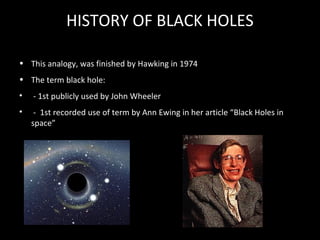
• This analogy, was finished by Hawking in 1974
• The term black hole:
•

- 1st publicly used by John Wheeler

•

- 1st recorded use of term by Ann Ewing in her article “Black Holes in
space”
FEATURES
CLASSIFICATION

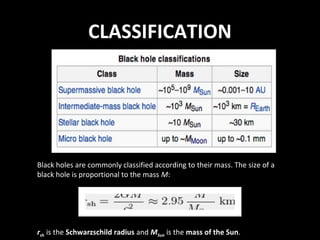
Black holes are commonly classified according to their mass. The size of a
black hole is proportional to the mass M:

rsh is the Schwarzschild radius and MSun is the mass of the Sun.
EVENT HORIZON
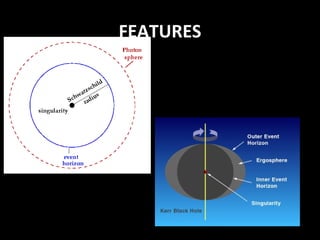
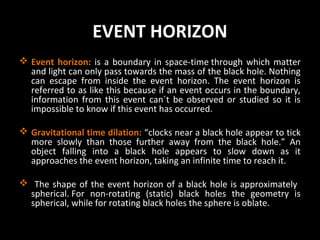
 Event horizon: is a boundary in space-time through which matter
and light can only pass towards the mass of the black hole. Nothing
can escape from inside the event horizon. The event horizon is
referred to as like this because if an event occurs in the boundary,
information from this event can´t be observed or studied so it is
impossible to know if this event has occurred.
 Gravitational time dilation: “clocks near a black hole appear to tick
more slowly than those further away from the black hole.” An
object falling into a black hole appears to slow down as it
approaches the event horizon, taking an infinite time to reach it.
 The shape of the event horizon of a black hole is approximately
spherical. For non-rotating (static) black holes the geometry is
spherical, while for rotating black holes the sphere is oblate.
SINGULARITY
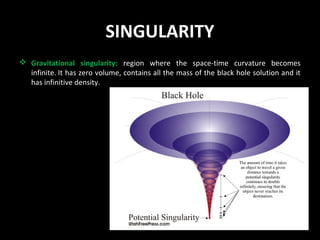
 Gravitational singularity: region where the space-time curvature becomes
infinite. It has zero volume, contains all the mass of the black hole solution and it
has infinitive density.
PHOTON SPHERE
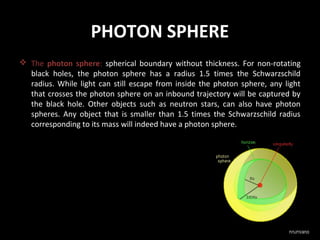
 The photon sphere: spherical boundary without thickness. For non-rotating
black holes, the photon sphere has a radius 1.5 times the Schwarzschild
radius. While light can still escape from inside the photon sphere, any light
that crosses the photon sphere on an inbound trajectory will be captured by
the black hole. Other objects such as neutron stars, can also have photon
spheres. Any object that is smaller than 1.5 times the Schwarzschild radius
corresponding to its mass will indeed have a photon sphere.
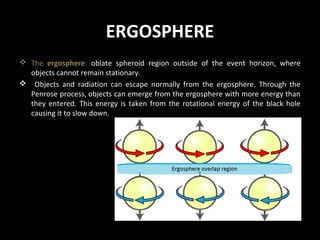
ERGOSPHERE
 The ergosphere: oblate spheroid region outside of the event horizon, where
objects cannot remain stationary.
 Objects and radiation can escape normally from the ergosphere. Through the
Penrose process, objects can emerge from the ergosphere with more energy than
they entered. This energy is taken from the rotational energy of the black hole
causing it to slow down.
Depending on the mass black holes can
be:
Supermasive black holes : They are those who have masses of several million
solar masses. They are at the heart of many galaxies . Are formed in the same
process that gives rise to spherical components of galaxies.
Stellar-mass black holes : They are formed when a star of mass 2.5 times that
of the Sun goes supernova and explodes. Its nucleus is concentrated in a very
small volume is reduced whenever more . This is the type of black hole for the
first time goes into the theory of general relativity.
Micro black holes : They are hypothetical objects , somewhat smaller than
stellar . If they are small enough, they can get to evaporate in a relatively
short period through emission of Hawking radiation . This type of physical
entities is postulated in some approaches to quantum gravity, but can not be
generated by a conventional process of gravitational collapse , which requires
higher mass to the Sun
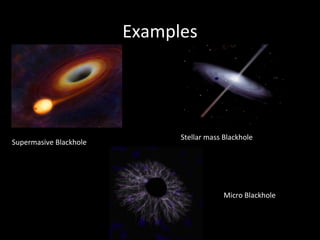
Examples

Supermasive Blackhole

Stellar mass Blackhole

Micro Blackhole
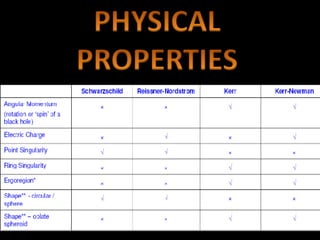
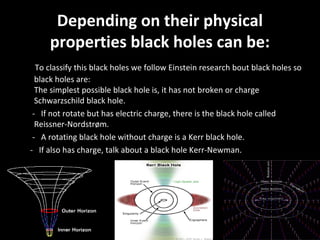
Depending on their physical
properties black holes can be:
To classify this black holes we follow Einstein research bout black holes so
black holes are:
The simplest possible black hole is, it has not broken or charge
Schwarzschild black hole.
- If not rotate but has electric charge, there is the black hole called
Reissner-Nordstrøm.
- A rotating black hole without charge is a Kerr black hole.
- If also has charge, talk about a black hole Kerr-Newman.

Black holes powerpoint

  • 1.
    HISTORY OF BLACKHOLES • • • • • • Geologist John Mitchell put forward the idea of a body so massive that even light could not escape. 1915 Einstein develops his theory of relativity The Golden Age of relativity General relativity Becoming mainstream started Black holes subjects of research • Israel, Carter and Robinson Noair Theorem • 1970s, Hawking other scientists formulation of black holes thermodynamics.
  • 2.
    HISTORY OF BLACKHOLES • This analogy, was finished by Hawking in 1974 • The term black hole: • - 1st publicly used by John Wheeler • - 1st recorded use of term by Ann Ewing in her article “Black Holes in space”
  • 4.
  • 5.
    CLASSIFICATION Black holes arecommonly classified according to their mass. The size of a black hole is proportional to the mass M: rsh is the Schwarzschild radius and MSun is the mass of the Sun.
  • 6.
    EVENT HORIZON  Eventhorizon: is a boundary in space-time through which matter and light can only pass towards the mass of the black hole. Nothing can escape from inside the event horizon. The event horizon is referred to as like this because if an event occurs in the boundary, information from this event can´t be observed or studied so it is impossible to know if this event has occurred.  Gravitational time dilation: “clocks near a black hole appear to tick more slowly than those further away from the black hole.” An object falling into a black hole appears to slow down as it approaches the event horizon, taking an infinite time to reach it.  The shape of the event horizon of a black hole is approximately spherical. For non-rotating (static) black holes the geometry is spherical, while for rotating black holes the sphere is oblate.
  • 7.
    SINGULARITY  Gravitational singularity:region where the space-time curvature becomes infinite. It has zero volume, contains all the mass of the black hole solution and it has infinitive density.
  • 8.
    PHOTON SPHERE  Thephoton sphere: spherical boundary without thickness. For non-rotating black holes, the photon sphere has a radius 1.5 times the Schwarzschild radius. While light can still escape from inside the photon sphere, any light that crosses the photon sphere on an inbound trajectory will be captured by the black hole. Other objects such as neutron stars, can also have photon spheres. Any object that is smaller than 1.5 times the Schwarzschild radius corresponding to its mass will indeed have a photon sphere.
  • 9.
    ERGOSPHERE  The ergosphere:oblate spheroid region outside of the event horizon, where objects cannot remain stationary.  Objects and radiation can escape normally from the ergosphere. Through the Penrose process, objects can emerge from the ergosphere with more energy than they entered. This energy is taken from the rotational energy of the black hole causing it to slow down.
  • 10.
    Depending on themass black holes can be: Supermasive black holes : They are those who have masses of several million solar masses. They are at the heart of many galaxies . Are formed in the same process that gives rise to spherical components of galaxies. Stellar-mass black holes : They are formed when a star of mass 2.5 times that of the Sun goes supernova and explodes. Its nucleus is concentrated in a very small volume is reduced whenever more . This is the type of black hole for the first time goes into the theory of general relativity. Micro black holes : They are hypothetical objects , somewhat smaller than stellar . If they are small enough, they can get to evaporate in a relatively short period through emission of Hawking radiation . This type of physical entities is postulated in some approaches to quantum gravity, but can not be generated by a conventional process of gravitational collapse , which requires higher mass to the Sun
  • 11.
  • 12.
    Depending on theirphysical properties black holes can be: To classify this black holes we follow Einstein research bout black holes so black holes are: The simplest possible black hole is, it has not broken or charge Schwarzschild black hole. - If not rotate but has electric charge, there is the black hole called Reissner-Nordstrøm. - A rotating black hole without charge is a Kerr black hole. - If also has charge, talk about a black hole Kerr-Newman.