DARK MATTER 
Presentation by: Ernesto Jiménez, Irene 
Mengibar and Irene Wbanet
Introduction 
• Everything we can see is made of atoms. 
• Ordinary matter is just a 5% of the 
universe. 
• Evidence for dark matter (95%): 
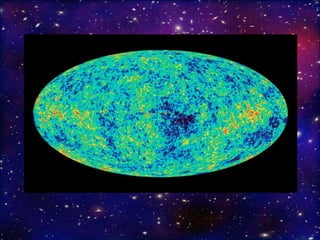
1.Cosmic Microwave Background. 
2.The need of more matter than the visible 
one to explain some gravitational effects.
Definition of dark matter 
• Dark matter is a 27% of the universe. 
• It is not reactant to light. 
• It is important because of its gravitational 
effects in the universe’s structure.
1st type: Cosmological constant 
• It is spread all around the universe, 
homogeneously. 
• It is the simplest for of dark energy 
because it is constant in space and time. 
• It is the type which causes the expansion 
of the universe.
2nd type: Scalar fields 
• Is dynamic, so constant over space but 
changes over time. 
• Can change over space also but these 
ones are very similar to cosmological 
constant.
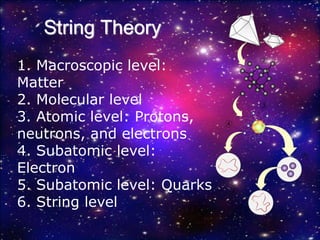
String Theory 
1. Macroscopic level: 
Matter 
2. Molecular level 
3. Atomic level: Protons, 
neutrons, and electrons 
4. Subatomic level: 
Electron 
5. Subatomic level: Quarks 
6. String level
String Theory 
• One string is the base of matter 
• Each oscillation makes a sub-particle 
• It makes up their properties 
• It also explains particle interaction
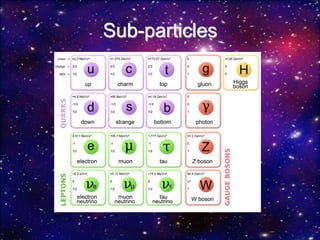
Sub-particles
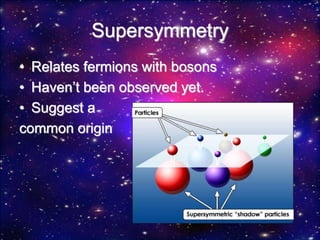
Supersymmetry 
• Relates fermions with bosons 
• Haven’t been observed yet. 
• Suggest a 
common origin
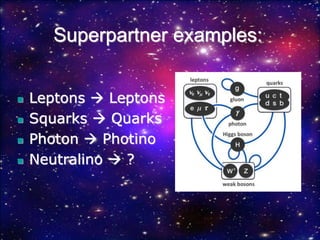
Superpartner examples: 
 Leptons  Leptons 
 Squarks  Quarks 
 Photon  Photino 
 Neutralino  ?
What is dark matter? 
• Dark matter is not in the form of stars and 
planets that we can see. 
• It is not in the form of dark clouds of 
normal matter, otherwise we could detect 
the baryonic clouds which forms this 
matter 
• Dark matter is not antimatter, because we 
can’t see the gamma rays
Composition 
There are two different possibilities: 
•The WIMPS (Weakly interacting Massive 
Particles) 
•The MACHOs (Massive Compact Halo 
Objects)
WIMPs 
• They are subatomic particles which are 
not made up of ordinary matter. 
• They include neutrinos, axions and 
neutralinos
MACHOs 
• They are objects ranging in size from 
small stars to super massive black holes. 
• They are made up of ordinary matter (like 
protons, neutrons and electrons) 
• They may be black holes, neutron stars or 
brown dwarfs.
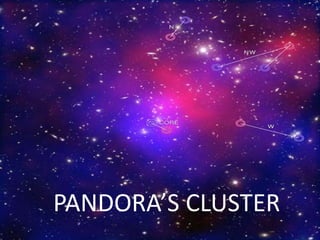
Pandora’s Cluster 
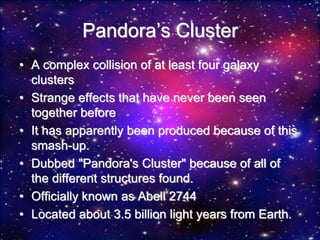
• A complex collision of at least four galaxy 
clusters 
• Strange effects that have never been seen 
together before 
• It has apparently been produced because of this 
smash-up. 
• Dubbed "Pandora's Cluster" because of all of 
the different structures found. 
• Officially known as Abell 2744 
• Located about 3.5 billion light years from Earth.
PANDORA’S CLUSTER
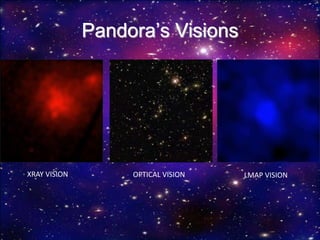
Pandora’s Visions 
XRAY VISION OPTICAL VISION LMAP VISION
NOW PREPARE YOURSELF 
FOR… 
A TEST 
Only one answer is valid…
Test 
• What does not react to electromagnetic 
waves in any significant form? 
A: Dark energy 
B: Dark matter 
C: Cosmic Microwave Background.
Test 
• What does not react to electromagnetic 
waves in any significant form? 
A: Dark energy 
B: Dark matter 
C: Cosmic Microwave Background.
Test 
• What is the value of the energy density 
of the vacuum of space? 
A: Dark energy 
B: Black holes 
C: Cosmological constant
Test 
• What is the value of the energy density 
of the vacuum of space? 
A: Dark energy 
B: Black holes 
C: Cosmological constant
Test 
• How would the supersymmetrical 
partner of an up quark be called? 
A: Down quark 
B: Antiup quark 
C: Up squark 
D: Up quark hasn’t got any 
supersymmetrical partner
Test 
• How would the supersymmetrical 
partner of an up quark be called? 
A: Down quark 
B: Antiup quark 
C: Up squark 
D: Up quark hasn’t got any 
supersymmetrical partner
Test 
• How many sub-atomic particles are 
there in the standard model? 
A: 15 
B: 18 
C: 17
Test 
• How many sub-atomic particles are 
there in the standard model? 
A: 15 
B: 18 
C: 17
Test 
• Can you name the three particles 
included in WIMPs? 
A: Protons, neutrons and neutralinos 
B: Neutrinos, axions and electrons 
C: Neutrinos, axions and neutralinos 
D: Neutrinos, neutrons and neutralinos
Test 
• Can you name the three particles 
included in WIMPs? 
A: Protons, neutrons and neutralinos 
B: Neutrinos, axions and electrons 
C: Neutrinos, axions and neutralinos 
D: Neutrinos, neutrons and neutralinos
Test 
• What are MACHOs? 
A: They are subatomic particles which are 
not made up of ordinary matter. 
B: They are very small objects made up of 
neutrinos, axions and neutralinos 
C: They are subatomic particles not made 
from ordinary matter 
D: They are objects ranging in size from 
small to massive black holes
Test 
• WIMPs are… 
A: Weakly Interacting Massive Particles 
B: Weakly Interesting Massive Particles 
C: White Infrared Massive Pieces 
D: Widely Interacting Massive Particles
Test 
• WIMPs are… 
A: Weakly Interacting Massive Particles 
B: Weakly Interesting Massive Particles 
C: White Infrared Massive Pieces 
D: Widely Interacting Massive Particles
HOPE YOU LIKED IT!! 
Be careful with black holes….