 BLACK HOLES
 PRESENTATION BY : BILAL MEHMOOD, BS CIVIL 5TH
 PRESENTATION CONTENTS
WHAT IS A BLACK HOLE ?
DO BLACK HOLES REALLY EXISTS ?
WHAT HAPPENS WHEN YOU GET CLOSE TO IT ?
HOW ARE THEY FORMED ?
SIZE OF BLACK HOLES
• Black holes are volumes of space where gravity is extreme enough to prevent the
escape of even the fastest moving particles.
• A German physicist and astronomer named Karl Schwarzschild proposed the modern
version of a black hole in 1915 after coming up with an exact solution to Einstein's
approximations of general relativity
• Schwarzschild realized it was possible for mass to be squeezed into an infinitely small
point. This would make space-time around it bend so that nothing – not even massless
photons of light – could escape its curvature making them the most dense object in the
entire observable universe
 WHAT IS THIS BLACK HOLE THING ?
 DO BLACK HOLES REALLY EXISTS ?
• For decades, black holes were exotic peculiarities of general relativity.
• Physicists have became increasingly confident in their existence as other extreme
astronomical objects, like neutron stars, were discovered.
• Most galaxies have monstrous black holes at their core.
ON THE OTHER HAND,
• “ Black holes do not exist—at least, not as we know them ” , says renowned physicist
Stephen Hawking, potentially provoking a rethink of one of space's most mysterious
objects.
• A new study from Hawking also says that black holes may not possess "firewalls,"
destructive belts of radiation that some researchers have proposed would incinerate
anything that passes through them but others scientists deem an impossibility.
Recent Discoveries
Date Discovery
September 26, 2019 TESS Mission Spots Its First Star-shredding Black Hole
September 25, 2019 Three Black Holes On Collision Course
September 11, 2019 Scientists Discover Black Hole Has Three Hot Meals a Day
August 8, 2019 Cloaked Black Hole Discovered in Early Universe (QSO PSO167-13)
July 24, 2019 How Black Holes Shape Galaxies (PG 1114+445)
August 8, 2019 Cloaked Black Hole Discovered in Early Universe (QSO PSO167-13)
July 24, 2019 How Black Holes Shape Galaxies (PG 1114+445)
July 11, 2019 Hubble Uncovers Black Hole Disk that Shouldn't Exist
July 3, 2019 X-rays Spot Spinning Black Holes Across Cosmic Sea
June 11, 2019 Magnetic Field May Be Keeping Milky Way’s Black Hole Quiet
April 25, 2019 The Giant Galaxy Around the Giant Black Hole
April 10, 2019 Chandra Captures X-rays in Coordination with Event Horizon Telescope
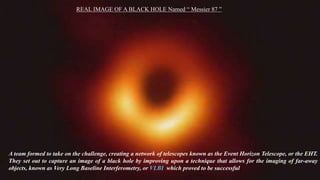
A team formed to take on the challenge, creating a network of telescopes known as the Event Horizon Telescope, or the EHT.
They set out to capture an image of a black hole by improving upon a technique that allows for the imaging of far-away
objects, known as Very Long Baseline Interferometry, or VLBI which proved to be successful
REAL IMAGE OF A BLACK HOLE Named “ Messier 87 ”
• Indeed, gravity would be so strong at this boundary that nothing, not even light,
could escape. And any matter that fell in would spiral helplessly to its doom in the
infinitely dense singularity.
• The exact effects depend on the size and mass of the black hole. A “Stellar-mass"
black hole - a black hole that's a few times the mass of the Sun - exerts a strong
"tidal" pull on any object that approaches its Event horizon.
• That is the same effect that creates the tides on Earth: The gravitational pull on the
side of the object that is closest to the black hole is significantly stronger than the
pull on the opposite side, so gravity stretches the object and pulls it apart
 WHAT HAPPENS WHEN YOU GET CLOSE
TO IT ?
• Black Holes are made when very large stars die. When the star runs out of fuel for
nuclear burning in the core it is no longer able to support itself from collapsing under
its own weight.
• The star first collapses and then the outer layers rebound to form a supernova
explosion.
• What's left at the core is a Neutron Star or a Black Hole depending on the initial mass
of the star. To form a Black Hole the mass left at the core after the explosion must be
more than about 3 times the mass of the Sun.
• The star for most of its life probably needs to be between 50 to 100 times the mass of
the Sun to eventually form a Black Hole.
 HOW ARE THEY FORMED ?
• Here's just how big black holes can really get.
• In a known galaxy, called M33, there's a black hole that is 58 miles across and packs
as much mass as 15.7 suns inside.
• Up next are the intermediate-mass black holes, like this one. At 1,460 miles across,
it's nearly large enough to stretch from Florida to Maine and, according to some
calculations, contains the mass of 400 suns.
 SIZES OF BLACKHOLES
• At this point, black holes start to get pretty big compared to Earth, but it's still nothing
when you consider the sheer mass they carry.
• Take this black hole, for example. It's nearly twice the size of Jupiter, spanning a
region about 172,000 miles wide, but inside is as much mass as 47,000 suns.
• But these black holes are nothing compared to supermassive black holes, like
Sagittarius A*, which lives at the center of our Milky Way galaxy. It covers a region
about 14.6 million miles in diameter.
THANK YOU...!

BLACK HOLES ( peculiar object in space )

  • 1.
     BLACK HOLES PRESENTATION BY : BILAL MEHMOOD, BS CIVIL 5TH
  • 2.
     PRESENTATION CONTENTS WHATIS A BLACK HOLE ? DO BLACK HOLES REALLY EXISTS ? WHAT HAPPENS WHEN YOU GET CLOSE TO IT ? HOW ARE THEY FORMED ? SIZE OF BLACK HOLES
  • 3.
    • Black holesare volumes of space where gravity is extreme enough to prevent the escape of even the fastest moving particles. • A German physicist and astronomer named Karl Schwarzschild proposed the modern version of a black hole in 1915 after coming up with an exact solution to Einstein's approximations of general relativity • Schwarzschild realized it was possible for mass to be squeezed into an infinitely small point. This would make space-time around it bend so that nothing – not even massless photons of light – could escape its curvature making them the most dense object in the entire observable universe  WHAT IS THIS BLACK HOLE THING ?
  • 5.
     DO BLACKHOLES REALLY EXISTS ? • For decades, black holes were exotic peculiarities of general relativity. • Physicists have became increasingly confident in their existence as other extreme astronomical objects, like neutron stars, were discovered. • Most galaxies have monstrous black holes at their core. ON THE OTHER HAND, • “ Black holes do not exist—at least, not as we know them ” , says renowned physicist Stephen Hawking, potentially provoking a rethink of one of space's most mysterious objects. • A new study from Hawking also says that black holes may not possess "firewalls," destructive belts of radiation that some researchers have proposed would incinerate anything that passes through them but others scientists deem an impossibility.
  • 6.
    Recent Discoveries Date Discovery September26, 2019 TESS Mission Spots Its First Star-shredding Black Hole September 25, 2019 Three Black Holes On Collision Course September 11, 2019 Scientists Discover Black Hole Has Three Hot Meals a Day August 8, 2019 Cloaked Black Hole Discovered in Early Universe (QSO PSO167-13) July 24, 2019 How Black Holes Shape Galaxies (PG 1114+445) August 8, 2019 Cloaked Black Hole Discovered in Early Universe (QSO PSO167-13) July 24, 2019 How Black Holes Shape Galaxies (PG 1114+445) July 11, 2019 Hubble Uncovers Black Hole Disk that Shouldn't Exist July 3, 2019 X-rays Spot Spinning Black Holes Across Cosmic Sea June 11, 2019 Magnetic Field May Be Keeping Milky Way’s Black Hole Quiet April 25, 2019 The Giant Galaxy Around the Giant Black Hole April 10, 2019 Chandra Captures X-rays in Coordination with Event Horizon Telescope
  • 7.
    A team formedto take on the challenge, creating a network of telescopes known as the Event Horizon Telescope, or the EHT. They set out to capture an image of a black hole by improving upon a technique that allows for the imaging of far-away objects, known as Very Long Baseline Interferometry, or VLBI which proved to be successful REAL IMAGE OF A BLACK HOLE Named “ Messier 87 ”
  • 8.
    • Indeed, gravitywould be so strong at this boundary that nothing, not even light, could escape. And any matter that fell in would spiral helplessly to its doom in the infinitely dense singularity. • The exact effects depend on the size and mass of the black hole. A “Stellar-mass" black hole - a black hole that's a few times the mass of the Sun - exerts a strong "tidal" pull on any object that approaches its Event horizon. • That is the same effect that creates the tides on Earth: The gravitational pull on the side of the object that is closest to the black hole is significantly stronger than the pull on the opposite side, so gravity stretches the object and pulls it apart  WHAT HAPPENS WHEN YOU GET CLOSE TO IT ?
  • 9.
    • Black Holesare made when very large stars die. When the star runs out of fuel for nuclear burning in the core it is no longer able to support itself from collapsing under its own weight. • The star first collapses and then the outer layers rebound to form a supernova explosion. • What's left at the core is a Neutron Star or a Black Hole depending on the initial mass of the star. To form a Black Hole the mass left at the core after the explosion must be more than about 3 times the mass of the Sun. • The star for most of its life probably needs to be between 50 to 100 times the mass of the Sun to eventually form a Black Hole.  HOW ARE THEY FORMED ?
  • 10.
    • Here's justhow big black holes can really get. • In a known galaxy, called M33, there's a black hole that is 58 miles across and packs as much mass as 15.7 suns inside. • Up next are the intermediate-mass black holes, like this one. At 1,460 miles across, it's nearly large enough to stretch from Florida to Maine and, according to some calculations, contains the mass of 400 suns.  SIZES OF BLACKHOLES
  • 11.
    • At thispoint, black holes start to get pretty big compared to Earth, but it's still nothing when you consider the sheer mass they carry. • Take this black hole, for example. It's nearly twice the size of Jupiter, spanning a region about 172,000 miles wide, but inside is as much mass as 47,000 suns. • But these black holes are nothing compared to supermassive black holes, like Sagittarius A*, which lives at the center of our Milky Way galaxy. It covers a region about 14.6 million miles in diameter.
  • 12.