An Introduction to Asymmetric Multiprocessing:
when this architecture can be a game changer
and how to survive it.
Nicola La Gloria, Laura Nao
Kynetics LLC
Santa Clara, California
Hybrid Architecture: warpx.io
The Hybrid Design Architecture (HDA)
combines the power of an application
processor with the ease-of-use of
micro-controllers.
Software on warpx HDA
SMP vs AMP
SMP on homogeneous architectures:
● Single OS controlling two or more
identical cores sharing system
resources
● Dynamic scheduling and load
balancing
Core1
CoreN
Kernel SMP
OS
App App
. . .
SMP vs AMP
Core1
CoreN
MCAPI
OS OS/RTOS
App App Task Task
AMP on heterogeneous architectures:
● Different OS on each core -->
full-featured OS alongside a
real-time kernel
● Inter processor communication
protocol
● Efficient when the application can
be statically partitioned across
cores - high performance is
achieved locally
. . .
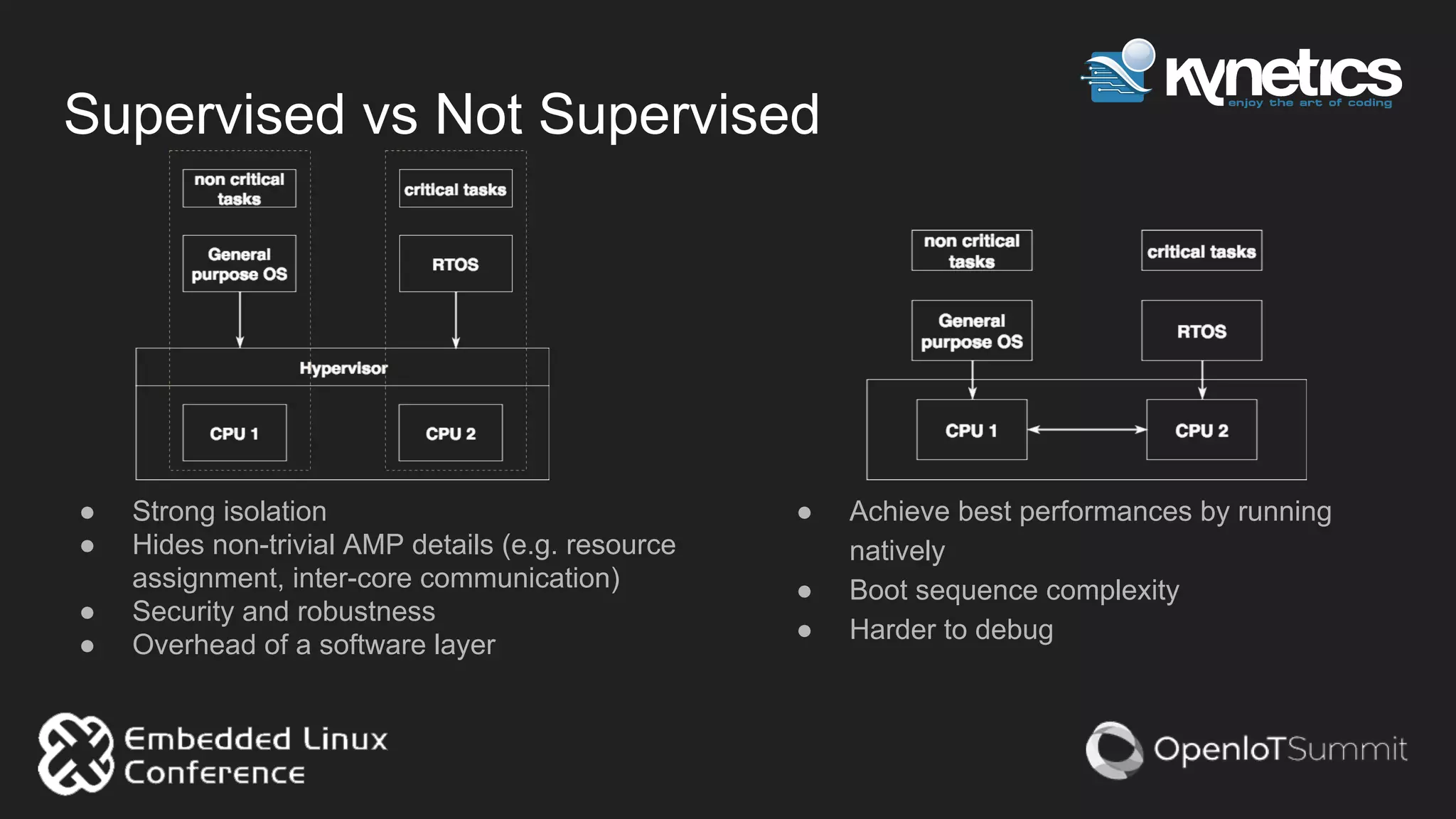
Supervised vs Not Supervised
● Strong isolation
● Hides non-trivial AMP details (e.g. resource
assignment, inter-core communication)
● Security and robustness
● Overhead of a software layer
● Achieve best performances by running
natively
● Boot sequence complexity
● Harder to debug
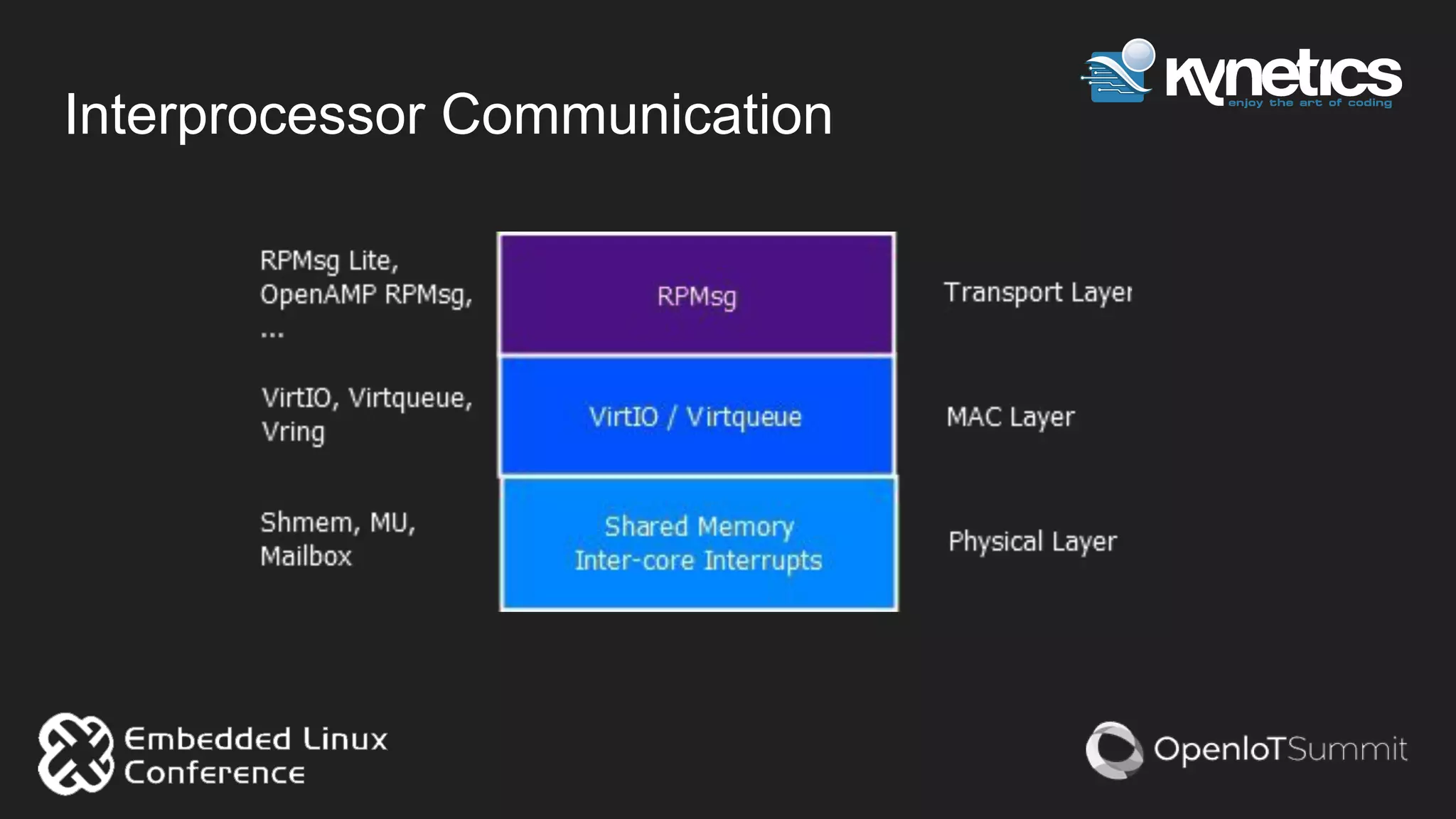
Interprocessor Communication
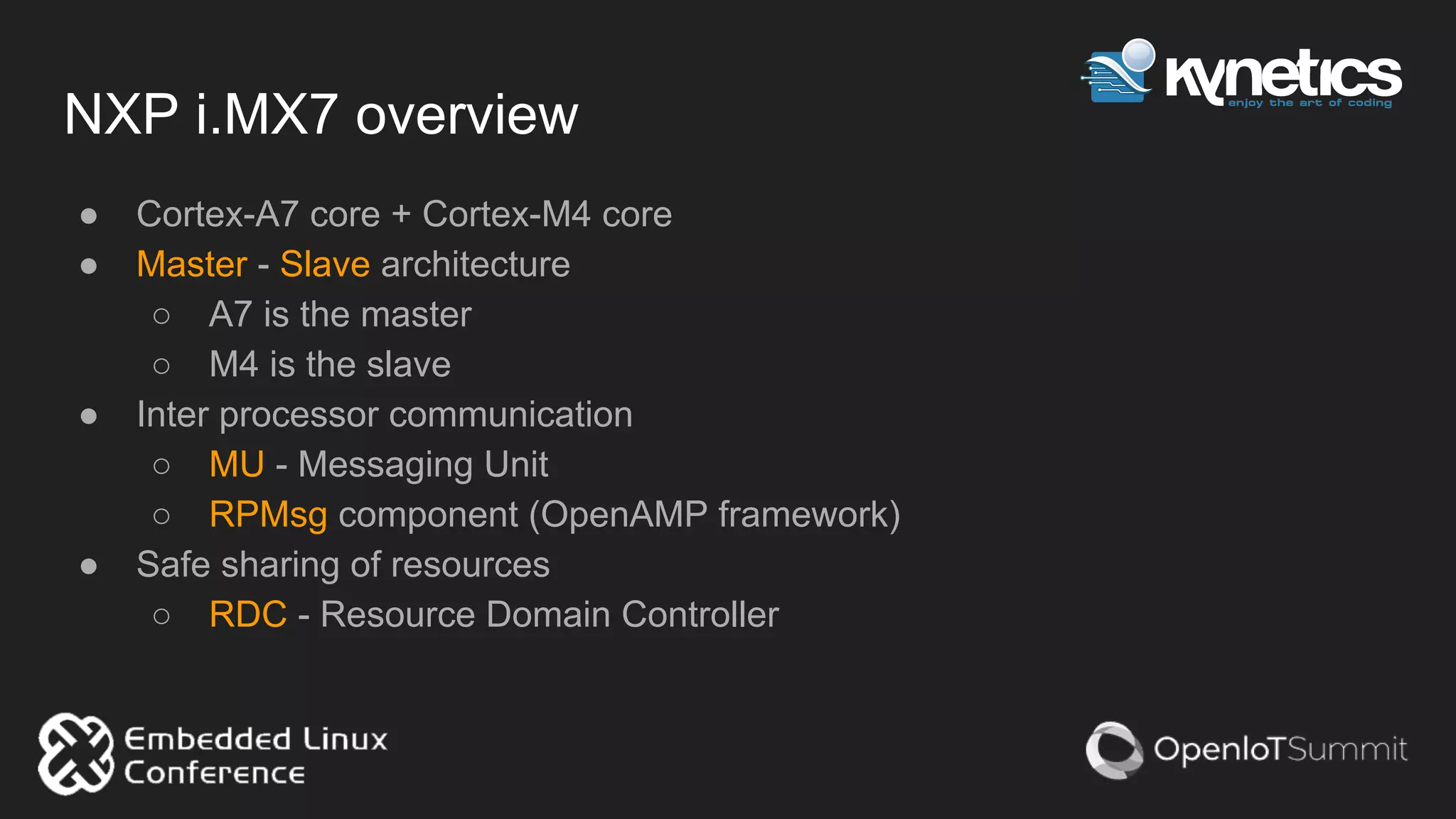
NXP i.MX7 overview
● Cortex-A7 core + Cortex-M4 core
● Master - Slave architecture
○ A7 is the master
○ M4 is the slave
● Inter processor communication
○ MU - Messaging Unit
○ RPMsg component (OpenAMP framework)
● Safe sharing of resources
○ RDC - Resource Domain Controller
NXP i.MX7 - RDC
NXP i.MX7 IPC - MU
MAC (VirtIO)
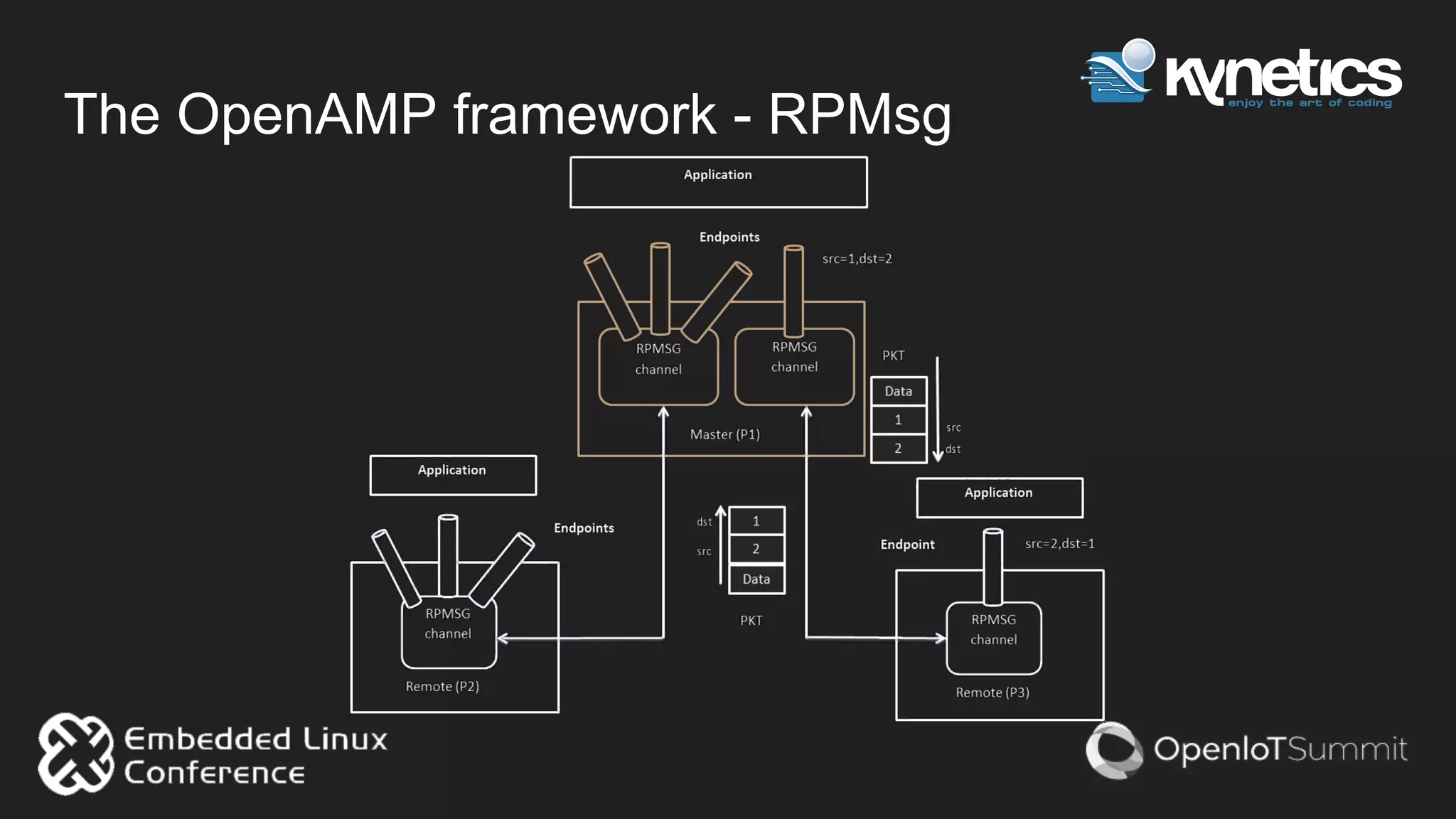
The OpenAMP framework - RPMsg
RPMsg on Linux
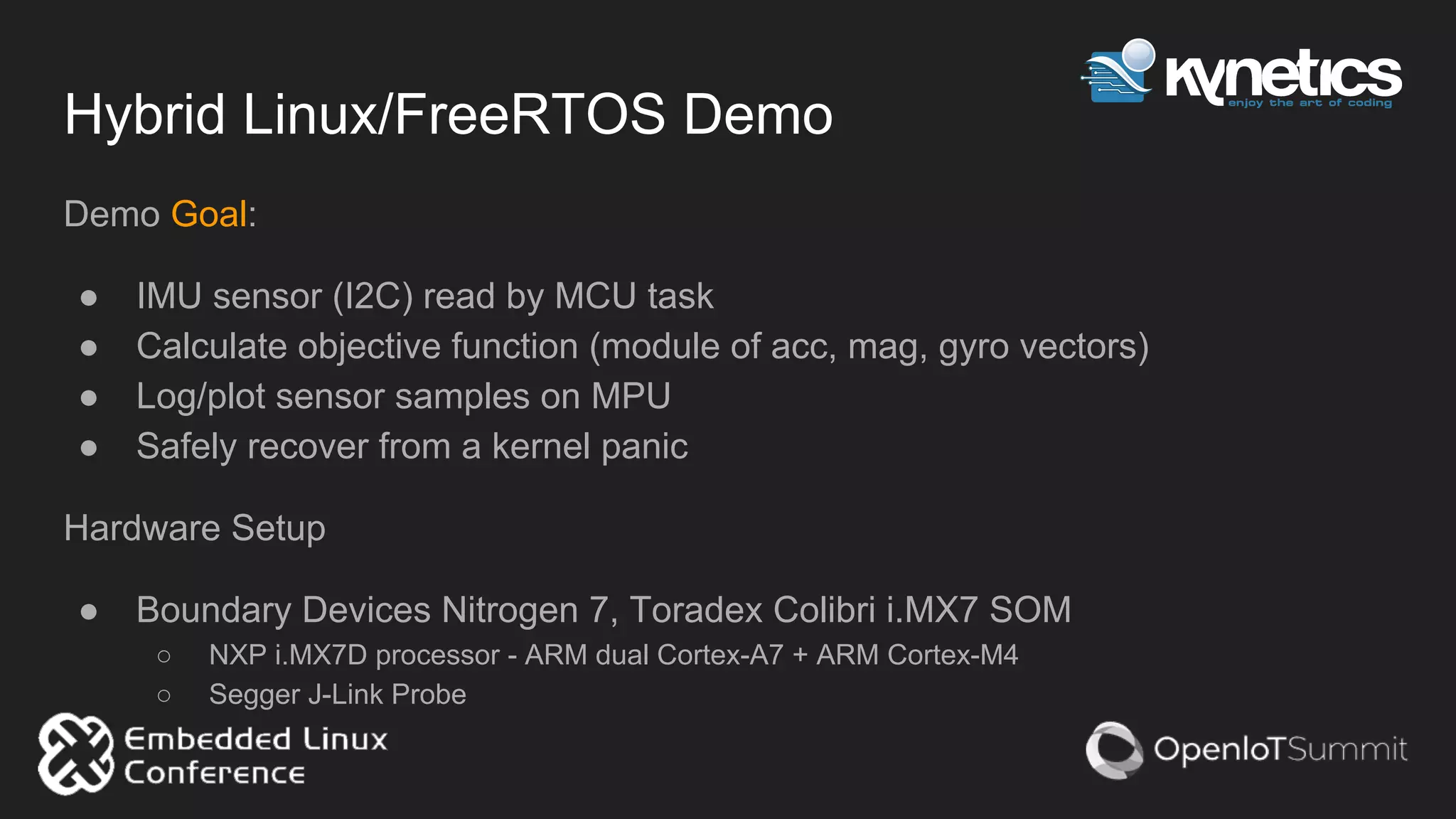
Hybrid Linux/FreeRTOS Demo
Demo Goal:
● IMU sensor (I2C) read by MCU task
● Calculate objective function (module of acc, mag, gyro vectors)
● Log/plot sensor samples on MPU
● Safely recover from a kernel panic
Hardware Setup
● Boundary Devices Nitrogen 7, Toradex Colibri i.MX7 SOM
○ NXP i.MX7D processor - ARM dual Cortex-A7 + ARM Cortex-M4
○ Segger J-Link Probe
Cortex M4 Bring Up (1)
Environment setup:
● Download FreeRTOS sources
https://github.com/boundarydevices/freertos-boundary.git
● Download GNU ARM Embedded Toolchain
https://developer.arm.com/open-source/gnu-toolchain/gnu-rm/download
● Example applications for Cortex-M4 are located in the
examples/imx7d_nitrogen7_m4/ folder
● Scripts for building both debug and release binaries are available in the
armgcc subfolder
Cortex M4 Bring Up (2)
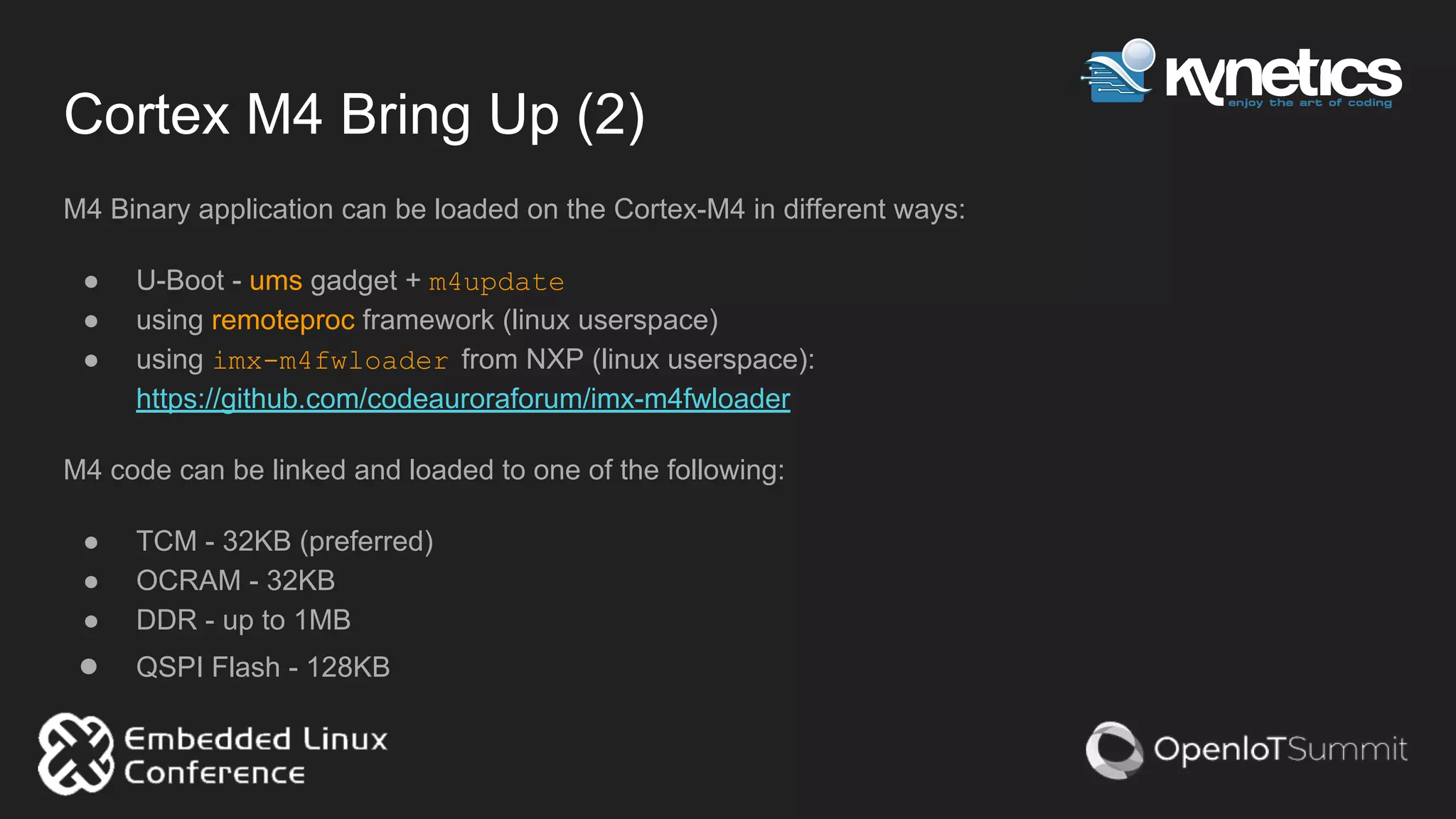
M4 Binary application can be loaded on the Cortex-M4 in different ways:
● U-Boot - ums gadget + m4update
● using remoteproc framework (linux userspace)
● using imx-m4fwloader from NXP (linux userspace):
https://github.com/codeauroraforum/imx-m4fwloader
M4 code can be linked and loaded to one of the following:
● TCM - 32KB (preferred)
● OCRAM - 32KB
● DDR - up to 1MB
● QSPI Flash - 128KB
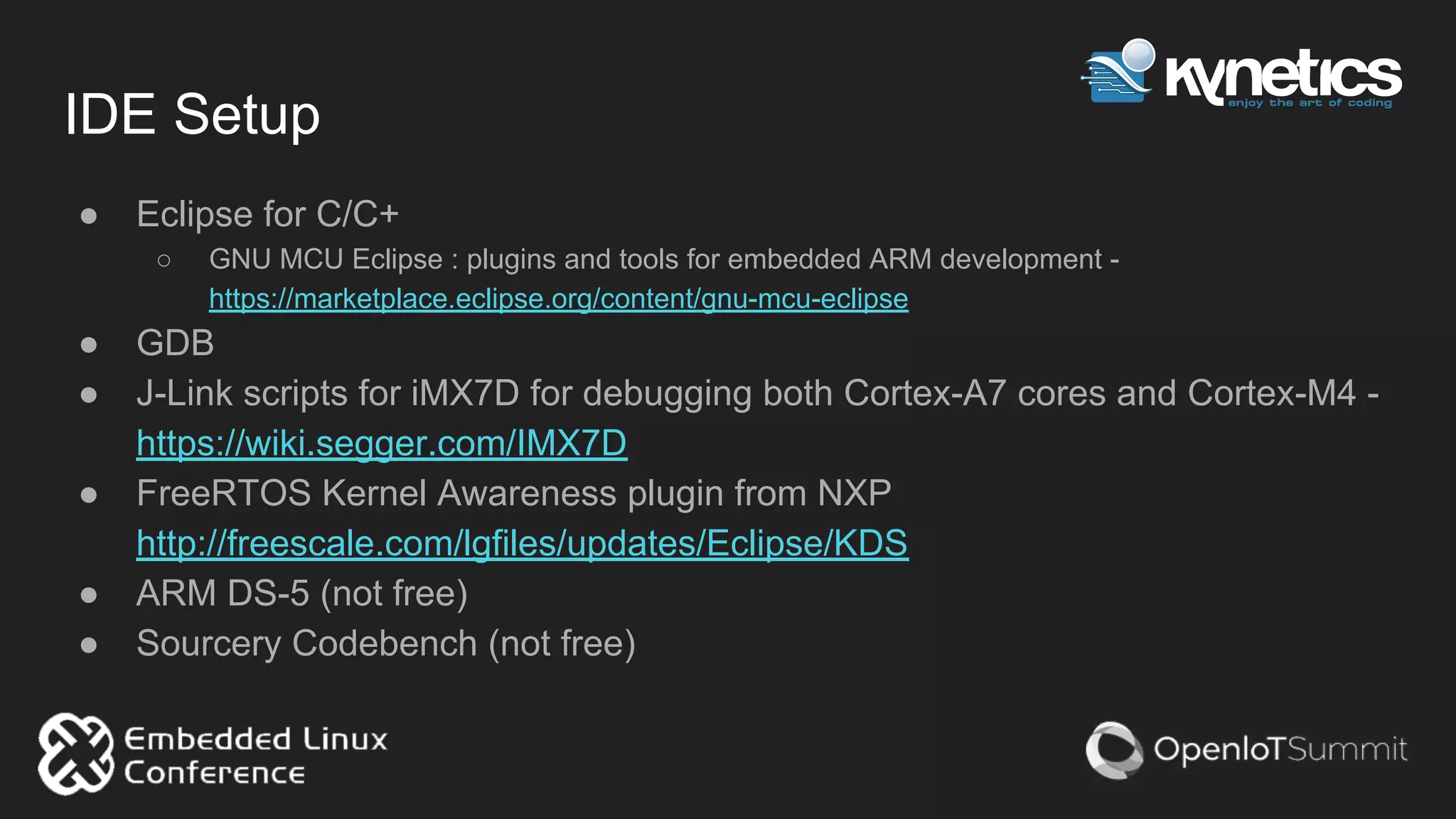
IDE Setup
● Eclipse for C/C+
○ GNU MCU Eclipse : plugins and tools for embedded ARM development -
https://marketplace.eclipse.org/content/gnu-mcu-eclipse
● GDB
● J-Link scripts for iMX7D for debugging both Cortex-A7 cores and Cortex-M4 -
https://wiki.segger.com/IMX7D
● FreeRTOS Kernel Awareness plugin from NXP
http://freescale.com/lgfiles/updates/Eclipse/KDS
● ARM DS-5 (not free)
● Sourcery Codebench (not free)
Workbench
code
MPU
console
Break
points
(MCU)
FreeRTOS
kernel
awareness
MCU
console
Demo Parameters
Remote core:
● Sample IMUs every 10ms
● Calculate the objective function on MCU (module of vectors)
● Buffer of 300 elements = 3Kb (stored TCM Memory only 32 Kb)
● Items (12 byte each) are dequeued and sent to master 10 at a time every 100
ms
Master core:
● Master reads incoming samples by polling the character device
Architecture Overview
start_cmd, stop_cmd, heartbeatLinux 4.9 FreeRTOS 1.0.1
The OpenAMP framework - RPMsg
Control Flow (2 cores)
● S0 RPMsg channel is down
● S1 RPMsg channel is up, /dev/rpmsg0 is created
● S2 RPMsg channel is up, endpoint created, data is
dumped into a log file
● S0 RPMsg channel is down
● S1 RPMsg channel is up (sampling IMU sensor,
buffering data)
● S2 RPMsg channel is up, sending data to master
core, (sampling IMU sensor, buffering data),
Register rpmsg char driver
+ probe
open /dev/rpmsg0
read /dev/rpmsg0
Channel created
stop_cmd
Master is dead
start_cmd
Master
heartbeat
rpmsg_char_client Data sender task
close /dev/rpmsg0
What if Linux Kernel Panics
● Kexec: system call to load and boot into another kernel from the currently
running kernel (4.9.74).
○ crashkernel=128M [normal kernel cmdline]
○ irqpoll, nosmp, reset_devices [crash kernel
cmdline]
○ --load-panic option
● Kdump: Linux mechanism to dump machine memory content on kernel
panic.
● Kexec/Kdump support on ARM platforms is still experimental
Video of the Demo
VIDEO
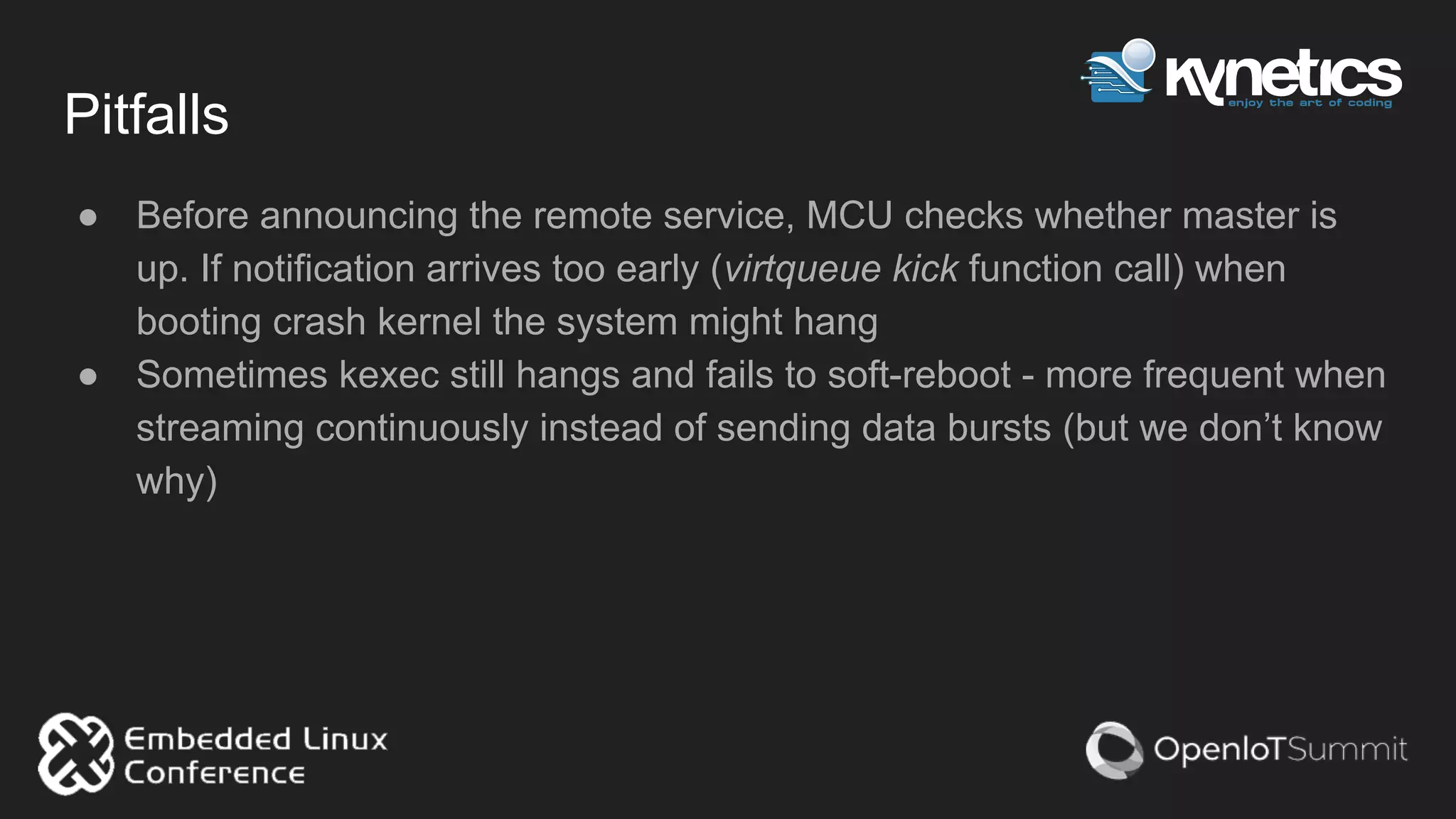
Pitfalls
● Before announcing the remote service, MCU checks whether master is
up. If notification arrives too early (virtqueue kick function call) when
booting crash kernel the system might hang
● Sometimes kexec still hangs and fails to soft-reboot - more frequent when
streaming continuously instead of sending data bursts (but we don’t know
why)
References
● OpenAMP project page: https://github.com/OpenAMP/
● Asymmetric multiprocessing and embedded linux (ELC 2017):
https://elinux.org/images/3/3b/NOVAK_CERVENKA.pdf
● Mantainers:
○ Open-amp:
■ Wendy Liang
○ RPMsg (Linux)
■ Ohad Ben-Cohen
■ Bjorn Andersson
○ Kexec (Linux)
■ Eric Biederman
○ Kdump (Linux)
■ Dave Young
■ Baoquan He
Q/A

Asymmetric Multiprocessing - Kynetics ELC 2018 portland

  • 1.
    An Introduction toAsymmetric Multiprocessing: when this architecture can be a game changer and how to survive it. Nicola La Gloria, Laura Nao Kynetics LLC Santa Clara, California
  • 2.
    Hybrid Architecture: warpx.io TheHybrid Design Architecture (HDA) combines the power of an application processor with the ease-of-use of micro-controllers.
  • 3.
  • 4.
    SMP vs AMP SMPon homogeneous architectures: ● Single OS controlling two or more identical cores sharing system resources ● Dynamic scheduling and load balancing Core1 CoreN Kernel SMP OS App App . . .
  • 5.
    SMP vs AMP Core1 CoreN MCAPI OSOS/RTOS App App Task Task AMP on heterogeneous architectures: ● Different OS on each core --> full-featured OS alongside a real-time kernel ● Inter processor communication protocol ● Efficient when the application can be statically partitioned across cores - high performance is achieved locally . . .
  • 6.
    Supervised vs NotSupervised ● Strong isolation ● Hides non-trivial AMP details (e.g. resource assignment, inter-core communication) ● Security and robustness ● Overhead of a software layer ● Achieve best performances by running natively ● Boot sequence complexity ● Harder to debug
  • 7.
  • 8.
    NXP i.MX7 overview ●Cortex-A7 core + Cortex-M4 core ● Master - Slave architecture ○ A7 is the master ○ M4 is the slave ● Inter processor communication ○ MU - Messaging Unit ○ RPMsg component (OpenAMP framework) ● Safe sharing of resources ○ RDC - Resource Domain Controller
  • 9.
  • 10.
  • 11.
  • 12.
  • 13.
  • 14.
    Hybrid Linux/FreeRTOS Demo DemoGoal: ● IMU sensor (I2C) read by MCU task ● Calculate objective function (module of acc, mag, gyro vectors) ● Log/plot sensor samples on MPU ● Safely recover from a kernel panic Hardware Setup ● Boundary Devices Nitrogen 7, Toradex Colibri i.MX7 SOM ○ NXP i.MX7D processor - ARM dual Cortex-A7 + ARM Cortex-M4 ○ Segger J-Link Probe
  • 15.
    Cortex M4 BringUp (1) Environment setup: ● Download FreeRTOS sources https://github.com/boundarydevices/freertos-boundary.git ● Download GNU ARM Embedded Toolchain https://developer.arm.com/open-source/gnu-toolchain/gnu-rm/download ● Example applications for Cortex-M4 are located in the examples/imx7d_nitrogen7_m4/ folder ● Scripts for building both debug and release binaries are available in the armgcc subfolder
  • 16.
    Cortex M4 BringUp (2) M4 Binary application can be loaded on the Cortex-M4 in different ways: ● U-Boot - ums gadget + m4update ● using remoteproc framework (linux userspace) ● using imx-m4fwloader from NXP (linux userspace): https://github.com/codeauroraforum/imx-m4fwloader M4 code can be linked and loaded to one of the following: ● TCM - 32KB (preferred) ● OCRAM - 32KB ● DDR - up to 1MB ● QSPI Flash - 128KB
  • 17.
    IDE Setup ● Eclipsefor C/C+ ○ GNU MCU Eclipse : plugins and tools for embedded ARM development - https://marketplace.eclipse.org/content/gnu-mcu-eclipse ● GDB ● J-Link scripts for iMX7D for debugging both Cortex-A7 cores and Cortex-M4 - https://wiki.segger.com/IMX7D ● FreeRTOS Kernel Awareness plugin from NXP http://freescale.com/lgfiles/updates/Eclipse/KDS ● ARM DS-5 (not free) ● Sourcery Codebench (not free)
  • 18.
  • 19.
    Demo Parameters Remote core: ●Sample IMUs every 10ms ● Calculate the objective function on MCU (module of vectors) ● Buffer of 300 elements = 3Kb (stored TCM Memory only 32 Kb) ● Items (12 byte each) are dequeued and sent to master 10 at a time every 100 ms Master core: ● Master reads incoming samples by polling the character device
  • 20.
    Architecture Overview start_cmd, stop_cmd,heartbeatLinux 4.9 FreeRTOS 1.0.1
  • 21.
  • 22.
    Control Flow (2cores) ● S0 RPMsg channel is down ● S1 RPMsg channel is up, /dev/rpmsg0 is created ● S2 RPMsg channel is up, endpoint created, data is dumped into a log file ● S0 RPMsg channel is down ● S1 RPMsg channel is up (sampling IMU sensor, buffering data) ● S2 RPMsg channel is up, sending data to master core, (sampling IMU sensor, buffering data), Register rpmsg char driver + probe open /dev/rpmsg0 read /dev/rpmsg0 Channel created stop_cmd Master is dead start_cmd Master heartbeat rpmsg_char_client Data sender task close /dev/rpmsg0
  • 23.
    What if LinuxKernel Panics ● Kexec: system call to load and boot into another kernel from the currently running kernel (4.9.74). ○ crashkernel=128M [normal kernel cmdline] ○ irqpoll, nosmp, reset_devices [crash kernel cmdline] ○ --load-panic option ● Kdump: Linux mechanism to dump machine memory content on kernel panic. ● Kexec/Kdump support on ARM platforms is still experimental
  • 24.
    Video of theDemo VIDEO
  • 25.
    Pitfalls ● Before announcingthe remote service, MCU checks whether master is up. If notification arrives too early (virtqueue kick function call) when booting crash kernel the system might hang ● Sometimes kexec still hangs and fails to soft-reboot - more frequent when streaming continuously instead of sending data bursts (but we don’t know why)
  • 26.
    References ● OpenAMP projectpage: https://github.com/OpenAMP/ ● Asymmetric multiprocessing and embedded linux (ELC 2017): https://elinux.org/images/3/3b/NOVAK_CERVENKA.pdf ● Mantainers: ○ Open-amp: ■ Wendy Liang ○ RPMsg (Linux) ■ Ohad Ben-Cohen ■ Bjorn Andersson ○ Kexec (Linux) ■ Eric Biederman ○ Kdump (Linux) ■ Dave Young ■ Baoquan He
  • 27.