RNATIONAL JOURNAL FOR TRENDS IN ENGINEERING & TECHNOLOGY
VOLUME 5 ISSUE 1 – MAY 2015 - ISSN: 2349 - 9303
77
Enhanced Built-In Self Test for MSP 430
J.R.Nishanth1
PG Scholars 1
Department of Electronics and
Communication Engineering,
SNS College of Engineering, Coimbatore
johnnishanth.j.r@gmail.com
S.Kamalakannan2
Assistant Professor3
, Department of
Electronics and Communication
Engineering, SNS College of Engineering,
Kamalakannan.ap@gmail.com
Abstract - The enhanced Built in self test (BIST) is a combined form of both hardware and software together to
resolve the memory problem in self testing. So it automatically comprises own test using self test pattern generation. The
implementation can be done using the microcontroller MSP 430 series. Here we are using the Xilinx software for
compilation in the design implementation. Also its functional can be done using dynamic RAM and reduces the external
testing methods also includes diagnosis of test.
Keywords- BIST, ATE, DRAM
I INTRODUCTION
BIST is a perfect solution for automatic generation of
an address and data, performing a write to memory, and
afterwards performing read and comparing to the expected
content of memory cells. It also used in critical circuits
directly we cannot involve memory based functions. Better
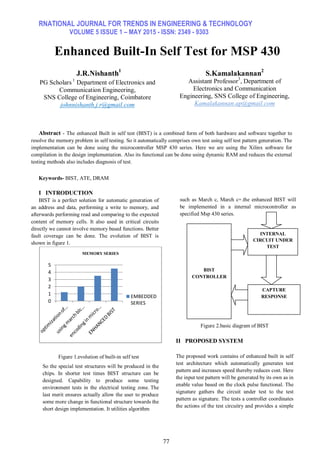
fault coverage can be done. The evolution of BIST is
shown in figure 1.
Figure 1.evolution of built-in self test
So the special test structures will be produced in the
chips. In shorter test times BIST structure can be
designed. Capability to produce some testing
environment tests in the electrical testing zone. The
last merit ensures actually allow the user to produce
some more change in functional structure towards the
short design implementation. It utilities algorithm
such as March c, March c+.the enhanced BIST will
be implemented in a internal microcontroller as
specified Msp 430 series.
B
Figure 2.basic diagram of BIST
II PROPOSED SYSTEM
The proposed work contains of enhanced built in self
test architecture which automatically generates test
pattern and increases speed thereby reduces cost. Here
the input test pattern will be generated by its own as in
enable value based on the clock pulse functional. The
signature gathers the circuit under test to the test
pattern as signature. The tests a controller coordinates
the actions of the test circuitry and provides a simple
0
1
2
3
4
5
MEMORY SERIES
EMBEDDED
SERIES
BIST
CONTROLLER
INTERNAL
CIRCUIT UNDER
TEST
CAPTURE
RESPONSE
RNATIONAL JOURNAL FOR TRENDS IN ENGINEERING & TECHNOLOGY
VOLUME 5 ISSUE 1 – MAY 2015 - ISSN: 2349 - 9303
78
external interface.here the test output will be produced
towards the pattern generator and introduce a circuit
under test hence produce output. Here the enhanced
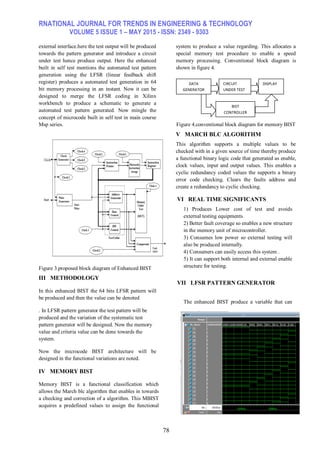
built in self test mentions the automated test pattern
generation using the LFSR (linear feedback shift
register) produces a automated test generation in 64
bit memory processing in an instant. Now it can be
designed to merge the LFSR coding in Xilinx
workbench to produce a schematic to generate a
automated test pattern generated. Now mingle the
concept of microcode built in self test in main course
Msp series.
Figure 3.proposed block diagram of Enhanced BIST
III METHODOLOGY
In this enhanced BIST the 64 bits LFSR pattern will
be produced and then the value can be denoted
. In LFSR pattern generator the test pattern will be
produced and the variation of the systematic test
pattern generator will be designed. Now the memory
value and criteria value can be done towards the
system.
Now the microcode BIST architecture will be
designed in the functional variations are noted.
IV MEMORY BIST
Memory BIST is a functional classification which
allows the March blc algorithm that enables in towards
a checking and correction of a algorithm. This MBIST
acquires a predefined values to assign the functional
system to produce a value regarding. This allocates a
special memory test procedure to enable a speed
memory processing. Conventional block diagram is
shown in figure 4.
Figure 4.conventional block diagram for memory BIST
V MARCH BLC ALGORITHM
This algorithm supports a multiple values to be
checked with in a given source of time thereby produce
a functional binary logic code that generated as enable,
clock values, input and output values. This enables a
cyclic redundancy coded values the supports a binary
error code checking. Clears the faults address and
create a redundancy to cyclic checking.
VI REAL TIME SIGNIFICANTS
1) Produces Lower cost of test and avoids
external testing equipments
2) Better fault coverage so enables a new structure
in the memory unit of microcontroller.
3) Consumes low power so external testing will
also be produced internally.
4) Consumers can easily access this system .
5) It can support both internal and external enable
structure for testing.
VII LFSR PATTERN GENERATOR
The enhanced BIST produce a variable that can
DATA
GENERATOR
BIST
CONTROLLER
DISPLAYCIRCUIT
UNDER TEST
RNATIONAL JOURNAL FOR TRENDS IN ENGINEERING & TECHNOLOGY
VOLUME 5 ISSUE 1 – MAY 2015 - ISSN: 2349 - 9303
79
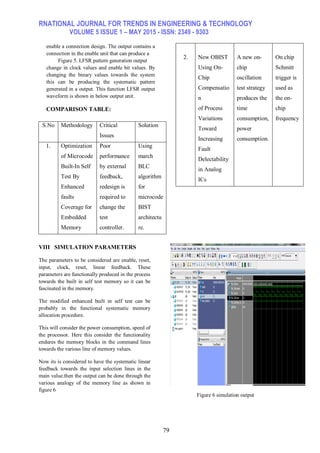
enable a connection design. The output contains a
connection in the enable unit that can produce a
Figure 5. LFSR pattern generation output
change in clock values and enable bit values. By
changing the binary values towards the system
this can be producing the systematic pattern
generated in a output. This function LFSR output
waveform is shown in below output unit.
COMPARISON TABLE:
S.No Methodology Critical
Issues
Solution
1. Optimization
of Microcode
Built-In Self
Test By
Enhanced
faults
Coverage for
Embedded
Memory
Poor
performance
by external
feedback,
redesign is
required to
change the
test
controller.
Using
march
BLC
algorithm
for
microcode
BIST
architectu
re.
2. New OBIST
Using On-
Chip
Compensatio
n
of Process
Variations
Toward
Increasing
Fault
Delectability
in Analog
ICs
A new on-
chip
oscillation
test strategy
produces the
time
consumption,
power
consumption.
On chip
Schmitt
trigger is
used as
the on-
chip
frequency
VIII SIMULATION PARAMETERS
The parameters to be considered are enable, reset,
input, clock, reset, linear feedback. These
parameters are functionally produced in the process
towards the built in self test memory so it can be
fascinated in the memory.
The modified enhanced built in self test can be
probably in the functional systematic memory
allocation procedure.
This will consider the power consumption, speed of
the processor. Here this consider the functionality
endures the memory blocks in the command lines
towards the various line of memory values.
Now its is considered to have the systematic linear
feedback towards the input selection lines in the
main value.then the output can be done through the
various analogy of the memory line as shown in
figure 6
Figure 6 simulation output
RNATIONAL JOURNAL FOR TRENDS IN ENGINEERING & TECHNOLOGY
VOLUME 5 ISSUE 1 – MAY 2015 - ISSN: 2349 - 9303
80
The same output value can change the various
values in the considerable memory location. This
enables the changing values in the clock value and
then can be producing a variation in the functional
procedure BIST consider the input value and
produce a variation in the LFSR pattern value.
The input value will be changed based on the
microcode BIST architecture. Producing new
architecture for changing test pattern
The generated value adds sum of the functional
variation towards the value in consideration on the
value in bits produced so that can reduces the main
value system.
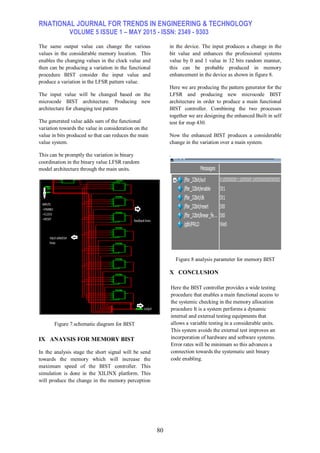
This can be promptly the variation in binary
coordination in the binary value LFSR random
model architecture through the main units.
Figure 7.schematic diagram for BIST
IX ANAYSIS FOR MEMORY BIST
In the analysis stage the short signal will be send
towards the memory which will increase the
maximum speed of the BIST controller. This
simulation is done in the XILINX platform. This
will produce the change in the memory perception
in the device. The input produces a change in the
bit value and enhances the professional systems
value by 0 and 1 value in 32 bits random manner,
this can be probable produced in memory
enhancement in the device as shown in figure 8.
Here we are producing the pattern generator for the
LFSR and producing new microcode BIST
architecture in order to produce a main functional
BIST controller. Combining the two processes
together we are designing the enhanced Built in self
test for msp 430.
Now the enhanced BIST produces a considerable
change in the variation over a main system.
.
Figure 8 analysis parameter for memory BIST
X CONCLUSION
Here the BIST controller provides a wide testing
procedure that enables a main functional access to
the systemic checking in the memory allocation
procedure It is a system performs a dynamic
internal and external testing equipments that
allows a variable testing in a considerable units.
This system avoids the external test improves an
incorporation of hardware and software systems.
Error rates will be minimum so this advances a
connection towards the systematic unit binary
code enabling.
RNATIONAL JOURNAL FOR TRENDS IN ENGINEERING & TECHNOLOGY
VOLUME 5 ISSUE 1 – MAY 2015 - ISSN: 2349 - 9303
81
REFERENCE
[1] Mohd Yamani Idna Idris, Mashkuri Yaacob,
Zaidi Razak, “A VHDL Implementation Of UART
Design with BIST capability”
[2] Dr. T.V.S.P. Gupta, Y. Kumari,M.Asok
Kumar”UART realization with BIST architecture
using VHDL” International Journal of Engineering
Research and Applications (IJERA) ISSN: 2248-
9622 www.ijera.com Vol. 3, Issue 1, January -
February 2013, pp.636-640.
[3] M.S. Harvey,Generic UART Manual,Silicon
Valley,December 1999
[4] P. J. Anderson, “The designer’s guide to
VHDL” , Morgan Kaufman , 2nd edition, 2002.
[5] Neil H.E. Weste, Kim Haase, David Harris, A.
Banerjee , “CMOS VLSI Design: A circuits and
Systems Perspective”, Pearson Education.
[6] K. Zarrineh, and S. J. Upadhyaya, “On
programmable memory built-in self test
architectures”, Design, Automation and Test in
Europe Conference and Exhibition 1999.
Proceedings, 1999, pp. 708 -713.
[7] Sandra Irobi Zaid Al-Ars Said
Hamdioui.Memory Test Optimizationfor Parasitic
Bit.
[8] N. Z. Haron, S.A.M. Junos, A.S.A. Aziz,
“Modelling and Simulation of Microcode Built-In
Self test Architecture for Embedded Memories”, In
Proc. of IEEE International Symposium on
Communications and Information Technologies pp.
136-139, 2007.
[9] S. Hamdioui, Z. Al-Ars, A.J. van de Goor,
“Testing Static andDynamic Faults in
Random Access Memories”, In Proc. of IEEE
VLSI Test Symposium, pp. 395-400, 2002.
[10]S. Hamdioui, et. al, “Importance of Dynamic
Faults for New SRAM Technologies”, In
IEEE Proc. Of European Test Workshop, pp.
29-34, 2003.
[11] International SEMATECH, “International
Technology Roadmap for Semiconductors
(ITRS): Edition 2001”.
12]A.J. van de Goor, “Testing Semiconductor
Memories, TheoryPractice” ComTex Publishing,
Gouda, Netherlands, 1998.
[13]A.J. van de Goor and Z. Al-Ars, “Functional
Fault Models: A Formal Notation and
Taxonomy”, In Proc. of IEEE VLSI Test
Symposium, pp. 281-289, 2000.
[14]“Xilinx ISE 6 Software Manuals and help –
PDF Collection”,
http://toolbox.xilinx.com/docsan/xilinx7/
books/manuals.pdf
[15]Zarrineh, K. and Upadhyaya, S.J., “On
Programmable memory built-in self test
architectures,” Design, Automation and Test
in Europ Conference and Exhibition 1999.
Proceedings , 1999, pp. 708 -713
[16]Sungju Park et al, “Microcode-Based Memory
BIST Implementing Modified March
Algorithms”, Journal of the Korean Physical
Society, Vol. 40, No. 4, April 2002, pp. 749-
753 SCEECS 2012
[17] A.J. van de Goor, “Using March tests to test
SRAMs”, Design & Test of Computers, IEEE,
Volume: 10, Issue: 1, March 1993 Pages: 8-
14.
[18] R. Dekker, F. Beenker and L. Thijssen, “Fault
Modeling and Test Algorithm Development
for Static Random Access Memories”
[19]R. Dekker, F. Beenker, L. Thijssen. “A realistic
fault model and test algorithm for static
random access memories”.IEEE Transactions
on CAD, Vol. 9(6), pp 567-572, June 1990.
RNATIONAL JOURNAL FOR TRENDS IN ENGINEERING & TECHNOLOGY
VOLUME 5 ISSUE 1 – MAY 2015 - ISSN: 2349 - 9303
82
[20]B. F. Cockburn: “Tutorial on Semiconductor
Memory Testing” Journal of Electronic
Testing: Theory and Applications, 5, pp 321-
336 1994 Kluwer Academic Publishers.
RNATIONAL JOURNAL FOR TRENDS IN ENGINEERING & TECHNOLOGY
VOLUME 5 ISSUE 1 – MAY 2015 - ISSN: 2349 - 9303
83

Enhanced Built-In Self Test for MSP 430

  • 1.
    RNATIONAL JOURNAL FORTRENDS IN ENGINEERING & TECHNOLOGY VOLUME 5 ISSUE 1 – MAY 2015 - ISSN: 2349 - 9303 77 Enhanced Built-In Self Test for MSP 430 J.R.Nishanth1 PG Scholars 1 Department of Electronics and Communication Engineering, SNS College of Engineering, Coimbatore johnnishanth.j.r@gmail.com S.Kamalakannan2 Assistant Professor3 , Department of Electronics and Communication Engineering, SNS College of Engineering, Kamalakannan.ap@gmail.com Abstract - The enhanced Built in self test (BIST) is a combined form of both hardware and software together to resolve the memory problem in self testing. So it automatically comprises own test using self test pattern generation. The implementation can be done using the microcontroller MSP 430 series. Here we are using the Xilinx software for compilation in the design implementation. Also its functional can be done using dynamic RAM and reduces the external testing methods also includes diagnosis of test. Keywords- BIST, ATE, DRAM I INTRODUCTION BIST is a perfect solution for automatic generation of an address and data, performing a write to memory, and afterwards performing read and comparing to the expected content of memory cells. It also used in critical circuits directly we cannot involve memory based functions. Better fault coverage can be done. The evolution of BIST is shown in figure 1. Figure 1.evolution of built-in self test So the special test structures will be produced in the chips. In shorter test times BIST structure can be designed. Capability to produce some testing environment tests in the electrical testing zone. The last merit ensures actually allow the user to produce some more change in functional structure towards the short design implementation. It utilities algorithm such as March c, March c+.the enhanced BIST will be implemented in a internal microcontroller as specified Msp 430 series. B Figure 2.basic diagram of BIST II PROPOSED SYSTEM The proposed work contains of enhanced built in self test architecture which automatically generates test pattern and increases speed thereby reduces cost. Here the input test pattern will be generated by its own as in enable value based on the clock pulse functional. The signature gathers the circuit under test to the test pattern as signature. The tests a controller coordinates the actions of the test circuitry and provides a simple 0 1 2 3 4 5 MEMORY SERIES EMBEDDED SERIES BIST CONTROLLER INTERNAL CIRCUIT UNDER TEST CAPTURE RESPONSE
  • 2.
    RNATIONAL JOURNAL FORTRENDS IN ENGINEERING & TECHNOLOGY VOLUME 5 ISSUE 1 – MAY 2015 - ISSN: 2349 - 9303 78 external interface.here the test output will be produced towards the pattern generator and introduce a circuit under test hence produce output. Here the enhanced built in self test mentions the automated test pattern generation using the LFSR (linear feedback shift register) produces a automated test generation in 64 bit memory processing in an instant. Now it can be designed to merge the LFSR coding in Xilinx workbench to produce a schematic to generate a automated test pattern generated. Now mingle the concept of microcode built in self test in main course Msp series. Figure 3.proposed block diagram of Enhanced BIST III METHODOLOGY In this enhanced BIST the 64 bits LFSR pattern will be produced and then the value can be denoted . In LFSR pattern generator the test pattern will be produced and the variation of the systematic test pattern generator will be designed. Now the memory value and criteria value can be done towards the system. Now the microcode BIST architecture will be designed in the functional variations are noted. IV MEMORY BIST Memory BIST is a functional classification which allows the March blc algorithm that enables in towards a checking and correction of a algorithm. This MBIST acquires a predefined values to assign the functional system to produce a value regarding. This allocates a special memory test procedure to enable a speed memory processing. Conventional block diagram is shown in figure 4. Figure 4.conventional block diagram for memory BIST V MARCH BLC ALGORITHM This algorithm supports a multiple values to be checked with in a given source of time thereby produce a functional binary logic code that generated as enable, clock values, input and output values. This enables a cyclic redundancy coded values the supports a binary error code checking. Clears the faults address and create a redundancy to cyclic checking. VI REAL TIME SIGNIFICANTS 1) Produces Lower cost of test and avoids external testing equipments 2) Better fault coverage so enables a new structure in the memory unit of microcontroller. 3) Consumes low power so external testing will also be produced internally. 4) Consumers can easily access this system . 5) It can support both internal and external enable structure for testing. VII LFSR PATTERN GENERATOR The enhanced BIST produce a variable that can DATA GENERATOR BIST CONTROLLER DISPLAYCIRCUIT UNDER TEST
  • 3.
    RNATIONAL JOURNAL FORTRENDS IN ENGINEERING & TECHNOLOGY VOLUME 5 ISSUE 1 – MAY 2015 - ISSN: 2349 - 9303 79 enable a connection design. The output contains a connection in the enable unit that can produce a Figure 5. LFSR pattern generation output change in clock values and enable bit values. By changing the binary values towards the system this can be producing the systematic pattern generated in a output. This function LFSR output waveform is shown in below output unit. COMPARISON TABLE: S.No Methodology Critical Issues Solution 1. Optimization of Microcode Built-In Self Test By Enhanced faults Coverage for Embedded Memory Poor performance by external feedback, redesign is required to change the test controller. Using march BLC algorithm for microcode BIST architectu re. 2. New OBIST Using On- Chip Compensatio n of Process Variations Toward Increasing Fault Delectability in Analog ICs A new on- chip oscillation test strategy produces the time consumption, power consumption. On chip Schmitt trigger is used as the on- chip frequency VIII SIMULATION PARAMETERS The parameters to be considered are enable, reset, input, clock, reset, linear feedback. These parameters are functionally produced in the process towards the built in self test memory so it can be fascinated in the memory. The modified enhanced built in self test can be probably in the functional systematic memory allocation procedure. This will consider the power consumption, speed of the processor. Here this consider the functionality endures the memory blocks in the command lines towards the various line of memory values. Now its is considered to have the systematic linear feedback towards the input selection lines in the main value.then the output can be done through the various analogy of the memory line as shown in figure 6 Figure 6 simulation output
  • 4.
    RNATIONAL JOURNAL FORTRENDS IN ENGINEERING & TECHNOLOGY VOLUME 5 ISSUE 1 – MAY 2015 - ISSN: 2349 - 9303 80 The same output value can change the various values in the considerable memory location. This enables the changing values in the clock value and then can be producing a variation in the functional procedure BIST consider the input value and produce a variation in the LFSR pattern value. The input value will be changed based on the microcode BIST architecture. Producing new architecture for changing test pattern The generated value adds sum of the functional variation towards the value in consideration on the value in bits produced so that can reduces the main value system. This can be promptly the variation in binary coordination in the binary value LFSR random model architecture through the main units. Figure 7.schematic diagram for BIST IX ANAYSIS FOR MEMORY BIST In the analysis stage the short signal will be send towards the memory which will increase the maximum speed of the BIST controller. This simulation is done in the XILINX platform. This will produce the change in the memory perception in the device. The input produces a change in the bit value and enhances the professional systems value by 0 and 1 value in 32 bits random manner, this can be probable produced in memory enhancement in the device as shown in figure 8. Here we are producing the pattern generator for the LFSR and producing new microcode BIST architecture in order to produce a main functional BIST controller. Combining the two processes together we are designing the enhanced Built in self test for msp 430. Now the enhanced BIST produces a considerable change in the variation over a main system. . Figure 8 analysis parameter for memory BIST X CONCLUSION Here the BIST controller provides a wide testing procedure that enables a main functional access to the systemic checking in the memory allocation procedure It is a system performs a dynamic internal and external testing equipments that allows a variable testing in a considerable units. This system avoids the external test improves an incorporation of hardware and software systems. Error rates will be minimum so this advances a connection towards the systematic unit binary code enabling.
  • 5.
    RNATIONAL JOURNAL FORTRENDS IN ENGINEERING & TECHNOLOGY VOLUME 5 ISSUE 1 – MAY 2015 - ISSN: 2349 - 9303 81 REFERENCE [1] Mohd Yamani Idna Idris, Mashkuri Yaacob, Zaidi Razak, “A VHDL Implementation Of UART Design with BIST capability” [2] Dr. T.V.S.P. Gupta, Y. Kumari,M.Asok Kumar”UART realization with BIST architecture using VHDL” International Journal of Engineering Research and Applications (IJERA) ISSN: 2248- 9622 www.ijera.com Vol. 3, Issue 1, January - February 2013, pp.636-640. [3] M.S. Harvey,Generic UART Manual,Silicon Valley,December 1999 [4] P. J. Anderson, “The designer’s guide to VHDL” , Morgan Kaufman , 2nd edition, 2002. [5] Neil H.E. Weste, Kim Haase, David Harris, A. Banerjee , “CMOS VLSI Design: A circuits and Systems Perspective”, Pearson Education. [6] K. Zarrineh, and S. J. Upadhyaya, “On programmable memory built-in self test architectures”, Design, Automation and Test in Europe Conference and Exhibition 1999. Proceedings, 1999, pp. 708 -713. [7] Sandra Irobi Zaid Al-Ars Said Hamdioui.Memory Test Optimizationfor Parasitic Bit. [8] N. Z. Haron, S.A.M. Junos, A.S.A. Aziz, “Modelling and Simulation of Microcode Built-In Self test Architecture for Embedded Memories”, In Proc. of IEEE International Symposium on Communications and Information Technologies pp. 136-139, 2007. [9] S. Hamdioui, Z. Al-Ars, A.J. van de Goor, “Testing Static andDynamic Faults in Random Access Memories”, In Proc. of IEEE VLSI Test Symposium, pp. 395-400, 2002. [10]S. Hamdioui, et. al, “Importance of Dynamic Faults for New SRAM Technologies”, In IEEE Proc. Of European Test Workshop, pp. 29-34, 2003. [11] International SEMATECH, “International Technology Roadmap for Semiconductors (ITRS): Edition 2001”. 12]A.J. van de Goor, “Testing Semiconductor Memories, TheoryPractice” ComTex Publishing, Gouda, Netherlands, 1998. [13]A.J. van de Goor and Z. Al-Ars, “Functional Fault Models: A Formal Notation and Taxonomy”, In Proc. of IEEE VLSI Test Symposium, pp. 281-289, 2000. [14]“Xilinx ISE 6 Software Manuals and help – PDF Collection”, http://toolbox.xilinx.com/docsan/xilinx7/ books/manuals.pdf [15]Zarrineh, K. and Upadhyaya, S.J., “On Programmable memory built-in self test architectures,” Design, Automation and Test in Europ Conference and Exhibition 1999. Proceedings , 1999, pp. 708 -713 [16]Sungju Park et al, “Microcode-Based Memory BIST Implementing Modified March Algorithms”, Journal of the Korean Physical Society, Vol. 40, No. 4, April 2002, pp. 749- 753 SCEECS 2012 [17] A.J. van de Goor, “Using March tests to test SRAMs”, Design & Test of Computers, IEEE, Volume: 10, Issue: 1, March 1993 Pages: 8- 14. [18] R. Dekker, F. Beenker and L. Thijssen, “Fault Modeling and Test Algorithm Development for Static Random Access Memories” [19]R. Dekker, F. Beenker, L. Thijssen. “A realistic fault model and test algorithm for static random access memories”.IEEE Transactions on CAD, Vol. 9(6), pp 567-572, June 1990.
  • 6.
    RNATIONAL JOURNAL FORTRENDS IN ENGINEERING & TECHNOLOGY VOLUME 5 ISSUE 1 – MAY 2015 - ISSN: 2349 - 9303 82 [20]B. F. Cockburn: “Tutorial on Semiconductor Memory Testing” Journal of Electronic Testing: Theory and Applications, 5, pp 321- 336 1994 Kluwer Academic Publishers.
  • 7.
    RNATIONAL JOURNAL FORTRENDS IN ENGINEERING & TECHNOLOGY VOLUME 5 ISSUE 1 – MAY 2015 - ISSN: 2349 - 9303 83