Birthday Paradox
What is a Paradox…?
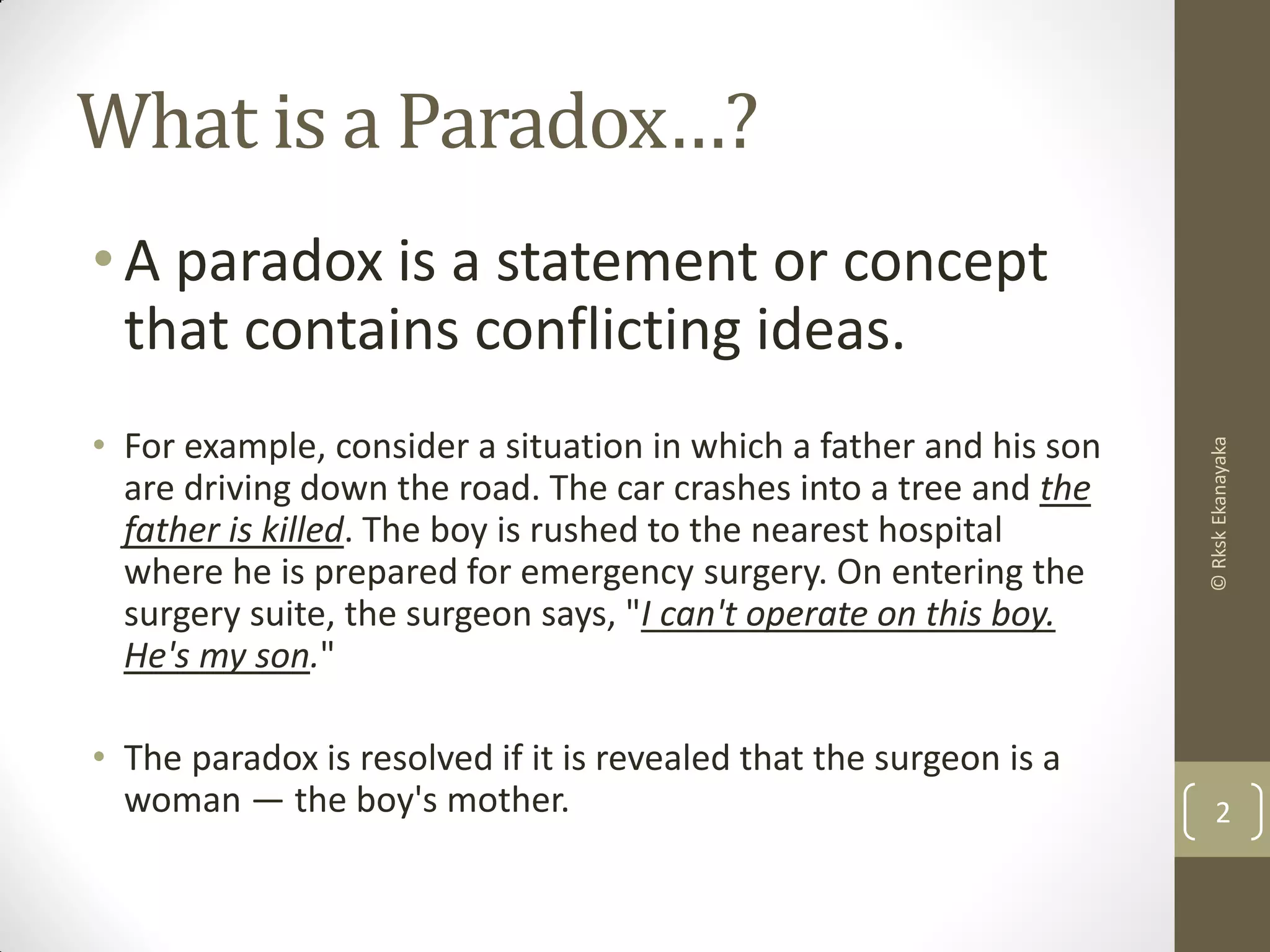
•A paradox is a statement or concept
that contains conflicting ideas.
• For example, consider a situation in which a father and his son
are driving down the road. The car crashes into a tree and the
father is killed. The boy is rushed to the nearest hospital
where he is prepared for emergency surgery. On entering the
surgery suite, the surgeon says, "I can't operate on this boy.
He's my son."
• The paradox is resolved if it is revealed that the surgeon is a
woman — the boy's mother. 2
©RkskEkanayaka
The Birthday Paradox
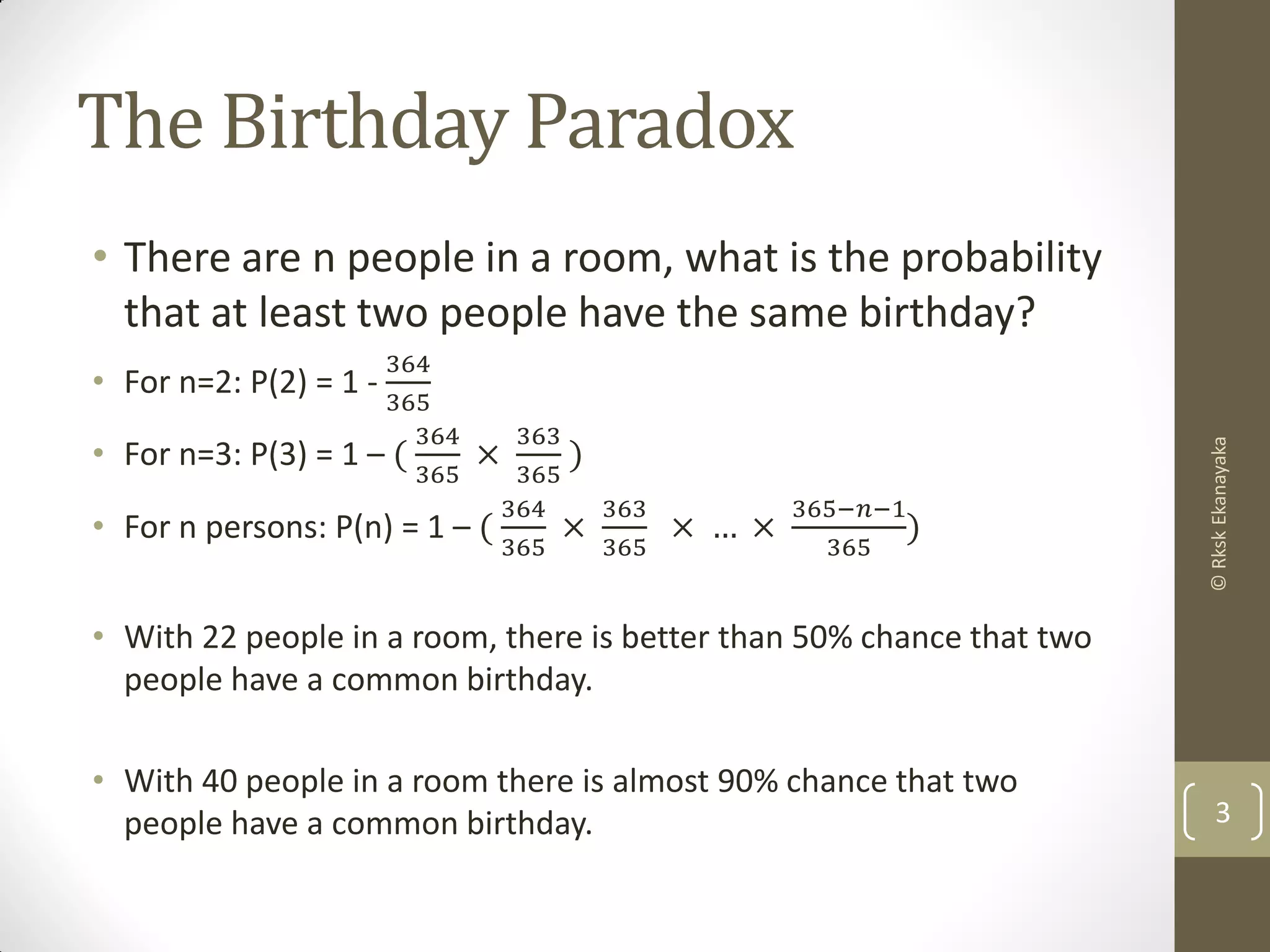
• There are n people in a room, what is the probability
that at least two people have the same birthday?
• For n=2: P(2) = 1 -
364
365
• For n=3: P(3) = 1 – (
364
365
×
363
365
)
• For n persons: P(n) = 1 – (
364
365
×
363
365
× … ×
365−𝑛−1
365
)
• With 22 people in a room, there is better than 50% chance that two
people have a common birthday.
• With 40 people in a room there is almost 90% chance that two
people have a common birthday. 3
©RkskEkanayaka
The Birthday Paradox…
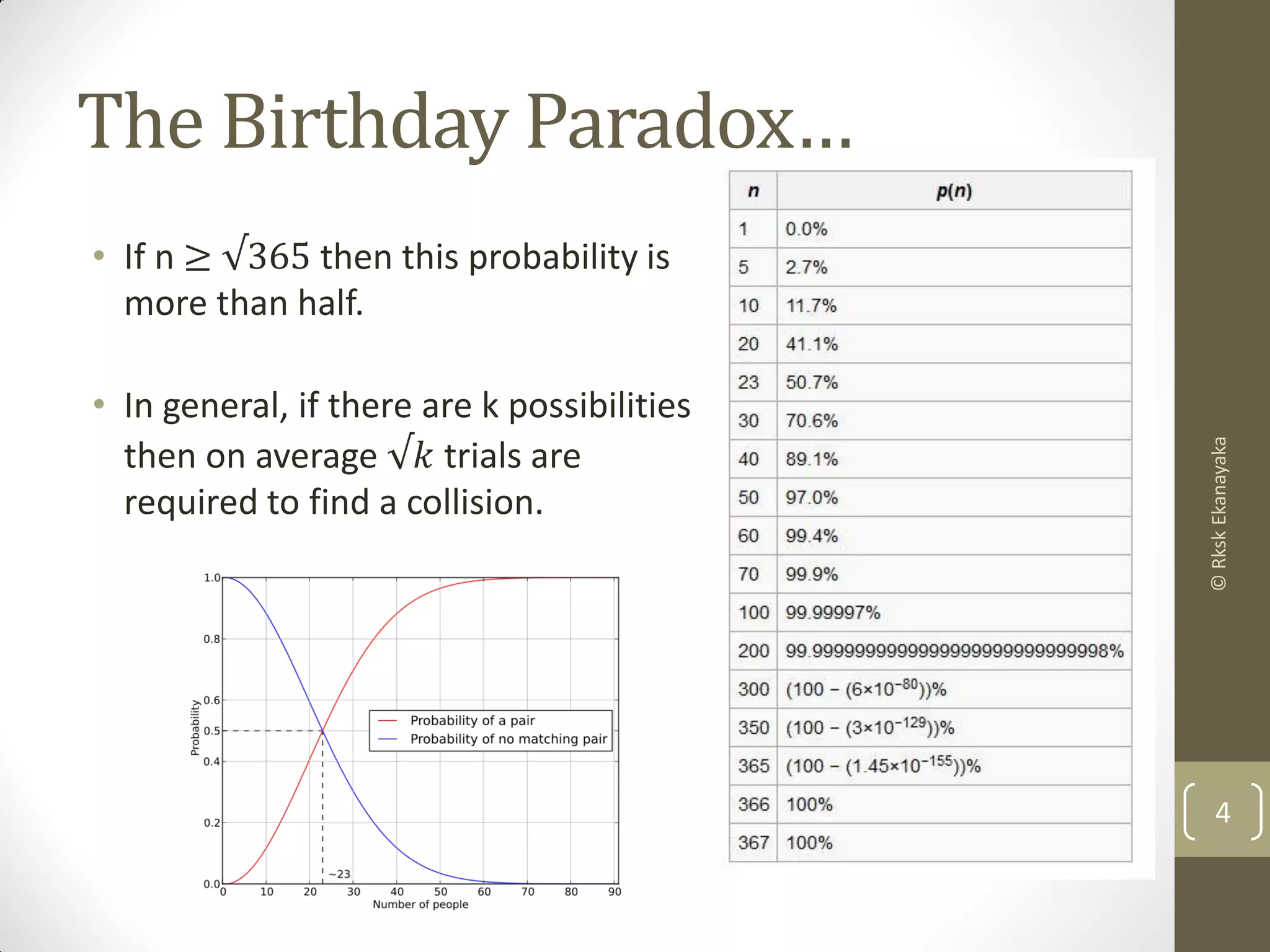
• If n ≥ √365 then this probability is
more than half.
• In general, if there are k possibilities
then on average √𝑘 trials are
required to find a collision.
4
©RkskEkanayaka
Hash Functions
• A hash function takes a variable
length message M and produces a
fixed length message digest.
• If the length of the digest is m
then there are 2 𝑚 possible
message digests.
• More than one message will be
mapped to the same digest.
5
©RkskEkanayaka
Probability of Hash Collisions
• If we apply k random messages to our hash code
what must the value of k to have probability of
0.5 that at least one duplicate?
Using previous equation, we have
k = √2 𝑚
= 2 𝑚/2 6
©RkskEkanayaka
Birthday Attack
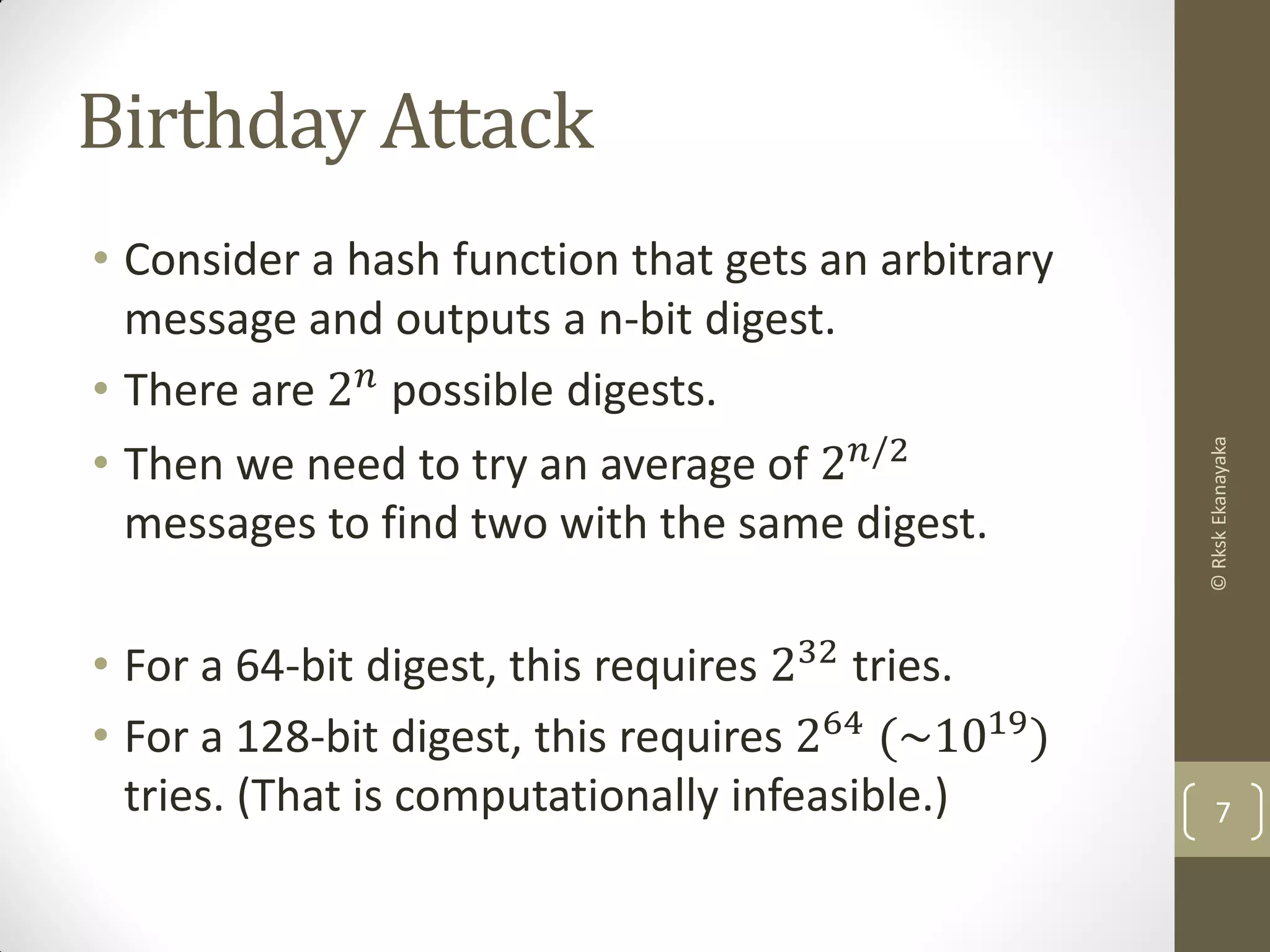
• Consider a hash function that gets an arbitrary
message and outputs a n-bit digest.
• There are 2 𝑛 possible digests.
• Then we need to try an average of 2 𝑛/2
messages to find two with the same digest.
• For a 64-bit digest, this requires 232
tries.
• For a 128-bit digest, this requires 264 (~1019)
tries. (That is computationally infeasible.) 7
©RkskEkanayaka
Birthday Attack…
• A is prepared to “sign” a message by appending
the appropriate m-bit hash code and encrypting
that hash code with A’s private key.
• An attacker generates 2 𝑚/2 variations on the
message, all of which gives the same meaning.
The attacker prepares an equal number of
messages, all of which are variations of the
fraudulent message to be substituted for the real
one. 8
©RkskEkanayaka
Birthday Attack…
• The two sets of messages are compared to find a pair of
messages that produce the same hash code. The probability of
success is greater than 0.5. If no match is found, additional
valid and fraudulent messages are generated until a match is
made.
• The attacker offers the valid variation to A for signature. This
signature can then be attached to the fraudulent variation for
transmission to the intended recipient. Because the two
variations have the same hash code, they will produce the
same signature; the attacker is assured of success even
though the encryption key is not known.
9
©RkskEkanayaka
How to avoid birthday attack
• To avoid this attack, the output length of
the hash function used for a signature
scheme can be chosen large enough so
that the birthday attack becomes
computationally infeasible.
• i.e. about twice as many bits as are
needed to prevent an ordinary brute-force
attack.
10
©RkskEkanayaka
References
• https://en.wikipedia.org/wiki/Birthday_problem
• https://en.wikipedia.org/wiki/Birthday_attack
• www.facweb.iitkgp.ernet.in/~sourav/lecture_note9.pdf
• https://www.youtube.com/watch?v=2bEL3ok8D70
• https://www.youtube.com/watch?v=jBXWuQGRosM
©RkskEkanayaka
11
Thank you.
12
©RkskEkanayaka

Birthday Paradox explained

  • 1.
  • 2.
    What is aParadox…? •A paradox is a statement or concept that contains conflicting ideas. • For example, consider a situation in which a father and his son are driving down the road. The car crashes into a tree and the father is killed. The boy is rushed to the nearest hospital where he is prepared for emergency surgery. On entering the surgery suite, the surgeon says, "I can't operate on this boy. He's my son." • The paradox is resolved if it is revealed that the surgeon is a woman — the boy's mother. 2 ©RkskEkanayaka
  • 3.
    The Birthday Paradox •There are n people in a room, what is the probability that at least two people have the same birthday? • For n=2: P(2) = 1 - 364 365 • For n=3: P(3) = 1 – ( 364 365 × 363 365 ) • For n persons: P(n) = 1 – ( 364 365 × 363 365 × … × 365−𝑛−1 365 ) • With 22 people in a room, there is better than 50% chance that two people have a common birthday. • With 40 people in a room there is almost 90% chance that two people have a common birthday. 3 ©RkskEkanayaka
  • 4.
    The Birthday Paradox… •If n ≥ √365 then this probability is more than half. • In general, if there are k possibilities then on average √𝑘 trials are required to find a collision. 4 ©RkskEkanayaka
  • 5.
    Hash Functions • Ahash function takes a variable length message M and produces a fixed length message digest. • If the length of the digest is m then there are 2 𝑚 possible message digests. • More than one message will be mapped to the same digest. 5 ©RkskEkanayaka
  • 6.
    Probability of HashCollisions • If we apply k random messages to our hash code what must the value of k to have probability of 0.5 that at least one duplicate? Using previous equation, we have k = √2 𝑚 = 2 𝑚/2 6 ©RkskEkanayaka
  • 7.
    Birthday Attack • Considera hash function that gets an arbitrary message and outputs a n-bit digest. • There are 2 𝑛 possible digests. • Then we need to try an average of 2 𝑛/2 messages to find two with the same digest. • For a 64-bit digest, this requires 232 tries. • For a 128-bit digest, this requires 264 (~1019) tries. (That is computationally infeasible.) 7 ©RkskEkanayaka
  • 8.
    Birthday Attack… • Ais prepared to “sign” a message by appending the appropriate m-bit hash code and encrypting that hash code with A’s private key. • An attacker generates 2 𝑚/2 variations on the message, all of which gives the same meaning. The attacker prepares an equal number of messages, all of which are variations of the fraudulent message to be substituted for the real one. 8 ©RkskEkanayaka
  • 9.
    Birthday Attack… • Thetwo sets of messages are compared to find a pair of messages that produce the same hash code. The probability of success is greater than 0.5. If no match is found, additional valid and fraudulent messages are generated until a match is made. • The attacker offers the valid variation to A for signature. This signature can then be attached to the fraudulent variation for transmission to the intended recipient. Because the two variations have the same hash code, they will produce the same signature; the attacker is assured of success even though the encryption key is not known. 9 ©RkskEkanayaka
  • 10.
    How to avoidbirthday attack • To avoid this attack, the output length of the hash function used for a signature scheme can be chosen large enough so that the birthday attack becomes computationally infeasible. • i.e. about twice as many bits as are needed to prevent an ordinary brute-force attack. 10 ©RkskEkanayaka
  • 11.
    References • https://en.wikipedia.org/wiki/Birthday_problem • https://en.wikipedia.org/wiki/Birthday_attack •www.facweb.iitkgp.ernet.in/~sourav/lecture_note9.pdf • https://www.youtube.com/watch?v=2bEL3ok8D70 • https://www.youtube.com/watch?v=jBXWuQGRosM ©RkskEkanayaka 11
  • 12.