


Authentication protocols based on zero knowledge proof 
Brief introduction (Part 2) 
Israel Buitron Damaso1 
Guillermo B. Morales Luna1 (Advisor) 
Feliu Salgols Troncoso2 (Advisor) 
1Computer Science Department 
2Mathematics Department 
Center for Research and Advanced Studies of the National Polytechnic Institute 
November 12, 2014
Outline 
Introduction 
Our work
Outline 
Introduction 
Introductory notions
Authentication 
Idea 
I Authentication is the process of verifying an entity's identity, given its 
credentials. 
I The entity could be in the form of a person, a computer, a device, a group 
of network computers, etc.
Interactive proof 
Idea 
I An interactive proof is a protocol between two parties (the prover and the 
veri
er). 
I The crucial point is that the veri
er is restricted to be a probabilistic 
polynomial-time algorithm, whereas no such restriction applies to the 
prover.
Interactive proof 
Objetive 
I By means of an interactive proof, the prover convinces the veri
er of the 
validity of a given statement. 
I A statement is of the form x 2 L, where x is a word and L is a formal 
language. 
I The interesting languages are those for which no polynomial-time 
membership tests (are known to) exist. 
I It follows that the veri
er cannot determine on its own whether x 2 L 
holds.
Interactive proof 
Properties 
Interactive proofs have two basic properties: 
I Completeness, which means that executions of the protocol between the 
prover and the veri
er should result in the veri
er accepting the proof, if 
x 2 L holds. 
I Soundness, which means that executions of the protocol between the 
prover and the veri
er should result in the veri
er rejecting the proof, if 
x62 L holds. 
This property protects the interest of the veri
er.
Zero knowledge proof 
Idea 
I Zero-knowledge is a property attributed to interactive proofs. 
I This property protects the interest of the prover. 
I By means of a zero-knowledge proof, the prover is able to convince the 
veri
er of the validity of a given statement, without releasing any 
knowledge beyond the validity of the statement.
Outline 
Introduction 
Our work
Outline 
Our work 
Proposed solution 
Authentication protocol 
Completed tasks 
Current tasks
Proposed solution 
I Give an authentication protocol, based on: 
I a zero-knowledge proof 
I the NP-hardness of the Independence Set Problem in Graph Theory 
I synthetic problem instances
Authentication protocol 
Public and private keys 
I Let P be a set of participants. 
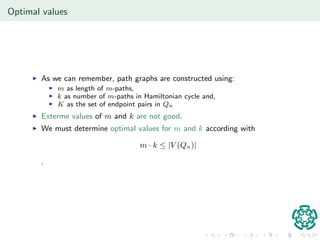
I Each participant p 2 P constructs randomly a Hamiltonian cycle hp and 
selects as private key a set p of kp non-crossing and disjoint mp-paths. 
I Then, the participant selects as public key the tuple (kp;mp;Kp), where 
Kp is the set of pairs of endpoints of the paths in p.
Authentication protocol 
Procedure 
1. The veri
er selects a subset Lv  Kp and sends it to the prover as a 
challenge. 
2. The prover replies with the list RLp of mp-paths connecting each pair at 
Lv. 
3. The veri
er accepts accordingly to whether RLp is a collection of pairwise 
non-crossing and disjoint mp-paths in the graph.
Outline 
Our work 
Proposed solution 
Completed tasks 
f-sequences search 
Path graphs construction 
Odd-holes search 
Encoding problem instances 
Current tasks
f-sequences 
Idea 
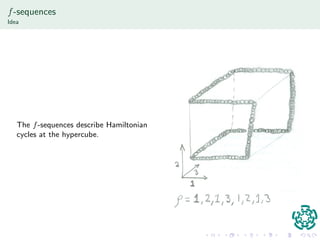
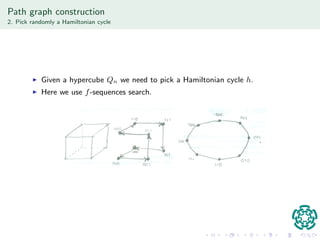
The f-sequences describe Hamiltonian 
cycles at the hypercube.
f-equivalence 
De
nition 
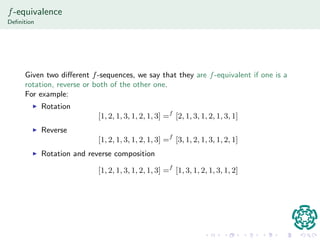
Given two dierent f-sequences, we say that they are f-equivalent if one is a 
rotation, reverse or both of the other one. 
For example: 
I Rotation 
[1; 2; 1; 3; 1; 2; 1; 3] =f [2; 1; 3; 1; 2; 1; 3; 1] 
I Reverse 
[1; 2; 1; 3; 1; 2; 1; 3] =f [3; 1; 2; 1; 3; 1; 2; 1] 
I Rotation and reverse composition 
[1; 2; 1; 3; 1; 2; 1; 3] =f [1; 3; 1; 2; 1; 3; 1; 2]
f-sequences 
Search problem 
I All f-sequences in a hypercube can be found using a breadth-

Authentication protocols based on zero knowledge proof (Part 2 - Brief talk)

  • 1.
    Authentication protocols basedon zero knowledge proof Brief introduction (Part 2) Israel Buitron Damaso1 Guillermo B. Morales Luna1 (Advisor) Feliu Salgols Troncoso2 (Advisor) 1Computer Science Department 2Mathematics Department Center for Research and Advanced Studies of the National Polytechnic Institute November 12, 2014
  • 2.
  • 3.
  • 4.
    Authentication Idea IAuthentication is the process of verifying an entity's identity, given its credentials. I The entity could be in the form of a person, a computer, a device, a group of network computers, etc.
  • 5.
    Interactive proof Idea I An interactive proof is a protocol between two parties (the prover and the veri
  • 6.
    er). I Thecrucial point is that the veri
  • 7.
    er is restrictedto be a probabilistic polynomial-time algorithm, whereas no such restriction applies to the prover.
  • 8.
    Interactive proof Objetive I By means of an interactive proof, the prover convinces the veri
  • 9.
    er of the validity of a given statement. I A statement is of the form x 2 L, where x is a word and L is a formal language. I The interesting languages are those for which no polynomial-time membership tests (are known to) exist. I It follows that the veri
  • 10.
    er cannot determineon its own whether x 2 L holds.
  • 11.
    Interactive proof Properties Interactive proofs have two basic properties: I Completeness, which means that executions of the protocol between the prover and the veri
  • 12.
    er should resultin the veri
  • 13.
    er accepting theproof, if x 2 L holds. I Soundness, which means that executions of the protocol between the prover and the veri
  • 14.
    er should resultin the veri
  • 15.
    er rejecting theproof, if x62 L holds. This property protects the interest of the veri
  • 16.
  • 17.
    Zero knowledge proof Idea I Zero-knowledge is a property attributed to interactive proofs. I This property protects the interest of the prover. I By means of a zero-knowledge proof, the prover is able to convince the veri
  • 18.
    er of thevalidity of a given statement, without releasing any knowledge beyond the validity of the statement.
  • 19.
  • 20.
    Outline Our work Proposed solution Authentication protocol Completed tasks Current tasks
  • 21.
    Proposed solution IGive an authentication protocol, based on: I a zero-knowledge proof I the NP-hardness of the Independence Set Problem in Graph Theory I synthetic problem instances
  • 22.
    Authentication protocol Publicand private keys I Let P be a set of participants. I Each participant p 2 P constructs randomly a Hamiltonian cycle hp and selects as private key a set p of kp non-crossing and disjoint mp-paths. I Then, the participant selects as public key the tuple (kp;mp;Kp), where Kp is the set of pairs of endpoints of the paths in p.
  • 23.
  • 24.
    er selects asubset Lv Kp and sends it to the prover as a challenge. 2. The prover replies with the list RLp of mp-paths connecting each pair at Lv. 3. The veri
  • 25.
    er accepts accordinglyto whether RLp is a collection of pairwise non-crossing and disjoint mp-paths in the graph.
  • 26.
    Outline Our work Proposed solution Completed tasks f-sequences search Path graphs construction Odd-holes search Encoding problem instances Current tasks
  • 27.
    f-sequences Idea Thef-sequences describe Hamiltonian cycles at the hypercube.
  • 28.
  • 29.
    nition Given twodierent f-sequences, we say that they are f-equivalent if one is a rotation, reverse or both of the other one. For example: I Rotation [1; 2; 1; 3; 1; 2; 1; 3] =f [2; 1; 3; 1; 2; 1; 3; 1] I Reverse [1; 2; 1; 3; 1; 2; 1; 3] =f [3; 1; 2; 1; 3; 1; 2; 1] I Rotation and reverse composition [1; 2; 1; 3; 1; 2; 1; 3] =f [1; 3; 1; 2; 1; 3; 1; 2]
  • 30.
    f-sequences Search problem I All f-sequences in a hypercube can be found using a breadth-