PRE-EMBYRONIC STAG <4 WEEKS
 First cell division 30 hours
 Zygote reaches uterine cavity 4 days
 Implantation 5-6 days
 Bilminar disc 12 days
 Lynozation of female 16days
 Fromation of trilminar disc 19 days
and primitive streak
Embryonic stage 4-12 weeks
 ORGANOGENESIS 4-8 WEEKS
 BRAIN & SPINAL CORD ARE FORMING 4 WKEEKS
 FIRST SING OF HEART BEAT & LIMB BUDS 6 WEEKS
 BRAIN,EYES, HEART & LIMBS – DEVELOP RAPIDLY
 BOWEL AND LUNG BEGINNING TO DEVELOP
 DIGITS APPEARED, EARS,KIDNEYS,LIVER & 8 WEEKS
MUSCLES ARE DEVELOPING.
PALATE CLOSES AND JOINT FORM 10 WEEKS
SEXUAL DIFFERENTIATION ALMOST COMPLETE 12 WEEKS
Deformation
External force causing distortion of an otherwise normal structure is called
deformation
Because of intrauterine crowding - as with multiple fetal pregnancy
Amniotic fluid leakage
Ex – Hip dislocation, Talipes equinovarus.
Deformation carry good prognosis
Disruption
Damage or dissolution of a part following normal development of body part
Ex - Amniotic band, thromboembolic episode.
Dysplasia
Morphological defects due to abnormal maturation and organization of cells into
Tissue is known as dysplasia.
Ectodermal dysplasia – abnormal skin, hair, nail and teeth.
Skeletal dysplasia - spondyloepipyseal dysplasia
Malformation
Morphological defects occur due to error in the normal development
And differentiation of embryo is known as malformation.
Type of malformation
Sequence
Syndrome
Association
14% minor
3% two or >2 malformation
3% single major malformation
0.7% multiple malformation
Minor malformation : they do not cause any function defect
Major malformation : If malformation left uncorrected leads to
Significant Impairment of body function
Sequence
The chain of events resulting in multiple defect –
Chronic leakage of amniotic fluid or less production of amniotic fluid leads
To fetus compression –
Potter sequence -squashed face, dislocation of hip
talipes equinovarus, pulmonary hypoplasia.
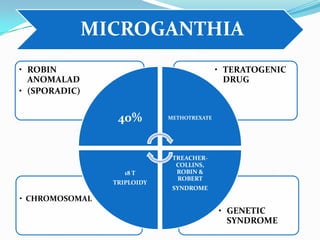
Pierre- Robin sequence- Microganthia, Tongue fall back and prevent closure
palate, leading to cleft palate.
Syndrome
Co-occurrence of several distinct abnormalities(group of features)
definitely or presumably if
caused by same etiological factor in all affected individuals
Is known as syndrome.
Association
Co-occurrence of group of malformations, more frequently
Than expected by chance, without definite cause is called association.
VATER - VERTEBRAL, anal, tracheal, oesophageal and renal
CHARGE - coloboma, heart, atresia choanae, retarded growth, genital
and ear malformation
FETAL STAGE >12 – 38 WEEKS
 FETAL MOVEMENT 16-18 WEEKS
 EYELIDS OPEN 24-26 WEEKS
 FETUS VIABLE WITH SPECIAL CARE 24-26 WEEKS
 RAPID WEIGHT GAIN 28-28 WEEKS
BIRTH DEFECT
 A BIRTH DEFCT IS DEFIND AS THE MARCH OF
DIMES IS “ FUNCTIONAL OR STRUCTURAL”, THAT
PRESENT IN INFANCY OR LATER IN LIFE AND IS
CAUSED BY EVENTS PRECEDING BIRTH WHETHER
INHERITED OR ACQURIED.
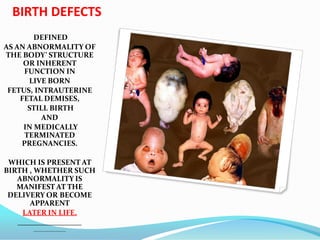
BIRTH DEFECTS
DEFINED
AS AN ABNORMALITY OF
THE BODY’ STRUCTURE
OR INHERENT
FUNCTION IN
LIVE BORN
FETUS, INTRAUTERINE
FETAL DEMISES,
STILL BIRTH
AND
IN MEDICALLY
TERMINATED
PREGNANCIES.
WHICH IS PRESENT AT
BIRTH , WHETHER SUCH
ABNORMALITY IS
MANIFEST AT THE
DELIVERY OR BECOME
APPARENT
LATER IN LIFE.
BIRTH DEFECT
1. Congenital malformation :- It is a primary structural defect
arising from a localised error in morphogenesis,resulting in
the abnormal formation of a tissue or organ.
2. Disruption : :- It is a structural defect resulting from the
destruction of a structure that had formed normally before
the insult such as - ischemia, infection & trauma.
3. Deformation : is a defect resulting from an abnormal
mechanical forces that distorts an otherwise normal
structure.
4. Dysplasia: is an abnormal orgination of cells into tissue.
Most dysplasia are cause by sinle gene defects & are
associated with high recurrence risk for sibling &/or
offspring
 It is estimated that 1 in 40 or 2.5% of new born have a
recongisable malformations at birth.
 In a about half of case a single isolated malformations and
other half display multiple malformations.
 It is estimated that 10% of paediatric hospital admission
have a non-genetic condition, 18% have congenital defect
of unknown etiology and 40% have surgical admission are
patient with congenital malformations.
 20-30% of infant death and 30-50% death after the
neonatal period are due to congenital abnormalities.
 When several malformation occurred in a single
individual they are classified a syndrome, sequences or
association.
3. Deformation :- It is an alteration in shape or structural of a structure or organ that
has differentiated normally.
Uterine compression
Intrinsic
Oligohydramnios
Uterine hypertonia
Multiple foetuses
Large fetus
Uterine deformities
(biocornate)
Extrinsic
Small pelvis
Bony lumbar spines
Increased abdominal tone
Abnormal fetal posture
(including breech)
Abnormal fetal
Muscular tone
Increased mechanical forces
Fetal constraint
Deformations
Craniofacial Extremity Other
Scaphocephaly Dislocated hips Torticollis
Plagiocephaly Metatarsus adductus Lung hypoplasia
Mandibular asymmetry Equinovarus foot Scoliosis
Flattened facies Calcaneovalgus foot
Deviated nasal septum Tibial bowing
Crumpled ear Hyperflexed hips
Craniostenosis Hyperextended knees
Contractures
Internal tibial torsion
DEATHS DUE TO BIRTH DEFECTS
• CHROMOSOMAL
• CNS
• RESPIRATORY
• CHD
28% 15%
15%12%
What causes birth defects?
Birth defects have a variety of causes, such as:
Genetic problems -caused when one or more
genes doesn't work properly or part of a gene is
missing
Problems with chromosomes- such as having an
extra chromosome or missing part of a
chromosome
Environmental factors- that a woman is exposed
to during pregnancy, such as rubella or German
measles while pregnant, or using drugs or alcohol
during pregnancy.
• GENETIC –
CHROMOSOMAL
ANOMALY
• MATERNAL
ILLNESS ,DRUGS
AND INFECTION
• MULTIFACTORIAL• SPORADIC
40-60% 20-25%
12-25%10-13%
MOLECULAR MECHANISMS OF MALFORMATIONS:
Inborn Errors of Development
The gene mutation in malformation syndrome are key factor for
development events.
Gene mutation
Environmental agent Teratogenes
Transduction pathway Transcription pathway
Regulatory Protein
Development Events
Genetic factors A gene is a tiny, invisible unit containing
information (DNA) that guides how the body forms and functions.
Each child gets half of its genes from each parent, arranged on 46
chromosomes. Genes control all aspects of the body, how it works,
and all its unique characteristics, including eye color and body size.
Genes are influenced by chemicals and radiation, but sometimes
changes in the genes are unexplained accidents.
In each pair of genes, one will take precedence (dominant) over the
other (recessive) in determining each trait, or characteristic.
Birth defects caused by dominant inheritance include a form of
dwarfism called achondroplasia; high cholesterol; Huntington's
disease, a progressive nervous system disorder; Marfan syndrome,
which affects connective tissue; some forms of glaucoma, and
polydactyly (extra fingers or toes).
If both parents carry the same recessive gene, they have a
one-in-four chance that the child will inherit the disease.
Recessive diseases are severe and may lead to an early
death. They include sickle cell anemia, a blood disorder
that affects blacks, and Tay-Sachs disease, which causes
mental retardation in people of eastern European Jewish
heritage. Two recessive disorders that affect mostly
are: cystic fibrosis, a lung and digestive disorder,
and phenylketonuria (PKU), a metabolic disorder.
If only one parent passes along the genes for the disorder,
the normal gene received from the other parent will
prevent the disease, but the child will be a carrier. Having
the gene is not harmful to the carrier, but there is the 25%
chance of the genetic disease showing up in the child of
two carriers.
Some disorders are linked to the sex-determining
chromosomes passed along by parents.
Hemophilia, a condition that prevents blood from
clotting, and Duchenne muscular dystrophy,
which causes muscle weakness, are carried on the
X chromosome.
Genetic defects can also take place when the egg
or sperm are forming if the mother or father
passes along some faulty gene material. This is
more common in older mothers. The most
common defect of this kind is Down syndrome, a
pattern of mental retardation and physical
abnormalities, often including heart defects,
caused by inheriting three copies of a
chromosome rather than the normal pair.
A less understood cause of birth defects results from the interaction
of genes from one or both parents plus environmental influences.
These defects are thought to include:
Cleft lip and palate, which are malformations of the mouth
Clubfoot, ankle or foot deformities.
Spina bifida, an open spine caused when the tube that forms the
brain and spinal chord does not close properly.
Water on the brain (hydrocephalus), which causes brain damage.
Diabetes mellitus, an abnormality in sugar metabolism that
appears later in life.
Congenital Heart defects
DRUGS (TERATOGENS)
Only a few drugs are known to cause birth defects, but all have the potential
to cause harm. Thalidomide is known to cause defects of the arms and legs.
Steroid cleft lip & palate
Lithium Ebstein’s anomaly
Retinoic acid Conotruncal anomaly
Valproic acid Coarctation of
forta,HLHS,PA
Carbamazepin,valporic acid Spina bifida
radiation Microcephaly, spina bifida,
blindness,cleft palate
Drugs Birth defects
Hyperthermia Spina bifida
Warfarin Hypoplastic nasal
bone,skeletal dysplasia
Vitamin D Supravuvular aortic stenosis
D penacillamine Cutis laxa syndrome
The enzyme 5,10-methylenetetrahydrofolate reductase (MTHFR) is
responsible for converting folic acid to 5-methyltetrahydrofolate. 5-
methyltetrahydrofolate serves as a methyl group donor in the
conversion of homocysteine to methionine.
This methylation is important in providing carbon units to rapidly
dividing cells and the synthesis of nucleotide bases. Thus, folic acid
deficiency would result in a neural tube defect.
Moreover, if there is a mutation in the gene regulating MTHFR,
homocysteine will not get converted to methionine and affected
individuals will have neural tube defect.
Increase folic acid intake can overcome the neural tube defect
due to genetically mediated enzyme deficiency.
Now with control of infections in neonates,
BIRTH DEFECTS
are becoming an important cause of perinatal mortality in india.
If perinatal mortility is to be reduced further one should reduce
birth defects at an early stage that is when fetus is in the age of
nonsurvival or by planning birth of such babies at tertiary care
centres dedicated for care of such babies.
THIS IS POSSIBLE BY FETAL MEDICINE.
E.g. Sonic Hedgehog as model :- The SHH pathway is developmentally important during
embryogeneous to induce controlled proliferation in a tissue specific manner, disruption of specific
steps in this pathway results in a variety of related developmental disorder and malformation.
1Sonic Hedgehog of
2Cleavage
N-Shin
Cholesterol
N-Shin-Chol
Holoprosencephaly1
Microcephaly
Mental retardation
Failure of CNS
lateralization
Hypotelorism ti
Smith-Lemil-Opitz Syndrome2
Microcephaly
Mental retardation
Short, Upturned nose
Hypospadias
Post axial prolydactyly
Pallister-Hall
Syndrome3
Hypothalamic
hamartoma
Short, upturned nose
Central and postaxial
polydactyly
Bild epiglottis
Greig Greig
Cephalopolysyndactyly
syndrome4
Macrocephaly
Hypertelorism
Pre and postaxial polydactyly
Rubinstein-Taybi
Syndrome5
Microcephaly
Mental retardation
Prominent beaked nose
Broad thumbs
Hirsutism
GLI-1 GLI-2
4GLI-3.5CBP GLI1
PTC1 Twist
HNF3β
The birth defects are groups according to ICD-10
classification:
(Q00-Q07) nervous system,
(Q10-Q18) eye, ear, face and neck,
(Q20-Q28) circulatory system,
(Q30-Q34) respiratory system,
(Q35-Q37) cleft lip and cleft palate,
(Q38-Q45) digestive system,
(Q50-Q56) genital organs,
(Q60-Q64) urinary system,
(Q65-Q79) musculoskeletal system,
(Q80-Q89) other defects and
(Q90-Q99) chromosomal abnormalities, not elsewhere
classified.
Nervous system:
(740) Anencephalus and similar anomalies
(740.0) Anencephalus
(741) Spina bifida
(742) Other congenital anomalies of nervous system
(742.1) Microcephalus
(742.3) Hydrocephalus
TYPES OF CONGENITAL MALFORMATIONS
1. Central Nervous System
• Neural Tube defects
• Spina bifida
• Meningocele
• Meningomyelocele
• Encephalocele
• Anencephaly
• Hydrocephalus and ventriculomegaly
• Holoprosencephaly
• Agenesis of the corpus collosum
• Dandy-Walker complex
• Microcephaly
• Megalencephaly
• Destructive cerebral lesions
• Arachnoid cysts
• Choroid plexus cysts
• Vein of Galen aneurysm
2. Face
• Orbital defects
• Facial cleft
• Micrognathia
• Ear defects
3. Cardiovascular system
• Atrial septal defects
• Ventricular septal defects
• Atrioventricular septal defects
• Univentricular heart
• Aortic stenosis
• Coarctation and tubular hypoplasia of the aorta
• Interrupted aortic arch
• Hypoplastic left heart syndrome
• Pulmonary stenosis and pulmonary atresia
• Ebstein’s anomaly and tricuspid valve dysplasia
• Conotruncal malformations
• Transposition of the great arteries
• Tetralogy of Fallot
• Double-outlet right ventricle
• Truncus arteriosus communis
• Cardiosplenic syndromes
• Echogenic foci
4. Pulmonary abnormalities
• Cystic adenomatoid malformation
• Diaphragmatic hernia
• Pleural effusions
• Sequestration of the lungs
5. Anterior abdominal wall
• Exomphalos
• Gastroschisis
• Body stalk anaomaly
• Bladder exstrophy and cloacal exstrophy
6. Gastrointestinal tract
• Esopageal atresia
• Duodenal atresia
• Intestinal obstruction
• Hirschsprung’s disease
• Meconium peritonitis
• Hepatosplenomegaly
• stenosis and imperforate
• Hepatic calcifications
• Abdominal cysts
7. Kidneys and urinary tract
• Renal agenesis
• Infantile polycystic Kidney disease (Potter type I)
• Multicystic dysplastic kidney disease (Potter type II)
• Potter type III renal dysplasia
• Obstructive uropathies
8. Skeleton
• Skeletal anomalies
• Osteochondrodysplasias
• Limb deficiency or congenital amputations
• Split hand and foot syndrome
• Clubhands
• Polydactyly
• Fetal akinesia deformation sequence (FADS)
9. Hydrops fetalis
How we should approach for detection of
Congenital Malformations ?
CLINICAL EVALUATION
1.By History :-
(i) Pedigree analysis
(ii) Parental ages at the time of conception
(iii) Parental consanguinity
(iv) History of abortions
(v) Still birth and exposure to the drug teratogens
(vi) Maternal disorders and infections
2. By Examinations :-
A good observation is essential to recognize the
malformations.
(i) The defects produced due to an abnormality of a
development of a body part early in the prenatal life eg.
Cleft lip and palate and polydactyly and holoprosencephaly.
(ii) Anthropometry is important as is the measurement of
any other relevant dysmorphic feature eg.
Hypo/hypertelorism, low set ears etc.
(iii) Look for the presence of abnormal genitalia or delayed
puberty e.g. Smith Lemi Optiz syndrome, Tumer syndrome
etc.
(iv) Look for the presence of abnormal genitalia or delayed
puberty, e.g. Smith Lemi Optiz syndrome, Tumer syndrome
etc.
INVESTIGATIONS:-
1. Chromosomal analysis :-
• Karyotype analysis e.g. Down syndrome
• Fluorescent in situ hybridization (F.I.S.H.) e.g.
William syndrome, Prader Willi syndrome,
Angelman syndrome, Velocardiofacial syndrome.
• PCR studies
• Micro-array technology
2. Imaging studies (CT, MRI) e.g. CNS malformations
3. Echo done in all cases of Down syndrome and
velocardio facial syndrome.
4. Metabolic study particularly in (amino acids and
organic acids) e.g. like Mucopolysaccharidosis,
Zellweger syndrome, Smith Lemli Opitz syndrome
(v) Psychomotor delay, speech delay or mental retardation
are common feature many syndrome e.g. down syndrome,
Fragile-X syndrome.
(vi) Examination of presence of hearing loss and
abnormalities of the eye are essential in dysmorphogical
examination. It provides diagnostic clues for some
syndromes like chorioretinal lacunae in Aicardi syndrome,
Brusfield spots in Down syndrome.
(vii) Some clinical features suggest a specific diagnosis. These
features have been termed as
“Pearls of Dysmorphology” by Hall?
 Pursed up lips – Whistling face syndrome
 Broad thumbs/great toes – Rubinstein Taybi syndrome, Pfeiffer
syndrome.
 Radial ray defects – Holt Oram syndrome, Thrombocytopenia absent
radius syndrome, Fanconi anemia.
 Absent clavicles – Cleidocranial dysostosis.
 Heterochromia iridis – Waardenburg syndrome
 Mitten hands – Apert syndrome
 Inverted nipples – Congenital disorder of glycosylation.
 Webbing of the neck – Turner and Noonan syndromes.
 Eversion of the lateral third of the lower eyelid – Kabuki Make-up
syndrome.
 Hyper extensibility of skin and joins – Ehlers Danlos syndrome.
CNS
AT 7 WEEKS
FLUID FILLED
VESICLE SEEN –
ROMBENCEPHALIC
VESICLE
AT 9 WEEKS
CONVULATED
PATTERN OF THE
THREE PRIMARY
CEREBRAL VESICLE
IS VISIBLE.
AT 11 WEEKS
BRIGHT ECHOGENIC
CHOROID PLEXUS
FILL LARGE LATERAL
VENTRICLES.
A simple classification of anomalies of brain & spine is as follows:
Failure of dorsal induction:
1. Anomaly of cranial development failure:
Anaencephaly, cephalocele
Chiari malformation
Dysraphism
2.Anomaly of ventral induction failure:
Holoprosencephalies
Facial abnormalities
Posterior fossa malformation: Dany –Walker malformation,Joubert
syndrome , Rhomboenvephalosynapsis.
3.Failure of histogenesis, neuronal proliferatio, migration &
organization
Disorder of sulcation & cell migration: lissencephalic &
nonlissencephalic dysplasia.
Gray mater hetrotropia
Cortical dysplasia- schizencephaly
Abnormalities of corpus callosum
Phakomatosis -
• RECURRENCE RISK IF
ONE PARENT OR
PREVIOUS SIB HAVE
NTD
• RECURRENCE
RISK IN NEXT SIB
• ENCEPHALOCELE
• ANENCEPHALY
• SPINA BIFIDA
95% 5%
5-10%2-4/1000
NEURAL TUBE DEFECTS
RACHICHISIS
SEVERE FORM OF SPINA
BIFIDA.
INCOMPATIBLE WITH
LIFE
MENINGOMYELOSIS
COMMON TYPE
FEW SEGMENT BIFID
SPINA BIFIDA OCCULTA
ONLY BONE BIFID
TELL-TALE SIGN MAY
BE SEEN
CNS malformation
1. NEURAL TUBE DEFECTS
Classification
A.Primary NTD -95 % failure of closure of neural tube at
17 to 28 days of gestation
-Meningomyelocele
-Encephalocele
-Anencephaly
B.Secondary NTD -5% occurs after neural tube closure due
to defect in mesoderm.
-meningocele
-Lipomeningocele
-Diastometomyelia
-Dorsal sermal sinus
- Tethered cord
Etiology of NTD
1. Multifactorial inheritance
2. Maternal risk factor alcohol, radiation,
valproate, methotraxate
3. Genetic MTHFR, gene defect
4. Chromosomal abnormality Trisomy 13 & 18
PREVENTION
 Folate supplementation 0.4mg/day to all mothers 1
month before to 3 months of pregnancy.
 If there is any previous affected child than give
5mg/day.
- prenatal diagnosis in subsequent pregnancy by MSAFP estimation
and fetal ultrasound at 12 week and 16-20 week of gestation.
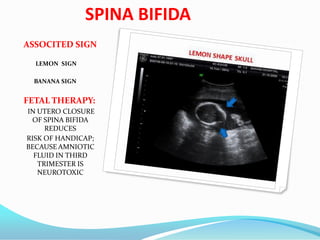
SPINA BIFIDA
ASSOCITED SIGN
LEMON SIGN
BANANA SIGN
FETAL THERAPY:
IN UTERO CLOSURE
OF SPINA BIFIDA
REDUCES
RISK OF HANDICAP;
BECAUSE AMNIOTIC
FLUID IN THIRD
TRIMESTER IS
NEUROTOXIC
Spina Bifida Occulta :-
 This is a midline defect of vertebral bodies without protrusion of the spinal
cord or meninges.
 Most individuals are asymptomatic and lack neurologic sign.
 In some cases, patch of hair, lipoma, discoloration of skin, dermal sinus in
the midline of lower back suggest a more significance malformations of
spinal cord.
 A Spine X-ray shows a defect in closure of posterior vertebral arches and
laminae, typically involve in L5 and S1.
 It is occasionally associated with more significant developmental
abnormalities of the spinal cord, including syringomyelia,
 Diastematomyelia and tethered cord.
 These are the best identified with MRI.
 A dermoid sinus usually forms a small skin opening, which lead to narrow
duct, some time indicated by protruding hairs, hairy patch or vascular
nervus.
 Demoid sinus occur in the midline at the sight of meningocele or
enencephalocele may occur.
 Demoid sinus tracts may pass through the dura, acting age conduit for the
spread of infection.
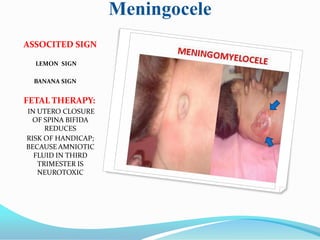
Meningocele
ASSOCITED SIGN
LEMON SIGN
BANANA SIGN
FETAL THERAPY:
IN UTERO CLOSURE
OF SPINA BIFIDA
REDUCES
RISK OF HANDICAP;
BECAUSE AMNIOTIC
FLUID IN THIRD
TRIMESTER IS
NEUROTOXIC
Meningocele
ASSOCITED SIGN
LEMON SIGN
BANANA SIGN
FETAL THERAPY:
IN UTERO CLOSURE
OF SPINA BIFIDA
REDUCES
RISK OF HANDICAP;
BECAUSE AMNIOTIC
FLUID IN THIRD
TRIMESTER IS
NEUROTOXIC
Meningocele
ASSOCITED SIGN
LEMON SIGN
BANANA SIGN
FETAL THERAPY:
IN UTERO CLOSURE
OF SPINA BIFIDA
REDUCES
RISK OF HANDICAP;
BECAUSE AMNIOTIC
FLUID IN THIRD
TRIMESTER IS
NEUROTOXIC
Meningocele
ASSOCITED SIGN
LEMON SIGN
BANANA SIGN
FETAL THERAPY:
IN UTERO CLOSURE
OF SPINA BIFIDA
REDUCES
RISK OF HANDICAP;
BECAUSE AMNIOTIC
FLUID IN THIRD
TRIMESTER IS
NEUROTOXIC
.
 Meningocele :- It is formed when the meninges
herminate through a defect in the posterior vertebral
arches.
A functuant midline mass that may transilluminate
occurs along the vertebral column, usually in the
lower back.
Asymptomatic children with normal neurological
finding and fullthickness skin covering may have
surgery delayed.
Those patients with leaking CSF should under go
immediate surgery.
MYELOMENINGOCELE
It is the most severe form of dysraphism involving the
vertebral column.
Incidence = 1/4000 live births.
Treatment :-
Management and supervision of a child and family
myelomeningocele require a multidisciplinary team including
surgeon, physician, therapisis.
Surgery is often done within a day or so of birth but can be
delay for several days when there is a CSF leak.
Prognosis :-
For a child who is born with a myelomeningocele and who is
treated aggressively mortality 10-15%.
ENENCEPHALOCELE :-
 Two major forms of dysraphism affect the skull, resulting in protrusion
of tissue through a bony midline defect, called cranium bifidum.
 A cranial meningocele consists of CSF filled meningeal sac only, and a
cranial encephalocele contain the sac + cereberal cortex, cerebellium,
portions of the brainstem.
 This defects occur most commonly in the ocipital region but in certain
part of world, frontal or nasofrontal enencephalocele are more
prominent.
Meckel-Gruber syndrome is a rare autosomal recessive condition that is
characterized by occipital enencephalocele, cleft lip or palate, microcephaly,
microphthalamia, abnormal genitalia, polycystic kidney and polydactyly.
Diagnosis MRI & CT Scan :-
Maternal serum alpha fetoprotein level and ultrasound measurement of BPD as
well as identification of enencephalocele in utero .
ANENCEPHALY
40% MORTILITY
OCCUR DURING
NEONATAL
PERIOD.
80 % OF THE
SURVIVAL WILL BE
INTELLECTUALY
AND
NEUROLOGICALLY
HADICAP
50% ARE
ASSOCIATED WITH
SPINA BIFIDA
ANENCEPHALY
40% MORTILITY
OCCUR DURING
NEONATAL
PERIOD.
80 % OF THE
SURVIVAL WILL BE
INTELLECTUALY
AND
NEUROLOGICALLY
HADICAP
50% ARE
ASSOCIATED WITH
SPINA BIFIDA
ANENCEPHALY :-
 It is distinctive appearance with a large defect of calvarium, meninges
and scalp associated with a rudimentary brain, which results from failure
of closure of the rostral neuropore the opening of the anterior neural
tube.
 The incidence – 1/1000 live births. The most anenecephalic infants die
within several days of birth.
 The recurrence risk is 4% and increase to 10% if a couple has had two
previously affected pregnancies.
 Approximately 50% of cases of anencephaly have associated
polyhydraminos.
Diagnosis :-
Couples who have had an anencephalic infant
should have successive pregnancy monitored,
including amniocentesis, determination of
AFP levels and ultrasound examination
between the 14th and 16th week of gestation.
HYDROCEPHALUS AND VENTRICULOMEGALY
In hydrocephalus there is pathological increase in the size of the cerebral
ventricles.
Prevalence
Hydrocephalus is found in about 2 per 1,000 births. Ventriculomegaly
(lateral ventricle diameter of 10 mm or more) is found in 1% of
pregnancies at the 18-23 week scan. Therefore the majority of fetuses
with ventriculomegaly do not develop hydrocephalus.
Etiology
This may result from chromosomal and genetic abnormalities,
intrauterine hemorrhage or congenital infection, although many cases
have as yet no clear-cut etiology.
Diagnosis
Fetal hydrocephalus is diagnosed sonographically, by the
demonstration of abnormally dilated lateral cerebral ventricles.
Prognosis
Fetal or perinatal death and
neurodevelopment in survivors are strongly
related to the presence of other
malformations and chromosomal defects.
Although mild, also referred to as borderline,
ventriculomegaly is generally associated with a
good prognosis,
HOLOPROSENCEPHALYPREVALENCE : 1/10,000
BIRTHand occurs with a
rate of 1 in 250 during
embryogenesis
There are three
classifications of
holoprosencephaly. Alobar,
in which the brain has not
divided at all, is usually
associated with severe facial
deformities. Semilobar, in
which the brain's
hemispheres have
somewhat divided, causes
an intermediate form of the
disorder. Lobar, in which
there is considerable
evidence of separate brain
hemispheres, is the least
severe form. In some cases
of lobar holoprosencephaly
the baby's brain may be
nearly normal.
HOLOPROCENCEPHALYCAUSES: A variety of
teratogens, chromosomal
abnormalities (in 25-50% of
cases), and single gene
mutations can result in
holoprosencephaly. Trisomy 13
(in about 40% of cases) and
trisomy 18 are the most
frequently identified
chromosomal anomalies. Many
single-gene disorders (18-25%)
can result in syndromes with a
variable incidence of
holoprosencephaly. Examples
include Pallister-Hall,
Rubinstein-Taybi, Kallmann,
Smith-Lemli-Opitz, Meckel,
hydrolethalus, pseudotrisomy
13, and microtia -anotia
syndromes. Maternal diabetes
has been implicated in about
1% of cases.
RECURRENCE RISK 6%
ALOBAR &SEMILOBAR
-LETHAL
LOBAR : MR
ABSENT SEPTUM PELLUCIDUM
Absence of the septum
pellucidum is reported to be an
unusual anomaly that occurs in
an estimated 2 to 3 individuals
per 1 00,000 people in the
general
population Absence of the SP
alone is not a disorder but is
instead a characteristic noted in
children with septo-optic
dysplasia.
The prognosis for individuals
with septo-optic
dysplasia varies according to
the presence and severity of
symptoms
AGENESIS OF THE CORPUS CALLOSUM
PREVALENCE : 5/1000
BIRTH
Agenesis of the corpus callosum is
caused by disruption to
development of the fetal brain
between the 5th and 16th week of
pregnancy
CAUSES: However, research
suggests that some possible causes
may include chromosome errors,
inherited genetic factors, prenatal
infections or injuries, prenatal
toxic exposures, structural
blockage by cysts or other brain
abnormalities, and metabolic
disorders.
Some syndromes that frequently
include ACC are Aicardi syndrome,
Miller-Dieker syndrome (MDLS;
247200), Rubinstein-Taybi
syndrome (RSTS; 180849),
acrocallosal syndrome (ACLD;
200990), and Joubert syndrome
(JBTS; 213300). Andermann
syndrome, Shapiro syndrome,
Acrocallosal syndrome,septo-optic
dysplasia (optic nerve hypoplasia),
Mowat-Wilson syndrome and
Menkes syndrome.
DANDY WALKER SYNDROME
PREVALENCE:
1/30,000
CAUSES:
LOW RECURRENCE RISK
1-5%
13 & 18 TRISOMIES
TRIPLOIDY
50 GENETIC SYNDROME
CONGENITAL
INFECTION
WARFARIN
20 NEONATAL
MORTILITY
50% INTELLECTUAL AND
NEUROLOGICAL
HANDICAP.
DANDY WALKER SYNDROMEThere are, at present, three types of
Dandy-Walker complexes.
They are divided into three closely
associated forms:
The DWS malformation is the most
severe presentation of the
syndrome. The posterior fossa is
enlarged and the tentorium is in
high position. There is partial or
complete agenesis of the cerebellar
vermis. There is also cystic
dilation of the fourth ventricle,
which fills the posterior fossa. This
often involves hydrocephaly and
complications due to associated
genetic conditions, such as Spina
Bifida.
Mega cisterna magna
The second type is a mega cisterna
magna . The posterior fossa is
enlarged but it is secondary to an
enlarged cisterna. This form is
represented by a large accumulation
of CSF in the cisterna magna in the
posterior fossa. The cerebellar
vermis and the fourth ventricle are
normal.
.
DANDY WALKER SYNDROME
The fourth ventricle is only
mildly enlarged and there is
mild enlargement of the
posterior fossa. The cerebellar
vermis is hypoplastic and has a
variably sized cyst space. This is
caused by open communication
of the posteroinferior fourth
ventricle and the cisterna
magna through the
enlarged vallecula. Patients
exhibit hydrocephalus in 25%
of cases and supratentorial CNS
variances are uncommon, only
present in 20% of cases. There
is notorcular-
lambdoid inversion, as usually
seen in patients with the
malformation. The third and
lateral ventricles as well as the
brain stem are normal.
ARNOLD CHIARI MALFORMATION
Incidence : The Chiari
malformation, defined as
tonsilar herniations of 3 to
5 mm or greater
The incidence is approximately
1 in 1,200.The incidence of
symptomatic Chiari is less but
unknown.
A prevalence of approximately
in 1000 has been described.
The Austrian pathologist Hans
Chiari in the late 1800s
described seemingly related
anomalies of the hindbrain, the
so called Chiari malformations
I, II and III. Later, other
investigators added a fourth
(Chiari IV) malformation. The
scale of severity is rated I -
IV, with IV being the most
severe. Types III and IV are
very rare
Type Presentation Other notes
I
Is generally asymptomatic during childhood, but
often manifests with headaches and cerebellar
symptoms. Herniation of cerebellar tonsils.
The most common form.
II
Usually accompanied by a myelomeningocele leading
to partial or complete paralysis below the spinal
defect. Abnormal development of the cerebellar
vermis and medulla oblongata occur, and they both
descend into the foramen magnum. Hydrocephalus is
frequently present.
III
Causes severe neurological defects. It is associated
with an encephalocele
IV Characterized by a lack of cerebellar development.[
The brainstem, cranial nerves, and the lower portion of the cerebellum may be stretched
or compressed. Therefore, any of the functions controlled by these areas may be
affected. The blockage of Cerebro-Spinal Fluid (CSF) flow may also cause a syrinx to
form, eventually leading to syringomyelia. Chiari is often associated with major
headaches, sometimes mistaken for migraines. Chiari headaches usually include
intense pressure in the back of the head, aggravated by Valsalva maneuvers, such as
yawning, laughing, crying, coughing, sneezing or straining. Chiari also includes muscle
weakness, facial pain, hearing problems, and extreme fatigue. It also can cause
insomnia cycles of sleep deprivation followed by inabilities to remain awake cycling
between them. 15% of patients with adult Chiari malformation are asymptomatic
Treatment
Once symptomatic onset occurs, a common treatment is decompression surgery,[14] in
which a neurosurgeon usually removes the lamina of the first and sometimes the second
or even third cervical vertebrae and part of the occipital bone of the skull to relieve
pressure. The flow of spinal fluid may be accompanied by a shunt. Since this surgery
usually involves the opening of the dura mater and the expansion of the space beneath, a
dural graft is usually applied to cover the expanded posterior fossa.
A small number of neurological surgeons believe that detethering the spinal cord as an
alternate approach relieves the compression of the brain against the skull opening
(foramen magnum), obviating the need for decompression surgery and associated
trauma. However, this approach is significantly less documented in the medical literature,
with reports on only a handful of patients. It should be noted that the alternative spinal
surgery is also not without risk.
Prognosis
The prognosis differs dependent on the type of malformation (i.e., type I, II, III, or IV). Type
I is generally adult-onset and, while not curable, treatable and non-fatal. Types I and II
sufferers may also develop syringomyelia. Type II is typically diagnosed at birth or
prenatally. Approximately 33% of individuals with Chiari II malformation develop
symptoms of brainstem damage within five years; a 1996 study found a mortality rate of
33% or more among symptomatic patients, with death frequently occurring due to
respiratory failure. 15% of individuals with Chiari II malformation die within two years of
birth. Among children under two who also have myelomeningocele, it is the leading cause
of death. Prognosis among children with Chiari II malformation who do not have spina
bifida is linked to specific symptoms; the condition may be fatal among symptomatic
children when it leads to neurological deterioration, but surgical intervention has shown
promise. Types III and IV are extremely rare and patients generally do not survive past the
age of two or three
ARNOLD CHIARI MALFORMATION
Arnold Chiari Malformation:-
Type I –It is usually not associated
with hydrocephalus patient
complain of headache,neck
pain,urinary frequency and
progressive lower extremity
spasticity.The deformity consist of
displacement of cerebellar tonsil
into cervical canal. Although
pathogenesis is unknown, a theory
suggest that obstruction of caudal
portion of the IV ventrical during
fetal development is responsible.
Type II :-It is charactarised by
progressive hydrocephalus with a
myelomeningocele, pointing of
frontal horn & colpocephaly
(dialted occipital horn) .This lesion
represent and anomaly of hindbrain
probably due to failure of pontine
flexure during embriyogenesis,and
result in elongation of the IV
ventrical and kinking of the
brainstem with displacement of
inferior vermis,pons,medulla into
cervical canal.This anomaly is
treated by surgical decompression.
ARNOLD CHIERI MALFORMATION
Type III - in this there is high
cervical encephalo-
meningocele: in which the
medulla, 4TH ventricle, and
entire cerebellum reside.
AQUEDUCTAL STENOSISCongenital: Some patients are born
with a congenitally narrow or
completely obstructed aqueduct. In
complete, this usually presents as
pediatric hydrocephalus. However,
if the obstruction is more minor, the
patient may be asymptomatic or
may not present until older age. The
obstruction can appear as a general
narrowing of the aqueduct or can
appear as small webs or rings of
tissue across the channel.
Post-Infectious or Post-Hemorrhage:
Infection in the cerebrospinal fluid
or hemorrhage into the ventricles
from other causes can occasionally
lead to scarring that creates webs or
rings that cause aqueductal stenosis
and block flow through the
aqueduct.
Idiopathic Acquired: Some patients
present in adulthood with the new
onset or gradual onset of
hydrocephalus. In many cases it is
unclear what the underlying cause
of the stenosis was and is
considered idiopathic
ARACHNOID CYSTArachnoid cysts are fluid-filled cysts
contained within the arachnoid
space.
Prevalence : Arachnoid cysts are
extremely rare.
Etiology :Unknown; infectious
process has been hypothesized but
it is unlikely that this may explain
the congenital cysts.
Diagnosis : Arachnoid cysts appear
on antenatal ultrasound as
sonolucent lesions with a thin
regular outline, that do not contain
blood flow, do not communicate
with the lateral ventricles and
anyhow are not associated with loss
of brain tissue. They occur most
frequently in the area of the cerebral
fissure and in the midline. .
Prognosis : Large cysts may cause
intracranial hypertension and
require neurosurgical treatment.
However, a normal intellectual
development in the range of 80-
90% is reported by most series.
Spontaneous remission has been
described both in the postnatal as
well as in the antenatal period.
CHOROID PLEXUS CYSTPrevalence : Choroid plexus cysts
are found in about 2% of fetuses at
20 weeks of gestation but in more
than 90% of cases they resolve by 26
weeks.
Etiology : Choroid plexus cysts
contain cerebrospinal fluid and
cellular debris.
Diagnosis :The diagnosis is made
by the presence of single or multiple
cystic areas (greater than 2 mm in
diameter) in one or both choroid
plexuses.
Prognosis :They are usually of no
pathological significance, but they
are associated with an increased
risk for trisomy 18 if maternal age
>35years, serum beta hCG >
0.3MoM, nuchal fold >6mm,
echogenic bowel, hydronephrosis
and cyst > 10 mm and possibly
trisomy 21. In the absence of other
markers of trisomy 18 the maternal
age-related risk is increased by a
factor of 1.5. The choroid plexus
cyst < 10 mm sometime disappear
spontaneously.
VEIN OF GALEN MALFORMATION
Vein of Galen aneurysm is a
very rare abnormality.
Prevalence : Vein of Galen
aneurysm is a sporadic
abnormality.
Diagnosis : The diagnosis is
made by the demonstration of a
supratentorial mid-line
translucent elongated cyst.
Prognosis : In the neonatal
period about 50% of the infants
present with heart failure and
the rest are asymptomatic. In
later life hydrocephalus and
intracranial hemorrhage may
develop.
Good results can be
achieved by
catheterization and
embolization of the
malformation.
LISSENCEPHALY
Lissencephaly, which
literally means smooth
brain, is a rare brain
formation disorder caused
by defective neuronal
migration during the 12th to
24th weeks of gestation,
resulting in a lack of
development of brain folds
(gyri) and grooves (sulci). It
is a form of cephalic
disorder. Terms such as
'agyria' (no gyri) or
'pachygyria' (broad gyri) are
used to describe the
appearance of the surface of
the brain. Affected children
display severe psychomotor
retardation, failure to
thrive, seizures, and
muscle spasticity or
hypotonia.[
LISSENCEPHALY
Other symptoms of the
disorder may include
unusual facial
appearance, difficulty in
swallowing, and
anomalies of the
hands, fingers, or toes.
The diagnosis of
lissencephaly is usually
made at birth or soon
after
by ultrasound, computed
tomography (CT),
or magnetic resonance
imaging (MRI).
category type
Classical (type 1) LIS: Lissencephaly due to PAFAH1B1 gene
mutation
Type I isolated lissencephaly (601545
Miller –dicker syndrome(247200)
LI SX : lissencephaly due to double
cortin(DCX) gene mutation(330121)
Lissencephaly type I without genetic
disorder
Cobblestone (type 2) Walker –Warburg syndrome(236670)
Fukuyama syndrome (253800)
Muscle Eye Brain disease (MEB)253280
other LIS2: Norman –Robert syndrome 253280
LIS3: TUBA1A, 611603
LISX2 : ARX, 300215
MICRO-LISSENCEPHALY
DESTRUCTIVE CEREBRAL LESIONS
Prevalence :
Destructive cerebral
lesions are found in
about 1 per 10,000
births. These lesions
include
hydranencephaly
porencephaly and
schizencephaly .
HYDRANENCEPHALY
hydranencephaly there
is absence of the cerebral
hemispheres with
preservation of the
mid-brain and
cerebellum.
Complete absence of
echoes from the
anterior and middle
fossae distinguishes
hydranencephaly from
severe hydrocep’
Prognosis
Hydranencephaly is
usually incompatible
with survival beyond
early infancyhalus .
PORENCEPHALY
In porencephaly there are
cystic cavities within the brain
that usually communicate
with the ventricular system,
the subarachnoid space or
both.
Etiology : Porencephaly may be
caused by infarction of the
cerebral arteries or
hemorrhage into the brain
parenchyma.
Diagnosis : In true
porencephaly there is one or
more cystic areas in the
cerebral cortex, which
communicates with the
ventricle while in pseudo
porencephalic cyst cavity donot
communictes with ventricle.
Prognosis : The prognosis in
porencephaly is related to the
size and location of the lesion
and although there is
increased risk of impaired
neurodevelopment in some
cases development is normal
SCHIZENCEPHALY
Schizencephaly is associated
with clefts in the fetal brain
connecting the lateral
ventricles with the
subarachnoid space.
Etiology : Schizencephaly may
be a primary disorder of brain
development or it may be due to
bilateral occlusion of the
middle cerebral arteries.
Dignosis : In schizencephaly
there are bilateral clefts
extending from the lateral
ventricles to the subarachnoid
space, and is usually associated
with absence of the cavum
septum pellucidum.
Prognosis : Schizencephaly is
associated with severe
neurodevelopmental delay and
seizures.
ENCEPHALOMALACIA
Cystic encephalomalacia
an irregular cystic area in
the brain parenchyma
which is characterised by
the presence of multiple
glial septations surrounded
by astrocytic proliferation.
This may be caused by
infarction, infection or
trauma. They may be focal
or diffuse and their
distribution will depend on
the cause and severity of
the injury and the post
conceptual age of the
patient. Encephalomalacia
caused by infarction may
be in the distribution of a
major cerebral artery.
ENCEPHALOMALACIA
If the injury is caused by
mild to moderate
hypotension the areas of
encephalomalacia may lie
in the boundary zones
between the major cerebral
arteries, whereas severe
hypotension may result in
widespread cystic
encephalomalacia with
sparing of the deep
periventricular white
matter only. The presence
of reactive astrocytosis and
glial septations
distinguishes cystic
encephalomalacia from an
area of porencephaly and
indicates that the injury
occurred late in gestation,
in the perinatal period, or
after birth
CHOROID PLEXUS PAPILLOMA
Guerard described the first CPP in
a 3-year-old girl in 1832, and
Perthes described the first
successful surgical removal in 1910.
The male-to-female incidence ratio
of CPP is 2.8 : 1.
CPPs are rare, comprising less than
1% of brain tumors in patients of
all ages. However, CPPs most often
occur in children and constitute up
to 3% of childhood intracranial
neoplasms with a predilection for
younger ages. CPPs comprise 4-6%
of the intracranial neoplasms in
children younger than 2 years and
12-13% of intracranial neoplasms in
children younger than 1 year.
Circulatory system
(745) Bulbus cordis anomalies and anomalies of cardiac septal closure
(745.4) Ventricular septal defect
(745.5) Atrial septal defect
(746) Other congenital anomalies of heart
(747) Other congenital anomalies of circulatory system
(747.1) Coarctation of aorta
(747.11) Interruption of aortic arch
(747.2) Other congenital anomalies of aorta
(747.3) Congenital anomalies of pulmonary artery
(747.4) Congenital anomalies of great veins
(747.5) Absence or hypoplasia of umbilical artery
(747.6) Arteriovenous malformation, unspec.
(747.8) Other specified anomalies of circulatory system
(747.81) Arteriovenous malformation of brain
(746.82) Cor triatriatum
(746.83) Infundibular pulmonic stenosis congenital
(746.84) Congenital obstructive anomalies of heart not elsewhere classified
(746.85) Coronary artery anomaly congenital
(746.86) Congenital heart block
(746.87) Malposition of heart and cardiac apex
(747.89) Other specified congenital anomalies of heart
Brugada syndrome
(747.9) Unspecified congenital anomaly of circulatory system
CONGENITAL HEART DISEASES
80-90% CHD’S
LOW RISK
PREGNANCIES
MJORITY OF
THEM ARE
PRIMI
9% INFANT
MORTILITY IN
U.K.
DUE – C.H.D.
SIX TIME MORE
COMMON THAN
TRISOMIES 21,18,13
FOUR TIMES MORE
COMMON THAN
NEURAL TUBE
DEFECTS
PREVALENCE
8/1000 LIVE BIRTH
30/1000
STILL BIRTH
FIRST ORGAN TO BE FUNCTIONAL
IN HUMAN BEING - HEART
CARDIOGENESIS
TWO POOL OF
CARDIAC
PRECURSORS
SECOND
FIELD
DEVELOP
INTO
RV, OFT,
SINUS
VENOSUS
FIRST FIELD
DVELOPS
INTO
RA,LA, LV
Primitive heart tube 21-22days
Looping of heart 22-24days
Development of IAS 30days
Development of IVS 28-days
Formation of AV Valve
Formation of outflow septum & tract
STREETER’S HORIZONS
STAGES (CVS DEVELOPMENT)
22 24 26 28 30 32 34 36 38DAYS
OF
LIFE
HEART
PULSAION
SINO –
ATRIAL
FORAMEN
*CIRCUL
ATION
*AV
CUSHION
*D.V.
*3ARCHES
•P.VS.
•PA -6
•AORTA
4 ARCH
PVS->LA
*RV,LV
*AV
NODE
O.P.>CL
*O.SEC.
*RV-6A
*LV-4A
TA-
SEPTATION
S.CUSP
TV
MV
IVS
NERVE
IVS
GENETIC ASPECT OF THE
CHDs
• 40%• 100%
• 80%• 40-50%
21 T 13 T
OX18 T
VENRICULAR SEPTAL DEFECT 2/1000
ATRIAL SEPTAL DEFECT 1/3000
AORTIS STENOSIS 1/7000
PULMONARY STENOSIS 1/1000
PULMONARY ATRESIA 1/10,000
d – TRANSPOSITION OF GREAT
ARTERIES
1/5000
TETRALOGY OF FALLOT’S 1/3000
DOUBLE OUTLET RIGHT
VENTRCLE
1/10,000
TRUNCUS ARTERIOSUS 1/10,000
CARDIO SPLENIC SYBDROME 1/10,000
CHD
30%
10%
3%
0.1%
0.01%
2%
OVERALL RECURRENCE RISK IN CHDs
%
GENERAL POPULATION 1
SIBS OF ISOLATED CASE 2
OFFSPRING OF ISOLATED CASE 3
TWO AFFECTED SIBS ( SIB +PARENT) 10
> TWO AFFECTED FIRST DEGREE
RELATIVE
50
MOTHER WITH CHD 10
FATHER WITH CHD 2
VENTRICULAR SEPTAL DEFECT
30% OF CHD’S
2/1000 BIRTH
50% V.S.D. ARE ISOLATED
PERIMEMBRANOUS 80%
INLET V.S.D.
MUSCULAR V.S.D.
OUTLET V.S.D.
90 SMALL V.S.D. CLOSE
SPONTANEOUSLY.
SURGICAL OUT COME IS GOOD
ATRIAL SEPTAL DEFECT
1/3000 BIRTH
10% OF ALL CHD’S
F.OVALE 3%
A.S.D. SECONDUM (ABOVE
F.OVALE)
A.S.D. PRIMUM
(BELOW F. OVALE)
A.S.D. SINUS VENOSUS
CORONARY SINUS A.S.D.;
A rare type A.S.D. in which
coronary sinu and left atrium open
partially or completely unroofed ,
leading to left to right shunt.
50% with A.S.D. Have other
associated other cardiac defects.
? DIFICULT TO DIAGNOSED
ANTENATALLY
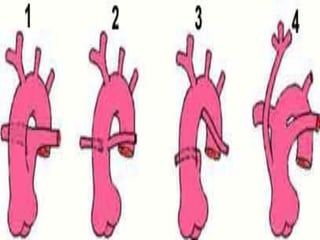
COARCTATION OF AORTA
PREVALENCE :
0.2-O.3 /1000 LIVE BIRTHS
8TH COMMON
CARDIAC DEFECT
MORE IN MALES AS
COMPARE TO FEMALES
Types :1. Uncomplicated
COA beyond infancy
2.Uncomplicated COA in
neonates/infants with
/without V.S.D.
3. COA with MS/MR
4. COA with bicuspid
aortic valve / aortic
stenosis
5. Interrupted aortic arch
6.Atypical COA
SHONE COMPLEX :
COA,AS,MS &
HYPOPLASTI LEFT
VENTRICLE
PULMONARY STENOSIS
PREVALENCE :
Pulmonary stenosis :
1/2000 live births.
Pumonary atresia :
1/10,000live births.
5th common CHD’S
50% patients with PS had
associated CHD’S.
Ballloon dilatation is
indicated when PPG is 30
mmHg across pulmonary
valve.
Dysplastic p. valve:
noonsyndrome.
Peripheral branch
stenosis :
Rubella syndrome
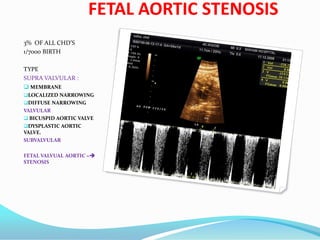
FETAL AORTIC STENOSIS
3% OF ALL CHD’S
1/7000 BIRTH
TYPE
SUPRA VALVULAR :
 MEMBRANE
LOCALIZED NARROWING
DIFFUSE NARROWING
VALVULAR
 BICUSPID AORTIC VALVE
DYSPLASTIC AORTIC
VALVE.
SUBVALVULAR
FETAL VALVUAL AORTIC =
STENOSIS
PATENT DUCTUS ATERIOSUS
PREVALENCE :
O.138-O.8/1000 LIVE BIRTHS
Eighty percent (80%) of the DA in
term infants close by 48 hours and
nearly 100% by 96 hours.
Failure of the ductus arteriosus to
close within 48-96 hours of postnatal
age results in a left to right shunt
across the ductus and overloading of
the pulmonary circulation.
A hemodynamically significant shunt
due to PDA has been reported in 40%
of infants less
than 1000 grams and 20% of infants
between 1000-1500 grams Initial
Indomethacin.
0.2 mg/kg stat followed by age
adjusted doses:
Subsequent dose
< 2 day- 0.1 mg/kg/dose 12 hourly for
2 doses
2-7 day- 0.2 mg/kg/dose 12 hourly for
2 doses
7 day- 0.25 mg/kg/dose 12 hourly for
2 doses.
Ibuprofen : 10 mg/kg stat followed
by 5 mg/kg/dose 24 hourly for 2 doses
PULMONARY ARTERY
DAO
SINGLE VENTRICLE1.5 % OF ALL CHD’S
Univentricular heart includes
both those cases in which two
atrial chambers are connected, by
either two distinct atrioventricular
valves or by a common one, to a
main ventricular chamber
(double-inlet single ventricle) as
well as those cases in which,
because of the absence of one
atrioventricular connection
(tricuspid or mitral atresia), one
of the ventricular chambers is
either rudimentary or absent.
Surgical treatment (the Fontan
procedure) involves separation of
the systemic circulations by
anastomosing the superior and
inferior vena cava directly to the
pulmonary artery.
GALEN SHUNT
FONATAN PROCEDURE
COMPLICATIONS :
ARRHYTHMIA
THROMBUS FORMATION
PROTEIN LOOSING ENTERO
PATHY
CONGENITAL MITRAL STENOSIS
Congenital MS is rare,
occurring in 0.5% of
patients with congenital
heart disease (CHD)
Congenital MS, a rare entity,
takes several forms. These
include hypoplasia of the
mitral valve annulus, mitral
valve commissural fusion,
double orifice mitral valve,
shortened or thickened
chordae tendinae, and
parachute mitral valve, in
which all chordae attach to
a single papillary muscle.
The most common
associated malformations
arecoarctation of the
aorta, aortic valve stenosis,
and subvalvular aortic
stenosis.
LA
LA
CONGENITAL MITRAL ATRESIA
The association of
multiple levels of left-
sided inflow and outflow
tract obstruction is
termed the Shone
complex.
Severe hypoplasia, or
atresia, of the mitral
valve results in a
hypoplastic LV cavity size
that is not capable of
sustaining the systemic
cardiac output.
This situation is
considered part of the
spectrum of
the hypoplastic left heart
syndrome
ATRIO – VENTRICULAR SEPTAL DEFECT
PREVALENCE : 7% OF ALL
CHD’S
1/3000 LIVE BIRTHS
50% of cases are associated
with aneuploidy, 60%
being trisomy 21, 25%
trisomy 18 ( associated with
extra-cardiac anomalies)
or in fetuses with
cardiosplenic syndromes
associated with multiple
cardiac anomalies and
abnormal disposition of
the abdominal organs are
almost the rule.
Diagnosis :
Antenatal echocardiographic
diagnosis of complete
atrioventricular septal defects is
usually easy. The incomplete
forms are more difficult to
recognize.
ATRIO – VENTRICULAR SEPTAL DEFECT
Prognosis : Atrioventricular
septal defects do not impair
the fetal circulation per se.
However, the presence of
atrioventricular valve
insufficiency may lead to
intrauterine heart failure.
About 50% of untreated
infants die within the first year
of life from heart failure,
arrhythmias and pulmonary
hypertention due to right-to-
left shunting (Eisenmenger
syndrome).
Survival after surgical
closure, which is usually
carried out in the sixth
month of life, is more than
90%. But in about 10% of
patients a second operation
for atrioventricular valve
repair or replacement is
necessary.
Long-term prognosis is
good.
d - TRANSPOSITION OF GREAT ARTERIESPREVALENCE :
0.24/1000 LIVE BIRTHS(1/5000)
2ND MOST COMMON CHD’S
ENCOUNTERED IN INFANCY &
REQUIRE TRANSFER TO TERTIARY
CARE CENTER WITHIN FIRST TWO
WEEK OF LIFE.
TYPE OF TGA
 Those with intact ventricular
septum with or without
pulmonary stenosis,
 Those with ventricular septal
defects and
 Those with ventricular septal
defect and pulmonary stenosis.
Diagnosis : Complete
transposition is probably one of
the most difficult cardiac
lesions to recognize in utero. In
most cases the four-chamber
view is normal, and the cardiac
cavities and the vessels have
normal
PROGNOSIS :Surgery which
involves arterial switch to
establish anatomic and
physiological correction, is
usually carried out within the
first two weeks of life..
.
P.A.
LA
TETRALOGY OF FALLOT’S
Prevalence : 3-26/10.000 live
births.
Mutation : NKX2,5 for 4%
TOF
Deletion of human TBX1 ;
chromosome 22q11.2, for 15% TOF
Trisomy 21 ,18,13 for 10% TOF.
Thus in 70% TOF is genetic
etiology remains to be determine.
Anatomical lesion
:Underdevelopment of
pulmonary infundibulum,
subaortic V.S.D.,
overriding of aorta and
right ventricular hypertrophy
61% simple TOF
33% pulmonary atresia
3% absent pulmonary valve
3% common atrio-ventricular canal
Tetralogy of Fallot It is the most
common cyanotic heart defect,
representing 55-70%, and the most
common cause of blue baby
syndrome. It was described in 1672
by Niels Stensen, in 1773 by Edward
Sandifort, and in 1888 by the
French physician Étienn-Louis
Arthur Fallot, for whom it is
named
TETRALOGY OF FALLOT’S
When severe pulmonic stenosis
is present, cyanosis tends to
develop immediately after birth.
With lesser degrees of
obstruction to pulmonary
blood flow the onset of
cyanosis may not appear until
later in the first year of life.
Diagnosis : Echocardiographic
diagnosis of tetralogy of Fallot
relies on the demonstration of a
ventricular septal defect in the
outlet portion of the septum
and an overriding aorta. There
is an inverse relationship
between the size of the
ascending aorta and pulmonary
artery, with a disproportion that is
often striking. A large aortic root
is indeed an important diagnostic
clue.
Prognosis : Cardiac failure is
never seen in fetal life as well as
postnatally.
TETRALOGY OF FALLOT’S
Even in cases of tight pulmonary
stenosis or atresia, the wide
ventricular septal defect
provides adequate combined
ventricular output, while the
pulmonary vascular bed is
supplied in a retrograde manner
by the ductus. . When there is
pulmonary atresia, rapid and
severe deterioration follows
ductal constriction. Survival
after complete surgical repair
(which is usually carried out in
the third month of life) is more
than 90% and about 80% of
survivors have normal exercise
tolerance.
TRUNCUS ARTERIOSUS
7% OF ALL CHD’S
1/10,000 BIRTH
30% HAVE EXTRACARDIAC
MALFORMATION
TRUNCUS IS CONNECTED TO :
40% RGIHT VENTRCLE
20% LEFT VENTRICLE
40% TO BOTH VENTRICLE
TYPE :
 I : MAIN PA CONNECTED TO
TA
II : PA BRANCH FROM LATERAL
ASPECT OF TRUNCUS
III: PA BRANCH FROM
POSTERIOR ASPECT OF TA.
IV : NO PA; LUNG GETS BLOOD
SUPLLY FROM – AORTIC
COLATERALS
DOUBLE OULET RIGHT VENTRICLE7% OF ALL CHD’S
PREVALENCE : 1/10,000 BIRTH
In double-outlet right ventricle
(DORV) most of the aorta and
pulmonary valve arise
completely or almost
completely from the right
ventricle. The relation between
the two vessels may vary,
ranging from a Fallot-like to a
TGA-like situation (the Taussig-
Bing anomaly). Pulmonary
stenosis is very common in all
types of DORV, but left outflow
obstructions, from subaortic
stenosis to coarctation and
interruption of the aortic arch,
can also be seen.
Diagnosis : Prenatal diagnosis of
DORV can be reliably made in the
fetus but differentiation from other
conotruncal anomalies can be very
difficult.
PROGNOSIS: Since the fetal
heart works as a common
chamber where the blood is
mixed and pumped, DORV is
not associated with intrauterine
heart failure.
RV
PA
AO
LA
IVS
LA
TRICUSPID ATRESIA
Prevalence : 0.057/live births
2.6% 0f all CHD’S
Classification:
Type I :Normally related both
great arteries (70%)
Type I A : NO VSD , PA
Type I B : small VSD ,PS
Type I C : large VSD no PS
Type II d –TGA (27%)
Type II A : NO VSD , PA
Type II B : small VSD ,PS
Type II C : large VSD no PS
Type III : l – TGA (3%)
ECG : LAD WITH LVH
Procedure : Surgical treatment
(the Fontan procedure) involves
separation of the systemic
circulations by anastomosing the
superior and inferior vena cava
directly to the pulmonary artery.
GAENN SHUNT at 6months
FONATAN PROCEDURE at 2
years of age.
TRICUSPID ATRESIA
Prevalence : 0.057/live births
2.6% 0f all CHD’S
Classification:
Type I :Normally related both
great arteries (70%)
Type I A : NO VSD , PA
Type I B : small VSD ,PS
Type I C : large VSD no PS
Type II d –TGA (27%)
Type II A : NO VSD , PA
Type II B : small VSD ,PS
Type II C : large VSD no PS
Type III : l – TGA (3%)
ECG : LAD WITH LVH
Procedure : Surgical treatment
(the Fontan procedure) involves
separation of the systemic
circulations by anastomosing the
superior and inferior vena cava
directly to the pulmonary artery.
GAENN SHUNT at 6months
FONATAN PROCEDURE at 2
years of age.
TRICUSPID ATRESIA
Prevalence : 0.057/live births
2.6% 0f all CHD’S
Classification:
Type I :Normally related both
great arteries (70%)
Type I A : NO VSD , PA
Type I B : small VSD ,PS
Type I C : large VSD no PS
Type II d –TGA (27%)
Type II A : NO VSD , PA
Type II B : small VSD ,PS
Type II C : large VSD no PS
Type III : l – TGA (3%)
ECG : LAD WITH LVH
Procedure : Surgical treatment
(the Fontan procedure) involves
separation of the systemic
circulations by anastomosing the
superior and inferior vena cava
directly to the pulmonary artery.
GAENN SHUNT at 6months
FONATAN PROCEDURE at 2
years of age.
TOTAL ANOMALOUS PULMONARY VENOUS RETURN
12 MOST COMMON
CARDIAC DEFECT
2.6% OF ALL CHD’S
PREVALENCE :
0.056/1000LIVE BIRTHS
TYPE :
SUPRA CARDIAC :PVS
DRAIN INTO LEFT
INNOMINATE VEI, LEFT
SVC OR AZYGOUS VEIN
CARDIAC : PVS DRAIN
INTO RIGHT ATRIUM OR
CORONARY SINUS
INFRACARDIAC: PVS
DRAIN INTO PORTAL VEIN,
DUCTUS VENOSUS AND
HEPATIC VEIN
MIXED:
RUPTURE OF SINUS OF VALSALVA
Sinus of Valsalva aneurysm
comprises approximately 0.1-
3.5% of all congenital cardiac
anomalies. Discovery in the
pediatric age group is
unusual.Congenital sinus of
Valsalva aneurysm was first
described by Hope. The 3 sinuses
of Valsalva are located in the most
proximal portion of the aorta, just
above the cusps of the aortic valve.
The sinuses correspond to the
individual cusps of the aortic valve.
Aneurysm of a sinus of Valsalva is a
rare congenital cardiac defect that
can rupture, causing heart failure
or other catastrophic cardiac
events. If the aneurysm remains
unruptured, it occasionally causes
obstruction of cardiac flow
resulting from compression of
normal structures. Aneurysms
typically develop as a discrete
flaw in the aortic media within
one of the sinuses of Valsalva.
Aneurysms most often involve the
right aortic sinus (67-85% of
patients, often associated with a
supracristal ventricular septal
defect), followed by the
noncoronary sinus, whereas an
aneurysm of the left sinus is rare.
RUPTURE OF SINUS OF VALSALVA
Distortion and prolapse of the
sinus and aortic valve tissue can
lead to progressive aortic valve
insufficiency. Unruptured
aneurysm may cause distortion
and obstruction in the right
ventricular outflow tract.
Distortion and compression may
also cause myocardial ischemia (by
coronary artery compression) and,
possibly, heart block (by
compressing the conduction
system).
Rupture may occur into any
chamber, although rupture most
commonly occurs into the aortic
right ventricular communication.
Rupture into the right atrium is the
second most common, in
association with a noncoronary
cusp aneurysm. Rupture may occur
less commonly into the left-sided
chambers, the pulmonary
artery, and rarely extends into the
pericardium.
RSOVs are commonly "wind-
sock"-like, with a broader aortic
end, ADO is best suited for this
defect, although other
Amplatzer devices
ALCPA
ALCAPA or
Blannd-Garland-White
syndrome is a rare
congenital anomaly with
incidence of 1 in 3 lac live
births, accounting for
0.25% of congenital heart
disease.
Wesselhoeft et al.
classified the clinical
spectrum of
ALCAPA as follows:
1. Infantile Syndrome :
This is the most common
form. Patient develops
acute episode of
respiratory insufficiency,
cyanosis, irritability and
profuse sweating. Most
of them die within two
years.
ALCPA
2. Mitral Regurgitation : It is
characterised by mitral
regurgitation murmur,
congestive heart failure,
cardiomegaly and atrial
arrythmias in children,
adolescent and adults.
3. Syndrome of Continuous
Murmur : This occurs in
asymptomatic patients with
angina pectoris. A continuous
murmur results from great
volume of blood flowing
through collateral branches
between right and left
coronary arteries.
4. Sudden Death in Adolescents
or Adults : Most of the patients
are asymptomatic, but some
may experience angina on
exertion, cardiac arrhythmias
and sudden death.
EBSTEIN’S ANOMALY TRICUSPID VALVE
Ebstein disease
Prevalence : 0.012-0.06/1000
live births Ebstein's may be
associated with trisomy 13, 21,
Turner, Cornelia de Lange and
Marfan syndromes. Maternal
ingestion of lithium has also
been incriminated as a causal
factor
Ebstein's anomaly results
from a faulty implantation of
the tricuspid valve. The
posterior and septal leaflets
are elongated and tethered
below their normal level of
attachment on the annulus or
displaced apically, away from
the annulus, down to the
junction between the inlet and
trabecular portion of the right
ventricle. . Associated
anomalies include atrial septal
defect, pulmonary atresia,
ventricular septal defect, and
supraventricular tachycardia.
EBSTEIN’S ANOMALY TRICUSPID VALVE
Ebstein disease
Prevalence : 0.012-0.06/1000
live births Ebstein's may be
associated with trisomy 13, 21,
Turner, Cornelia de Lange and
Marfan syndromes. Maternal
ingestion of lithium has also
been incriminated as a causal
factor
Ebstein's anomaly results
from a faulty implantation of
the tricuspid valve. The
posterior and septal leaflets
are elongated and tethered
below their normal level of
attachment on the annulus or
displaced apically, away from
the annulus, down to the
junction between the inlet and
trabecular portion of the right
ventricle. . Associated
anomalies include atrial septal
defect, pulmonary atresia,
ventricular septal defect, and
supraventricular tachycardia.
EBSTEIN’S ANOMALY
Ebstein disease
Prevalence : 0.012-0.06/1000
live births Ebstein's may be
associated with trisomy 13, 21,
Turner, Cornelia de Lange and
Marfan syndromes. Maternal
ingestion of lithium has also
been incriminated as a causal
factor
Ebstein's anomaly results
from a faulty implantation of
the tricuspid valve. The
posterior and septal leaflets
are elongated and tethered
below their normal level of
attachment on the annulus or
displaced apically, away from
the annulus, down to the
junction between the inlet and
trabecular portion of the right
ventricle. . Associated
anomalies include atrial septal
defect, pulmonary atresia,
ventricular septal defect, and
supraventricular tachycardia.
LA
CORTRIATRIATUMThe incidence of cor triatriatum
is less than 1 in 10,000.
First reported in 1868, cor
triatriatum, that is, a heart with
3 atria (triatrial heart), is a
congenital anomaly in which
the left atrium (cor triatriatum
sinistrum) or right atrium (cor
triatriatum dextrum) is divided
into 2 parts by a fold of tissue, a
membrane, or a fibromuscular
band. Classically, the proximal
(upper or superior) portion of
the corresponding atrium
receives venous blood, whereas
the distal (lower or inferior)
portion is in contact with the
atrioventricular valve and
contains the atrial appendage
and the true atrial septum that
bears the fossa ovalis. The
membrane that separates the
atrium into 2 parts varies
significantly in size and shape.
CORTRIATRIATUM
It may appear similar to a
diaphragm or be funnel-shaped,
bandlike, entirely intact
(imperforate) or contain one or
more openings (fenestrations)
ranging from small, restrictive-
type to large and widely open. Cor
triatriatum dexter is a rare cardiac
abnormality in which the right
atrium is subdivided into two
distinct chambers. This anomaly
is generally attributed to the
persistence of the right sinus
venosus valve and it is frequently
associated with severe
malformations of other right
heart structures. Cor triatriatum
dexter results from persistence of
the entire right sinus venosus
valve, which forms a large,
obstructive flap or septum across
the right atrium and divides it
into 2 separate chambers. The
upstream chamber receives superior
and inferior vena caval flow, while the
downstream chamber incorporates the
right atrial appendage.
CORTRIATRIATUM
In this situation, venous flow is
directed to the upstream
chamber and subsequently
across an atrial septal defect to
the left atrium, resulting in a
right-to-left shunt. Because the
membrane is usually
perforated, there is also some
flow across the membrane into
the downstream chamber and
through the tricuspid valve into
the right ventricle.
Echocardiographically, the
membrane generally runs from
the inferior vena cava to the
superior vena cava, separating
the right atrial appendage and
tricuspid valve from the great
veins. This cardiac
malformation can be
differentiated from the
gianteustachian valve dividing
the right atrium, by
echocardiographic
demonstration of the atrial
septal defect and by the
presence of cyanosis
ENLARGE CORONARY SINUS
The coronary sinus is enlarge
1. If left superior vena cava or
pulmonary vein open into it.
PREVALENCE : 0.5% in general
population & 3-10 %among childern
with CHD.
2. In condition associated with
raise right atrial pressure like –
tricuspid atresia, severe pulmonary
arterial hypertension.
3. Increased left main coronary
artery flow and increased
coronary sinus return.
Dilated coronary sinus is a
prompt to look for further cardiac
abnormalities such as intracardiac
shunts or thoracic venous
abnormalities.
The complex of an unroofed
coronary sinus (UCS) and a
persistent left superior vena cava
(PLSVC) is a rare congenital heart
disease first described by Raghib
et al. in 1965.1 A normal coronary
sinus drains the cardiac veins into
the right atrium. A UCS, in addition
to draining the cardiac veins, also
communicates abnormally with the
left atrium.
ENLARGE CORONARY SINUS
This abnormal communication is
thought to be due to impaired
development of the partition
between the left atrium and the
coronary sinus – an alternative
explanation is subsequent
dissolution of this partition.
A PLSVC, abnormally draining the
left internal jugular and subclavian
veins into the coronary sinus, is
due to impaired degenerationof the
embryonic left counterpart of the
normal right superior vena cava.
A UCS or a PLSVC may be further
associated with other cardiac
abnormalities. UCS and PLSVC
may cause no symptoms or may
cause right ventricular failure,
paradoxical cerebral embolism and
cerebral abscess, or cyanosis that
may vary with neck position. UCS
and PLSVC may be further
associated with other cardiac
abnormalities such as
atrioventricular septal defect, atrial
appendage anomalies and
coronary sinus ostial atresia .
ENLARGE CORONARY SINUSsuch as atrioventricular septal
defect, atrial appendage anomalies
and coronary sinus ostial atresia .
UCS and PLSVC may be further
associated with other cardiac
abnormalities such as
atrioventricular septal defect, atrial
appendage anomalies and
coronary sinus ostial atresia. This
case is associated with a PAPVD.
UCS, PLSVC and associated cardiac
abnormalities may be investigated
with echocardiography.
Treatment of UCS and PLSVC, if
needed, is surgical correction of its
components and associated
abnormalities.
Dilated coronary sinus is a
prompt to look for further cardiac
abnormalities such as intracardiac
shunts or thoracic venous
abnormalities. The complex of UCS
and PLSVC is one such
abnormality and its treatment
requires careful assessment of not
only the UCS and PLSVC but also
other concomitant cardiac
abnormalities to prevent post-
treatment haemodynamic
complications
CARDIAC MALPOSITION
PREVALENCE :
0.103/1000LIVE BIRTH
1% OF ALL CHD’S
TYPE :
 DEXTROCARDIA
ECTOPIA CORDIS -
PENTALOGY OF CANTRELL
ASPLENIA
POLYSPLENIA
RHABDOMYOMA
Prevalence: Any cardiac
tumor 1-2/10,000; over 90%
are benign. Rhabdomyoma
is the most common
benign congenital tumor..
occurring in the fetus and neonate,
with most identified within the
first year of life
Recurrence risk: Frequent in
patients with tuberous sclerosis.
Associated anomalies: Tuberous
sclerosis (50-86%), cardiac
dysrhythmia, non-immune
hydrops.
Intracavitary growth of the tumors
may cause disruption of
intracardiac blood flow leading to
congestive heart failure and
hydrops. Cardiac dysrhythmias,
caused by compression of the
conducting system, are also
frequently identified.
Rhabdomyomas grow slowly in
utero but tend to regress
spontaneously after birth.
FETAL P S V T
Adenosine :Per umbilical
0.05 to 0.2mg
Flecanide : oral 200-300mg
Digoxin : Oral, parenteral
Transplacental, 0.5- 1 mg
Amiodarone : parenteral
600-800mg
Sotatlol : oral; 80-320 mg
FETAL PSVT ========
FETAL COMPLETE A-V BLOCK
1901 MORQUIO gave first
description of CCAVB.
1908 Van den heuvel – ECG
1929 Yater IN UTERO
diagnosis of CCAVB.
Can be diagnosed as
early as 16th week of
gestation.
1976 McCue &
Chameides - association
between CCAVB &
connective tissue
disorder .
75% anti –Ro positive
Prevalence : 1/22,000
live births
1/3 to ¼ have -
structural heart defects
- L – TGA
ECD
Eye, ear, face and neck
(743) Congenital anomalies of eye
(743.0) Anophthalmos
(743.1) Microphthalmos
(743.2) Buphthalmos
(743.3) Congenital cataract and lens anomalies
(743.4) Coloboma and other anomalies of anterior segment
(743.45) Aniridia
(743.5) Congenital anomalies of posterior segment
(743.6) Congenital anomalies of eyelids, lacrimal system, and orbit
(744) Congenital anomalies of ear, face, and neck
(744.0) Anomalies of ear causing impairment of hearing
(744.1) Accessory auricle
(744.2) Other specified congenital anomalie of ea
(744.22) Macrotia
(744.23) Microtia
(744.3) Unspecified congenital anomaly of ear
(744.4) Branchial cleft cyst or fistula; preauricular sinus
(744.5) Webbing of neck
(744.8) Other specified congenital anomalies of face and neck
(744.81) Macrocheilia
(744.82) Microcheilia
(744.83) Macrostomia
(744.84) Microstomia
OPHTHALAMIC BIRTH DEFECTS CONGENITAL CORNEAL OPACITY
Most ocular abnormalities
have occurred in patients with
chromosomal defects. Major
ocular abnormalities, such as
anophthalmia, cyclopia,
retinoblastoma,
microphthalmia, corneal
opacities, coloboma,
cataracts, intraocular
cartilage, retinal dysplasia
and absent optic nerves;
and, minor abnormalities,
such as ptosis, abnormal
eyelid fissures, and
Brushfield spots are present
in individuals with abnormal
chromosomes. The
chromosome errors are usually
present in all somatic tissues.
Consequently, multiple tissue
abnormalities would be
expected in most patients with
chromosome abnormalities.
CONGENITAL PTOSISMental retardation is very
common in those patients
with abnormalities of
autosomes. Therefore, it is
unlikely that an isolated single
clinical or histopathological
ocular abnormality will be the
result of a chromosome error.
However, if the individual has
multiple systemic
abnormalities, then a
chromosome error can be
considered reasonably. Any
chromosome disorder can be
identified correctly by an
appropriate banding
chromosome determination
on the affected individuals.
With the possible exception of
the association of 13ql4- and
retinoblastoma, there does not
appear to be any
pathognomonic ocular
abnormalities that occur in
individuals with chromosome
errors.
Mental retardation is very
common in those patients
with abnormalities of
autosomes. Therefore, it is
unlikely that an isolated single
clinical or histopathological
ocular abnormality will be the
result of a chromosome error.
However, if the individual has
multiple systemic
abnormalities, then a
chromosome error can be
considered reasonably. Any
chromosome disorder can be
identified correctly by an
appropriate banding
chromosome determination
on the affected individuals.
With the possible exception of
the association of 13ql4- and
retinoblastoma, there does not
appear to be any
pathognomonic ocular
abnormalities that occur in
individuals with chromosome
errors.
CONGENITAL GLUCOMA
Buphthalmos is defined as a
"large eye" [bu (Greek) = ox or
cow]. It is most often present
in both eyes in children due to
congenital open-angle
glaucoma of the eye, noted by
unusually large corneas and
increased overall size of the
eyeball. An abnormally narrow
angle between the cornea and
iris blocks the outflow of
aqueous humor, which leads to
an increased intraocular
pressure and a characteristic
bulging enlargement of the
eyeball. Patient symptoms may
include excessive tearing and
light sensitivity
("photophobia"). Cupping of
the optic disk, which may be
the first sign to be seen on
dilated examination by an eye
care professional. Congenital
glaucoma untreated usually
leads to blindness.
CONGENITAL GLUCOMA
Aniridia is a rare congenital
condition characterized by the
underdevelopment of the eye's iris.
This usually occurs in both eyes. It
is associated with poor
development of the retina at the
back of the eye preventing normal
vision development. Aniridia does
not always cause lack of vision, but
usually leads to a number of
complications with the eye The
AN2 region of the short arm of
chromosome 11 (11p13) includes the
PAX6 gene (named for its PAired
boX status), whose gene product
helps regulate a cascade of other
genetic processes involved in the
development of the eye Aniridia is
a heterozygotic disease, meaning
that only one of the two
chromosome 11 copies is affected.
When both copies are altered
(homozygous condition), the result
is a uniformly fatal condition with
near complete failure of entire eye
formation
ANIRIDIAAniridia may be broadly
divided into hereditary and
sporadic forms. Hereditary
aniridia is usually transmitted
in an autosomal dominant
manner (each offspring has a
50% chance of being affected),
although rarer autosomal
recessive forms (such as
Gillespie syndrome) have also
been reported. Sporadic
aniridia mutations may affect
the WT1 region adjacent to the
AN2 aniridia region, causing a
kidney cancer called
nephroblastoma (Wilms
tumor). These patients often
also have genitourinary
abnormalities and mental
retardation (WAGR
syndrome).
ANIRIDIA
Aniridia is a rare congenital
condition characterized by the
underdevelopment of the eye’s iris. This
usually occurs in both eyes. It is
associated with poor development of
the retina at the back of the eye
preventing normal vision
development. Aniridia does not always
cause lack of vision, but usually leads to a
number of complications with the eye
The AN2 region of the short arm of
chromosome 11 (11p13) includes the PAX6
gene (named for its PAired boX status),
whose gene product helps regulate a
cascade of other genetic processes
involved in the development of the eye
(as well as other nonocular structures).[
Aniridia is a heterozygotic disease,
meaning that only one of the two
chromosome 11 copies is affected. When
both copies are altered (homozygous
condition), the result is a uniformly fatal
condition with near complete failure of
entire eye formation. In 2001, two cases
of homozygous An iridia patients were
reported; the fetuses died prior to birth
and had severe brain damage. In mice,
homozygous Small eye defect (mouse
Pax-6) led to loss of eyes, nose and the
fetuses suffered severe brain damage.
[Aniridia may be broadly divided into
hereditary and sporadic forms.
ANIRIDIA
Hereditary aniridia is usually transmitted
in an autosomal dominant manner (each
offspring has a 50% chance of being
affected), although rarer autosomal
recessive forms (such as Gillespie
syndrome) have also been reported.
Sporadic aniridia mutations may affect
the WT1 region adjacent to the AN2
aniridia region, causing a kidney cancer
called nephroblastoma (Wilms tumor).
These patients often also have
genitourinary abnormalities and mental
retardation (WAGR syndrome). Several
different mutations may affect the PAX6
gene. Some mutations appear to inhibit
gene function more than others, with
subsequent variability in the severity of
the disease. Thus, some aniridic
individuals are only missing a relatively
small amount of iris, do not have foveal
hypoplasia, and retain relatively normal
vision. Presumably, the genetic defect in
these individuals causes less
"heterozygous insufficiency," meaning
they retain enough gene function to yield
a milder phenotype
(OMIM) 106210 AN
(OMIM) 106220 Aniridia and absent
patella
(OMIM) 106230 Aniridia, microcornea,
and spontaneously reabsorbed cataract
(OMIM) 206700 Aniridia, cerebellar
ataxia, and mental deficiency (Gillespie
syndrome)
CONGENITAL ANTERIOR STAPHYLOMA
Staphyloma : It is the
protrusion of the sclera or
cornea, usually lined with
uveal tissue. In 1827 F.A. Von
Ammon describe it.
Anterior staphyloma
staphyloma is in the anterior
part of the eye.
corneal staphyloma 1.
bulging of the cornea with
adherent uveal tissue.
2. One formed by protrusion
of the iris through a corneal
wound.
posterior staphyloma,
staphyloma posticum
backward bulging of sclera at
posterior pole of eye.
scleral staphyloma
protrusion of the contents of
the eyeball where the sclera
has become thinned
CONGENITAL ANTERIOR STAPHYLOMA
Probabilities are that two
types of such congenital
anterior staphyloma exist –
one is of inflammatory
origin and the other is due
to developmental defect.
The latter is, however, all
the more rare.
FACE - CLEFT
MICRO OPHTHALMIA
ANOPHTHALMIA
HYPOTELORISM
(STENOPIA)
HYPERTELORISM
FACE - CLEFT
• ONLY PALATE
• ONLY LIP
• BOTH LIP & PALATE
ARE CLEFT
• PREVALENCE
1/800
BIRTH
50%
25%25%
CLEFT LIP & PALATE
INHERITANCE
AD, AR, XR & XD
1-2 % WITH 13 & 18
TRISOMY
5% TERATOGEN –
ANTIEPILEPTICS
WITH 100 GENETIC
DISODERS
.
80% CLEFT S LIP
WITH /WITHOUT
PALATE
ISOLATED
20 % CLEFT
ASSOCIATED
WITH SYNDROME
PREVALENCE
1/800 BIRTH
CLEFT LIP AND PALATE
.
CLEFT LIP
MEDIAN CLEFT LIP
PREVALENCE IS 0.5 %
ASSOCIATE WITH
HOLOPROSENCEPHALY
&
ORAL – FACIAL DIGITAL
SYNDROME
.
MEDIAN
&
LATERAL
CLEFT
LIP
TYPE OF CLEFT LIP
CLEFT LIP
.
FACIAL CLEFT
 This term refers to a wide spectrum of clefting defects (unilateral, bilateral
and less commonly mid-line) usually involving the upper lip, the palate, or both.
 Cleft palate without cleft lip is a distinct disorder. Facial clefts encompass a broad
spectrum of severity, ranging from minimal defects, such as a bifid uvula, linear
indentation of the lip, or submucous cleft of the soft palate, to large deep defects
of the facial bones and soft tissues.
 The typical cleft lip will appear as a linear defect extending from one side of the lip
into the nostril.
 Cleft palate associated with cleft lip may extend through the alveolar ridge and hard
palate, reaching the floor of the nasal cavity or even the floor of the orbit. Isolated
cleft palate may include defects of the hard palate, the soft palate, or both.
 Both cleft lip and palate are unilateral in about 75% of cases and the left side is
more often involved than the right side.
Prevalence
The incidence of cleft lip with or without cleft palate 1/750, the incidence of cleft
palate alone is 1/2500.
Treatment
Surgical closer of cleft lip is usually performed by three months of the age when the
infant has satisfactory weight gain and free from respiratory and systemic infection.
Closer of palate is usually done before 1 year of age to enhance normal speech
development.
ANGULAR CLEFT LIP
.
ABSENT DEPRESSOR ANGULARIS ORIS
The depressor angularis oris
muscle (DAOM) originates from
the oblique line of the mandible
and extends upward and
medially to the orbi-cularis oris.
It attaches to the skin and the
mucous membrane of the lower
lip. The DAOM draws the lower
corner of the mouth downward
and everts the lower lip. The
cause for agenesis of the muscle
is unknown. The absence or
hypoplasia of the DAOM
produces characteristic findings.
The lower lip on the affected side
looks thinner because of the lack
of eversion and feels thinner
because of the muscle agenesis.
When crying, the corner of the
mouth on the affected side is
displaced toward the normal
side and the lower lip on the
normal side moves downward
and outward
ABSENT ORBICULARIS ORIS
.
These patients have
symmetrical forehead
wrinkling, eye closure, and
nasolabial fold depth. The
diagnosis may be confirmed by
electrophysiologic studies. The
facial nerve conduction time
to the mentalis and orbicularis
oris muscle are normal. There
is no fibrillation in the area
normally occupied by the
DAOM. Motor units are
decreased or absent in the
same area.
Agenesis of the DAOM can
occur as an isolated anomaly
but it has also been reported in
association with
cardiovascular,
musculoskeletal,
genitourinary, and respiratory
defects.
MICROGANTHIA
OTOCEPHALY :
SEVERE HYPOPLASIA OF MANDIBLE
SEVERE MIDLINE CLEFT
HOLOPROSENCEPHALY,
ANTERIOR ENCEPHALOCELE
CYCLOPIA,
AGLOSSIAMICROSTOMIA,
MID FACIAL LOCATION-
OF EAR S “EAR HEAD”
.
PREVALENCE
1/1000
BIRTH
MICROGANTHIA
• GENETIC
SYNDROME
• CHROMOSOMAL
• TERATOGENIC
DRUG
• ROBIN
ANOMALAD
• (SPORADIC)
40% METHOTREXATE
TREACHER-
COLLINS,
ROBIN &
ROBERT
SYNDROME
18 T
TRIPLOIDY
NECK
TURNER SYNDROME
45 0X
.
CYSTIC
HYGROMA
Respiratory system
(748) Congenital anomalies of respiratory system
(748.0) Choanal atresia
RESPIRATORY SYSTEM
CONGENITAL
DIAPHRAGMATIC
HERNIA
PLEURAL
EFFUSION
SEQUESTRATION OF
LUNG
CYSTIC
ADENOMATOID
MALFORMATION
CYSTIC ADENOMATOID MALFORMATION
1/4000 BIRTH
85% UNILATERAL
TYPE –
I - MACRO CYSTIC >5 mm
II -MIXED
III - MICRO CYSTIC <5 mm
PULMONARY ABNORMALITIES
CYSTIC ADENOMATOID MALFORMATION (CAM)
 Cystic adenomatoid malformation of the lung is a developmental
abnormality arising from an overgrowth of the terminal respiratory
bronchioles.
 The condition may be bilateral involving all lung tissue, but in the
majority of cases it is confined to a single lung or lobe. The lesions are
either macrocystic (cysts of at least 5mm in diameter) or microcystic
(cysts less than 5 mm in diameter).
 In 85% of cases, the lesion is unilateral with equal frequency in the right
and left lungs and equal frequency in the microcystic and macrocystic
types.
Prevalence: CCAM is common 1-4/100000 birth.
Clinical Features :
New born present with respiratory distress recurrent respiratory infection
and pneumothorax.
The lesion may be confused with a diaphragmatic hernia.
Treatment :
 Antenatal treatment is
controversial it may include
excision of affected lobe,
aspiration of macrocystic
lesion.
 In the postnatal period surgery
is indicated for all symptomatic
patients.
CONGENITAL
DIAPHRAGMATIC HERNIA
• GENETIC
SYNDROME
• CHROMOSOMAL
• OTHER
• SPORADIC
50%
CARNIO SPINAL
DEFECT
INIENCEPHALY
CARDIAC
DEFECT
FRYNS
SYNDROME
MARFAN
DE LANG
SYNDROME
18 & 13T
MOSAIC
TETRASOMY12 p
PALLISTER-
KILLIAN SYN
CONGENITAL DIAPHRAGMATIC HERNIA
1/4000 BIRTHS
TYPE :
RIGHT CDH
LIVER HERNIATING
INTO CHEST
HEART ON LEFT SIDE
OF CHEST
FETAL THERAPY:
TRACHEAL OCCLUSION
EITHER BY FETSCOPE
OR
BY BALLON OCCLUSION
HEART RIGHT HEMITHORAX LEFT
LIVER IN RIGHT HEMITHORAX
CONGENITAL DIAPHRAGMATIC HERNIA
1/4000 BIRTHS
TYPE :
LEFT CDH
STOMACH,SPLEEN &
BOWEL HERNIATING
INTO CHEST
FETAL THERAPY:
Initial approach was
tracheal occlusion by clips
on the trachea.
It is now performed with
intra-tracheal inflatable
balloon. The balloon is
inserted at 26 to 28 weeks
and removed at 34 weeks.
HEART RIGHT HEMITHORAX
DIAPHRAGMATIC HERNIA
 Development of the diaphragm is usually completed by the 9th
week of gestation.
 In the presence of a defective diaphragm, there is herniation of the
abdominal viscera into the thorax at about 10–12 weeks, when the
intestines return to the abdominal cavity from the umbilical cord.
 However, at least in some cases, intrathoracic herniation of viscera
may be delayed until the second or third trimester of pregnancy.
Prevalence:
Diaphragmatic hernia is found in about 1 per 4000 births.
Clinical Features:
Respiratory distress grunting use of accessory muscle and cyanosis
and child have scaphoid abdomen.
Etiology
 Diaphragmatic hernia is usually a sporadic abnormality.
 However, in about 50% of affected fetuses there are associated
chromosomal abnormalities (mainly trisomy 18, trisomy 13 and
Pallister–Killian syndrome – mosaicism for tetrasomy 12p), other
defects (mainly craniospinal defects, including spina bifida,
hydrocephaly and the otherwise rare iniencephaly, and cardiac
abnormalities) and genetic syndromes (such as Fryns syndrome, de
Lange syndrome and Marfan syndrome).
Treatment
Aggressive respiratory support it include rapid endotracheal
intubation, sedation, possibly paralysis.
Surfactant is commonly used but no study has proven.
High frequency oscillation ventilation (HFOV).
Extracorporeal membrane oxygeneration (ECMO).
Nitric oxide is used has selective vasodilator.
Surgery : Ideal time to repair after stabilization.
CONGENITAL DIAPHRAGMATIC HERNIA
1/4000 BIRTHS
TYPE :
RIGHT CDH :
LIVER HERNIATING
INTO CHEST
FETAL THERAPY:
TRACHEAL OCCLUSION
EITHER BY FETSCOPE
OR
BY BALLON OCCLUSION
PLEURAL EFFUSIONUnilateral Bilateral
Primary
most often chylous;
often on the right
Secondary
Clear; as part of
non-immune
hydrops
Isolated
usually associated with
an underlying
structural anomaly:
 pulmonary
lymphangiectasia
 cystic
adenomatoid
malformation of
the lung
 bronchopulmona
ry sequestration
 diaphragmatic
hernia
 chest wall
hamartoma
 pulmonary vein
atres
incidence of about
one per 1,000
pregnancies.
Associated with
other
manifestations
of hydrops
 subcutaneo
us skin
oedema
 pericardial
effusion
 ascites
PLEURAL EFFUSION
One option in the management of
fetuses with pleural effusion is
thoracocentesis and drainage of
the effusions. However, in the
majority of cases the fluid
reaccumulates within 24-48 hours
requiring repeated procedures and
it is therefore preferable to achieve
chronic drainage by the insertion
of pleural-amniotic shunts. The
clinical course of primary fetal
hydrothorax is unpredictable.
Whereas smaller unilateral
effusions might remain stable or
even regress, this is rarely the case
with larger collections. Bilateral
effusions, hydrops, preterm
delivery and the lack of antenatal
therapy are all associated with poor
outcome. Once structural and
chromosomal anomalies have been
excluded, optimal management
depends on gestational age, rate of
progression, the development of
hydrops and associated maternal
symptoms. For very large effusions
with mediastinal shift, hydrops
and/or hydramnios, or when there
is rapid enlargement of the
effusion, fetal intervention is
warranted
CHEST WALL LYMPHATIC HYGROMA
Congenital lymphangioma is a
malformation of the lymphatic
system. Although
histologically it is a benign
disorder, it has a propensityfor
rapid growth and local
invasion into the muscle,
bone, and underlying tissue,
and it may lead to a decreased
quality of life. This
lymphangioma can occur in
various anatomic locations,
such as the axilla, the anterior
abdominal wall, and the
extremities.
Chest wall lymphangioma,
however, seems to be a
completely different disease,
and prenatal diagnosis of this
condition is rare.
CHEST WALL LYMPHATIC HYGROMA & LEG HAEMNGIOMA
The findings may be unilocular or
multilocular, and the lesions range
in size from several millimeters to
much larger and contain a clear or
cloudy lymphoid fluid.
Lymphangiomas are believed to be
caused by the anomalous
development of the lymphatic
system; the etiology is variable,
probably multigenic.
Lymphangiomas are made up of
lymphatic vessels supported by
connective tissue. No
communication exists between the
normal lymphatic system and the
lymphangioma. Lymphangiomas
have a predilection for local
infiltration of the dermis,
subcutaneous tissue, and soft
tissue and occasionally are
widespread.
In contrast to cystic hygroma, chest
lymphangioma may be a different
congenital anomaly
CHEST WALL LYMPHATIC HYGROMA
We suggest that chest wall
lymphangioma should be
included in the entity of
findings of low incidence for
chromosomal abnormalities.
These lesions are usually not
associated with other
congenital abnormalities or
generalized lymphedema. The
prenatal finding of chest wall
lymphangioma is relatively
simple and easy to diagnose
sonographically, and the
treatment of choice is surgical
excision. The outcome is
relatively favorable, with a
recurrence rate of 10% to 15%,
depending on the technical
possibilities of complete
removal of the pathologic
tissue
digestive system
(749) Cleft palate
(749.0) Cleft palate, unspec.
(749.2) Cleft palate w/ cleft lip
(750) Other congenital anomalies of upper alimentary tract
(750.0) Tongue tie
(750.5) Pyloric stenosis
(751) Other congenital anomalies of digestive system
(751.0) Meckel's diverticulum
(751.2) Imperforate anus
(751.3) Hirschsprung's disease
ABDOMEN
EXOMPHALOS 1/4000
GASTROCHESIS 1/4000
BODY STALK ANOMALY 1/10,000
BADDER EXTROPHY 1/30,000
CLOACAL EXTORPHY 1/20,000
BODY STALK COMPLEX. . Limb body wall complex was
described for the first time by Van
Allen et al. in 1987. Two of the three
following anomalies must be present to
establish the diagnosis:
1. Thoracic and/or abdominal celosomia.
2. Exencephaly or encephalocele with a
facial cleft.
3. Anomalies of the extremities.
The anomaly consists of a poly-
malformation syndrome with a thoraco-
and/or abdomino-schisis associated with
an eventration of the internal organs and
anomalies of the extremities. Russo et al.
in 1993 and later Cusi et al. in 1996
distinguished two different phenotypes
according to the fetoplacental
relationships.
In the phenotype with the “cranio-
placental attachment” a neural tube
closure defect is associated with one or
more complex facial clefts and an
anterior coelosomy, whereas amniotic
bands are inconstant and anomalies of
the extremities, if any, touch primarily
the upper limbs .
In the phenotype with the “abdomino-
placental attachment” the authors
describe:
A persistence of the cavity of the
extraembryonic coelom containing the
exteriorized abdominal organs.
BODY STALK COMPLEX. . The umbilical cord is always
localized on the wall of this bag; it
is short, non-free and is
incompletely covered by the
amnion.
Urogenital anomalies and the
persistence of the primitive cloaca.
Rachidian anomalies
Prevalence : is estimated to
be 0.7 in 10,000 births; 1/14000
BIRTHS
IT IS A LETHAL ANOMALY, IN THE
FIRST 12 WEEKS. THE ABDOMINAL
WALL WITH HERNIATED ORGANS IS
FUSED TO THE PLACENTA. Body
stalk anomaly is a severe
abdominal wall defect caused
by the failure to form a body
stalk and is characterized by
the absence of an umbilical
cord , naval & failure of fusion
of the four flod of abdominal
wall.
THE ASSOCIATED MALFORMATIONS
ARE – NEURAL TUBE
DEFECTS,GASTROINTESTINAL,
GENTOURINARY SYSTEM, HEART,
LIVER & LUNGS.
BODY STALK COMPLEX. Three etiologic mechanisms
have been suggested:
· mechanical obstruction
secondary to compression by
amniotic bands,
.Abnormalities in the germ
disk or
·vascular disruption of the
fetoplacental circulation.
The body stalk malformation
results from a defect in the
germ disc, leading to an
abnormal body folding, an
abnormal amniotic cavity
formation and a failure to
obliterate the extraembryonic
coelom. This accounts for the
short or absent umbilical cord
and the broad insertion of the
amnio-peritoneal membrane
onto the placental chorionic
plate8
BODY STALK COMPLEX-Closing failure of the
Cephalic body fold defects
lead to an anterior
diaphragmatic hernia, ectopia
cordis, sternal cleft, cardiac
defects and an upper midline
omphalocele as observed in
the Pentalogy of Cantrell.
Closing failure of the caudal
body fold results in exstrophy
of the bladder, imperforate
anus, partial colonic agenesis
and agenesis of one umbilical
artery together with a
hypogastric omphalocele.
Aplasia or hypoplasia of the
paraspinous or thoracolumbar
musculature is responsible for
the severe scoliosis.
Insufficiency in both cephalic
and caudal body folding leads
to a combination of the above-
mentioned features.
EXOMPHALOS
1/4000 BIRTHS
RECURRENCE RISK 1%
50% WITH
EXOMPHALOS HAVE
18/13 TRISOMY; AT 12
WEEKS OF
GESTATION,30% AT MID
GESTATION & IN 15%
NEONATES .
BECKWITH WIEDEMANN
SYNDROME-SPORADIC,
AD,AR, X LINKED AND
POLYGENIC
INHERITANCE
ABDOMEN
OMPHALOCELE
OMPHALOCELE
EXOMPHALOS
LESS OFTEN ASSOCIATED
WITH FAILURE IN THE
CEPHALIC EMBYRONIC
FOLD-
PENTALOGY OF CANTRAL
ACRANIA
STERNAL DEFECT
ECTOPIA CORDIS
DIAPHRAGMATIC HERNIA
EXOMPHALOS
FILURE OF CAUDAL FOLD
WITH EXTROPHY OF
BLADDER & CLOACA,
IMPERFORATED ANUS,
COLONICATRESIA AND
SACRAL VERTEBRAL
DEFECTS
ABDOMEN
OMPHALOCELE
OMPHALOCELE
EXOMPHALOS
1/4000 BIRTHS
RECURRENCE RISK 1%
50% WITH
EXOMPHALOS HAVE
18/13 TRISOMY; AT 12
WEEKS OF
GESTATION,30% AT MID
GESTATION & IN 15%
NEONATES .
BECKWITH WIEDEMANN
SYNDROME-SPORADIC,
AD,AR, X LINKED AND
POLYGENIC
INHERITANCE
ABDOMEN
OMPHALOCELE
OMPHALOCELE
GASTROSCHISIS
1/4000 BIRTH
UMBILICUS IS NORMAL
INTESTINE HERNIATE
THROUGH DEFECT IN
ABDOMINAL WALL JUST
LATERAL & USUALLY ON
RIGHT SIDE OF THE
UMBILICUS
SPORADIC
ABNORMALITY
CHILD REQUIRE TOTAL
PARENTRAL NUTRITION
DURING IMMEDIATE
POSTNATAL PERIOD
DEATH IS AROUD 4
YEARS OF AGE DUE TO
LIVER FAILURE
GASTROSCHISIS
1/4000 BIRTH
UMBILICUS IS NORMAL
INTESTINE HERNIATE
THROUGH DEFECT IN
ABDOMINAL WALL JUST
LATERAL & USUALLY ON
RIGHT SIDE OF THE
UMBILICUS
SPORADIC
ABNORMALITY
CHILD REQUIRE TOTAL
PARENTRAL NUTRITION
DURING IMMEDIATE
POSTNATAL PERIOD
DEATH IS AROUD 4
YEARS OF AGE DUE TO
LIVER FAILURE
BADDER EXTROPHY
1/3000 0BIRTH
SPORADIC
ABNORMALITY
DIAGNOSIS:
NORMAL AMNIOTIC
FLUID
URINARY BLADDER
NOT VISUALIZED
ANECHOGENIC MASS
PROTUDING FROM
LOWER ABDOMINAL
WALL
CLOACAL EXTROPHY
½0,000BIRTH
SPORADIC
ABNORMALITY
DIAGNOSIS:
NORMAL AMNIOTIC
FLUID
URINARY BLADDER
NOT VISUALIZED
ANECHOGENIC MASS
PROTUDING FROM
LOWER ABDOMINAL
WALL .
POSTERIOR
ANOMALOUS
COMPONENT-
HERNIATED BOWEL
&/OR
MENINGOMYELOCELE
Digestive system
(749) Cleft palate
(749.0) Cleft palate, unspec.
(749.2) Cleft palate w/ cleft lip
(750) Other congenital anomalies of upper alimentary tract
(750.0) Tongue tie
(750.5) Pyloric stenosis
(751) Other congenital anomalies of digestive system
(751.0) Meckel's diverticulum
(751.2) Imperforate anus
(751.3) Hirschsprung's disease
GASTROINTESTINAL DEFECTS
EOSOPHAGEAL ATRESIA 1/3000 BIRTHS
DUODENAL ATRESIA 1/5000 BIRTHS
INTESTINAL OBSTRUCTION 1/2,000 BIRTHS
HIRSCHPRUNG DISEASE 1/3,000 BIRTHS
MECONIUM PERITONITIS 1/3,000 BIRTHS
HEPATIC CALCIFICATION 1/2000 BIRTHS
ANORECTAL MALFORMATION 1/4000 BIRTHS
ESOPHAGEAL WEB OR RING
Esophageal webs are thin (2-
3mm) membranes of normal
esophageal tissue consisting of
mucosa and submucosa. They
can be congenital or acquired.
Congenital webs commonly
appear in the middle and
inferior third of the esophagus,
and they are more likely to be
circumferential with a central
or eccentric orifice. esophageal
webs and rings are estimated
to occur in 1 in 25,000 to 1 in
50,000 live births. They are
mainly observed in the
Plummer-Vinson syndrome,
which is associated with
chronic iron deficiency
anemia. Esophageal webs are
associated with bullous
diseases (such as
epidermolysis bullosa,
pemphigus, and bullous
pemphigoid), with graft versus
host disease involving the
esophagus, and with celiac
disease.
TRACHEO- ESOPHAGEAL FISTLA
ESOPHAGEAL ATRESIA & TRACHEO ESOPHAGEL FISTULA
Esophageal atresia and
tracheoesophageal fistulae, found
in about 90% of cases, result from
failure of the primitive foregut to
divide into the anterior trachea
and posterior esophagus, which
normally occurs during the 4th
week of gestation.
Prevalence
Esophageal atresia is found in
about 1 in 3000 births.
Causes
Sporadic defect. 20% may have 18
& 21 trisomy. 50% with it have
cardiac defects. It may part of
VATER defect. 80% patient with
esophageal atresia have tracheo –
esophageal fistula.
RK
LK
NO STOMACH BUBBLE
ESOPHAGEAL ATRESIA & TRACHEO ESOPHAGEL FISTULA
Diagnosis
Prenatally, the diagnosis of
esophageal atresia is suspected
when, in the presence of
polyhydramnios (usually after 25
weeks), repeated ultrasonographic
examinations fail to demonstrate
the fetal stomach.
Prognosis
Survival is primarily dependent on
gestation at delivery and the
presence of other anomalies. Thus,
for babies with an isolated
tracheoesophageal fistula, born
after 32 weeks, when an early
diagnosis is made, avoiding
reflux and aspiration pneumonitis,
postoperative survival is more than
95%.
RK
LK
NO STOMACH BUBBLE
DUODENAL ATRESIA
DUODENAL ATRESIA
At 5 weeks of embryonic life,
the lumen of the duodenum is
obliterated by proliferating
epithelium. The patency of the
lumen is usually restored by
the 11th week and failure of
vacuolization may lead to
stenosis or atresia. Duodenal
obstruction can also be caused
by compression from the
surrounding annular pancreas
or by peritoneal fibrous bands.
Prevalence
Duodenal atresia is found in
about 1 per 5000 births.
DOUBLE BUBBLE
DUODENAL ATRESIAEtiology
Duodenal atresia is a sporadic
abnormality, although, in some
cases, there is an autosomal
recessive pattern of inheritance.
Approximately half of fetuses with
duodenal atresia have associated
abnormalities, including trisomy
21 (in about 40% of fetuses) and
skeletal defects (vertebral and rib
anomalies, sacral agenesis, radial
abnormalities and talipes),
gastrointestinal abnormalities
(esophageal
atresia/tracheoesophageal fistula,
intestinal malrotation, Meckel’s
diverticulum and anorectal
atresia), cardiac and renal defects.
Diagnosis
Prenatal diagnosis is based on
the demonstration of the
characteristic ‘double bubble’
appearance of the dilated
stomach and proximal
duodenum, commonly associated
with polyhydramnios.
Prognosis
Survival after surgery in cases with
isolated duodenal atresia is more
than 95%.
DOUBLE BUBBLE
INTESTINAL OBSTRUCTION
Intrinsic lesions result from
absent (atresia) or partial
(stenosis) recanalization of the
intestine. In cases of atresia, the
two segments of the gut may be
either completely separated or
connected by a fibrous cord. In
cases of stenosis, the lumen of the
gut is narrowed or the two
intestinal segments are separated
by a septum with a central
diaphragm.. The most frequent site
of small bowel obstruction is distal
ileus (35%), followed by proximal
jejunum (30%), distal jejunum
(20%), proximal ileus (15%). In
about 5% of cases, obstructions
occur in multiple sites. Anorectal
atresia results from abnormal
division of the cloaca during the
9th week of development.
Prevalence
Intestinal obstruction is found in
about 1 per 2000 births; in about
half of the cases, there is small
bowel obstruction and in the other
half anorectal atresia.
Small intestine 1/750 BIRTHS
DIALTED BOWEL
LOOP
Dx ILEAL ATRESIA
INTESTINAL OBSTRUCTION
Diagnosis
Diagnosis of obstruction is usually
made quite late in pregnancy (after
25 weeks), as dilatation of the
intestinal lumen is slow and
progressive. . The abdomen is
usually distended and active
peristalsis may be observed.
If bowel perforation occurs,
transient ascites, meconium
peritonitis and meconium
pseudocysts may ensue.
Prognosis
The prognosis is related to the
gestational age at delivery, the
presence of associated
abnormalities and site of
obstruction. In those born after 32
weeks with isolated obstruction
requiring resection of only a short
segment of bowel, survival is
more than 95%. Loss of large
segments of bowel can lead to
short gut syndrome, which is a
lethal condition.
HIRSCHSPRUNG’S DISEASE
Hirschsprung’s disease is
characterized by congenital
absence of intramural
parasympathetic nerve ganglia in
a segment of the colon. It derives
from failure of migration of
neuroblasts from the neural crest
to the bowel segments, which
generally occurs between the 6th
and 12th weeks of gestation.
Another theory suggests that the
disease is caused by
degeneration of normally
migrated neuroblasts during either
pre- or postnatal life.
Prevalence
1 in 3000 births.
Etiology
It is considered to be a sporadic
disease, although in about 5% of
cases there is a familial
inheritance. In a small number
of cases, Hirschsprung’s disease is
associated with trisomy 21.
HIRSCHSPRUNG’S DISEASE
Diagnosis
The aganglionic segment is unable
to transmit a peristaltic wave, and
therefore meconium accumulates
and causes dilatation of the lumen
of the bowel.
The ultrasound appearance is
similar to that of anorectal
atresia, when the affected
segment is colon or
rectum. Polyhydramnios
and dilatation of the loops
are present in the case of
small bowel involvement; on
this occasion, it is not different
from other types of obstruction.
Prognosis
Postnatal surgery is aimed at
removing the affected segment and
this may be a two-stage procedure
with temporary colostomy.
Neonatal mortality is
approximately 20%.
MECONIUM PERITONITIS
Etiology
Intestinal stenosis or
atresia and meconium ileus
account for 65% of the
cases. Other causes include
volvulus and Meckel’s
diverticulum. Meconium
ileus is the impaction of
abnormally thick and
sticky meconium in the
distal ileum, and, in the
majority of cases, this is
due to cystic fibrosis.
Prevalence
Meconium peritonitis is
found in about 1 in 3000
births.
MECONIUM ILEUS
Diagnosis
In the typical case, meconium
peritonitis is featured by the
association of intra-abdominal
echogenic area, dilated bowel
loops and ascites. Postnatally
“SOAP BUBBLE “appearance on C
– ray due air & meconium mixing
Meconium ileus
hyperechogenic fetal bowel at 16–
18 weeks of gestation may be
present in 75% of fetuses with
cystic fibrosis. The prevalence of
cystic fibrosis in fetuses with
prenatal diagnosis of intestinal
obstruction may be about 10%.
Prognosis
Meconium peritonitis is associated
with a more than 50% mortality in
the neonatal period.
ANORECTAL MALFORMATION
.Incidence 1 in 4000.
Imperforated anus
It can be devided into low lesion where
the rectum has descended through the
sphincter comlex,and high lesion where
it has not.
Manifestationand diagnosis
:Low anal atresia
anal opening is covered with skin, after
24 hrs meconium bulding may be seen.
In these cases immediate perineal
procedure performed followed by
dilation programm.
-High lesion
Perineum appear flat,or there may be air
or meconium passed via the penis or
urethra, in this condition entering the
bulbur,prostatic urethra and even the
bladder.They have good prognosis with a
normal sacrum and anal dimple and
intact sphincter function.
UB
HEPATO-BILIARY SYSTEM
Fetal cholelithiasis was first
diagnosed in 1983 and since then
there have been only few reports
about the presence of gallstones
in the fetus. Maternal conditions,
fetal or obstetrical predisposing
risk factors have been proposed
to have a causative role, but the
pathogenesis of fetal gallstones
remains unknown. fetal
cholelithiasis confirmed to be a
self-limiting disease without
complications and did not
require any form of therapy.
However, a close follow-up is
indicated in these patients until
spontaneous resolution is
demonstrated by US.
HEPATO-BILIARY SYSTEM
Fetal cholelithiasis was first
diagnosed in 1983 and since
then there have been only few
reports about the presence of
gallstones in the fetus.
Maternal conditions, fetal or
obstetrical predisposing risk
factors have been proposed to
have a causative role, but the
pathogenesis of fetal gallstones
remains unknown. fetal
cholelithiasis confirmed to be a
self-limiting disease without
complications and did not
require any form of therapy.
However, a close follow-up is
indicated in these patients until
spontaneous resolution is
demonstrated by US.
ABDOMINAL CYST
Choledochal,uncommon
congenital disorder
characterized by a globular or
fusiform dilatation of the
common bile duct just below
the site of entry of the cystic
duct. It is detected with an
incidence of 0.2 - 0.5% per
1.000.000 population. There is
a 3:1 female predominance.
Type I choledocal cyst refers to
aneurysmal dilatation of the
common bile duct often
accompanied by distal
narrowing. It accounts for
80% - 90% of cases.
Types II choledochocoele
which involves only the
intraduodenal portion of the
main bile duct and accounts
for 1 - 5% of cases. the
common bile duct terminates
into the choledochocoele
which drains into the
duodenum via an aperture in
its wall. The main pancreatic
duct may also empty into the
ABDOMINAL CYST
Type III occurs when the
common bile duct enters
normally into the papilla and
the choledococoele fills and
empties directly into the
common bile duct. In this
variant the pancreatic duct
usually enters into the main
bile duct proximally to the
choledochocoele.
Type IV refers to multiple
cysts. Type IVa refers to
multiple intrahepatic cysts and
an extrahepatic cyst and Type
IVb refers to multiple
extrahepatic cysts.
Type V refers to Carolis disease
complete biliary tree is
involved.
CHOLEDOCAL CYST
MESENTRIC CYST
OMENTAL CYST
INTTESTINAL
DUPLICATION CYST
OVARIAN CYST
ANOMALIES OF UMBILICAL CORD
Abnormalities of the
umbilical vein, which are
very rare, can be divided in
three groups:
(1) Persistence of the right
umbilical vein with ductus
venosus and presence or
absence of left umbical
vein.
(2) Absence of the ductus
venosus with extrahepatic
insertion of the umbilical
vein.
(3) Dilated umbilical vein
with normal insertion.
PENTALOGY OF CANTERLLPentalogy of Cantrell is a
condition in which a person
typically has two or three of the
following birth defects, with very
few people having all five findings:
(1) a deficiency of the front part of
the diaphragm (the thin layer
of muscle underneath the lungs
involved in breathing); (2) a defect
of the middle part of the abdomen
above the belly button; (3) a defect
in the pericardium (the outer
layer) of the diaphragm; (4) various
congenital (present at birth) heart
abnormalities; and (5) a defect of
the lower part of the sternum
(breastbone). The condition is
believed to be caused by a failure in
development that occurs when the
fetus is about 14-18 days old.
Treatment is based on the
symptoms present in the
personCephalic body fold defects
lead to an anterior diaphragmatic
hernia, ectopia cordis, sternal cleft,
cardiac defects and an upper
midline omphalocele as observed
in the Pentalogy of Cantrell
Urinary system
(753) Congenital anomalies of urinary system
(753.0) Renal agenesis and dysgenesis
(753.1) Cystic kidney disease
(753.2) Obstructive defects of renal pelvis and ureter
(753.3) Other specified anomalies of kidney
Renal ectopia
Horseshoe kidney
(753.4) Other specified anomalies of ureter
Ectopic ureter
(753.5) Exstrophy of urinary bladder
(753.6) Atresia and stenosis of urethra and bladder neck
(753.7) Anomalies of urachus
Urachal cyst
(753.8) Other specified anomalies of bladder and urethra
(753.9) Unspecified anomaly of urinary system
KIDNEY AND URINARY TRACT
RENAL AGENESIS
BILATERAL
1/5000 BIRTHS
RENAL AGENESIS
UNILATERAL
1/2000 BIRTHS
INFANTILE POLCYSTIC KIDNEY 1/30,000 BIRTHS
MULTICYSTIC DYSPLASTIC
KIDNEY DISEASE
1/1,000 BIRTHS
ADULTPOLCYSTIC KIDNEY
DISEASE
1/1,000 BIRTHS
URETERO –PELVIC JUNCTION
OBSTRUCTION
VESICO URETERIC REFLUX
POSTERIOR URETHRAL VALVE 1/3000 BIRTH
RECRRENCE RISK 3%
AR ; RECURRENCE RISK
25%
RENAL AGENESIS
Renal agenesis
is the consequence of failure of
differentiation of the metanephric
blastema during the 25–28th day of
development and both ureters and
kidneys and renal arteries are absent.
Prevalence
Bilateral renal agenesis is found in 1 per
5000 births, while unilateral disease is
found in 1 per 2000 births.
Etiology
Renal agenesis is usually an isolated
sporadic abnormality but, in a few
cases, it may be secondary to a
chromosomal abnormality or part of a
genetic syndrome (such as Fraser
syndrome), or a developmental defect
(such as VACTERL association). In non-
syndromic cases, the risk of
recurrence is approximately 3%.
However, in about 15% of cases, one of
the parents has unilateral renal
agenesis and in these families the risk of
recurrence is increased.
SP
S
RENAL AGENESIS
Diagnosis
Antenatally, the condition is suspected
by the combination of anhydramnios
(from 17 weeks) and empty fetal
bladder (from as early as 14 weeks).
Examination of the renal areas is
often hampered by the
oligohydramnios and the ‘crumpled’
position adopted by these fetuses, and
care should be taken to avoid the
mistaken diagnosis of perirenal fat and
large fetal adrenals for the absent
kidneys..
Prognosis
Bilateral renal agenesis is a lethal
condition, usually in the neonatal
period due to pulmonary
hypoplasia.
The prognosis with unilateral
agenesis is normal.
ECTOPIC KIDNEY
A kidney not in the
usual position. The most
common types are
abdominal, lumbar,
pelvic, thoracic, and
crossed fused ectopic
kidneys
Prevalance 1/1000births
but only about one in 10 of
these are ever diagnosed.
Ectopic kidney has a
reported frequency of
1:500 to 1 : 110; ectopic
thoracic kidney 1:13000;
solitary kidney 1:1000;
solitary pelvic kidney
1:22000; one normal and
one pelvic kidney 1:3000;
and crossed renal ectopia
1:7000
ECTOPIC KIDNEY
Sometimes the kidney will not
form at all, and never develops, and
is called renal agenesis.
Sometimes the kidney tissue
forms, but forms poorly and forms
a scarred and poorly functioning
kidney, known as renal dysplasia or
as a multi-cystic dysplastic
kidney (MCDK).
Sometimes these kidneys will stay
fairly big and can be fairly easily
seen and followed.
Other times they will shrink down
and atrophy and involute and may
more or less completely disappear.
Sometimes the kidney tissue will
form normally, but the kidney will
be small in size, known as a
hypoplastic kidney.
Sometimes the kidney tissue will
form normally, and the kidneys
will be normal size, but the two
kidneys may migrate abnormally or
may be fused together known as
ectopic kidneys or as a
horseshoe kidney.
ECTOPIC KIDNEY
Sometimes the kidney will not
form at all, and never develops, and
is called renal agenesis.
Sometimes the kidney tissue
forms, but forms poorly and forms
a scarred and poorly functioning
kidney, known as renal dysplasia or
as a multi-cystic dysplastic
kidney (MCDK).
Sometimes these kidneys will stay
fairly big and can be fairly easily
seen and followed.
Other times they will shrink down
and atrophy and involute and may
more or less completely disappear.
Sometimes the kidney tissue will
form normally, but the kidney will
be small in size, known as a
hypoplastic kidney.
Sometimes the kidney tissue will
form normally, and the kidneys
will be normal size, but the two
kidneys may migrate abnormally or
may be fused together known as
ectopic kidneys or as a
horseshoe kidney.
UB
UB
INFANTILE POLYCYSTIC DISEASE (POTTER TYPE I)
Prevalence
Infantile polycystic
kidney disease is found
in about 1 per 30 000
births.
Etiology
This is an autosomal
recessive condition. The
responsible gene is in
the short arm of
chromosome 6 and
prenatal diagnosis in
families at risk can be
carried out by first-
trimester chorion villous
sampling.
INFANTILE POLYCYSTIC DISEASE (POTTER TYPE I)
Diagnosis
Prenatal diagnosis is based on the
demonstration of bilaterally
enlarged and homogeneously
hyperechogenic kidneys. There is
often associated oligohydramnios,
but this is not invariably so. These
sonographic appearances, however,
may not become apparent before
24 weeks of gestation and,
therefore, serial scans should be
performed for exclusion of the
diagnosis.
INFANTILE POLYCYSTIC DISEASE (POTTER TYPE I)
Prognosis
The perinatal type is lethal either
in utero or in the neonatal period
due to pulmonary hypoplasia.
The neonatal type results in death
due to renal failure within the 1st
year of life.
The infantile and juvenile types
result in chronic renal failure,
hepatic fibrosis and portal
hypertension; many cases survive
into their teens and require
renal transplantation.
MULTICYSTIC DYSPLASTIC KIDNEY DISEASE (POTTER TYPE II)
Multicystic dysplastic kidney
disease is thought to be a
consequence of either
developmental failure of the
mesonephric blastema to form
nephrons or early obstruction due
to urethral or ureteric atresia. The
collecting tubules become cystic
and the diameter of the cysts
determines the size of the
kidneys, which may be enlarged or
small.
Prevalence
Multicystic dysplastic kidney
disease is found in about 1 per 1000
births.
unilateral ½,500-4,500 children
Bilateral 25,000 children
Etiology
In the majority of cases, this is a
sporadic abnormality but
chromosomal abnormalities
(mainly trisomy 18), genetic
syndromes and other defects
(mainly cardiac) are present in
about 50% of the cases.
Multicystic renal dysplasia Termed as "Type II" in the Potter classification.
There are two main subgroups.
Type IIa : If the affected kidney
is large in size.
Type II b :If the affected
kidney is quite small, it can
also be termed
"hypodysplasia" .
Different combinations are
possible, so that only one
kidney or part of one kidney
can be affected and be either
larger or small; both affected
kidneys can be large or both
can be small, or one can be
larger and the other small.
It is quite common for
asymmetry to be present.
Grossly, the cysts are variably
sized, from 1 mm to 1 cm in
size, and filled with clear fluid
MULTICYSTIC DYSPLASTIC KIDNEY DISEASE (POTTER TYPE II)
There are few recognizable
glomeruli and tubules
microscopically, and the remaining
glomeruli are not affected by the
cystic change.
The hallmark of renal dysplasia
is the presence of "primitive
ducts" lined by cuboidal to
columnar epithelium and
surrounded by a collagenous
stroma.
This increased stroma may contain
small islands of cartilage. The liver
will not show congenital hepatic
fibrosis.
Multicystic renal dysplasia is often
the only finding, but it may occur in
combination with other anomalies
and be part of a syndrome (e.g.,
Meckel-Gruber syndrome), in which
case the recurrence risk will be
defined by the syndrome.
If this disease is bilateral, the
problems associated with
oligohydramnios are present, with
pulmonary hypoplasia .
Dominant Polycystic Kidney Disease (DPKD)
This condition is
inherited in an autosomal
dominant pattern, so the
recurrence risk in affected
families is 50%. However,
this disease rarely
manifests itself before
middle age.
If DPKD is manifested in
fetuses and infants, the
cysts may involve the
gomeruli (so-called
"glomerular cysts").
 It is possible in some
cases for the liver to be
more severely affected, so
that hepatic failure results.
Patients with DPKD are
also prone to have berry
aneurysms of the cerebral
arteries.
Cystic Change with Obstruction
When the obstruction
is complete and occurs
early in fetal life, renal
hypoplasia (deficiency in
total nephron population)
and dysplasia (Potter type
II; formation of abnormal
nephrons and
mesenchymal stroma)
ensue.
On the other hand, where
intermittent obstruction
allows for normal renal
development, or when it
occurs in the second half of
pregnancy, hydronephrosis
will result and the severity
of the renal damage will
depend on the degree
and duration of the
obstruction.
Cystic Change with Obstruction
Grossly, this form of
cystic disease may not be
apparent. The cysts may be
no more than 1 mm in size.
 The cysts may be more
than 1 mm in size.
Microscopically, the cysts
form in association with
the more sensitive
developing glomeruli in
the nephrogenic zone so
that the cysts tend to be in
a cortical location.
Thus, "cortical
microcysts" are the
hallmark of this form of
cystic disease.
 if the obstruction is at
the bladder outlet,
oligohydramnios with
pulmonary hypoplasia can
result.
Medullary sponge kidney (MSK)
 It is a congenital
condition that most often
occurs sporadically,
without a defined
inheritance pattern.
It is often bilateral, but
incidental and found only
on radiologic imaging
studies, with an incidence
of 0.5 to 1% in adults.
MSK may become
symptomatic in young
adults, with onset of
recurrent hematuria
and/or urinary tract
infection as a consequence
of formation of calculi,
which develop in 60% of
cases. Renal failure is
unlikely to occur, but may
result from severe
pyelonephritis.
HYDRONEPHROSISVarying degrees of
pelvicalyceal dilatation
are found in about 1% of
fetuses.
Transient hydronephrosis
may be due to relaxation
of smooth muscle of the
urinary tract by the high
levels of circulating
maternal hormones, or
maternal–fetal
overhydration. In the
majority of cases, the
condition remains stable
or resolves in the
neonatal period.
HYDRONEPHROSIS. Mild hydronephrosis or
pyelectasia
is defined by the presence
of an anteroposterior
diameter of the pelvis is
4 mm at 15–19 weeks,
> 5 mm at 20–29 weeks
and
> 7 mm at 30–40 weeks.
Moderate
hydronephrosis
Is characterized by an
anteroposterior pelvic
diameter of more than
10 mm and pelvicalyceal
dilatation, is usually
progressive and in more
than 50% of cases surgery
is necessary during the first
2 years of life.
URETEROPELVIC JUNCTION OBSTRUCTIO
In about 20% of cases
underlying cause may be
ureteropelvic junction
obstruction or
vesicoureteric reflux.
This is usually sporadic.
Although in some cases
there is an anatomic
cause, such as ureteral
valves.
In 80% of cases, the
condition is unilateral.
URETEROPELVIC JUNCTION OBSTRUCTIO
Prenatal diagnosis is based
on the demonstration of
hydronephrosis in the
absenceof dilated ureters
and bladder.
The degree of pelvicalyceal
dilatation is variable and,
occasionally, perinephric
urinomas and urinary ascites
may be present.
Spotaneous resolution of it
occur in 50-70% of all fetuses
during antenatal period or in
postnatal life upto three years.
Postnatally, renal function
is assessed by serial isotope
imaging studies and, if there
is deterioration, pyeloplasty is
performed. About 20% of
cases, requires postnatal
follow-up and possible
surgery.
VESICO URETERIC REFLUX
This sporadic abnormality .
It is suspected when
intermittent dilatation of the
upper urinary tract over a
short period of time is seen
on ultrasound scanning.
Occasionally, in massive
vesicoureteric reflux without
obstruction, the bladder
appears persistently dilated
because it empties but
rapidly refills with refluxed
urine.
 Primary megaureter can
be distinguished from
ureterovesical junction
obstruction by the absence
of significant
hydronephrosis.
URETERO VESICLE JUNCTION OBSTRUCTION
This is a sporadic
abnormality characterized by
hydronephrosis and
hydroureter in the presence of
a normal bladder.
The etiology is diverse,
including ureteric stricture or
atresia, retrocaval ureter,
vascular obstruction, valves,
diverticulum, ureterocele, and
vesicoureteral reflux.
Ureteroceles visible as a thin-
walled and fluid-filled small
circular area inside the
bladder; are usually found in
association with duplication
of the collecting system. In
ureteral duplication, the
upper pole moiety
characteristically obstructs
and the lower one refluxes.
The dilated upper pole may
enlarge to displace the non-
dilated lower pole inferiorly
and laterally.
URETHRAL OBSTRUCTION
Urethralobstruction can be
caused by urethral agenesis,
persistence of the cloaca,
urethral strictureor posterior
urethral valves.
Posterior urethral valves
occur only in males and are
the commonest cause of
bladder outlet obstruction.
The condition is sporadic.
Prevalence is about 1 in 3000
male fetuses. With posterior
urethral valves, there is
usually incomplete or
intermittent obstruction of
the urethra, resulting in an
enlarged and hypertrophied
bladder with varying degrees
of hydroureters,
hydronephrosis, a spectrum
of renal hypoplasia and
dysplasia, oligohydramnios
and pulmonary hypoplasia.
RK LK RK
LK
UB
URETHRAL OBSTRUCTION
Urethralobstruction can be
caused by urethral agenesis,
persistence of the cloaca,
urethral strictureor posterior
urethral valves.
Posterior urethral valves
occur only in males and are
the commonest cause of
bladder outlet obstruction.
The condition is sporadic.
Prevalence is about 1 in 3000
male fetuses. With posterior
urethral valves, there is
usually incomplete or
intermittent obstruction of
the urethra, resulting in an
enlarged and hypertrophied
bladder with varying degrees
of hydroureters,
hydronephrosis, a spectrum
of renal hypoplasia and
dysplasia, oligohydramnios
and pulmonary hypoplasia.
RK LK RK
LK
UB
URETHRAL OBSTRUCTION
Urethralobstruction can be
caused by urethral agenesis,
persistence of the cloaca,
urethral strictureor posterior
urethral valves.
Posterior urethral valves
occur only in males and are
the commonest cause of
bladder outlet obstruction.
The condition is sporadic.
Prevalence is about 1 in 3000
male fetuses. With posterior
urethral valves, there is
usually incomplete or
intermittent obstruction of
the urethra, resulting in an
enlarged and hypertrophied
bladder with varying degrees
of hydroureters,
hydronephrosis, a spectrum
of renal hypoplasia and
dysplasia, oligohydramnios
and pulmonary hypoplasia.
RK LK RK
LK
UB
FETAL TUMORS
The most common site of
origin of fetal tumors are
heart, face and neck and
abdomen.
The most common site of
origin of tumor is the heart
(20/84, 23.8%), followed by
the face and neck region
(19/84, 22.6%) and the
abdomen (16/84, 19%).
Lymphangiomas (21/84, 25%)
and rhabdomyomas (19/84,
22.6%) comprised half of the
tumor histologically. Less
frequently, teratomas (14/84,
16.6%) and hemangiomas
(12/84, 14.2%) were seen.
Heart tumor is
Rhabdomyoma. The birth
prevalence is 1 per 10,000.
In 50% tumor is associated
with Tuberous sclerosis
(AD).
FETAL TUMORSNeck tumors are goiter, cervical
teratoma – epiganthus –teratoma
arising from oral cavity and
pharynx.
Mediastinal tumors are
neuroblastoma and haemangioma.
Renal toumors :
Mesoblastic nephroma
(renal hemartoma ) is
the most frequent renal
tumor while Wilm’s
tumor is rare. The
sonographic features in
both tumors are the
solitary mass replacing
normal architecture of
the kidney.
FETAL TUMORSNeck tumors are goiter, cervical
teratoma – epiganthus –teratoma
arising from oral cavity and
pharynx.
Mediastinal tumors are
neuroblastoma and haemangioma.
Renal toumors :
Mesoblastic nephroma
(renal hemartoma ) is
the most frequent renal
tumor while Wilm’s
tumor is rare. The
sonographic features in
both tumors are the
solitary mass replacing
normal architecture of
the kidney.
FETAL TUMORS. Neuroblastoma is found
in 1 per 20,000 births.
It arises from
undifferentiated neural
tissue of the adrenal
medulla or sympathetic
ganglia in the abdomen,
thorax, pelvis or head
and neck.
The mass appear solid
with or without
calcification.
CHOROID PLEXUS PAPILLOMA
Intracranial tumors
are teratomas,
epidermoid, dermoid,
meduloblastoma,
lipoma of corpus
callosum, choroid
plexus papilloma etc.
SACROCOCCYGEAL TERATOMA
Tumors of the skin :
Sacrococcygeal teratoma –
It is found in about 1 per
40.000 births. Female are
four times more
commonly affected than
males, but malignant
changes is more common
in males.
LYMPHANGIOMA
Tumors of the
extrimities: are
vascular hamartoma,
hemangioma,
lymphangioma and
sarcoma.
.
.
Genital organs
(752) Congenital anomalies of genital organs
(752.4) Anomalies of cervix, vagina, and external female
genitalia
(752.42) Imperforate hymen
(752.5) Undescended testicle
(752.6) Hypospadias and epispadias
(752.61) Hypospadias
(752.62) Epispadias
(752.63) Congenital chordee
(752.64) Micropenis
BICORNUATE UTERUS
Müllerian duct anomalies in the
female patient include a lack of
development (hypoplasia,
aplasia, or the unicornuate
uterus), lack of fusion at the
midline (didelphys or
bicornuate uterus), or lack of
resorption of midline tissue
after fusion (septate and arcuate
uteri). Those anomalies that
result in the appearance of 2
symmetric endometrial cavities
(septate, bicornuate, and
didelphys uteri) may be difficult
to distinguish. This distinction
is important if infertility
warrants surgical repair. No
surgery is undertaken in
didelphys uteri, whereas the
approach in bicornuate uteri is
laparoscopic and hysteroscopic
in septate uteri.
Uterine didelphys is complete
nonfusion of the müllerian
ducts with 2 uteri, 2 cervices,
and duplication of the upper
third of the vagina.
BICORNUATE UTERUSThe bicornuate uterus results
from partial nonfusion with 1
cervix and vagina. In a septate
uterus, there is complete fusion
with a single uterus, but lack of
resorption of the midline
septum. Septal resorption
occurs from caudal to cranial
and may be arrested at any
point, resulting in variable
length of the septum. In the
most severe case, the septum
extends to the level of the
cervix, or even perhaps the
upper vagina, resulting in a
similar appearance to a
didelphys uterus.
Characterization of the
intervening uterine tissue and
presence or absence of cervical
duplication are not reliable
distinguishing features. The key
to diagnosis is the contour of
the fundus.
The fundal contour is
normal in the septate
uterus, with a deep
concavity (>1 cm) in
didelphys and bicornuate
uteri.
BICORNUATE UTERUS
Congenital malformations
of ovaries, fallopian
tubes and broad ligaments
(Q51.) Congenital
malformations
of uterus and cervix
 (Q51.0) Agenesis and apl
asia of uterus
 (Q51.1) Doubling of
uterus with doubling of
cervix and vagina
 (Q51.2) Other doubling
of uterus
 (Q51.3) Bicornate uterus
 (Q51.4) Unicornate
uterus
 (Q51.5) Agenesis and
aplasia of cervix
 (Q51.6) Embryonic cyst
of cervix
 (Q51.7) Congenital
fistulae between uterus
and digestive and urinar
y tracts
 (Q51.8) Other congenital
malformations of uterus
and cervix
 (Q51.9) Congenital
malformation of uterus
and cervix, unspecified
HYPOAPADIAS
Prevalence : 1 in 4000 to as high as
1 in 125 boys.
Sporadic occurrence
The urethral meatus opens on
the glans penis in about 50–75% of
cases; these are categorized as first
degree hypospadias. Second
degree (when the urethra opens on
the shaft), and third degree (when
the urethra opens on
the perineum) occur in up to 20
and 30% of cases respectively. The
more severe degrees are more
likely to be associated
with chordee, in which the phallus
is incompletely separated from the
perineum or is still tethered
downwards by connective tissue,
or with undescended testes
(cryptorchidism). Up to 10% of
boys with hypospadias have at
least one undescended testis, and
a similar number have an inguinal
hernia. An enlarged prostatic
utricle is common when the
hypospadias is severe (scrotal or
perineal), and can predispose
to urinary tract infections, pseudo-
incontinence, or even stone
formation
Musculoskeletal system
(754) Certain congenital musculoskeletal deformities
(754.1) Torticollis, sternomastoid
(754.3) Dislocation of hip, unilateral
(754.5) Varus deformities of feet
(754.51) Talipes equinovarus
(754.6) Valgus deformities of feet
(754.8) Other specified nonteratogenic anomalies
(754.81) Pectus excavatum
(755) Other congenital anomalies of limbs
(755.0) Polydactyly
(755.5) Other congenital anomalies of upper limb including shoulder girdle
(755.55) Acrocephalosyndactyly
Apert syndrome
(755.9) Limb anomaly, unspec.
(756) Other congenital musculoskeletal anomalies
(756.1) Anomalies of spine
(756.12) Spondylolisthesis
(756.17) Spina bifida occulta
(756.5) Osteodystrophies
(756.51) Osteogenesis imperfecta
SKELETAL ANOMALIES
• 1: 4000
PREVALENCE
• 25%
STILL BIRTH
• 30%
NEONATAL DEATH
CLASIFICTION OF SKELETAL DYSPLASIA
 I- The Osteochondrodysplasias, in
which there is, generalized
abnormality in bone or cartilage.
This group is subdivided into three
main categories:
 Defects of the growth of tubular
bones and or spine
(chondrodysplasias).
 Abnormalities of density or cortical
diaphyseal structure and or
metaphyseal modeling.
 Disorganized development of
cartilage and fibrous components of
the skeleton.
 II- Dysostoses: This group refers to
malformationsor absence of individual
bones singly or in combination. They are
mostly static and their malformations
occur during blastogenesis (1st 8 weeks
of embryonic life). This is in contrast to
osteochondrodysplasias, which often
present after this stage, has a more
general skeletal involvement and
continue to evolve as a result of active
gene involvement throughout life .
 The dysostoses group can be sub-
classified into three main categories:
 Those primarily concerned with
craniofacial involvement and includes in
various craniosynostosis.
 Those with predominant axial
involvement including the various
segmentation defect disorders.
 Those affecting only the limbs.
SKELETAL ANOMALY
.
According to the
International
Nomenclature for Skeletal
Dysplasias, the diseases are
subdivided into three
different groups:
(1) Osteochondrodysplasias
(abnormalities of cartilage
and / or bone growth and
development)
(2) Disorganized
development of
cartilaginous and fibrous
components of the
skeleton;
and
(3) Idiopathic osteolyses.
SKELETAL ANOMALY
ACHONDROPLASIA 1 : 26.000 FGFR3
THANATOPHORIC DYSPLASIA 1 : 10,000 FGFR3
ACHONDROGENESIS 1 : 40,000 COL2A1
OSTEOGENESIS IMPERFECTA
TYPE I
1 : 30,000 COL1A1, COL1A2
ASPHYXIATING THORACIC
DYRTROPHY (JENUE SYNDROME)
1 : 70,000
HYPOPHOSPHATASIA 1 : 100,000
CAMPOMELIC DYSPLASIA 1 : 200,000
SPLIT HAND & FOOT SYNDROME TYPICAL 1:90,000: ATYPICAL +
1 : 15,0000
FGFR3
AD
AD/AR
AD
AR
AD
BOWING
AMELIA
OSTEOPETROSIS
SHORT RIB
POLYDACTYLY
SYNDROME
CLEIDOCRANIAL
DYSPLASIA
EILIS - VAN
CREVELD
SYNDROME
STRAIGHT
THANATOPHORIC
DYSPLASIA
CLEDOCRANIAL
DYSPLASIA
JARCHO-LEVIN
SYNDROME
LONG BONE ECHOGENICITY NORMAL, SEVERE SHORTING
RHIZOMELIA MESOMELIA RHIZOMESOMELIA
BOWING
OI TYPE
1 AND 3
STRAIGHT
THANATOPHORIC
DYSPLASIA
ACHONDROGENES
IS TYPE 1A & 1B
OI TYPE 3
BOWING
HYPOCHONDROPLASIA
JERCHO – LEVIN
SYNDROME
OI TYPE 3
SHORT RIB
POLYDACTYLY
SPONDYLOEPI --
PHYSEAL
DYSPLASIA
STRAIGHT
FEMORAL
HYPOPLASIA
UNUSUAL FACE
SYNDROME
DIASTROPHIC
DYSPLASIA
BOWING
EILIS - VAN
CREVELD
SYNDROME
STRAIGHT
EILIS – VAN
CREVELD
SYNDROME
LONG BONE ECHOGENICITY NORMAL, MODERATE SHORTING
RHIZOMELIA MESOMELIA RHIZOMESOMELIA
MESOMELIC SYNDROME
SPONDYLOEPIPHYSEAL
DYSPLASIA CONGENITA
BOWING
OI TYPE 1
SHORT RIB
POLYDACTYLY
SPONDYLOEPI --
PHYSEAL
DYSPLASIA
CONGENITA
STRAIGHT
OI TYPE 1
HYPOCHONDROPLASIA
JARCHO-LEVIN SYNDROME
OI TYPE 3
CLEIDOCRANIAL DYSPLASIA
PUNCTATA
SPONDYLOEPIPHYSEAL
DYSPLASIA COMGENITA
LONG BONE ECHOGENICITY NORMAL, MILD SHORTING
RHIZOMELIA AND /OR
MESOMELIA
MESOMELIA
FEMORAL
HYPOPLASIA
UNUSUAL
FACE
SYNDROME
OI TYPE 2
MESOMELIC
DYSPLASIA
FEMORAL
HYPOPLASIA
UNUSUAL
FACE
SYNDROME
Polydactyly and syndactyly are due
to errors in the process of fetal
development. For example,
syndactyly results from the failure
of the programmed cell death that
normally occurs between digits.
Most often these errors are due to
genetic defects.
Polydactyly and syndactyly can
both occur by themselves as
isolated conditions or in
conjunction with other symptoms
as one aspect of a multi-symptom
disease. There are several forms of
isolated syndactyly and several
forms of isolated polydactyly; each
of these, where the genetics is
understood, is caused by an
autosomal dominant gene. This
means that since the gene is
autosomal (not sex-linked), males
and females are equally likely to
inherit the trait. This also means
that since the gene is dominant,
children who have only one
parent with the trait have a 50%
chance of inheriting it. However,
people in the same family carrying
the same gene can have different
degrees of polydactyly or
syndactyly
Polydactyly and syndactyly are also
possible outcomes of a large number
of rare inherited and developmental
disorders. One or both of them can
be present in
over 100 different disorders where
they are minor features compared to
other characteristics of these
diseases.
For example, polydactyly is a
characteristic of Meckel syndrome
and Laurence-Moon-Biedl
syndrome. Polydactyly may also be
present in Patau's syndrome,
asphyxiating thoracic dystrophy,
hereditary spherocytic hemolytic
anemia, Moebius syndrome,
VACTERL association, and Klippel-
Trenaunay syndrome.
Syndactyly is a characteristic of
Apert syndrome, Poland syndrome,
Jarcho-Levin syndrome, oral-facial-
digital syndrome, Pfeiffer
syndrome, and Edwards syndrome.
Syndactyly may also occur with
Gordon syndrome, Fraser
syndrome, Greig
cephalopolysyndactyly,
phenylketonuria, Saethre-Chotzen
syndrome, Russell-Silver syndrome,
and triploidy.
In some isolated cases of
polydactyly or syndactyly, it is not
possible to determine the cause.
Some of these cases might
nevertheless be due to genetic
defects; sometimes there is too
little information to demonstrate a
genetic cause. Some cases might be
due to external factors like
exposure to toxins or womb
anomalies.
Postaxial polydactyly (80% of cases)
Extra digit on ulnar or fibular side of
limb
Preaxial polydactyly Extra digit on
radial or tibial side of limb
TALIPES EQUINOVAROUSThe incidence (i.e., how often it
occurs) of the condition varies with
race, sex, and familial incidence:
Boys are twice as likely to get the
disease as girls
The incidence among Caucasians is
around 1 per 1,000 live births
The incidence among children in
Japan is 0.5 per 1,000 live births
The incidence among natives of
the South Pacific is nearly 7 per
1,000 live births
The incidence for children who
have a sibling with clubfoot is
approximately 3%
The incidence for children who
have 1 parent that had clubfoot is
3-4%; if both parents had it, the
incidence is 15%
Children born with clubfoot have a
higher-than-normal incidence
(around 14%) of other genetic
conditions, including Edward's
Syndrome , Larsen's syndrome,
spina bifida, neural tube defects,
and congenital heart defects
Children born with
clubfoot have a higher than
normal incidence (around
14%) of other genetic
conditions, including
Edward's Syndrome ,
Larsen's syndrome, spina
bifida, neural tube defects,
and congenital heart
defects
Approximately 40% of
children with clubfoot will
have the abnormality in
both feet.
It is believed that the cause
is multifactorial , in which
a number of different genes
and non-genetic factors are
involved.
TALIPES EQUINOVAROUS
About one in every 1,000 babies is
born with clubfoot.
Clubfoot does not have anything
to do with the baby’s position in
the womb.
It is mostly a problem passed from
parents to children (genetic), and
it may run in families.
If you have one baby with clubfoot,
the chances of having a second
child with the condition are about
one in 40.
About half of children with the
condition have two clubfeet.
Children with certain neurological
and chromosome conditions are
more likely to have clubfoot.
Most times children who have
clubfoot are otherwise completely
healthy.
Clubfoot is the common name
used to describe the condition
talipes equinovarus, in which there
is a deformity of the foot or feet
that affects children at birth.
Clubfoot may be classified as
congenital (i.e. existing at birth)
or teratologic (in which it is
associated with a neuromuscular
disorder). .
.
LIMB DEFICIENCY
0.49/10,000 BIRTHS
AMELIA : COMPLETE ABSENCE
OF LIMB
MEROMELIA : PARTIAL
ABSENCE OF LIMB.
TERMINAL DEFICIENCY- ALL
SKELETAL ELEMENTS ALONG A
LONGITUDINAL RAY BEYOND A
GIVEN POINT ARE ABSENT.
INERCALARY : ABSENCE OF
PROXIMAL OR MIDDLE
SEGMENT OF A LIMB WITH ALL
THE DISTAL SEGMENT PRESENT.
FURTHER SUBGROUPING IS
BASED ON THE AXIS OF
DEFICIENCY – TRANSVERSE OR
LONGITUDINAL
LIMB DEFICIENCY
Classification of the various types
of limb deficiencies has always
been difficult.
In the past a combination of Greek
and Latin has been used and words
like dysmelia, phocomelia and
amelia may appear to describe
individual deficiencies; but these
definitions tend to confuse rather
than clarify.
It is now agreed by international
standard ISO 8548/1 that there are
two types of deficiency:
The Transverse in which the limb
has developed normally to a
particular level, beyond which no
skeletal elements exist though
there may be digital buds.
The Longitudinal in which there
is a reduction or absence of an
element or elements within the
long axis of the limb. There may be
skeletal elements distal to the
affected bones or bone
ACHONDROPLASIA
Prevalence : 1 in 26 000
It is inherited as autosomal
dominant disorder, majority
of cases represent new
mutations. It is the most
common nonlethal skelatal
dysplasia.The characteristic
features of heterozygous
achondroplasia include short
limbs, lumbar lordosis, short
hands and fingers,
macrocephaly with frontal
bossing and depressed nasal
bridge.
Intelligence and life
expectancy are normal.
Prenatally, limb shortening
and typical facis usually
become apparent only after 22
weeks of gestation. In the
homozygous state, which is a
lethal condition, short limbs
are associated with a narrow
thorax.
ACHONDROPLASIA
Achondroplasia is due to a
specific mutation within
the fibroblast growth factor
receptor type 3 gene
(FGFR3) located on 4p16.3.
and can now be diagnosed by
DNA analysis of fetal blood or
amniotic fluid obtained in
cases of suspicious
sonographic findings.
In cases where both
parents have
achondroplasia, there is a
25% chance that the fetus
is affected by the lethal type
and the diagnosis can be made
by first-trimester chorion
villous sampling
OSTEOGENESIS OF IMPERFECTA
Osteogenesis imperfecta is a
genetically heterogeneous group of
disorders .
The underlying defect is a
dominant negative mutation
affecting COL1A1 or COL1A2
alleles, which encode the
proA1(I) and proa2(I) chains of
type I collagen, a protein of
paramount importance for
normal skin and bone
development. The mutations result
in the production of abnormal
quantity (O I type I) or quality (types
II, III and IV) of collagen.
There are four clinical subtypes.
Type I : which is an autosomal
dominant condition with a birth
prevalence of about 1 in 30 000.
The affected individuals have
fragile bones, blue sclerae, loose
joints, growth deficiency and
progressive deafness, but life
expectancy is normal. Prenatal
diagnosis is available by DNA
analysis. Ultrasonography in the
second and third trimesters may
demonstrate fractures of long bones.
OSTEOGENESIS OF IMPERFECTA
Type II: which is a lethal
disorder .
Prevalence 1 in 60 000 births.
Most cases represent new
dominant mutations
(recurrence is about 6%). The
disorder is characterized by
early prenatal onset of severe
bone shortening and bowing
due to multiple fractures
affecting all long bones and
ribs, and poor mineralization
of the skull.
OSTEOGENESIS IMPERFECTA
Type III is a progressively
deforming condition characterized
by multiple fractures, usually
present at birth, resulting in
scoliosis and very short stature.
Bowing of the femur has been
described in these cases in utero.
Both autosomal dominant and
recessive modes of inheritance
have been reported.
Type IV is an autosomal dominant
condition with variable
expressivity. Severely affected
individuals may have deformities
of the long bones due to fractures.
Prenatal diagnosis of types III
and IV can be made by chorion
villous sampling and DNA
analysis, or by demonstration of
abnormal collagen production
in cultured fibroblasts.
CAMPOMELIC DYSPLASIA
Prevalence: 1 in 20,000
births.
It lethal , autosomal
dominant syndrome due
to mutation in the SOX9
gene at,an SRY – related
gene at 17q23-qter. is
characterized by
shortening and bowing of
the long bones of the legs,
narrow chest, hypoplastic
scapulae, and large
calvarium with
disproportionately small
face.
Some of the affected
genetically male
individuals show a female
phenotype.
Patients usually die in the
neonatal period from
pulmonary hypoplasia.
CAMPOMELIC DYSPLASIA
Prevalence: 1 in 20,000
births.
It lethal , autosomal
dominant syndrome due
to mutation in the SOX9
gene at,an SRY – related
gene at 17q23-qter. is
characterized by
shortening and bowing of
the long bones of the legs,
narrow chest, hypoplastic
scapulae, and large
calvarium with
disproportionately small
face.
Some of the affected
genetically male
individuals show a female
phenotype.
Patients usually die in the
neonatal period from
pulmonary hypoplasia.
ASPHXIATED THORACIC DYSPLASIA(JEUNE SYNDROME)
Prevalence : 1 in 70 000
births.
It is the autosomal
recessive disorder.
It ‘s characteristic features
are narrow chest and
rhizomelic limb
shortening, postaxial
polydactyly and
intracerebral anomalies.
There is a variable
phenotypic expression
and, consequently, the
prognosis varies from
neonatal death, due to
pulmonary hypoplasia
(70%), to normal survival.
Limb shortening is mild
to moderate and this may
not become apparent until
after 24 weeks of gestation.
ELLIS – VAN CREVELD SYNDROME
This rare,
autosomal recessive
condition is
characterized by
acromelic and
mesomelic
shortness of limbs,
postaxial
polydactyly, small
chest, ectodermal
dysplasia, midline
cleft or notched
upper lip and
congenital heart
defects in more than
50% of cases.
SHORT LIMB POLYDACTYLY SYNDROME
This group of lethal disorders is
characterized by short limbs,
narrow thorax and postaxial
polydactyly. Associated anomalies
are frequently found, including
congenital heart disease, polycystic
kidneys, and intestinal atresia.
Four different types have been
recognized.
Type I (Saldino–Noonan) has
narrow metaphyses;
Type II (Majewski) has cleft lip
and palate and disproportionally
shortened tibiae;
Type III (Naumoff) has wide
metaphyses with spurs;
Type IV (Beemer–Langer) is
characterized by median cleft lip,
small chest with extremely short
ribs, protuberant abdomen with
umbilical hernia and ambiguous
genitalia in some 46,XY
individuals.
JARCHO- LEVIN SYNDROME
This is a heterogeneous
disorder, characterized by
vertebral and rib
abnormalities
(misalignment of the
cervical spine and ribs). An
autosomal recessive type is
characterized by a
constricted short thorax
and respiratory death in
infancy. Another
autosomal recessive and an
autosomal dominant type
are associated with a short
stature and are compatible
with survival to adult life
but with some degree of
physical disability.
DIASTROPHIC DYSPLASIA
This autosomal recessive
condition due to mutation in the
diastrophic dysplasia sulfatase
transporter gene located at
chromosome 5q32-q33.1 ; resultng
in undersulfated proteoglycans in
the cartilage matrix. It is
characterized by severe
shortening and bowing of all
long bones, talipes equinovarus,
hand deformities with abducted
position of the thumbs
(‘hitchhiker thumb’), multiple
joint flexion contractures and
scoliosis.
The bones are characterized by
crescent – shaped flattened
epiphyses , a short and broad
femoral neck, and shorting of
the metaphyseal widening of
tubular bones. There is a wide
spectrum in phenotypic
expression and some cases may
not be diagnosable in utero. This
disease is not lethal and
neurodevelopment is normal.
HYPOPHOSPHATASIA
Prevalence : 1 in 100
00births.
It autosomal recessive
disoder & is characterized
by severe shortening of the
long bones, small thorax,
hypomineralization of the
skull and long bones.
There is absence of liver
and bone isoenzymes of
alkaline phosphatase, and
first-trimester diagnosis is
made by measurement of
alkaline phosphatase
isoenzymes in chorion
villous samples.
The diagnosis can also be
made by DNA studies.
FETAL AKINESIA DEFORMATION SEQUENCE
Prevalence : 1 in 3000 Births.
Neurological, muscular,
connective tissue, and skeletal
abnormalities result in multiple
joint contractures, including
bilateral talipes and fixed
flexion or extension deformities
of the hips, knees, elbows and
wrists.
This sequence includes
congenital lethal arthrogryposis,
multiple pterygium and Pena–
Shokeir syndromes.
The deformities are usually
symmetric and, in most cases, all
four limbs are involved. The
severity of the deformities
increases distally in the involved
limb, with the hands and feet
typically being the most severely
affected. The condition is
commonly associated with
polyhydramnios (usually after 25
weeks), narrow chest,
micrognathia and nuchal edema
(or increased nuchal translucency
at 10–13 +6 weeks).
POLYDACTYLY SYNDROME
Polydactyly is the presence of an
additional digit, which may range
from a fleshy nubbin to a
complete digit with controlled
flexion and extension. Postaxial
polydactyly (the most common
form) occurs on the ulnar side of
the hand and fibular side of the
foot. Preaxial polydactyly is
present on the radial side of the
hand and the tibial side of the
foot. The majority of conditions
are isolated with an autosomal
dominant mode of inheritance.
Some of them are part of a
syndrome, usually an autosomal
recessive one. Preaxial
polydactyly, especially
triphalangeal thumb, is most
likely to be part of a
multisystem syndrome. Central
polydactyly, which consists of an
extra digit (usually hidden
between the long and the ring
finger), is often bilateral and is
associated with other hand and
foot malformations; it is inherited
with an autosomal mode of
inheritance.
POLYDACTYLY SYNDROME
Polydactyly is the presence of an
additional digit, which may range
from a fleshy nubbin to a
complete digit with controlled
flexion and extension. Postaxial
polydactyly (the most common
form) occurs on the ulnar side of
the hand and fibular side of the
foot. Preaxial polydactyly is
present on the radial side of the
hand and the tibial side of the
foot. The majority of conditions
are isolated with an autosomal
dominant mode of inheritance.
Some of them are part of a
syndrome, usually an autosomal
recessive one. Preaxial
polydactyly, especially
triphalangeal thumb, is most
likely to be part of a
multisystem syndrome. Central
polydactyly, which consists of an
extra digit (usually hidden
between the long and the ring
finger), is often bilateral and is
associated with other hand and
foot malformations; it is inherited
with an autosomal mode of
inheritance.
CLUB HAND DEFORMITY
Clubhand deformities are
classified into two main categories:
radial and ulnar.
Radial clubhand includes a wide
spectrum of disorders that
encompass absent thumb, thumb
hypoplasia, thin first metacarpal
and absent radius.
Ulnar clubhand, which is less
common, ranges from mild deviations
of the hand on the ulnar side of the
forearm to complete absence of the
ulna. While radial clubhand is
frequently syndromatic, ulnar
clubhand is usually an isolated
anomaly.
Clubhand deformities are often
found in association with
chromosomal abnormalities (such
as trisomy 18), hematological
abnormalities (such as Fanconi’s
pancytopenia, TAR syndrome and
Aase syndrome), or genetic
syndromes with cardiac defects (such
as Holt–Oram syndrome, or the
Lewis upper limb–cardiovascular
syndrome).
SPLIT HAND FOOT SYNDROME
The term ‘split hand and foot’
syndrome refers to a group of
disorders characterized by splitting of
the hand and foot into two parts;
other terms include lobster-claw
deformity and ectrodactyly.
The conditions are classified into
typical and atypical varieties.
The typical variety found in 1 per
90 000 births and usually inherited
with an autosomal dominant
pattern) consists of absence of
both the finger and the metacarpal
bone, resulting in a deep V-shaped
central defect that clearly divides the
hand into an ulnar and a radial part.
The atypical variety (found in 1 per
150000 births) is characterized by a
much wider cleft formed by a defect
of the metacarpals and the middle
fingers; the cleft is U-shaped and
wide, with only the thumb and small
finger remaining.
LIMBS AMNIOTIC BAND SYNDROME
g constriction rings of limbs or digits
g amputation of limbs or digits
g lymphedema
g pseudosyndactyly (pseudosyndactyly involves only the distalportion of the digits,
whereas syndactyly includes the base of the digits)
g abnormal dermal ridge patterns
g simian crease
g clubfeet
Cranium
g multiple and asymmetric cephaloceles
g anencephaly
g acrania
Face
g cleft-lip, -palate & -face
g nasal deformities
g asymmetric microphthalmos
g incomplete or absent calcifications of the skull
Thorax
g rib clefting
Spine
g scoliosis
Abdominal wall
g gastroschisis
g omphalocele
g bladder Exstrophy
Perineum
g ambiguous Genitalia
g imperforate Anus
AMNIOTIC BAND SYNDROMEAmniotic band syndrome is a set of
congenital malformations ranging
from minor constriction rings and
lymph edema of the digits to complex,
bizarre multiple congenital anomalies
that are attributed to amniotic bands
that stick, entangle and disrupt fetal
parts.
Prevalence: The prevalence for live
births is 7.7:10,0001; for spontaneous
abortions it can be as high as
178:10.0003. M1:F1
Amniotic banding affects
approximately 1 in 1,200 live births. It
is also believed to be the cause of 178
in 10,000 miscarriages.
Up to 50% of cases have other
congenital anomalies including cleft
lip, cleft palate, and clubfoot
deformity. Hand and finger anomalies
occur in up to 80%.
Pathogenesis: Rupture of the
amnion in early pregnancy leads to
entrapment of fetal structures by
“sticky” mesodermic bands that
originate from the chorionic side of
the amnion, followed by disruption.
This theory has been contested
recently based on clinical and
experimental data
AMNIOTIC BAND SYNDROMEAmniotic band syndrome is a set of
congenital malformations ranging
from minor constriction rings and
lymph edema of the digits to complex,
bizarre multiple congenital anomalies
that are attributed to amniotic bands
that stick, entangle and disrupt fetal
parts.
Prevalence: The prevalence for live
births is 7.7:10,0001; for spontaneous
abortions it can be as high as
178:10.0003. M1:F1
Amniotic banding affects
approximately 1 in 1,200 live births. It
is also believed to be the cause of 178
in 10,000 miscarriages.
Up to 50% of cases have other
congenital anomalies including cleft
lip, cleft palate, and clubfoot
deformity. Hand and finger anomalies
occur in up to 80%.
Pathogenesis: Rupture of the
amnion in early pregnancy leads to
entrapment of fetal structures by
“sticky” mesodermic bands that
originate from the chorionic side of
the amnion, followed by disruption.
This theory has been contested
recently based on clinical and
experimental data
AMNIOTIC BAND SYNDROMEAmniotic band syndrome is a set of
congenital malformations ranging
from minor constriction rings and
lymph edema of the digits to complex,
bizarre multiple congenital anomalies
that are attributed to amniotic bands
that stick, entangle and disrupt fetal
parts.
Prevalence: The prevalence for live
births is 7.7:10,0001; for spontaneous
abortions it can be as high as
178:10.0003. M1:F1
Amniotic banding affects
approximately 1 in 1,200 live births. It
is also believed to be the cause of 178
in 10,000 miscarriages.
Up to 50% of cases have other
congenital anomalies including cleft
lip, cleft palate, and clubfoot
deformity. Hand and finger anomalies
occur in up to 80%.
Pathogenesis: Rupture of the
amnion in early pregnancy leads to
entrapment of fetal structures by
“sticky” mesodermic bands that
originate from the chorionic side of
the amnion, followed by disruption.
This theory has been contested
recently based on clinical and
experimental data
AMNIOTIC BAND SYNDROMEAmniotic band syndrome is a set of
congenital malformations ranging
from minor constriction rings and
lymph edema of the digits to complex,
bizarre multiple congenital anomalies
that are attributed to amniotic bands
that stick, entangle and disrupt fetal
parts.
Prevalence: The prevalence for live
births is 7.7:10,0001; for spontaneous
abortions it can be as high as
178:10.0003. M1:F1
Amniotic banding affects
approximately 1 in 1,200 live births. It
is also believed to be the cause of 178
in 10,000 miscarriages.
Up to 50% of cases have other
congenital anomalies including cleft
lip, cleft palate, and clubfoot
deformity. Hand and finger anomalies
occur in up to 80%.
Pathogenesis: Rupture of the
amnion in early pregnancy leads to
entrapment of fetal structures by
“sticky” mesodermic bands that
originate from the chorionic side of
the amnion, followed by disruption.
This theory has been contested
recently based on clinical and
experimental data
AMNIOTIC BAND SYNDROMEAmniotic band syndrome is a set of
congenital malformations ranging
from minor constriction rings and
lymph edema of the digits to complex,
bizarre multiple congenital anomalies
that are attributed to amniotic bands
that stick, entangle and disrupt fetal
parts.
Prevalence: The prevalence for live
births is 7.7:10,0001; for spontaneous
abortions it can be as high as
178:10.0003. M1:F1
Amniotic banding affects
approximately 1 in 1,200 live births. It
is also believed to be the cause of 178
in 10,000 miscarriages.
Up to 50% of cases have other
congenital anomalies including cleft
lip, cleft palate, and clubfoot
deformity. Hand and finger anomalies
occur in up to 80%.
Pathogenesis: Rupture of the
amnion in early pregnancy leads to
entrapment of fetal structures by
“sticky” mesodermic bands that
originate from the chorionic side of
the amnion, followed by disruption.
This theory has been contested
recently based on clinical and
experimental data
AMNIOTIC BAND SYNDROMEAmniotic band syndrome is a set of
congenital malformations ranging
from minor constriction rings and
lymph edema of the digits to complex,
bizarre multiple congenital anomalies
that are attributed to amniotic bands
that stick, entangle and disrupt fetal
parts.
Prevalence: The prevalence for live
births is 7.7:10,0001; for spontaneous
abortions it can be as high as
178:10.0003. M1:F1
Amniotic banding affects
approximately 1 in 1,200 live births. It
is also believed to be the cause of 178
in 10,000 miscarriages.
Up to 50% of cases have other
congenital anomalies including cleft
lip, cleft palate, and clubfoot
deformity. Hand and finger anomalies
occur in up to 80%.
Pathogenesis: Rupture of the
amnion in early pregnancy leads to
entrapment of fetal structures by
“sticky” mesodermic bands that
originate from the chorionic side of
the amnion, followed by disruption.
This theory has been contested
recently based on clinical and
experimental data
In medicine, the term collodion baby
applies to newborns who appear to
have an extra layer of skin (known as
a collodion membrane) that has a
collodion-like quality. It is a
descriptive term, not a specific
diagnosis or disorder . Ichthyosis
lammellaris (lamellar ichthyosis) and
nonbullous congenital ichthyosis, is a
rare inherited skin disorder, affecting
around 1 in 600,000 people. The
appearance is often described as a
shiny film looking like a layer of
vaseline. The eyelids and mouth may
have the appearance of being forced
open due to the tightness of the skin.
There can be associated eversion of
the eyelids (ectropion). Most cases
(approximately 75%) of collodion
baby will go on to develop a type of
autosomal recessive congenital
ichthyosis (either lamellar ichthyosis
or congenital ichthyosiform
erythrodema) This condition is an
autosomal recessive genetic disorder,
which means the defective gene is
located on an autosome, and both
parents must carry one copy of the
defective gene in order to have a child
born with the disorder. Carriers of a
recessive gene usually do not show
any signs or symptoms of the
disorder. Ichthyosis lamellaris is
associated with a deficiency of the
enzyme keratinocyte
transglutaminase. Genes involved
include TGM1, ABCA12, and CYP4F22.[
The appearance can be caused by several
skin diseases, and it is most often not
associated with other birth defects. In
most cases, the baby develops an
ichthyosis or ichthyosis-like condition or
other rare skin disorder.
Most cases (approximately 75%) of
collodion baby will go on to develop a
type of autosomal recessive congenital
ichthyosis (either lamellar ichthyosis or
congenital ichthyosiform erythrodema).
In around 10% of cases the baby sheds
this layer of skin and has normal skin
for the rest of its life.. This is known
as self-healing collodion baby.
The remaining 15% of cases are caused by
a variety of diseases involving
keratinization disorders.[ Known causes
of collodion baby include ichthyosis
vulgaris and trichothiodystrophy. Less
well documented causes include Sjögren-
Larsson syndrome, Netherton syndrome,
Gaucher disease type 2, congenital
hypothyroidism, Conradi syndrome,
Dorfman-Chanarin syndrome,
ketoadipiaciduria, koraxitrachitic
syndrome, ichthyosis variegata and
palmoplantar keratoderma with
anogenital leukokeratosis. Since many of
these conditions have an autosomal
recessive inheritance pattern, they are
rare and can be associated with
consanguinity.
Tests that can be used to find the cause
of collodion baby include examination of
the hairs, blood tests and a skin biopsy
Ectodermal dysplasia is the term used to
describe a group of rare congenital
anomalies characterized by abnormal
development of 1 or several ectoderm-
derived tissues. At least 154 different
types, divided into 11 clinical subgroups,
have been recognized.1 Among them, the
hypohidrotic type is the most common
form, withan incidence of 1 per 10,000 to
1 per 100,000 live births.2–4 This
condition, originally known as anhidrotic
ectodermal dysplasia because of the
notable reduction of sweat gland
function, is clinically characterized by
hypohidrosis, hypotrichosis, and
hypodontia.2–4 Most cases are inherited
as an X-linked recessive trait, with the
gene responsible being mapped to Xq12-
q13.1.5 The autosomal recessive and
dominant patterns of inheritance have
also been documented.6,7
Prenatal diagnosis of this condition has
been reported previously in high-risk
pregnancies on the basis of histologic
analysisof fetal skin obtained by second-
trimester fetoscopy-guided skin biopsy.8,9
DNA-based linkage analysis has also
made thediagnosis possible with the use
of chorionic villi in the firsttrimester.10 In
this report, we describe noninvasive
prenatal diagnosis of hypohidrotic
ectodermal dysplasia in a pregnancy at
risk for this condition.
Thrombocytopenia-absent radius (TAR)
syndrome is a rare condition in which
thrombocytopenia is associated with
bilateral radial aplasia. TAR syndrome
was first described in 1951. An autosomal
recessive inheritance pattern was
proposed because TAR affected more
than one member of some families. In
1969, TAR was defined as a syndrome and
further classified as the association of
hypomegakaryocytic thrombocytopenia
and absent radii. TAR syndrome is
congenital, and patients usually present
with symptomatic thrombocytopenia in
the first week of life.
Epidermolysis bullosa (EB) is
an inherited connective
tissue
disease causing blisters in
the skin and mucosal
membranes, with an
incidence of 1/50,000. Its
severity ranges from mild to
lethal. It is caused by a
mutation in the keratin
or collagen gene. Of these
cases, approximately 92%
are EBS, 5% are DEB, 1% are
JEB, and 2% are unclassified.
Carrier frequency ranges
from 1 in 333 for Junctional,
to 1 in 450 for Dystrophic.
Carrier frequency for Simplex
is not indicated in this article,
but is presumed to be much
higher than JEB or DEB.
Epidermolysis bullosa simplex
Generalized epidermolysis bullosa simplex(Koebner variant of generalized epidermolysis bullosa simplex)
Localized epidermolysis bullosa simplex(Weber-Cockayne variant of generalized epidermolysis bullosa simplex)
Epidermolysis bullosa herpetiformis (Dowling-Meara epidermolysis bullosa simplex)
Epidermolysis bullosa simplex of Ogna
Epidermolysis bullosa simplex with muscular dystrophy
Epidermolysis bullosa simplex with mottled pigmentation
OMIM Name Locus Gene
609352
epidermolysis bullosa
simplex with migratory
circinate erythema
12q13 KRT5
131960
epidermolysis bullosa
simplex with mottled
pigmentation; EBS-MP
12q13 KRT5
601001
epidermolysis bullosa
simplex, autosomal
recessive
17q12-q21 KRT14
131900
epidermolysis bullosa
simplex, Koebner type;
EBS2
17q12-q21, 12q13 KRT5,KRT14
131800
epidermolysis bullosa
simplex, Weber-Cockayne
type
17q12-q21, 17q11-qter, 12q13 KRT5,KRT14
131760
epidermolysis bullosa
herpetiformis, Dowling-
Meara type
17q12-q21, 12q13 KRT5,KRT14
226670
epidermolysis bullosa
simplex with muscular
dystrophy
8q24 PLEC1
612138
epidermolysis bullosa
simplex with pyloric
atresia
8q24 PLEC1
131950
epidermolysis bullosa
simplex, Ogna type
8q24 PLEC1
OMIM Name Locus Gene
226730
epidermolysis
bullosa
junctionalis
with pyloric
atresia
17q11-qter,
2q31.1
ITGB4, ITGA
6
226700
epidermolysis
bullosa,
junctional,
Herlitz type
18q11.2, 1q32,
1q25-q31
LAMA3, LAM
B3, LAMC2
226650
epidermolysis
bullosa,
junctional,
non-Herlitz
type
18q11.2, 1q32,
17q11-qter,
1q25-q31,
10q24.3
LAMA3, LAM
B3, LAMC2, C
OL17A1,ITGB
4
Junctional epidermolysis bullosa
Junctional epidermolysis bullosa gravis(Epidermolysis bullosa lethalis,
Herlitz disease, Herlitz epidermolysis bullosa, Lethal junctional epidermolysis bullosa)
Mitis junctional epidermolysis bullosa
Generalized atrophic benign epidermolysis bullosa
Cicatricial junctional epidermolysis bullosa
Junctional epidermolysis bullosa with pyloric atresia
OMIM Name Locus Gene
131750
epidermolysis
bullosa dystrophica,
autosomal
dominant; DDEB
3p21.3 COL7A1
226600
epidermolysis
bullosa dystrophica,
autosomal recessive;
RDEB
11q22-q23, 3p21.3 COL7A1, MMP1
131850
epidermolysis
bullosa dystrophica,
pretibial
3p21.3 COL7A1
604129
epidermolysis
bullosa pruriginosa
3p21.3 COL7A1
132000
epidermolysis
bullosa with
congenital localized
absence of skin and
deformity of nails
3p21.3 COL7A1
131705
transient bullous
dermolysis of the
newborn; TBDN
3p21.3 COL7A1
• Dystrophic epidermolysis bullosa
• Dominant dystrophic epidermolysis bullosa(Cockayne-Touraine disease)
• Recessive dystrophic epidermolysis bullosa (Hallopeau-Siemens variant of
epidermolysis bullosa)
Integument
(757) Congenital anomalies of the integument
(757.3) Other specified anomalies of skin
(757.32) Birthmarks
(757.39) Other specified congenital anomalies of skin
Bloom syndrome
Epidermolysis bullosa
Pseudoxanthoma elasticum
(757.6) Supernumerary nipple
Deafness
 Recent studies estimate that over 50% of non-syndromic
deafness is due to genetic factors with mutations in GJB2, the
gene for Connexin 26, causing approximately 30% of cases of
sporadic hearing loss and over 50% of cases of congenital
severe-to-profound deafness in which there is an affected
sibling. It is anticipated that genetic testing will provide a
number of advantages by facilitating diagnosis and
ultimately impacting prevention and intervention. The
purpose of this is to review the clinical process of genetic
testing including genetic counselling for deaf and hard of
hearing patients and their families.
NECK
TURNER SYNDROME
45 0X
.
CYSTIC
HYGROMA
[
BARTSOCAS – PAPAS SYNDROMEBartsocas – papas syndrome (BPS)
MIM263650 is a severe and rare
autosomal recessive syndrome
characterized by popliteal pterigium/
webbing, oligo-syndactyly, genital
anomalies and typical face with short
palpebral fissures, ankyloblepharon ,
hypoplastic nose, oro-facial clefts and
small mouth It is inherited as autosomal
recessive disorder and X - linked
recessive disorder. In autosomal
recessive variant recurrence risk is 25%.
This syndrome is characterized by the
multiple pterygium - chinto-sternum,
cervical, axillary, antecubital, popliteal
and crural; flexion contracture; skeletal
abnormalities – absences of metacarpal,
metatarsal, phalangeal bones and
scapulae; hypoplastic heart and lung;
facial anomalies - ectropion, medial
canthal web, blephrophimosis,
hypoplasia of nose, oral and
nasopharyngeal cavities, vocal cord,
tongue, microganithia, orolabial
synechia; sad and expression less face;
short neck; asymmetric nipples; stenosis
of rectum; hypoplastic labia majora;
complete syndactyly of all fingers and
toes; pes equinovarus and absence nails
and phalangeal creases. This syndrome
should be differentiated form an
autosomal recessive - Pena – Shokeir
syndrome. It is characterized by
neurogenic arthogryphosis, facial
anomalies, pulmonary hypo plasia and
dismorphic features, resulting from fetal
akinesia
[
[
[
References
1. Nelson Text book of Pediatrics 18th edition.
2. Ghai Essential Pediatrics 2nd edition.
3. Manuals of Neonatal care cloherty 6th edition.
4. Rudolf Pediatrics
5. Pediatrics Cardiology Robert Anderson, ellot M. Tyran.
6. Centers for Disease Control and Prevention.
7. The National Library of Medicine or MEDLINE/PubMed Mesh
(medical subject heading) term
8. American College of Medical Genetics Centre New York.
9. Essentials of Embryology and Birth Defects, 6th ed. 2003.
10. Cohen MM Jr. Child with Multiple Birth Defects. New York.
11. Buyse ML. Birth Defects Encyclopedia. Oxford, 1990.
12. Hall BD. The state of the art of dysmorphology. Am J; 1993.
Birth defect 2014
Birth defect 2014

Birth defect 2014

  • 2.
    PRE-EMBYRONIC STAG <4WEEKS  First cell division 30 hours  Zygote reaches uterine cavity 4 days  Implantation 5-6 days  Bilminar disc 12 days  Lynozation of female 16days  Fromation of trilminar disc 19 days and primitive streak
  • 3.
    Embryonic stage 4-12weeks  ORGANOGENESIS 4-8 WEEKS  BRAIN & SPINAL CORD ARE FORMING 4 WKEEKS  FIRST SING OF HEART BEAT & LIMB BUDS 6 WEEKS  BRAIN,EYES, HEART & LIMBS – DEVELOP RAPIDLY  BOWEL AND LUNG BEGINNING TO DEVELOP  DIGITS APPEARED, EARS,KIDNEYS,LIVER & 8 WEEKS MUSCLES ARE DEVELOPING. PALATE CLOSES AND JOINT FORM 10 WEEKS SEXUAL DIFFERENTIATION ALMOST COMPLETE 12 WEEKS
  • 4.
    Deformation External force causingdistortion of an otherwise normal structure is called deformation Because of intrauterine crowding - as with multiple fetal pregnancy Amniotic fluid leakage Ex – Hip dislocation, Talipes equinovarus. Deformation carry good prognosis
  • 5.
    Disruption Damage or dissolutionof a part following normal development of body part Ex - Amniotic band, thromboembolic episode.
  • 6.
    Dysplasia Morphological defects dueto abnormal maturation and organization of cells into Tissue is known as dysplasia. Ectodermal dysplasia – abnormal skin, hair, nail and teeth. Skeletal dysplasia - spondyloepipyseal dysplasia
  • 7.
    Malformation Morphological defects occurdue to error in the normal development And differentiation of embryo is known as malformation. Type of malformation Sequence Syndrome Association 14% minor 3% two or >2 malformation 3% single major malformation 0.7% multiple malformation Minor malformation : they do not cause any function defect Major malformation : If malformation left uncorrected leads to Significant Impairment of body function
  • 8.
    Sequence The chain ofevents resulting in multiple defect – Chronic leakage of amniotic fluid or less production of amniotic fluid leads To fetus compression – Potter sequence -squashed face, dislocation of hip talipes equinovarus, pulmonary hypoplasia. Pierre- Robin sequence- Microganthia, Tongue fall back and prevent closure palate, leading to cleft palate.
  • 9.
    Syndrome Co-occurrence of severaldistinct abnormalities(group of features) definitely or presumably if caused by same etiological factor in all affected individuals Is known as syndrome.
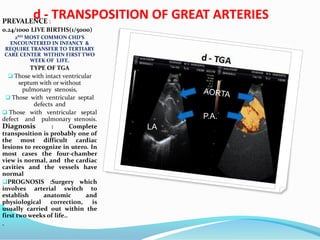
  • 10.
    Association Co-occurrence of groupof malformations, more frequently Than expected by chance, without definite cause is called association. VATER - VERTEBRAL, anal, tracheal, oesophageal and renal CHARGE - coloboma, heart, atresia choanae, retarded growth, genital and ear malformation
  • 11.
    FETAL STAGE >12– 38 WEEKS  FETAL MOVEMENT 16-18 WEEKS  EYELIDS OPEN 24-26 WEEKS  FETUS VIABLE WITH SPECIAL CARE 24-26 WEEKS  RAPID WEIGHT GAIN 28-28 WEEKS
  • 13.
    BIRTH DEFECT  ABIRTH DEFCT IS DEFIND AS THE MARCH OF DIMES IS “ FUNCTIONAL OR STRUCTURAL”, THAT PRESENT IN INFANCY OR LATER IN LIFE AND IS CAUSED BY EVENTS PRECEDING BIRTH WHETHER INHERITED OR ACQURIED.
  • 14.
    BIRTH DEFECTS DEFINED AS ANABNORMALITY OF THE BODY’ STRUCTURE OR INHERENT FUNCTION IN LIVE BORN FETUS, INTRAUTERINE FETAL DEMISES, STILL BIRTH AND IN MEDICALLY TERMINATED PREGNANCIES. WHICH IS PRESENT AT BIRTH , WHETHER SUCH ABNORMALITY IS MANIFEST AT THE DELIVERY OR BECOME APPARENT LATER IN LIFE.
  • 15.
    BIRTH DEFECT 1. Congenitalmalformation :- It is a primary structural defect arising from a localised error in morphogenesis,resulting in the abnormal formation of a tissue or organ. 2. Disruption : :- It is a structural defect resulting from the destruction of a structure that had formed normally before the insult such as - ischemia, infection & trauma. 3. Deformation : is a defect resulting from an abnormal mechanical forces that distorts an otherwise normal structure. 4. Dysplasia: is an abnormal orgination of cells into tissue. Most dysplasia are cause by sinle gene defects & are associated with high recurrence risk for sibling &/or offspring
  • 16.
     It isestimated that 1 in 40 or 2.5% of new born have a recongisable malformations at birth.  In a about half of case a single isolated malformations and other half display multiple malformations.  It is estimated that 10% of paediatric hospital admission have a non-genetic condition, 18% have congenital defect of unknown etiology and 40% have surgical admission are patient with congenital malformations.  20-30% of infant death and 30-50% death after the neonatal period are due to congenital abnormalities.  When several malformation occurred in a single individual they are classified a syndrome, sequences or association.
  • 17.
    3. Deformation :-It is an alteration in shape or structural of a structure or organ that has differentiated normally. Uterine compression Intrinsic Oligohydramnios Uterine hypertonia Multiple foetuses Large fetus Uterine deformities (biocornate) Extrinsic Small pelvis Bony lumbar spines Increased abdominal tone Abnormal fetal posture (including breech) Abnormal fetal Muscular tone Increased mechanical forces Fetal constraint Deformations Craniofacial Extremity Other Scaphocephaly Dislocated hips Torticollis Plagiocephaly Metatarsus adductus Lung hypoplasia Mandibular asymmetry Equinovarus foot Scoliosis Flattened facies Calcaneovalgus foot Deviated nasal septum Tibial bowing Crumpled ear Hyperflexed hips Craniostenosis Hyperextended knees Contractures Internal tibial torsion
  • 18.
    DEATHS DUE TOBIRTH DEFECTS • CHROMOSOMAL • CNS • RESPIRATORY • CHD 28% 15% 15%12%
  • 19.
    What causes birthdefects? Birth defects have a variety of causes, such as: Genetic problems -caused when one or more genes doesn't work properly or part of a gene is missing Problems with chromosomes- such as having an extra chromosome or missing part of a chromosome Environmental factors- that a woman is exposed to during pregnancy, such as rubella or German measles while pregnant, or using drugs or alcohol during pregnancy.
  • 20.
    • GENETIC – CHROMOSOMAL ANOMALY •MATERNAL ILLNESS ,DRUGS AND INFECTION • MULTIFACTORIAL• SPORADIC 40-60% 20-25% 12-25%10-13%
  • 21.
    MOLECULAR MECHANISMS OFMALFORMATIONS: Inborn Errors of Development The gene mutation in malformation syndrome are key factor for development events. Gene mutation Environmental agent Teratogenes Transduction pathway Transcription pathway Regulatory Protein Development Events
  • 22.
    Genetic factors Agene is a tiny, invisible unit containing information (DNA) that guides how the body forms and functions. Each child gets half of its genes from each parent, arranged on 46 chromosomes. Genes control all aspects of the body, how it works, and all its unique characteristics, including eye color and body size. Genes are influenced by chemicals and radiation, but sometimes changes in the genes are unexplained accidents. In each pair of genes, one will take precedence (dominant) over the other (recessive) in determining each trait, or characteristic. Birth defects caused by dominant inheritance include a form of dwarfism called achondroplasia; high cholesterol; Huntington's disease, a progressive nervous system disorder; Marfan syndrome, which affects connective tissue; some forms of glaucoma, and polydactyly (extra fingers or toes).
  • 23.
    If both parentscarry the same recessive gene, they have a one-in-four chance that the child will inherit the disease. Recessive diseases are severe and may lead to an early death. They include sickle cell anemia, a blood disorder that affects blacks, and Tay-Sachs disease, which causes mental retardation in people of eastern European Jewish heritage. Two recessive disorders that affect mostly are: cystic fibrosis, a lung and digestive disorder, and phenylketonuria (PKU), a metabolic disorder. If only one parent passes along the genes for the disorder, the normal gene received from the other parent will prevent the disease, but the child will be a carrier. Having the gene is not harmful to the carrier, but there is the 25% chance of the genetic disease showing up in the child of two carriers.
  • 24.
    Some disorders arelinked to the sex-determining chromosomes passed along by parents. Hemophilia, a condition that prevents blood from clotting, and Duchenne muscular dystrophy, which causes muscle weakness, are carried on the X chromosome. Genetic defects can also take place when the egg or sperm are forming if the mother or father passes along some faulty gene material. This is more common in older mothers. The most common defect of this kind is Down syndrome, a pattern of mental retardation and physical abnormalities, often including heart defects, caused by inheriting three copies of a chromosome rather than the normal pair.
  • 25.
    A less understoodcause of birth defects results from the interaction of genes from one or both parents plus environmental influences. These defects are thought to include: Cleft lip and palate, which are malformations of the mouth Clubfoot, ankle or foot deformities. Spina bifida, an open spine caused when the tube that forms the brain and spinal chord does not close properly. Water on the brain (hydrocephalus), which causes brain damage. Diabetes mellitus, an abnormality in sugar metabolism that appears later in life. Congenital Heart defects
  • 26.
    DRUGS (TERATOGENS) Only afew drugs are known to cause birth defects, but all have the potential to cause harm. Thalidomide is known to cause defects of the arms and legs. Steroid cleft lip & palate Lithium Ebstein’s anomaly Retinoic acid Conotruncal anomaly Valproic acid Coarctation of forta,HLHS,PA Carbamazepin,valporic acid Spina bifida radiation Microcephaly, spina bifida, blindness,cleft palate Drugs Birth defects Hyperthermia Spina bifida Warfarin Hypoplastic nasal bone,skeletal dysplasia Vitamin D Supravuvular aortic stenosis D penacillamine Cutis laxa syndrome
  • 27.
    The enzyme 5,10-methylenetetrahydrofolatereductase (MTHFR) is responsible for converting folic acid to 5-methyltetrahydrofolate. 5- methyltetrahydrofolate serves as a methyl group donor in the conversion of homocysteine to methionine. This methylation is important in providing carbon units to rapidly dividing cells and the synthesis of nucleotide bases. Thus, folic acid deficiency would result in a neural tube defect. Moreover, if there is a mutation in the gene regulating MTHFR, homocysteine will not get converted to methionine and affected individuals will have neural tube defect. Increase folic acid intake can overcome the neural tube defect due to genetically mediated enzyme deficiency.
  • 28.
    Now with controlof infections in neonates, BIRTH DEFECTS are becoming an important cause of perinatal mortality in india. If perinatal mortility is to be reduced further one should reduce birth defects at an early stage that is when fetus is in the age of nonsurvival or by planning birth of such babies at tertiary care centres dedicated for care of such babies. THIS IS POSSIBLE BY FETAL MEDICINE.
  • 29.
    E.g. Sonic Hedgehogas model :- The SHH pathway is developmentally important during embryogeneous to induce controlled proliferation in a tissue specific manner, disruption of specific steps in this pathway results in a variety of related developmental disorder and malformation. 1Sonic Hedgehog of 2Cleavage N-Shin Cholesterol N-Shin-Chol Holoprosencephaly1 Microcephaly Mental retardation Failure of CNS lateralization Hypotelorism ti Smith-Lemil-Opitz Syndrome2 Microcephaly Mental retardation Short, Upturned nose Hypospadias Post axial prolydactyly Pallister-Hall Syndrome3 Hypothalamic hamartoma Short, upturned nose Central and postaxial polydactyly Bild epiglottis Greig Greig Cephalopolysyndactyly syndrome4 Macrocephaly Hypertelorism Pre and postaxial polydactyly Rubinstein-Taybi Syndrome5 Microcephaly Mental retardation Prominent beaked nose Broad thumbs Hirsutism GLI-1 GLI-2 4GLI-3.5CBP GLI1 PTC1 Twist HNF3β
  • 30.
    The birth defectsare groups according to ICD-10 classification: (Q00-Q07) nervous system, (Q10-Q18) eye, ear, face and neck, (Q20-Q28) circulatory system, (Q30-Q34) respiratory system, (Q35-Q37) cleft lip and cleft palate, (Q38-Q45) digestive system, (Q50-Q56) genital organs, (Q60-Q64) urinary system, (Q65-Q79) musculoskeletal system, (Q80-Q89) other defects and (Q90-Q99) chromosomal abnormalities, not elsewhere classified.
  • 31.
    Nervous system: (740) Anencephalusand similar anomalies (740.0) Anencephalus (741) Spina bifida (742) Other congenital anomalies of nervous system (742.1) Microcephalus (742.3) Hydrocephalus
  • 32.
    TYPES OF CONGENITALMALFORMATIONS 1. Central Nervous System • Neural Tube defects • Spina bifida • Meningocele • Meningomyelocele • Encephalocele • Anencephaly • Hydrocephalus and ventriculomegaly • Holoprosencephaly • Agenesis of the corpus collosum • Dandy-Walker complex • Microcephaly • Megalencephaly • Destructive cerebral lesions • Arachnoid cysts • Choroid plexus cysts • Vein of Galen aneurysm 2. Face • Orbital defects • Facial cleft • Micrognathia • Ear defects
  • 33.
    3. Cardiovascular system •Atrial septal defects • Ventricular septal defects • Atrioventricular septal defects • Univentricular heart • Aortic stenosis • Coarctation and tubular hypoplasia of the aorta • Interrupted aortic arch • Hypoplastic left heart syndrome • Pulmonary stenosis and pulmonary atresia • Ebstein’s anomaly and tricuspid valve dysplasia • Conotruncal malformations • Transposition of the great arteries • Tetralogy of Fallot • Double-outlet right ventricle • Truncus arteriosus communis • Cardiosplenic syndromes • Echogenic foci
  • 34.
    4. Pulmonary abnormalities •Cystic adenomatoid malformation • Diaphragmatic hernia • Pleural effusions • Sequestration of the lungs 5. Anterior abdominal wall • Exomphalos • Gastroschisis • Body stalk anaomaly • Bladder exstrophy and cloacal exstrophy 6. Gastrointestinal tract • Esopageal atresia • Duodenal atresia • Intestinal obstruction • Hirschsprung’s disease • Meconium peritonitis • Hepatosplenomegaly • stenosis and imperforate • Hepatic calcifications • Abdominal cysts
  • 35.
    7. Kidneys andurinary tract • Renal agenesis • Infantile polycystic Kidney disease (Potter type I) • Multicystic dysplastic kidney disease (Potter type II) • Potter type III renal dysplasia • Obstructive uropathies 8. Skeleton • Skeletal anomalies • Osteochondrodysplasias • Limb deficiency or congenital amputations • Split hand and foot syndrome • Clubhands • Polydactyly • Fetal akinesia deformation sequence (FADS) 9. Hydrops fetalis
  • 36.
    How we shouldapproach for detection of Congenital Malformations ? CLINICAL EVALUATION 1.By History :- (i) Pedigree analysis (ii) Parental ages at the time of conception (iii) Parental consanguinity (iv) History of abortions (v) Still birth and exposure to the drug teratogens (vi) Maternal disorders and infections
  • 37.
    2. By Examinations:- A good observation is essential to recognize the malformations. (i) The defects produced due to an abnormality of a development of a body part early in the prenatal life eg. Cleft lip and palate and polydactyly and holoprosencephaly. (ii) Anthropometry is important as is the measurement of any other relevant dysmorphic feature eg. Hypo/hypertelorism, low set ears etc. (iii) Look for the presence of abnormal genitalia or delayed puberty e.g. Smith Lemi Optiz syndrome, Tumer syndrome etc. (iv) Look for the presence of abnormal genitalia or delayed puberty, e.g. Smith Lemi Optiz syndrome, Tumer syndrome etc.
  • 38.
    INVESTIGATIONS:- 1. Chromosomal analysis:- • Karyotype analysis e.g. Down syndrome • Fluorescent in situ hybridization (F.I.S.H.) e.g. William syndrome, Prader Willi syndrome, Angelman syndrome, Velocardiofacial syndrome. • PCR studies • Micro-array technology 2. Imaging studies (CT, MRI) e.g. CNS malformations 3. Echo done in all cases of Down syndrome and velocardio facial syndrome. 4. Metabolic study particularly in (amino acids and organic acids) e.g. like Mucopolysaccharidosis, Zellweger syndrome, Smith Lemli Opitz syndrome
  • 39.
    (v) Psychomotor delay,speech delay or mental retardation are common feature many syndrome e.g. down syndrome, Fragile-X syndrome. (vi) Examination of presence of hearing loss and abnormalities of the eye are essential in dysmorphogical examination. It provides diagnostic clues for some syndromes like chorioretinal lacunae in Aicardi syndrome, Brusfield spots in Down syndrome. (vii) Some clinical features suggest a specific diagnosis. These features have been termed as
  • 40.
    “Pearls of Dysmorphology”by Hall?  Pursed up lips – Whistling face syndrome  Broad thumbs/great toes – Rubinstein Taybi syndrome, Pfeiffer syndrome.  Radial ray defects – Holt Oram syndrome, Thrombocytopenia absent radius syndrome, Fanconi anemia.  Absent clavicles – Cleidocranial dysostosis.  Heterochromia iridis – Waardenburg syndrome  Mitten hands – Apert syndrome  Inverted nipples – Congenital disorder of glycosylation.  Webbing of the neck – Turner and Noonan syndromes.  Eversion of the lateral third of the lower eyelid – Kabuki Make-up syndrome.  Hyper extensibility of skin and joins – Ehlers Danlos syndrome.
  • 41.
    CNS AT 7 WEEKS FLUIDFILLED VESICLE SEEN – ROMBENCEPHALIC VESICLE AT 9 WEEKS CONVULATED PATTERN OF THE THREE PRIMARY CEREBRAL VESICLE IS VISIBLE. AT 11 WEEKS BRIGHT ECHOGENIC CHOROID PLEXUS FILL LARGE LATERAL VENTRICLES.
  • 46.
    A simple classificationof anomalies of brain & spine is as follows: Failure of dorsal induction: 1. Anomaly of cranial development failure: Anaencephaly, cephalocele Chiari malformation Dysraphism 2.Anomaly of ventral induction failure: Holoprosencephalies Facial abnormalities Posterior fossa malformation: Dany –Walker malformation,Joubert syndrome , Rhomboenvephalosynapsis. 3.Failure of histogenesis, neuronal proliferatio, migration & organization Disorder of sulcation & cell migration: lissencephalic & nonlissencephalic dysplasia. Gray mater hetrotropia Cortical dysplasia- schizencephaly Abnormalities of corpus callosum Phakomatosis -
  • 47.
    • RECURRENCE RISKIF ONE PARENT OR PREVIOUS SIB HAVE NTD • RECURRENCE RISK IN NEXT SIB • ENCEPHALOCELE • ANENCEPHALY • SPINA BIFIDA 95% 5% 5-10%2-4/1000
  • 48.
    NEURAL TUBE DEFECTS RACHICHISIS SEVEREFORM OF SPINA BIFIDA. INCOMPATIBLE WITH LIFE MENINGOMYELOSIS COMMON TYPE FEW SEGMENT BIFID SPINA BIFIDA OCCULTA ONLY BONE BIFID TELL-TALE SIGN MAY BE SEEN
  • 49.
    CNS malformation 1. NEURALTUBE DEFECTS Classification A.Primary NTD -95 % failure of closure of neural tube at 17 to 28 days of gestation -Meningomyelocele -Encephalocele -Anencephaly B.Secondary NTD -5% occurs after neural tube closure due to defect in mesoderm. -meningocele -Lipomeningocele -Diastometomyelia -Dorsal sermal sinus - Tethered cord
  • 50.
    Etiology of NTD 1.Multifactorial inheritance 2. Maternal risk factor alcohol, radiation, valproate, methotraxate 3. Genetic MTHFR, gene defect 4. Chromosomal abnormality Trisomy 13 & 18 PREVENTION  Folate supplementation 0.4mg/day to all mothers 1 month before to 3 months of pregnancy.  If there is any previous affected child than give 5mg/day. - prenatal diagnosis in subsequent pregnancy by MSAFP estimation and fetal ultrasound at 12 week and 16-20 week of gestation.
  • 51.
    SPINA BIFIDA ASSOCITED SIGN LEMONSIGN BANANA SIGN FETAL THERAPY: IN UTERO CLOSURE OF SPINA BIFIDA REDUCES RISK OF HANDICAP; BECAUSE AMNIOTIC FLUID IN THIRD TRIMESTER IS NEUROTOXIC
  • 52.
    Spina Bifida Occulta:-  This is a midline defect of vertebral bodies without protrusion of the spinal cord or meninges.  Most individuals are asymptomatic and lack neurologic sign.  In some cases, patch of hair, lipoma, discoloration of skin, dermal sinus in the midline of lower back suggest a more significance malformations of spinal cord.  A Spine X-ray shows a defect in closure of posterior vertebral arches and laminae, typically involve in L5 and S1.  It is occasionally associated with more significant developmental abnormalities of the spinal cord, including syringomyelia,  Diastematomyelia and tethered cord.  These are the best identified with MRI.  A dermoid sinus usually forms a small skin opening, which lead to narrow duct, some time indicated by protruding hairs, hairy patch or vascular nervus.  Demoid sinus occur in the midline at the sight of meningocele or enencephalocele may occur.  Demoid sinus tracts may pass through the dura, acting age conduit for the spread of infection.
  • 53.
    Meningocele ASSOCITED SIGN LEMON SIGN BANANASIGN FETAL THERAPY: IN UTERO CLOSURE OF SPINA BIFIDA REDUCES RISK OF HANDICAP; BECAUSE AMNIOTIC FLUID IN THIRD TRIMESTER IS NEUROTOXIC
  • 54.
    Meningocele ASSOCITED SIGN LEMON SIGN BANANASIGN FETAL THERAPY: IN UTERO CLOSURE OF SPINA BIFIDA REDUCES RISK OF HANDICAP; BECAUSE AMNIOTIC FLUID IN THIRD TRIMESTER IS NEUROTOXIC
  • 55.
    Meningocele ASSOCITED SIGN LEMON SIGN BANANASIGN FETAL THERAPY: IN UTERO CLOSURE OF SPINA BIFIDA REDUCES RISK OF HANDICAP; BECAUSE AMNIOTIC FLUID IN THIRD TRIMESTER IS NEUROTOXIC
  • 56.
    Meningocele ASSOCITED SIGN LEMON SIGN BANANASIGN FETAL THERAPY: IN UTERO CLOSURE OF SPINA BIFIDA REDUCES RISK OF HANDICAP; BECAUSE AMNIOTIC FLUID IN THIRD TRIMESTER IS NEUROTOXIC
  • 57.
    .  Meningocele :-It is formed when the meninges herminate through a defect in the posterior vertebral arches. A functuant midline mass that may transilluminate occurs along the vertebral column, usually in the lower back. Asymptomatic children with normal neurological finding and fullthickness skin covering may have surgery delayed. Those patients with leaking CSF should under go immediate surgery.
  • 58.
    MYELOMENINGOCELE It is themost severe form of dysraphism involving the vertebral column. Incidence = 1/4000 live births. Treatment :- Management and supervision of a child and family myelomeningocele require a multidisciplinary team including surgeon, physician, therapisis. Surgery is often done within a day or so of birth but can be delay for several days when there is a CSF leak. Prognosis :- For a child who is born with a myelomeningocele and who is treated aggressively mortality 10-15%.
  • 59.
    ENENCEPHALOCELE :-  Twomajor forms of dysraphism affect the skull, resulting in protrusion of tissue through a bony midline defect, called cranium bifidum.  A cranial meningocele consists of CSF filled meningeal sac only, and a cranial encephalocele contain the sac + cereberal cortex, cerebellium, portions of the brainstem.  This defects occur most commonly in the ocipital region but in certain part of world, frontal or nasofrontal enencephalocele are more prominent. Meckel-Gruber syndrome is a rare autosomal recessive condition that is characterized by occipital enencephalocele, cleft lip or palate, microcephaly, microphthalamia, abnormal genitalia, polycystic kidney and polydactyly. Diagnosis MRI & CT Scan :- Maternal serum alpha fetoprotein level and ultrasound measurement of BPD as well as identification of enencephalocele in utero .
  • 60.
    ANENCEPHALY 40% MORTILITY OCCUR DURING NEONATAL PERIOD. 80% OF THE SURVIVAL WILL BE INTELLECTUALY AND NEUROLOGICALLY HADICAP 50% ARE ASSOCIATED WITH SPINA BIFIDA
  • 61.
    ANENCEPHALY 40% MORTILITY OCCUR DURING NEONATAL PERIOD. 80% OF THE SURVIVAL WILL BE INTELLECTUALY AND NEUROLOGICALLY HADICAP 50% ARE ASSOCIATED WITH SPINA BIFIDA
  • 63.
    ANENCEPHALY :-  Itis distinctive appearance with a large defect of calvarium, meninges and scalp associated with a rudimentary brain, which results from failure of closure of the rostral neuropore the opening of the anterior neural tube.  The incidence – 1/1000 live births. The most anenecephalic infants die within several days of birth.  The recurrence risk is 4% and increase to 10% if a couple has had two previously affected pregnancies.  Approximately 50% of cases of anencephaly have associated polyhydraminos. Diagnosis :- Couples who have had an anencephalic infant should have successive pregnancy monitored, including amniocentesis, determination of AFP levels and ultrasound examination between the 14th and 16th week of gestation.
  • 64.
    HYDROCEPHALUS AND VENTRICULOMEGALY Inhydrocephalus there is pathological increase in the size of the cerebral ventricles. Prevalence Hydrocephalus is found in about 2 per 1,000 births. Ventriculomegaly (lateral ventricle diameter of 10 mm or more) is found in 1% of pregnancies at the 18-23 week scan. Therefore the majority of fetuses with ventriculomegaly do not develop hydrocephalus. Etiology This may result from chromosomal and genetic abnormalities, intrauterine hemorrhage or congenital infection, although many cases have as yet no clear-cut etiology. Diagnosis Fetal hydrocephalus is diagnosed sonographically, by the demonstration of abnormally dilated lateral cerebral ventricles.
  • 65.
    Prognosis Fetal or perinataldeath and neurodevelopment in survivors are strongly related to the presence of other malformations and chromosomal defects. Although mild, also referred to as borderline, ventriculomegaly is generally associated with a good prognosis,
  • 66.
    HOLOPROSENCEPHALYPREVALENCE : 1/10,000 BIRTHandoccurs with a rate of 1 in 250 during embryogenesis There are three classifications of holoprosencephaly. Alobar, in which the brain has not divided at all, is usually associated with severe facial deformities. Semilobar, in which the brain's hemispheres have somewhat divided, causes an intermediate form of the disorder. Lobar, in which there is considerable evidence of separate brain hemispheres, is the least severe form. In some cases of lobar holoprosencephaly the baby's brain may be nearly normal.
  • 67.
    HOLOPROCENCEPHALYCAUSES: A varietyof teratogens, chromosomal abnormalities (in 25-50% of cases), and single gene mutations can result in holoprosencephaly. Trisomy 13 (in about 40% of cases) and trisomy 18 are the most frequently identified chromosomal anomalies. Many single-gene disorders (18-25%) can result in syndromes with a variable incidence of holoprosencephaly. Examples include Pallister-Hall, Rubinstein-Taybi, Kallmann, Smith-Lemli-Opitz, Meckel, hydrolethalus, pseudotrisomy 13, and microtia -anotia syndromes. Maternal diabetes has been implicated in about 1% of cases. RECURRENCE RISK 6% ALOBAR &SEMILOBAR -LETHAL LOBAR : MR
  • 68.
    ABSENT SEPTUM PELLUCIDUM Absenceof the septum pellucidum is reported to be an unusual anomaly that occurs in an estimated 2 to 3 individuals per 1 00,000 people in the general population Absence of the SP alone is not a disorder but is instead a characteristic noted in children with septo-optic dysplasia. The prognosis for individuals with septo-optic dysplasia varies according to the presence and severity of symptoms
  • 69.
    AGENESIS OF THECORPUS CALLOSUM PREVALENCE : 5/1000 BIRTH Agenesis of the corpus callosum is caused by disruption to development of the fetal brain between the 5th and 16th week of pregnancy CAUSES: However, research suggests that some possible causes may include chromosome errors, inherited genetic factors, prenatal infections or injuries, prenatal toxic exposures, structural blockage by cysts or other brain abnormalities, and metabolic disorders. Some syndromes that frequently include ACC are Aicardi syndrome, Miller-Dieker syndrome (MDLS; 247200), Rubinstein-Taybi syndrome (RSTS; 180849), acrocallosal syndrome (ACLD; 200990), and Joubert syndrome (JBTS; 213300). Andermann syndrome, Shapiro syndrome, Acrocallosal syndrome,septo-optic dysplasia (optic nerve hypoplasia), Mowat-Wilson syndrome and Menkes syndrome.
  • 70.
    DANDY WALKER SYNDROME PREVALENCE: 1/30,000 CAUSES: LOWRECURRENCE RISK 1-5% 13 & 18 TRISOMIES TRIPLOIDY 50 GENETIC SYNDROME CONGENITAL INFECTION WARFARIN 20 NEONATAL MORTILITY 50% INTELLECTUAL AND NEUROLOGICAL HANDICAP.
  • 71.
    DANDY WALKER SYNDROMEThereare, at present, three types of Dandy-Walker complexes. They are divided into three closely associated forms: The DWS malformation is the most severe presentation of the syndrome. The posterior fossa is enlarged and the tentorium is in high position. There is partial or complete agenesis of the cerebellar vermis. There is also cystic dilation of the fourth ventricle, which fills the posterior fossa. This often involves hydrocephaly and complications due to associated genetic conditions, such as Spina Bifida. Mega cisterna magna The second type is a mega cisterna magna . The posterior fossa is enlarged but it is secondary to an enlarged cisterna. This form is represented by a large accumulation of CSF in the cisterna magna in the posterior fossa. The cerebellar vermis and the fourth ventricle are normal. .
  • 72.
    DANDY WALKER SYNDROME Thefourth ventricle is only mildly enlarged and there is mild enlargement of the posterior fossa. The cerebellar vermis is hypoplastic and has a variably sized cyst space. This is caused by open communication of the posteroinferior fourth ventricle and the cisterna magna through the enlarged vallecula. Patients exhibit hydrocephalus in 25% of cases and supratentorial CNS variances are uncommon, only present in 20% of cases. There is notorcular- lambdoid inversion, as usually seen in patients with the malformation. The third and lateral ventricles as well as the brain stem are normal.
  • 73.
    ARNOLD CHIARI MALFORMATION Incidence: The Chiari malformation, defined as tonsilar herniations of 3 to 5 mm or greater The incidence is approximately 1 in 1,200.The incidence of symptomatic Chiari is less but unknown. A prevalence of approximately in 1000 has been described. The Austrian pathologist Hans Chiari in the late 1800s described seemingly related anomalies of the hindbrain, the so called Chiari malformations I, II and III. Later, other investigators added a fourth (Chiari IV) malformation. The scale of severity is rated I - IV, with IV being the most severe. Types III and IV are very rare
  • 74.
    Type Presentation Othernotes I Is generally asymptomatic during childhood, but often manifests with headaches and cerebellar symptoms. Herniation of cerebellar tonsils. The most common form. II Usually accompanied by a myelomeningocele leading to partial or complete paralysis below the spinal defect. Abnormal development of the cerebellar vermis and medulla oblongata occur, and they both descend into the foramen magnum. Hydrocephalus is frequently present. III Causes severe neurological defects. It is associated with an encephalocele IV Characterized by a lack of cerebellar development.[ The brainstem, cranial nerves, and the lower portion of the cerebellum may be stretched or compressed. Therefore, any of the functions controlled by these areas may be affected. The blockage of Cerebro-Spinal Fluid (CSF) flow may also cause a syrinx to form, eventually leading to syringomyelia. Chiari is often associated with major headaches, sometimes mistaken for migraines. Chiari headaches usually include intense pressure in the back of the head, aggravated by Valsalva maneuvers, such as yawning, laughing, crying, coughing, sneezing or straining. Chiari also includes muscle weakness, facial pain, hearing problems, and extreme fatigue. It also can cause insomnia cycles of sleep deprivation followed by inabilities to remain awake cycling between them. 15% of patients with adult Chiari malformation are asymptomatic
  • 75.
    Treatment Once symptomatic onsetoccurs, a common treatment is decompression surgery,[14] in which a neurosurgeon usually removes the lamina of the first and sometimes the second or even third cervical vertebrae and part of the occipital bone of the skull to relieve pressure. The flow of spinal fluid may be accompanied by a shunt. Since this surgery usually involves the opening of the dura mater and the expansion of the space beneath, a dural graft is usually applied to cover the expanded posterior fossa. A small number of neurological surgeons believe that detethering the spinal cord as an alternate approach relieves the compression of the brain against the skull opening (foramen magnum), obviating the need for decompression surgery and associated trauma. However, this approach is significantly less documented in the medical literature, with reports on only a handful of patients. It should be noted that the alternative spinal surgery is also not without risk. Prognosis The prognosis differs dependent on the type of malformation (i.e., type I, II, III, or IV). Type I is generally adult-onset and, while not curable, treatable and non-fatal. Types I and II sufferers may also develop syringomyelia. Type II is typically diagnosed at birth or prenatally. Approximately 33% of individuals with Chiari II malformation develop symptoms of brainstem damage within five years; a 1996 study found a mortality rate of 33% or more among symptomatic patients, with death frequently occurring due to respiratory failure. 15% of individuals with Chiari II malformation die within two years of birth. Among children under two who also have myelomeningocele, it is the leading cause of death. Prognosis among children with Chiari II malformation who do not have spina bifida is linked to specific symptoms; the condition may be fatal among symptomatic children when it leads to neurological deterioration, but surgical intervention has shown promise. Types III and IV are extremely rare and patients generally do not survive past the age of two or three
  • 76.
    ARNOLD CHIARI MALFORMATION ArnoldChiari Malformation:- Type I –It is usually not associated with hydrocephalus patient complain of headache,neck pain,urinary frequency and progressive lower extremity spasticity.The deformity consist of displacement of cerebellar tonsil into cervical canal. Although pathogenesis is unknown, a theory suggest that obstruction of caudal portion of the IV ventrical during fetal development is responsible. Type II :-It is charactarised by progressive hydrocephalus with a myelomeningocele, pointing of frontal horn & colpocephaly (dialted occipital horn) .This lesion represent and anomaly of hindbrain probably due to failure of pontine flexure during embriyogenesis,and result in elongation of the IV ventrical and kinking of the brainstem with displacement of inferior vermis,pons,medulla into cervical canal.This anomaly is treated by surgical decompression.
  • 77.
    ARNOLD CHIERI MALFORMATION TypeIII - in this there is high cervical encephalo- meningocele: in which the medulla, 4TH ventricle, and entire cerebellum reside.
  • 78.
    AQUEDUCTAL STENOSISCongenital: Somepatients are born with a congenitally narrow or completely obstructed aqueduct. In complete, this usually presents as pediatric hydrocephalus. However, if the obstruction is more minor, the patient may be asymptomatic or may not present until older age. The obstruction can appear as a general narrowing of the aqueduct or can appear as small webs or rings of tissue across the channel. Post-Infectious or Post-Hemorrhage: Infection in the cerebrospinal fluid or hemorrhage into the ventricles from other causes can occasionally lead to scarring that creates webs or rings that cause aqueductal stenosis and block flow through the aqueduct. Idiopathic Acquired: Some patients present in adulthood with the new onset or gradual onset of hydrocephalus. In many cases it is unclear what the underlying cause of the stenosis was and is considered idiopathic
  • 79.
    ARACHNOID CYSTArachnoid cystsare fluid-filled cysts contained within the arachnoid space. Prevalence : Arachnoid cysts are extremely rare. Etiology :Unknown; infectious process has been hypothesized but it is unlikely that this may explain the congenital cysts. Diagnosis : Arachnoid cysts appear on antenatal ultrasound as sonolucent lesions with a thin regular outline, that do not contain blood flow, do not communicate with the lateral ventricles and anyhow are not associated with loss of brain tissue. They occur most frequently in the area of the cerebral fissure and in the midline. . Prognosis : Large cysts may cause intracranial hypertension and require neurosurgical treatment. However, a normal intellectual development in the range of 80- 90% is reported by most series. Spontaneous remission has been described both in the postnatal as well as in the antenatal period.
  • 80.
    CHOROID PLEXUS CYSTPrevalence: Choroid plexus cysts are found in about 2% of fetuses at 20 weeks of gestation but in more than 90% of cases they resolve by 26 weeks. Etiology : Choroid plexus cysts contain cerebrospinal fluid and cellular debris. Diagnosis :The diagnosis is made by the presence of single or multiple cystic areas (greater than 2 mm in diameter) in one or both choroid plexuses. Prognosis :They are usually of no pathological significance, but they are associated with an increased risk for trisomy 18 if maternal age >35years, serum beta hCG > 0.3MoM, nuchal fold >6mm, echogenic bowel, hydronephrosis and cyst > 10 mm and possibly trisomy 21. In the absence of other markers of trisomy 18 the maternal age-related risk is increased by a factor of 1.5. The choroid plexus cyst < 10 mm sometime disappear spontaneously.
  • 81.
    VEIN OF GALENMALFORMATION Vein of Galen aneurysm is a very rare abnormality. Prevalence : Vein of Galen aneurysm is a sporadic abnormality. Diagnosis : The diagnosis is made by the demonstration of a supratentorial mid-line translucent elongated cyst. Prognosis : In the neonatal period about 50% of the infants present with heart failure and the rest are asymptomatic. In later life hydrocephalus and intracranial hemorrhage may develop. Good results can be achieved by catheterization and embolization of the malformation.
  • 82.
    LISSENCEPHALY Lissencephaly, which literally meanssmooth brain, is a rare brain formation disorder caused by defective neuronal migration during the 12th to 24th weeks of gestation, resulting in a lack of development of brain folds (gyri) and grooves (sulci). It is a form of cephalic disorder. Terms such as 'agyria' (no gyri) or 'pachygyria' (broad gyri) are used to describe the appearance of the surface of the brain. Affected children display severe psychomotor retardation, failure to thrive, seizures, and muscle spasticity or hypotonia.[
  • 83.
    LISSENCEPHALY Other symptoms ofthe disorder may include unusual facial appearance, difficulty in swallowing, and anomalies of the hands, fingers, or toes. The diagnosis of lissencephaly is usually made at birth or soon after by ultrasound, computed tomography (CT), or magnetic resonance imaging (MRI).
  • 84.
    category type Classical (type1) LIS: Lissencephaly due to PAFAH1B1 gene mutation Type I isolated lissencephaly (601545 Miller –dicker syndrome(247200) LI SX : lissencephaly due to double cortin(DCX) gene mutation(330121) Lissencephaly type I without genetic disorder Cobblestone (type 2) Walker –Warburg syndrome(236670) Fukuyama syndrome (253800) Muscle Eye Brain disease (MEB)253280 other LIS2: Norman –Robert syndrome 253280 LIS3: TUBA1A, 611603 LISX2 : ARX, 300215 MICRO-LISSENCEPHALY
  • 85.
    DESTRUCTIVE CEREBRAL LESIONS Prevalence: Destructive cerebral lesions are found in about 1 per 10,000 births. These lesions include hydranencephaly porencephaly and schizencephaly .
  • 86.
    HYDRANENCEPHALY hydranencephaly there is absenceof the cerebral hemispheres with preservation of the mid-brain and cerebellum. Complete absence of echoes from the anterior and middle fossae distinguishes hydranencephaly from severe hydrocep’ Prognosis Hydranencephaly is usually incompatible with survival beyond early infancyhalus .
  • 87.
    PORENCEPHALY In porencephaly thereare cystic cavities within the brain that usually communicate with the ventricular system, the subarachnoid space or both. Etiology : Porencephaly may be caused by infarction of the cerebral arteries or hemorrhage into the brain parenchyma. Diagnosis : In true porencephaly there is one or more cystic areas in the cerebral cortex, which communicates with the ventricle while in pseudo porencephalic cyst cavity donot communictes with ventricle. Prognosis : The prognosis in porencephaly is related to the size and location of the lesion and although there is increased risk of impaired neurodevelopment in some cases development is normal
  • 88.
    SCHIZENCEPHALY Schizencephaly is associated withclefts in the fetal brain connecting the lateral ventricles with the subarachnoid space. Etiology : Schizencephaly may be a primary disorder of brain development or it may be due to bilateral occlusion of the middle cerebral arteries. Dignosis : In schizencephaly there are bilateral clefts extending from the lateral ventricles to the subarachnoid space, and is usually associated with absence of the cavum septum pellucidum. Prognosis : Schizencephaly is associated with severe neurodevelopmental delay and seizures.
  • 89.
    ENCEPHALOMALACIA Cystic encephalomalacia an irregularcystic area in the brain parenchyma which is characterised by the presence of multiple glial septations surrounded by astrocytic proliferation. This may be caused by infarction, infection or trauma. They may be focal or diffuse and their distribution will depend on the cause and severity of the injury and the post conceptual age of the patient. Encephalomalacia caused by infarction may be in the distribution of a major cerebral artery.
  • 90.
    ENCEPHALOMALACIA If the injuryis caused by mild to moderate hypotension the areas of encephalomalacia may lie in the boundary zones between the major cerebral arteries, whereas severe hypotension may result in widespread cystic encephalomalacia with sparing of the deep periventricular white matter only. The presence of reactive astrocytosis and glial septations distinguishes cystic encephalomalacia from an area of porencephaly and indicates that the injury occurred late in gestation, in the perinatal period, or after birth
  • 91.
    CHOROID PLEXUS PAPILLOMA Guerarddescribed the first CPP in a 3-year-old girl in 1832, and Perthes described the first successful surgical removal in 1910. The male-to-female incidence ratio of CPP is 2.8 : 1. CPPs are rare, comprising less than 1% of brain tumors in patients of all ages. However, CPPs most often occur in children and constitute up to 3% of childhood intracranial neoplasms with a predilection for younger ages. CPPs comprise 4-6% of the intracranial neoplasms in children younger than 2 years and 12-13% of intracranial neoplasms in children younger than 1 year.
  • 92.
    Circulatory system (745) Bulbuscordis anomalies and anomalies of cardiac septal closure (745.4) Ventricular septal defect (745.5) Atrial septal defect (746) Other congenital anomalies of heart (747) Other congenital anomalies of circulatory system (747.1) Coarctation of aorta (747.11) Interruption of aortic arch (747.2) Other congenital anomalies of aorta (747.3) Congenital anomalies of pulmonary artery (747.4) Congenital anomalies of great veins (747.5) Absence or hypoplasia of umbilical artery (747.6) Arteriovenous malformation, unspec. (747.8) Other specified anomalies of circulatory system (747.81) Arteriovenous malformation of brain (746.82) Cor triatriatum (746.83) Infundibular pulmonic stenosis congenital (746.84) Congenital obstructive anomalies of heart not elsewhere classified (746.85) Coronary artery anomaly congenital (746.86) Congenital heart block (746.87) Malposition of heart and cardiac apex (747.89) Other specified congenital anomalies of heart Brugada syndrome (747.9) Unspecified congenital anomaly of circulatory system
  • 93.
    CONGENITAL HEART DISEASES 80-90%CHD’S LOW RISK PREGNANCIES MJORITY OF THEM ARE PRIMI 9% INFANT MORTILITY IN U.K. DUE – C.H.D. SIX TIME MORE COMMON THAN TRISOMIES 21,18,13 FOUR TIMES MORE COMMON THAN NEURAL TUBE DEFECTS PREVALENCE 8/1000 LIVE BIRTH 30/1000 STILL BIRTH
  • 94.
    FIRST ORGAN TOBE FUNCTIONAL IN HUMAN BEING - HEART CARDIOGENESIS TWO POOL OF CARDIAC PRECURSORS SECOND FIELD DEVELOP INTO RV, OFT, SINUS VENOSUS FIRST FIELD DVELOPS INTO RA,LA, LV
  • 98.
    Primitive heart tube21-22days Looping of heart 22-24days Development of IAS 30days Development of IVS 28-days Formation of AV Valve Formation of outflow septum & tract
  • 99.
    STREETER’S HORIZONS STAGES (CVSDEVELOPMENT) 22 24 26 28 30 32 34 36 38DAYS OF LIFE HEART PULSAION SINO – ATRIAL FORAMEN *CIRCUL ATION *AV CUSHION *D.V. *3ARCHES •P.VS. •PA -6 •AORTA 4 ARCH PVS->LA *RV,LV *AV NODE O.P.>CL *O.SEC. *RV-6A *LV-4A TA- SEPTATION S.CUSP TV MV IVS NERVE IVS
  • 100.
    GENETIC ASPECT OFTHE CHDs • 40%• 100% • 80%• 40-50% 21 T 13 T OX18 T
  • 101.
    VENRICULAR SEPTAL DEFECT2/1000 ATRIAL SEPTAL DEFECT 1/3000 AORTIS STENOSIS 1/7000 PULMONARY STENOSIS 1/1000 PULMONARY ATRESIA 1/10,000 d – TRANSPOSITION OF GREAT ARTERIES 1/5000 TETRALOGY OF FALLOT’S 1/3000 DOUBLE OUTLET RIGHT VENTRCLE 1/10,000 TRUNCUS ARTERIOSUS 1/10,000 CARDIO SPLENIC SYBDROME 1/10,000 CHD 30% 10% 3% 0.1% 0.01% 2%
  • 102.
    OVERALL RECURRENCE RISKIN CHDs % GENERAL POPULATION 1 SIBS OF ISOLATED CASE 2 OFFSPRING OF ISOLATED CASE 3 TWO AFFECTED SIBS ( SIB +PARENT) 10 > TWO AFFECTED FIRST DEGREE RELATIVE 50 MOTHER WITH CHD 10 FATHER WITH CHD 2
  • 103.
    VENTRICULAR SEPTAL DEFECT 30%OF CHD’S 2/1000 BIRTH 50% V.S.D. ARE ISOLATED PERIMEMBRANOUS 80% INLET V.S.D. MUSCULAR V.S.D. OUTLET V.S.D. 90 SMALL V.S.D. CLOSE SPONTANEOUSLY. SURGICAL OUT COME IS GOOD
  • 104.
    ATRIAL SEPTAL DEFECT 1/3000BIRTH 10% OF ALL CHD’S F.OVALE 3% A.S.D. SECONDUM (ABOVE F.OVALE) A.S.D. PRIMUM (BELOW F. OVALE) A.S.D. SINUS VENOSUS CORONARY SINUS A.S.D.; A rare type A.S.D. in which coronary sinu and left atrium open partially or completely unroofed , leading to left to right shunt. 50% with A.S.D. Have other associated other cardiac defects. ? DIFICULT TO DIAGNOSED ANTENATALLY
  • 105.
    COARCTATION OF AORTA PREVALENCE: 0.2-O.3 /1000 LIVE BIRTHS 8TH COMMON CARDIAC DEFECT MORE IN MALES AS COMPARE TO FEMALES Types :1. Uncomplicated COA beyond infancy 2.Uncomplicated COA in neonates/infants with /without V.S.D. 3. COA with MS/MR 4. COA with bicuspid aortic valve / aortic stenosis 5. Interrupted aortic arch 6.Atypical COA SHONE COMPLEX : COA,AS,MS & HYPOPLASTI LEFT VENTRICLE
  • 106.
    PULMONARY STENOSIS PREVALENCE : Pulmonarystenosis : 1/2000 live births. Pumonary atresia : 1/10,000live births. 5th common CHD’S 50% patients with PS had associated CHD’S. Ballloon dilatation is indicated when PPG is 30 mmHg across pulmonary valve. Dysplastic p. valve: noonsyndrome. Peripheral branch stenosis : Rubella syndrome
  • 107.
    FETAL AORTIC STENOSIS 3%OF ALL CHD’S 1/7000 BIRTH TYPE SUPRA VALVULAR :  MEMBRANE LOCALIZED NARROWING DIFFUSE NARROWING VALVULAR  BICUSPID AORTIC VALVE DYSPLASTIC AORTIC VALVE. SUBVALVULAR FETAL VALVUAL AORTIC = STENOSIS
  • 108.
    PATENT DUCTUS ATERIOSUS PREVALENCE: O.138-O.8/1000 LIVE BIRTHS Eighty percent (80%) of the DA in term infants close by 48 hours and nearly 100% by 96 hours. Failure of the ductus arteriosus to close within 48-96 hours of postnatal age results in a left to right shunt across the ductus and overloading of the pulmonary circulation. A hemodynamically significant shunt due to PDA has been reported in 40% of infants less than 1000 grams and 20% of infants between 1000-1500 grams Initial Indomethacin. 0.2 mg/kg stat followed by age adjusted doses: Subsequent dose < 2 day- 0.1 mg/kg/dose 12 hourly for 2 doses 2-7 day- 0.2 mg/kg/dose 12 hourly for 2 doses 7 day- 0.25 mg/kg/dose 12 hourly for 2 doses. Ibuprofen : 10 mg/kg stat followed by 5 mg/kg/dose 24 hourly for 2 doses PULMONARY ARTERY DAO
  • 109.
    SINGLE VENTRICLE1.5 %OF ALL CHD’S Univentricular heart includes both those cases in which two atrial chambers are connected, by either two distinct atrioventricular valves or by a common one, to a main ventricular chamber (double-inlet single ventricle) as well as those cases in which, because of the absence of one atrioventricular connection (tricuspid or mitral atresia), one of the ventricular chambers is either rudimentary or absent. Surgical treatment (the Fontan procedure) involves separation of the systemic circulations by anastomosing the superior and inferior vena cava directly to the pulmonary artery. GALEN SHUNT FONATAN PROCEDURE COMPLICATIONS : ARRHYTHMIA THROMBUS FORMATION PROTEIN LOOSING ENTERO PATHY
  • 110.
    CONGENITAL MITRAL STENOSIS CongenitalMS is rare, occurring in 0.5% of patients with congenital heart disease (CHD) Congenital MS, a rare entity, takes several forms. These include hypoplasia of the mitral valve annulus, mitral valve commissural fusion, double orifice mitral valve, shortened or thickened chordae tendinae, and parachute mitral valve, in which all chordae attach to a single papillary muscle. The most common associated malformations arecoarctation of the aorta, aortic valve stenosis, and subvalvular aortic stenosis. LA LA
  • 111.
    CONGENITAL MITRAL ATRESIA Theassociation of multiple levels of left- sided inflow and outflow tract obstruction is termed the Shone complex. Severe hypoplasia, or atresia, of the mitral valve results in a hypoplastic LV cavity size that is not capable of sustaining the systemic cardiac output. This situation is considered part of the spectrum of the hypoplastic left heart syndrome
  • 112.
    ATRIO – VENTRICULARSEPTAL DEFECT PREVALENCE : 7% OF ALL CHD’S 1/3000 LIVE BIRTHS 50% of cases are associated with aneuploidy, 60% being trisomy 21, 25% trisomy 18 ( associated with extra-cardiac anomalies) or in fetuses with cardiosplenic syndromes associated with multiple cardiac anomalies and abnormal disposition of the abdominal organs are almost the rule. Diagnosis : Antenatal echocardiographic diagnosis of complete atrioventricular septal defects is usually easy. The incomplete forms are more difficult to recognize.
  • 113.
    ATRIO – VENTRICULARSEPTAL DEFECT Prognosis : Atrioventricular septal defects do not impair the fetal circulation per se. However, the presence of atrioventricular valve insufficiency may lead to intrauterine heart failure. About 50% of untreated infants die within the first year of life from heart failure, arrhythmias and pulmonary hypertention due to right-to- left shunting (Eisenmenger syndrome). Survival after surgical closure, which is usually carried out in the sixth month of life, is more than 90%. But in about 10% of patients a second operation for atrioventricular valve repair or replacement is necessary. Long-term prognosis is good.
  • 114.
    d - TRANSPOSITIONOF GREAT ARTERIESPREVALENCE : 0.24/1000 LIVE BIRTHS(1/5000) 2ND MOST COMMON CHD’S ENCOUNTERED IN INFANCY & REQUIRE TRANSFER TO TERTIARY CARE CENTER WITHIN FIRST TWO WEEK OF LIFE. TYPE OF TGA  Those with intact ventricular septum with or without pulmonary stenosis,  Those with ventricular septal defects and  Those with ventricular septal defect and pulmonary stenosis. Diagnosis : Complete transposition is probably one of the most difficult cardiac lesions to recognize in utero. In most cases the four-chamber view is normal, and the cardiac cavities and the vessels have normal PROGNOSIS :Surgery which involves arterial switch to establish anatomic and physiological correction, is usually carried out within the first two weeks of life.. . P.A. LA
  • 115.
    TETRALOGY OF FALLOT’S Prevalence: 3-26/10.000 live births. Mutation : NKX2,5 for 4% TOF Deletion of human TBX1 ; chromosome 22q11.2, for 15% TOF Trisomy 21 ,18,13 for 10% TOF. Thus in 70% TOF is genetic etiology remains to be determine. Anatomical lesion :Underdevelopment of pulmonary infundibulum, subaortic V.S.D., overriding of aorta and right ventricular hypertrophy 61% simple TOF 33% pulmonary atresia 3% absent pulmonary valve 3% common atrio-ventricular canal Tetralogy of Fallot It is the most common cyanotic heart defect, representing 55-70%, and the most common cause of blue baby syndrome. It was described in 1672 by Niels Stensen, in 1773 by Edward Sandifort, and in 1888 by the French physician Étienn-Louis Arthur Fallot, for whom it is named
  • 116.
    TETRALOGY OF FALLOT’S Whensevere pulmonic stenosis is present, cyanosis tends to develop immediately after birth. With lesser degrees of obstruction to pulmonary blood flow the onset of cyanosis may not appear until later in the first year of life. Diagnosis : Echocardiographic diagnosis of tetralogy of Fallot relies on the demonstration of a ventricular septal defect in the outlet portion of the septum and an overriding aorta. There is an inverse relationship between the size of the ascending aorta and pulmonary artery, with a disproportion that is often striking. A large aortic root is indeed an important diagnostic clue. Prognosis : Cardiac failure is never seen in fetal life as well as postnatally.
  • 117.
    TETRALOGY OF FALLOT’S Evenin cases of tight pulmonary stenosis or atresia, the wide ventricular septal defect provides adequate combined ventricular output, while the pulmonary vascular bed is supplied in a retrograde manner by the ductus. . When there is pulmonary atresia, rapid and severe deterioration follows ductal constriction. Survival after complete surgical repair (which is usually carried out in the third month of life) is more than 90% and about 80% of survivors have normal exercise tolerance.
  • 118.
    TRUNCUS ARTERIOSUS 7% OFALL CHD’S 1/10,000 BIRTH 30% HAVE EXTRACARDIAC MALFORMATION TRUNCUS IS CONNECTED TO : 40% RGIHT VENTRCLE 20% LEFT VENTRICLE 40% TO BOTH VENTRICLE TYPE :  I : MAIN PA CONNECTED TO TA II : PA BRANCH FROM LATERAL ASPECT OF TRUNCUS III: PA BRANCH FROM POSTERIOR ASPECT OF TA. IV : NO PA; LUNG GETS BLOOD SUPLLY FROM – AORTIC COLATERALS
  • 120.
    DOUBLE OULET RIGHTVENTRICLE7% OF ALL CHD’S PREVALENCE : 1/10,000 BIRTH In double-outlet right ventricle (DORV) most of the aorta and pulmonary valve arise completely or almost completely from the right ventricle. The relation between the two vessels may vary, ranging from a Fallot-like to a TGA-like situation (the Taussig- Bing anomaly). Pulmonary stenosis is very common in all types of DORV, but left outflow obstructions, from subaortic stenosis to coarctation and interruption of the aortic arch, can also be seen. Diagnosis : Prenatal diagnosis of DORV can be reliably made in the fetus but differentiation from other conotruncal anomalies can be very difficult. PROGNOSIS: Since the fetal heart works as a common chamber where the blood is mixed and pumped, DORV is not associated with intrauterine heart failure. RV PA AO LA IVS LA
  • 121.
    TRICUSPID ATRESIA Prevalence :0.057/live births 2.6% 0f all CHD’S Classification: Type I :Normally related both great arteries (70%) Type I A : NO VSD , PA Type I B : small VSD ,PS Type I C : large VSD no PS Type II d –TGA (27%) Type II A : NO VSD , PA Type II B : small VSD ,PS Type II C : large VSD no PS Type III : l – TGA (3%) ECG : LAD WITH LVH Procedure : Surgical treatment (the Fontan procedure) involves separation of the systemic circulations by anastomosing the superior and inferior vena cava directly to the pulmonary artery. GAENN SHUNT at 6months FONATAN PROCEDURE at 2 years of age.
  • 122.
    TRICUSPID ATRESIA Prevalence :0.057/live births 2.6% 0f all CHD’S Classification: Type I :Normally related both great arteries (70%) Type I A : NO VSD , PA Type I B : small VSD ,PS Type I C : large VSD no PS Type II d –TGA (27%) Type II A : NO VSD , PA Type II B : small VSD ,PS Type II C : large VSD no PS Type III : l – TGA (3%) ECG : LAD WITH LVH Procedure : Surgical treatment (the Fontan procedure) involves separation of the systemic circulations by anastomosing the superior and inferior vena cava directly to the pulmonary artery. GAENN SHUNT at 6months FONATAN PROCEDURE at 2 years of age.
  • 123.
    TRICUSPID ATRESIA Prevalence :0.057/live births 2.6% 0f all CHD’S Classification: Type I :Normally related both great arteries (70%) Type I A : NO VSD , PA Type I B : small VSD ,PS Type I C : large VSD no PS Type II d –TGA (27%) Type II A : NO VSD , PA Type II B : small VSD ,PS Type II C : large VSD no PS Type III : l – TGA (3%) ECG : LAD WITH LVH Procedure : Surgical treatment (the Fontan procedure) involves separation of the systemic circulations by anastomosing the superior and inferior vena cava directly to the pulmonary artery. GAENN SHUNT at 6months FONATAN PROCEDURE at 2 years of age.
  • 124.
    TOTAL ANOMALOUS PULMONARYVENOUS RETURN 12 MOST COMMON CARDIAC DEFECT 2.6% OF ALL CHD’S PREVALENCE : 0.056/1000LIVE BIRTHS TYPE : SUPRA CARDIAC :PVS DRAIN INTO LEFT INNOMINATE VEI, LEFT SVC OR AZYGOUS VEIN CARDIAC : PVS DRAIN INTO RIGHT ATRIUM OR CORONARY SINUS INFRACARDIAC: PVS DRAIN INTO PORTAL VEIN, DUCTUS VENOSUS AND HEPATIC VEIN MIXED:
  • 125.
    RUPTURE OF SINUSOF VALSALVA Sinus of Valsalva aneurysm comprises approximately 0.1- 3.5% of all congenital cardiac anomalies. Discovery in the pediatric age group is unusual.Congenital sinus of Valsalva aneurysm was first described by Hope. The 3 sinuses of Valsalva are located in the most proximal portion of the aorta, just above the cusps of the aortic valve. The sinuses correspond to the individual cusps of the aortic valve. Aneurysm of a sinus of Valsalva is a rare congenital cardiac defect that can rupture, causing heart failure or other catastrophic cardiac events. If the aneurysm remains unruptured, it occasionally causes obstruction of cardiac flow resulting from compression of normal structures. Aneurysms typically develop as a discrete flaw in the aortic media within one of the sinuses of Valsalva. Aneurysms most often involve the right aortic sinus (67-85% of patients, often associated with a supracristal ventricular septal defect), followed by the noncoronary sinus, whereas an aneurysm of the left sinus is rare.
  • 126.
    RUPTURE OF SINUSOF VALSALVA Distortion and prolapse of the sinus and aortic valve tissue can lead to progressive aortic valve insufficiency. Unruptured aneurysm may cause distortion and obstruction in the right ventricular outflow tract. Distortion and compression may also cause myocardial ischemia (by coronary artery compression) and, possibly, heart block (by compressing the conduction system). Rupture may occur into any chamber, although rupture most commonly occurs into the aortic right ventricular communication. Rupture into the right atrium is the second most common, in association with a noncoronary cusp aneurysm. Rupture may occur less commonly into the left-sided chambers, the pulmonary artery, and rarely extends into the pericardium. RSOVs are commonly "wind- sock"-like, with a broader aortic end, ADO is best suited for this defect, although other Amplatzer devices
  • 127.
    ALCPA ALCAPA or Blannd-Garland-White syndrome isa rare congenital anomaly with incidence of 1 in 3 lac live births, accounting for 0.25% of congenital heart disease. Wesselhoeft et al. classified the clinical spectrum of ALCAPA as follows: 1. Infantile Syndrome : This is the most common form. Patient develops acute episode of respiratory insufficiency, cyanosis, irritability and profuse sweating. Most of them die within two years.
  • 128.
    ALCPA 2. Mitral Regurgitation: It is characterised by mitral regurgitation murmur, congestive heart failure, cardiomegaly and atrial arrythmias in children, adolescent and adults. 3. Syndrome of Continuous Murmur : This occurs in asymptomatic patients with angina pectoris. A continuous murmur results from great volume of blood flowing through collateral branches between right and left coronary arteries. 4. Sudden Death in Adolescents or Adults : Most of the patients are asymptomatic, but some may experience angina on exertion, cardiac arrhythmias and sudden death.
  • 129.
    EBSTEIN’S ANOMALY TRICUSPIDVALVE Ebstein disease Prevalence : 0.012-0.06/1000 live births Ebstein's may be associated with trisomy 13, 21, Turner, Cornelia de Lange and Marfan syndromes. Maternal ingestion of lithium has also been incriminated as a causal factor Ebstein's anomaly results from a faulty implantation of the tricuspid valve. The posterior and septal leaflets are elongated and tethered below their normal level of attachment on the annulus or displaced apically, away from the annulus, down to the junction between the inlet and trabecular portion of the right ventricle. . Associated anomalies include atrial septal defect, pulmonary atresia, ventricular septal defect, and supraventricular tachycardia.
  • 130.
    EBSTEIN’S ANOMALY TRICUSPIDVALVE Ebstein disease Prevalence : 0.012-0.06/1000 live births Ebstein's may be associated with trisomy 13, 21, Turner, Cornelia de Lange and Marfan syndromes. Maternal ingestion of lithium has also been incriminated as a causal factor Ebstein's anomaly results from a faulty implantation of the tricuspid valve. The posterior and septal leaflets are elongated and tethered below their normal level of attachment on the annulus or displaced apically, away from the annulus, down to the junction between the inlet and trabecular portion of the right ventricle. . Associated anomalies include atrial septal defect, pulmonary atresia, ventricular septal defect, and supraventricular tachycardia.
  • 131.
    EBSTEIN’S ANOMALY Ebstein disease Prevalence: 0.012-0.06/1000 live births Ebstein's may be associated with trisomy 13, 21, Turner, Cornelia de Lange and Marfan syndromes. Maternal ingestion of lithium has also been incriminated as a causal factor Ebstein's anomaly results from a faulty implantation of the tricuspid valve. The posterior and septal leaflets are elongated and tethered below their normal level of attachment on the annulus or displaced apically, away from the annulus, down to the junction between the inlet and trabecular portion of the right ventricle. . Associated anomalies include atrial septal defect, pulmonary atresia, ventricular septal defect, and supraventricular tachycardia. LA
  • 132.
    CORTRIATRIATUMThe incidence ofcor triatriatum is less than 1 in 10,000. First reported in 1868, cor triatriatum, that is, a heart with 3 atria (triatrial heart), is a congenital anomaly in which the left atrium (cor triatriatum sinistrum) or right atrium (cor triatriatum dextrum) is divided into 2 parts by a fold of tissue, a membrane, or a fibromuscular band. Classically, the proximal (upper or superior) portion of the corresponding atrium receives venous blood, whereas the distal (lower or inferior) portion is in contact with the atrioventricular valve and contains the atrial appendage and the true atrial septum that bears the fossa ovalis. The membrane that separates the atrium into 2 parts varies significantly in size and shape.
  • 133.
    CORTRIATRIATUM It may appearsimilar to a diaphragm or be funnel-shaped, bandlike, entirely intact (imperforate) or contain one or more openings (fenestrations) ranging from small, restrictive- type to large and widely open. Cor triatriatum dexter is a rare cardiac abnormality in which the right atrium is subdivided into two distinct chambers. This anomaly is generally attributed to the persistence of the right sinus venosus valve and it is frequently associated with severe malformations of other right heart structures. Cor triatriatum dexter results from persistence of the entire right sinus venosus valve, which forms a large, obstructive flap or septum across the right atrium and divides it into 2 separate chambers. The upstream chamber receives superior and inferior vena caval flow, while the downstream chamber incorporates the right atrial appendage.
  • 134.
    CORTRIATRIATUM In this situation,venous flow is directed to the upstream chamber and subsequently across an atrial septal defect to the left atrium, resulting in a right-to-left shunt. Because the membrane is usually perforated, there is also some flow across the membrane into the downstream chamber and through the tricuspid valve into the right ventricle. Echocardiographically, the membrane generally runs from the inferior vena cava to the superior vena cava, separating the right atrial appendage and tricuspid valve from the great veins. This cardiac malformation can be differentiated from the gianteustachian valve dividing the right atrium, by echocardiographic demonstration of the atrial septal defect and by the presence of cyanosis
  • 135.
    ENLARGE CORONARY SINUS Thecoronary sinus is enlarge 1. If left superior vena cava or pulmonary vein open into it. PREVALENCE : 0.5% in general population & 3-10 %among childern with CHD. 2. In condition associated with raise right atrial pressure like – tricuspid atresia, severe pulmonary arterial hypertension. 3. Increased left main coronary artery flow and increased coronary sinus return. Dilated coronary sinus is a prompt to look for further cardiac abnormalities such as intracardiac shunts or thoracic venous abnormalities. The complex of an unroofed coronary sinus (UCS) and a persistent left superior vena cava (PLSVC) is a rare congenital heart disease first described by Raghib et al. in 1965.1 A normal coronary sinus drains the cardiac veins into the right atrium. A UCS, in addition to draining the cardiac veins, also communicates abnormally with the left atrium.
  • 136.
    ENLARGE CORONARY SINUS Thisabnormal communication is thought to be due to impaired development of the partition between the left atrium and the coronary sinus – an alternative explanation is subsequent dissolution of this partition. A PLSVC, abnormally draining the left internal jugular and subclavian veins into the coronary sinus, is due to impaired degenerationof the embryonic left counterpart of the normal right superior vena cava. A UCS or a PLSVC may be further associated with other cardiac abnormalities. UCS and PLSVC may cause no symptoms or may cause right ventricular failure, paradoxical cerebral embolism and cerebral abscess, or cyanosis that may vary with neck position. UCS and PLSVC may be further associated with other cardiac abnormalities such as atrioventricular septal defect, atrial appendage anomalies and coronary sinus ostial atresia .
  • 137.
    ENLARGE CORONARY SINUSsuchas atrioventricular septal defect, atrial appendage anomalies and coronary sinus ostial atresia . UCS and PLSVC may be further associated with other cardiac abnormalities such as atrioventricular septal defect, atrial appendage anomalies and coronary sinus ostial atresia. This case is associated with a PAPVD. UCS, PLSVC and associated cardiac abnormalities may be investigated with echocardiography. Treatment of UCS and PLSVC, if needed, is surgical correction of its components and associated abnormalities. Dilated coronary sinus is a prompt to look for further cardiac abnormalities such as intracardiac shunts or thoracic venous abnormalities. The complex of UCS and PLSVC is one such abnormality and its treatment requires careful assessment of not only the UCS and PLSVC but also other concomitant cardiac abnormalities to prevent post- treatment haemodynamic complications
  • 138.
    CARDIAC MALPOSITION PREVALENCE : 0.103/1000LIVEBIRTH 1% OF ALL CHD’S TYPE :  DEXTROCARDIA ECTOPIA CORDIS - PENTALOGY OF CANTRELL ASPLENIA POLYSPLENIA
  • 139.
    RHABDOMYOMA Prevalence: Any cardiac tumor1-2/10,000; over 90% are benign. Rhabdomyoma is the most common benign congenital tumor.. occurring in the fetus and neonate, with most identified within the first year of life Recurrence risk: Frequent in patients with tuberous sclerosis. Associated anomalies: Tuberous sclerosis (50-86%), cardiac dysrhythmia, non-immune hydrops. Intracavitary growth of the tumors may cause disruption of intracardiac blood flow leading to congestive heart failure and hydrops. Cardiac dysrhythmias, caused by compression of the conducting system, are also frequently identified. Rhabdomyomas grow slowly in utero but tend to regress spontaneously after birth.
  • 140.
    FETAL P SV T Adenosine :Per umbilical 0.05 to 0.2mg Flecanide : oral 200-300mg Digoxin : Oral, parenteral Transplacental, 0.5- 1 mg Amiodarone : parenteral 600-800mg Sotatlol : oral; 80-320 mg FETAL PSVT ========
  • 141.
    FETAL COMPLETE A-VBLOCK 1901 MORQUIO gave first description of CCAVB. 1908 Van den heuvel – ECG 1929 Yater IN UTERO diagnosis of CCAVB. Can be diagnosed as early as 16th week of gestation. 1976 McCue & Chameides - association between CCAVB & connective tissue disorder . 75% anti –Ro positive Prevalence : 1/22,000 live births 1/3 to ¼ have - structural heart defects - L – TGA ECD
  • 142.
    Eye, ear, faceand neck (743) Congenital anomalies of eye (743.0) Anophthalmos (743.1) Microphthalmos (743.2) Buphthalmos (743.3) Congenital cataract and lens anomalies (743.4) Coloboma and other anomalies of anterior segment (743.45) Aniridia (743.5) Congenital anomalies of posterior segment (743.6) Congenital anomalies of eyelids, lacrimal system, and orbit (744) Congenital anomalies of ear, face, and neck (744.0) Anomalies of ear causing impairment of hearing (744.1) Accessory auricle (744.2) Other specified congenital anomalie of ea (744.22) Macrotia (744.23) Microtia (744.3) Unspecified congenital anomaly of ear (744.4) Branchial cleft cyst or fistula; preauricular sinus (744.5) Webbing of neck (744.8) Other specified congenital anomalies of face and neck (744.81) Macrocheilia (744.82) Microcheilia (744.83) Macrostomia (744.84) Microstomia
  • 143.
    OPHTHALAMIC BIRTH DEFECTSCONGENITAL CORNEAL OPACITY Most ocular abnormalities have occurred in patients with chromosomal defects. Major ocular abnormalities, such as anophthalmia, cyclopia, retinoblastoma, microphthalmia, corneal opacities, coloboma, cataracts, intraocular cartilage, retinal dysplasia and absent optic nerves; and, minor abnormalities, such as ptosis, abnormal eyelid fissures, and Brushfield spots are present in individuals with abnormal chromosomes. The chromosome errors are usually present in all somatic tissues. Consequently, multiple tissue abnormalities would be expected in most patients with chromosome abnormalities.
  • 144.
    CONGENITAL PTOSISMental retardationis very common in those patients with abnormalities of autosomes. Therefore, it is unlikely that an isolated single clinical or histopathological ocular abnormality will be the result of a chromosome error. However, if the individual has multiple systemic abnormalities, then a chromosome error can be considered reasonably. Any chromosome disorder can be identified correctly by an appropriate banding chromosome determination on the affected individuals. With the possible exception of the association of 13ql4- and retinoblastoma, there does not appear to be any pathognomonic ocular abnormalities that occur in individuals with chromosome errors.
  • 145.
    Mental retardation isvery common in those patients with abnormalities of autosomes. Therefore, it is unlikely that an isolated single clinical or histopathological ocular abnormality will be the result of a chromosome error. However, if the individual has multiple systemic abnormalities, then a chromosome error can be considered reasonably. Any chromosome disorder can be identified correctly by an appropriate banding chromosome determination on the affected individuals. With the possible exception of the association of 13ql4- and retinoblastoma, there does not appear to be any pathognomonic ocular abnormalities that occur in individuals with chromosome errors.
  • 146.
    CONGENITAL GLUCOMA Buphthalmos isdefined as a "large eye" [bu (Greek) = ox or cow]. It is most often present in both eyes in children due to congenital open-angle glaucoma of the eye, noted by unusually large corneas and increased overall size of the eyeball. An abnormally narrow angle between the cornea and iris blocks the outflow of aqueous humor, which leads to an increased intraocular pressure and a characteristic bulging enlargement of the eyeball. Patient symptoms may include excessive tearing and light sensitivity ("photophobia"). Cupping of the optic disk, which may be the first sign to be seen on dilated examination by an eye care professional. Congenital glaucoma untreated usually leads to blindness.
  • 147.
    CONGENITAL GLUCOMA Aniridia isa rare congenital condition characterized by the underdevelopment of the eye's iris. This usually occurs in both eyes. It is associated with poor development of the retina at the back of the eye preventing normal vision development. Aniridia does not always cause lack of vision, but usually leads to a number of complications with the eye The AN2 region of the short arm of chromosome 11 (11p13) includes the PAX6 gene (named for its PAired boX status), whose gene product helps regulate a cascade of other genetic processes involved in the development of the eye Aniridia is a heterozygotic disease, meaning that only one of the two chromosome 11 copies is affected. When both copies are altered (homozygous condition), the result is a uniformly fatal condition with near complete failure of entire eye formation
  • 148.
    ANIRIDIAAniridia may bebroadly divided into hereditary and sporadic forms. Hereditary aniridia is usually transmitted in an autosomal dominant manner (each offspring has a 50% chance of being affected), although rarer autosomal recessive forms (such as Gillespie syndrome) have also been reported. Sporadic aniridia mutations may affect the WT1 region adjacent to the AN2 aniridia region, causing a kidney cancer called nephroblastoma (Wilms tumor). These patients often also have genitourinary abnormalities and mental retardation (WAGR syndrome).
  • 149.
    ANIRIDIA Aniridia is arare congenital condition characterized by the underdevelopment of the eye’s iris. This usually occurs in both eyes. It is associated with poor development of the retina at the back of the eye preventing normal vision development. Aniridia does not always cause lack of vision, but usually leads to a number of complications with the eye The AN2 region of the short arm of chromosome 11 (11p13) includes the PAX6 gene (named for its PAired boX status), whose gene product helps regulate a cascade of other genetic processes involved in the development of the eye (as well as other nonocular structures).[ Aniridia is a heterozygotic disease, meaning that only one of the two chromosome 11 copies is affected. When both copies are altered (homozygous condition), the result is a uniformly fatal condition with near complete failure of entire eye formation. In 2001, two cases of homozygous An iridia patients were reported; the fetuses died prior to birth and had severe brain damage. In mice, homozygous Small eye defect (mouse Pax-6) led to loss of eyes, nose and the fetuses suffered severe brain damage. [Aniridia may be broadly divided into hereditary and sporadic forms.
  • 150.
    ANIRIDIA Hereditary aniridia isusually transmitted in an autosomal dominant manner (each offspring has a 50% chance of being affected), although rarer autosomal recessive forms (such as Gillespie syndrome) have also been reported. Sporadic aniridia mutations may affect the WT1 region adjacent to the AN2 aniridia region, causing a kidney cancer called nephroblastoma (Wilms tumor). These patients often also have genitourinary abnormalities and mental retardation (WAGR syndrome). Several different mutations may affect the PAX6 gene. Some mutations appear to inhibit gene function more than others, with subsequent variability in the severity of the disease. Thus, some aniridic individuals are only missing a relatively small amount of iris, do not have foveal hypoplasia, and retain relatively normal vision. Presumably, the genetic defect in these individuals causes less "heterozygous insufficiency," meaning they retain enough gene function to yield a milder phenotype (OMIM) 106210 AN (OMIM) 106220 Aniridia and absent patella (OMIM) 106230 Aniridia, microcornea, and spontaneously reabsorbed cataract (OMIM) 206700 Aniridia, cerebellar ataxia, and mental deficiency (Gillespie syndrome)
  • 151.
    CONGENITAL ANTERIOR STAPHYLOMA Staphyloma: It is the protrusion of the sclera or cornea, usually lined with uveal tissue. In 1827 F.A. Von Ammon describe it. Anterior staphyloma staphyloma is in the anterior part of the eye. corneal staphyloma 1. bulging of the cornea with adherent uveal tissue. 2. One formed by protrusion of the iris through a corneal wound. posterior staphyloma, staphyloma posticum backward bulging of sclera at posterior pole of eye. scleral staphyloma protrusion of the contents of the eyeball where the sclera has become thinned
  • 152.
    CONGENITAL ANTERIOR STAPHYLOMA Probabilitiesare that two types of such congenital anterior staphyloma exist – one is of inflammatory origin and the other is due to developmental defect. The latter is, however, all the more rare.
  • 153.
    FACE - CLEFT MICROOPHTHALMIA ANOPHTHALMIA HYPOTELORISM (STENOPIA) HYPERTELORISM
  • 154.
    FACE - CLEFT •ONLY PALATE • ONLY LIP • BOTH LIP & PALATE ARE CLEFT • PREVALENCE 1/800 BIRTH 50% 25%25%
  • 155.
    CLEFT LIP &PALATE INHERITANCE AD, AR, XR & XD 1-2 % WITH 13 & 18 TRISOMY 5% TERATOGEN – ANTIEPILEPTICS WITH 100 GENETIC DISODERS . 80% CLEFT S LIP WITH /WITHOUT PALATE ISOLATED 20 % CLEFT ASSOCIATED WITH SYNDROME PREVALENCE 1/800 BIRTH
  • 156.
    CLEFT LIP ANDPALATE .
  • 157.
    CLEFT LIP MEDIAN CLEFTLIP PREVALENCE IS 0.5 % ASSOCIATE WITH HOLOPROSENCEPHALY & ORAL – FACIAL DIGITAL SYNDROME . MEDIAN & LATERAL CLEFT LIP TYPE OF CLEFT LIP
  • 158.
  • 159.
    FACIAL CLEFT  Thisterm refers to a wide spectrum of clefting defects (unilateral, bilateral and less commonly mid-line) usually involving the upper lip, the palate, or both.  Cleft palate without cleft lip is a distinct disorder. Facial clefts encompass a broad spectrum of severity, ranging from minimal defects, such as a bifid uvula, linear indentation of the lip, or submucous cleft of the soft palate, to large deep defects of the facial bones and soft tissues.  The typical cleft lip will appear as a linear defect extending from one side of the lip into the nostril.  Cleft palate associated with cleft lip may extend through the alveolar ridge and hard palate, reaching the floor of the nasal cavity or even the floor of the orbit. Isolated cleft palate may include defects of the hard palate, the soft palate, or both.  Both cleft lip and palate are unilateral in about 75% of cases and the left side is more often involved than the right side. Prevalence The incidence of cleft lip with or without cleft palate 1/750, the incidence of cleft palate alone is 1/2500. Treatment Surgical closer of cleft lip is usually performed by three months of the age when the infant has satisfactory weight gain and free from respiratory and systemic infection. Closer of palate is usually done before 1 year of age to enhance normal speech development.
  • 160.
  • 161.
    ABSENT DEPRESSOR ANGULARISORIS The depressor angularis oris muscle (DAOM) originates from the oblique line of the mandible and extends upward and medially to the orbi-cularis oris. It attaches to the skin and the mucous membrane of the lower lip. The DAOM draws the lower corner of the mouth downward and everts the lower lip. The cause for agenesis of the muscle is unknown. The absence or hypoplasia of the DAOM produces characteristic findings. The lower lip on the affected side looks thinner because of the lack of eversion and feels thinner because of the muscle agenesis. When crying, the corner of the mouth on the affected side is displaced toward the normal side and the lower lip on the normal side moves downward and outward
  • 162.
    ABSENT ORBICULARIS ORIS . Thesepatients have symmetrical forehead wrinkling, eye closure, and nasolabial fold depth. The diagnosis may be confirmed by electrophysiologic studies. The facial nerve conduction time to the mentalis and orbicularis oris muscle are normal. There is no fibrillation in the area normally occupied by the DAOM. Motor units are decreased or absent in the same area. Agenesis of the DAOM can occur as an isolated anomaly but it has also been reported in association with cardiovascular, musculoskeletal, genitourinary, and respiratory defects.
  • 163.
    MICROGANTHIA OTOCEPHALY : SEVERE HYPOPLASIAOF MANDIBLE SEVERE MIDLINE CLEFT HOLOPROSENCEPHALY, ANTERIOR ENCEPHALOCELE CYCLOPIA, AGLOSSIAMICROSTOMIA, MID FACIAL LOCATION- OF EAR S “EAR HEAD” . PREVALENCE 1/1000 BIRTH
  • 164.
    MICROGANTHIA • GENETIC SYNDROME • CHROMOSOMAL •TERATOGENIC DRUG • ROBIN ANOMALAD • (SPORADIC) 40% METHOTREXATE TREACHER- COLLINS, ROBIN & ROBERT SYNDROME 18 T TRIPLOIDY
  • 165.
  • 166.
    Respiratory system (748) Congenitalanomalies of respiratory system (748.0) Choanal atresia
  • 167.
  • 168.
    CYSTIC ADENOMATOID MALFORMATION 1/4000BIRTH 85% UNILATERAL TYPE – I - MACRO CYSTIC >5 mm II -MIXED III - MICRO CYSTIC <5 mm
  • 169.
    PULMONARY ABNORMALITIES CYSTIC ADENOMATOIDMALFORMATION (CAM)  Cystic adenomatoid malformation of the lung is a developmental abnormality arising from an overgrowth of the terminal respiratory bronchioles.  The condition may be bilateral involving all lung tissue, but in the majority of cases it is confined to a single lung or lobe. The lesions are either macrocystic (cysts of at least 5mm in diameter) or microcystic (cysts less than 5 mm in diameter).  In 85% of cases, the lesion is unilateral with equal frequency in the right and left lungs and equal frequency in the microcystic and macrocystic types. Prevalence: CCAM is common 1-4/100000 birth. Clinical Features : New born present with respiratory distress recurrent respiratory infection and pneumothorax. The lesion may be confused with a diaphragmatic hernia.
  • 170.
    Treatment :  Antenataltreatment is controversial it may include excision of affected lobe, aspiration of macrocystic lesion.  In the postnatal period surgery is indicated for all symptomatic patients.
  • 171.
    CONGENITAL DIAPHRAGMATIC HERNIA • GENETIC SYNDROME •CHROMOSOMAL • OTHER • SPORADIC 50% CARNIO SPINAL DEFECT INIENCEPHALY CARDIAC DEFECT FRYNS SYNDROME MARFAN DE LANG SYNDROME 18 & 13T MOSAIC TETRASOMY12 p PALLISTER- KILLIAN SYN
  • 172.
    CONGENITAL DIAPHRAGMATIC HERNIA 1/4000BIRTHS TYPE : RIGHT CDH LIVER HERNIATING INTO CHEST HEART ON LEFT SIDE OF CHEST FETAL THERAPY: TRACHEAL OCCLUSION EITHER BY FETSCOPE OR BY BALLON OCCLUSION HEART RIGHT HEMITHORAX LEFT LIVER IN RIGHT HEMITHORAX
  • 173.
    CONGENITAL DIAPHRAGMATIC HERNIA 1/4000BIRTHS TYPE : LEFT CDH STOMACH,SPLEEN & BOWEL HERNIATING INTO CHEST FETAL THERAPY: Initial approach was tracheal occlusion by clips on the trachea. It is now performed with intra-tracheal inflatable balloon. The balloon is inserted at 26 to 28 weeks and removed at 34 weeks. HEART RIGHT HEMITHORAX
  • 174.
    DIAPHRAGMATIC HERNIA  Developmentof the diaphragm is usually completed by the 9th week of gestation.  In the presence of a defective diaphragm, there is herniation of the abdominal viscera into the thorax at about 10–12 weeks, when the intestines return to the abdominal cavity from the umbilical cord.  However, at least in some cases, intrathoracic herniation of viscera may be delayed until the second or third trimester of pregnancy. Prevalence: Diaphragmatic hernia is found in about 1 per 4000 births. Clinical Features: Respiratory distress grunting use of accessory muscle and cyanosis and child have scaphoid abdomen.
  • 175.
    Etiology  Diaphragmatic herniais usually a sporadic abnormality.  However, in about 50% of affected fetuses there are associated chromosomal abnormalities (mainly trisomy 18, trisomy 13 and Pallister–Killian syndrome – mosaicism for tetrasomy 12p), other defects (mainly craniospinal defects, including spina bifida, hydrocephaly and the otherwise rare iniencephaly, and cardiac abnormalities) and genetic syndromes (such as Fryns syndrome, de Lange syndrome and Marfan syndrome). Treatment Aggressive respiratory support it include rapid endotracheal intubation, sedation, possibly paralysis. Surfactant is commonly used but no study has proven. High frequency oscillation ventilation (HFOV). Extracorporeal membrane oxygeneration (ECMO). Nitric oxide is used has selective vasodilator. Surgery : Ideal time to repair after stabilization.
  • 176.
    CONGENITAL DIAPHRAGMATIC HERNIA 1/4000BIRTHS TYPE : RIGHT CDH : LIVER HERNIATING INTO CHEST FETAL THERAPY: TRACHEAL OCCLUSION EITHER BY FETSCOPE OR BY BALLON OCCLUSION
  • 177.
    PLEURAL EFFUSIONUnilateral Bilateral Primary mostoften chylous; often on the right Secondary Clear; as part of non-immune hydrops Isolated usually associated with an underlying structural anomaly:  pulmonary lymphangiectasia  cystic adenomatoid malformation of the lung  bronchopulmona ry sequestration  diaphragmatic hernia  chest wall hamartoma  pulmonary vein atres incidence of about one per 1,000 pregnancies. Associated with other manifestations of hydrops  subcutaneo us skin oedema  pericardial effusion  ascites
  • 178.
    PLEURAL EFFUSION One optionin the management of fetuses with pleural effusion is thoracocentesis and drainage of the effusions. However, in the majority of cases the fluid reaccumulates within 24-48 hours requiring repeated procedures and it is therefore preferable to achieve chronic drainage by the insertion of pleural-amniotic shunts. The clinical course of primary fetal hydrothorax is unpredictable. Whereas smaller unilateral effusions might remain stable or even regress, this is rarely the case with larger collections. Bilateral effusions, hydrops, preterm delivery and the lack of antenatal therapy are all associated with poor outcome. Once structural and chromosomal anomalies have been excluded, optimal management depends on gestational age, rate of progression, the development of hydrops and associated maternal symptoms. For very large effusions with mediastinal shift, hydrops and/or hydramnios, or when there is rapid enlargement of the effusion, fetal intervention is warranted
  • 179.
    CHEST WALL LYMPHATICHYGROMA Congenital lymphangioma is a malformation of the lymphatic system. Although histologically it is a benign disorder, it has a propensityfor rapid growth and local invasion into the muscle, bone, and underlying tissue, and it may lead to a decreased quality of life. This lymphangioma can occur in various anatomic locations, such as the axilla, the anterior abdominal wall, and the extremities. Chest wall lymphangioma, however, seems to be a completely different disease, and prenatal diagnosis of this condition is rare.
  • 180.
    CHEST WALL LYMPHATICHYGROMA & LEG HAEMNGIOMA The findings may be unilocular or multilocular, and the lesions range in size from several millimeters to much larger and contain a clear or cloudy lymphoid fluid. Lymphangiomas are believed to be caused by the anomalous development of the lymphatic system; the etiology is variable, probably multigenic. Lymphangiomas are made up of lymphatic vessels supported by connective tissue. No communication exists between the normal lymphatic system and the lymphangioma. Lymphangiomas have a predilection for local infiltration of the dermis, subcutaneous tissue, and soft tissue and occasionally are widespread. In contrast to cystic hygroma, chest lymphangioma may be a different congenital anomaly
  • 181.
    CHEST WALL LYMPHATICHYGROMA We suggest that chest wall lymphangioma should be included in the entity of findings of low incidence for chromosomal abnormalities. These lesions are usually not associated with other congenital abnormalities or generalized lymphedema. The prenatal finding of chest wall lymphangioma is relatively simple and easy to diagnose sonographically, and the treatment of choice is surgical excision. The outcome is relatively favorable, with a recurrence rate of 10% to 15%, depending on the technical possibilities of complete removal of the pathologic tissue
  • 182.
    digestive system (749) Cleftpalate (749.0) Cleft palate, unspec. (749.2) Cleft palate w/ cleft lip (750) Other congenital anomalies of upper alimentary tract (750.0) Tongue tie (750.5) Pyloric stenosis (751) Other congenital anomalies of digestive system (751.0) Meckel's diverticulum (751.2) Imperforate anus (751.3) Hirschsprung's disease
  • 183.
    ABDOMEN EXOMPHALOS 1/4000 GASTROCHESIS 1/4000 BODYSTALK ANOMALY 1/10,000 BADDER EXTROPHY 1/30,000 CLOACAL EXTORPHY 1/20,000
  • 184.
    BODY STALK COMPLEX.. Limb body wall complex was described for the first time by Van Allen et al. in 1987. Two of the three following anomalies must be present to establish the diagnosis: 1. Thoracic and/or abdominal celosomia. 2. Exencephaly or encephalocele with a facial cleft. 3. Anomalies of the extremities. The anomaly consists of a poly- malformation syndrome with a thoraco- and/or abdomino-schisis associated with an eventration of the internal organs and anomalies of the extremities. Russo et al. in 1993 and later Cusi et al. in 1996 distinguished two different phenotypes according to the fetoplacental relationships. In the phenotype with the “cranio- placental attachment” a neural tube closure defect is associated with one or more complex facial clefts and an anterior coelosomy, whereas amniotic bands are inconstant and anomalies of the extremities, if any, touch primarily the upper limbs . In the phenotype with the “abdomino- placental attachment” the authors describe: A persistence of the cavity of the extraembryonic coelom containing the exteriorized abdominal organs.
  • 185.
    BODY STALK COMPLEX.. The umbilical cord is always localized on the wall of this bag; it is short, non-free and is incompletely covered by the amnion. Urogenital anomalies and the persistence of the primitive cloaca. Rachidian anomalies Prevalence : is estimated to be 0.7 in 10,000 births; 1/14000 BIRTHS IT IS A LETHAL ANOMALY, IN THE FIRST 12 WEEKS. THE ABDOMINAL WALL WITH HERNIATED ORGANS IS FUSED TO THE PLACENTA. Body stalk anomaly is a severe abdominal wall defect caused by the failure to form a body stalk and is characterized by the absence of an umbilical cord , naval & failure of fusion of the four flod of abdominal wall. THE ASSOCIATED MALFORMATIONS ARE – NEURAL TUBE DEFECTS,GASTROINTESTINAL, GENTOURINARY SYSTEM, HEART, LIVER & LUNGS.
  • 186.
    BODY STALK COMPLEX.Three etiologic mechanisms have been suggested: · mechanical obstruction secondary to compression by amniotic bands, .Abnormalities in the germ disk or ·vascular disruption of the fetoplacental circulation. The body stalk malformation results from a defect in the germ disc, leading to an abnormal body folding, an abnormal amniotic cavity formation and a failure to obliterate the extraembryonic coelom. This accounts for the short or absent umbilical cord and the broad insertion of the amnio-peritoneal membrane onto the placental chorionic plate8
  • 187.
    BODY STALK COMPLEX-Closingfailure of the Cephalic body fold defects lead to an anterior diaphragmatic hernia, ectopia cordis, sternal cleft, cardiac defects and an upper midline omphalocele as observed in the Pentalogy of Cantrell. Closing failure of the caudal body fold results in exstrophy of the bladder, imperforate anus, partial colonic agenesis and agenesis of one umbilical artery together with a hypogastric omphalocele. Aplasia or hypoplasia of the paraspinous or thoracolumbar musculature is responsible for the severe scoliosis. Insufficiency in both cephalic and caudal body folding leads to a combination of the above- mentioned features.
  • 188.
    EXOMPHALOS 1/4000 BIRTHS RECURRENCE RISK1% 50% WITH EXOMPHALOS HAVE 18/13 TRISOMY; AT 12 WEEKS OF GESTATION,30% AT MID GESTATION & IN 15% NEONATES . BECKWITH WIEDEMANN SYNDROME-SPORADIC, AD,AR, X LINKED AND POLYGENIC INHERITANCE ABDOMEN OMPHALOCELE OMPHALOCELE
  • 189.
    EXOMPHALOS LESS OFTEN ASSOCIATED WITHFAILURE IN THE CEPHALIC EMBYRONIC FOLD- PENTALOGY OF CANTRAL ACRANIA STERNAL DEFECT ECTOPIA CORDIS DIAPHRAGMATIC HERNIA EXOMPHALOS FILURE OF CAUDAL FOLD WITH EXTROPHY OF BLADDER & CLOACA, IMPERFORATED ANUS, COLONICATRESIA AND SACRAL VERTEBRAL DEFECTS ABDOMEN OMPHALOCELE OMPHALOCELE
  • 190.
    EXOMPHALOS 1/4000 BIRTHS RECURRENCE RISK1% 50% WITH EXOMPHALOS HAVE 18/13 TRISOMY; AT 12 WEEKS OF GESTATION,30% AT MID GESTATION & IN 15% NEONATES . BECKWITH WIEDEMANN SYNDROME-SPORADIC, AD,AR, X LINKED AND POLYGENIC INHERITANCE ABDOMEN OMPHALOCELE OMPHALOCELE
  • 191.
    GASTROSCHISIS 1/4000 BIRTH UMBILICUS ISNORMAL INTESTINE HERNIATE THROUGH DEFECT IN ABDOMINAL WALL JUST LATERAL & USUALLY ON RIGHT SIDE OF THE UMBILICUS SPORADIC ABNORMALITY CHILD REQUIRE TOTAL PARENTRAL NUTRITION DURING IMMEDIATE POSTNATAL PERIOD DEATH IS AROUD 4 YEARS OF AGE DUE TO LIVER FAILURE
  • 192.
    GASTROSCHISIS 1/4000 BIRTH UMBILICUS ISNORMAL INTESTINE HERNIATE THROUGH DEFECT IN ABDOMINAL WALL JUST LATERAL & USUALLY ON RIGHT SIDE OF THE UMBILICUS SPORADIC ABNORMALITY CHILD REQUIRE TOTAL PARENTRAL NUTRITION DURING IMMEDIATE POSTNATAL PERIOD DEATH IS AROUD 4 YEARS OF AGE DUE TO LIVER FAILURE
  • 193.
    BADDER EXTROPHY 1/3000 0BIRTH SPORADIC ABNORMALITY DIAGNOSIS: NORMALAMNIOTIC FLUID URINARY BLADDER NOT VISUALIZED ANECHOGENIC MASS PROTUDING FROM LOWER ABDOMINAL WALL
  • 194.
    CLOACAL EXTROPHY ½0,000BIRTH SPORADIC ABNORMALITY DIAGNOSIS: NORMAL AMNIOTIC FLUID URINARYBLADDER NOT VISUALIZED ANECHOGENIC MASS PROTUDING FROM LOWER ABDOMINAL WALL . POSTERIOR ANOMALOUS COMPONENT- HERNIATED BOWEL &/OR MENINGOMYELOCELE
  • 195.
    Digestive system (749) Cleftpalate (749.0) Cleft palate, unspec. (749.2) Cleft palate w/ cleft lip (750) Other congenital anomalies of upper alimentary tract (750.0) Tongue tie (750.5) Pyloric stenosis (751) Other congenital anomalies of digestive system (751.0) Meckel's diverticulum (751.2) Imperforate anus (751.3) Hirschsprung's disease
  • 196.
    GASTROINTESTINAL DEFECTS EOSOPHAGEAL ATRESIA1/3000 BIRTHS DUODENAL ATRESIA 1/5000 BIRTHS INTESTINAL OBSTRUCTION 1/2,000 BIRTHS HIRSCHPRUNG DISEASE 1/3,000 BIRTHS MECONIUM PERITONITIS 1/3,000 BIRTHS HEPATIC CALCIFICATION 1/2000 BIRTHS ANORECTAL MALFORMATION 1/4000 BIRTHS
  • 197.
    ESOPHAGEAL WEB ORRING Esophageal webs are thin (2- 3mm) membranes of normal esophageal tissue consisting of mucosa and submucosa. They can be congenital or acquired. Congenital webs commonly appear in the middle and inferior third of the esophagus, and they are more likely to be circumferential with a central or eccentric orifice. esophageal webs and rings are estimated to occur in 1 in 25,000 to 1 in 50,000 live births. They are mainly observed in the Plummer-Vinson syndrome, which is associated with chronic iron deficiency anemia. Esophageal webs are associated with bullous diseases (such as epidermolysis bullosa, pemphigus, and bullous pemphigoid), with graft versus host disease involving the esophagus, and with celiac disease.
  • 198.
  • 199.
    ESOPHAGEAL ATRESIA &TRACHEO ESOPHAGEL FISTULA Esophageal atresia and tracheoesophageal fistulae, found in about 90% of cases, result from failure of the primitive foregut to divide into the anterior trachea and posterior esophagus, which normally occurs during the 4th week of gestation. Prevalence Esophageal atresia is found in about 1 in 3000 births. Causes Sporadic defect. 20% may have 18 & 21 trisomy. 50% with it have cardiac defects. It may part of VATER defect. 80% patient with esophageal atresia have tracheo – esophageal fistula. RK LK NO STOMACH BUBBLE
  • 200.
    ESOPHAGEAL ATRESIA &TRACHEO ESOPHAGEL FISTULA Diagnosis Prenatally, the diagnosis of esophageal atresia is suspected when, in the presence of polyhydramnios (usually after 25 weeks), repeated ultrasonographic examinations fail to demonstrate the fetal stomach. Prognosis Survival is primarily dependent on gestation at delivery and the presence of other anomalies. Thus, for babies with an isolated tracheoesophageal fistula, born after 32 weeks, when an early diagnosis is made, avoiding reflux and aspiration pneumonitis, postoperative survival is more than 95%. RK LK NO STOMACH BUBBLE
  • 201.
    DUODENAL ATRESIA DUODENAL ATRESIA At5 weeks of embryonic life, the lumen of the duodenum is obliterated by proliferating epithelium. The patency of the lumen is usually restored by the 11th week and failure of vacuolization may lead to stenosis or atresia. Duodenal obstruction can also be caused by compression from the surrounding annular pancreas or by peritoneal fibrous bands. Prevalence Duodenal atresia is found in about 1 per 5000 births. DOUBLE BUBBLE
  • 202.
    DUODENAL ATRESIAEtiology Duodenal atresiais a sporadic abnormality, although, in some cases, there is an autosomal recessive pattern of inheritance. Approximately half of fetuses with duodenal atresia have associated abnormalities, including trisomy 21 (in about 40% of fetuses) and skeletal defects (vertebral and rib anomalies, sacral agenesis, radial abnormalities and talipes), gastrointestinal abnormalities (esophageal atresia/tracheoesophageal fistula, intestinal malrotation, Meckel’s diverticulum and anorectal atresia), cardiac and renal defects. Diagnosis Prenatal diagnosis is based on the demonstration of the characteristic ‘double bubble’ appearance of the dilated stomach and proximal duodenum, commonly associated with polyhydramnios. Prognosis Survival after surgery in cases with isolated duodenal atresia is more than 95%. DOUBLE BUBBLE
  • 203.
    INTESTINAL OBSTRUCTION Intrinsic lesionsresult from absent (atresia) or partial (stenosis) recanalization of the intestine. In cases of atresia, the two segments of the gut may be either completely separated or connected by a fibrous cord. In cases of stenosis, the lumen of the gut is narrowed or the two intestinal segments are separated by a septum with a central diaphragm.. The most frequent site of small bowel obstruction is distal ileus (35%), followed by proximal jejunum (30%), distal jejunum (20%), proximal ileus (15%). In about 5% of cases, obstructions occur in multiple sites. Anorectal atresia results from abnormal division of the cloaca during the 9th week of development. Prevalence Intestinal obstruction is found in about 1 per 2000 births; in about half of the cases, there is small bowel obstruction and in the other half anorectal atresia. Small intestine 1/750 BIRTHS DIALTED BOWEL LOOP Dx ILEAL ATRESIA
  • 204.
    INTESTINAL OBSTRUCTION Diagnosis Diagnosis ofobstruction is usually made quite late in pregnancy (after 25 weeks), as dilatation of the intestinal lumen is slow and progressive. . The abdomen is usually distended and active peristalsis may be observed. If bowel perforation occurs, transient ascites, meconium peritonitis and meconium pseudocysts may ensue. Prognosis The prognosis is related to the gestational age at delivery, the presence of associated abnormalities and site of obstruction. In those born after 32 weeks with isolated obstruction requiring resection of only a short segment of bowel, survival is more than 95%. Loss of large segments of bowel can lead to short gut syndrome, which is a lethal condition.
  • 205.
    HIRSCHSPRUNG’S DISEASE Hirschsprung’s diseaseis characterized by congenital absence of intramural parasympathetic nerve ganglia in a segment of the colon. It derives from failure of migration of neuroblasts from the neural crest to the bowel segments, which generally occurs between the 6th and 12th weeks of gestation. Another theory suggests that the disease is caused by degeneration of normally migrated neuroblasts during either pre- or postnatal life. Prevalence 1 in 3000 births. Etiology It is considered to be a sporadic disease, although in about 5% of cases there is a familial inheritance. In a small number of cases, Hirschsprung’s disease is associated with trisomy 21.
  • 206.
    HIRSCHSPRUNG’S DISEASE Diagnosis The aganglionicsegment is unable to transmit a peristaltic wave, and therefore meconium accumulates and causes dilatation of the lumen of the bowel. The ultrasound appearance is similar to that of anorectal atresia, when the affected segment is colon or rectum. Polyhydramnios and dilatation of the loops are present in the case of small bowel involvement; on this occasion, it is not different from other types of obstruction. Prognosis Postnatal surgery is aimed at removing the affected segment and this may be a two-stage procedure with temporary colostomy. Neonatal mortality is approximately 20%.
  • 207.
    MECONIUM PERITONITIS Etiology Intestinal stenosisor atresia and meconium ileus account for 65% of the cases. Other causes include volvulus and Meckel’s diverticulum. Meconium ileus is the impaction of abnormally thick and sticky meconium in the distal ileum, and, in the majority of cases, this is due to cystic fibrosis. Prevalence Meconium peritonitis is found in about 1 in 3000 births.
  • 208.
    MECONIUM ILEUS Diagnosis In thetypical case, meconium peritonitis is featured by the association of intra-abdominal echogenic area, dilated bowel loops and ascites. Postnatally “SOAP BUBBLE “appearance on C – ray due air & meconium mixing Meconium ileus hyperechogenic fetal bowel at 16– 18 weeks of gestation may be present in 75% of fetuses with cystic fibrosis. The prevalence of cystic fibrosis in fetuses with prenatal diagnosis of intestinal obstruction may be about 10%. Prognosis Meconium peritonitis is associated with a more than 50% mortality in the neonatal period.
  • 209.
    ANORECTAL MALFORMATION .Incidence 1in 4000. Imperforated anus It can be devided into low lesion where the rectum has descended through the sphincter comlex,and high lesion where it has not. Manifestationand diagnosis :Low anal atresia anal opening is covered with skin, after 24 hrs meconium bulding may be seen. In these cases immediate perineal procedure performed followed by dilation programm. -High lesion Perineum appear flat,or there may be air or meconium passed via the penis or urethra, in this condition entering the bulbur,prostatic urethra and even the bladder.They have good prognosis with a normal sacrum and anal dimple and intact sphincter function. UB
  • 210.
    HEPATO-BILIARY SYSTEM Fetal cholelithiasiswas first diagnosed in 1983 and since then there have been only few reports about the presence of gallstones in the fetus. Maternal conditions, fetal or obstetrical predisposing risk factors have been proposed to have a causative role, but the pathogenesis of fetal gallstones remains unknown. fetal cholelithiasis confirmed to be a self-limiting disease without complications and did not require any form of therapy. However, a close follow-up is indicated in these patients until spontaneous resolution is demonstrated by US.
  • 211.
    HEPATO-BILIARY SYSTEM Fetal cholelithiasiswas first diagnosed in 1983 and since then there have been only few reports about the presence of gallstones in the fetus. Maternal conditions, fetal or obstetrical predisposing risk factors have been proposed to have a causative role, but the pathogenesis of fetal gallstones remains unknown. fetal cholelithiasis confirmed to be a self-limiting disease without complications and did not require any form of therapy. However, a close follow-up is indicated in these patients until spontaneous resolution is demonstrated by US.
  • 212.
    ABDOMINAL CYST Choledochal,uncommon congenital disorder characterizedby a globular or fusiform dilatation of the common bile duct just below the site of entry of the cystic duct. It is detected with an incidence of 0.2 - 0.5% per 1.000.000 population. There is a 3:1 female predominance. Type I choledocal cyst refers to aneurysmal dilatation of the common bile duct often accompanied by distal narrowing. It accounts for 80% - 90% of cases. Types II choledochocoele which involves only the intraduodenal portion of the main bile duct and accounts for 1 - 5% of cases. the common bile duct terminates into the choledochocoele which drains into the duodenum via an aperture in its wall. The main pancreatic duct may also empty into the
  • 213.
    ABDOMINAL CYST Type IIIoccurs when the common bile duct enters normally into the papilla and the choledococoele fills and empties directly into the common bile duct. In this variant the pancreatic duct usually enters into the main bile duct proximally to the choledochocoele. Type IV refers to multiple cysts. Type IVa refers to multiple intrahepatic cysts and an extrahepatic cyst and Type IVb refers to multiple extrahepatic cysts. Type V refers to Carolis disease complete biliary tree is involved. CHOLEDOCAL CYST MESENTRIC CYST OMENTAL CYST INTTESTINAL DUPLICATION CYST OVARIAN CYST
  • 214.
    ANOMALIES OF UMBILICALCORD Abnormalities of the umbilical vein, which are very rare, can be divided in three groups: (1) Persistence of the right umbilical vein with ductus venosus and presence or absence of left umbical vein. (2) Absence of the ductus venosus with extrahepatic insertion of the umbilical vein. (3) Dilated umbilical vein with normal insertion.
  • 215.
    PENTALOGY OF CANTERLLPentalogyof Cantrell is a condition in which a person typically has two or three of the following birth defects, with very few people having all five findings: (1) a deficiency of the front part of the diaphragm (the thin layer of muscle underneath the lungs involved in breathing); (2) a defect of the middle part of the abdomen above the belly button; (3) a defect in the pericardium (the outer layer) of the diaphragm; (4) various congenital (present at birth) heart abnormalities; and (5) a defect of the lower part of the sternum (breastbone). The condition is believed to be caused by a failure in development that occurs when the fetus is about 14-18 days old. Treatment is based on the symptoms present in the personCephalic body fold defects lead to an anterior diaphragmatic hernia, ectopia cordis, sternal cleft, cardiac defects and an upper midline omphalocele as observed in the Pentalogy of Cantrell
  • 216.
    Urinary system (753) Congenitalanomalies of urinary system (753.0) Renal agenesis and dysgenesis (753.1) Cystic kidney disease (753.2) Obstructive defects of renal pelvis and ureter (753.3) Other specified anomalies of kidney Renal ectopia Horseshoe kidney (753.4) Other specified anomalies of ureter Ectopic ureter (753.5) Exstrophy of urinary bladder (753.6) Atresia and stenosis of urethra and bladder neck (753.7) Anomalies of urachus Urachal cyst (753.8) Other specified anomalies of bladder and urethra (753.9) Unspecified anomaly of urinary system
  • 217.
    KIDNEY AND URINARYTRACT RENAL AGENESIS BILATERAL 1/5000 BIRTHS RENAL AGENESIS UNILATERAL 1/2000 BIRTHS INFANTILE POLCYSTIC KIDNEY 1/30,000 BIRTHS MULTICYSTIC DYSPLASTIC KIDNEY DISEASE 1/1,000 BIRTHS ADULTPOLCYSTIC KIDNEY DISEASE 1/1,000 BIRTHS URETERO –PELVIC JUNCTION OBSTRUCTION VESICO URETERIC REFLUX POSTERIOR URETHRAL VALVE 1/3000 BIRTH RECRRENCE RISK 3% AR ; RECURRENCE RISK 25%
  • 218.
    RENAL AGENESIS Renal agenesis isthe consequence of failure of differentiation of the metanephric blastema during the 25–28th day of development and both ureters and kidneys and renal arteries are absent. Prevalence Bilateral renal agenesis is found in 1 per 5000 births, while unilateral disease is found in 1 per 2000 births. Etiology Renal agenesis is usually an isolated sporadic abnormality but, in a few cases, it may be secondary to a chromosomal abnormality or part of a genetic syndrome (such as Fraser syndrome), or a developmental defect (such as VACTERL association). In non- syndromic cases, the risk of recurrence is approximately 3%. However, in about 15% of cases, one of the parents has unilateral renal agenesis and in these families the risk of recurrence is increased. SP S
  • 219.
    RENAL AGENESIS Diagnosis Antenatally, thecondition is suspected by the combination of anhydramnios (from 17 weeks) and empty fetal bladder (from as early as 14 weeks). Examination of the renal areas is often hampered by the oligohydramnios and the ‘crumpled’ position adopted by these fetuses, and care should be taken to avoid the mistaken diagnosis of perirenal fat and large fetal adrenals for the absent kidneys.. Prognosis Bilateral renal agenesis is a lethal condition, usually in the neonatal period due to pulmonary hypoplasia. The prognosis with unilateral agenesis is normal.
  • 220.
    ECTOPIC KIDNEY A kidneynot in the usual position. The most common types are abdominal, lumbar, pelvic, thoracic, and crossed fused ectopic kidneys Prevalance 1/1000births but only about one in 10 of these are ever diagnosed. Ectopic kidney has a reported frequency of 1:500 to 1 : 110; ectopic thoracic kidney 1:13000; solitary kidney 1:1000; solitary pelvic kidney 1:22000; one normal and one pelvic kidney 1:3000; and crossed renal ectopia 1:7000
  • 221.
    ECTOPIC KIDNEY Sometimes thekidney will not form at all, and never develops, and is called renal agenesis. Sometimes the kidney tissue forms, but forms poorly and forms a scarred and poorly functioning kidney, known as renal dysplasia or as a multi-cystic dysplastic kidney (MCDK). Sometimes these kidneys will stay fairly big and can be fairly easily seen and followed. Other times they will shrink down and atrophy and involute and may more or less completely disappear. Sometimes the kidney tissue will form normally, but the kidney will be small in size, known as a hypoplastic kidney. Sometimes the kidney tissue will form normally, and the kidneys will be normal size, but the two kidneys may migrate abnormally or may be fused together known as ectopic kidneys or as a horseshoe kidney.
  • 222.
    ECTOPIC KIDNEY Sometimes thekidney will not form at all, and never develops, and is called renal agenesis. Sometimes the kidney tissue forms, but forms poorly and forms a scarred and poorly functioning kidney, known as renal dysplasia or as a multi-cystic dysplastic kidney (MCDK). Sometimes these kidneys will stay fairly big and can be fairly easily seen and followed. Other times they will shrink down and atrophy and involute and may more or less completely disappear. Sometimes the kidney tissue will form normally, but the kidney will be small in size, known as a hypoplastic kidney. Sometimes the kidney tissue will form normally, and the kidneys will be normal size, but the two kidneys may migrate abnormally or may be fused together known as ectopic kidneys or as a horseshoe kidney. UB UB
  • 223.
    INFANTILE POLYCYSTIC DISEASE(POTTER TYPE I) Prevalence Infantile polycystic kidney disease is found in about 1 per 30 000 births. Etiology This is an autosomal recessive condition. The responsible gene is in the short arm of chromosome 6 and prenatal diagnosis in families at risk can be carried out by first- trimester chorion villous sampling.
  • 224.
    INFANTILE POLYCYSTIC DISEASE(POTTER TYPE I) Diagnosis Prenatal diagnosis is based on the demonstration of bilaterally enlarged and homogeneously hyperechogenic kidneys. There is often associated oligohydramnios, but this is not invariably so. These sonographic appearances, however, may not become apparent before 24 weeks of gestation and, therefore, serial scans should be performed for exclusion of the diagnosis.
  • 225.
    INFANTILE POLYCYSTIC DISEASE(POTTER TYPE I) Prognosis The perinatal type is lethal either in utero or in the neonatal period due to pulmonary hypoplasia. The neonatal type results in death due to renal failure within the 1st year of life. The infantile and juvenile types result in chronic renal failure, hepatic fibrosis and portal hypertension; many cases survive into their teens and require renal transplantation.
  • 226.
    MULTICYSTIC DYSPLASTIC KIDNEYDISEASE (POTTER TYPE II) Multicystic dysplastic kidney disease is thought to be a consequence of either developmental failure of the mesonephric blastema to form nephrons or early obstruction due to urethral or ureteric atresia. The collecting tubules become cystic and the diameter of the cysts determines the size of the kidneys, which may be enlarged or small. Prevalence Multicystic dysplastic kidney disease is found in about 1 per 1000 births. unilateral ½,500-4,500 children Bilateral 25,000 children Etiology In the majority of cases, this is a sporadic abnormality but chromosomal abnormalities (mainly trisomy 18), genetic syndromes and other defects (mainly cardiac) are present in about 50% of the cases.
  • 227.
    Multicystic renal dysplasiaTermed as "Type II" in the Potter classification. There are two main subgroups. Type IIa : If the affected kidney is large in size. Type II b :If the affected kidney is quite small, it can also be termed "hypodysplasia" . Different combinations are possible, so that only one kidney or part of one kidney can be affected and be either larger or small; both affected kidneys can be large or both can be small, or one can be larger and the other small. It is quite common for asymmetry to be present. Grossly, the cysts are variably sized, from 1 mm to 1 cm in size, and filled with clear fluid
  • 228.
    MULTICYSTIC DYSPLASTIC KIDNEYDISEASE (POTTER TYPE II) There are few recognizable glomeruli and tubules microscopically, and the remaining glomeruli are not affected by the cystic change. The hallmark of renal dysplasia is the presence of "primitive ducts" lined by cuboidal to columnar epithelium and surrounded by a collagenous stroma. This increased stroma may contain small islands of cartilage. The liver will not show congenital hepatic fibrosis. Multicystic renal dysplasia is often the only finding, but it may occur in combination with other anomalies and be part of a syndrome (e.g., Meckel-Gruber syndrome), in which case the recurrence risk will be defined by the syndrome. If this disease is bilateral, the problems associated with oligohydramnios are present, with pulmonary hypoplasia .
  • 229.
    Dominant Polycystic KidneyDisease (DPKD) This condition is inherited in an autosomal dominant pattern, so the recurrence risk in affected families is 50%. However, this disease rarely manifests itself before middle age. If DPKD is manifested in fetuses and infants, the cysts may involve the gomeruli (so-called "glomerular cysts").  It is possible in some cases for the liver to be more severely affected, so that hepatic failure results. Patients with DPKD are also prone to have berry aneurysms of the cerebral arteries.
  • 230.
    Cystic Change withObstruction When the obstruction is complete and occurs early in fetal life, renal hypoplasia (deficiency in total nephron population) and dysplasia (Potter type II; formation of abnormal nephrons and mesenchymal stroma) ensue. On the other hand, where intermittent obstruction allows for normal renal development, or when it occurs in the second half of pregnancy, hydronephrosis will result and the severity of the renal damage will depend on the degree and duration of the obstruction.
  • 231.
    Cystic Change withObstruction Grossly, this form of cystic disease may not be apparent. The cysts may be no more than 1 mm in size.  The cysts may be more than 1 mm in size. Microscopically, the cysts form in association with the more sensitive developing glomeruli in the nephrogenic zone so that the cysts tend to be in a cortical location. Thus, "cortical microcysts" are the hallmark of this form of cystic disease.  if the obstruction is at the bladder outlet, oligohydramnios with pulmonary hypoplasia can result.
  • 232.
    Medullary sponge kidney(MSK)  It is a congenital condition that most often occurs sporadically, without a defined inheritance pattern. It is often bilateral, but incidental and found only on radiologic imaging studies, with an incidence of 0.5 to 1% in adults. MSK may become symptomatic in young adults, with onset of recurrent hematuria and/or urinary tract infection as a consequence of formation of calculi, which develop in 60% of cases. Renal failure is unlikely to occur, but may result from severe pyelonephritis.
  • 233.
    HYDRONEPHROSISVarying degrees of pelvicalycealdilatation are found in about 1% of fetuses. Transient hydronephrosis may be due to relaxation of smooth muscle of the urinary tract by the high levels of circulating maternal hormones, or maternal–fetal overhydration. In the majority of cases, the condition remains stable or resolves in the neonatal period.
  • 234.
    HYDRONEPHROSIS. Mild hydronephrosisor pyelectasia is defined by the presence of an anteroposterior diameter of the pelvis is 4 mm at 15–19 weeks, > 5 mm at 20–29 weeks and > 7 mm at 30–40 weeks. Moderate hydronephrosis Is characterized by an anteroposterior pelvic diameter of more than 10 mm and pelvicalyceal dilatation, is usually progressive and in more than 50% of cases surgery is necessary during the first 2 years of life.
  • 235.
    URETEROPELVIC JUNCTION OBSTRUCTIO Inabout 20% of cases underlying cause may be ureteropelvic junction obstruction or vesicoureteric reflux. This is usually sporadic. Although in some cases there is an anatomic cause, such as ureteral valves. In 80% of cases, the condition is unilateral.
  • 236.
    URETEROPELVIC JUNCTION OBSTRUCTIO Prenataldiagnosis is based on the demonstration of hydronephrosis in the absenceof dilated ureters and bladder. The degree of pelvicalyceal dilatation is variable and, occasionally, perinephric urinomas and urinary ascites may be present. Spotaneous resolution of it occur in 50-70% of all fetuses during antenatal period or in postnatal life upto three years. Postnatally, renal function is assessed by serial isotope imaging studies and, if there is deterioration, pyeloplasty is performed. About 20% of cases, requires postnatal follow-up and possible surgery.
  • 237.
    VESICO URETERIC REFLUX Thissporadic abnormality . It is suspected when intermittent dilatation of the upper urinary tract over a short period of time is seen on ultrasound scanning. Occasionally, in massive vesicoureteric reflux without obstruction, the bladder appears persistently dilated because it empties but rapidly refills with refluxed urine.  Primary megaureter can be distinguished from ureterovesical junction obstruction by the absence of significant hydronephrosis.
  • 238.
    URETERO VESICLE JUNCTIONOBSTRUCTION This is a sporadic abnormality characterized by hydronephrosis and hydroureter in the presence of a normal bladder. The etiology is diverse, including ureteric stricture or atresia, retrocaval ureter, vascular obstruction, valves, diverticulum, ureterocele, and vesicoureteral reflux. Ureteroceles visible as a thin- walled and fluid-filled small circular area inside the bladder; are usually found in association with duplication of the collecting system. In ureteral duplication, the upper pole moiety characteristically obstructs and the lower one refluxes. The dilated upper pole may enlarge to displace the non- dilated lower pole inferiorly and laterally.
  • 239.
    URETHRAL OBSTRUCTION Urethralobstruction canbe caused by urethral agenesis, persistence of the cloaca, urethral strictureor posterior urethral valves. Posterior urethral valves occur only in males and are the commonest cause of bladder outlet obstruction. The condition is sporadic. Prevalence is about 1 in 3000 male fetuses. With posterior urethral valves, there is usually incomplete or intermittent obstruction of the urethra, resulting in an enlarged and hypertrophied bladder with varying degrees of hydroureters, hydronephrosis, a spectrum of renal hypoplasia and dysplasia, oligohydramnios and pulmonary hypoplasia. RK LK RK LK UB
  • 240.
    URETHRAL OBSTRUCTION Urethralobstruction canbe caused by urethral agenesis, persistence of the cloaca, urethral strictureor posterior urethral valves. Posterior urethral valves occur only in males and are the commonest cause of bladder outlet obstruction. The condition is sporadic. Prevalence is about 1 in 3000 male fetuses. With posterior urethral valves, there is usually incomplete or intermittent obstruction of the urethra, resulting in an enlarged and hypertrophied bladder with varying degrees of hydroureters, hydronephrosis, a spectrum of renal hypoplasia and dysplasia, oligohydramnios and pulmonary hypoplasia. RK LK RK LK UB
  • 241.
    URETHRAL OBSTRUCTION Urethralobstruction canbe caused by urethral agenesis, persistence of the cloaca, urethral strictureor posterior urethral valves. Posterior urethral valves occur only in males and are the commonest cause of bladder outlet obstruction. The condition is sporadic. Prevalence is about 1 in 3000 male fetuses. With posterior urethral valves, there is usually incomplete or intermittent obstruction of the urethra, resulting in an enlarged and hypertrophied bladder with varying degrees of hydroureters, hydronephrosis, a spectrum of renal hypoplasia and dysplasia, oligohydramnios and pulmonary hypoplasia. RK LK RK LK UB
  • 242.
    FETAL TUMORS The mostcommon site of origin of fetal tumors are heart, face and neck and abdomen. The most common site of origin of tumor is the heart (20/84, 23.8%), followed by the face and neck region (19/84, 22.6%) and the abdomen (16/84, 19%). Lymphangiomas (21/84, 25%) and rhabdomyomas (19/84, 22.6%) comprised half of the tumor histologically. Less frequently, teratomas (14/84, 16.6%) and hemangiomas (12/84, 14.2%) were seen. Heart tumor is Rhabdomyoma. The birth prevalence is 1 per 10,000. In 50% tumor is associated with Tuberous sclerosis (AD).
  • 243.
    FETAL TUMORSNeck tumorsare goiter, cervical teratoma – epiganthus –teratoma arising from oral cavity and pharynx. Mediastinal tumors are neuroblastoma and haemangioma. Renal toumors : Mesoblastic nephroma (renal hemartoma ) is the most frequent renal tumor while Wilm’s tumor is rare. The sonographic features in both tumors are the solitary mass replacing normal architecture of the kidney.
  • 244.
    FETAL TUMORSNeck tumorsare goiter, cervical teratoma – epiganthus –teratoma arising from oral cavity and pharynx. Mediastinal tumors are neuroblastoma and haemangioma. Renal toumors : Mesoblastic nephroma (renal hemartoma ) is the most frequent renal tumor while Wilm’s tumor is rare. The sonographic features in both tumors are the solitary mass replacing normal architecture of the kidney.
  • 245.
    FETAL TUMORS. Neuroblastomais found in 1 per 20,000 births. It arises from undifferentiated neural tissue of the adrenal medulla or sympathetic ganglia in the abdomen, thorax, pelvis or head and neck. The mass appear solid with or without calcification.
  • 246.
    CHOROID PLEXUS PAPILLOMA Intracranialtumors are teratomas, epidermoid, dermoid, meduloblastoma, lipoma of corpus callosum, choroid plexus papilloma etc.
  • 247.
    SACROCOCCYGEAL TERATOMA Tumors ofthe skin : Sacrococcygeal teratoma – It is found in about 1 per 40.000 births. Female are four times more commonly affected than males, but malignant changes is more common in males.
  • 248.
    LYMPHANGIOMA Tumors of the extrimities:are vascular hamartoma, hemangioma, lymphangioma and sarcoma.
  • 249.
  • 250.
    Genital organs (752) Congenitalanomalies of genital organs (752.4) Anomalies of cervix, vagina, and external female genitalia (752.42) Imperforate hymen (752.5) Undescended testicle (752.6) Hypospadias and epispadias (752.61) Hypospadias (752.62) Epispadias (752.63) Congenital chordee (752.64) Micropenis
  • 251.
    BICORNUATE UTERUS Müllerian ductanomalies in the female patient include a lack of development (hypoplasia, aplasia, or the unicornuate uterus), lack of fusion at the midline (didelphys or bicornuate uterus), or lack of resorption of midline tissue after fusion (septate and arcuate uteri). Those anomalies that result in the appearance of 2 symmetric endometrial cavities (septate, bicornuate, and didelphys uteri) may be difficult to distinguish. This distinction is important if infertility warrants surgical repair. No surgery is undertaken in didelphys uteri, whereas the approach in bicornuate uteri is laparoscopic and hysteroscopic in septate uteri. Uterine didelphys is complete nonfusion of the müllerian ducts with 2 uteri, 2 cervices, and duplication of the upper third of the vagina.
  • 252.
    BICORNUATE UTERUSThe bicornuateuterus results from partial nonfusion with 1 cervix and vagina. In a septate uterus, there is complete fusion with a single uterus, but lack of resorption of the midline septum. Septal resorption occurs from caudal to cranial and may be arrested at any point, resulting in variable length of the septum. In the most severe case, the septum extends to the level of the cervix, or even perhaps the upper vagina, resulting in a similar appearance to a didelphys uterus. Characterization of the intervening uterine tissue and presence or absence of cervical duplication are not reliable distinguishing features. The key to diagnosis is the contour of the fundus. The fundal contour is normal in the septate uterus, with a deep concavity (>1 cm) in didelphys and bicornuate uteri.
  • 253.
    BICORNUATE UTERUS Congenital malformations ofovaries, fallopian tubes and broad ligaments (Q51.) Congenital malformations of uterus and cervix  (Q51.0) Agenesis and apl asia of uterus  (Q51.1) Doubling of uterus with doubling of cervix and vagina  (Q51.2) Other doubling of uterus  (Q51.3) Bicornate uterus  (Q51.4) Unicornate uterus  (Q51.5) Agenesis and aplasia of cervix  (Q51.6) Embryonic cyst of cervix  (Q51.7) Congenital fistulae between uterus and digestive and urinar y tracts  (Q51.8) Other congenital malformations of uterus and cervix  (Q51.9) Congenital malformation of uterus and cervix, unspecified
  • 254.
    HYPOAPADIAS Prevalence : 1in 4000 to as high as 1 in 125 boys. Sporadic occurrence The urethral meatus opens on the glans penis in about 50–75% of cases; these are categorized as first degree hypospadias. Second degree (when the urethra opens on the shaft), and third degree (when the urethra opens on the perineum) occur in up to 20 and 30% of cases respectively. The more severe degrees are more likely to be associated with chordee, in which the phallus is incompletely separated from the perineum or is still tethered downwards by connective tissue, or with undescended testes (cryptorchidism). Up to 10% of boys with hypospadias have at least one undescended testis, and a similar number have an inguinal hernia. An enlarged prostatic utricle is common when the hypospadias is severe (scrotal or perineal), and can predispose to urinary tract infections, pseudo- incontinence, or even stone formation
  • 255.
    Musculoskeletal system (754) Certaincongenital musculoskeletal deformities (754.1) Torticollis, sternomastoid (754.3) Dislocation of hip, unilateral (754.5) Varus deformities of feet (754.51) Talipes equinovarus (754.6) Valgus deformities of feet (754.8) Other specified nonteratogenic anomalies (754.81) Pectus excavatum (755) Other congenital anomalies of limbs (755.0) Polydactyly (755.5) Other congenital anomalies of upper limb including shoulder girdle (755.55) Acrocephalosyndactyly Apert syndrome (755.9) Limb anomaly, unspec. (756) Other congenital musculoskeletal anomalies (756.1) Anomalies of spine (756.12) Spondylolisthesis (756.17) Spina bifida occulta (756.5) Osteodystrophies (756.51) Osteogenesis imperfecta
  • 256.
    SKELETAL ANOMALIES • 1:4000 PREVALENCE • 25% STILL BIRTH • 30% NEONATAL DEATH
  • 257.
    CLASIFICTION OF SKELETALDYSPLASIA  I- The Osteochondrodysplasias, in which there is, generalized abnormality in bone or cartilage. This group is subdivided into three main categories:  Defects of the growth of tubular bones and or spine (chondrodysplasias).  Abnormalities of density or cortical diaphyseal structure and or metaphyseal modeling.  Disorganized development of cartilage and fibrous components of the skeleton.  II- Dysostoses: This group refers to malformationsor absence of individual bones singly or in combination. They are mostly static and their malformations occur during blastogenesis (1st 8 weeks of embryonic life). This is in contrast to osteochondrodysplasias, which often present after this stage, has a more general skeletal involvement and continue to evolve as a result of active gene involvement throughout life .  The dysostoses group can be sub- classified into three main categories:  Those primarily concerned with craniofacial involvement and includes in various craniosynostosis.  Those with predominant axial involvement including the various segmentation defect disorders.  Those affecting only the limbs.
  • 258.
    SKELETAL ANOMALY . According tothe International Nomenclature for Skeletal Dysplasias, the diseases are subdivided into three different groups: (1) Osteochondrodysplasias (abnormalities of cartilage and / or bone growth and development) (2) Disorganized development of cartilaginous and fibrous components of the skeleton; and (3) Idiopathic osteolyses.
  • 259.
    SKELETAL ANOMALY ACHONDROPLASIA 1: 26.000 FGFR3 THANATOPHORIC DYSPLASIA 1 : 10,000 FGFR3 ACHONDROGENESIS 1 : 40,000 COL2A1 OSTEOGENESIS IMPERFECTA TYPE I 1 : 30,000 COL1A1, COL1A2 ASPHYXIATING THORACIC DYRTROPHY (JENUE SYNDROME) 1 : 70,000 HYPOPHOSPHATASIA 1 : 100,000 CAMPOMELIC DYSPLASIA 1 : 200,000 SPLIT HAND & FOOT SYNDROME TYPICAL 1:90,000: ATYPICAL + 1 : 15,0000 FGFR3 AD AD/AR AD AR AD
  • 260.
    BOWING AMELIA OSTEOPETROSIS SHORT RIB POLYDACTYLY SYNDROME CLEIDOCRANIAL DYSPLASIA EILIS -VAN CREVELD SYNDROME STRAIGHT THANATOPHORIC DYSPLASIA CLEDOCRANIAL DYSPLASIA JARCHO-LEVIN SYNDROME LONG BONE ECHOGENICITY NORMAL, SEVERE SHORTING RHIZOMELIA MESOMELIA RHIZOMESOMELIA BOWING OI TYPE 1 AND 3 STRAIGHT THANATOPHORIC DYSPLASIA ACHONDROGENES IS TYPE 1A & 1B OI TYPE 3 BOWING HYPOCHONDROPLASIA JERCHO – LEVIN SYNDROME OI TYPE 3 SHORT RIB POLYDACTYLY SPONDYLOEPI -- PHYSEAL DYSPLASIA STRAIGHT FEMORAL HYPOPLASIA UNUSUAL FACE SYNDROME DIASTROPHIC DYSPLASIA
  • 261.
    BOWING EILIS - VAN CREVELD SYNDROME STRAIGHT EILIS– VAN CREVELD SYNDROME LONG BONE ECHOGENICITY NORMAL, MODERATE SHORTING RHIZOMELIA MESOMELIA RHIZOMESOMELIA MESOMELIC SYNDROME SPONDYLOEPIPHYSEAL DYSPLASIA CONGENITA BOWING OI TYPE 1 SHORT RIB POLYDACTYLY SPONDYLOEPI -- PHYSEAL DYSPLASIA CONGENITA STRAIGHT OI TYPE 1
  • 262.
    HYPOCHONDROPLASIA JARCHO-LEVIN SYNDROME OI TYPE3 CLEIDOCRANIAL DYSPLASIA PUNCTATA SPONDYLOEPIPHYSEAL DYSPLASIA COMGENITA LONG BONE ECHOGENICITY NORMAL, MILD SHORTING RHIZOMELIA AND /OR MESOMELIA MESOMELIA FEMORAL HYPOPLASIA UNUSUAL FACE SYNDROME OI TYPE 2 MESOMELIC DYSPLASIA FEMORAL HYPOPLASIA UNUSUAL FACE SYNDROME
  • 263.
    Polydactyly and syndactylyare due to errors in the process of fetal development. For example, syndactyly results from the failure of the programmed cell death that normally occurs between digits. Most often these errors are due to genetic defects. Polydactyly and syndactyly can both occur by themselves as isolated conditions or in conjunction with other symptoms as one aspect of a multi-symptom disease. There are several forms of isolated syndactyly and several forms of isolated polydactyly; each of these, where the genetics is understood, is caused by an autosomal dominant gene. This means that since the gene is autosomal (not sex-linked), males and females are equally likely to inherit the trait. This also means that since the gene is dominant, children who have only one parent with the trait have a 50% chance of inheriting it. However, people in the same family carrying the same gene can have different degrees of polydactyly or syndactyly
  • 264.
    Polydactyly and syndactylyare also possible outcomes of a large number of rare inherited and developmental disorders. One or both of them can be present in over 100 different disorders where they are minor features compared to other characteristics of these diseases. For example, polydactyly is a characteristic of Meckel syndrome and Laurence-Moon-Biedl syndrome. Polydactyly may also be present in Patau's syndrome, asphyxiating thoracic dystrophy, hereditary spherocytic hemolytic anemia, Moebius syndrome, VACTERL association, and Klippel- Trenaunay syndrome. Syndactyly is a characteristic of Apert syndrome, Poland syndrome, Jarcho-Levin syndrome, oral-facial- digital syndrome, Pfeiffer syndrome, and Edwards syndrome. Syndactyly may also occur with Gordon syndrome, Fraser syndrome, Greig cephalopolysyndactyly, phenylketonuria, Saethre-Chotzen syndrome, Russell-Silver syndrome, and triploidy.
  • 265.
    In some isolatedcases of polydactyly or syndactyly, it is not possible to determine the cause. Some of these cases might nevertheless be due to genetic defects; sometimes there is too little information to demonstrate a genetic cause. Some cases might be due to external factors like exposure to toxins or womb anomalies. Postaxial polydactyly (80% of cases) Extra digit on ulnar or fibular side of limb Preaxial polydactyly Extra digit on radial or tibial side of limb
  • 266.
    TALIPES EQUINOVAROUSThe incidence(i.e., how often it occurs) of the condition varies with race, sex, and familial incidence: Boys are twice as likely to get the disease as girls The incidence among Caucasians is around 1 per 1,000 live births The incidence among children in Japan is 0.5 per 1,000 live births The incidence among natives of the South Pacific is nearly 7 per 1,000 live births The incidence for children who have a sibling with clubfoot is approximately 3% The incidence for children who have 1 parent that had clubfoot is 3-4%; if both parents had it, the incidence is 15% Children born with clubfoot have a higher-than-normal incidence (around 14%) of other genetic conditions, including Edward's Syndrome , Larsen's syndrome, spina bifida, neural tube defects, and congenital heart defects
  • 267.
    Children born with clubfoothave a higher than normal incidence (around 14%) of other genetic conditions, including Edward's Syndrome , Larsen's syndrome, spina bifida, neural tube defects, and congenital heart defects Approximately 40% of children with clubfoot will have the abnormality in both feet. It is believed that the cause is multifactorial , in which a number of different genes and non-genetic factors are involved.
  • 268.
    TALIPES EQUINOVAROUS About onein every 1,000 babies is born with clubfoot. Clubfoot does not have anything to do with the baby’s position in the womb. It is mostly a problem passed from parents to children (genetic), and it may run in families. If you have one baby with clubfoot, the chances of having a second child with the condition are about one in 40. About half of children with the condition have two clubfeet. Children with certain neurological and chromosome conditions are more likely to have clubfoot. Most times children who have clubfoot are otherwise completely healthy. Clubfoot is the common name used to describe the condition talipes equinovarus, in which there is a deformity of the foot or feet that affects children at birth. Clubfoot may be classified as congenital (i.e. existing at birth) or teratologic (in which it is associated with a neuromuscular disorder). .
  • 269.
  • 270.
    LIMB DEFICIENCY 0.49/10,000 BIRTHS AMELIA: COMPLETE ABSENCE OF LIMB MEROMELIA : PARTIAL ABSENCE OF LIMB. TERMINAL DEFICIENCY- ALL SKELETAL ELEMENTS ALONG A LONGITUDINAL RAY BEYOND A GIVEN POINT ARE ABSENT. INERCALARY : ABSENCE OF PROXIMAL OR MIDDLE SEGMENT OF A LIMB WITH ALL THE DISTAL SEGMENT PRESENT. FURTHER SUBGROUPING IS BASED ON THE AXIS OF DEFICIENCY – TRANSVERSE OR LONGITUDINAL
  • 271.
    LIMB DEFICIENCY Classification ofthe various types of limb deficiencies has always been difficult. In the past a combination of Greek and Latin has been used and words like dysmelia, phocomelia and amelia may appear to describe individual deficiencies; but these definitions tend to confuse rather than clarify. It is now agreed by international standard ISO 8548/1 that there are two types of deficiency: The Transverse in which the limb has developed normally to a particular level, beyond which no skeletal elements exist though there may be digital buds. The Longitudinal in which there is a reduction or absence of an element or elements within the long axis of the limb. There may be skeletal elements distal to the affected bones or bone
  • 272.
    ACHONDROPLASIA Prevalence : 1in 26 000 It is inherited as autosomal dominant disorder, majority of cases represent new mutations. It is the most common nonlethal skelatal dysplasia.The characteristic features of heterozygous achondroplasia include short limbs, lumbar lordosis, short hands and fingers, macrocephaly with frontal bossing and depressed nasal bridge. Intelligence and life expectancy are normal. Prenatally, limb shortening and typical facis usually become apparent only after 22 weeks of gestation. In the homozygous state, which is a lethal condition, short limbs are associated with a narrow thorax.
  • 273.
    ACHONDROPLASIA Achondroplasia is dueto a specific mutation within the fibroblast growth factor receptor type 3 gene (FGFR3) located on 4p16.3. and can now be diagnosed by DNA analysis of fetal blood or amniotic fluid obtained in cases of suspicious sonographic findings. In cases where both parents have achondroplasia, there is a 25% chance that the fetus is affected by the lethal type and the diagnosis can be made by first-trimester chorion villous sampling
  • 274.
    OSTEOGENESIS OF IMPERFECTA Osteogenesisimperfecta is a genetically heterogeneous group of disorders . The underlying defect is a dominant negative mutation affecting COL1A1 or COL1A2 alleles, which encode the proA1(I) and proa2(I) chains of type I collagen, a protein of paramount importance for normal skin and bone development. The mutations result in the production of abnormal quantity (O I type I) or quality (types II, III and IV) of collagen. There are four clinical subtypes. Type I : which is an autosomal dominant condition with a birth prevalence of about 1 in 30 000. The affected individuals have fragile bones, blue sclerae, loose joints, growth deficiency and progressive deafness, but life expectancy is normal. Prenatal diagnosis is available by DNA analysis. Ultrasonography in the second and third trimesters may demonstrate fractures of long bones.
  • 275.
    OSTEOGENESIS OF IMPERFECTA TypeII: which is a lethal disorder . Prevalence 1 in 60 000 births. Most cases represent new dominant mutations (recurrence is about 6%). The disorder is characterized by early prenatal onset of severe bone shortening and bowing due to multiple fractures affecting all long bones and ribs, and poor mineralization of the skull.
  • 276.
    OSTEOGENESIS IMPERFECTA Type IIIis a progressively deforming condition characterized by multiple fractures, usually present at birth, resulting in scoliosis and very short stature. Bowing of the femur has been described in these cases in utero. Both autosomal dominant and recessive modes of inheritance have been reported. Type IV is an autosomal dominant condition with variable expressivity. Severely affected individuals may have deformities of the long bones due to fractures. Prenatal diagnosis of types III and IV can be made by chorion villous sampling and DNA analysis, or by demonstration of abnormal collagen production in cultured fibroblasts.
  • 277.
    CAMPOMELIC DYSPLASIA Prevalence: 1in 20,000 births. It lethal , autosomal dominant syndrome due to mutation in the SOX9 gene at,an SRY – related gene at 17q23-qter. is characterized by shortening and bowing of the long bones of the legs, narrow chest, hypoplastic scapulae, and large calvarium with disproportionately small face. Some of the affected genetically male individuals show a female phenotype. Patients usually die in the neonatal period from pulmonary hypoplasia.
  • 278.
    CAMPOMELIC DYSPLASIA Prevalence: 1in 20,000 births. It lethal , autosomal dominant syndrome due to mutation in the SOX9 gene at,an SRY – related gene at 17q23-qter. is characterized by shortening and bowing of the long bones of the legs, narrow chest, hypoplastic scapulae, and large calvarium with disproportionately small face. Some of the affected genetically male individuals show a female phenotype. Patients usually die in the neonatal period from pulmonary hypoplasia.
  • 279.
    ASPHXIATED THORACIC DYSPLASIA(JEUNESYNDROME) Prevalence : 1 in 70 000 births. It is the autosomal recessive disorder. It ‘s characteristic features are narrow chest and rhizomelic limb shortening, postaxial polydactyly and intracerebral anomalies. There is a variable phenotypic expression and, consequently, the prognosis varies from neonatal death, due to pulmonary hypoplasia (70%), to normal survival. Limb shortening is mild to moderate and this may not become apparent until after 24 weeks of gestation.
  • 280.
    ELLIS – VANCREVELD SYNDROME This rare, autosomal recessive condition is characterized by acromelic and mesomelic shortness of limbs, postaxial polydactyly, small chest, ectodermal dysplasia, midline cleft or notched upper lip and congenital heart defects in more than 50% of cases.
  • 281.
    SHORT LIMB POLYDACTYLYSYNDROME This group of lethal disorders is characterized by short limbs, narrow thorax and postaxial polydactyly. Associated anomalies are frequently found, including congenital heart disease, polycystic kidneys, and intestinal atresia. Four different types have been recognized. Type I (Saldino–Noonan) has narrow metaphyses; Type II (Majewski) has cleft lip and palate and disproportionally shortened tibiae; Type III (Naumoff) has wide metaphyses with spurs; Type IV (Beemer–Langer) is characterized by median cleft lip, small chest with extremely short ribs, protuberant abdomen with umbilical hernia and ambiguous genitalia in some 46,XY individuals.
  • 282.
    JARCHO- LEVIN SYNDROME Thisis a heterogeneous disorder, characterized by vertebral and rib abnormalities (misalignment of the cervical spine and ribs). An autosomal recessive type is characterized by a constricted short thorax and respiratory death in infancy. Another autosomal recessive and an autosomal dominant type are associated with a short stature and are compatible with survival to adult life but with some degree of physical disability.
  • 283.
    DIASTROPHIC DYSPLASIA This autosomalrecessive condition due to mutation in the diastrophic dysplasia sulfatase transporter gene located at chromosome 5q32-q33.1 ; resultng in undersulfated proteoglycans in the cartilage matrix. It is characterized by severe shortening and bowing of all long bones, talipes equinovarus, hand deformities with abducted position of the thumbs (‘hitchhiker thumb’), multiple joint flexion contractures and scoliosis. The bones are characterized by crescent – shaped flattened epiphyses , a short and broad femoral neck, and shorting of the metaphyseal widening of tubular bones. There is a wide spectrum in phenotypic expression and some cases may not be diagnosable in utero. This disease is not lethal and neurodevelopment is normal.
  • 284.
    HYPOPHOSPHATASIA Prevalence : 1in 100 00births. It autosomal recessive disoder & is characterized by severe shortening of the long bones, small thorax, hypomineralization of the skull and long bones. There is absence of liver and bone isoenzymes of alkaline phosphatase, and first-trimester diagnosis is made by measurement of alkaline phosphatase isoenzymes in chorion villous samples. The diagnosis can also be made by DNA studies.
  • 285.
    FETAL AKINESIA DEFORMATIONSEQUENCE Prevalence : 1 in 3000 Births. Neurological, muscular, connective tissue, and skeletal abnormalities result in multiple joint contractures, including bilateral talipes and fixed flexion or extension deformities of the hips, knees, elbows and wrists. This sequence includes congenital lethal arthrogryposis, multiple pterygium and Pena– Shokeir syndromes. The deformities are usually symmetric and, in most cases, all four limbs are involved. The severity of the deformities increases distally in the involved limb, with the hands and feet typically being the most severely affected. The condition is commonly associated with polyhydramnios (usually after 25 weeks), narrow chest, micrognathia and nuchal edema (or increased nuchal translucency at 10–13 +6 weeks).
  • 286.
    POLYDACTYLY SYNDROME Polydactyly isthe presence of an additional digit, which may range from a fleshy nubbin to a complete digit with controlled flexion and extension. Postaxial polydactyly (the most common form) occurs on the ulnar side of the hand and fibular side of the foot. Preaxial polydactyly is present on the radial side of the hand and the tibial side of the foot. The majority of conditions are isolated with an autosomal dominant mode of inheritance. Some of them are part of a syndrome, usually an autosomal recessive one. Preaxial polydactyly, especially triphalangeal thumb, is most likely to be part of a multisystem syndrome. Central polydactyly, which consists of an extra digit (usually hidden between the long and the ring finger), is often bilateral and is associated with other hand and foot malformations; it is inherited with an autosomal mode of inheritance.
  • 287.
    POLYDACTYLY SYNDROME Polydactyly isthe presence of an additional digit, which may range from a fleshy nubbin to a complete digit with controlled flexion and extension. Postaxial polydactyly (the most common form) occurs on the ulnar side of the hand and fibular side of the foot. Preaxial polydactyly is present on the radial side of the hand and the tibial side of the foot. The majority of conditions are isolated with an autosomal dominant mode of inheritance. Some of them are part of a syndrome, usually an autosomal recessive one. Preaxial polydactyly, especially triphalangeal thumb, is most likely to be part of a multisystem syndrome. Central polydactyly, which consists of an extra digit (usually hidden between the long and the ring finger), is often bilateral and is associated with other hand and foot malformations; it is inherited with an autosomal mode of inheritance.
  • 288.
    CLUB HAND DEFORMITY Clubhanddeformities are classified into two main categories: radial and ulnar. Radial clubhand includes a wide spectrum of disorders that encompass absent thumb, thumb hypoplasia, thin first metacarpal and absent radius. Ulnar clubhand, which is less common, ranges from mild deviations of the hand on the ulnar side of the forearm to complete absence of the ulna. While radial clubhand is frequently syndromatic, ulnar clubhand is usually an isolated anomaly. Clubhand deformities are often found in association with chromosomal abnormalities (such as trisomy 18), hematological abnormalities (such as Fanconi’s pancytopenia, TAR syndrome and Aase syndrome), or genetic syndromes with cardiac defects (such as Holt–Oram syndrome, or the Lewis upper limb–cardiovascular syndrome).
  • 289.
    SPLIT HAND FOOTSYNDROME The term ‘split hand and foot’ syndrome refers to a group of disorders characterized by splitting of the hand and foot into two parts; other terms include lobster-claw deformity and ectrodactyly. The conditions are classified into typical and atypical varieties. The typical variety found in 1 per 90 000 births and usually inherited with an autosomal dominant pattern) consists of absence of both the finger and the metacarpal bone, resulting in a deep V-shaped central defect that clearly divides the hand into an ulnar and a radial part. The atypical variety (found in 1 per 150000 births) is characterized by a much wider cleft formed by a defect of the metacarpals and the middle fingers; the cleft is U-shaped and wide, with only the thumb and small finger remaining.
  • 290.
    LIMBS AMNIOTIC BANDSYNDROME g constriction rings of limbs or digits g amputation of limbs or digits g lymphedema g pseudosyndactyly (pseudosyndactyly involves only the distalportion of the digits, whereas syndactyly includes the base of the digits) g abnormal dermal ridge patterns g simian crease g clubfeet Cranium g multiple and asymmetric cephaloceles g anencephaly g acrania Face g cleft-lip, -palate & -face g nasal deformities g asymmetric microphthalmos g incomplete or absent calcifications of the skull Thorax g rib clefting Spine g scoliosis Abdominal wall g gastroschisis g omphalocele g bladder Exstrophy Perineum g ambiguous Genitalia g imperforate Anus
  • 291.
    AMNIOTIC BAND SYNDROMEAmnioticband syndrome is a set of congenital malformations ranging from minor constriction rings and lymph edema of the digits to complex, bizarre multiple congenital anomalies that are attributed to amniotic bands that stick, entangle and disrupt fetal parts. Prevalence: The prevalence for live births is 7.7:10,0001; for spontaneous abortions it can be as high as 178:10.0003. M1:F1 Amniotic banding affects approximately 1 in 1,200 live births. It is also believed to be the cause of 178 in 10,000 miscarriages. Up to 50% of cases have other congenital anomalies including cleft lip, cleft palate, and clubfoot deformity. Hand and finger anomalies occur in up to 80%. Pathogenesis: Rupture of the amnion in early pregnancy leads to entrapment of fetal structures by “sticky” mesodermic bands that originate from the chorionic side of the amnion, followed by disruption. This theory has been contested recently based on clinical and experimental data
  • 292.
    AMNIOTIC BAND SYNDROMEAmnioticband syndrome is a set of congenital malformations ranging from minor constriction rings and lymph edema of the digits to complex, bizarre multiple congenital anomalies that are attributed to amniotic bands that stick, entangle and disrupt fetal parts. Prevalence: The prevalence for live births is 7.7:10,0001; for spontaneous abortions it can be as high as 178:10.0003. M1:F1 Amniotic banding affects approximately 1 in 1,200 live births. It is also believed to be the cause of 178 in 10,000 miscarriages. Up to 50% of cases have other congenital anomalies including cleft lip, cleft palate, and clubfoot deformity. Hand and finger anomalies occur in up to 80%. Pathogenesis: Rupture of the amnion in early pregnancy leads to entrapment of fetal structures by “sticky” mesodermic bands that originate from the chorionic side of the amnion, followed by disruption. This theory has been contested recently based on clinical and experimental data
  • 293.
    AMNIOTIC BAND SYNDROMEAmnioticband syndrome is a set of congenital malformations ranging from minor constriction rings and lymph edema of the digits to complex, bizarre multiple congenital anomalies that are attributed to amniotic bands that stick, entangle and disrupt fetal parts. Prevalence: The prevalence for live births is 7.7:10,0001; for spontaneous abortions it can be as high as 178:10.0003. M1:F1 Amniotic banding affects approximately 1 in 1,200 live births. It is also believed to be the cause of 178 in 10,000 miscarriages. Up to 50% of cases have other congenital anomalies including cleft lip, cleft palate, and clubfoot deformity. Hand and finger anomalies occur in up to 80%. Pathogenesis: Rupture of the amnion in early pregnancy leads to entrapment of fetal structures by “sticky” mesodermic bands that originate from the chorionic side of the amnion, followed by disruption. This theory has been contested recently based on clinical and experimental data
  • 294.
    AMNIOTIC BAND SYNDROMEAmnioticband syndrome is a set of congenital malformations ranging from minor constriction rings and lymph edema of the digits to complex, bizarre multiple congenital anomalies that are attributed to amniotic bands that stick, entangle and disrupt fetal parts. Prevalence: The prevalence for live births is 7.7:10,0001; for spontaneous abortions it can be as high as 178:10.0003. M1:F1 Amniotic banding affects approximately 1 in 1,200 live births. It is also believed to be the cause of 178 in 10,000 miscarriages. Up to 50% of cases have other congenital anomalies including cleft lip, cleft palate, and clubfoot deformity. Hand and finger anomalies occur in up to 80%. Pathogenesis: Rupture of the amnion in early pregnancy leads to entrapment of fetal structures by “sticky” mesodermic bands that originate from the chorionic side of the amnion, followed by disruption. This theory has been contested recently based on clinical and experimental data
  • 295.
    AMNIOTIC BAND SYNDROMEAmnioticband syndrome is a set of congenital malformations ranging from minor constriction rings and lymph edema of the digits to complex, bizarre multiple congenital anomalies that are attributed to amniotic bands that stick, entangle and disrupt fetal parts. Prevalence: The prevalence for live births is 7.7:10,0001; for spontaneous abortions it can be as high as 178:10.0003. M1:F1 Amniotic banding affects approximately 1 in 1,200 live births. It is also believed to be the cause of 178 in 10,000 miscarriages. Up to 50% of cases have other congenital anomalies including cleft lip, cleft palate, and clubfoot deformity. Hand and finger anomalies occur in up to 80%. Pathogenesis: Rupture of the amnion in early pregnancy leads to entrapment of fetal structures by “sticky” mesodermic bands that originate from the chorionic side of the amnion, followed by disruption. This theory has been contested recently based on clinical and experimental data
  • 296.
    AMNIOTIC BAND SYNDROMEAmnioticband syndrome is a set of congenital malformations ranging from minor constriction rings and lymph edema of the digits to complex, bizarre multiple congenital anomalies that are attributed to amniotic bands that stick, entangle and disrupt fetal parts. Prevalence: The prevalence for live births is 7.7:10,0001; for spontaneous abortions it can be as high as 178:10.0003. M1:F1 Amniotic banding affects approximately 1 in 1,200 live births. It is also believed to be the cause of 178 in 10,000 miscarriages. Up to 50% of cases have other congenital anomalies including cleft lip, cleft palate, and clubfoot deformity. Hand and finger anomalies occur in up to 80%. Pathogenesis: Rupture of the amnion in early pregnancy leads to entrapment of fetal structures by “sticky” mesodermic bands that originate from the chorionic side of the amnion, followed by disruption. This theory has been contested recently based on clinical and experimental data
  • 297.
    In medicine, theterm collodion baby applies to newborns who appear to have an extra layer of skin (known as a collodion membrane) that has a collodion-like quality. It is a descriptive term, not a specific diagnosis or disorder . Ichthyosis lammellaris (lamellar ichthyosis) and nonbullous congenital ichthyosis, is a rare inherited skin disorder, affecting around 1 in 600,000 people. The appearance is often described as a shiny film looking like a layer of vaseline. The eyelids and mouth may have the appearance of being forced open due to the tightness of the skin. There can be associated eversion of the eyelids (ectropion). Most cases (approximately 75%) of collodion baby will go on to develop a type of autosomal recessive congenital ichthyosis (either lamellar ichthyosis or congenital ichthyosiform erythrodema) This condition is an autosomal recessive genetic disorder, which means the defective gene is located on an autosome, and both parents must carry one copy of the defective gene in order to have a child born with the disorder. Carriers of a recessive gene usually do not show any signs or symptoms of the disorder. Ichthyosis lamellaris is associated with a deficiency of the enzyme keratinocyte transglutaminase. Genes involved include TGM1, ABCA12, and CYP4F22.[
  • 298.
    The appearance canbe caused by several skin diseases, and it is most often not associated with other birth defects. In most cases, the baby develops an ichthyosis or ichthyosis-like condition or other rare skin disorder. Most cases (approximately 75%) of collodion baby will go on to develop a type of autosomal recessive congenital ichthyosis (either lamellar ichthyosis or congenital ichthyosiform erythrodema). In around 10% of cases the baby sheds this layer of skin and has normal skin for the rest of its life.. This is known as self-healing collodion baby. The remaining 15% of cases are caused by a variety of diseases involving keratinization disorders.[ Known causes of collodion baby include ichthyosis vulgaris and trichothiodystrophy. Less well documented causes include Sjögren- Larsson syndrome, Netherton syndrome, Gaucher disease type 2, congenital hypothyroidism, Conradi syndrome, Dorfman-Chanarin syndrome, ketoadipiaciduria, koraxitrachitic syndrome, ichthyosis variegata and palmoplantar keratoderma with anogenital leukokeratosis. Since many of these conditions have an autosomal recessive inheritance pattern, they are rare and can be associated with consanguinity. Tests that can be used to find the cause of collodion baby include examination of the hairs, blood tests and a skin biopsy
  • 299.
    Ectodermal dysplasia isthe term used to describe a group of rare congenital anomalies characterized by abnormal development of 1 or several ectoderm- derived tissues. At least 154 different types, divided into 11 clinical subgroups, have been recognized.1 Among them, the hypohidrotic type is the most common form, withan incidence of 1 per 10,000 to 1 per 100,000 live births.2–4 This condition, originally known as anhidrotic ectodermal dysplasia because of the notable reduction of sweat gland function, is clinically characterized by hypohidrosis, hypotrichosis, and hypodontia.2–4 Most cases are inherited as an X-linked recessive trait, with the gene responsible being mapped to Xq12- q13.1.5 The autosomal recessive and dominant patterns of inheritance have also been documented.6,7 Prenatal diagnosis of this condition has been reported previously in high-risk pregnancies on the basis of histologic analysisof fetal skin obtained by second- trimester fetoscopy-guided skin biopsy.8,9 DNA-based linkage analysis has also made thediagnosis possible with the use of chorionic villi in the firsttrimester.10 In this report, we describe noninvasive prenatal diagnosis of hypohidrotic ectodermal dysplasia in a pregnancy at risk for this condition.
  • 300.
    Thrombocytopenia-absent radius (TAR) syndromeis a rare condition in which thrombocytopenia is associated with bilateral radial aplasia. TAR syndrome was first described in 1951. An autosomal recessive inheritance pattern was proposed because TAR affected more than one member of some families. In 1969, TAR was defined as a syndrome and further classified as the association of hypomegakaryocytic thrombocytopenia and absent radii. TAR syndrome is congenital, and patients usually present with symptomatic thrombocytopenia in the first week of life.
  • 301.
    Epidermolysis bullosa (EB)is an inherited connective tissue disease causing blisters in the skin and mucosal membranes, with an incidence of 1/50,000. Its severity ranges from mild to lethal. It is caused by a mutation in the keratin or collagen gene. Of these cases, approximately 92% are EBS, 5% are DEB, 1% are JEB, and 2% are unclassified. Carrier frequency ranges from 1 in 333 for Junctional, to 1 in 450 for Dystrophic. Carrier frequency for Simplex is not indicated in this article, but is presumed to be much higher than JEB or DEB.
  • 302.
    Epidermolysis bullosa simplex Generalizedepidermolysis bullosa simplex(Koebner variant of generalized epidermolysis bullosa simplex) Localized epidermolysis bullosa simplex(Weber-Cockayne variant of generalized epidermolysis bullosa simplex) Epidermolysis bullosa herpetiformis (Dowling-Meara epidermolysis bullosa simplex) Epidermolysis bullosa simplex of Ogna Epidermolysis bullosa simplex with muscular dystrophy Epidermolysis bullosa simplex with mottled pigmentation
  • 303.
    OMIM Name LocusGene 609352 epidermolysis bullosa simplex with migratory circinate erythema 12q13 KRT5 131960 epidermolysis bullosa simplex with mottled pigmentation; EBS-MP 12q13 KRT5 601001 epidermolysis bullosa simplex, autosomal recessive 17q12-q21 KRT14 131900 epidermolysis bullosa simplex, Koebner type; EBS2 17q12-q21, 12q13 KRT5,KRT14 131800 epidermolysis bullosa simplex, Weber-Cockayne type 17q12-q21, 17q11-qter, 12q13 KRT5,KRT14 131760 epidermolysis bullosa herpetiformis, Dowling- Meara type 17q12-q21, 12q13 KRT5,KRT14 226670 epidermolysis bullosa simplex with muscular dystrophy 8q24 PLEC1 612138 epidermolysis bullosa simplex with pyloric atresia 8q24 PLEC1 131950 epidermolysis bullosa simplex, Ogna type 8q24 PLEC1
  • 304.
    OMIM Name LocusGene 226730 epidermolysis bullosa junctionalis with pyloric atresia 17q11-qter, 2q31.1 ITGB4, ITGA 6 226700 epidermolysis bullosa, junctional, Herlitz type 18q11.2, 1q32, 1q25-q31 LAMA3, LAM B3, LAMC2 226650 epidermolysis bullosa, junctional, non-Herlitz type 18q11.2, 1q32, 17q11-qter, 1q25-q31, 10q24.3 LAMA3, LAM B3, LAMC2, C OL17A1,ITGB 4 Junctional epidermolysis bullosa Junctional epidermolysis bullosa gravis(Epidermolysis bullosa lethalis, Herlitz disease, Herlitz epidermolysis bullosa, Lethal junctional epidermolysis bullosa) Mitis junctional epidermolysis bullosa Generalized atrophic benign epidermolysis bullosa Cicatricial junctional epidermolysis bullosa Junctional epidermolysis bullosa with pyloric atresia
  • 305.
    OMIM Name LocusGene 131750 epidermolysis bullosa dystrophica, autosomal dominant; DDEB 3p21.3 COL7A1 226600 epidermolysis bullosa dystrophica, autosomal recessive; RDEB 11q22-q23, 3p21.3 COL7A1, MMP1 131850 epidermolysis bullosa dystrophica, pretibial 3p21.3 COL7A1 604129 epidermolysis bullosa pruriginosa 3p21.3 COL7A1 132000 epidermolysis bullosa with congenital localized absence of skin and deformity of nails 3p21.3 COL7A1 131705 transient bullous dermolysis of the newborn; TBDN 3p21.3 COL7A1 • Dystrophic epidermolysis bullosa • Dominant dystrophic epidermolysis bullosa(Cockayne-Touraine disease) • Recessive dystrophic epidermolysis bullosa (Hallopeau-Siemens variant of epidermolysis bullosa)
  • 306.
    Integument (757) Congenital anomaliesof the integument (757.3) Other specified anomalies of skin (757.32) Birthmarks (757.39) Other specified congenital anomalies of skin Bloom syndrome Epidermolysis bullosa Pseudoxanthoma elasticum (757.6) Supernumerary nipple
  • 307.
    Deafness  Recent studiesestimate that over 50% of non-syndromic deafness is due to genetic factors with mutations in GJB2, the gene for Connexin 26, causing approximately 30% of cases of sporadic hearing loss and over 50% of cases of congenital severe-to-profound deafness in which there is an affected sibling. It is anticipated that genetic testing will provide a number of advantages by facilitating diagnosis and ultimately impacting prevention and intervention. The purpose of this is to review the clinical process of genetic testing including genetic counselling for deaf and hard of hearing patients and their families.
  • 308.
  • 309.
  • 310.
    BARTSOCAS – PAPASSYNDROMEBartsocas – papas syndrome (BPS) MIM263650 is a severe and rare autosomal recessive syndrome characterized by popliteal pterigium/ webbing, oligo-syndactyly, genital anomalies and typical face with short palpebral fissures, ankyloblepharon , hypoplastic nose, oro-facial clefts and small mouth It is inherited as autosomal recessive disorder and X - linked recessive disorder. In autosomal recessive variant recurrence risk is 25%. This syndrome is characterized by the multiple pterygium - chinto-sternum, cervical, axillary, antecubital, popliteal and crural; flexion contracture; skeletal abnormalities – absences of metacarpal, metatarsal, phalangeal bones and scapulae; hypoplastic heart and lung; facial anomalies - ectropion, medial canthal web, blephrophimosis, hypoplasia of nose, oral and nasopharyngeal cavities, vocal cord, tongue, microganithia, orolabial synechia; sad and expression less face; short neck; asymmetric nipples; stenosis of rectum; hypoplastic labia majora; complete syndactyly of all fingers and toes; pes equinovarus and absence nails and phalangeal creases. This syndrome should be differentiated form an autosomal recessive - Pena – Shokeir syndrome. It is characterized by neurogenic arthogryphosis, facial anomalies, pulmonary hypo plasia and dismorphic features, resulting from fetal akinesia
  • 311.
  • 312.
  • 313.
  • 314.
    References 1. Nelson Textbook of Pediatrics 18th edition. 2. Ghai Essential Pediatrics 2nd edition. 3. Manuals of Neonatal care cloherty 6th edition. 4. Rudolf Pediatrics 5. Pediatrics Cardiology Robert Anderson, ellot M. Tyran. 6. Centers for Disease Control and Prevention. 7. The National Library of Medicine or MEDLINE/PubMed Mesh (medical subject heading) term 8. American College of Medical Genetics Centre New York. 9. Essentials of Embryology and Birth Defects, 6th ed. 2003. 10. Cohen MM Jr. Child with Multiple Birth Defects. New York. 11. Buyse ML. Birth Defects Encyclopedia. Oxford, 1990. 12. Hall BD. The state of the art of dysmorphology. Am J; 1993.