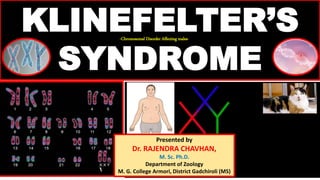
KLINEFELTER’S
SYNDROME
Presented by
Dr. RAJENDRA CHAVHAN,
M. Sc. Ph.D.
Department of Zoology
M. G. College Armori, District Gadchiroli (MS)
-Chromosomal Disorder Affecting males-
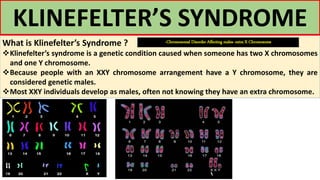
What is Klinefelter’s Syndrome ?
Klinefelter’s syndrome is a genetic condition caused when someone has two X chromosomes
and one Y chromosome.
Because people with an XXY chromosome arrangement have a Y chromosome, they are
considered genetic males.
Most XXY individuals develop as males, often not knowing they have an extra chromosome.
KLINEFELTER’S SYNDROME
-Chromosomal Disorder Affecting males- extra X Chromosome
KLINEFELTER’S SYNDROME
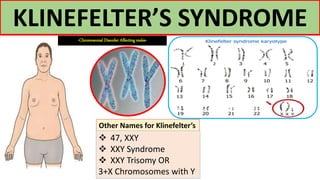
Other Names for Klinefelter’s
 47, XXY
 XXY Syndrome
 XXY Trisomy OR
3+X Chromosomes with Y
-Chromosomal Disorder Affecting males-
HISTORY OF KLINEFELTER’S SYNDROME
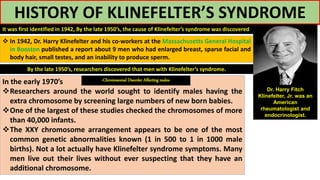
It was first identified in 1942, By the late 1950’s, the cause of Klinefelter’s syndrome was discovered
Dr. Harry Fitch
Klinefelter, Jr. was an
American
rheumatologist and
endocrinologist.
 In 1942, Dr. Harry Klinefelter and his co-workers at the Massachusetts General Hospital
in Booston published a report about 9 men who had enlarged breast, sparse facial and
body hair, small testes, and an inability to produce sperm.
By the late 1950’s, researchers discovered that men with Klinefelter’s syndrome.
In the early 1970’s
Researchers around the world sought to identify males having the
extra chromosome by screening large numbers of new born babies.
One of the largest of these studies checked the chromosomes of more
than 40,000 infants.
The XXY chromosome arrangement appears to be one of the most
common genetic abnormalities known (1 in 500 to 1 in 1000 male
births). Not a lot actually have Klinefelter syndrome symptoms. Many
men live out their lives without ever suspecting that they have an
additional chromosome.
-Chromosomal Disorder Affecting males-
KLINEFELTER’S SYNDROME
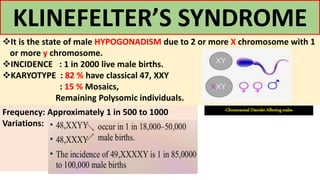
It is the state of male HYPOGONADISM due to 2 or more X chromosome with 1
or more y chromosome.
INCIDENCE : 1 in 2000 live male births.
KARYOTYPE : 82 % have classical 47, XXY
: 15 % Mosaics,
Remaining Polysomic individuals.
Frequency: Approximately 1 in 500 to 1000
Variations:
-Chromosomal Disorder Affecting males-
CAUSES OF KLINEFELTER’S SYNDROME
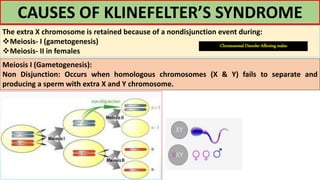
The extra X chromosome is retained because of a nondisjunction event during:
Meiosis- I (gametogenesis)
Meiosis- II in females
Meiosis I (Gametogenesis):
Non Disjunction: Occurs when homologous chromosomes (X & Y) fails to separate and
producing a sperm with extra X and Y chromosome.
-Chromosomal Disorder Affecting males-
CAUSES OF KLINEFELTER’S SYNDROME
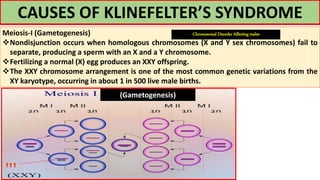
Meiosis-I (Gametogenesis)
Nondisjunction occurs when homologous chromosomes (X and Y sex chromosomes) fail to
separate, producing a sperm with an X and a Y chromosome.
Fertilizing a normal (X) egg produces an XXY offspring.
The XXY chromosome arrangement is one of the most common genetic variations from the
XY karyotype, occurring in about 1 in 500 live male births.
(Gametogenesis)
-Chromosomal Disorder Affecting males-
CAUSES OF KLINEFELTER’S SYNDROME
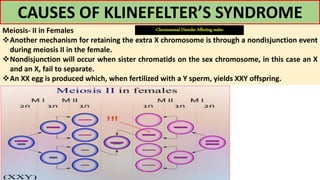
Meiosis- II in Females
Another mechanism for retaining the extra X chromosome is through a nondisjunction event
during meiosis II in the female.
Nondisjunction will occur when sister chromatids on the sex chromosome, in this case an X
and an X, fail to separate.
An XX egg is produced which, when fertilized with a Y sperm, yields XXY offspring.
-Chromosomal Disorder Affecting males-
CAUSES OF KLINEFELTER’S SYNDROME
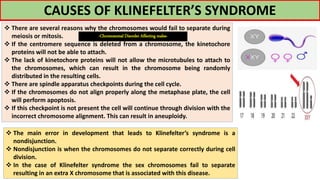
 The main error in development that leads to Klinefelter’s syndrome is a
nondisjunction.
 Nondisjunction is when the chromosomes do not separate correctly during cell
division.
 In the case of Klinefelter syndrome the sex chromosomes fail to separate
resulting in an extra X chromosome that is associated with this disease.
 There are several reasons why the chromosomes would fail to separate during
meiosis or mitosis.
 If the centromere sequence is deleted from a chromosome, the kinetochore
proteins will not be able to attach.
 The lack of kinetochore proteins will not allow the microtubules to attach to
the chromosomes, which can result in the chromosome being randomly
distributed in the resulting cells.
 There are spindle apparatus checkpoints during the cell cycle.
 If the chromosomes do not align properly along the metaphase plate, the cell
will perform apoptosis.
 If this checkpoint is not present the cell will continue through division with the
incorrect chromosome alignment. This can result in aneuploidy.
-Chromosomal Disorder Affecting males-
Language symptoms:
 Learn to talk late.
 Trouble expressing thoughts and
needs.
 Problems reading.
 Trouble processing what they hear.
Others symptoms:
 Normal sex lives, but cannot father
children.
 Produce much less testosterone.
SIGNS AND SYMPTOMS OF KLINEFELTER’S SYNDROME
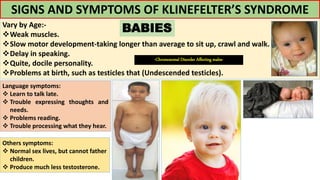
Vary by Age:-
Weak muscles.
Slow motor development-taking longer than average to sit up, crawl and walk.
Delay in speaking.
Quite, docile personality.
Problems at birth, such as testicles that (Undescended testicles).
BABIES
-Chromosomal Disorder Affecting males-
SIGNS AND SYMPTOMS OF KLINEFELTER’S SYNDROME
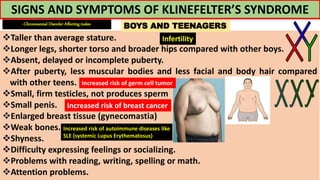
Taller than average stature.
Longer legs, shorter torso and broader hips compared with other boys.
Absent, delayed or incomplete puberty.
After puberty, less muscular bodies and less facial and body hair compared
with other teens.
Small, firm testicles, not produces sperm
Small penis.
Enlarged breast tissue (gynecomastia)
Weak bones.
Shyness.
Difficulty expressing feelings or socializing.
Problems with reading, writing, spelling or math.
Attention problems.
BOYS AND TEENAGERS
Increased risk of breast cancer
Increased risk of germ cell tumor
Increased risk of autoimmune diseases like
SLE (systemic Lupus Erythematosus)
Infertility
-Chromosomal Disorder Affecting males-
SIGNS AND SYMPTOMS OF KLINEFELTER’S SYNDROME
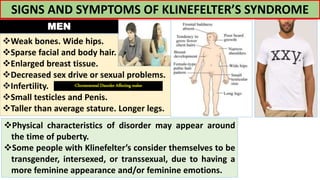
Weak bones. Wide hips.
Sparse facial and body hair.
Enlarged breast tissue.
Decreased sex drive or sexual problems.
Infertility.
Small testicles and Penis.
Taller than average stature. Longer legs.
Physical characteristics of disorder may appear around
the time of puberty.
Some people with Klinefelter’s consider themselves to be
transgender, intersexed, or transsexual, due to having a
more feminine appearance and/or feminine emotions.
MEN
-Chromosomal Disorder Affecting males-
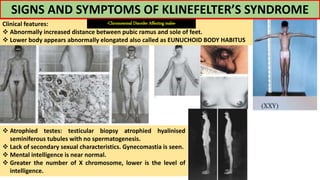
Clinical features:
 Abnormally increased distance between pubic ramus and sole of feet.
 Lower body appears abnormally elongated also called as EUNUCHOID BODY HABITUS
SIGNS AND SYMPTOMS OF KLINEFELTER’S SYNDROME
 Atrophied testes: testicular biopsy atrophied hyalinised
seminiferous tubules with no spermatogenesis.
 Lack of secondary sexual characteristics. Gynecomastia is seen.
 Mental intelligence is near normal.
 Greater the number of X chromosome, lower is the level of
intelligence.
-Chromosomal Disorder Affecting males-
IT IS INTERESTING OF KLINEFELTER’S SYNDROME
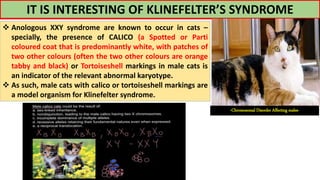
 Anologous XXY syndrome are known to occur in cats –
specially, the presence of CALICO (a Spotted or Parti
coloured coat that is predominantly white, with patches of
two other colours (often the two other colours are orange
tabby and black) or Tortoiseshell markings in male cats is
an indicator of the relevant abnormal karyotype.
 As such, male cats with calico or tortoiseshell markings are
a model organism for Klinefelter syndrome.
-Chromosomal Disorder Affecting males-
Diagnosis OF KLINEFELTER’S SYNDROME
 If a doctor suspects that an individual may be XXY (based an physical characteristics, most commonly
infertility), the diagnosis can be made using a karyotype.
 A karyotype is an analysis of a patient’s chromosomes taken from a blood sample.
 It is diagnosed during pregnancy by taking amniotic fluid.
The greatest chances to make Klinefelter’s diagnosing are in following times of life:
 Before or Shortly after birth. Early childhood. Adolescence. Adulthood
For males in which Klinefelter syndrome is suspected, a special blood test is recommended to confirm the
Klinefelter syndrome diagnosis.
Some facts OF KLINEFELTER’S SYNDROME
 About 10 % of Klinefelter cases are found by prenatal diagnosis.
 Only a quarter of the affected males are recognized as having Klinefelter
syndrome at puberty (Despite the presence of small testes).
 25 % received their diagnosis in late adulthood (about 64 % affected individuals
are not recognized as such).
 Often the diagnosis is made accidentally as a result of examinations and
medical visits for reasons not linked to the condition.
-Chromosomal Disorder Affecting males-
TESTS OF KLINEFELTER’S SYNDROME
BLOOD TEST:
 Blood test called a karyotype and is the standard diagnostic method.
 Test looks at a person’s chromosomes.
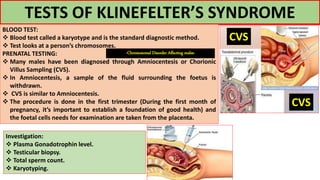
PRENATAL TESTING:
 Many males have been diagnosed through Amniocentesis or Chorionic
Villus Sampling (CVS).
 In Amniocentesis, a sample of the fluid surrounding the foetus is
withdrawn.
 CVS is similar to Amniocentesis.
 The procedure is done in the first trimester (During the first month of
pregnancy, it’s important to establish a foundation of good health) and
the foetal cells needs for examination are taken from the placenta.
CVS
CVS
Investigation:
 Plasma Gonadotrophin level.
 Testicular biopsy.
 Total sperm count.
 Karyotyping.
-Chromosomal Disorder Affecting males-
TREATMENT ON KLINEFELTER’S SYNDROME
TESTOSTERONE TREATMENT: Should begin at puberty.
 Can normalize body proportions and promote development of normal secondary sex characteristics.
 But does not treat Infertility, Gynecomastia and small testes.
 By 2010 over 100 successful pregnancies have been reported using IVF (In Vitro Fertilization) technology with
surgically removed sperm material from men with Klinefelter syndrome.
 The results of a study on 87 Australian adults with the syndrome shows:
 Who have had a diagnosis and appropriate treatment from a very young age had a significant benefit with
respect to those who had been diagnosed in adulthood.
IVF (in Vitro Fertilization)
Is a process by which an egg is fertilized by sperm outside the body: in vitro
Involves: 1. Monitoring a woman’s ovulatory process.
2. Removing ovum or ova (egg or Eggs) from woman’s ovaries.
3.Letting sperm fertilize them in a fluid medium in a laboratory.
When a woman’s natural cycle is monitored to collect a naturally selected ovum
(egg) for fertilization (it is known as natural cycle IVF) the fertilized egg (Zygote) is
then transferred to the patients uterus with the intention of establishing a
successful pregnancy.
-Chromosomal Disorder Affecting males-
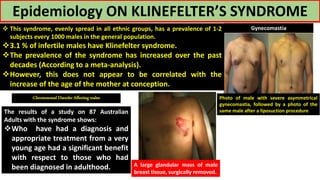
Photo of male with severe asymmetrical
gynecomastia, followed by a photo of the
same male after a liposuction procedure
Gynecomastia
Epidemiology ON KLINEFELTER’S SYNDROME
A large glandular mass of male
breast tissue, surgically removed.
 This syndrome, evenly spread in all ethnic groups, has a prevalence of 1-2
subjects every 1000 males in the general population.
3.1 % of infertile males have Klinefelter syndrome.
The prevalence of the syndrome has increased over the past
decades (According to a meta-analysis).
However, this does not appear to be correlated with the
increase of the age of the mother at conception.
The results of a study on 87 Australian
Adults with the syndrome shows:
Who have had a diagnosis and
appropriate treatment from a very
young age had a significant benefit
with respect to those who had
been diagnosed in adulthood.
-Chromosomal Disorder Affecting males-
Klinefelter Syndrome

Klinefelter Syndrome

  • 1.
    KLINEFELTER’S SYNDROME Presented by Dr. RAJENDRACHAVHAN, M. Sc. Ph.D. Department of Zoology M. G. College Armori, District Gadchiroli (MS) -Chromosomal Disorder Affecting males-
  • 2.
    What is Klinefelter’sSyndrome ? Klinefelter’s syndrome is a genetic condition caused when someone has two X chromosomes and one Y chromosome. Because people with an XXY chromosome arrangement have a Y chromosome, they are considered genetic males. Most XXY individuals develop as males, often not knowing they have an extra chromosome. KLINEFELTER’S SYNDROME -Chromosomal Disorder Affecting males- extra X Chromosome
  • 3.
    KLINEFELTER’S SYNDROME Other Namesfor Klinefelter’s  47, XXY  XXY Syndrome  XXY Trisomy OR 3+X Chromosomes with Y -Chromosomal Disorder Affecting males-
  • 4.
    HISTORY OF KLINEFELTER’SSYNDROME It was first identified in 1942, By the late 1950’s, the cause of Klinefelter’s syndrome was discovered Dr. Harry Fitch Klinefelter, Jr. was an American rheumatologist and endocrinologist.  In 1942, Dr. Harry Klinefelter and his co-workers at the Massachusetts General Hospital in Booston published a report about 9 men who had enlarged breast, sparse facial and body hair, small testes, and an inability to produce sperm. By the late 1950’s, researchers discovered that men with Klinefelter’s syndrome. In the early 1970’s Researchers around the world sought to identify males having the extra chromosome by screening large numbers of new born babies. One of the largest of these studies checked the chromosomes of more than 40,000 infants. The XXY chromosome arrangement appears to be one of the most common genetic abnormalities known (1 in 500 to 1 in 1000 male births). Not a lot actually have Klinefelter syndrome symptoms. Many men live out their lives without ever suspecting that they have an additional chromosome. -Chromosomal Disorder Affecting males-
  • 5.
    KLINEFELTER’S SYNDROME It isthe state of male HYPOGONADISM due to 2 or more X chromosome with 1 or more y chromosome. INCIDENCE : 1 in 2000 live male births. KARYOTYPE : 82 % have classical 47, XXY : 15 % Mosaics, Remaining Polysomic individuals. Frequency: Approximately 1 in 500 to 1000 Variations: -Chromosomal Disorder Affecting males-
  • 6.
    CAUSES OF KLINEFELTER’SSYNDROME The extra X chromosome is retained because of a nondisjunction event during: Meiosis- I (gametogenesis) Meiosis- II in females Meiosis I (Gametogenesis): Non Disjunction: Occurs when homologous chromosomes (X & Y) fails to separate and producing a sperm with extra X and Y chromosome. -Chromosomal Disorder Affecting males-
  • 7.
    CAUSES OF KLINEFELTER’SSYNDROME Meiosis-I (Gametogenesis) Nondisjunction occurs when homologous chromosomes (X and Y sex chromosomes) fail to separate, producing a sperm with an X and a Y chromosome. Fertilizing a normal (X) egg produces an XXY offspring. The XXY chromosome arrangement is one of the most common genetic variations from the XY karyotype, occurring in about 1 in 500 live male births. (Gametogenesis) -Chromosomal Disorder Affecting males-
  • 8.
    CAUSES OF KLINEFELTER’SSYNDROME Meiosis- II in Females Another mechanism for retaining the extra X chromosome is through a nondisjunction event during meiosis II in the female. Nondisjunction will occur when sister chromatids on the sex chromosome, in this case an X and an X, fail to separate. An XX egg is produced which, when fertilized with a Y sperm, yields XXY offspring. -Chromosomal Disorder Affecting males-
  • 9.
    CAUSES OF KLINEFELTER’SSYNDROME  The main error in development that leads to Klinefelter’s syndrome is a nondisjunction.  Nondisjunction is when the chromosomes do not separate correctly during cell division.  In the case of Klinefelter syndrome the sex chromosomes fail to separate resulting in an extra X chromosome that is associated with this disease.  There are several reasons why the chromosomes would fail to separate during meiosis or mitosis.  If the centromere sequence is deleted from a chromosome, the kinetochore proteins will not be able to attach.  The lack of kinetochore proteins will not allow the microtubules to attach to the chromosomes, which can result in the chromosome being randomly distributed in the resulting cells.  There are spindle apparatus checkpoints during the cell cycle.  If the chromosomes do not align properly along the metaphase plate, the cell will perform apoptosis.  If this checkpoint is not present the cell will continue through division with the incorrect chromosome alignment. This can result in aneuploidy. -Chromosomal Disorder Affecting males-
  • 10.
    Language symptoms:  Learnto talk late.  Trouble expressing thoughts and needs.  Problems reading.  Trouble processing what they hear. Others symptoms:  Normal sex lives, but cannot father children.  Produce much less testosterone. SIGNS AND SYMPTOMS OF KLINEFELTER’S SYNDROME Vary by Age:- Weak muscles. Slow motor development-taking longer than average to sit up, crawl and walk. Delay in speaking. Quite, docile personality. Problems at birth, such as testicles that (Undescended testicles). BABIES -Chromosomal Disorder Affecting males-
  • 11.
    SIGNS AND SYMPTOMSOF KLINEFELTER’S SYNDROME Taller than average stature. Longer legs, shorter torso and broader hips compared with other boys. Absent, delayed or incomplete puberty. After puberty, less muscular bodies and less facial and body hair compared with other teens. Small, firm testicles, not produces sperm Small penis. Enlarged breast tissue (gynecomastia) Weak bones. Shyness. Difficulty expressing feelings or socializing. Problems with reading, writing, spelling or math. Attention problems. BOYS AND TEENAGERS Increased risk of breast cancer Increased risk of germ cell tumor Increased risk of autoimmune diseases like SLE (systemic Lupus Erythematosus) Infertility -Chromosomal Disorder Affecting males-
  • 12.
    SIGNS AND SYMPTOMSOF KLINEFELTER’S SYNDROME Weak bones. Wide hips. Sparse facial and body hair. Enlarged breast tissue. Decreased sex drive or sexual problems. Infertility. Small testicles and Penis. Taller than average stature. Longer legs. Physical characteristics of disorder may appear around the time of puberty. Some people with Klinefelter’s consider themselves to be transgender, intersexed, or transsexual, due to having a more feminine appearance and/or feminine emotions. MEN -Chromosomal Disorder Affecting males-
  • 13.
    Clinical features:  Abnormallyincreased distance between pubic ramus and sole of feet.  Lower body appears abnormally elongated also called as EUNUCHOID BODY HABITUS SIGNS AND SYMPTOMS OF KLINEFELTER’S SYNDROME  Atrophied testes: testicular biopsy atrophied hyalinised seminiferous tubules with no spermatogenesis.  Lack of secondary sexual characteristics. Gynecomastia is seen.  Mental intelligence is near normal.  Greater the number of X chromosome, lower is the level of intelligence. -Chromosomal Disorder Affecting males-
  • 14.
    IT IS INTERESTINGOF KLINEFELTER’S SYNDROME  Anologous XXY syndrome are known to occur in cats – specially, the presence of CALICO (a Spotted or Parti coloured coat that is predominantly white, with patches of two other colours (often the two other colours are orange tabby and black) or Tortoiseshell markings in male cats is an indicator of the relevant abnormal karyotype.  As such, male cats with calico or tortoiseshell markings are a model organism for Klinefelter syndrome. -Chromosomal Disorder Affecting males-
  • 15.
    Diagnosis OF KLINEFELTER’SSYNDROME  If a doctor suspects that an individual may be XXY (based an physical characteristics, most commonly infertility), the diagnosis can be made using a karyotype.  A karyotype is an analysis of a patient’s chromosomes taken from a blood sample.  It is diagnosed during pregnancy by taking amniotic fluid. The greatest chances to make Klinefelter’s diagnosing are in following times of life:  Before or Shortly after birth. Early childhood. Adolescence. Adulthood For males in which Klinefelter syndrome is suspected, a special blood test is recommended to confirm the Klinefelter syndrome diagnosis. Some facts OF KLINEFELTER’S SYNDROME  About 10 % of Klinefelter cases are found by prenatal diagnosis.  Only a quarter of the affected males are recognized as having Klinefelter syndrome at puberty (Despite the presence of small testes).  25 % received their diagnosis in late adulthood (about 64 % affected individuals are not recognized as such).  Often the diagnosis is made accidentally as a result of examinations and medical visits for reasons not linked to the condition. -Chromosomal Disorder Affecting males-
  • 16.
    TESTS OF KLINEFELTER’SSYNDROME BLOOD TEST:  Blood test called a karyotype and is the standard diagnostic method.  Test looks at a person’s chromosomes. PRENATAL TESTING:  Many males have been diagnosed through Amniocentesis or Chorionic Villus Sampling (CVS).  In Amniocentesis, a sample of the fluid surrounding the foetus is withdrawn.  CVS is similar to Amniocentesis.  The procedure is done in the first trimester (During the first month of pregnancy, it’s important to establish a foundation of good health) and the foetal cells needs for examination are taken from the placenta. CVS CVS Investigation:  Plasma Gonadotrophin level.  Testicular biopsy.  Total sperm count.  Karyotyping. -Chromosomal Disorder Affecting males-
  • 17.
    TREATMENT ON KLINEFELTER’SSYNDROME TESTOSTERONE TREATMENT: Should begin at puberty.  Can normalize body proportions and promote development of normal secondary sex characteristics.  But does not treat Infertility, Gynecomastia and small testes.  By 2010 over 100 successful pregnancies have been reported using IVF (In Vitro Fertilization) technology with surgically removed sperm material from men with Klinefelter syndrome.  The results of a study on 87 Australian adults with the syndrome shows:  Who have had a diagnosis and appropriate treatment from a very young age had a significant benefit with respect to those who had been diagnosed in adulthood. IVF (in Vitro Fertilization) Is a process by which an egg is fertilized by sperm outside the body: in vitro Involves: 1. Monitoring a woman’s ovulatory process. 2. Removing ovum or ova (egg or Eggs) from woman’s ovaries. 3.Letting sperm fertilize them in a fluid medium in a laboratory. When a woman’s natural cycle is monitored to collect a naturally selected ovum (egg) for fertilization (it is known as natural cycle IVF) the fertilized egg (Zygote) is then transferred to the patients uterus with the intention of establishing a successful pregnancy. -Chromosomal Disorder Affecting males-
  • 18.
    Photo of malewith severe asymmetrical gynecomastia, followed by a photo of the same male after a liposuction procedure Gynecomastia Epidemiology ON KLINEFELTER’S SYNDROME A large glandular mass of male breast tissue, surgically removed.  This syndrome, evenly spread in all ethnic groups, has a prevalence of 1-2 subjects every 1000 males in the general population. 3.1 % of infertile males have Klinefelter syndrome. The prevalence of the syndrome has increased over the past decades (According to a meta-analysis). However, this does not appear to be correlated with the increase of the age of the mother at conception. The results of a study on 87 Australian Adults with the syndrome shows: Who have had a diagnosis and appropriate treatment from a very young age had a significant benefit with respect to those who had been diagnosed in adulthood. -Chromosomal Disorder Affecting males-