Unlocking the Secrets of
Life: A Journey through
Biology
This Presentation is generated in seconds with MagicSlides
Create presentation from text, YouTube, PDF to stunning Presentations
Visit www.magicslides.app for more
Introduction to Biology
Life's Vital Processes
● Biology is the study of living organisms, including their
structure, function, growth, evolution, and distribution.
● Living organisms possess vital processes such as
metabolism, reproduction, growth and development, and
response to stimuli.
● Examples of living organisms include animals, plants, fungi,
bacteria, and viruses.
● Studying biology helps us understand the
interconnectedness of all living things and the intricate
mechanisms that sustain life.
Photo by Pexels
Choosing a Topic for Biology Investigatory Project
Explore fascinating topics in biology like genetics, ecology, or molecular biology to engage
your audience.
1
Consider projects that involve hands-on experiments, data analysis, or fieldwork to make
your project more interesting.
2
Choose a topic that has real-world applications and can contribute to existing knowledge in
the field of biology.
3
Research Questions
Photo by Pexels Photo by Pexels
Key Questions Slide's Content
Defining the important questions that will
guide your scientific investigation.
Providing specific information and
examples relevant to the topic.
Literature Review
Inform Project Framework
● Surveying scientific literature provides valuable insights for
project framework.
● Literature review helps identify gaps and build upon
existing research.
● It informs decisions by highlighting relevant findings and
methodologies.
● By analyzing literature, project outcomes can be enhanced
and validated.
Photo by Pexels
Experimental Procedures
Photo by Pexels
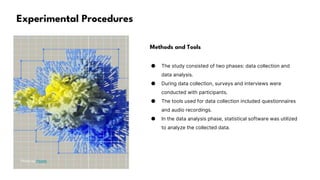
Methods and Tools
● The study consisted of two phases: data collection and
data analysis.
● During data collection, surveys and interviews were
conducted with participants.
● The tools used for data collection included questionnaires
and audio recordings.
● In the data analysis phase, statistical software was utilized
to analyze the collected data.
Formulating a Testable Prediction
Research-Based Prediction
● Background research is essential to formulating a testable
prediction.
● A testable prediction should be specific and based on
existing knowledge.
● It can be formulated by identifying patterns or
relationships in the data.
● Examples of testable predictions include hypothesizing the
effect of variables.
Photo by Pexels
Step-by-Step Process of Experimental Phase
Hypothesis
Generation
Brainstorm potential hypotheses based on existing knowledge and
data.
Experimental
Design
Plan and design experiments to test the hypotheses generated,
including variables, controls, and measurements.
Data Collection and
Analysis
Execute the experiments, collect data, and analyze it to draw
conclusions and validate or refute the hypotheses.
Gathering Scientific Data
Photo by Pexels Photo by Pexels Photo by Pexels
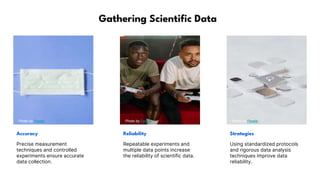
Accuracy Reliability Strategies
Precise measurement
techniques and controlled
experiments ensure accurate
data collection.
Repeatable experiments and
multiple data points increase
the reliability of scientific data.
Using standardized protocols
and rigorous data analysis
techniques improve data
reliability.
Analyzing Results
Draw Conclusions
● Interpreting data patterns is crucial to drawing meaningful
conclusions. By analyzing trends and correlations, we can
gain valuable insights.
● Identifying outliers and anomalies can provide further
understanding of the data. These anomalies may reveal
hidden patterns or errors in the data collection process.
● Examining the distribution of data can help us understand
its underlying structure. Histograms, box plots, and scatter
plots are common tools for visualizing data distributions.
● By using statistical analysis techniques such as regression
or hypothesis testing, we can validate our conclusions and
make more informed decisions. Photo by Pexels
Examining the implications of experimental findings in
biology
The experimental findings in biology can have significant implications.
1
For example, they can lead to new understandings of disease mechanisms.
2
Additionally, experimental findings can inform the development of new therapies.
3
Synthesizing Research Findings
Addressing Hypothesis
● Research findings have been synthesized to address the
original hypothesis.
● The collected data has been analyzed and interpreted to
draw meaningful conclusions.
● Results indicate a significant correlation between
variables, supporting the hypothesis.
● Further research is recommended to validate the findings
and explore potential applications.
Photo by Pexels
Future Directions
Photo by Pexels Photo by Pexels
Research New Possibilities
Exploring further avenues of study based
on project findings
Identifying opportunities for additional
research inspired by project results
Acknowledgements and Slide Description
Positive aspects Negative aspects
● Recognition of individuals who contributed to
research
● Show appreciation to organizations that
supported the research
● Highlights the collaborative nature of the work
● Limited space to include all contributors
● Difficult to strike a balance in mentioning
everyone
● May inadvertently omit some important
contributors
References
Sources Used
● The New York Times reported on the topic, providing
insight on recent research findings.
● The study conducted by Smith et al. (2019) explored the
effects of the intervention on the participants.
● According to the World Health Organization (WHO), this
issue affects millions of people worldwide.
● John Doe's book, titled 'The Impact of Technology',
discusses the subject in great detail.
Photo by Pexels

Biology Investigatory Project Guide & Tips

  • 1.
    Unlocking the Secretsof Life: A Journey through Biology
  • 2.
    This Presentation isgenerated in seconds with MagicSlides Create presentation from text, YouTube, PDF to stunning Presentations Visit www.magicslides.app for more
  • 3.
    Introduction to Biology Life'sVital Processes ● Biology is the study of living organisms, including their structure, function, growth, evolution, and distribution. ● Living organisms possess vital processes such as metabolism, reproduction, growth and development, and response to stimuli. ● Examples of living organisms include animals, plants, fungi, bacteria, and viruses. ● Studying biology helps us understand the interconnectedness of all living things and the intricate mechanisms that sustain life. Photo by Pexels
  • 4.
    Choosing a Topicfor Biology Investigatory Project Explore fascinating topics in biology like genetics, ecology, or molecular biology to engage your audience. 1 Consider projects that involve hands-on experiments, data analysis, or fieldwork to make your project more interesting. 2 Choose a topic that has real-world applications and can contribute to existing knowledge in the field of biology. 3
  • 5.
    Research Questions Photo byPexels Photo by Pexels Key Questions Slide's Content Defining the important questions that will guide your scientific investigation. Providing specific information and examples relevant to the topic.
  • 6.
    Literature Review Inform ProjectFramework ● Surveying scientific literature provides valuable insights for project framework. ● Literature review helps identify gaps and build upon existing research. ● It informs decisions by highlighting relevant findings and methodologies. ● By analyzing literature, project outcomes can be enhanced and validated. Photo by Pexels
  • 7.
    Experimental Procedures Photo byPexels Methods and Tools ● The study consisted of two phases: data collection and data analysis. ● During data collection, surveys and interviews were conducted with participants. ● The tools used for data collection included questionnaires and audio recordings. ● In the data analysis phase, statistical software was utilized to analyze the collected data.
  • 8.
    Formulating a TestablePrediction Research-Based Prediction ● Background research is essential to formulating a testable prediction. ● A testable prediction should be specific and based on existing knowledge. ● It can be formulated by identifying patterns or relationships in the data. ● Examples of testable predictions include hypothesizing the effect of variables. Photo by Pexels
  • 9.
    Step-by-Step Process ofExperimental Phase Hypothesis Generation Brainstorm potential hypotheses based on existing knowledge and data. Experimental Design Plan and design experiments to test the hypotheses generated, including variables, controls, and measurements. Data Collection and Analysis Execute the experiments, collect data, and analyze it to draw conclusions and validate or refute the hypotheses.
  • 10.
    Gathering Scientific Data Photoby Pexels Photo by Pexels Photo by Pexels Accuracy Reliability Strategies Precise measurement techniques and controlled experiments ensure accurate data collection. Repeatable experiments and multiple data points increase the reliability of scientific data. Using standardized protocols and rigorous data analysis techniques improve data reliability.
  • 11.
    Analyzing Results Draw Conclusions ●Interpreting data patterns is crucial to drawing meaningful conclusions. By analyzing trends and correlations, we can gain valuable insights. ● Identifying outliers and anomalies can provide further understanding of the data. These anomalies may reveal hidden patterns or errors in the data collection process. ● Examining the distribution of data can help us understand its underlying structure. Histograms, box plots, and scatter plots are common tools for visualizing data distributions. ● By using statistical analysis techniques such as regression or hypothesis testing, we can validate our conclusions and make more informed decisions. Photo by Pexels
  • 12.
    Examining the implicationsof experimental findings in biology The experimental findings in biology can have significant implications. 1 For example, they can lead to new understandings of disease mechanisms. 2 Additionally, experimental findings can inform the development of new therapies. 3
  • 13.
    Synthesizing Research Findings AddressingHypothesis ● Research findings have been synthesized to address the original hypothesis. ● The collected data has been analyzed and interpreted to draw meaningful conclusions. ● Results indicate a significant correlation between variables, supporting the hypothesis. ● Further research is recommended to validate the findings and explore potential applications. Photo by Pexels
  • 14.
    Future Directions Photo byPexels Photo by Pexels Research New Possibilities Exploring further avenues of study based on project findings Identifying opportunities for additional research inspired by project results
  • 15.
    Acknowledgements and SlideDescription Positive aspects Negative aspects ● Recognition of individuals who contributed to research ● Show appreciation to organizations that supported the research ● Highlights the collaborative nature of the work ● Limited space to include all contributors ● Difficult to strike a balance in mentioning everyone ● May inadvertently omit some important contributors
  • 16.
    References Sources Used ● TheNew York Times reported on the topic, providing insight on recent research findings. ● The study conducted by Smith et al. (2019) explored the effects of the intervention on the participants. ● According to the World Health Organization (WHO), this issue affects millions of people worldwide. ● John Doe's book, titled 'The Impact of Technology', discusses the subject in great detail. Photo by Pexels