G R A D U AT E
R E S E A R C H P L A N
S T AT E M E N T
2020 NSF-GRFP Online Course
Kelsey Wood
WHERE ARE YOU AT?
• Level 0: no idea what to write about
• Level 1: have a general idea but not sure about specific experiments
• Level 2: have multiple competing ideas
• Level 3: have a pretty good sense of what experiments you will write about
GRADUATE RESEARCH PLAN
STATEMENT
• Written in the style of a grant proposal
• But you don’t actually have to carry out the proposed research
• Demonstrates to the reviewers that you can think scientifically and
design experiments
• You can be creative in choosing what to write about
HOW WILL IT BE EVALUATED?
• What is the potential for the proposed activity to:
– Advance knowledge and understanding within its own field or across different fields
(Intellectual Merit); and
– Benefit society or advance desired societal outcomes (Broader Impacts)?
• To what extent do the proposed activities suggest and explore creative, original, or
potentially transformative concepts?
• Is the plan for carrying out the proposed activities well-reasoned, well-organized,
and based on a sound rationale? Does the plan incorporate a mechanism to
assess success?
• How well qualified is the individual, team, or organization to conduct the proposed
activities?
• Are there adequate resources available to the PI (either at the home organization or
through collaborations) to carry out the proposed activities?
(according to the solicitation)
WHAT SHOULD YOU WRITE ABOUT?
Your PI’s research
Your
Proposed
Research
Resources to carry
out research
Context for experiments
Build upon previous findings
Novel methods or novel questions
Incorporate your skills acquired
from prev experiences
Novel collaborations?
INSPIRATION AND HELP DECIDING
• Do literature searches – take notes and save citations! (use a reference
manager like Mendeley)
• Ask to read your PI’s grant proposals
• Schedule a meeting with your PI to discuss ideas
• Due this week: research proposal pitches
– Rough sketches of ideas for experiments, will email a template
– It’s a good thing to have too many ideas – can pick the best ones to write about
THE 4
QUESTIONS
OF
RESEARCH
PROPOSALS
1. Is it important?
2. Is it novel?
3. Is it feasible?
4.Why you?
IS IT IMPORTANT?
FUNDAMENTAL PROCESS
INTELLECTUAL MERIT
BENEFITTING SOCIETY
BROADER IMPACT
+
IS IT NOVEL?
• Use the “known/unknown” model:
[what is known] [what is unknown] [how your study will fill gap in knowledge]
• Just being unknown is not enough – must also be important
• Engage the reader in wanting to find out what is unknown
“The Burning Question”
• Do you use novel/improved methods?
• Are experiments creative? Potentially transformative?
IS IT FEASIBLE?
l Describe methods in enough detail that reviewers can feel
confident that you know what you are doing
l Cite successful expts that use same methods
o Use ACS format to save space on citations.
l How will you validate new methods?
l Best experiments: gain knowledge regardless of results
l HAVE A CONTINGENCY PLAN!
WHY YOU?
• Why are you/your PI/your institution/your
collaborators/your study system the BEST for answering
your big questions?
• Research experience speaks to this
• If you are lacking in a skill needed to do your project –
explain how you will acquire that skill
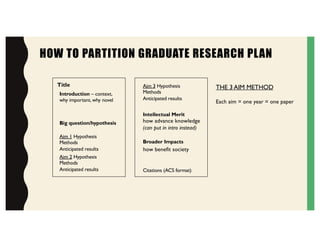
HOW TO PARTITION GRADUATE RESEARCH PLAN
Introduction – context,
why important, why novel
Big question/hypothesis
Aim 1 Hypothesis
Methods
Anticipated results
Title
Aim 2 Hypothesis
Methods
Anticipated results
Aim 3 Hypothesis
Methods
Anticipated results
Intellectual Merit
Broader Impacts
Citations (ACS format)
THE 3 AIM METHOD
Each aim = one year = one paper
how advance knowledge
(can put in intro instead)
how benefit society
BACKGROUND & INTRODUCTION
• Max 2 short paragraphs (~1/2 page)
• Give importance (background)
• Introduce study system – what is known, what is unknown
• What is your big question and why is it novel?
“The Burning Question”
SETTING UP THE BURNING QUESTION
• “One roadblock to assessing global N2-fixation rates is an incomplete
understanding of asymbiotic N2-fixation”
• “Little is known about the role of active transport in plant biotic interactions.”
• “To date, only one publication has looked at miRNA involvement in Th17
differentiation.”
• “While neural circuits underpin all behaviors and we are beginning to
understand how single cells process information, it is still unclear how even
two neurons work in a simple circuit.”
Known/unknown model
HYPOTHESIS/RESEARCH QUESTION(S)
• What is the overarching question you are trying to answer?
• Could be phrased as a hypothesis or a question, ex:
2014 Plant Path
2014 Genomics
PRELIMINARY DATA
• Include it if you have it!
• Use a figure only if it is worth 1000 words
A nice figure can
demonstrate your
intellectual merit and
communication skills
3 YEARS, 3 AIMS, 3 PAPERS
• Aims should not be interdependent (complementary is better)
• Could also do 2-4 aims depending on project
• Each aim will have:
– Hypothesis or question
– Methods
– Anticipated results (if I see x, then it means y)
– Contingency plan (if appropriate)(reviewers love this)
INTELLECTUAL MERIT SECTION
• IM is implicit in your research proposal
• Use this section as a summary and conclusion
– Alternatively, could start with an IM section in intro, but I think it
makes a stronger case to put at the end
• Emphasize how your research will advance knowledge and the
wider context.
• ~2-3 sentences
BROADER IMPACT SECTION
l Societal benefits – US economy, environment, climate change
l Will you share results? Blog about research?
l Train undergrads, outreach to underrep. communities and public
l Propose novel broader impact activity that goes along with
your research (describe in personal statement)
l 1 paragraph (3-5 sentences)
FORMATTING
• standard 8.5" x 11" page size
• Times New Roman font for all text, Cambria Math font for equations, Symbol font for non-
alphabetic characters (it is recommended that equations and symbols be inserted as an image),
no smaller than 11-point, except text that is part of an image
• 1" margins on all sides, no text inside 1" margins (no header, footer, name, or page number)
• No less than single-spacing (approximately 6 lines per inch). Do not use line spacing
options such as "exactly 11 point," that are less than single spaced.
• Page limits include all references, citations, charts, figures, images, and lists of publications and
presentations
APPLICATIONSTHAT ARE NOT COMPLIANT WITH
THESE FORMAT REQUIREMENTS WILL BE
RETURNED WITHOUT REVIEW!!!
ASSIGNMENT: RESEARCH PROPOSAL
PITCHES
• For each pitch:
– What is the Big Question:
– Why is it important:
– How will you answer question:
– How are your questions or methods novel?
– Is your approach feasible?
– Why you?

The NSF-GRFP: Proposed Research Statement

  • 1.
    G R AD U AT E R E S E A R C H P L A N S T AT E M E N T 2020 NSF-GRFP Online Course Kelsey Wood
  • 2.
    WHERE ARE YOUAT? • Level 0: no idea what to write about • Level 1: have a general idea but not sure about specific experiments • Level 2: have multiple competing ideas • Level 3: have a pretty good sense of what experiments you will write about
  • 3.
    GRADUATE RESEARCH PLAN STATEMENT •Written in the style of a grant proposal • But you don’t actually have to carry out the proposed research • Demonstrates to the reviewers that you can think scientifically and design experiments • You can be creative in choosing what to write about
  • 4.
    HOW WILL ITBE EVALUATED? • What is the potential for the proposed activity to: – Advance knowledge and understanding within its own field or across different fields (Intellectual Merit); and – Benefit society or advance desired societal outcomes (Broader Impacts)? • To what extent do the proposed activities suggest and explore creative, original, or potentially transformative concepts? • Is the plan for carrying out the proposed activities well-reasoned, well-organized, and based on a sound rationale? Does the plan incorporate a mechanism to assess success? • How well qualified is the individual, team, or organization to conduct the proposed activities? • Are there adequate resources available to the PI (either at the home organization or through collaborations) to carry out the proposed activities? (according to the solicitation)
  • 5.
    WHAT SHOULD YOUWRITE ABOUT? Your PI’s research Your Proposed Research Resources to carry out research Context for experiments Build upon previous findings Novel methods or novel questions Incorporate your skills acquired from prev experiences Novel collaborations?
  • 6.
    INSPIRATION AND HELPDECIDING • Do literature searches – take notes and save citations! (use a reference manager like Mendeley) • Ask to read your PI’s grant proposals • Schedule a meeting with your PI to discuss ideas • Due this week: research proposal pitches – Rough sketches of ideas for experiments, will email a template – It’s a good thing to have too many ideas – can pick the best ones to write about
  • 7.
    THE 4 QUESTIONS OF RESEARCH PROPOSALS 1. Isit important? 2. Is it novel? 3. Is it feasible? 4.Why you?
  • 8.
    IS IT IMPORTANT? FUNDAMENTALPROCESS INTELLECTUAL MERIT BENEFITTING SOCIETY BROADER IMPACT +
  • 9.
    IS IT NOVEL? •Use the “known/unknown” model: [what is known] [what is unknown] [how your study will fill gap in knowledge] • Just being unknown is not enough – must also be important • Engage the reader in wanting to find out what is unknown “The Burning Question” • Do you use novel/improved methods? • Are experiments creative? Potentially transformative?
  • 10.
    IS IT FEASIBLE? lDescribe methods in enough detail that reviewers can feel confident that you know what you are doing l Cite successful expts that use same methods o Use ACS format to save space on citations. l How will you validate new methods? l Best experiments: gain knowledge regardless of results l HAVE A CONTINGENCY PLAN!
  • 11.
    WHY YOU? • Whyare you/your PI/your institution/your collaborators/your study system the BEST for answering your big questions? • Research experience speaks to this • If you are lacking in a skill needed to do your project – explain how you will acquire that skill
  • 12.
    HOW TO PARTITIONGRADUATE RESEARCH PLAN Introduction – context, why important, why novel Big question/hypothesis Aim 1 Hypothesis Methods Anticipated results Title Aim 2 Hypothesis Methods Anticipated results Aim 3 Hypothesis Methods Anticipated results Intellectual Merit Broader Impacts Citations (ACS format) THE 3 AIM METHOD Each aim = one year = one paper how advance knowledge (can put in intro instead) how benefit society
  • 13.
    BACKGROUND & INTRODUCTION •Max 2 short paragraphs (~1/2 page) • Give importance (background) • Introduce study system – what is known, what is unknown • What is your big question and why is it novel? “The Burning Question”
  • 14.
    SETTING UP THEBURNING QUESTION • “One roadblock to assessing global N2-fixation rates is an incomplete understanding of asymbiotic N2-fixation” • “Little is known about the role of active transport in plant biotic interactions.” • “To date, only one publication has looked at miRNA involvement in Th17 differentiation.” • “While neural circuits underpin all behaviors and we are beginning to understand how single cells process information, it is still unclear how even two neurons work in a simple circuit.” Known/unknown model
  • 15.
    HYPOTHESIS/RESEARCH QUESTION(S) • Whatis the overarching question you are trying to answer? • Could be phrased as a hypothesis or a question, ex: 2014 Plant Path 2014 Genomics
  • 16.
    PRELIMINARY DATA • Includeit if you have it! • Use a figure only if it is worth 1000 words A nice figure can demonstrate your intellectual merit and communication skills
  • 17.
    3 YEARS, 3AIMS, 3 PAPERS • Aims should not be interdependent (complementary is better) • Could also do 2-4 aims depending on project • Each aim will have: – Hypothesis or question – Methods – Anticipated results (if I see x, then it means y) – Contingency plan (if appropriate)(reviewers love this)
  • 18.
    INTELLECTUAL MERIT SECTION •IM is implicit in your research proposal • Use this section as a summary and conclusion – Alternatively, could start with an IM section in intro, but I think it makes a stronger case to put at the end • Emphasize how your research will advance knowledge and the wider context. • ~2-3 sentences
  • 19.
    BROADER IMPACT SECTION lSocietal benefits – US economy, environment, climate change l Will you share results? Blog about research? l Train undergrads, outreach to underrep. communities and public l Propose novel broader impact activity that goes along with your research (describe in personal statement) l 1 paragraph (3-5 sentences)
  • 20.
    FORMATTING • standard 8.5"x 11" page size • Times New Roman font for all text, Cambria Math font for equations, Symbol font for non- alphabetic characters (it is recommended that equations and symbols be inserted as an image), no smaller than 11-point, except text that is part of an image • 1" margins on all sides, no text inside 1" margins (no header, footer, name, or page number) • No less than single-spacing (approximately 6 lines per inch). Do not use line spacing options such as "exactly 11 point," that are less than single spaced. • Page limits include all references, citations, charts, figures, images, and lists of publications and presentations APPLICATIONSTHAT ARE NOT COMPLIANT WITH THESE FORMAT REQUIREMENTS WILL BE RETURNED WITHOUT REVIEW!!!
  • 21.
    ASSIGNMENT: RESEARCH PROPOSAL PITCHES •For each pitch: – What is the Big Question: – Why is it important: – How will you answer question: – How are your questions or methods novel? – Is your approach feasible? – Why you?