Biotechnology for
Solid Waste
Management
1JUNIOR
HIMANSHU JAIN
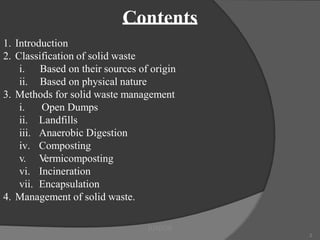
1. Introduction
2. Classification of solid waste
i. Based on their sources of origin
ii. Based on physical nature
3. Methods for solid waste management
i. Open Dumps
ii. Landfills
iii. Anaerobic Digestion
iv. Composting
v. Vermicomposting
vi. Incineration
vii. Encapsulation
4. Management of solid waste.
Contents
2
JUNIOR
i. Management of non-degradable solid waste
ii. Management of Medical solid waste
iii. Management of Hazardous waste
iv. Management of non-hazardous & biodegradable
solid waste
Vi . Management of electronic waste, “e-waste”
5. Factors affecting solid waste management
3
JUNIOR
Waste:
Depending on their physical state they are classified as:
Liquid wastes
Gaseous wastes
Solid wastes.
Solid waste: Solid waste is the unwanted or useless solid materials
generated from combined residential, industrial and commercial
activities in a given area.
4
1. Introduction:
[Ref: T. Srinivas, Environmental Biotechnology, www.cyen.org]
JUNIOR
Solid Waste Management:
5
Solid waste management is the process of collection, transportation and disposal
of solid waste in a systematic, economic and hygienic manner.
‘Or’
Solid-waste management is the process of the collecting, treating, and disposing
of solid material that is discarded because it is of no longer use.
[Ref: T. Srinivas, Environmental Biotechnology, www.britannica.org]
JUNIOR
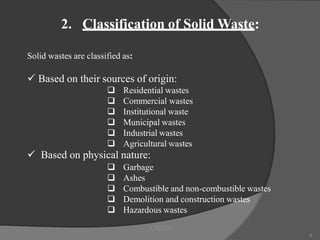
2. Classification of Solid Waste:
6
Solid wastes are classified as:
 Based on their sources of origin:
 Residential wastes
 Commercial wastes
 Institutional waste
 Municipal wastes
 Industrial wastes
 Agricultural wastes
 Based on physical nature:
 Garbage
 Ashes
 Combustible and non-combustible wastes
 Demolition and construction wastes
 Hazardous wastes
JUNIOR
Methods for the treatment of the solid waste:
10
With different types of wastes, different treatment methods are applied.
These treatment processes has been listed below:
 Open Dumps
 Landfills
 AnaerobicDigestion
 Composting
 Vermicomposting
 Encapsulation
 Incineration7
JUNIOR
•Open dumps refer to uncovered
areas that are used to dump solid
waste of all kinds.
•The waste is untreated, and not
segregated.
•It is the breeding ground for
files, rats, and other insects
that spread disease.
• The
these
rainwater run-off from
dumps contaminates
nearby land and water, thereby
spreading disease. In
some countries, open dumps are
being phased out.
i. Open Dumps:
[Ref: Indu Shekhar Thakur- Environmental Biotechnology]
Open dump site
8
JUNIOR
•A landfill may also refer to the ground that has been filled in with
soil and rocks instead of waste materials, so that it can be used for a
specific purpose, such as for building houses.
•Landfill, also known as a dump or tip, is a site for disposal of waste
materials by burial.
•Older, poorly designed or poorly managed landfills can create
a number of adverse environmental impacts such as wind-blown
litter, attraction of vermin, and generation of liquid leachate.
9
ii. Landfills:
[Ref: Indu Shekhar Thakur- Environmental Biotechnology, T. Srinivas, Environmental Biotechnology]
JUNIOR
•Sanitary Landfills are designed to greatly reduce or eliminate the risks that waste
disposal may pose to the public health and environmental quality.
 Sanitary landfills:
Fig: Main features of a modern landfill (Sanitary landfill)
10
[Ref: Indu Shekhar Thakur- Environmental Biotechnology and www.cyen.org ]JUNIOR
Composting is the biological
decomposition of organic waste
under controlled aerobic condition.
Industries as paper,
agricultural and food processing
give out wastes which are almost
100% organic. This organic
matter can be composted to yield
good manure.
Compost is the end product
obtained after subjecting
the organic fraction of solid
waste to aerobic or
anaerobic decomposition to yield
humus like solid, carbon dioxide,
water vapour and energy.
iii.Composting:
Fig: Compost cycle
11
[Ref: Indu Shekhar Thakur- Environmental Biotechnology and www.cuesa.org]JUNIOR
 Segregation of solid waste
 Processing the compostable matter
 Preparation for compost
 Digestion
 Curing
 Screening
 Different stages of composting:
[Ref: T. Srinivas, Environmental Biotechnology]
12
JUNIOR
Fig: Growth pattern of microbes
during composting
[Ref: U.Satayanarayan, Biotechnology, and S.V.S Rana, environmental
Biotechnology]
• Composting is a very complex
involving the participation of
process
several
microorganisms like bacteria, actinomycetes
and fungi.
•The bacteria bring out the decomposition of
macromolecule namely proteins and
lipids. Besides generating energy (heat) .
Fungi and actinomycetes degrade cellulose
and other complex organic compounds.
•Composting may be divided into three stages
with reference to changes in temperature:
 Mesophilic stage
 Thermophilic stage
 Cooling stage
 Mechanism of composting:
13
JUNIOR
•Anaerobic digestion is a regulated version of the natural events of landfill, in
that it results in the controlled release of methane-rich biogas, which offers
the potential for a very real form of energy from waste.
•It is carried out in large fermented tanks.
•In these tanks, solid waste is taken in the absence of oxygen and the
anaerobic bacteria convert the large organic molecules mainly into methane CH4
and carbon dioxide CO2.
•Unlike composting, Anaerobic Digestion occurs at one of three distinct
temperature ranges, namely:
 Cryophilic (<20 ◦C)
 Mesophilic (20–45 ◦C)
 Thermophilic (>45 ◦C)
[Ref: Gareth M. Evans, Environmental Biotechnology, Theory and Application]
14
iv. Anaerobic Digestion:
JUNIOR
There are four main groups of bacteria involved in Anaerobic digestion, as
shown below, with some typical examples of each:
Hydrolytic fermentative bacteria – Clostridium and Peptococcus.
Acetogenic bacteria – Syntrophobacter and Syntrophomonas.
Acidogenic bacteria – Methanosarcina and Methanothrix.
Methanogenic bacteria – Methanobacterium and Methanobrevibacterium.
15
 Micro-organisms involved inAnaerobic digestion:
[Ref: Gareth M. Evans, Environmental Biotechnology, Theory andApplication]
JUNIOR
19
The digestion process involves 4
steps. They are:
 Hydrolysis
 Acidogenesis
 Acetogenesis
 Methanogenesis
 The digestion process:
[Ref: Gareth M. Evans, Environmental Biotechnology, Theory andApplication]
Complex organic matter
(eg: fat, carbohydrate, protein, lipids etc)
Monomer unit
(eg: glucose, fatty acid, glycerol etc)
Organic acids(acetic, butyric, propionic
acid),alcohol and ketones
Acetates, CO2, H2O
Methane, CO2, H2O
Hydrolytic bacteria
Fermentative
acidogenic bacteria
Acetogenic bacteria
Methanogenesis
Hydrolysis
Acidogenesis
Acetogenesis
Methanogenic
bacteria
16
JUNIOR
•Vermicomposting is a simple biotechnological process of
composting, in which certain species of earthworms are used to enhance
the process of waste conversion and produce a better end product.
•Vermicomposting differs from composting in several ways.
Utilizing microorganism’s (earthworms that are active at 10–
32°C).
The process is faster than composting (Because the material
passes through the earthworm gut, a significant but not yet
fully understood transformation takes place, whereby the
resulting earthworm castings (worm manure) are rich in microbial
activity and plant growth regulators).
17
v. Vermicomposting:
[Ref: Indu Shekhar Thakur- Environmental Biotechnology]
JUNIOR
18
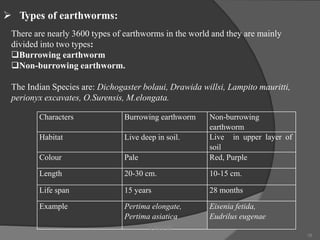
There are nearly 3600 types of earthworms in the world and they are mainly
divided into two types:
Burrowing earthworm
Non-burrowing earthworm.
The Indian Species are: Dichogaster bolaui, Drawida willsi, Lampito mauritti,
perionyx excavates, O.Surensis, M.elongata.
 Types of earthworms:
Characters Burrowing earthworm Non-burrowing
earthworm
Habitat Live deep in soil. Live in upper layer of
soil
Colour Pale Red, Purple
Length 20-30 cm. 10-15 cm.
Life span 15 years 28 months
Example Pertima elongate,
Pertima asiatica
Eisenia fetida,
Eudrilus eugenae
JUNIOR
 Encapsulation:
19
Solid particulate waste material is coated with a thermosetting resin which is
compressed and cured to form a rigid core. The rigid core is coated
with a flexible thermoplastic resin to provide a sealed encapsulated
waste agglomerate which can withstand moderate compressive loads.
Encapsulation method are of the types:
Microencapsulation
Microencapsulation
[Ref: Indu Shekhar Thakur- Environmental Biotechnology,
www.google.com/patents/US4234632]JUNIOR
 Incineration:
20
•Incineration is the most common thermal treatment process. It is
burning of the waste at a temperature of 1000°C ± 100°C in
the presence of oxygen so as to eliminate all odours and to ensure
good combustion.
•After incineration, the wastes are converted to carbon
dioxide, water vapour and ash.
•It converts hazardous organic substances into less hazardous
components.
JUNIOR
4. Management of Solid waste:
[Ref: Indu Shekhar Thakur- Environmental Biotechnology]
21
The fundamental objective of waste processing is to reduce the amount
of wastes through recycling and disposal of waste in a way not to impair
environmental conservation.
Four R’s should be followed for waste management:
Refuse
Reuse
Recycle
Reduce
JUNIOR
The management of the solid waste is done according to its
nature:
i.Management of Medical solid waste
ii.Management of non-degradable solid waste
iii.Management of Hazardous waste
iv.Management of non-hazardous&
biodegradable solid waste
v.Management of electronic waste Dze-wastedz
[Ref: Indu Shekhar Thakur- Environmental Biotechnology]
22
JUNIOR
•Hospital waste is generated during the diagnosis, treatment,
or immunization of human beings or animals or in research activities
in these fields or in the production or testing of biological.
•Medical solid waste includes both non-hazardous and hazardous waste
constituents.
 The non-hazardous waste
Hazardous wastes
Medical solid waste
Treatment options:
Incineration
Sanitary landfill
[Ref: Indu Shekhar Thakur- Environmental Biotechnology]
23
i. Management of Medical solid waste:
JUNIOR
• Examples of non-degradable solid wastes are:
 Ferrous & non-ferrous metals: Eg: Iron,
Steel and Aluminium etc.
 Glass
 Plastics
 Textiles
• Treatment options:
 Recycling
 Sanitary landfill
 Incineration
[Ref: Indu Shekhar Thakur- Environmental Biotechnology]
29
ii. Management of non-degradable solid waste:
24
JUNIOR
Following process
waste treatment:
applied in hazardous
 Physical separation
 Gravity separation
 Dissolved air floatation
 Solvent extraction
 Sorption on activated carbon
iii.
Management of Hazardous waste:
Hazardous waste
[Ref: Indu Shekhar Thakur- Environmental Biotechnology]
30
Treatment options:
 Thermal treatment
 Incineration
 Biological treatment
25
JUNIOR
solid waste:
•Non-hazardous solid waste is total waste including municipal waste, industrial
waste, agricultural waste and sewage sludge.
•Following methods are followedby management of
non-hazardous and biodegradable solid wastes:
Open Dumps
Landfills
Anaerobic Digestion
Composting
Vermicomposting
T. Srinivas, Environmental Biotechnology]
26
iv. Management of non-hazardous & biodegradable
[Ref: Indu Shekhar Thakur- Environmental Biotechnology,
JUNIOR
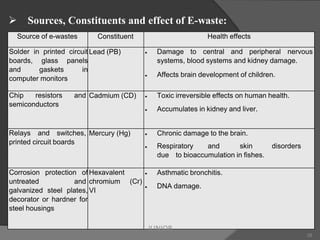
• Electronic waste is of concern largely due to the toxicity and
carcinogenicity of some of the substances if processed improperly. Toxic
substances in electronic waste include lead, mercury and
cadmium. Carcinogenic substances in electronic waste may include
polychlorinated biphenyls (PCBs).
•A typical computer may contain more than 6% lead by
weight. Capacitors, transformers, PVC insulated wires of
polychlorinated biphenyls.
vi. Management of Electronic waste, “E-Waste”:
27
[Ref: Indu Shekhar Thakur- Environmental Biotechnology]
JUNIOR
28
 Sources, Constituents and effect of E-waste:
Source of e-wastes Constituent Health effects
Solder in printed circuit
boards, glass panels
and gaskets in
computer monitors
Lead (PB)  Damage to central and peripheral nervous
systems, blood systems and kidney damage.
 Affects brain development of children.
Chip resistors and
semiconductors
Cadmium (CD)  Toxic irreversible effects on human health.
 Accumulates in kidney and liver.
Relays and switches,
printed circuit boards
Mercury (Hg)  Chronic damage to the brain.
 Respiratory and skin disorders
due to bioaccumulation in fishes.
Corrosion protection of
untreated and
galvanized steel plates,
decorator or hardner for
steel housings
Hexavalent
chromium (Cr)
VI
 Asthmatic bronchitis.
 DNA damage.
JUNIOR
E.waste consists of Diverse items like ferrous and non-ferrous metals, glass,
plastics, electronic components and other items. The potential treatment options
based on this composition are given below:
 Encapsulation
 Incineration
 Sanitary landfill
29
 Treatment options:
[Ref: T. Srinivas, Environmental Biotechnology]
JUNIOR
Designer Rodrigo Alonso created
N+ew Seats to address this --
stools that are formed of a whole
lot of electronic junk. This was
covered back in 2007.
The idea behind N+EW isn’t
the creation of a recyclable object,
but the way to immortalize and to
give a last use to objects that
their only destination is
contamination."
E-Waste Furniture
[Ref: www.treehugger.com]
30
Reuse of the electronic waste in the form of a stool:
JUNIOR
5. Factors affecting solid waste management:
There are certain factors that affect the management of solid
waste: management. They are:
Per capita income and status
Climate and percentage moisture
Systematic growth of city
Status of the municipality
Resources available
31
[Ref: T. Srinivas, Environmental Biotechnology]
JUNIOR
6. Conclusion:
32
Solid waste management is the process of removal of solid waste in such
a manner that it does not cause any problem to environment and
the living organism as well. It is done through different methods as per
the category of the solid waste.
JUNIOR

Biotechnology for Solid waste Management

  • 1.
  • 2.
    1. Introduction 2. Classificationof solid waste i. Based on their sources of origin ii. Based on physical nature 3. Methods for solid waste management i. Open Dumps ii. Landfills iii. Anaerobic Digestion iv. Composting v. Vermicomposting vi. Incineration vii. Encapsulation 4. Management of solid waste. Contents 2 JUNIOR
  • 3.
    i. Management ofnon-degradable solid waste ii. Management of Medical solid waste iii. Management of Hazardous waste iv. Management of non-hazardous & biodegradable solid waste Vi . Management of electronic waste, “e-waste” 5. Factors affecting solid waste management 3 JUNIOR
  • 4.
    Waste: Depending on theirphysical state they are classified as: Liquid wastes Gaseous wastes Solid wastes. Solid waste: Solid waste is the unwanted or useless solid materials generated from combined residential, industrial and commercial activities in a given area. 4 1. Introduction: [Ref: T. Srinivas, Environmental Biotechnology, www.cyen.org] JUNIOR
  • 5.
    Solid Waste Management: 5 Solidwaste management is the process of collection, transportation and disposal of solid waste in a systematic, economic and hygienic manner. ‘Or’ Solid-waste management is the process of the collecting, treating, and disposing of solid material that is discarded because it is of no longer use. [Ref: T. Srinivas, Environmental Biotechnology, www.britannica.org] JUNIOR
  • 6.
    2. Classification ofSolid Waste: 6 Solid wastes are classified as:  Based on their sources of origin:  Residential wastes  Commercial wastes  Institutional waste  Municipal wastes  Industrial wastes  Agricultural wastes  Based on physical nature:  Garbage  Ashes  Combustible and non-combustible wastes  Demolition and construction wastes  Hazardous wastes JUNIOR
  • 7.
    Methods for thetreatment of the solid waste: 10 With different types of wastes, different treatment methods are applied. These treatment processes has been listed below:  Open Dumps  Landfills  AnaerobicDigestion  Composting  Vermicomposting  Encapsulation  Incineration7 JUNIOR
  • 8.
    •Open dumps referto uncovered areas that are used to dump solid waste of all kinds. •The waste is untreated, and not segregated. •It is the breeding ground for files, rats, and other insects that spread disease. • The these rainwater run-off from dumps contaminates nearby land and water, thereby spreading disease. In some countries, open dumps are being phased out. i. Open Dumps: [Ref: Indu Shekhar Thakur- Environmental Biotechnology] Open dump site 8 JUNIOR
  • 9.
    •A landfill mayalso refer to the ground that has been filled in with soil and rocks instead of waste materials, so that it can be used for a specific purpose, such as for building houses. •Landfill, also known as a dump or tip, is a site for disposal of waste materials by burial. •Older, poorly designed or poorly managed landfills can create a number of adverse environmental impacts such as wind-blown litter, attraction of vermin, and generation of liquid leachate. 9 ii. Landfills: [Ref: Indu Shekhar Thakur- Environmental Biotechnology, T. Srinivas, Environmental Biotechnology] JUNIOR
  • 10.
    •Sanitary Landfills aredesigned to greatly reduce or eliminate the risks that waste disposal may pose to the public health and environmental quality.  Sanitary landfills: Fig: Main features of a modern landfill (Sanitary landfill) 10 [Ref: Indu Shekhar Thakur- Environmental Biotechnology and www.cyen.org ]JUNIOR
  • 11.
    Composting is thebiological decomposition of organic waste under controlled aerobic condition. Industries as paper, agricultural and food processing give out wastes which are almost 100% organic. This organic matter can be composted to yield good manure. Compost is the end product obtained after subjecting the organic fraction of solid waste to aerobic or anaerobic decomposition to yield humus like solid, carbon dioxide, water vapour and energy. iii.Composting: Fig: Compost cycle 11 [Ref: Indu Shekhar Thakur- Environmental Biotechnology and www.cuesa.org]JUNIOR
  • 12.
     Segregation ofsolid waste  Processing the compostable matter  Preparation for compost  Digestion  Curing  Screening  Different stages of composting: [Ref: T. Srinivas, Environmental Biotechnology] 12 JUNIOR
  • 13.
    Fig: Growth patternof microbes during composting [Ref: U.Satayanarayan, Biotechnology, and S.V.S Rana, environmental Biotechnology] • Composting is a very complex involving the participation of process several microorganisms like bacteria, actinomycetes and fungi. •The bacteria bring out the decomposition of macromolecule namely proteins and lipids. Besides generating energy (heat) . Fungi and actinomycetes degrade cellulose and other complex organic compounds. •Composting may be divided into three stages with reference to changes in temperature:  Mesophilic stage  Thermophilic stage  Cooling stage  Mechanism of composting: 13 JUNIOR
  • 14.
    •Anaerobic digestion isa regulated version of the natural events of landfill, in that it results in the controlled release of methane-rich biogas, which offers the potential for a very real form of energy from waste. •It is carried out in large fermented tanks. •In these tanks, solid waste is taken in the absence of oxygen and the anaerobic bacteria convert the large organic molecules mainly into methane CH4 and carbon dioxide CO2. •Unlike composting, Anaerobic Digestion occurs at one of three distinct temperature ranges, namely:  Cryophilic (<20 ◦C)  Mesophilic (20–45 ◦C)  Thermophilic (>45 ◦C) [Ref: Gareth M. Evans, Environmental Biotechnology, Theory and Application] 14 iv. Anaerobic Digestion: JUNIOR
  • 15.
    There are fourmain groups of bacteria involved in Anaerobic digestion, as shown below, with some typical examples of each: Hydrolytic fermentative bacteria – Clostridium and Peptococcus. Acetogenic bacteria – Syntrophobacter and Syntrophomonas. Acidogenic bacteria – Methanosarcina and Methanothrix. Methanogenic bacteria – Methanobacterium and Methanobrevibacterium. 15  Micro-organisms involved inAnaerobic digestion: [Ref: Gareth M. Evans, Environmental Biotechnology, Theory andApplication] JUNIOR
  • 16.
    19 The digestion processinvolves 4 steps. They are:  Hydrolysis  Acidogenesis  Acetogenesis  Methanogenesis  The digestion process: [Ref: Gareth M. Evans, Environmental Biotechnology, Theory andApplication] Complex organic matter (eg: fat, carbohydrate, protein, lipids etc) Monomer unit (eg: glucose, fatty acid, glycerol etc) Organic acids(acetic, butyric, propionic acid),alcohol and ketones Acetates, CO2, H2O Methane, CO2, H2O Hydrolytic bacteria Fermentative acidogenic bacteria Acetogenic bacteria Methanogenesis Hydrolysis Acidogenesis Acetogenesis Methanogenic bacteria 16 JUNIOR
  • 17.
    •Vermicomposting is asimple biotechnological process of composting, in which certain species of earthworms are used to enhance the process of waste conversion and produce a better end product. •Vermicomposting differs from composting in several ways. Utilizing microorganism’s (earthworms that are active at 10– 32°C). The process is faster than composting (Because the material passes through the earthworm gut, a significant but not yet fully understood transformation takes place, whereby the resulting earthworm castings (worm manure) are rich in microbial activity and plant growth regulators). 17 v. Vermicomposting: [Ref: Indu Shekhar Thakur- Environmental Biotechnology] JUNIOR
  • 18.
    18 There are nearly3600 types of earthworms in the world and they are mainly divided into two types: Burrowing earthworm Non-burrowing earthworm. The Indian Species are: Dichogaster bolaui, Drawida willsi, Lampito mauritti, perionyx excavates, O.Surensis, M.elongata.  Types of earthworms: Characters Burrowing earthworm Non-burrowing earthworm Habitat Live deep in soil. Live in upper layer of soil Colour Pale Red, Purple Length 20-30 cm. 10-15 cm. Life span 15 years 28 months Example Pertima elongate, Pertima asiatica Eisenia fetida, Eudrilus eugenae JUNIOR
  • 19.
     Encapsulation: 19 Solid particulatewaste material is coated with a thermosetting resin which is compressed and cured to form a rigid core. The rigid core is coated with a flexible thermoplastic resin to provide a sealed encapsulated waste agglomerate which can withstand moderate compressive loads. Encapsulation method are of the types: Microencapsulation Microencapsulation [Ref: Indu Shekhar Thakur- Environmental Biotechnology, www.google.com/patents/US4234632]JUNIOR
  • 20.
     Incineration: 20 •Incineration isthe most common thermal treatment process. It is burning of the waste at a temperature of 1000°C ± 100°C in the presence of oxygen so as to eliminate all odours and to ensure good combustion. •After incineration, the wastes are converted to carbon dioxide, water vapour and ash. •It converts hazardous organic substances into less hazardous components. JUNIOR
  • 21.
    4. Management ofSolid waste: [Ref: Indu Shekhar Thakur- Environmental Biotechnology] 21 The fundamental objective of waste processing is to reduce the amount of wastes through recycling and disposal of waste in a way not to impair environmental conservation. Four R’s should be followed for waste management: Refuse Reuse Recycle Reduce JUNIOR
  • 22.
    The management ofthe solid waste is done according to its nature: i.Management of Medical solid waste ii.Management of non-degradable solid waste iii.Management of Hazardous waste iv.Management of non-hazardous& biodegradable solid waste v.Management of electronic waste Dze-wastedz [Ref: Indu Shekhar Thakur- Environmental Biotechnology] 22 JUNIOR
  • 23.
    •Hospital waste isgenerated during the diagnosis, treatment, or immunization of human beings or animals or in research activities in these fields or in the production or testing of biological. •Medical solid waste includes both non-hazardous and hazardous waste constituents.  The non-hazardous waste Hazardous wastes Medical solid waste Treatment options: Incineration Sanitary landfill [Ref: Indu Shekhar Thakur- Environmental Biotechnology] 23 i. Management of Medical solid waste: JUNIOR
  • 24.
    • Examples ofnon-degradable solid wastes are:  Ferrous & non-ferrous metals: Eg: Iron, Steel and Aluminium etc.  Glass  Plastics  Textiles • Treatment options:  Recycling  Sanitary landfill  Incineration [Ref: Indu Shekhar Thakur- Environmental Biotechnology] 29 ii. Management of non-degradable solid waste: 24 JUNIOR
  • 25.
    Following process waste treatment: appliedin hazardous  Physical separation  Gravity separation  Dissolved air floatation  Solvent extraction  Sorption on activated carbon iii. Management of Hazardous waste: Hazardous waste [Ref: Indu Shekhar Thakur- Environmental Biotechnology] 30 Treatment options:  Thermal treatment  Incineration  Biological treatment 25 JUNIOR
  • 26.
    solid waste: •Non-hazardous solidwaste is total waste including municipal waste, industrial waste, agricultural waste and sewage sludge. •Following methods are followedby management of non-hazardous and biodegradable solid wastes: Open Dumps Landfills Anaerobic Digestion Composting Vermicomposting T. Srinivas, Environmental Biotechnology] 26 iv. Management of non-hazardous & biodegradable [Ref: Indu Shekhar Thakur- Environmental Biotechnology, JUNIOR
  • 27.
    • Electronic wasteis of concern largely due to the toxicity and carcinogenicity of some of the substances if processed improperly. Toxic substances in electronic waste include lead, mercury and cadmium. Carcinogenic substances in electronic waste may include polychlorinated biphenyls (PCBs). •A typical computer may contain more than 6% lead by weight. Capacitors, transformers, PVC insulated wires of polychlorinated biphenyls. vi. Management of Electronic waste, “E-Waste”: 27 [Ref: Indu Shekhar Thakur- Environmental Biotechnology] JUNIOR
  • 28.
    28  Sources, Constituentsand effect of E-waste: Source of e-wastes Constituent Health effects Solder in printed circuit boards, glass panels and gaskets in computer monitors Lead (PB)  Damage to central and peripheral nervous systems, blood systems and kidney damage.  Affects brain development of children. Chip resistors and semiconductors Cadmium (CD)  Toxic irreversible effects on human health.  Accumulates in kidney and liver. Relays and switches, printed circuit boards Mercury (Hg)  Chronic damage to the brain.  Respiratory and skin disorders due to bioaccumulation in fishes. Corrosion protection of untreated and galvanized steel plates, decorator or hardner for steel housings Hexavalent chromium (Cr) VI  Asthmatic bronchitis.  DNA damage. JUNIOR
  • 29.
    E.waste consists ofDiverse items like ferrous and non-ferrous metals, glass, plastics, electronic components and other items. The potential treatment options based on this composition are given below:  Encapsulation  Incineration  Sanitary landfill 29  Treatment options: [Ref: T. Srinivas, Environmental Biotechnology] JUNIOR
  • 30.
    Designer Rodrigo Alonsocreated N+ew Seats to address this -- stools that are formed of a whole lot of electronic junk. This was covered back in 2007. The idea behind N+EW isn’t the creation of a recyclable object, but the way to immortalize and to give a last use to objects that their only destination is contamination." E-Waste Furniture [Ref: www.treehugger.com] 30 Reuse of the electronic waste in the form of a stool: JUNIOR
  • 31.
    5. Factors affectingsolid waste management: There are certain factors that affect the management of solid waste: management. They are: Per capita income and status Climate and percentage moisture Systematic growth of city Status of the municipality Resources available 31 [Ref: T. Srinivas, Environmental Biotechnology] JUNIOR
  • 32.
    6. Conclusion: 32 Solid wastemanagement is the process of removal of solid waste in such a manner that it does not cause any problem to environment and the living organism as well. It is done through different methods as per the category of the solid waste. JUNIOR